Visit https://testbankbell.com to download the full version and
explore more testbank or solutions manual
Operations Management Reid 5th Edition Test Bank
_____ Click the link below to download _____
http://testbankbell.com/product/operations-management-
reid-5th-edition-test-bank/
Explore and download more testbank or solutions manual at testbankbell.com
Here are some recommended products that we believe you will be
interested in. You can click the link to download.
Solution manual for Operations Management Reid Sanders 5th
Edition
http://testbankbell.com/product/solution-manual-for-operations-
management-reid-sanders-5th-edition/
Operations Management 6th Edition Reid Solutions Manual
http://testbankbell.com/product/operations-management-6th-edition-
reid-solutions-manual/
Test Bank for Operations Management, 5th Edition: Roger
Schroeder
http://testbankbell.com/product/test-bank-for-operations-
management-5th-edition-roger-schroeder/
Test Bank for Pediatric Nursing: Caring for Children and
Their Families, 3rd Edition, Nicki L. Potts, Barbara L.
Mandleco
http://testbankbell.com/product/test-bank-for-pediatric-nursing-
caring-for-children-and-their-families-3rd-edition-nicki-l-potts-
barbara-l-mandleco/
Test Bank for Principles of Educational Psychology, Second
Canadian Edition, 2/E 2nd Edition
http://testbankbell.com/product/test-bank-for-principles-of-
educational-psychology-second-canadian-edition-2-e-2nd-edition/
Solution Manual for Mathematical Proofs: A Transition to
Advanced Mathematics, 3/E 3rd Edition Gary Chartrand,
Albert D. Polimeni, Ping Zhang
http://testbankbell.com/product/solution-manual-for-mathematical-
proofs-a-transition-to-advanced-mathematics-3-e-3rd-edition-gary-
chartrand-albert-d-polimeni-ping-zhang/
Test Bank for Organizational Behavior: Improving
Performance and Commitment in the Workplace 5th Edition
http://testbankbell.com/product/test-bank-for-organizational-behavior-
improving-performance-and-commitment-in-the-workplace-5th-edition/
Test Bank for Ethical, Legal, and Professional Issues in
Counseling, 6th Edition, Theodore P. Remley
http://testbankbell.com/product/test-bank-for-ethical-legal-and-
professional-issues-in-counseling-6th-edition-theodore-p-remley/
Solution Manual for Operations and Supply Chain Management
for MBAs, 7th Edition, Jack R. Meredith, Scott M. Shafer
http://testbankbell.com/product/solution-manual-for-operations-and-
supply-chain-management-for-mbas-7th-edition-jack-r-meredith-scott-m-
shafer/
Solution Manual for Marketing: An Introduction, 13th
Edition, Gary Armstrong, Philip Kotler
http://testbankbell.com/product/solution-manual-for-marketing-an-
introduction-13th-edition-gary-armstrong-philip-kotler/
Operations Management Reid 5th Edition Test Bank
Full download link at: https://testbankbell.com/product/operations-management-reid-
5th-edition-test-bank/
Multiple Choice
1. Every business is managed through what three major functions?
a) accounting, finance, and marketing
b) engineering, finance, and operations management
c) accounting, purchasing, and human resources
d) accounting, engineering, and marketing
e) finance, marketing, and operations management
Ans: e
Section Ref: What is Operations Management?
Level: easy
2. Which business function is responsible for managing cash flow, current assets, and capital investments?
a) accounting
b) finance
c) marketing
d) operations management
e) purchasing
Ans: b
Section Ref: What is Operations Management?
Level: easy
3. The finance function is responsible for
a) sales, generating customer demand, and understanding customer wants and needs
b) plans and coordinates all the resources needed to design, produce, and deliver the merchandise to its
various retail locations
c) planning, coordinating, and controlling the resources needed to produce a company’s products and
services
d) managing cash flow, current assets, and capital investments
e) efficiency and costs
Ans: d
Section Ref: What is Operations Management?
Level: easy
4. Which business function is responsible for sales, generating customer demand, and understanding
customer wants and needs?
a) finance
b) human resources
c) marketing
d) operations management
e) purchasing
Ans: c
Section Ref: What is Operations Management?
Level: easy
5. Which business function is responsible for planning, coordinating, and controlling the resources needed
to produce a company’s products and services?
a) engineering
b) finance
c) human resources
d) marketing
e) operations management
Ans: e
Section Ref: What is Operations Management?
Level: easy
6. Which of the following is not true for business process reengineering?
a) It can increase efficiency.
b) It cannot be used to improve quality.
c) It can reduce costs.
d) It involves asking why things are done in a certain way.
e) It involves redesigning processes.
Ans: b
Section Ref: Historical Development
Level: easy
7. At the GAP, which function plans and coordinates all the resources needed to design, produce, and
deliver the merchandise to its various retail locations?
a) engineering
b) human resources
c) marketing
d) operations management
e) purchasing
Ans: d
Section Ref: What is Operations Management?
Level: easy
8. Operations Management is responsible for increasing the organization’s efficiency, which means the
company will be able to __________.
a) add to the engineering process
b) take for granted current operations
c) increase the number of positions under the manager’s position
d) eliminate activities that do not add value
e) increasing purchasing opportunities
Ans: d
Section Ref: What is Operations Management?
Level: moderate
9. Which one of the following would not generally be considered to be a transformation?
a) a haircut
b) a train ride
c) manufacturing a radio
d) waiting to see the doctor
e) a surgery
Ans: d
Section Ref: What is Operations Management?
Level: moderate
10. At a factory, the transformation process is a (an) change of raw materials and
components into products.
a) locational
b) imperceptible
c) hypothetical
d) irreversible
e) physical
Ans: e
Section Ref: What is Operations Management?
Level: moderate
11. Which of the following is not an input?
a) services
b) managers
c) buildings
d) technology
e) information
Ans: a
Section Ref: What is Operations Management?
Level: moderate
12. Operations management is responsible for orchestrating all the resources needed to produce the final
product. This includes all of the following except ______________________________________.
a) obtaining customer feedback
b) arranging schedules
c) managing inventory
d) controlling quality
e) designing work methods
Ans: a
Section Ref: What is Operations Management?
Level: hard
13. Which second-tier computer company utilized a drastic change in its operations function to become an
industry leader in the late 1990s?
a) Apple
b) Compaq
c) Dell
d) IBM
e) Kozmo
Ans: c
Section Ref: What is Operations Management?
Level: easy
14. A company with a low customer contact that is capital intensive is called:
a) a farm
b) manufacturing
c) quasi-manufacturing
d) service
e) Industrial era operations management
Ans: c
Section Ref: Differences Between Manufacturing and Service Organizations
Level: easy
15. Which initially successful web-based home delivery company had to shut down in 2001 due to
inadequate management of its operations?
a) Contact.com
b) Time Saver.com
c) Kozmo.com
d) Kramer.com
e) Neptune.com
Ans: c
Section Ref: What is Operations Management?
Level: moderate
16. In order to be successful with Web-based on-line shopping, companies must do all except which of the
following?
a) manage distribution centers and warehouses
b) operate fleets of trucks
c) maintain adequate inventories of products
d) promise same-day delivery
e) schedule deliveries
Ans: d
Section Ref: What is Operations Management?
Level: hard
17. What outsourcing functions does UPS provide for clients?
a) accounting and inventories
b) inventories and deliveries
c) accounting and deliveries
d) accounting and maintenance
e) deliveries and maintenance
Ans: b
Section Ref: What is Operations Management?
Level: hard
18. An example of an operation that does not add value is ____________________________.
a) removing iron ore from the ground and shipping it to a steel mill
b) filling the underground gasoline tanks at a service station
c) making a wedding cake
d) moving components to a warehouse for storage until the factory needs them
e) moving luggage from a cab to the airport ticket counter
Ans: d
Section Ref: What is Operations Management?
Level: hard
19. Which famous economist once suggested that, “The production problem has been solved.”?
a) John Nash
b) Irving Fisher
c) John Kenneth Galbraith
d) Adam Smith
e) John Maynard Keynes
Ans: c
Section Ref: Historical Development
Level: hard
20. What was the primary reason why American firms lost market dominance in many industries in the
1970s and 1980s?
a) OPEC oil embargoes
b) the Vietnam war had drained the economy of resources
c) after Richard Nixon was President, foreign consumers began to mistrust American firms
d) they had become lax with a lack of competition in the 1950s and 1960s
e) foreign government subsidies for business
Ans: d
Section Ref: Historical Development
Level: moderate
21. In what area does General Motors earn its highest return on capital?
a) selling cars
b) selling logo merchandise
c) financing
d) selling racing engines
e) post-sales parts and service
Ans: e
Section Ref: What is Operations Management?
Level: hard
22. Which of the following is an example of a “back room” operation for an airline company?
a) serving food and drinks to passengers
b) collecting tickets and checking passengers in at the gate
c) loading luggage onto the airplane
d) demonstrating use of the seat belt and other safety features of the airplane
e) assisting passengers in getting off of the plane
Ans: c
Section Ref: Differences Between Manufacturing and Service Organizations
Level: moderate
23. What are companies that have low customer contact and are capital intensive; yet provide a service,
called?
a) pseudo-manufacturing organizations
b) quasi-manufacturing organizations
c) hierarchical manufacturing organizations
d) service factories
e) servifacturing organizations
Ans: b
Section Ref: Differences Between Manufacturing and Service Organizations
Level: moderate
24. What percentage of total non-farm jobs in the U.S. economy comes from service-producing industries?
a) 20%
b) 50%
c) 60%
d) 80%
e) 95%
Ans: d
Section Ref: Differences Between Manufacturing and Service Organizations
Level: moderate
25. What are long-term decisions that set the direction for the entire organization called?
a) tactical
b) operational
c) directional
d) distant
e) strategic
Ans: e
Section Ref: Operations Management Decisions
Level: easy
26. Which of the following is not true with respect to strategic and tactical decisions?
a) tactical decisions focus on more specific day-to-day decisions
b) tactical decisions determine the direction for strategic decisions
c) tactical decisions provide feedback to strategic decisions
d) tactical decisions are made more frequently and routinely
e) tactical decisions must be aligned with strategic decisions
Ans: b
Section Ref: Operations Management Decisions
Level: moderate
27. Which of the following is not primarily performed by the operation management function?
a) job design and work measurement
b) advertising strategy
c) location analysis
d) quality management
e) facility layout
Ans: b
Section Ref: Operations Management Decisions
Level: moderate
28. When did operations management emerge as a formal field of study?
a) during the late 1950s and early 1960s
b) during the late 1970s and early 1980s
c) during World War II
d) during the nineteenth century
e) during the early 1900s
Ans: a
Section Ref: Historical Development
Level: moderate
29. Managing the transformation of inputs into goods and services is:
a) a post industrial era process.
b) a direct contributor to the curved earth syndrome.
c) as old as time.
d) a twenty-first century developed process.
e) a design of Frederick Taylor.
Ans: c
Section Ref: Historical Development
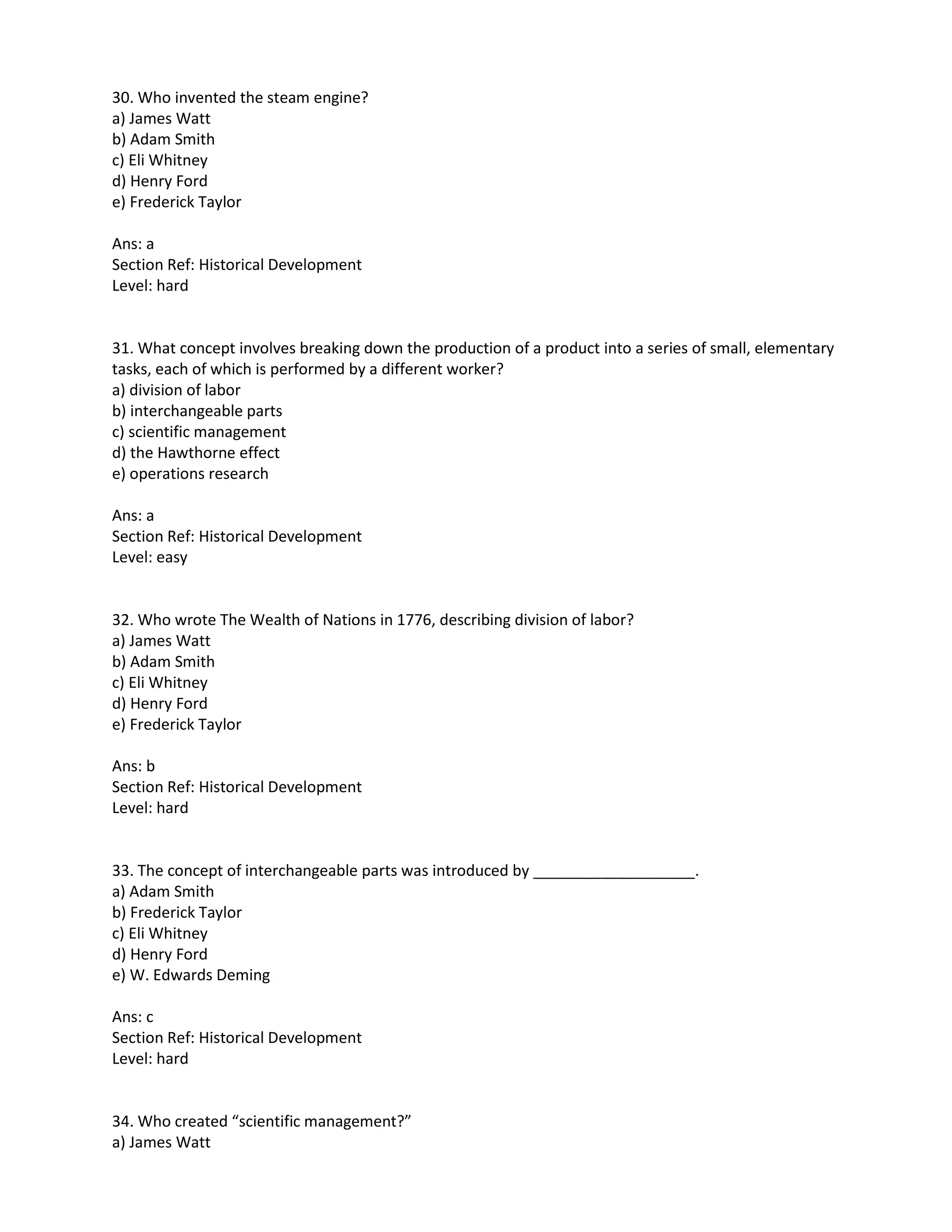
Level: hard
30. Who invented the steam engine?
a) James Watt
b) Adam Smith
c) Eli Whitney
d) Henry Ford
e) Frederick Taylor
Ans: a
Section Ref: Historical Development
Level: hard
31. What concept involves breaking down the production of a product into a series of small, elementary
tasks, each of which is performed by a different worker?
a) division of labor
b) interchangeable parts
c) scientific management
d) the Hawthorne effect
e) operations research
Ans: a
Section Ref: Historical Development
Level: easy
32. Who wrote The Wealth of Nations in 1776, describing division of labor?
a) James Watt
b) Adam Smith
c) Eli Whitney
d) Henry Ford
e) Frederick Taylor
Ans: b
Section Ref: Historical Development
Level: hard
33. The concept of interchangeable parts was introduced by ___________________.
a) Adam Smith
b) Frederick Taylor
c) Eli Whitney
d) Henry Ford
e) W. Edwards Deming
Ans: c
Section Ref: Historical Development
Level: hard
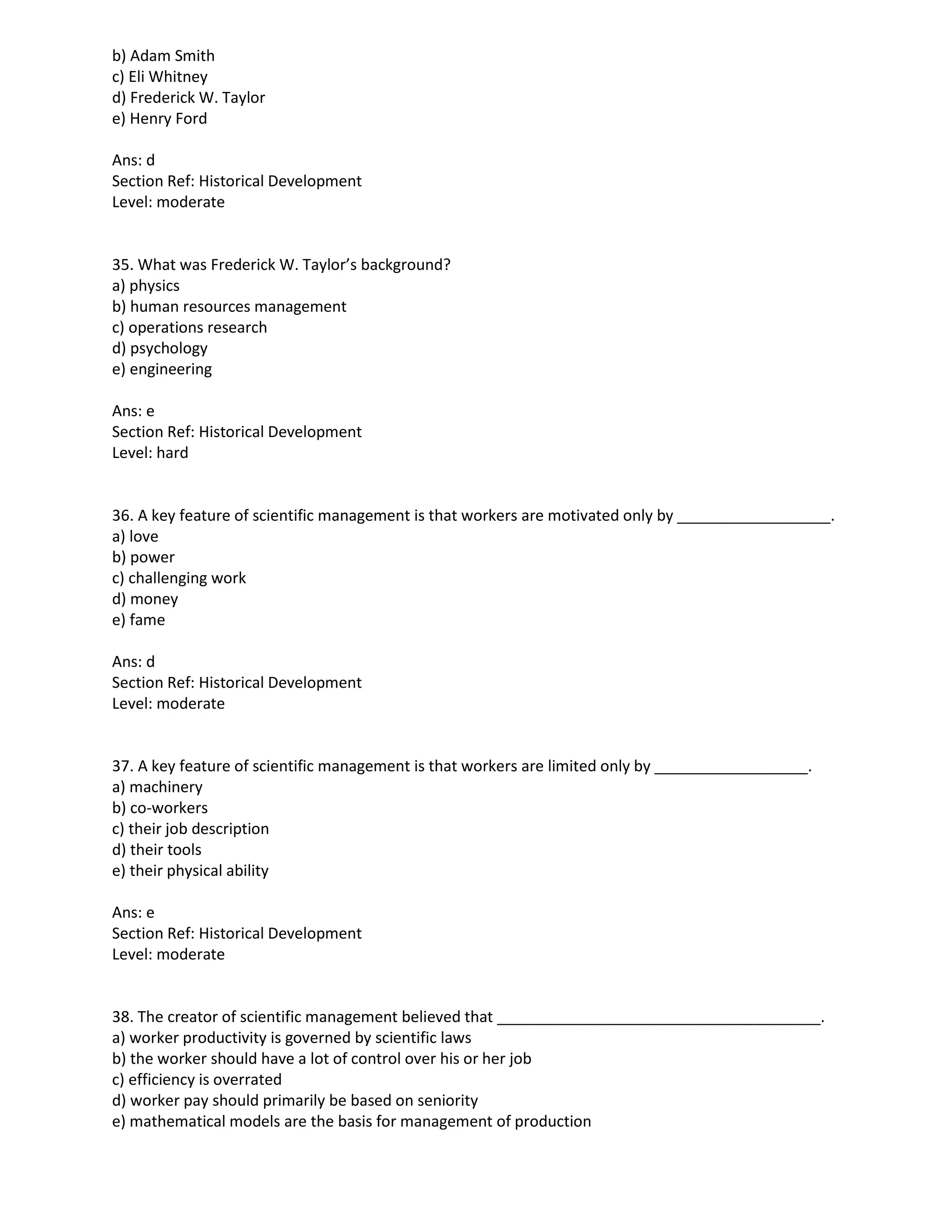
34. Who created “scientific management?”
a) James Watt
b) Adam Smith
c) Eli Whitney
d) Frederick W. Taylor
e) Henry Ford
Ans: d
Section Ref: Historical Development
Level: moderate
35. What was Frederick W. Taylor’s background?
a) physics
b) human resources management
c) operations research
d) psychology
e) engineering
Ans: e
Section Ref: Historical Development
Level: hard
36. A key feature of scientific management is that workers are motivated only by __________________.
a) love
b) power
c) challenging work
d) money
e) fame
Ans: d
Section Ref: Historical Development
Level: moderate
37. A key feature of scientific management is that workers are limited only by __________________.
a) machinery
b) co-workers
c) their job description
d) their tools
e) their physical ability
Ans: e
Section Ref: Historical Development
Level: moderate
38. The creator of scientific management believed that ______________________________________.
a) worker productivity is governed by scientific laws
b) the worker should have a lot of control over his or her job
c) efficiency is overrated
d) worker pay should primarily be based on seniority
e) mathematical models are the basis for management of production
Ans: a
Section Ref: Historical Development
Level: moderate
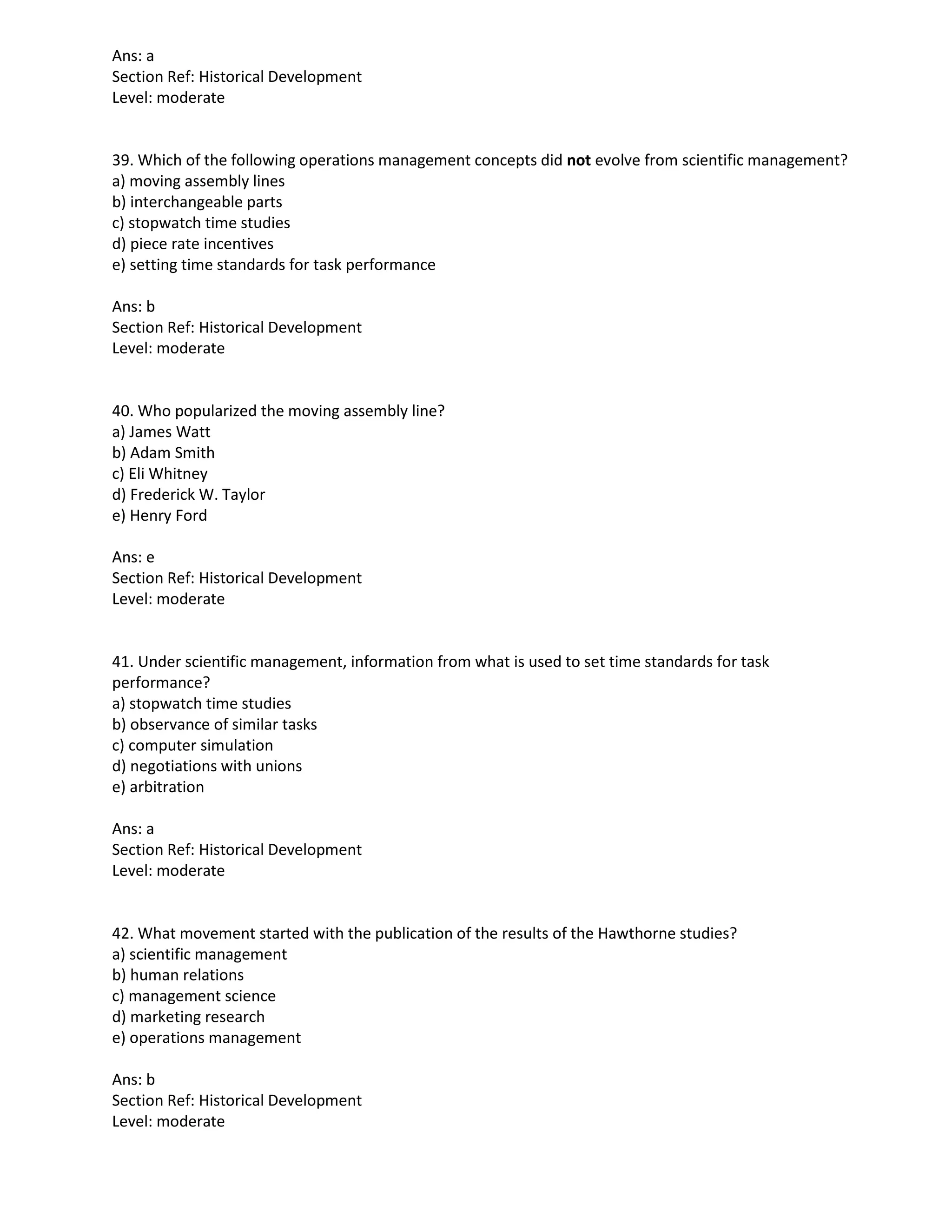
39. Which of the following operations management concepts did not evolve from scientific management?
a) moving assembly lines
b) interchangeable parts
c) stopwatch time studies
d) piece rate incentives
e) setting time standards for task performance
Ans: b
Section Ref: Historical Development
Level: moderate
40. Who popularized the moving assembly line?
a) James Watt
b) Adam Smith
c) Eli Whitney
d) Frederick W. Taylor
e) Henry Ford
Ans: e
Section Ref: Historical Development
Level: moderate
41. Under scientific management, information from what is used to set time standards for task
performance?
a) stopwatch time studies
b) observance of similar tasks
c) computer simulation
d) negotiations with unions
e) arbitration
Ans: a
Section Ref: Historical Development
Level: moderate
42. What movement started with the publication of the results of the Hawthorne studies?
a) scientific management
b) human relations
c) management science
d) marketing research
e) operations management
Ans: b
Section Ref: Historical Development
Level: moderate
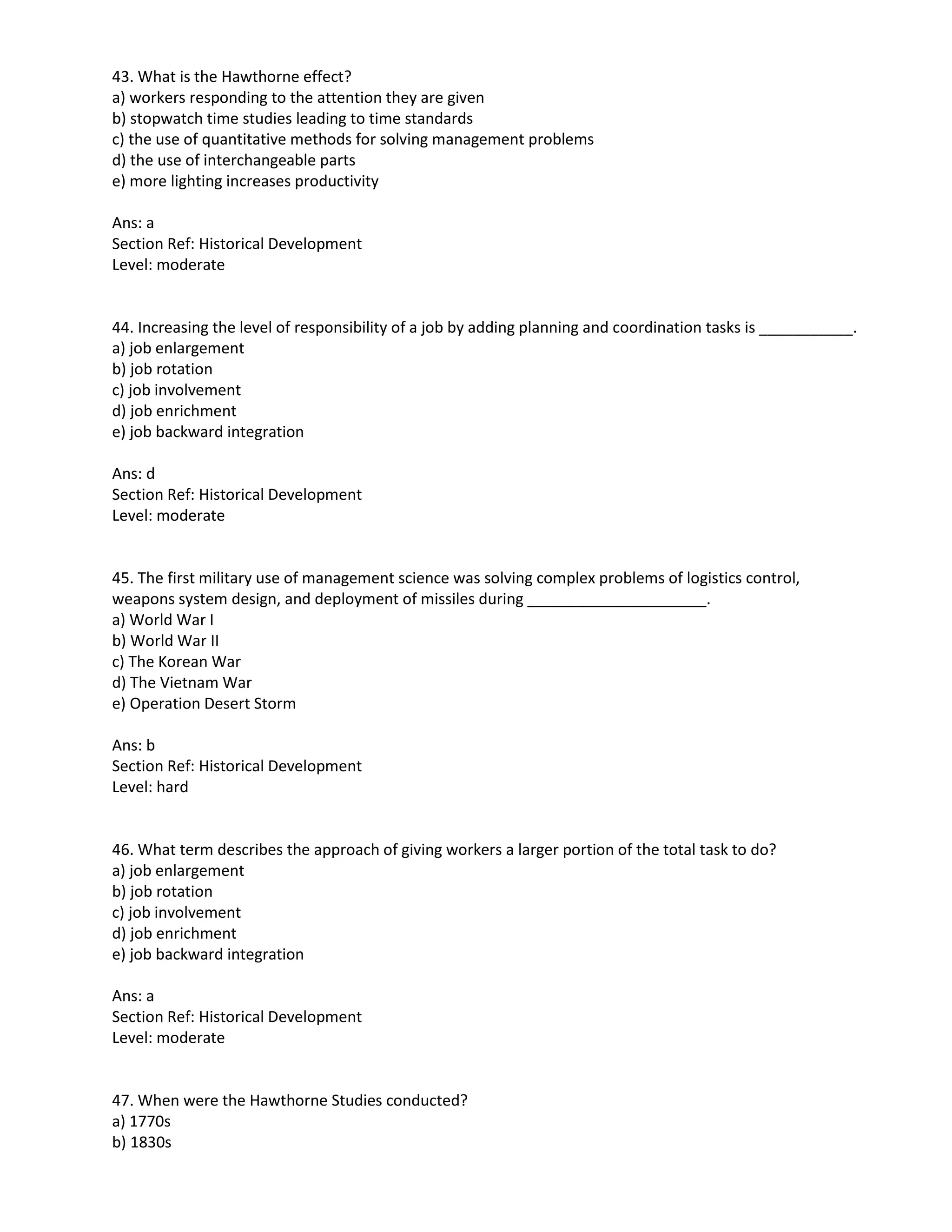
43. What is the Hawthorne effect?
a) workers responding to the attention they are given
b) stopwatch time studies leading to time standards
c) the use of quantitative methods for solving management problems
d) the use of interchangeable parts
e) more lighting increases productivity
Ans: a
Section Ref: Historical Development
Level: moderate
44. Increasing the level of responsibility of a job by adding planning and coordination tasks is ___________.
a) job enlargement
b) job rotation
c) job involvement
d) job enrichment
e) job backward integration
Ans: d
Section Ref: Historical Development
Level: moderate
45. The first military use of management science was solving complex problems of logistics control,
weapons system design, and deployment of missiles during _____________________.
a) World War I
b) World War II
c) The Korean War
d) The Vietnam War
e) Operation Desert Storm
Ans: b
Section Ref: Historical Development
Level: hard
46. What term describes the approach of giving workers a larger portion of the total task to do?
a) job enlargement
b) job rotation
c) job involvement
d) job enrichment
e) job backward integration
Ans: a
Section Ref: Historical Development
Level: moderate
47. When were the Hawthorne Studies conducted?
a) 1770s
b) 1830s
c) 1930s
d) 1960s
e) 1980s
Ans: c
Section Ref: Historical Development
Level: moderate
48. In what company were the Hawthorne Studies conducted?
a) Westinghouse
b) General Electric
c) Hawthorne Incorporated
d) General Motors
e) Western Electric
Ans: e
Section Ref: Historical Development
Level: hard
49. Management science is focused on:
a) profit margin
b) qualitative systems analysis
c) management promotion metrics
d) quantitative techniques for solving personnel issues
e) quantitative techniques for solving operations problems
Ans: e
Section Ref: Historical Development
Level: hard
50. When was the first mathematical model for inventory management developed?
a) 1770
b) 1865
c) 1900
d) 1913
e) 1930
Ans: d
Section Ref: Historical Development
Level: hard
51. Where was the just-in-time philosophy developed?
a) Germany
b) United States
c) Canada
d) Japan
e) Italy
Ans: d
Section Ref: Historical Development
Level: moderate
52. Just-in-time philosophy is applicable in:
a) Service organizations
b) Manufacturing organizations
c) Assembly line operations
d) A, B, and C
e) A and C only
Ans: d
Section Ref: Historical Development
Level: moderate
53. When was the just-in-time philosophy developed?
a) 1980s
b) 1930s
c) 1800s
d) 1700s
e) 1990s
Ans: a
Section Ref: Historical Development
Level: hard
54. What is a philosophy that aggressively seeks to improve product quality by eliminating causes of
product defects and making quality an all-encompassing organizational philosophy?
a) CQI
b) TQM
c) SPC
d) JIT
e) BPR
Ans: b
Section Ref: Historical Development
Level: moderate
55. Which of the following is considered a “quality guru?”
a) Elton Mayo
b) W. Edwards Deming
c) Alex Gamble
d) F.W. Harris
e) Frederick W. Taylor
Ans: b
Section Ref: Historical Development
Level: hard
56. Supply chain management involves managing:
a) the flow of internal information only.
b) the flow of materials and information from suppliers and buyers to the final customer.
c) the flow of raw materials to inventory only.
d) managing the stock room supply only.
Ans: b
Section Ref: Historical Development
Level: hard
57. Many companies require their suppliers to meet what standards as a condition for obtaining contracts?
a) RFO 6000
b) PUR 8000
c) ISO 9000
d) MACH 5000
e) SUP 2000
Ans: c
Section Ref: Historical Development
Level: hard
58. One of the two most important features of time-based competition involves ___________________.
a) advertising on the Internet
b) stopwatch time studies
c) setting time standards for task performance
d) instantaneous access to inventory information
e) developing new products and services faster than the competition
Ans: e
Section Ref: Historical Development
Level: moderate
59. ISO 14000 standards provide guidelines for what?
a) business ethics
b) environmentally responsible actions
c) supplier certification
d) quality control
e) web site development
Ans: b
Section Ref: Historical Development
Level: moderate
60. NAFTA and the EU are _________________________.
a) certification groups
b) regional trade agreements
c) quality control methods
d) logistics providers
e) U.S. government agencies
Ans: b
Section Ref: Historical Development
Level: moderate
61. What type of commerce makes up the highest percentage of electronic transactions?
a) B2C
b) C2C
c) B4B
d) B2B
e) B4C
Ans: d
Section Ref: Historical Development
Level: moderate
62. The Internet developed from a government network called ARPANET, which was created in 1969 by
_____.
a) Japanese scientists
b) the EPA
c) the U.S. Defense Department
d) NSF
e) ISO
Ans: c
Section Ref: Historical Development
Level: hard
63. Today’s business must think in terms of:
a) regional trade zones
b) the EPA
c) the U.S. Defense Department
d) the global market place
e) the curved world
Ans: d
Section Ref: Historical Development
Level: hard
64. General Electric’s Trading Process Network primarily handles transactions between _______________.
a) individual customers
b) companies and individual customers
c) companies and their shipping firms
d) companies and their distributors
e) companies and their suppliers
Ans: e
Section Ref: Historical Development
Level: moderate
65. What is a concept that takes a total system approach to creating efficient operations?
a) lean systems
b) enterprise resource planning
c) customer relationship management
d) management science
e) management information systems
Ans: a
Section Ref: Today's OM Environment
Level: easy
66. What are software solutions that allow the firm to collect customer-specific data?
a) MRP
b) CRM
c) ERP
d) JIT
e) ISO
Ans: b
Section Ref: Today's OM Environment
Level: moderate
67. Entry-level positions for operations management graduates include all of the following except
_________.
a) quality specialist
b) inventory analyst
c) plant manager
d) production analyst
e) production supervisor
Ans: c
Section Ref: Today's OM Environment
Level: moderate
68. Operations management personnel perform a variety of functions, including all of the following except
___________________.
a) analyzing production problems
b) analyzing potential mergers
c) developing forecasts
d) developing employee schedules
e) monitoring inventory
Ans: b
Section Ref: Today's OM Environment
Level: moderate
69. Which of the following concepts is linked the least with Henry Ford?
a) scientific management
b) mass production
c) mass customization
d) technology
e) interchangeable parts
Ans: c
Section Ref: Historical Development
Level: hard
70. Today’s operations management is characterized by:
a) its use of the internet.
b) its reliance on the intranet.
c) its increased use of cross-functional decision making.
d) its use of cross-functional job sharing.
e) its use of interchangeable parts.
Ans: c
Section Ref: Today’s OM Environment
Level: hard
71. Which of the following historical figures would probably have the most different management style
from the others?
a) Elton Mayo
b) Henry Ford
c) Eli Whitney
d) Frederick W. Taylor
e) Adam Smith
Ans: a
Section Ref: Historical Development
Level: hard
72. Operations management interacts with which of the following:
a) Marketing
b) Information systems
c) Finance
d) Engineering
e) all the above
Ans: e
Section Ref: OM Across the Organization
Level: moderate
73. OM’s transformation role is to add value. Value added is
a) performing activities well for the least possible cost
b) the net decrease between output product value and input material value
c) increasing product value in the first stage
d) the net increase between output product value and input material value
e) customizing a product, regardless of expense, to satisfy customer needs
Ans: d
Section Ref: OM’s Transformation Role
Level: moderate
True/False
74. Operations management is the business function that plans, coordinates, and controls the resources
needed to produce a company’s products and services.
Ans: True
Section Ref: What is Operations Management?
Level: easy
75. Marketing is the central core function of every company.
Ans: False
Section Ref: What is Operations Management?
Level: easy
76. Operations management is the central core function of every company.
Ans: True
Section Ref: What is Operations Management?
Level: easy
77. An example of a transformation is waiting to see the doctor.
Ans: False
Section Ref: What is Operations Management?
Level: moderate
78. At a factory, the transformation process is the physical change of raw materials and components into
products.
Ans: True
Section Ref: What is Operations Management?
Level: moderate
79. An example of an operation that does not add value is making a wedding cake.
Ans: False
Section Ref: What is Operations Management?
Level: moderate
80. Efficiency means being able to perform most activities.
Ans: False
Section Ref: What is Operations Management?
Level: moderate
81. An example of a “back room” operation for an airline company is loading luggage onto the airplane.
Ans: True
Section Ref: Differences Between Manufacturing and Service Organizations
Level: moderate
82. Companies that have low customer contact and are capital intensive, yet provide a service, are called
service factories.
Ans: False
Section Ref: Differences Between Manufacturing and Service Organizations
Level: moderate
83. The Industrial Revolution started in the 1770s with the development of a number of inventions that
relied on machine power instead of human power.
Ans: True
Section Ref: Historical Development
Level: moderate
84 Division of labor involves breaking down the production of a product into a series of small, elementary
tasks, each of which is performed by a different worker.
Ans: True
Section Ref: Historical Development
Level: moderate
85. A key feature of scientific management is that workers are limited only by their tools.
Ans: False
Section Ref: Historical Development
Level: moderate
86. The creator of scientific management believed that worker productivity was governed by scientific laws.
Ans: True
Section Ref: Historical Development
Level: moderate
87. Operations management is a result of a single event, the industrial revolution.
Ans: False
Section Ref: Historical Development
Level: moderate
88. Worker participation in decision making is a key feature of scientific management.
Ans: False
R Section Ref: Historical Development
Level: moderate
89. “Job enrichment” is an approach in which workers are given a larger portion of the total task to do.
Ans: False
Section Ref: Historical Development
Level: moderate
90. The first mathematical model for inventory management was developed by Elton Mayo.
Ans: False
Section Ref: Historical Development
Level: hard
91. Operations research started with the publication of the results of the Hawthorne studies.
Ans: False
Section Ref: Historical Development
Level: moderate
92. Sustainability was an early 1950’s management function and focus.
Ans: False
Section Ref: Historical Development
Level: moderate
93. The Hawthorne effect is that workers are motivated by the attention they are given.
Ans: True
Section Ref: Historical Development
Level: moderate
94. Increasing the level of responsibility of a job by adding planning and coordination tasks is called job
enrichment.
Ans: True
Another Random Scribd Document
with Unrelated Content
half-wild gleam now and then. The lips that belonged to this
face were slightly parted in a smile; the smile and the
expression in the eyes stole straight down with a glow of
delicious comfort into Priscilla’s heart.
“Thank you,” she said, in her stiff, wooden tone; but her
eyes did not look stiff, and the girl began to talk again.
“I believe my room is next to yours. My name is Oliphant—
Margaret Oliphant, but everyone calls me Maggie. That is,
of course, I mean my friends do. Would you like to come
into my room, and let me tell you some of the rules?”
“Thank you,” said Priscilla again. She longed to add, “I
should love beyond words to come into your room;” but
instead she remarked icily, “I think Miss Heath has given me
printed rules.”
“Oh, you have seen our dear Dorothea—I mean Miss Heath.
Isn’t she lovely?”
“I don’t know,” answered Priscilla. “I think she’s rather a
plain person.”
“My dear Miss—(I have not caught your name)—you really
are too deliciously prosaic. Stay here for a month, and then
tell me if you think Dorothea—I mean Miss Heath—plain.
No, I won’t say any more. You must find out for yourself.
But now, about the rules. I don’t mean the printed rules.
We have, I assure you, at St. Benet’s all kinds of little
etiquettes which we expect each other to observe. We are
supposed to be democratic, and inclined to go in for all that
is advanced in womanhood. But, oh dear, oh dear! let any
student dare to break one of our own little pet proprieties,
and you will see how conservative we can be.”
“Have I broken any of them?” asked Priscilla in alarm. “I did
notice that everyone stared at me when I came into the
hall, but I thought it was because my face was fresh, and I
hoped people would get accustomed to me by-and-by.”
“You poor dear child, there are lots of fresh faces here
besides yours. You should have come down under the
shelter of my wing, then it would have been all right.”
“But what have I done? Do tell me. I’d much rather know.”
“Well, dear, you have only come into the hall by the dons’
entrance, and you have only seated yourself at the top of
the table, where the learned students who are going in for a
tripos take their august meals. That is pretty good for a
Fresher. Forgive me, we call the new girls Freshers for a
week or two. Oh, you have done nothing wrong. Of course
not, how could you know any better? Only I think it would
be nice to put you up to our little rules, would it not?”
“I should be very much obliged,” said Priscilla. “And please
tell me now where I ought to sit at dinner.”
Miss Oliphant’s merry eyes twinkled.
“Look down this long hall,” she said. “Observe that door at
the farther end—that is the students’ door; through that
door you ought to have entered.”
“Yes—well, well?”
“What an impatient ‘Well, well.’ I shall make you quite an
enthusiastic Benetite before dinner is over.”
Priscilla blushed.
“I am sorry I spoke too eagerly,” she said.
“Oh, no, not a bit too eagerly.”
“But please tell me where I ought to have seated myself.”
“There is a table near that lower entrance, Miss—”
“Peel,” interposed Priscilla. “My name is Priscilla Peel.”
“How quaint and great-grandmotherly. Quite delicious! Well,
Miss Peel, by that entrance door is a table, a table rather in
a draught, and consecrated to the Freshers—there the
Freshers humbly partake of nourishment.”
“I see. Then I am as far from the right place as I can be.”
“About as far as you can be.”
“And that is why all the girls have stared so at me.”
“Yes, of course; but let them stare. Who minds such a
trifle?”
Priscilla sat silent for a few moments. One of the neat
waiting-maids removed her plate; her almost untasted
dinner lay upon it. Miss Oliphant turned to attack some
roast mutton with truly British vigour.
By-and-by Priscilla’s voice, stiff but with a break in it, fell
upon her ear.
“I think the students at St. Benet’s must be very cruel.”
“My dear Miss Peel, the honour of the most fascinating
college in England is imperilled. Unsay those words.”
Maggie Oliphant was joking. Her voice was gay with
badinage, her eyes brimful of laughter. But Priscilla,
unaccustomed to light repartee or chaff in any form, replied
to her with heavy and pained seriousness.
“I think the students here are cruel,” she repeated. “How
can a stranger know which is the dons’ entrance, and which
is the right seat to take at table? If nobody shows her, how
can a stranger know? I do think the students are cruel, and
I am sorry—I am very sorry I came.”
Chapter Three.
An Unwilling “At Home.”
Most of the girls who sat at those dinner-tables had fringed
or tousled or curled locks. Priscilla’s were brushed simply
away from her broad forehead. After saying her last words,
she bent her head low over her plate, and longed even for
the protection of a fringe to hide her burning blushes. Her
momentary courage had evaporated; she was shocked at
having betrayed herself to a stranger; her brief fit of
passion left her stiffer and shyer than ever. Blinding tears
rushed to Priscilla’s eyes, and her terror was that they
would drop on to her plate. Suppose some of those horrid
girls saw her crying? Hateful thought. She would rather die
than show emotion before them.
At this moment a soft, plump little hand was slipped into
hers, and the sweetest of voices said—
“I am so sorry anything has seemed unkind to you. Believe
me, we are not what you imagine. We have our fun and our
prejudices, of course, but we are not what you think we
are.”
Priscilla could not help smiling, nor could she resist slightly
squeezing the fingers which touched hers.
“You are not unkind, I know,” she answered; and she ate
the rest of her dinner in a comforted frame of mind.
After dinner one of the lecturers who resided at Heath Hall,
a pleasant, bright girl of two- or three-and-twenty, came
and introduced herself, and presently took Priscilla with her
to her own room, to talk over the line of study which the
young girl proposed to take up. This conference lasted some
little time, and then Priscilla, in the lecturer’s company,
returned to the hall for tea.
A great many girls kept coming in and out. Some stayed to
have tea, but most helped themselves to tea and bread-
and-butter, and took them away to partake of in their own
private rooms.
Maggie Oliphant and Nancy Banister presently rushed in for
this purpose. Maggie, seeing Priscilla, ran up to her.
“How are you getting on?” she asked brightly. “Oh, by-the-
bye, will you cocoa with me to-night at half-past ten?”
“I don’t know what you mean,” answered Priscilla. “But I’ll
do it,” she added, her eyes brightening.
“All right, I’ll explain the simple ceremony when you come.
My room is next to yours, so you’ll have no difficulty in
finding me out. I don’t expect to have anyone present
except Miss Banister,” nodding her head in Nancy’s
direction, “and perhaps one other girl. By-bye, I’ll see you
at half-past ten.”
Maggie turned to leave the hall, but Nancy lingered for a
moment by Priscilla’s side.
“Wouldn’t you like to take your tea up to your room?” she
asked. “We most of us do it. You may, you know.”
“I don’t think I wish to,” answered Priscilla, in an uncertain
voice.
Nancy half-turned to go, then came back.
“You are going to unpack by-and-by, aren’t you?” she
asked.
“Oh, yes, when I get back to my room.”
“Perhaps you ought to know beforehand; the girls will be
coming to call.”
Priscilla raised her eyes.
“What girls?” she asked, alarm in her tone.
“Oh, most of the students in your corridor. They always call
on a Fresher the first night in her room. You need not
bother yourself about them; they’ll just talk for a little while
and then go away. What is the matter, Miss Peel? Maggie
has told me your name, you see.”
“What you tell me sounds so very—very formal.”
“But it isn’t—not really. Shall I come and help you to
entertain them?”
“I wish—” began Priscilla. She hesitated; the words seemed
to stick in her throat.
“What did you say?” Nancy bent forward a little impatiently.
“I wish—yes, do come,” with a violent effort. “All right, you
may expect me.”
Nancy flew after Maggie Oliphant, and Priscilla went slowly
up the wide, luxurious stairs. She turned down the corridor
which led to her own room. There were doors leading out of
this corridor at both sides, and Priscilla caught glimpses of
luxurious rooms bright with flowers and electric light. Girls
were laughing and chatting in them; she saw pictures on
the walls, and lounges and chairs scattered about. Her own
room was at the far end of the corridor. The electric light
was also brightening it, but the fire was unlit, and the
presence of the unpacked trunk, taking up a position of
prominence on the floor, gave it a very unhomelike feel. In
itself the room was particularly picturesque. It had two
charming lattice windows, set in deep square bays. One
window faced the fireplace, the other the door. The effect
was slightly irregular, but for that very reason all the more
charming. The walls of the room were painted light blue;
there was a looking-glass over the mantelpiece set in a
frame of the palest, most delicate, blue. A picture-rail ran
round the room about six feet from the ground, and the
high frieze above had a scroll of wild roses painted on it in
bold, free relief.
The panels of the doors were also decorated with sprays of
wild flowers in picturesque confusion. Both the flowers and
the scroll were boldly designed, but were unfinished, the
final and completing touches remaining yet to be given.
Priscilla looked hungrily at these unexpected trophies of art.
She could have shouted with glee as she recognised some
of her dear, wild Devonshire flowers among the groups on
the door panels. She wondered if all the rest of the students
were treated to these artistic decorations, and grew a little
happier and less homesick at the thought.
Priscilla could have been an artist herself had the
opportunity arisen, but she was one of those girls all alive
with aspiration and longing who never up to the present had
come in the way of special culture in any style.
She stood for some time gazing at the groups of wild
flowers, then remembering with horror that she was to
receive visitors that night, she looked round the room to
see if she could do anything to make it appear home-like
and inviting.
It was a nice room, certainly. Priscilla had never before in
her whole life occupied such a luxurious apartment, and yet
it had a cold, dreary, uninhabited feel. She had an intuition
that none of the other students’ rooms looked like hers. She
rushed to light the fire, but could not find the matches,
which had been removed from their place on the
mantelpiece, and felt far too shy to ring the electric-bell. It
was Priscilla’s fashion to clasp her hands together when she
felt a sense of dismay, and she did so now, as she looked
around the pretty room, which yet with all its luxuries
looked to her cold and dreary.
The furniture was excellent of its kind. A Turkey carpet
covered the centre of the floor, the boards round the edge
were stained and brightly polished. In one corner of the
room was a little bed, made to look like a sofa by day, with
a Liberty cretonne covering. A curtain of the same shut
away the wardrobe and washing apparatus. Just under one
of the bay-windows stood a writing-table, so contrived as to
form a writing-table, and a bookcase at the top, and a chest
of drawers to hold linen below. Besides this there was a
small square table for tea in the room, and a couple of
chairs. The whole effect was undoubtedly bare.
Priscilla was hesitating whether to begin to unpack her
trunk or not when a light knock was heard at her door. She
said “Come in,” and two girls burst rather noisily into the
apartment.
“How do you do?” they said, favouring the fresh girl with a
brief nod. “You came to-day, didn’t you? What are you going
to study? Are you clever?”
These queries issued rapidly from the lips of the tallest of
the girls. She had red hair, tousled and tossed about her
head. Her face was essentially commonplace; her small
restless eyes now glanced at Priscilla, now wandered over
the room. She did not wait for a reply to any of her queries,
but turned rapidly to her companion.
“I told you so, Polly,” she said. “I was quite sure that she
was going to be put into Miss Lee’s room. You see I’m right,
this is Annabel Lee’s old room; it has never been occupied
since.”
“Hush!” said the other girl.
The two walked across the apartment and seated
themselves on Priscilla’s bed.
There came a fresh knock at the door, and this time three
students entered. They barely nodded to Priscilla, and then
rushed across the room with cries of rapture to greet the
girls who were seated on the bed.
“How do you do, Miss Atkins? How do you do, Miss Jones?”
Miss Jones and Miss Atkins exchanged kisses with Miss
Phillips, Miss Marsh, and Miss Day. The babel of tongues
rose high, and everyone had something to say with regard
to the room which had been assigned to Priscilla.
“Look,” said Miss Day, “it was in that corner she had her
rocking-chair. Girls, do you remember Annabel’s rocking-
chair, and how she used to sway herself backwards and
forwards in it, and half-shut her lovely eyes?”
“Oh, and don’t I just seem to see that little red tea-table of
hers near the fire,” burst from Miss Marsh. “That Japanese
table, with the Japanese tea-set—oh dear, oh dear! those
cups of tea—those cakes! Well, the room was luxurious, was
worth coming to see in Annabel’s time.”
“It’s more than it is now,” laughed Miss Jones in a harsh
voice. “How bare the walls look without her pictures. It was
in that recess the large figure of ‘Hope’ by Burne-Jones used
to hang, and there, that queer, wild, wonderful head looking
out of clouds. You know she never would tell us the artist’s
name. Yes, she had pretty things everywhere! How the
room is altered! I don’t think I care for it a bit now.”
“Could anyone who knew Annabel Lee care for the room
without her?” asked one of the girls. She had a common,
not to say vulgar, face, but it wore a wistful expression as
she uttered these words.
All this time Priscilla was standing, feeling utterly shy and
miserable. From time to time other girls came in; they
nodded to her, and then rushed upon their companions. The
eager talk began afresh, and always there were looks of
regret, and allusions, accompanied by sighs, to the girl who
had lived in the room last.
“Well,” said one merry little girl, who was spoken to by the
others as Ada Hardy, “I have no doubt that by-and-by, when
Miss—” She glanced towards Priscilla.
“Peel,” faltered Priscilla.
“When Miss Peel unpacks her trunk, she’ll make the room
look very pretty, too.”
“She can’t,” said Miss Day, in a tragic voice; “she never
could make the room look as it used to—not if she was to
live till the age of Methuselah. Of course you’ll improve it,
Miss Peel; you couldn’t possibly exist in it as it is now.”
“I can tell you of a capital shop in Kingsdene, Miss Peel,”
said Miss Marsh, “where you can buy tables and chairs, and
pretty artistic cloths, and little whatnots of all descriptions.
I’d advise you to go to Rigg’s! he’s in the High Street,
Number 48.”
“But Spilman has much the most recherché articles, you
know, Lucy,” interposed Miss Day. “I’ll walk over to
Spilman’s to-morrow with you, if you like, Miss Peel.”
Before Priscilla had time to reply there was again a knock at
the door, and this time Nancy Banister, looking flushed and
pretty, came in.
She took in the scene at a glance: numbers of girls making
themselves at home in Priscilla’s room, some seated on her
trunk, some on her bureau, several curled up in comfortable
attitudes on her bed, and she herself standing, meek,
awkward, depressed, near one of the windows.
“How tired you look, Miss Peel!” said Nancy Banister.
Priscilla smiled gratefully at her.
“And your trunk is not unpacked yet?”
“Oh! there is time enough,” faltered Priscilla.
“Are we in your way?” suddenly spoke Miss Marsh, springing
to her feet. “Good-night. My name is Marsh, my room is
thirty-eight.”
She swung herself lazily and carelessly out of the room,
followed, at longer or shorter intervals, by the other girls,
who all nodded to Priscilla, told her their names, and one or
two the numbers of their rooms. At last she was left alone
with Nancy Banister.
“Poor thing! How tired and white you look!” said Nancy. “But
now that dreadful martyrdom is over, you shall have a real
cosy time. Don’t you want a nice hot cup of cocoa? It will be
ready in a minute or two. And please may I help you to
unpack?”
“Thank you,” said Priscilla; her teeth were chattering. “If I
might have a fire?” she asked suddenly.
“Oh, you poor, shivering darling! Of course. Are there no
matches here? There were some on the mantelpiece before
dinner. No, I declare they have vanished. How careless of
the maid. I’ll run into Maggie’s room and fetch some.”
Miss Banister was not a minute away. She returned with a
box of matches, and, stooping down, set a light to the
wood, and a pleasant fire was soon blazing and crackling
merrily.
“Now, isn’t that better?” said Nancy. “Please sit down on
your bed, and give me the key of your trunk. I’ll soon have
the things out, and put all to rights for you. I’m a splendid
unpacker.”
But Priscilla had no desire to have her small and meagre
wardrobe overhauled even by the kindest of St. Benet’s
girls.
“I will unpack presently myself, if you don’t mind,” she said.
She felt full of gratitude, but she could not help an almost
surly tone coming into her voice.
Nancy drew back, repulsed and distressed.
“Perhaps you would like me to go away?” she said. “I will go
into Maggie’s room, and let you know when cocoa is ready.”
“Thank you,” said Prissie. Miss Banister disappeared, and
Priscilla sat on by the fire, unconscious that she had given
any pain or annoyance, thinking with gratitude of Nancy,
and with feelings of love of Maggie Oliphant, and wondering
what her little sisters were doing without her at home to-
night.
By-and-by there came a tap at her door. Priscilla ran to
open it. Miss Oliphant stood outside.
“Won’t you come in?” said Priscilla, throwing the door wide
open, and smiling with joy. It was already delightful to her
to look at Maggie. “Please come in,” she added, in a tone
almost of entreaty.
Maggie Oliphant started and turned pale. “Into that room?
No, no, I can’t,” she said in a queer voice. She rushed back
to her own, leaving Priscilla standing in amazement by her
open door.
There was a moment’s silence; then Miss Oliphant’s voice,
rich, soft, and lazy, was heard within the shelter of her own
apartment.
“Please come in, Miss Peel, cocoa awaits you. Do not stand
on ceremony.”
Priscilla went timidly across the landing, and the next
instant found herself in one of the prettiest of the students’
rooms at St. Benet’s. A few rare prints and some beautiful
photogravures of well-known pictures adorned the walls.
The room was crowded with knick-knacks, and rendered
gay and sweet by many tall flowers in pots. A piano stood
open by one of the walls, and a violin lay carelessly on a
chair not far off. There were piles of new music, and some
tempting, small, neatly-bound books lying about. A fire
glowed on the hearth, and a little brass kettle sang merrily
on the hob. The cocoa-table was drawn up in front of the
fire, and on a quaintly shaped tray stood the bright little
cocoa-pot, and the oddly devised cups and saucers.
“Welcome to St. Benet’s?” said Maggie, going up and taking
Priscilla’s hand cordially within her own. “Now you’ll have to
get into this low chair, and make yourself quite at home and
happy.”
“How snug you are here,” said Prissie, her eyes brightening,
and a pink colour mounting into her cheeks. She was glad
that Maggie was alone; she felt more at ease with her than
with anyone, but the next moment she said, with a look of
apparent regret—
“I thought Miss Banister was in your room?”
“No; Nancy has gone to her own room at the end of the
corridor to do some work for an hour. She will come back to
say good-night. She always does. Are you sorry to have me
by myself?”
“Indeed I am not,” said Priscilla. The smile, which made her
rather plain face attractive, crept slowly back to it. Maggie
poured out a cup of cocoa and brought it to her, then,
drawing another chair forward, she seated herself in it,
sipped her own cocoa, and began to talk.
Long afterwards Priscilla remembered that talk. It was not
what Maggie said, for her conversation in itself was not at
all brilliant, but it was the sound of her rich, calm, rather
lazy voice, the different lights which glanced and gleamed in
her eyes, the dimples about her mouth, the attitude she put
herself in. Maggie had a way of changing colour, too, which
added to her fascinations. Sometimes the beautiful oval of
her face would be almost ivory white, but then again a rosy
cloud would well up and up the cheeks, and even slightly
suffuse the broad, low forehead. Her face was never long
the same, never more than a moment in repose; eyes,
mouth, brow, even the very waves of her hair seemed to
Priscilla, this first night as she sat by her hearth, to be all
speech.
The girls grew cosy and confidential together. Priscilla told
Maggie about her home, a little also about her past history,
and her motive in coming to St. Benet’s. Maggie
sympathised with all the expression she was capable of. At
last Priscilla bade her new friend good-night, and, rising
from her luxurious chair, prepared to go back to her own
room.
She had just reached the door of Maggie’s room, and was
about to turn the handle, when a sudden thought arrested
her. She came back a few steps.
“May I ask you a question?” she said.
“Certainly,” replied Miss Oliphant.
“Who is the girl who used to live in my room? Annabel Lee,
the other girls call her. Who is she? What is there
remarkable about her?”
To Priscilla’s astonishment Maggie started a step forward,
her eyes blazed with an expression which was half
frightened—half angry. She interlocked one soft hand inside
the other, her face grew white, hard, and strained.
“You must not ask me about Annabel Lee,” she said in a
whisper, “for I—I can tell you nothing about her. I can never
tell you about her—never.”
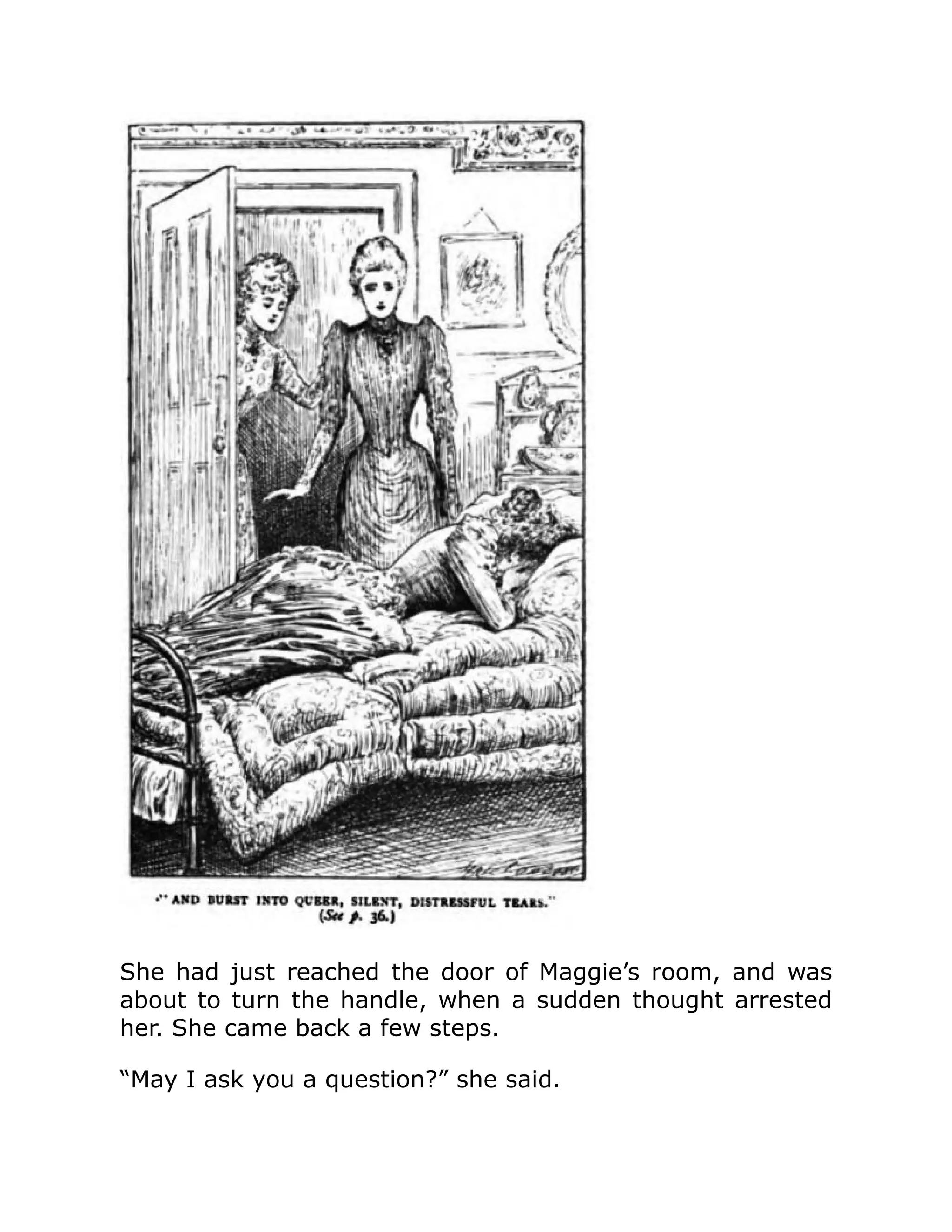
Then she rushed to her sofa-bed, flung herself upon it face
downwards, and burst into queer, silent, distressful tears.
Someone touched Priscilla softly on her shoulder.
“Let me take you to your room, Miss Peel,” said Nancy
Banister. “Don’t take any notice of Maggie; she will be all
right by-and-by.”
Nancy took Priscilla’s hand, and walked with her across the
corridor.
“I am so sorry I said anything to hurt Miss Oliphant,” said
Priscilla.
“Oh, you were not to blame. You could not know any better.
Of course, now that you do know, you will never do it
again.”
“But I don’t know anything now. Please will you tell me who
Annabel Lee is?”
“Hush! don’t speak so loud. Annabel Lee—” Nancy’s eyes
filled with tears—“no girl in the college was so popular.”
“Why do you say was? and why do you cry?”
“I did not know that I cried. Annabel Lee is dead.”
“Oh!”
Priscilla walked into her room, and Nancy went back to
Maggie Oliphant.
Chapter Four.
An Eavesdropper.
The students at St. Benet’s were accustomed to unlimited
licence in the matter of sitting up at night. At a certain hour
the electric lights were put out, but each girl was well
supplied with candles, and could sit up and pursue her
studies into the small hours, if she willed.
It was late when Priscilla left Maggie Oliphant’s room on this
first night, but, long as her journey had been, and tired as
she undoubtedly felt, the events of the evening had excited
her, and she did not care to go to bed. Her fire was now
burning well, and her room was warm and cosy. She drew
the bolt of her door, and, unlocking her trunk, began to
unpack. She was a methodical girl, and well trained. Miss
Rachel Peel had instilled order into Priscilla from her earliest
days, and she now quickly disposed of her small but neat
wardrobe. Her linen would just fit into the drawers of the
bureau. Her two or three dresses and jackets were hung
tidily away behind the curtain which formed her wardrobe.
Priscilla pushed her empty trunk against the wall, folded up
the bits of string and paper which lay scattered about, and
then, slowly undressing, she got into bed.
She undressed with a certain sense of luxuriousness and
pleasure. Her room began to look charming to her now that
her things were unpacked, and the first sharp pain of her
home-sickness was greatly softened since she had fallen in
love with Maggie Oliphant.
Priscilla had not often in the course of her life undressed by
a fire, but then had she ever spent an evening like this one?
All was fresh to her, new, exciting. Now she was really very
tired, and the moment she laid her head on her pillow
would doubtless be asleep.
She got into bed, and, putting out her candle, lay down.
The firelight played on the pale blue walls, and lit up the
bold design of the briar-roses, which ran round the frieze at
the top of the room.
Priscilla wondered why she did not drop asleep at once. She
felt vexed with herself when she discovered that each
instant the chance of slumber was flying before her, that
every moment her tired body became more restless and
wide-awake. She could not help gazing at that scroll of
briar-roses; she could not help thinking of the hand that
had painted the flowers, of the girl whose presence had
once made the room in which she now lay so charming.
Priscilla had not yet been twelve hours at St. Benet’s, and
yet almost every student she had met had spoken of
Annabel Lee—had spoken of her with interest, with regret.
One girl had gone further than this; she had breathed her
name with bitter sorrow.
Priscilla wished she had not been put into this room. She
felt absolutely nervous; she had a sense of usurping
someone else’s place, of turning somebody else out into the
cold. She did not believe in ghosts, but she had an
uncomfortable sensation, and it would not have greatly
surprised her if Annabel had come gliding back in the night
watches to put the finishing touches to those scrolls of wild
flowers which ornamented the panels of the doors, and to
the design of the briar-rose, which ran round the frieze of
the room. Annabel might come in, and pursue this work in
stealthy spirit fashion, and then glide up to her, and ask her
to get out of this little white bed, and let the strange visitor,
to whom it had once belonged, rest in it herself once more.
Annabel Lee! It was a queer name—a wild, bewitching sort
of a name—the name of a girl in a song.
Priscilla knew many of Poe’s strange songs, and she found
herself now murmuring some words which used to fascinate
her long ago:—
“And the angels, not half so happy in heaven,
Went envying her and me;
Yes! that was the reason (as all men know
In this kingdom by the sea)
That the wind came out of the cloud by night,
Chilling and killing my Annabel Lee!
“But our love it was stronger by far than the love
Of those who were older than we,—
Of many far wiser than we;
And neither the angels in heaven above,
Nor the demons down under the sea,
Can ever dissever my soul from the soul
Of the beautiful Annabel Lee.”
Some ashes fell from the expiring fire; Priscilla jumped up
in bed with a start. Her heart was beating fast. She thought
of Maggie’s exquisite face. She remembered it as she had
seen it that night when they were sitting by the fire, as she
had seen it last, when it turned so white, and the eyes
blazed at her in anger.
Priscilla stretched out her hand for a box of matches. She
would light her candle, and, as there was no chance of her
going to sleep, sit up, put her dressing-jacket on, and begin
to write a long letter home to Aunt Raby and to her little
sisters. Such methodical work would calm nerves not often
so highly strung.
She rose, and fetching her neat little leather writing-case
from where she had placed it on the top of her bureau,
prepared to open it.
The little case was locked. Priscilla went over to her
curtained wardrobe, pushed it aside, and felt in the pocket
of the dress she had worn that day for her purse. It was not
there. Within that purse the little key was safely hiding, but
the purse itself was nowhere to be found.
Priscilla looked all round the room. In vain; the neat brown-
leather purse, which held the key, some very precious
memoranda of different sorts, and her small store of worldly
wealth, was nowhere to be found.
She stood still for a moment in perplexity. All her nervous
fears had now completely vanished; a real calamity and a
grave one stared her in the face. Suppose her purse were
gone? Suppose it had been stolen? The very small supply of
money which that purse contained was most precious to
Priscilla. It seemed to her that nothing could well be more
terrible than for her now to have to apply to Aunt Raby for
fresh funds. Aunt Raby had stinted herself dreadfully to get
Priscilla’s modest little outfit together, and now—oh, she
would rather starve than appeal to her again.
Suddenly as she stood in the middle of her room a memory
came back to her. It was the recollection of a very trivial
incident. She remembered something dropping on the floor
as she sat by Maggie’s side at dinner. She had felt too
nervous and miserable at the time to take any notice of the
slight sound made by the fall, but now it returned vividly to
her memory. She was sure that her purse must have
dropped out of her pocket at that moment, and was
convinced that it was now lying quietly under the table
where she had sat.
Priscilla felt far too excited to wait until the morning to
make herself sure on this point. No; happen what might,
she would set her fears at rest now, and find her way
somehow through the strange and sleeping house until she
discovered her lost treasure.
Partly re-dressing, she took her candle in her hand, and
softly unhasped her door. It was a well-oiled lock, and made
no click or noise of any kind as she turned the handle.
When she opened the door wide it did not creak. The long
corridor outside had a stone floor, and was richly carpeted.
No fear of treacherous, creaking boards here. Priscilla
prepared to walk briskly down the length of the corridor,
when she was arrested by seeing a light streaming out of
Maggie Oliphant’s room.
The electric lights were all extinguished, and this light alone
shone like a ray in the darkness.
Prissie stood still, with a gasp of dismay. She did not want
Maggie to hear her now. She would have been distressed at
Maggie being acquainted with her carelessness. She felt
sure that a girl like Maggie Oliphant could never understand
what a little purse, which only contained a sovereign or two,
would mean to her.
On tiptoe, and shading the candle with her hand, she stole
past the partly open door. A rich tapestry curtain hung at
the other side, and Maggie doubtless thought the door was
shut.
Priscilla had almost gone past the open door, when her
steps were again arrested by the sound of voices. Someone
said “Priscilla Peel,” and then someone else laughed.
Priscilla stood perfectly still. Of course she had no right to
listen, but she did; she waited breathless, in an agony of
expectation, for the next words.
“I would not be jealous if I were you, Nancy,” said Maggie’s
lazy, sweet voice. “The poor girl is as queer as her name,
but it gives me a kind of aesthetic pleasure to be good to
people. You have no cause to be jealous, sweet pet.”
Priscilla raised one trembling hand, and noiselessly put out
her candle. Her feet seemed rooted to the spot.
Nancy murmured something, which Priscilla could not hear.
Then there was the sound of one girl kissing another, and
Maggie’s light laugh was heard again.
“The unfortunate girl has fallen in love with you, there’s no
doubt about that, Maggie,” said Nancy.
“Well, my dear, she’ll get over that little fever presently.
When I’m kind to them, they all have it. I believe I am
gracious to them just because I like to see that grateful,
affectionate expression in their eyes. The fact is, Nance, I
have a perfectly crazy desire to excite love.”
“But do you give love, Maggie? Do you ever give it back in
return?”
“Sometimes. I don’t know, I believe I am rather fond of
you, for instance.”
“Maggie, was Geoffrey Hammond at St. Hilda’s this
afternoon?”
“I can’t possibly say,” replied Maggie, in a cold voice. Then
she added excitedly, “I don’t believe the door is shut! You
are so careless, Nannie, so indifferent to the fact that there
may be eavesdroppers about.”
Priscilla crept back to her room. She had forgotten all about
her purse; every other feeling was completely swallowed up
in a burning, choking sense of anger.
Chapter Five.
Why Priscilla Peel went to St. Benet’s.
Priscilla had received a shock, and hers was not the sort of
nature to take such a blow easily. She was a reserved girl,
but her feelings were deep, her affections very strong.
Priscilla had a rather commonplace past, but it was the sort
of past to foster and deepen the peculiarities of her
character. Her father had died when she was twelve, her
mother when she was fourteen. They were north-country
folk, and they possessed all the best characteristics of their
class. They were rigidly upright people, they never went in
debt; they considered luxuries bad for the soul, and the
smaller refinements of life altogether unnecessary.
Mr Peel managed to save a little money out of his earnings.
He took year by year these savings to the nearest County
Bank, and invested them to the best of his ability. The bank
broke, and in one fell stroke he lost all the savings of a life.
This affected his health, and he never held up his head or
recovered his vigour of mind and body again.
He died, and two years afterwards his wife followed him.
Priscilla was then fourteen, and there were three little
sisters several years younger. They were merry little
children, strong, healthy, untouched by care. Priscilla, on
the contrary, was grave, and looked much older than her
years.
On the night their mother was buried, Aunt Rachel Peel,
their father’s sister, came from her home far away on the
borders of Devonshire, and told the four desolate children
that she was going to take them away to live on her little
farm with her.
Aunt Raby spoke in a very frank manner. She concealed
nothing.
“It’s only fair to tell you, Prissie,” she said, addressing the
tall, gawky girl, who stood with her hands folded in front of
her—“it’s only fair to tell you that hitherto I’ve just made
two ends meet for one mouth alone, and how I’m to fill four
extra ones the Lord knows, but I don’t. Still, I’m going to
try, for it shall never be said that Andrew Peel’s children
wanted bread while his sister, Rachel Peel, lived.”
“We have none of us big appetites,” said Priscilla, after a
long, solemn pause; “we can do with very little food—very
little. The only one who ever is really hungry is Hattie.”
Aunt Raby looked up at the pale face, for Prissie was taller
than her aunt even then, and said in a shocked voice—
“Good gracious, child! do you think I’d stint one of you? You
ought all to be hearty, and I hope you will be. No, no, it
isn’t that, Prissie, but there’ll be no luxuries, so don’t you
expect them.”
“I don’t want them,” answered Priscilla.
The children all went to Devonshire, and Aunt Raby toiled,
as perhaps no woman had ever toiled before, to put bread
into their mouths. Katie had a fever, which made her pale
and thin, and took away that look of robustness which had
characterised the little Yorkshire maiden. Nobody thought
about the children’s education, and they might have grown
up without any were it not for Priscilla, who taught them
what she knew herself. Nobody thought Priscilla clever; she
had no brilliance about her in any way, but she had a great
gift for acquiring knowledge. Wherever she went she picked
up a fresh fact, or a fresh fancy, or a new idea, and these
she turned over and over in her active, strong, young brain,
until she assimilated them, and made them part of herself.
Amongst the few things that had been saved from her early
home there was a box of her father’s old books, and as
these comprised several of the early poets and essayists,
she might have gone farther and fared worse.
One day the old clergyman who lived at a small vicarage
near called to see Miss Peel. He discovered Priscilla deep
over Carlyle’s “History of the French Revolution.” The young
girl had become absorbed in the fascination of the wild and
terrible tale. Some of the horror of it had got into her eyes
as she raised them to return Mr Hayes’ courteous greeting.
His attention was arrested by the look she gave him. He
questioned her about her reading, and presently offered to
help her. From this hour Priscilla made rapid progress. She
was not taught in the ordinary fashion, but she was being
really educated. Her life was full now; she knew nothing
about the world, nothing about society. She had no
ambitions, and she did not trouble herself to look very far
ahead. The old classics which she studied from morning till
night abundantly satisfied her really strong intellectual
nature.
Mr Hayes allowed her to talk with him, even to argue points
with him. He always liked her to draw her own conclusions;
he encouraged her really original ideas; he was proud of his
pupil, and he grew fond of her. It was not Priscilla’s way to
say a word about it, but she soon loved the old clergyman
as if he were her father.
Some time between her sixteenth and seventeenth birthday
that awakening came which altered the whole course of her
Welcome to our website – the ideal destination for book lovers and
knowledge seekers. With a mission to inspire endlessly, we offer a
vast collection of books, ranging from classic literary works to
specialized publications, self-development books, and children's
literature. Each book is a new journey of discovery, expanding
knowledge and enriching the soul of the reade
Our website is not just a platform for buying books, but a bridge
connecting readers to the timeless values of culture and wisdom. With
an elegant, user-friendly interface and an intelligent search system,
we are committed to providing a quick and convenient shopping
experience. Additionally, our special promotions and home delivery
services ensure that you save time and fully enjoy the joy of reading.
Let us accompany you on the journey of exploring knowledge and
personal growth!
testbankbell.com

Operations Management Reid 5th Edition Test Bank

  • 1.
    Visit https://testbankbell.com todownload the full version and explore more testbank or solutions manual Operations Management Reid 5th Edition Test Bank _____ Click the link below to download _____ http://testbankbell.com/product/operations-management- reid-5th-edition-test-bank/ Explore and download more testbank or solutions manual at testbankbell.com
  • 2.
    Here are somerecommended products that we believe you will be interested in. You can click the link to download. Solution manual for Operations Management Reid Sanders 5th Edition http://testbankbell.com/product/solution-manual-for-operations- management-reid-sanders-5th-edition/ Operations Management 6th Edition Reid Solutions Manual http://testbankbell.com/product/operations-management-6th-edition- reid-solutions-manual/ Test Bank for Operations Management, 5th Edition: Roger Schroeder http://testbankbell.com/product/test-bank-for-operations- management-5th-edition-roger-schroeder/ Test Bank for Pediatric Nursing: Caring for Children and Their Families, 3rd Edition, Nicki L. Potts, Barbara L. Mandleco http://testbankbell.com/product/test-bank-for-pediatric-nursing- caring-for-children-and-their-families-3rd-edition-nicki-l-potts- barbara-l-mandleco/
  • 3.
    Test Bank forPrinciples of Educational Psychology, Second Canadian Edition, 2/E 2nd Edition http://testbankbell.com/product/test-bank-for-principles-of- educational-psychology-second-canadian-edition-2-e-2nd-edition/ Solution Manual for Mathematical Proofs: A Transition to Advanced Mathematics, 3/E 3rd Edition Gary Chartrand, Albert D. Polimeni, Ping Zhang http://testbankbell.com/product/solution-manual-for-mathematical- proofs-a-transition-to-advanced-mathematics-3-e-3rd-edition-gary- chartrand-albert-d-polimeni-ping-zhang/ Test Bank for Organizational Behavior: Improving Performance and Commitment in the Workplace 5th Edition http://testbankbell.com/product/test-bank-for-organizational-behavior- improving-performance-and-commitment-in-the-workplace-5th-edition/ Test Bank for Ethical, Legal, and Professional Issues in Counseling, 6th Edition, Theodore P. Remley http://testbankbell.com/product/test-bank-for-ethical-legal-and- professional-issues-in-counseling-6th-edition-theodore-p-remley/ Solution Manual for Operations and Supply Chain Management for MBAs, 7th Edition, Jack R. Meredith, Scott M. Shafer http://testbankbell.com/product/solution-manual-for-operations-and- supply-chain-management-for-mbas-7th-edition-jack-r-meredith-scott-m- shafer/
  • 4.
    Solution Manual forMarketing: An Introduction, 13th Edition, Gary Armstrong, Philip Kotler http://testbankbell.com/product/solution-manual-for-marketing-an- introduction-13th-edition-gary-armstrong-philip-kotler/
  • 5.
    Operations Management Reid5th Edition Test Bank Full download link at: https://testbankbell.com/product/operations-management-reid- 5th-edition-test-bank/ Multiple Choice 1. Every business is managed through what three major functions? a) accounting, finance, and marketing b) engineering, finance, and operations management c) accounting, purchasing, and human resources d) accounting, engineering, and marketing e) finance, marketing, and operations management Ans: e Section Ref: What is Operations Management? Level: easy 2. Which business function is responsible for managing cash flow, current assets, and capital investments? a) accounting b) finance c) marketing d) operations management e) purchasing Ans: b Section Ref: What is Operations Management? Level: easy 3. The finance function is responsible for a) sales, generating customer demand, and understanding customer wants and needs b) plans and coordinates all the resources needed to design, produce, and deliver the merchandise to its various retail locations c) planning, coordinating, and controlling the resources needed to produce a company’s products and services d) managing cash flow, current assets, and capital investments e) efficiency and costs Ans: d Section Ref: What is Operations Management? Level: easy 4. Which business function is responsible for sales, generating customer demand, and understanding customer wants and needs? a) finance
  • 6.
    b) human resources c)marketing d) operations management e) purchasing Ans: c Section Ref: What is Operations Management? Level: easy 5. Which business function is responsible for planning, coordinating, and controlling the resources needed to produce a company’s products and services? a) engineering b) finance c) human resources d) marketing e) operations management Ans: e Section Ref: What is Operations Management? Level: easy 6. Which of the following is not true for business process reengineering? a) It can increase efficiency. b) It cannot be used to improve quality. c) It can reduce costs. d) It involves asking why things are done in a certain way. e) It involves redesigning processes. Ans: b Section Ref: Historical Development Level: easy 7. At the GAP, which function plans and coordinates all the resources needed to design, produce, and deliver the merchandise to its various retail locations? a) engineering b) human resources c) marketing d) operations management e) purchasing Ans: d Section Ref: What is Operations Management? Level: easy 8. Operations Management is responsible for increasing the organization’s efficiency, which means the company will be able to __________. a) add to the engineering process b) take for granted current operations c) increase the number of positions under the manager’s position
  • 7.
    d) eliminate activitiesthat do not add value e) increasing purchasing opportunities Ans: d Section Ref: What is Operations Management? Level: moderate 9. Which one of the following would not generally be considered to be a transformation? a) a haircut b) a train ride c) manufacturing a radio d) waiting to see the doctor e) a surgery Ans: d Section Ref: What is Operations Management? Level: moderate 10. At a factory, the transformation process is a (an) change of raw materials and components into products. a) locational b) imperceptible c) hypothetical d) irreversible e) physical Ans: e Section Ref: What is Operations Management? Level: moderate 11. Which of the following is not an input? a) services b) managers c) buildings d) technology e) information Ans: a Section Ref: What is Operations Management? Level: moderate 12. Operations management is responsible for orchestrating all the resources needed to produce the final product. This includes all of the following except ______________________________________. a) obtaining customer feedback b) arranging schedules c) managing inventory d) controlling quality e) designing work methods
  • 8.
    Ans: a Section Ref:What is Operations Management? Level: hard 13. Which second-tier computer company utilized a drastic change in its operations function to become an industry leader in the late 1990s? a) Apple b) Compaq c) Dell d) IBM e) Kozmo Ans: c Section Ref: What is Operations Management? Level: easy 14. A company with a low customer contact that is capital intensive is called: a) a farm b) manufacturing c) quasi-manufacturing d) service e) Industrial era operations management Ans: c Section Ref: Differences Between Manufacturing and Service Organizations Level: easy 15. Which initially successful web-based home delivery company had to shut down in 2001 due to inadequate management of its operations? a) Contact.com b) Time Saver.com c) Kozmo.com d) Kramer.com e) Neptune.com Ans: c Section Ref: What is Operations Management? Level: moderate 16. In order to be successful with Web-based on-line shopping, companies must do all except which of the following? a) manage distribution centers and warehouses b) operate fleets of trucks c) maintain adequate inventories of products d) promise same-day delivery e) schedule deliveries Ans: d Section Ref: What is Operations Management?
  • 9.
    Level: hard 17. Whatoutsourcing functions does UPS provide for clients? a) accounting and inventories b) inventories and deliveries c) accounting and deliveries d) accounting and maintenance e) deliveries and maintenance Ans: b Section Ref: What is Operations Management? Level: hard 18. An example of an operation that does not add value is ____________________________. a) removing iron ore from the ground and shipping it to a steel mill b) filling the underground gasoline tanks at a service station c) making a wedding cake d) moving components to a warehouse for storage until the factory needs them e) moving luggage from a cab to the airport ticket counter Ans: d Section Ref: What is Operations Management? Level: hard 19. Which famous economist once suggested that, “The production problem has been solved.”? a) John Nash b) Irving Fisher c) John Kenneth Galbraith d) Adam Smith e) John Maynard Keynes Ans: c Section Ref: Historical Development Level: hard 20. What was the primary reason why American firms lost market dominance in many industries in the 1970s and 1980s? a) OPEC oil embargoes b) the Vietnam war had drained the economy of resources c) after Richard Nixon was President, foreign consumers began to mistrust American firms d) they had become lax with a lack of competition in the 1950s and 1960s e) foreign government subsidies for business Ans: d Section Ref: Historical Development Level: moderate 21. In what area does General Motors earn its highest return on capital?
  • 10.
    a) selling cars b)selling logo merchandise c) financing d) selling racing engines e) post-sales parts and service Ans: e Section Ref: What is Operations Management? Level: hard 22. Which of the following is an example of a “back room” operation for an airline company? a) serving food and drinks to passengers b) collecting tickets and checking passengers in at the gate c) loading luggage onto the airplane d) demonstrating use of the seat belt and other safety features of the airplane e) assisting passengers in getting off of the plane Ans: c Section Ref: Differences Between Manufacturing and Service Organizations Level: moderate 23. What are companies that have low customer contact and are capital intensive; yet provide a service, called? a) pseudo-manufacturing organizations b) quasi-manufacturing organizations c) hierarchical manufacturing organizations d) service factories e) servifacturing organizations Ans: b Section Ref: Differences Between Manufacturing and Service Organizations Level: moderate 24. What percentage of total non-farm jobs in the U.S. economy comes from service-producing industries? a) 20% b) 50% c) 60% d) 80% e) 95% Ans: d Section Ref: Differences Between Manufacturing and Service Organizations Level: moderate 25. What are long-term decisions that set the direction for the entire organization called? a) tactical b) operational c) directional d) distant
  • 11.
    e) strategic Ans: e SectionRef: Operations Management Decisions Level: easy 26. Which of the following is not true with respect to strategic and tactical decisions? a) tactical decisions focus on more specific day-to-day decisions b) tactical decisions determine the direction for strategic decisions c) tactical decisions provide feedback to strategic decisions d) tactical decisions are made more frequently and routinely e) tactical decisions must be aligned with strategic decisions Ans: b Section Ref: Operations Management Decisions Level: moderate 27. Which of the following is not primarily performed by the operation management function? a) job design and work measurement b) advertising strategy c) location analysis d) quality management e) facility layout Ans: b Section Ref: Operations Management Decisions Level: moderate 28. When did operations management emerge as a formal field of study? a) during the late 1950s and early 1960s b) during the late 1970s and early 1980s c) during World War II d) during the nineteenth century e) during the early 1900s Ans: a Section Ref: Historical Development Level: moderate 29. Managing the transformation of inputs into goods and services is: a) a post industrial era process. b) a direct contributor to the curved earth syndrome. c) as old as time. d) a twenty-first century developed process. e) a design of Frederick Taylor. Ans: c Section Ref: Historical Development Level: hard
  • 12.
    30. Who inventedthe steam engine? a) James Watt b) Adam Smith c) Eli Whitney d) Henry Ford e) Frederick Taylor Ans: a Section Ref: Historical Development Level: hard 31. What concept involves breaking down the production of a product into a series of small, elementary tasks, each of which is performed by a different worker? a) division of labor b) interchangeable parts c) scientific management d) the Hawthorne effect e) operations research Ans: a Section Ref: Historical Development Level: easy 32. Who wrote The Wealth of Nations in 1776, describing division of labor? a) James Watt b) Adam Smith c) Eli Whitney d) Henry Ford e) Frederick Taylor Ans: b Section Ref: Historical Development Level: hard 33. The concept of interchangeable parts was introduced by ___________________. a) Adam Smith b) Frederick Taylor c) Eli Whitney d) Henry Ford e) W. Edwards Deming Ans: c Section Ref: Historical Development Level: hard 34. Who created “scientific management?” a) James Watt
  • 13.
    b) Adam Smith c)Eli Whitney d) Frederick W. Taylor e) Henry Ford Ans: d Section Ref: Historical Development Level: moderate 35. What was Frederick W. Taylor’s background? a) physics b) human resources management c) operations research d) psychology e) engineering Ans: e Section Ref: Historical Development Level: hard 36. A key feature of scientific management is that workers are motivated only by __________________. a) love b) power c) challenging work d) money e) fame Ans: d Section Ref: Historical Development Level: moderate 37. A key feature of scientific management is that workers are limited only by __________________. a) machinery b) co-workers c) their job description d) their tools e) their physical ability Ans: e Section Ref: Historical Development Level: moderate 38. The creator of scientific management believed that ______________________________________. a) worker productivity is governed by scientific laws b) the worker should have a lot of control over his or her job c) efficiency is overrated d) worker pay should primarily be based on seniority e) mathematical models are the basis for management of production
  • 14.
    Ans: a Section Ref:Historical Development Level: moderate 39. Which of the following operations management concepts did not evolve from scientific management? a) moving assembly lines b) interchangeable parts c) stopwatch time studies d) piece rate incentives e) setting time standards for task performance Ans: b Section Ref: Historical Development Level: moderate 40. Who popularized the moving assembly line? a) James Watt b) Adam Smith c) Eli Whitney d) Frederick W. Taylor e) Henry Ford Ans: e Section Ref: Historical Development Level: moderate 41. Under scientific management, information from what is used to set time standards for task performance? a) stopwatch time studies b) observance of similar tasks c) computer simulation d) negotiations with unions e) arbitration Ans: a Section Ref: Historical Development Level: moderate 42. What movement started with the publication of the results of the Hawthorne studies? a) scientific management b) human relations c) management science d) marketing research e) operations management Ans: b Section Ref: Historical Development Level: moderate
  • 15.
    43. What isthe Hawthorne effect? a) workers responding to the attention they are given b) stopwatch time studies leading to time standards c) the use of quantitative methods for solving management problems d) the use of interchangeable parts e) more lighting increases productivity Ans: a Section Ref: Historical Development Level: moderate 44. Increasing the level of responsibility of a job by adding planning and coordination tasks is ___________. a) job enlargement b) job rotation c) job involvement d) job enrichment e) job backward integration Ans: d Section Ref: Historical Development Level: moderate 45. The first military use of management science was solving complex problems of logistics control, weapons system design, and deployment of missiles during _____________________. a) World War I b) World War II c) The Korean War d) The Vietnam War e) Operation Desert Storm Ans: b Section Ref: Historical Development Level: hard 46. What term describes the approach of giving workers a larger portion of the total task to do? a) job enlargement b) job rotation c) job involvement d) job enrichment e) job backward integration Ans: a Section Ref: Historical Development Level: moderate 47. When were the Hawthorne Studies conducted? a) 1770s b) 1830s
  • 16.
    c) 1930s d) 1960s e)1980s Ans: c Section Ref: Historical Development Level: moderate 48. In what company were the Hawthorne Studies conducted? a) Westinghouse b) General Electric c) Hawthorne Incorporated d) General Motors e) Western Electric Ans: e Section Ref: Historical Development Level: hard 49. Management science is focused on: a) profit margin b) qualitative systems analysis c) management promotion metrics d) quantitative techniques for solving personnel issues e) quantitative techniques for solving operations problems Ans: e Section Ref: Historical Development Level: hard 50. When was the first mathematical model for inventory management developed? a) 1770 b) 1865 c) 1900 d) 1913 e) 1930 Ans: d Section Ref: Historical Development Level: hard 51. Where was the just-in-time philosophy developed? a) Germany b) United States c) Canada d) Japan e) Italy Ans: d
  • 17.
    Section Ref: HistoricalDevelopment Level: moderate 52. Just-in-time philosophy is applicable in: a) Service organizations b) Manufacturing organizations c) Assembly line operations d) A, B, and C e) A and C only Ans: d Section Ref: Historical Development Level: moderate 53. When was the just-in-time philosophy developed? a) 1980s b) 1930s c) 1800s d) 1700s e) 1990s Ans: a Section Ref: Historical Development Level: hard 54. What is a philosophy that aggressively seeks to improve product quality by eliminating causes of product defects and making quality an all-encompassing organizational philosophy? a) CQI b) TQM c) SPC d) JIT e) BPR Ans: b Section Ref: Historical Development Level: moderate 55. Which of the following is considered a “quality guru?” a) Elton Mayo b) W. Edwards Deming c) Alex Gamble d) F.W. Harris e) Frederick W. Taylor Ans: b Section Ref: Historical Development Level: hard
  • 18.
    56. Supply chainmanagement involves managing: a) the flow of internal information only. b) the flow of materials and information from suppliers and buyers to the final customer. c) the flow of raw materials to inventory only. d) managing the stock room supply only. Ans: b Section Ref: Historical Development Level: hard 57. Many companies require their suppliers to meet what standards as a condition for obtaining contracts? a) RFO 6000 b) PUR 8000 c) ISO 9000 d) MACH 5000 e) SUP 2000 Ans: c Section Ref: Historical Development Level: hard 58. One of the two most important features of time-based competition involves ___________________. a) advertising on the Internet b) stopwatch time studies c) setting time standards for task performance d) instantaneous access to inventory information e) developing new products and services faster than the competition Ans: e Section Ref: Historical Development Level: moderate 59. ISO 14000 standards provide guidelines for what? a) business ethics b) environmentally responsible actions c) supplier certification d) quality control e) web site development Ans: b Section Ref: Historical Development Level: moderate 60. NAFTA and the EU are _________________________. a) certification groups b) regional trade agreements c) quality control methods d) logistics providers e) U.S. government agencies
  • 19.
    Ans: b Section Ref:Historical Development Level: moderate 61. What type of commerce makes up the highest percentage of electronic transactions? a) B2C b) C2C c) B4B d) B2B e) B4C Ans: d Section Ref: Historical Development Level: moderate 62. The Internet developed from a government network called ARPANET, which was created in 1969 by _____. a) Japanese scientists b) the EPA c) the U.S. Defense Department d) NSF e) ISO Ans: c Section Ref: Historical Development Level: hard 63. Today’s business must think in terms of: a) regional trade zones b) the EPA c) the U.S. Defense Department d) the global market place e) the curved world Ans: d Section Ref: Historical Development Level: hard 64. General Electric’s Trading Process Network primarily handles transactions between _______________. a) individual customers b) companies and individual customers c) companies and their shipping firms d) companies and their distributors e) companies and their suppliers Ans: e Section Ref: Historical Development Level: moderate
  • 20.
    65. What isa concept that takes a total system approach to creating efficient operations? a) lean systems b) enterprise resource planning c) customer relationship management d) management science e) management information systems Ans: a Section Ref: Today's OM Environment Level: easy 66. What are software solutions that allow the firm to collect customer-specific data? a) MRP b) CRM c) ERP d) JIT e) ISO Ans: b Section Ref: Today's OM Environment Level: moderate 67. Entry-level positions for operations management graduates include all of the following except _________. a) quality specialist b) inventory analyst c) plant manager d) production analyst e) production supervisor Ans: c Section Ref: Today's OM Environment Level: moderate 68. Operations management personnel perform a variety of functions, including all of the following except ___________________. a) analyzing production problems b) analyzing potential mergers c) developing forecasts d) developing employee schedules e) monitoring inventory Ans: b Section Ref: Today's OM Environment Level: moderate 69. Which of the following concepts is linked the least with Henry Ford?
  • 21.
    a) scientific management b)mass production c) mass customization d) technology e) interchangeable parts Ans: c Section Ref: Historical Development Level: hard 70. Today’s operations management is characterized by: a) its use of the internet. b) its reliance on the intranet. c) its increased use of cross-functional decision making. d) its use of cross-functional job sharing. e) its use of interchangeable parts. Ans: c Section Ref: Today’s OM Environment Level: hard 71. Which of the following historical figures would probably have the most different management style from the others? a) Elton Mayo b) Henry Ford c) Eli Whitney d) Frederick W. Taylor e) Adam Smith Ans: a Section Ref: Historical Development Level: hard 72. Operations management interacts with which of the following: a) Marketing b) Information systems c) Finance d) Engineering e) all the above Ans: e Section Ref: OM Across the Organization Level: moderate 73. OM’s transformation role is to add value. Value added is a) performing activities well for the least possible cost b) the net decrease between output product value and input material value c) increasing product value in the first stage d) the net increase between output product value and input material value
  • 22.
    e) customizing aproduct, regardless of expense, to satisfy customer needs Ans: d Section Ref: OM’s Transformation Role Level: moderate True/False 74. Operations management is the business function that plans, coordinates, and controls the resources needed to produce a company’s products and services. Ans: True Section Ref: What is Operations Management? Level: easy 75. Marketing is the central core function of every company. Ans: False Section Ref: What is Operations Management? Level: easy 76. Operations management is the central core function of every company. Ans: True Section Ref: What is Operations Management? Level: easy 77. An example of a transformation is waiting to see the doctor. Ans: False Section Ref: What is Operations Management? Level: moderate 78. At a factory, the transformation process is the physical change of raw materials and components into products. Ans: True Section Ref: What is Operations Management? Level: moderate 79. An example of an operation that does not add value is making a wedding cake. Ans: False Section Ref: What is Operations Management? Level: moderate
  • 23.
    80. Efficiency meansbeing able to perform most activities. Ans: False Section Ref: What is Operations Management? Level: moderate 81. An example of a “back room” operation for an airline company is loading luggage onto the airplane. Ans: True Section Ref: Differences Between Manufacturing and Service Organizations Level: moderate 82. Companies that have low customer contact and are capital intensive, yet provide a service, are called service factories. Ans: False Section Ref: Differences Between Manufacturing and Service Organizations Level: moderate 83. The Industrial Revolution started in the 1770s with the development of a number of inventions that relied on machine power instead of human power. Ans: True Section Ref: Historical Development Level: moderate 84 Division of labor involves breaking down the production of a product into a series of small, elementary tasks, each of which is performed by a different worker. Ans: True Section Ref: Historical Development Level: moderate 85. A key feature of scientific management is that workers are limited only by their tools. Ans: False Section Ref: Historical Development Level: moderate 86. The creator of scientific management believed that worker productivity was governed by scientific laws. Ans: True Section Ref: Historical Development Level: moderate
  • 24.
    87. Operations managementis a result of a single event, the industrial revolution. Ans: False Section Ref: Historical Development Level: moderate 88. Worker participation in decision making is a key feature of scientific management. Ans: False R Section Ref: Historical Development Level: moderate 89. “Job enrichment” is an approach in which workers are given a larger portion of the total task to do. Ans: False Section Ref: Historical Development Level: moderate 90. The first mathematical model for inventory management was developed by Elton Mayo. Ans: False Section Ref: Historical Development Level: hard 91. Operations research started with the publication of the results of the Hawthorne studies. Ans: False Section Ref: Historical Development Level: moderate 92. Sustainability was an early 1950’s management function and focus. Ans: False Section Ref: Historical Development Level: moderate 93. The Hawthorne effect is that workers are motivated by the attention they are given. Ans: True Section Ref: Historical Development Level: moderate 94. Increasing the level of responsibility of a job by adding planning and coordination tasks is called job enrichment. Ans: True
  • 25.
    Another Random ScribdDocument with Unrelated Content
  • 26.
    half-wild gleam nowand then. The lips that belonged to this face were slightly parted in a smile; the smile and the expression in the eyes stole straight down with a glow of delicious comfort into Priscilla’s heart. “Thank you,” she said, in her stiff, wooden tone; but her eyes did not look stiff, and the girl began to talk again. “I believe my room is next to yours. My name is Oliphant— Margaret Oliphant, but everyone calls me Maggie. That is, of course, I mean my friends do. Would you like to come into my room, and let me tell you some of the rules?” “Thank you,” said Priscilla again. She longed to add, “I should love beyond words to come into your room;” but instead she remarked icily, “I think Miss Heath has given me printed rules.” “Oh, you have seen our dear Dorothea—I mean Miss Heath. Isn’t she lovely?” “I don’t know,” answered Priscilla. “I think she’s rather a plain person.” “My dear Miss—(I have not caught your name)—you really are too deliciously prosaic. Stay here for a month, and then tell me if you think Dorothea—I mean Miss Heath—plain. No, I won’t say any more. You must find out for yourself. But now, about the rules. I don’t mean the printed rules. We have, I assure you, at St. Benet’s all kinds of little etiquettes which we expect each other to observe. We are supposed to be democratic, and inclined to go in for all that is advanced in womanhood. But, oh dear, oh dear! let any student dare to break one of our own little pet proprieties, and you will see how conservative we can be.”
  • 27.
    “Have I brokenany of them?” asked Priscilla in alarm. “I did notice that everyone stared at me when I came into the hall, but I thought it was because my face was fresh, and I hoped people would get accustomed to me by-and-by.” “You poor dear child, there are lots of fresh faces here besides yours. You should have come down under the shelter of my wing, then it would have been all right.” “But what have I done? Do tell me. I’d much rather know.” “Well, dear, you have only come into the hall by the dons’ entrance, and you have only seated yourself at the top of the table, where the learned students who are going in for a tripos take their august meals. That is pretty good for a Fresher. Forgive me, we call the new girls Freshers for a week or two. Oh, you have done nothing wrong. Of course not, how could you know any better? Only I think it would be nice to put you up to our little rules, would it not?” “I should be very much obliged,” said Priscilla. “And please tell me now where I ought to sit at dinner.” Miss Oliphant’s merry eyes twinkled. “Look down this long hall,” she said. “Observe that door at the farther end—that is the students’ door; through that door you ought to have entered.” “Yes—well, well?” “What an impatient ‘Well, well.’ I shall make you quite an enthusiastic Benetite before dinner is over.” Priscilla blushed. “I am sorry I spoke too eagerly,” she said.
  • 28.
    “Oh, no, nota bit too eagerly.” “But please tell me where I ought to have seated myself.” “There is a table near that lower entrance, Miss—” “Peel,” interposed Priscilla. “My name is Priscilla Peel.” “How quaint and great-grandmotherly. Quite delicious! Well, Miss Peel, by that entrance door is a table, a table rather in a draught, and consecrated to the Freshers—there the Freshers humbly partake of nourishment.” “I see. Then I am as far from the right place as I can be.” “About as far as you can be.” “And that is why all the girls have stared so at me.” “Yes, of course; but let them stare. Who minds such a trifle?” Priscilla sat silent for a few moments. One of the neat waiting-maids removed her plate; her almost untasted dinner lay upon it. Miss Oliphant turned to attack some roast mutton with truly British vigour. By-and-by Priscilla’s voice, stiff but with a break in it, fell upon her ear. “I think the students at St. Benet’s must be very cruel.” “My dear Miss Peel, the honour of the most fascinating college in England is imperilled. Unsay those words.” Maggie Oliphant was joking. Her voice was gay with badinage, her eyes brimful of laughter. But Priscilla,
  • 29.
    unaccustomed to lightrepartee or chaff in any form, replied to her with heavy and pained seriousness. “I think the students here are cruel,” she repeated. “How can a stranger know which is the dons’ entrance, and which is the right seat to take at table? If nobody shows her, how can a stranger know? I do think the students are cruel, and I am sorry—I am very sorry I came.”
  • 30.
    Chapter Three. An Unwilling“At Home.” Most of the girls who sat at those dinner-tables had fringed or tousled or curled locks. Priscilla’s were brushed simply away from her broad forehead. After saying her last words, she bent her head low over her plate, and longed even for the protection of a fringe to hide her burning blushes. Her momentary courage had evaporated; she was shocked at having betrayed herself to a stranger; her brief fit of passion left her stiffer and shyer than ever. Blinding tears rushed to Priscilla’s eyes, and her terror was that they would drop on to her plate. Suppose some of those horrid girls saw her crying? Hateful thought. She would rather die than show emotion before them. At this moment a soft, plump little hand was slipped into hers, and the sweetest of voices said— “I am so sorry anything has seemed unkind to you. Believe me, we are not what you imagine. We have our fun and our prejudices, of course, but we are not what you think we are.” Priscilla could not help smiling, nor could she resist slightly squeezing the fingers which touched hers. “You are not unkind, I know,” she answered; and she ate the rest of her dinner in a comforted frame of mind. After dinner one of the lecturers who resided at Heath Hall, a pleasant, bright girl of two- or three-and-twenty, came and introduced herself, and presently took Priscilla with her to her own room, to talk over the line of study which the
  • 31.
    young girl proposedto take up. This conference lasted some little time, and then Priscilla, in the lecturer’s company, returned to the hall for tea. A great many girls kept coming in and out. Some stayed to have tea, but most helped themselves to tea and bread- and-butter, and took them away to partake of in their own private rooms. Maggie Oliphant and Nancy Banister presently rushed in for this purpose. Maggie, seeing Priscilla, ran up to her. “How are you getting on?” she asked brightly. “Oh, by-the- bye, will you cocoa with me to-night at half-past ten?” “I don’t know what you mean,” answered Priscilla. “But I’ll do it,” she added, her eyes brightening. “All right, I’ll explain the simple ceremony when you come. My room is next to yours, so you’ll have no difficulty in finding me out. I don’t expect to have anyone present except Miss Banister,” nodding her head in Nancy’s direction, “and perhaps one other girl. By-bye, I’ll see you at half-past ten.” Maggie turned to leave the hall, but Nancy lingered for a moment by Priscilla’s side. “Wouldn’t you like to take your tea up to your room?” she asked. “We most of us do it. You may, you know.” “I don’t think I wish to,” answered Priscilla, in an uncertain voice. Nancy half-turned to go, then came back.
  • 32.
    “You are goingto unpack by-and-by, aren’t you?” she asked. “Oh, yes, when I get back to my room.” “Perhaps you ought to know beforehand; the girls will be coming to call.” Priscilla raised her eyes. “What girls?” she asked, alarm in her tone. “Oh, most of the students in your corridor. They always call on a Fresher the first night in her room. You need not bother yourself about them; they’ll just talk for a little while and then go away. What is the matter, Miss Peel? Maggie has told me your name, you see.” “What you tell me sounds so very—very formal.” “But it isn’t—not really. Shall I come and help you to entertain them?” “I wish—” began Priscilla. She hesitated; the words seemed to stick in her throat. “What did you say?” Nancy bent forward a little impatiently. “I wish—yes, do come,” with a violent effort. “All right, you may expect me.” Nancy flew after Maggie Oliphant, and Priscilla went slowly up the wide, luxurious stairs. She turned down the corridor which led to her own room. There were doors leading out of this corridor at both sides, and Priscilla caught glimpses of luxurious rooms bright with flowers and electric light. Girls were laughing and chatting in them; she saw pictures on
  • 33.
    the walls, andlounges and chairs scattered about. Her own room was at the far end of the corridor. The electric light was also brightening it, but the fire was unlit, and the presence of the unpacked trunk, taking up a position of prominence on the floor, gave it a very unhomelike feel. In itself the room was particularly picturesque. It had two charming lattice windows, set in deep square bays. One window faced the fireplace, the other the door. The effect was slightly irregular, but for that very reason all the more charming. The walls of the room were painted light blue; there was a looking-glass over the mantelpiece set in a frame of the palest, most delicate, blue. A picture-rail ran round the room about six feet from the ground, and the high frieze above had a scroll of wild roses painted on it in bold, free relief. The panels of the doors were also decorated with sprays of wild flowers in picturesque confusion. Both the flowers and the scroll were boldly designed, but were unfinished, the final and completing touches remaining yet to be given. Priscilla looked hungrily at these unexpected trophies of art. She could have shouted with glee as she recognised some of her dear, wild Devonshire flowers among the groups on the door panels. She wondered if all the rest of the students were treated to these artistic decorations, and grew a little happier and less homesick at the thought. Priscilla could have been an artist herself had the opportunity arisen, but she was one of those girls all alive with aspiration and longing who never up to the present had come in the way of special culture in any style. She stood for some time gazing at the groups of wild flowers, then remembering with horror that she was to receive visitors that night, she looked round the room to
  • 34.
    see if shecould do anything to make it appear home-like and inviting. It was a nice room, certainly. Priscilla had never before in her whole life occupied such a luxurious apartment, and yet it had a cold, dreary, uninhabited feel. She had an intuition that none of the other students’ rooms looked like hers. She rushed to light the fire, but could not find the matches, which had been removed from their place on the mantelpiece, and felt far too shy to ring the electric-bell. It was Priscilla’s fashion to clasp her hands together when she felt a sense of dismay, and she did so now, as she looked around the pretty room, which yet with all its luxuries looked to her cold and dreary. The furniture was excellent of its kind. A Turkey carpet covered the centre of the floor, the boards round the edge were stained and brightly polished. In one corner of the room was a little bed, made to look like a sofa by day, with a Liberty cretonne covering. A curtain of the same shut away the wardrobe and washing apparatus. Just under one of the bay-windows stood a writing-table, so contrived as to form a writing-table, and a bookcase at the top, and a chest of drawers to hold linen below. Besides this there was a small square table for tea in the room, and a couple of chairs. The whole effect was undoubtedly bare. Priscilla was hesitating whether to begin to unpack her trunk or not when a light knock was heard at her door. She said “Come in,” and two girls burst rather noisily into the apartment. “How do you do?” they said, favouring the fresh girl with a brief nod. “You came to-day, didn’t you? What are you going to study? Are you clever?”
  • 35.
    These queries issuedrapidly from the lips of the tallest of the girls. She had red hair, tousled and tossed about her head. Her face was essentially commonplace; her small restless eyes now glanced at Priscilla, now wandered over the room. She did not wait for a reply to any of her queries, but turned rapidly to her companion. “I told you so, Polly,” she said. “I was quite sure that she was going to be put into Miss Lee’s room. You see I’m right, this is Annabel Lee’s old room; it has never been occupied since.” “Hush!” said the other girl. The two walked across the apartment and seated themselves on Priscilla’s bed. There came a fresh knock at the door, and this time three students entered. They barely nodded to Priscilla, and then rushed across the room with cries of rapture to greet the girls who were seated on the bed. “How do you do, Miss Atkins? How do you do, Miss Jones?” Miss Jones and Miss Atkins exchanged kisses with Miss Phillips, Miss Marsh, and Miss Day. The babel of tongues rose high, and everyone had something to say with regard to the room which had been assigned to Priscilla. “Look,” said Miss Day, “it was in that corner she had her rocking-chair. Girls, do you remember Annabel’s rocking- chair, and how she used to sway herself backwards and forwards in it, and half-shut her lovely eyes?” “Oh, and don’t I just seem to see that little red tea-table of hers near the fire,” burst from Miss Marsh. “That Japanese table, with the Japanese tea-set—oh dear, oh dear! those
  • 36.
    cups of tea—thosecakes! Well, the room was luxurious, was worth coming to see in Annabel’s time.” “It’s more than it is now,” laughed Miss Jones in a harsh voice. “How bare the walls look without her pictures. It was in that recess the large figure of ‘Hope’ by Burne-Jones used to hang, and there, that queer, wild, wonderful head looking out of clouds. You know she never would tell us the artist’s name. Yes, she had pretty things everywhere! How the room is altered! I don’t think I care for it a bit now.” “Could anyone who knew Annabel Lee care for the room without her?” asked one of the girls. She had a common, not to say vulgar, face, but it wore a wistful expression as she uttered these words. All this time Priscilla was standing, feeling utterly shy and miserable. From time to time other girls came in; they nodded to her, and then rushed upon their companions. The eager talk began afresh, and always there were looks of regret, and allusions, accompanied by sighs, to the girl who had lived in the room last. “Well,” said one merry little girl, who was spoken to by the others as Ada Hardy, “I have no doubt that by-and-by, when Miss—” She glanced towards Priscilla. “Peel,” faltered Priscilla. “When Miss Peel unpacks her trunk, she’ll make the room look very pretty, too.” “She can’t,” said Miss Day, in a tragic voice; “she never could make the room look as it used to—not if she was to live till the age of Methuselah. Of course you’ll improve it, Miss Peel; you couldn’t possibly exist in it as it is now.”
  • 37.
    “I can tellyou of a capital shop in Kingsdene, Miss Peel,” said Miss Marsh, “where you can buy tables and chairs, and pretty artistic cloths, and little whatnots of all descriptions. I’d advise you to go to Rigg’s! he’s in the High Street, Number 48.” “But Spilman has much the most recherché articles, you know, Lucy,” interposed Miss Day. “I’ll walk over to Spilman’s to-morrow with you, if you like, Miss Peel.” Before Priscilla had time to reply there was again a knock at the door, and this time Nancy Banister, looking flushed and pretty, came in. She took in the scene at a glance: numbers of girls making themselves at home in Priscilla’s room, some seated on her trunk, some on her bureau, several curled up in comfortable attitudes on her bed, and she herself standing, meek, awkward, depressed, near one of the windows. “How tired you look, Miss Peel!” said Nancy Banister. Priscilla smiled gratefully at her. “And your trunk is not unpacked yet?” “Oh! there is time enough,” faltered Priscilla. “Are we in your way?” suddenly spoke Miss Marsh, springing to her feet. “Good-night. My name is Marsh, my room is thirty-eight.” She swung herself lazily and carelessly out of the room, followed, at longer or shorter intervals, by the other girls, who all nodded to Priscilla, told her their names, and one or two the numbers of their rooms. At last she was left alone with Nancy Banister.
  • 38.
    “Poor thing! Howtired and white you look!” said Nancy. “But now that dreadful martyrdom is over, you shall have a real cosy time. Don’t you want a nice hot cup of cocoa? It will be ready in a minute or two. And please may I help you to unpack?” “Thank you,” said Priscilla; her teeth were chattering. “If I might have a fire?” she asked suddenly. “Oh, you poor, shivering darling! Of course. Are there no matches here? There were some on the mantelpiece before dinner. No, I declare they have vanished. How careless of the maid. I’ll run into Maggie’s room and fetch some.” Miss Banister was not a minute away. She returned with a box of matches, and, stooping down, set a light to the wood, and a pleasant fire was soon blazing and crackling merrily. “Now, isn’t that better?” said Nancy. “Please sit down on your bed, and give me the key of your trunk. I’ll soon have the things out, and put all to rights for you. I’m a splendid unpacker.” But Priscilla had no desire to have her small and meagre wardrobe overhauled even by the kindest of St. Benet’s girls. “I will unpack presently myself, if you don’t mind,” she said. She felt full of gratitude, but she could not help an almost surly tone coming into her voice. Nancy drew back, repulsed and distressed. “Perhaps you would like me to go away?” she said. “I will go into Maggie’s room, and let you know when cocoa is ready.”
  • 39.
    “Thank you,” saidPrissie. Miss Banister disappeared, and Priscilla sat on by the fire, unconscious that she had given any pain or annoyance, thinking with gratitude of Nancy, and with feelings of love of Maggie Oliphant, and wondering what her little sisters were doing without her at home to- night. By-and-by there came a tap at her door. Priscilla ran to open it. Miss Oliphant stood outside. “Won’t you come in?” said Priscilla, throwing the door wide open, and smiling with joy. It was already delightful to her to look at Maggie. “Please come in,” she added, in a tone almost of entreaty. Maggie Oliphant started and turned pale. “Into that room? No, no, I can’t,” she said in a queer voice. She rushed back to her own, leaving Priscilla standing in amazement by her open door. There was a moment’s silence; then Miss Oliphant’s voice, rich, soft, and lazy, was heard within the shelter of her own apartment. “Please come in, Miss Peel, cocoa awaits you. Do not stand on ceremony.” Priscilla went timidly across the landing, and the next instant found herself in one of the prettiest of the students’ rooms at St. Benet’s. A few rare prints and some beautiful photogravures of well-known pictures adorned the walls. The room was crowded with knick-knacks, and rendered gay and sweet by many tall flowers in pots. A piano stood open by one of the walls, and a violin lay carelessly on a chair not far off. There were piles of new music, and some tempting, small, neatly-bound books lying about. A fire glowed on the hearth, and a little brass kettle sang merrily
  • 40.
    on the hob.The cocoa-table was drawn up in front of the fire, and on a quaintly shaped tray stood the bright little cocoa-pot, and the oddly devised cups and saucers. “Welcome to St. Benet’s?” said Maggie, going up and taking Priscilla’s hand cordially within her own. “Now you’ll have to get into this low chair, and make yourself quite at home and happy.” “How snug you are here,” said Prissie, her eyes brightening, and a pink colour mounting into her cheeks. She was glad that Maggie was alone; she felt more at ease with her than with anyone, but the next moment she said, with a look of apparent regret— “I thought Miss Banister was in your room?” “No; Nancy has gone to her own room at the end of the corridor to do some work for an hour. She will come back to say good-night. She always does. Are you sorry to have me by myself?” “Indeed I am not,” said Priscilla. The smile, which made her rather plain face attractive, crept slowly back to it. Maggie poured out a cup of cocoa and brought it to her, then, drawing another chair forward, she seated herself in it, sipped her own cocoa, and began to talk. Long afterwards Priscilla remembered that talk. It was not what Maggie said, for her conversation in itself was not at all brilliant, but it was the sound of her rich, calm, rather lazy voice, the different lights which glanced and gleamed in her eyes, the dimples about her mouth, the attitude she put herself in. Maggie had a way of changing colour, too, which added to her fascinations. Sometimes the beautiful oval of her face would be almost ivory white, but then again a rosy cloud would well up and up the cheeks, and even slightly
  • 41.
    suffuse the broad,low forehead. Her face was never long the same, never more than a moment in repose; eyes, mouth, brow, even the very waves of her hair seemed to Priscilla, this first night as she sat by her hearth, to be all speech. The girls grew cosy and confidential together. Priscilla told Maggie about her home, a little also about her past history, and her motive in coming to St. Benet’s. Maggie sympathised with all the expression she was capable of. At last Priscilla bade her new friend good-night, and, rising from her luxurious chair, prepared to go back to her own room.
  • 42.
    She had justreached the door of Maggie’s room, and was about to turn the handle, when a sudden thought arrested her. She came back a few steps. “May I ask you a question?” she said.
  • 43.
    “Certainly,” replied MissOliphant. “Who is the girl who used to live in my room? Annabel Lee, the other girls call her. Who is she? What is there remarkable about her?” To Priscilla’s astonishment Maggie started a step forward, her eyes blazed with an expression which was half frightened—half angry. She interlocked one soft hand inside the other, her face grew white, hard, and strained. “You must not ask me about Annabel Lee,” she said in a whisper, “for I—I can tell you nothing about her. I can never tell you about her—never.” Then she rushed to her sofa-bed, flung herself upon it face downwards, and burst into queer, silent, distressful tears. Someone touched Priscilla softly on her shoulder. “Let me take you to your room, Miss Peel,” said Nancy Banister. “Don’t take any notice of Maggie; she will be all right by-and-by.” Nancy took Priscilla’s hand, and walked with her across the corridor. “I am so sorry I said anything to hurt Miss Oliphant,” said Priscilla. “Oh, you were not to blame. You could not know any better. Of course, now that you do know, you will never do it again.” “But I don’t know anything now. Please will you tell me who Annabel Lee is?”
  • 44.
    “Hush! don’t speakso loud. Annabel Lee—” Nancy’s eyes filled with tears—“no girl in the college was so popular.” “Why do you say was? and why do you cry?” “I did not know that I cried. Annabel Lee is dead.” “Oh!” Priscilla walked into her room, and Nancy went back to Maggie Oliphant.
  • 45.
    Chapter Four. An Eavesdropper. Thestudents at St. Benet’s were accustomed to unlimited licence in the matter of sitting up at night. At a certain hour the electric lights were put out, but each girl was well supplied with candles, and could sit up and pursue her studies into the small hours, if she willed. It was late when Priscilla left Maggie Oliphant’s room on this first night, but, long as her journey had been, and tired as she undoubtedly felt, the events of the evening had excited her, and she did not care to go to bed. Her fire was now burning well, and her room was warm and cosy. She drew the bolt of her door, and, unlocking her trunk, began to unpack. She was a methodical girl, and well trained. Miss Rachel Peel had instilled order into Priscilla from her earliest days, and she now quickly disposed of her small but neat wardrobe. Her linen would just fit into the drawers of the bureau. Her two or three dresses and jackets were hung tidily away behind the curtain which formed her wardrobe. Priscilla pushed her empty trunk against the wall, folded up the bits of string and paper which lay scattered about, and then, slowly undressing, she got into bed. She undressed with a certain sense of luxuriousness and pleasure. Her room began to look charming to her now that her things were unpacked, and the first sharp pain of her home-sickness was greatly softened since she had fallen in love with Maggie Oliphant. Priscilla had not often in the course of her life undressed by a fire, but then had she ever spent an evening like this one?
  • 46.
    All was freshto her, new, exciting. Now she was really very tired, and the moment she laid her head on her pillow would doubtless be asleep. She got into bed, and, putting out her candle, lay down. The firelight played on the pale blue walls, and lit up the bold design of the briar-roses, which ran round the frieze at the top of the room. Priscilla wondered why she did not drop asleep at once. She felt vexed with herself when she discovered that each instant the chance of slumber was flying before her, that every moment her tired body became more restless and wide-awake. She could not help gazing at that scroll of briar-roses; she could not help thinking of the hand that had painted the flowers, of the girl whose presence had once made the room in which she now lay so charming. Priscilla had not yet been twelve hours at St. Benet’s, and yet almost every student she had met had spoken of Annabel Lee—had spoken of her with interest, with regret. One girl had gone further than this; she had breathed her name with bitter sorrow. Priscilla wished she had not been put into this room. She felt absolutely nervous; she had a sense of usurping someone else’s place, of turning somebody else out into the cold. She did not believe in ghosts, but she had an uncomfortable sensation, and it would not have greatly surprised her if Annabel had come gliding back in the night watches to put the finishing touches to those scrolls of wild flowers which ornamented the panels of the doors, and to the design of the briar-rose, which ran round the frieze of the room. Annabel might come in, and pursue this work in stealthy spirit fashion, and then glide up to her, and ask her
  • 47.
    to get outof this little white bed, and let the strange visitor, to whom it had once belonged, rest in it herself once more. Annabel Lee! It was a queer name—a wild, bewitching sort of a name—the name of a girl in a song. Priscilla knew many of Poe’s strange songs, and she found herself now murmuring some words which used to fascinate her long ago:— “And the angels, not half so happy in heaven, Went envying her and me; Yes! that was the reason (as all men know In this kingdom by the sea) That the wind came out of the cloud by night, Chilling and killing my Annabel Lee! “But our love it was stronger by far than the love Of those who were older than we,— Of many far wiser than we; And neither the angels in heaven above, Nor the demons down under the sea, Can ever dissever my soul from the soul Of the beautiful Annabel Lee.” Some ashes fell from the expiring fire; Priscilla jumped up in bed with a start. Her heart was beating fast. She thought of Maggie’s exquisite face. She remembered it as she had seen it that night when they were sitting by the fire, as she had seen it last, when it turned so white, and the eyes blazed at her in anger. Priscilla stretched out her hand for a box of matches. She would light her candle, and, as there was no chance of her going to sleep, sit up, put her dressing-jacket on, and begin to write a long letter home to Aunt Raby and to her little
  • 48.
    sisters. Such methodicalwork would calm nerves not often so highly strung. She rose, and fetching her neat little leather writing-case from where she had placed it on the top of her bureau, prepared to open it. The little case was locked. Priscilla went over to her curtained wardrobe, pushed it aside, and felt in the pocket of the dress she had worn that day for her purse. It was not there. Within that purse the little key was safely hiding, but the purse itself was nowhere to be found. Priscilla looked all round the room. In vain; the neat brown- leather purse, which held the key, some very precious memoranda of different sorts, and her small store of worldly wealth, was nowhere to be found. She stood still for a moment in perplexity. All her nervous fears had now completely vanished; a real calamity and a grave one stared her in the face. Suppose her purse were gone? Suppose it had been stolen? The very small supply of money which that purse contained was most precious to Priscilla. It seemed to her that nothing could well be more terrible than for her now to have to apply to Aunt Raby for fresh funds. Aunt Raby had stinted herself dreadfully to get Priscilla’s modest little outfit together, and now—oh, she would rather starve than appeal to her again. Suddenly as she stood in the middle of her room a memory came back to her. It was the recollection of a very trivial incident. She remembered something dropping on the floor as she sat by Maggie’s side at dinner. She had felt too nervous and miserable at the time to take any notice of the slight sound made by the fall, but now it returned vividly to her memory. She was sure that her purse must have
  • 49.
    dropped out ofher pocket at that moment, and was convinced that it was now lying quietly under the table where she had sat. Priscilla felt far too excited to wait until the morning to make herself sure on this point. No; happen what might, she would set her fears at rest now, and find her way somehow through the strange and sleeping house until she discovered her lost treasure. Partly re-dressing, she took her candle in her hand, and softly unhasped her door. It was a well-oiled lock, and made no click or noise of any kind as she turned the handle. When she opened the door wide it did not creak. The long corridor outside had a stone floor, and was richly carpeted. No fear of treacherous, creaking boards here. Priscilla prepared to walk briskly down the length of the corridor, when she was arrested by seeing a light streaming out of Maggie Oliphant’s room. The electric lights were all extinguished, and this light alone shone like a ray in the darkness. Prissie stood still, with a gasp of dismay. She did not want Maggie to hear her now. She would have been distressed at Maggie being acquainted with her carelessness. She felt sure that a girl like Maggie Oliphant could never understand what a little purse, which only contained a sovereign or two, would mean to her. On tiptoe, and shading the candle with her hand, she stole past the partly open door. A rich tapestry curtain hung at the other side, and Maggie doubtless thought the door was shut. Priscilla had almost gone past the open door, when her steps were again arrested by the sound of voices. Someone
  • 50.
    said “Priscilla Peel,”and then someone else laughed. Priscilla stood perfectly still. Of course she had no right to listen, but she did; she waited breathless, in an agony of expectation, for the next words. “I would not be jealous if I were you, Nancy,” said Maggie’s lazy, sweet voice. “The poor girl is as queer as her name, but it gives me a kind of aesthetic pleasure to be good to people. You have no cause to be jealous, sweet pet.” Priscilla raised one trembling hand, and noiselessly put out her candle. Her feet seemed rooted to the spot. Nancy murmured something, which Priscilla could not hear. Then there was the sound of one girl kissing another, and Maggie’s light laugh was heard again. “The unfortunate girl has fallen in love with you, there’s no doubt about that, Maggie,” said Nancy. “Well, my dear, she’ll get over that little fever presently. When I’m kind to them, they all have it. I believe I am gracious to them just because I like to see that grateful, affectionate expression in their eyes. The fact is, Nance, I have a perfectly crazy desire to excite love.” “But do you give love, Maggie? Do you ever give it back in return?” “Sometimes. I don’t know, I believe I am rather fond of you, for instance.” “Maggie, was Geoffrey Hammond at St. Hilda’s this afternoon?”
  • 51.
    “I can’t possiblysay,” replied Maggie, in a cold voice. Then she added excitedly, “I don’t believe the door is shut! You are so careless, Nannie, so indifferent to the fact that there may be eavesdroppers about.” Priscilla crept back to her room. She had forgotten all about her purse; every other feeling was completely swallowed up in a burning, choking sense of anger.
  • 52.
    Chapter Five. Why PriscillaPeel went to St. Benet’s. Priscilla had received a shock, and hers was not the sort of nature to take such a blow easily. She was a reserved girl, but her feelings were deep, her affections very strong. Priscilla had a rather commonplace past, but it was the sort of past to foster and deepen the peculiarities of her character. Her father had died when she was twelve, her mother when she was fourteen. They were north-country folk, and they possessed all the best characteristics of their class. They were rigidly upright people, they never went in debt; they considered luxuries bad for the soul, and the smaller refinements of life altogether unnecessary. Mr Peel managed to save a little money out of his earnings. He took year by year these savings to the nearest County Bank, and invested them to the best of his ability. The bank broke, and in one fell stroke he lost all the savings of a life. This affected his health, and he never held up his head or recovered his vigour of mind and body again. He died, and two years afterwards his wife followed him. Priscilla was then fourteen, and there were three little sisters several years younger. They were merry little children, strong, healthy, untouched by care. Priscilla, on the contrary, was grave, and looked much older than her years. On the night their mother was buried, Aunt Rachel Peel, their father’s sister, came from her home far away on the borders of Devonshire, and told the four desolate children
  • 53.
    that she wasgoing to take them away to live on her little farm with her. Aunt Raby spoke in a very frank manner. She concealed nothing. “It’s only fair to tell you, Prissie,” she said, addressing the tall, gawky girl, who stood with her hands folded in front of her—“it’s only fair to tell you that hitherto I’ve just made two ends meet for one mouth alone, and how I’m to fill four extra ones the Lord knows, but I don’t. Still, I’m going to try, for it shall never be said that Andrew Peel’s children wanted bread while his sister, Rachel Peel, lived.” “We have none of us big appetites,” said Priscilla, after a long, solemn pause; “we can do with very little food—very little. The only one who ever is really hungry is Hattie.” Aunt Raby looked up at the pale face, for Prissie was taller than her aunt even then, and said in a shocked voice— “Good gracious, child! do you think I’d stint one of you? You ought all to be hearty, and I hope you will be. No, no, it isn’t that, Prissie, but there’ll be no luxuries, so don’t you expect them.” “I don’t want them,” answered Priscilla. The children all went to Devonshire, and Aunt Raby toiled, as perhaps no woman had ever toiled before, to put bread into their mouths. Katie had a fever, which made her pale and thin, and took away that look of robustness which had characterised the little Yorkshire maiden. Nobody thought about the children’s education, and they might have grown up without any were it not for Priscilla, who taught them what she knew herself. Nobody thought Priscilla clever; she had no brilliance about her in any way, but she had a great
  • 54.
    gift for acquiringknowledge. Wherever she went she picked up a fresh fact, or a fresh fancy, or a new idea, and these she turned over and over in her active, strong, young brain, until she assimilated them, and made them part of herself. Amongst the few things that had been saved from her early home there was a box of her father’s old books, and as these comprised several of the early poets and essayists, she might have gone farther and fared worse. One day the old clergyman who lived at a small vicarage near called to see Miss Peel. He discovered Priscilla deep over Carlyle’s “History of the French Revolution.” The young girl had become absorbed in the fascination of the wild and terrible tale. Some of the horror of it had got into her eyes as she raised them to return Mr Hayes’ courteous greeting. His attention was arrested by the look she gave him. He questioned her about her reading, and presently offered to help her. From this hour Priscilla made rapid progress. She was not taught in the ordinary fashion, but she was being really educated. Her life was full now; she knew nothing about the world, nothing about society. She had no ambitions, and she did not trouble herself to look very far ahead. The old classics which she studied from morning till night abundantly satisfied her really strong intellectual nature. Mr Hayes allowed her to talk with him, even to argue points with him. He always liked her to draw her own conclusions; he encouraged her really original ideas; he was proud of his pupil, and he grew fond of her. It was not Priscilla’s way to say a word about it, but she soon loved the old clergyman as if he were her father. Some time between her sixteenth and seventeenth birthday that awakening came which altered the whole course of her
  • 55.
    Welcome to ourwebsite – the ideal destination for book lovers and knowledge seekers. With a mission to inspire endlessly, we offer a vast collection of books, ranging from classic literary works to specialized publications, self-development books, and children's literature. Each book is a new journey of discovery, expanding knowledge and enriching the soul of the reade Our website is not just a platform for buying books, but a bridge connecting readers to the timeless values of culture and wisdom. With an elegant, user-friendly interface and an intelligent search system, we are committed to providing a quick and convenient shopping experience. Additionally, our special promotions and home delivery services ensure that you save time and fully enjoy the joy of reading. Let us accompany you on the journey of exploring knowledge and personal growth! testbankbell.com