Visit https://testbankfan.com to download the full version and
browse more test banks or solution manuals
Operations Management Creating Value Along
Canadian 1st Edition Russel Test Bank
_____ Press the link below to begin your download _____
https://testbankfan.com/product/operations-management-
creating-value-along-canadian-1st-edition-russel-test-bank/
Access testbankfan.com now to download high-quality
test banks or solution manuals
We believe these products will be a great fit for you. Click
the link to download now, or visit testbankfan.com
to discover even more!
Operations Management Creating Value Along Canadian 1st
Edition Russel Solutions Manual
https://testbankfan.com/product/operations-management-creating-value-
along-canadian-1st-edition-russel-solutions-manual/
Operations Management Creating Value Along 7th Edition
Russel Test Bank
https://testbankfan.com/product/operations-management-creating-value-
along-7th-edition-russel-test-bank/
Operations Management Creating Value Along 7th Edition
Russel Solutions Manual
https://testbankfan.com/product/operations-management-creating-value-
along-7th-edition-russel-solutions-manual/
Leading and Managing in Nursing 6th Edition Wise Test Bank
https://testbankfan.com/product/leading-and-managing-in-nursing-6th-
edition-wise-test-bank/
Practical Management Science 4th Edition Winston Test Bank
https://testbankfan.com/product/practical-management-science-4th-
edition-winston-test-bank/
Statistics The Art and Science of Learning from Data 3rd
Edition Agresti Test Bank
https://testbankfan.com/product/statistics-the-art-and-science-of-
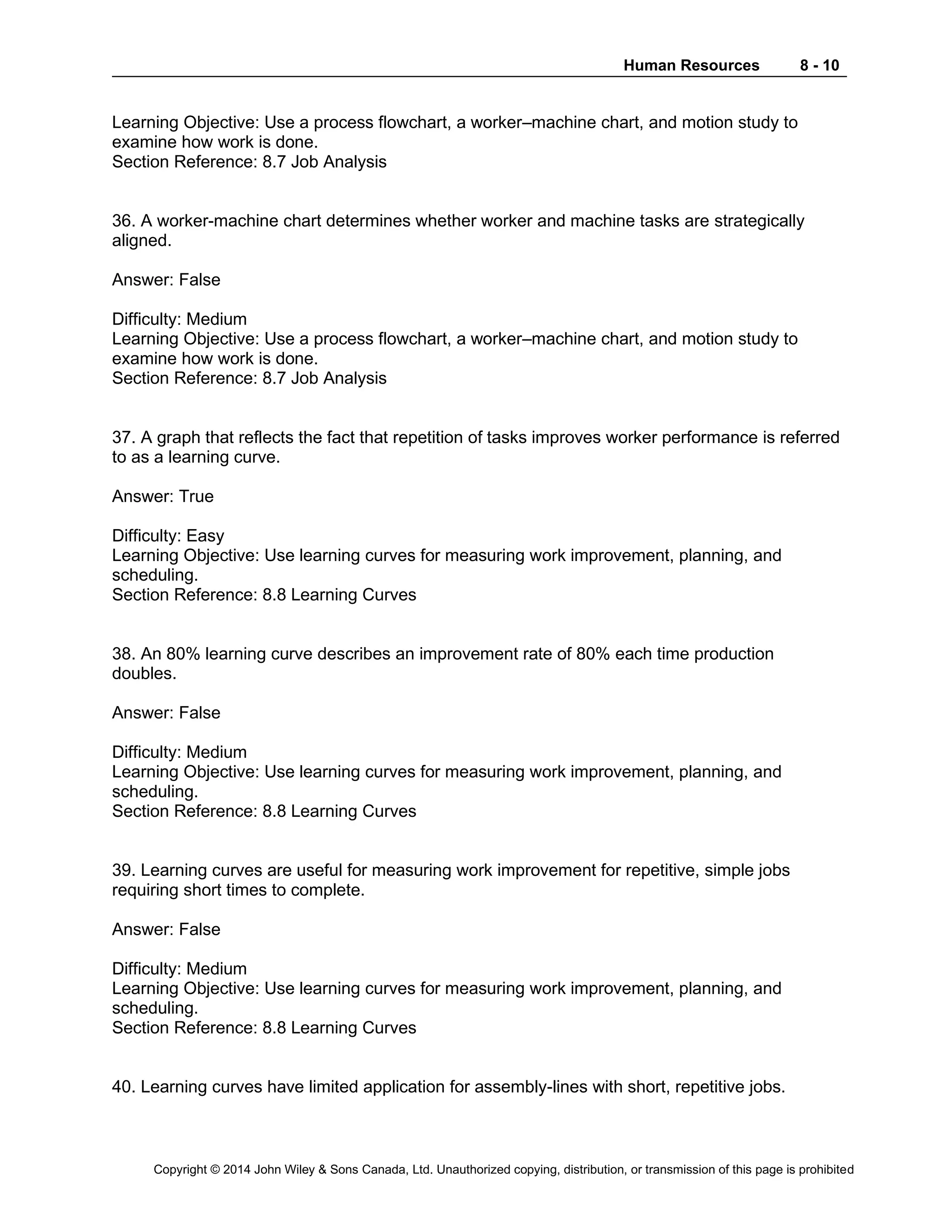
learning-from-data-3rd-edition-agresti-test-bank/
THINK Social Problems 2nd Edition Carl Test Bank
https://testbankfan.com/product/think-social-problems-2nd-edition-
carl-test-bank/
Using Information Technology 11th Edition Williams Test
Bank
https://testbankfan.com/product/using-information-technology-11th-
edition-williams-test-bank/
Biopsychology 10th Edition Pinel Solutions Manual
https://testbankfan.com/product/biopsychology-10th-edition-pinel-
solutions-manual/
Financial Statement Analysis and Security Valuation 5th
Edition Penman Test Bank
https://testbankfan.com/product/financial-statement-analysis-and-
security-valuation-5th-edition-penman-test-bank/
Copyright © 2014 John Wiley & Sons Canada, Ltd. Unauthorized copying, distribution, or transmission of this page is prohibited
CHAPTER 8
HUMAN RESOURCES
CHAPTER LEARNING OBJECTIVES
1. Discuss the basic principles of human resources management that quality-focused
companies follow. As with many other areas in production and operations management, the
quality movement and increased international competition have had a dramatic impact on
human resources. Traditional approaches to work in North America that once focused on task
specialization, simplification, and repetition are being supplanted by approaches that promote
higher job skill levels, broader task responsibility, more worker involvement, and, most
importantly, worker responsibility for quality. A number of Canadian manufacturing and service
firms have attempted to adopt new approaches to human resources management.
2. Explain the history and principles of scientific management and subsequent employee
motivation theories. Scientific management, developed by F. W. Taylor in the 1880s and
1890s, involves breaking down jobs into elemental activities and simplifying job design. This
system enabled companies to hire large numbers of cheap, unskilled labourers, who were
basically interchangeable and easily replaced. Taylor’s ideas gained widespread acceptance
when Ford embraced them in its assembly-line production model. However, scientific
management led to low employee morale—workers became bored and dissatisfied with the
numbing repetition of simple job tasks that required little thought, ingenuity, or responsibility.
This is in part why modern psychologists and behaviourists in the 1950s and 1960s eschewed
the principles of scientific management, and developed theories that proposed that to get
employees to work productively and efficiently they must be motivated.
3. Discuss contemporary trends in human resources management. A number of trends in
human resources management today are designed to increase quality and employee
motivation/productivity. These include job training, cross-training (where an employee learns
more than one job in a company), job enrichment, and empowerment. One way that companies
are realizing the advantages of empowerment is through the increased use of work groups and
teams. In addition, alternate work arrangements, such as flexible working schedules and
telecommuting, are also changing the way employees interact with their employers.
4. Explain different methods of employee compensation. Good human resource
management practices or motivation factors cannot compensate for insufficient monetary
rewards—self-motivation can go only so far and must be reinforced by financial rewards. The
two traditional forms of employee payment are the hourly wage and the individual incentive, or
piece-rate, wage, both of which are tied to time. In a piece-rate system, employees are paid for
the number of units they produce during the workday. In addition, many companies offer
gainsharing or profit sharing programs. The objective behind both incentive programs is to
create a sense among employees that it is in their self-interest for the company to do well.
Human Resources 8 - 2
Copyright © 2014 John Wiley & Sons Canada, Ltd. Unauthorized copying, distribution, or transmission of this page is prohibited
5. Discuss current issues relating to employee diversity, including examples of diversity
initiatives. Diversity in North American corporations has been a critical management issue for
decades. With the increasingly global business context, it has become an even more pervasive
factor in human resource management around the world. To be successful with a diverse
workforce, companies must provide a climate in which all employees feel comfortable, can do
their job, feel like they are valued by the organization, and perceive that they are treated fairly.
The most common diversity initiatives and programs are recruiting efforts designed to increase
diversity, diversity training, education and awareness programs, and community outreach.
6. Describe factors that must be considered in good job design. A key element in employee
motivation and job performance is to make sure the employee is well suited for a job and vice
versa. If a job is not designed properly and it is not a good fit for the employee, then it will not be
performed well. The elements of job design fall into three categories: an analysis of the tasks
included in the job, employee requirements, and the environment in which the job takes place.
Task analysis determines how to do each task and how all the tasks fit together to form a job.
Worker analysis determines the characteristics the worker must possess to meet the job
requirements, the responsibilities the worker will have in the job, and how the worker will be
rewarded. Environmental analysis refers to the physical location of the job in the production or
service facility and the environmental conditions that must exist.
7. Use a process flowchart, a worker–machine chart, and motion study to examine how
work is done. Methods analysis is used to redesign or improve existing jobs as well as to
develop new jobs. An analyst will study an existing job to determine if the work is being done in
the most efficient manner possible, if all the current tasks are necessary, or if new tasks should
be added. The primary tools of methods analysis are a variety of charts that illustrate in different
ways how a job or a work process is done. Two of the more popular charts are the process
flowchart and the worker–machine chart. A process flowchart is used to analyze how the steps
of a job or how a set of jobs fit together into the overall flow of the production process. A
worker–machine chart illustrates the amount of time a worker and a machine are working or idle
in a job, ultimately showing if the worker’s time and the machine time are being used efficiently.
The most detailed form of job analysis is motion study, which is used to ensure efficiency of
motion in a job. The purpose of motion study is to make sure that a job task does not include
any unnecessary motion by the worker and to select the sequence of motions that ensure that
the task is being performed in the most efficient way.
8. Use learning curves for measuring work improvement, planning, and scheduling. A
learning curve is a graph that reflects the fact that as workers repeat their tasks, they will
improve performance (because they learn how to do a job better as they produce more and
more units). Learning curves help managers project labour and budgeting requirements to
develop production scheduling plans. Although learning curves can be applied to many different
businesses, their impact is most pronounced in businesses and industries that include complex,
repetitive operations where the work pace is determined mostly by people, not machines.
8 - 3 Test Bank for Operations Management: Creating Value Along the Supply Chain, Canadian Edition
Copyright © 2014 John Wiley & Sons Canada, Ltd. Unauthorized copying, distribution, or transmission of this page is prohibited
TRUE-FALSE STATEMENTS
1. Successful quality-oriented firms recognize the importance of their employees when
developing a competitive strategy.
Answer: True
Difficulty: Easy
Learning Objective: Discuss the basic principles of human resources management that quality-
focused companies follow.
Section Reference: 8.1 Human Resources and Quality Management
2. With total quality management, employees are usually given precise directions to achieve
narrowly defined objectives.
Answer: False
Difficulty: Medium
Learning Objective: Discuss the basic principles of human resources management that quality-
focused companies follow.
Section Reference: 8.1 Human Resources and Quality Management
3. With total quality management, employees receive broad job training making them more
flexible in where they can work.
Answer: True
Difficulty: Medium
Learning Objective: Discuss the basic principles of human resources management that quality-
focused companies follow.
Section Reference: 8.1 Human Resources and Quality Management
4. Companies with a quality focus generally give their employees the power to make decisions
that will improve quality.
Answer: True
Difficulty: Easy
Learning Objective: Discuss the basic principles of human resources management that quality-
focused companies follow.
Section Reference: 8.1 Human Resources and Quality Management
5. Achieving strategic quality goals for quality and customer satisfaction often requires
teamwork and group participation.
Human Resources 8 - 4
Copyright © 2014 John Wiley & Sons Canada, Ltd. Unauthorized copying, distribution, or transmission of this page is prohibited
Answer: True
Difficulty: Medium
Learning Objective: Discuss the basic principles of human resources management that quality-
focused companies follow.
Section Reference: 8.1 Human Resources and Quality Management
6. Scientific management divides jobs into their most elemental activities to simplify job design.
Answer: True
Difficulty: Easy
Learning Objective: Explain the history and principles of scientific management and subsequent
employee motivation theories.
Section Reference: 8.2 The Changing Nature of Human Resources Management
7. Flexibility has traditionally been used as a measure of job efficiency.
Answer: True
Difficulty: Easy
Learning Objective: Explain the history and principles of scientific management and subsequent
employee motivation theories.
Section Reference: 8.2 The Changing Nature of Human Resources Management
8. Among the disadvantages of task specialization are high output, high costs, and extensive
training.
Answer: True
Difficulty: Easy
Learning Objective: Explain the history and principles of scientific management and subsequent
employee motivation theories.
Section Reference: 8.2 The Changing Nature of Human Resources Management
9. Studies have shown that the success of Japanese companies is due to cultural factors.
Answer: False
Difficulty: Medium
Learning Objective: Explain the history and principles of scientific management and subsequent
employee motivation theories.
Section Reference: 8.2 The Changing Nature of Human Resources Management
10. Studies have shown that the success of Japanese companies is due to management
practices.
8 - 5 Test Bank for Operations Management: Creating Value Along the Supply Chain, Canadian Edition
Copyright © 2014 John Wiley & Sons Canada, Ltd. Unauthorized copying, distribution, or transmission of this page is prohibited
Answer: True
Difficulty: Medium
Learning Objective: Explain the history and principles of scientific management and subsequent
employee motivation theories.
Section Reference: 8.2 The Changing Nature of Human Resources Management
11. The objective of ergonomics is to make the best use of employees’ capabilities while
maintaining the employees’ health and well-being.
Answer: True
Difficulty: Medium
Learning Objective: Explain the history and principles of scientific management and subsequent
employee motivation theories.
Section Reference: 8.2 The Changing Nature of Human Resources Management
12. Scientific Management involves breaking down jobs into elemental activities.
Answer: True
Difficulty: Medium
Learning Objective: Explain the history and principles of scientific management and subsequent
employee motivation theories.
Section Reference: 8.2 The Changing Nature of Human Resources Management
13. Motivation refers to the willingness of an employee to perform as needed to attain a goal or
objective.
Answer: True
Difficulty: Medium
Learning Objective: Explain the history and principles of scientific management and subsequent
employee motivation theories.
Section Reference: 8.2 The Changing Nature of Human Resources Management
14. For most industrialized countries the difference between a company’s success or failure is
dependent on the capability of its human resources.
Answer: True
Difficulty: Easy
Learning Objective: Discuss contemporary trends in human resources management.
Section Reference: 8.3 Contemporary Trends in Human Resources Management
Human Resources 8 - 6
Copyright © 2014 John Wiley & Sons Canada, Ltd. Unauthorized copying, distribution, or transmission of this page is prohibited
15. Because services are labour intensive, human resources is becoming a more important
strategic factor for service companies.
Answer: True
Difficulty: Easy
Learning Objective: Discuss contemporary trends in human resources management.
Section Reference: 8.3 Contemporary Trends in Human Resources Management
16. Job rotation often requires cross training of employees.
Answer: True
Difficulty: Medium
Learning Objective: Discuss contemporary trends in human resources management.
Section Reference: 8.3 Contemporary Trends in Human Resources Management
17. Empowerment involves giving employees the authority and responsibility to innovate and act
on their own.
Answer: True
Difficulty: Easy
Learning Objective: Discuss contemporary trends in human resources management.
Section Reference: 8.3 Contemporary Trends in Human Resources Management
18. An alternative workplace is a combination of nontraditional work locations and practices that
supplements or replaces the traditional office.
Answer: True
Difficulty: Medium
Learning Objective: Discuss contemporary trends in human resources management.
Section Reference: 8.3 Contemporary Trends in Human Resources Management
19. The motivation for companies to create alternative workplaces is primarily financial.
Answer: True
Difficulty: Easy
Learning Objective: Discuss contemporary trends in human resources management.
Section Reference: 8.3 Contemporary Trends in Human Resources Management
20. One of the prerequisites to job rotation is cross training.
Answer: True
8 - 7 Test Bank for Operations Management: Creating Value Along the Supply Chain, Canadian Edition
Copyright © 2014 John Wiley & Sons Canada, Ltd. Unauthorized copying, distribution, or transmission of this page is prohibited
Difficulty: Medium
Learning Objective: Discuss contemporary trends in human resources management.
Section Reference: 8.3 Contemporary Trends in Human Resources Management
21. In a piece-rate wage system, pay is based on the efficiency of the overall process.
Answer: False
Difficulty: Easy
Learning Objective: Explain different methods of employee compensation.
Section Reference: 8.4 Employee Compensation
22. A piece-rate wage plan rewards employees for attaining company goals and objectives.
Answer: False
Difficulty: Medium
Learning Objective: Explain different methods of employee compensation.
Section Reference: 8.4 Employee Compensation
23. One advantage of an individual piece-rate system is that it provides strong incentives to
ensure high quality.
Answer: False
Difficulty: Easy
Learning Objective: Explain different methods of employee compensation.
Section Reference: 8.4 Employee Compensation
24. While still an important issue, diversity issues in North American companies is on the
decline.
Answer: False
Difficulty: Medium
Learning Objective: Discuss current issues relating to employee diversity, including examples of
diversity initiatives.
Section Reference: 8.5 Managing Diversity in the Workplace
25. According to the Conference Board of Canada, only very few new immigrants are needed in
the future to stabilize the workforce and ensure economic growth.
Answer: False
Difficulty: Medium
Human Resources 8 - 8
Copyright © 2014 John Wiley & Sons Canada, Ltd. Unauthorized copying, distribution, or transmission of this page is prohibited
Learning Objective: Discuss current issues relating to employee diversity, including examples of
diversity initiatives.
Section Reference: 8.5 Managing Diversity in the Workplace
26. Globalization has resulted in an overall reduction in diversity-related issues in the workplace.
Answer: False
Difficulty: Medium
Learning Objective: Discuss current issues relating to employee diversity, including examples of
diversity initiatives.
Section Reference: 8.5 Managing Diversity in the Workplace
27. The elimination of racism, sexism, cultural indifference, and religious intolerance cannot be
mandated by higher management or managed by financial incentives.
Answer: True
Difficulty: Medium
Learning Objective: Discuss current issues relating to employee diversity, including examples of
diversity initiatives.
Section Reference: 8.5 Managing Diversity in the Workplace
28. By managing diversity a company can gain a competitive edge because all employees are
given an opportunity to do their best.
Answer: True
Difficulty: Medium
Learning Objective: Discuss current issues relating to employee diversity, including examples of
diversity initiatives.
Section Reference: 8.5 Managing Diversity in the Workplace
29. Job design includes determining the characteristics a worker needs to meet the job
requirements.
Answer: True
Difficulty: Medium
Learning Objective: Describe factors that must be considered in good job design.
Section Reference: 8.6 Job Design
30. The interface of workers with machines is probably the least important aspect of job design.
Answer: False
8 - 9 Test Bank for Operations Management: Creating Value Along the Supply Chain, Canadian Edition
Copyright © 2014 John Wiley & Sons Canada, Ltd. Unauthorized copying, distribution, or transmission of this page is prohibited
Difficulty: Easy
Learning Objective: Describe factors that must be considered in good job design.
Section Reference: 8.6 Job Design
31. Fitting the task to the person in a work environment is known as job analysis.
Answer: False
Difficulty: Medium
Learning Objective: Describe factors that must be considered in good job design.
Section Reference: 8.6 Job Design
32. Determining worker capabilities and responsibilities for a job is known as worker analysis.
Answer: True
Difficulty: Medium
Learning Objective: Describe factors that must be considered in good job design.
Section Reference: 8.6 Job Design
33. A process flowchart is a graph showing the steps of a job or how a set of jobs fit together
into the overall flow of the production process.
Answer: True
Difficulty: Medium
Learning Objective: Use a process flowchart, a worker–machine chart, and motion study to
examine how work is done.
Section Reference: 8.7 Job Analysis
34. A worker-machine chart illustrates the amount of time a worker and a machine are working
or idle.
Answer: True
Difficulty: Easy
Learning Objective: Use a process flowchart, a worker–machine chart, and motion study to
examine how work is done.
Section Reference: 8.7 Job Analysis
35. The formal study of the individual human motions used to perform a task was developed by
Frank and Lillian Gilbreth.
Answer: True
Difficulty: Medium
Human Resources 8 - 10
Copyright © 2014 John Wiley & Sons Canada, Ltd. Unauthorized copying, distribution, or transmission of this page is prohibited
Learning Objective: Use a process flowchart, a worker–machine chart, and motion study to
examine how work is done.
Section Reference: 8.7 Job Analysis
36. A worker-machine chart determines whether worker and machine tasks are strategically
aligned.
Answer: False
Difficulty: Medium
Learning Objective: Use a process flowchart, a worker–machine chart, and motion study to
examine how work is done.
Section Reference: 8.7 Job Analysis
37. A graph that reflects the fact that repetition of tasks improves worker performance is referred
to as a learning curve.
Answer: True
Difficulty: Easy
Learning Objective: Use learning curves for measuring work improvement, planning, and
scheduling.
Section Reference: 8.8 Learning Curves
38. An 80% learning curve describes an improvement rate of 80% each time production
doubles.
Answer: False
Difficulty: Medium
Learning Objective: Use learning curves for measuring work improvement, planning, and
scheduling.
Section Reference: 8.8 Learning Curves
39. Learning curves are useful for measuring work improvement for repetitive, simple jobs
requiring short times to complete.
Answer: False
Difficulty: Medium
Learning Objective: Use learning curves for measuring work improvement, planning, and
scheduling.
Section Reference: 8.8 Learning Curves
40. Learning curves have limited application for assembly-lines with short, repetitive jobs.
8 - 11 Test Bank for Operations Management: Creating Value Along the Supply Chain, Canadian Edition
Copyright © 2014 John Wiley & Sons Canada, Ltd. Unauthorized copying, distribution, or transmission of this page is prohibited
Answer: True
Difficulty: Easy
Learning Objective: Use learning curves for measuring work improvement, planning, and
scheduling.
Section Reference: 8.8 Learning Curves
Human Resources 8 - 12
Copyright © 2014 John Wiley & Sons Canada, Ltd. Unauthorized copying, distribution, or transmission of this page is prohibited
MULTIPLE CHOICE QUESTIONS
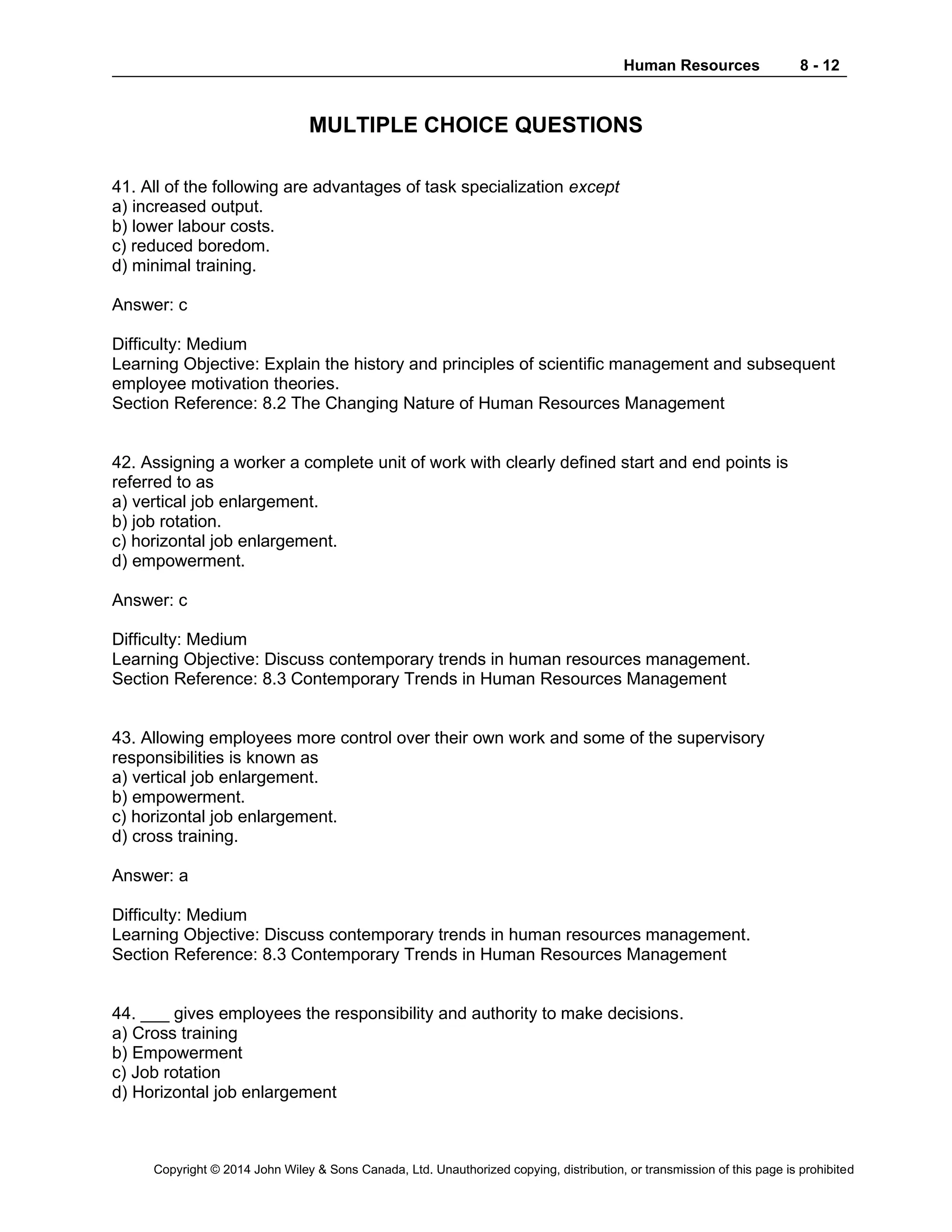
41. All of the following are advantages of task specialization except
a) increased output.
b) lower labour costs.
c) reduced boredom.
d) minimal training.
Answer: c
Difficulty: Medium
Learning Objective: Explain the history and principles of scientific management and subsequent
employee motivation theories.
Section Reference: 8.2 The Changing Nature of Human Resources Management
42. Assigning a worker a complete unit of work with clearly defined start and end points is
referred to as
a) vertical job enlargement.
b) job rotation.
c) horizontal job enlargement.
d) empowerment.
Answer: c
Difficulty: Medium
Learning Objective: Discuss contemporary trends in human resources management.
Section Reference: 8.3 Contemporary Trends in Human Resources Management
43. Allowing employees more control over their own work and some of the supervisory
responsibilities is known as
a) vertical job enlargement.
b) empowerment.
c) horizontal job enlargement.
d) cross training.
Answer: a
Difficulty: Medium
Learning Objective: Discuss contemporary trends in human resources management.
Section Reference: 8.3 Contemporary Trends in Human Resources Management
44. ___ gives employees the responsibility and authority to make decisions.
a) Cross training
b) Empowerment
c) Job rotation
d) Horizontal job enlargement
8 - 13 Test Bank for Operations Management: Creating Value Along the Supply Chain, Canadian Edition
Copyright © 2014 John Wiley & Sons Canada, Ltd. Unauthorized copying, distribution, or transmission of this page is prohibited
Answer: b
Difficulty: Easy
Learning Objective: Discuss contemporary trends in human resources management.
Section Reference: 8.3 Contemporary Trends in Human Resources Management
45. Advantages of empowerment include all of the following except
a) more attention to product quality.
b) higher productivity.
c) abuse of power.
d) more satisfying work.
Answer: c
Difficulty: Easy
Learning Objective: Discuss contemporary trends in human resources management.
Section Reference: 8.3 Contemporary Trends in Human Resources Management
46. Advantages of telecommuting include all of the following except
a) reduced turnover.
b) decreased absenteeism and leave usage.
c) flexible work schedules.
d) direct visual surveillance of employees.
Answer: d
Difficulty: Medium
Learning Objective: Discuss contemporary trends in human resources management.
Section Reference: 8.3 Contemporary Trends in Human Resources Management
47. An incentive plan that encourages employees to achieve a company’s goals and objectives
is referred to as
a) a piece-rate wage plan.
b) gainsharing.
c) profit sharing.
d) overtime.
Answer: b
Difficulty: Medium
Learning Objective: Explain different methods of employee compensation.
Section Reference: 8.4 Employee Compensation
48. The elements of job design include
a) task analysis.
b) worker analysis.
Human Resources 8 - 14
Copyright © 2014 John Wiley & Sons Canada, Ltd. Unauthorized copying, distribution, or transmission of this page is prohibited
c) environmental analysis.
d) all of the above.
Answer: d
Difficulty: Easy
Learning Objective: Describe factors that must be considered in good job design.
Section Reference: 8.6 Job Design
49. Determining how tasks fit together to form a job is referred to as
a) worker analysis.
b) task analysis.
c) environmental analysis.
d) ergonomics.
Answer: b
Difficulty: Easy
Learning Objective: Describe factors that must be considered in good job design.
Section Reference: 8.6 Job Design
50. Fitting the task to the employee in a work environment is known as
a) motivation.
b) worker analysis.
c) ergonomics.
d) task analysis.
Answer: c
Difficulty: Medium
Learning Objective: Describe factors that must be considered in good job design.
Section Reference: 8.6 Job Design
51. ___ refers to the physical location of a job and the requisite surroundings.
a) Task analysis
b) Worker analysis
c) Methods analysis
d) Environmental analysis
Answer: d
Difficulty: Medium
Learning Objective: Describe factors that must be considered in good job design.
Section Reference: 8.6 Job Design
52. The gradual shift from treating employees as a replaceable part to embracing them as a
valuable resource was primarily brought about by the trend toward
8 - 15 Test Bank for Operations Management: Creating Value Along the Supply Chain, Canadian Edition
Copyright © 2014 John Wiley & Sons Canada, Ltd. Unauthorized copying, distribution, or transmission of this page is prohibited
a) globalization.
b) quality management.
c) scientific management.
d) customization.
Answer: b
Difficulty: Easy
Learning Objective: Use a process flowchart, a worker–machine chart, and motion study to
examine how work is done.
Section Reference: 8.7 Job Analysis
53. In a piece-rate wage system a worker’s pay is based on
a) total output.
b) job rating.
c) job classification.
d) total time.
Answer: a
Difficulty: Easy
Learning Objective: Use a process flowchart, a worker–machine chart, and motion study to
examine how work is done.
Section Reference: 8.7 Job Analysis
54. ___ illustrate the improvement rate of workers as a job is repeated.
a) Learning curves
b) Process curves
c) Learning charts
d) Process charts
Answer: a
Difficulty: Medium
Learning Objective: Use a process flowchart, a worker–machine chart, and motion study to
examine how work is done.
Section Reference: 8.7 Job Analysis
55. ___ involves the horizontal movement or a worker between two or more jobs.
a) Cross training
b) Empowerment
c) Alternative workplace
d) Job rotation
Answer: d
Difficulty: Medium
Learning Objective: Use a process flowchart, a worker–machine chart, and motion study to
Human Resources 8 - 16
Copyright © 2014 John Wiley & Sons Canada, Ltd. Unauthorized copying, distribution, or transmission of this page is prohibited
examine how work is done.
Section Reference: 8.7 Job Analysis
56. Which of the following would most likely be used to redesign or improve existing jobs?
a) methods analysis
b) technology analysis
c) environmental analysis
d) task analysis
Answer: a
Difficulty: Medium
Learning Objective: Use a process flowchart, a worker–machine chart, and motion study to
examine how work is done.
Section Reference: 8.7 Job Analysis
57. A(n) ___ is used to graphically analyze how the steps of a job fit together into the overall
flow of the production process.
a) methods analysis
b) process flowchart
c) task analysis
d) environmental analysis
Answer: b
Difficulty: Medium
Learning Objective: Use a process flowchart, a worker–machine chart, and motion study to
examine how work is done.
Section Reference: 8.7 Job Analysis
58. Motion study, the study of the individual human motions used in a task, was developed by
a) Henry Ford.
b) F. W. Taylor.
c) Frank and Lillian Gilbreth.
d) Frederick Herzberg.
Answer: c
Difficulty: Medium
Learning Objective: Use a process flowchart, a worker–machine chart, and motion study to
examine how work is done.
Section Reference: 8.7 Job Analysis
59. The amount of time a worker and a machine are working or idle on a job is illustrated by a
a) process flowchart.
b) worker analysis.
c) task analysis.
8 - 17 Test Bank for Operations Management: Creating Value Along the Supply Chain, Canadian Edition
Copyright © 2014 John Wiley & Sons Canada, Ltd. Unauthorized copying, distribution, or transmission of this page is prohibited
d) worker-machine chart.
Answer: d
Difficulty: Medium
Learning Objective: Use a process flowchart, a worker–machine chart, and motion study to
examine how work is done.
Section Reference: 8.7 Job Analysis
60. The principles of motion study relate to all of the following categories except
a) the human body.
b) the efficient use of capital.
c) the workplace.
d) the efficient use of equipment and machinery.
Answer: b
Difficulty: Medium
Learning Objective: Use a process flowchart, a worker–machine chart, and motion study to
examine how work is done.
Section Reference: 8.7 Job Analysis
61. A graph that illustrates the improvement rate of workers as a job is repeated is known as a
a) learning curve.
b) process flowchart.
c) worker-machine chart.
d) task analysis chart.
Answer: a
Difficulty: Medium
Learning Objective: Use learning curves for measuring work improvement, planning, and
scheduling.
Section Reference: 8.8 Learning Curves
62. A learning curve illustrates that increasing the number of cumulative units produced ___ the
labour required per unit.
a) increases
b) eliminates
c) decreases
d) does not impact
Answer: c
Difficulty: Medium
Learning Objective: Use learning curves for measuring work improvement, planning, and
scheduling.
Section Reference: 8.8 Learning Curves
Human Resources 8 - 18
Copyright © 2014 John Wiley & Sons Canada, Ltd. Unauthorized copying, distribution, or transmission of this page is prohibited
63. A learning curve reflects the fact that
a) each time the number of units produced doubles, the processing time per unit decreases by a
constant percentage.
b) each time the number of units produced doubles, the processing time per unit increases by a
constant percentage.
c) each time the number of units produced doubles, the processing time per unit increases by
10%.
d) each time the number of units produced doubles, the processing time per unit remains the
same.
Answer: a
Difficulty: Medium
Learning Objective: Use learning curves for measuring work improvement, planning, and
scheduling.
Section Reference: 8.8 Learning Curves
64. A 90% learning curve indicates
a) a 90% increase in processing time per unit as output doubles.
b) a 90% decrease in processing time per unit as output doubles.
c) a 10% increase in processing time per unit as output doubles.
d) a 10% decrease in processing time per unit as output doubles.
Answer: d
Difficulty: Medium
Learning Objective: Use learning curves for measuring work improvement, planning, and
scheduling.
Section Reference: 8.8 Learning Curves
65. The direct labour time required to produce the first sailboat of a particular model was 3000
hours. If the company believes that an 80% learning curve applies to the production of this
model sailboat then the direct labour time required to produce the 2nd
boat is estimated to be
a) 600 hours.
b) 2,400 hours.
c) 3,600 hours.
d) 4,000 hours.
Answer: b
Difficulty: Medium
Learning Objective: Use learning curves for measuring work improvement, planning, and
scheduling.
Section Reference: 8.8 Learning Curves
66. A company has accepted a contract to produce a special electric motor. The number of
8 - 19 Test Bank for Operations Management: Creating Value Along the Supply Chain, Canadian Edition
Copyright © 2014 John Wiley & Sons Canada, Ltd. Unauthorized copying, distribution, or transmission of this page is prohibited
direct labour hours required to produce the first motor is 250. If an 85% learning curve applies to
the production of motors, then the number of labour hours needed to produce the 4th
motor is
a) 212.5 hours.
b) 180.6 hours.
c) 153.5 hours.
d) 0 37.5 hours
Answer: b
Difficulty: Hard
Learning Objective: Use learning curves for measuring work improvement, planning, and
scheduling.
Section Reference: 8.8 Learning Curves
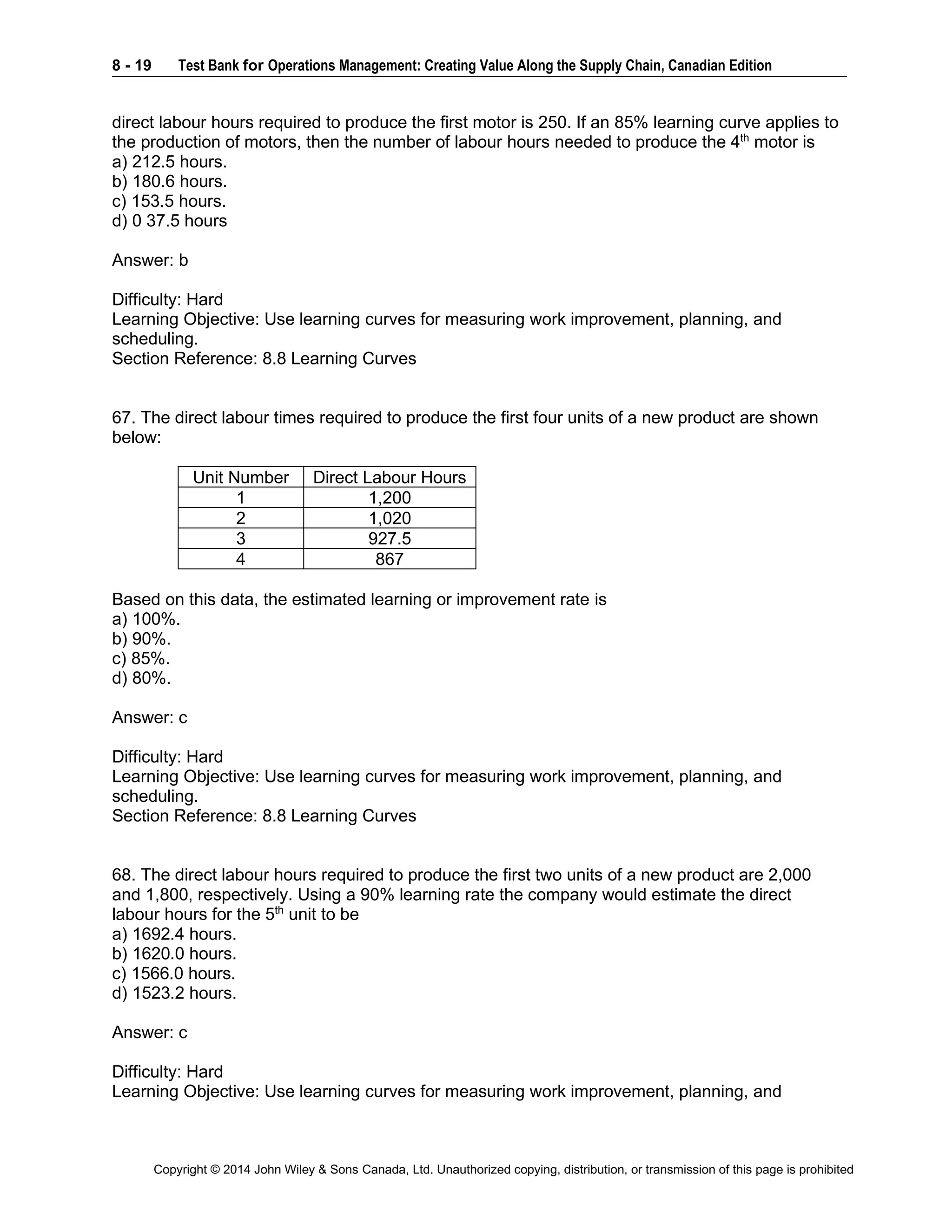
67. The direct labour times required to produce the first four units of a new product are shown
below:
Unit Number Direct Labour Hours
1 1,200
2 1,020
3 927.5
4 867
Based on this data, the estimated learning or improvement rate is
a) 100%.
b) 90%.
c) 85%.
d) 80%.
Answer: c
Difficulty: Hard
Learning Objective: Use learning curves for measuring work improvement, planning, and
scheduling.
Section Reference: 8.8 Learning Curves
68. The direct labour hours required to produce the first two units of a new product are 2,000
and 1,800, respectively. Using a 90% learning rate the company would estimate the direct
labour hours for the 5th
unit to be
a) 1692.4 hours.
b) 1620.0 hours.
c) 1566.0 hours.
d) 1523.2 hours.
Answer: c
Difficulty: Hard
Learning Objective: Use learning curves for measuring work improvement, planning, and
Human Resources 8 - 20
Copyright © 2014 John Wiley & Sons Canada, Ltd. Unauthorized copying, distribution, or transmission of this page is prohibited
scheduling.
Section Reference: 8.8 Learning Curves
69. Which of the following is not a true statement regarding learning curves?
a) Learning curves can help managers project labour requirements.
b) Learning curves are not affected by product modifications.
c) Learning curves are useful in developing production scheduling plans.
d) Learning curves can help make overall product cost estimates.
Answer: b
Difficulty: Medium
Learning Objective: Use learning curves for measuring work improvement, planning, and
scheduling.
Section Reference: 8.8 Learning Curves
Another Random Scribd Document
with Unrelated Content
’s for Matisse’s Mam’selle Marguerite,
(With whom all the Cubies are
madly in love;)
Her manner is so prepossessing
and sweet
That, if she but had them, we’d
fall at her feet!
(In her eyes, what a mingling
of serpent and
dove!)
—M’s for Matisse’s Mam’selle
Marguerite.
’s for the Nudes that the Cubies portray,—
We willingly vouch for their perfect
propriety,
Even while some we regard with
dismay,—
For instance, the lady as long as
Broadway:
With all due respect, we don’t
crave her society!
—N’s for the Nudes that the
Cubies portray.
’s for Objective and Optical Art,
(The kind we’ve been used to,
these long years gone
by,)
Which the Cubie Objects to with
all of his heart:
“Make the Object Subjective,” he
says, “at the start,—
Just a matter of Grammar, as
easy as pie!”
—O’s for Objective and Optical Art.
’s for Picasso, Picabia and Party
(Who deal in abstractions,
distractions and such.)
When, with vision chaotic and
expletives hearty,
You beg of a Cubie their sense to
impart, he
Profoundly makes answer: “In
little is much.”
—P’s for Picasso, Picabia and
Party.
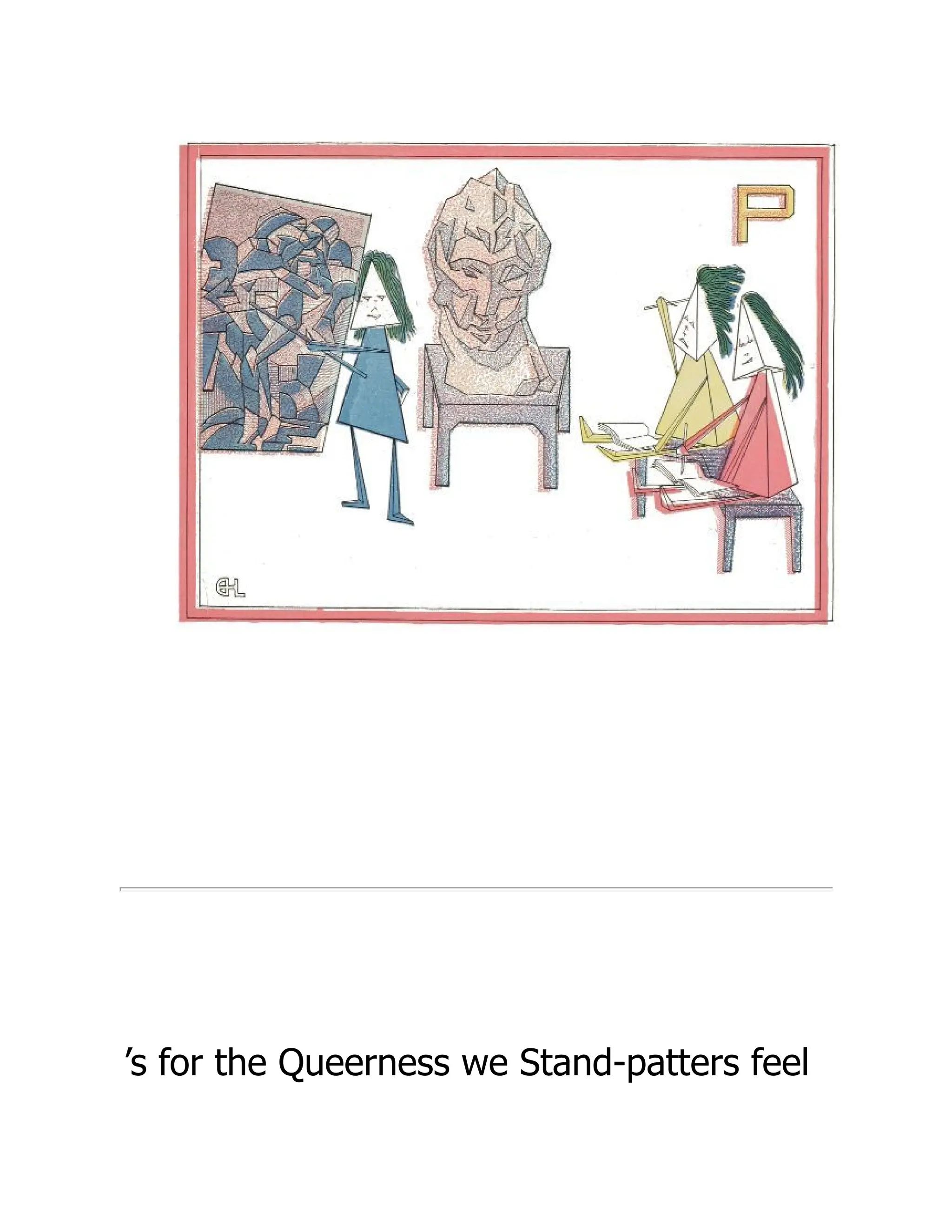
’s for the Queerness we Stand-patters feel
When Progressive young Cubies
start Art reformation.
They’re strong on Initiative, praise
the Square Deal:
“Though the Cubic is best!” they
aggressively squeal;
“Painting things as you see
them is rank
deformation!”
—Q’s for the Queerness we Stand-
patters feel.
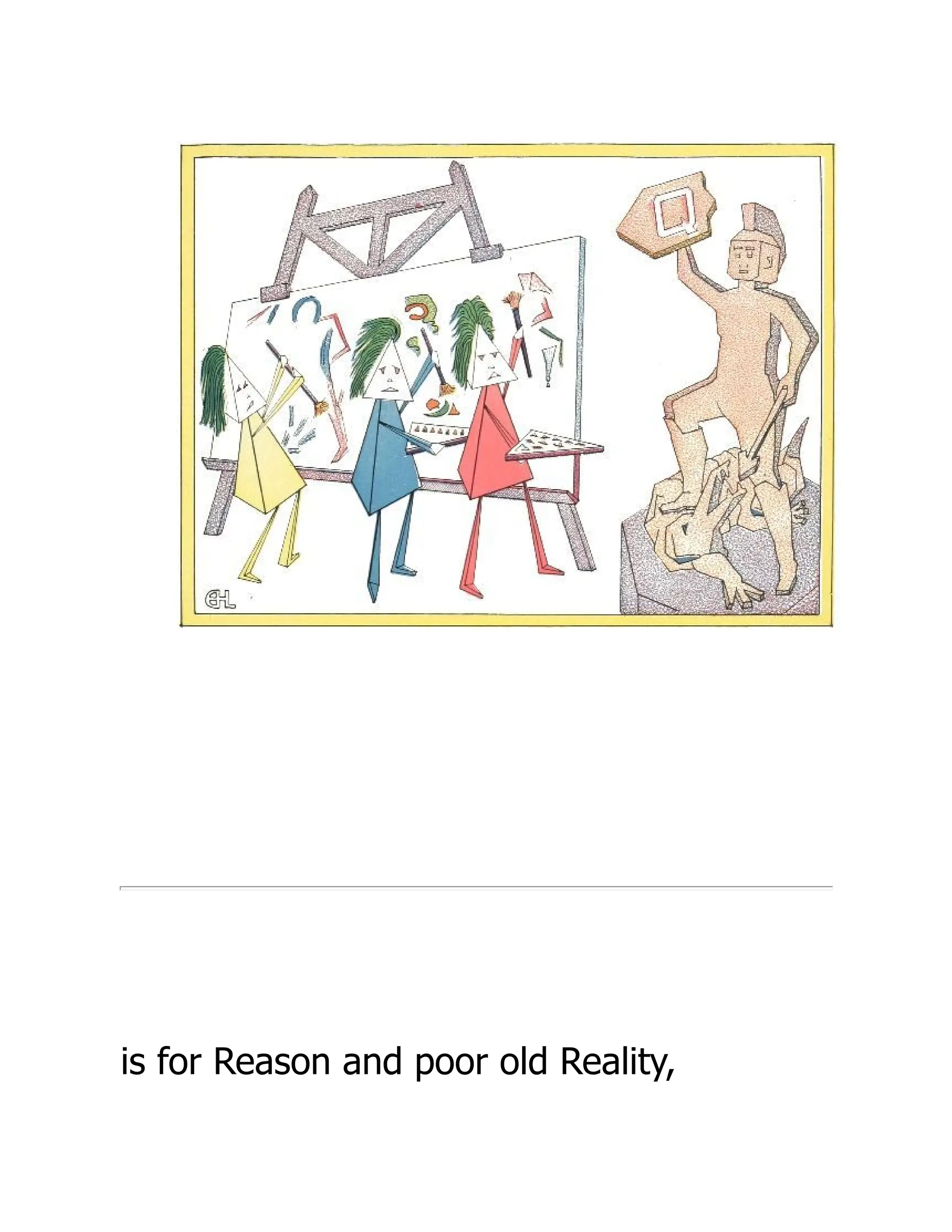
is for Reason and poor old Reality,
Once in the fashion, but now
obsolete,
Banished forever with grim
actuality.
Now the sole law is one’s own
personality—
Find its Cube Root and you
have it complete.
—R is for Reason and poor old
Reality.
is for Schamberg’s fair dame at her ’phone,
Conversing with G. Stein, the
Futurist scribe.
The Cubies, eavesdropping, hear
Gertrude bemoan:
“This one feeling many far
seeming alone,
The bluer the bliss the redder
the bribe!”
—S is for Schamberg’s fair dame
at her ’phone.
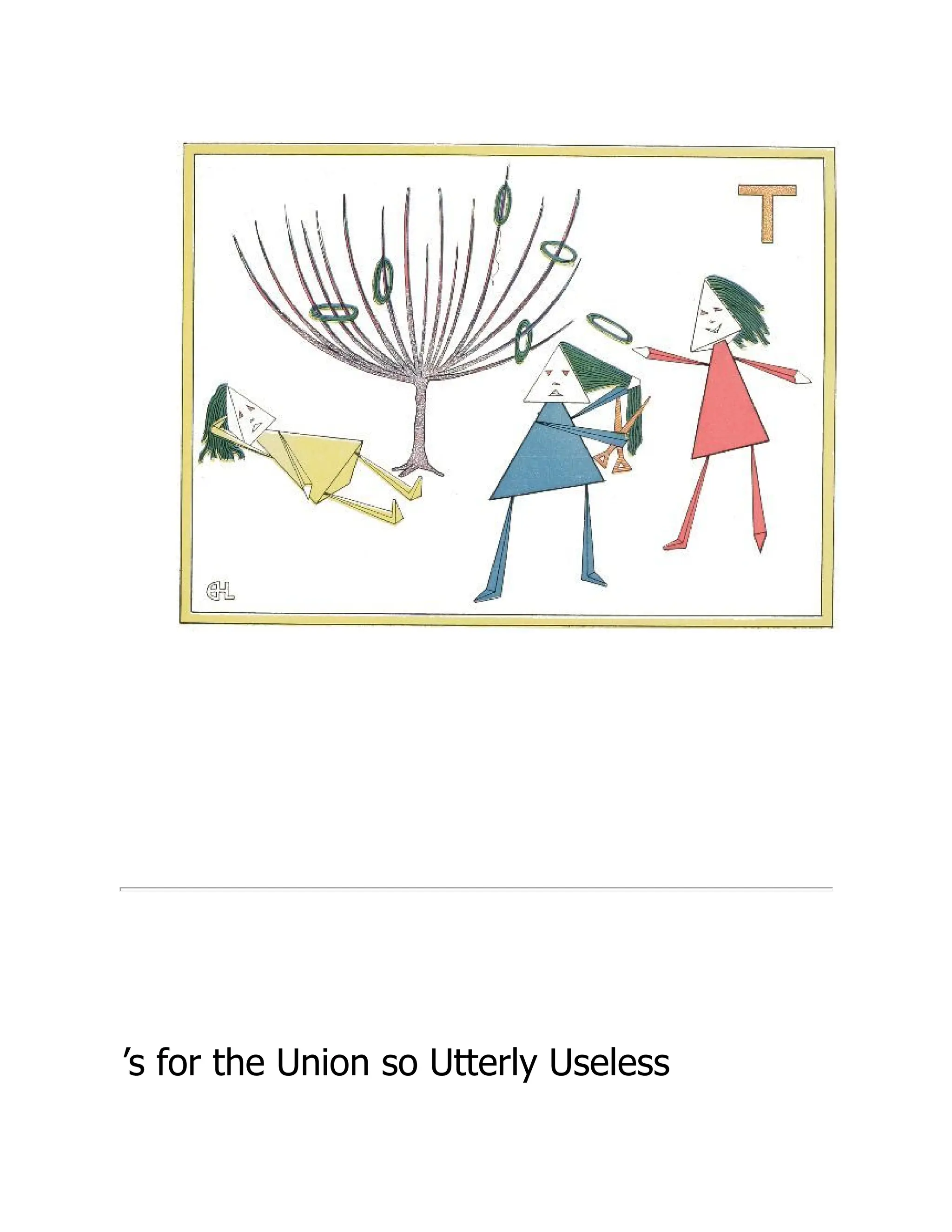
’s for the Type of Tree Chabaud’s erected.
The Cubies insist it’s as useful as
fair
For a game that they play when
they’re feeling dejected,
(A use which not every one would
have detected,)
Lassoing the branches with
rings of their hair.
—T’s for the Type of Tree
Chabaud’s erected.
’s for the Union so Utterly Useless
Uniting the members that make up
the whole.
Against it the Cubies wage war
that is truceless:
“Such rage for convention,” they
cry, “is excuseless!
Away with cohesion, and set
free the Soul!”
—U’s for the Union so Utterly
Useless.
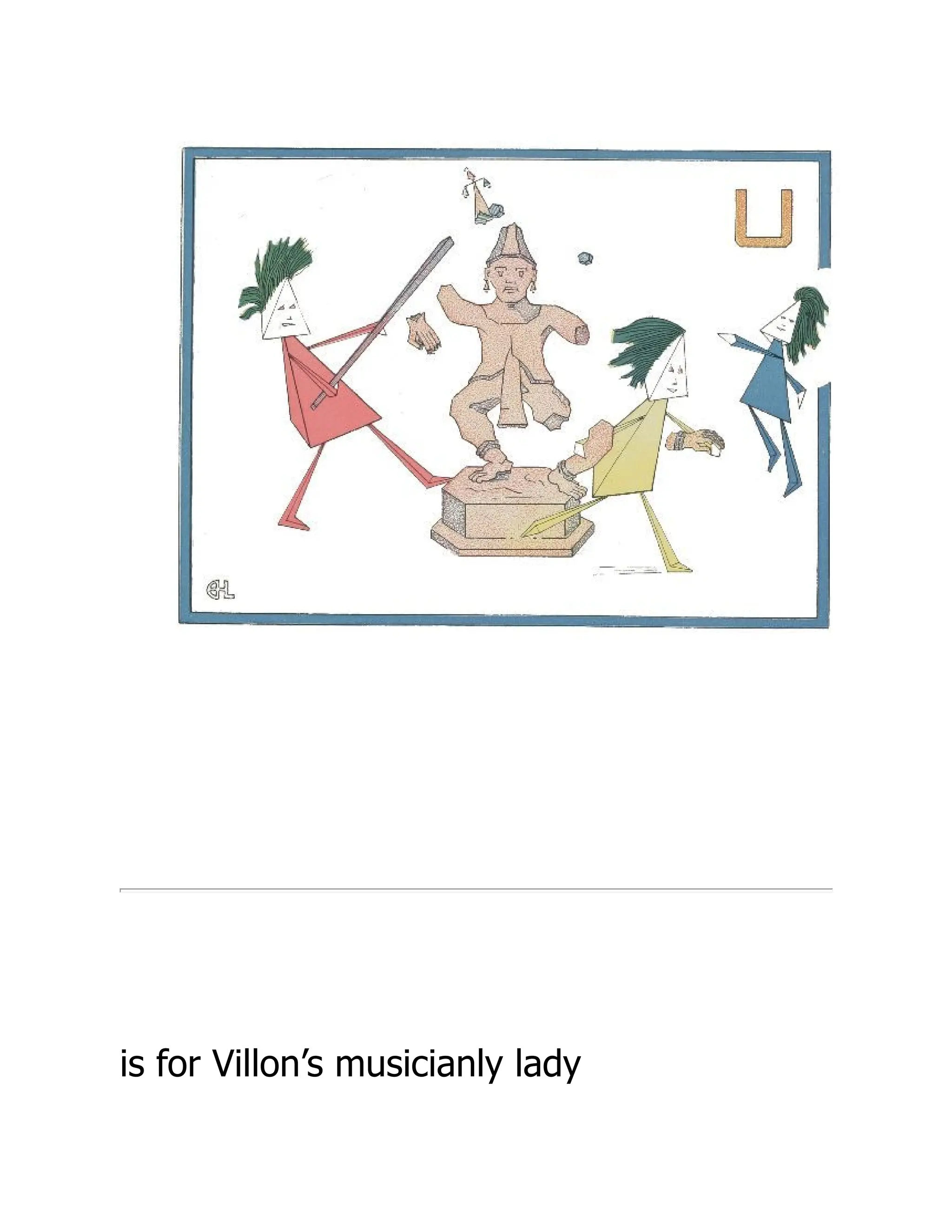
is for Villon’s musicianly lady
(With charm evanescent and
Visage remote.)
The picnics he gives in his
orchards so shady
Account for his hit with the Cubes.
I’m afraid he
Will spoil them completely for
plain table d’hôte.
—V is for Villon’s musicianly lady.
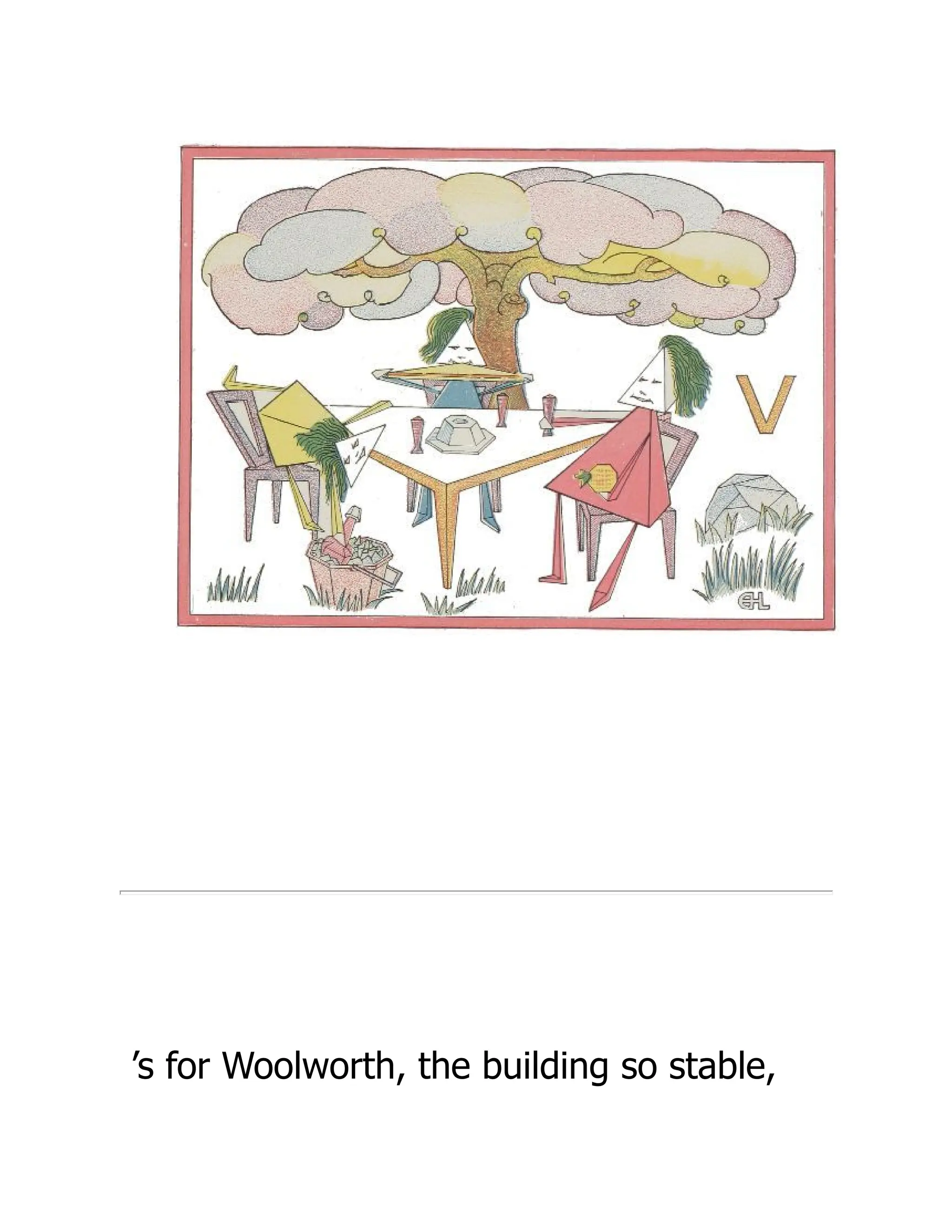
’s for Woolworth, the building so stable,
(Erected with nickels and dimes by
us all,)
Which Cubies paint writhing from
cellar to gable,
Distinctly resembling the Tower of
Babel,
Some decades ago, just
preceding its fall.
—W’s for Woolworth, the building
so stable.
is the Xit, Xtremely alluring
When Cubies invite us to study
their Art;
And the Xquisite pain we are sadly
enduring
The while they protest, with an air
reassuring:
“Of course this is merely a
diffident start!”
—X is the Xit, Xtremely alluring.
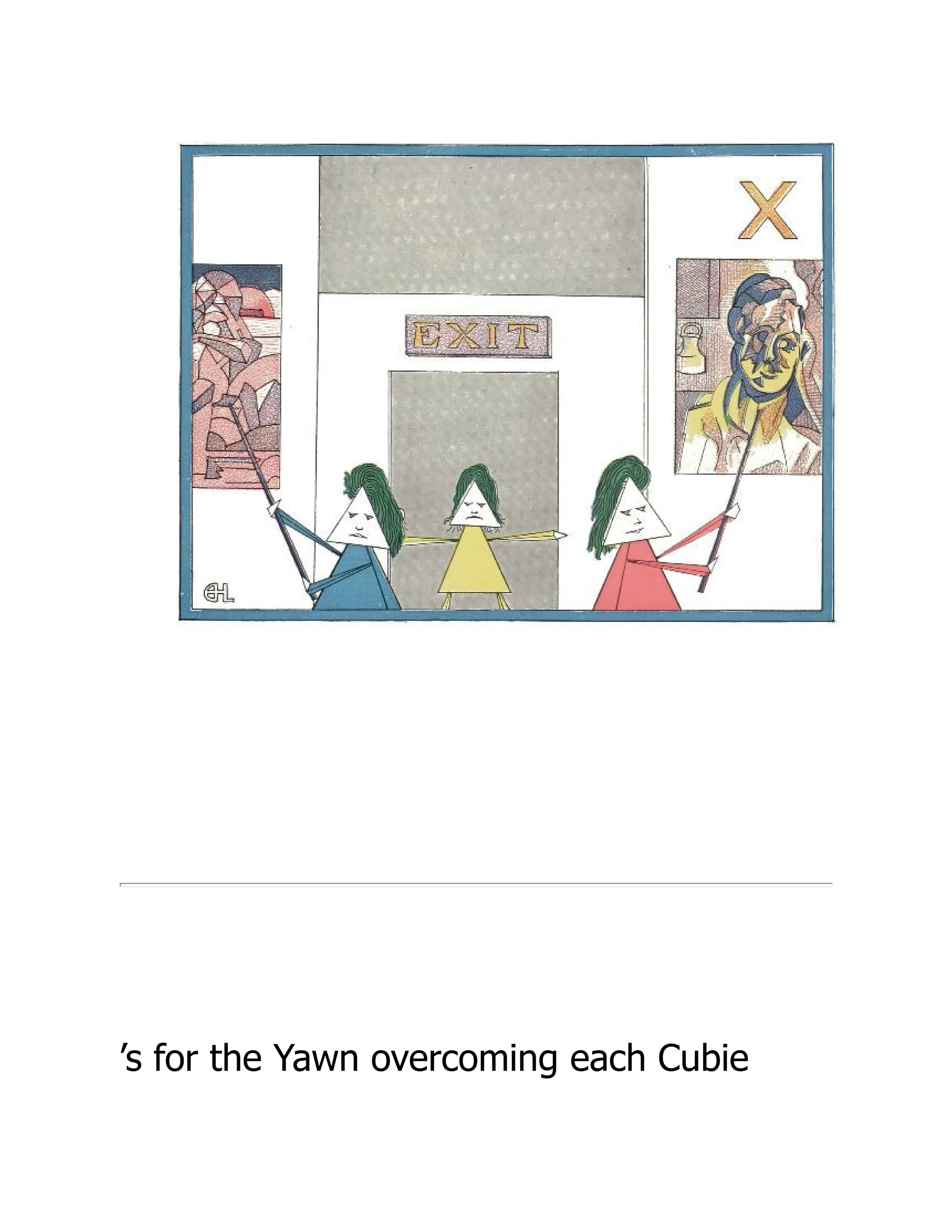
’s for the Yawn overcoming each Cubie
Welcome to our website – the perfect destination for book lovers and
knowledge seekers. We believe that every book holds a new world,
offering opportunities for learning, discovery, and personal growth.
That’s why we are dedicated to bringing you a diverse collection of
books, ranging from classic literature and specialized publications to
self-development guides and children's books.
More than just a book-buying platform, we strive to be a bridge
connecting you with timeless cultural and intellectual values. With an
elegant, user-friendly interface and a smart search system, you can
quickly find the books that best suit your interests. Additionally,
our special promotions and home delivery services help you save time
and fully enjoy the joy of reading.
Join us on a journey of knowledge exploration, passion nurturing, and
personal growth every day!
testbankfan.com


Operations Management Creating Value Along Canadian 1st Edition Russel Test Bank

  • 1.
    Visit https://testbankfan.com todownload the full version and browse more test banks or solution manuals Operations Management Creating Value Along Canadian 1st Edition Russel Test Bank _____ Press the link below to begin your download _____ https://testbankfan.com/product/operations-management- creating-value-along-canadian-1st-edition-russel-test-bank/ Access testbankfan.com now to download high-quality test banks or solution manuals
  • 2.
    We believe theseproducts will be a great fit for you. Click the link to download now, or visit testbankfan.com to discover even more! Operations Management Creating Value Along Canadian 1st Edition Russel Solutions Manual https://testbankfan.com/product/operations-management-creating-value- along-canadian-1st-edition-russel-solutions-manual/ Operations Management Creating Value Along 7th Edition Russel Test Bank https://testbankfan.com/product/operations-management-creating-value- along-7th-edition-russel-test-bank/ Operations Management Creating Value Along 7th Edition Russel Solutions Manual https://testbankfan.com/product/operations-management-creating-value- along-7th-edition-russel-solutions-manual/ Leading and Managing in Nursing 6th Edition Wise Test Bank https://testbankfan.com/product/leading-and-managing-in-nursing-6th- edition-wise-test-bank/

  • 3.
    Practical Management Science4th Edition Winston Test Bank https://testbankfan.com/product/practical-management-science-4th- edition-winston-test-bank/ Statistics The Art and Science of Learning from Data 3rd Edition Agresti Test Bank https://testbankfan.com/product/statistics-the-art-and-science-of- learning-from-data-3rd-edition-agresti-test-bank/ THINK Social Problems 2nd Edition Carl Test Bank https://testbankfan.com/product/think-social-problems-2nd-edition- carl-test-bank/ Using Information Technology 11th Edition Williams Test Bank https://testbankfan.com/product/using-information-technology-11th- edition-williams-test-bank/ Biopsychology 10th Edition Pinel Solutions Manual https://testbankfan.com/product/biopsychology-10th-edition-pinel- solutions-manual/

  • 4.
    Financial Statement Analysisand Security Valuation 5th Edition Penman Test Bank https://testbankfan.com/product/financial-statement-analysis-and- security-valuation-5th-edition-penman-test-bank/
  • 5.
    Copyright © 2014John Wiley & Sons Canada, Ltd. Unauthorized copying, distribution, or transmission of this page is prohibited CHAPTER 8 HUMAN RESOURCES CHAPTER LEARNING OBJECTIVES 1. Discuss the basic principles of human resources management that quality-focused companies follow. As with many other areas in production and operations management, the quality movement and increased international competition have had a dramatic impact on human resources. Traditional approaches to work in North America that once focused on task specialization, simplification, and repetition are being supplanted by approaches that promote higher job skill levels, broader task responsibility, more worker involvement, and, most importantly, worker responsibility for quality. A number of Canadian manufacturing and service firms have attempted to adopt new approaches to human resources management. 2. Explain the history and principles of scientific management and subsequent employee motivation theories. Scientific management, developed by F. W. Taylor in the 1880s and 1890s, involves breaking down jobs into elemental activities and simplifying job design. This system enabled companies to hire large numbers of cheap, unskilled labourers, who were basically interchangeable and easily replaced. Taylor’s ideas gained widespread acceptance when Ford embraced them in its assembly-line production model. However, scientific management led to low employee morale—workers became bored and dissatisfied with the numbing repetition of simple job tasks that required little thought, ingenuity, or responsibility. This is in part why modern psychologists and behaviourists in the 1950s and 1960s eschewed the principles of scientific management, and developed theories that proposed that to get employees to work productively and efficiently they must be motivated. 3. Discuss contemporary trends in human resources management. A number of trends in human resources management today are designed to increase quality and employee motivation/productivity. These include job training, cross-training (where an employee learns more than one job in a company), job enrichment, and empowerment. One way that companies are realizing the advantages of empowerment is through the increased use of work groups and teams. In addition, alternate work arrangements, such as flexible working schedules and telecommuting, are also changing the way employees interact with their employers. 4. Explain different methods of employee compensation. Good human resource management practices or motivation factors cannot compensate for insufficient monetary rewards—self-motivation can go only so far and must be reinforced by financial rewards. The two traditional forms of employee payment are the hourly wage and the individual incentive, or piece-rate, wage, both of which are tied to time. In a piece-rate system, employees are paid for the number of units they produce during the workday. In addition, many companies offer gainsharing or profit sharing programs. The objective behind both incentive programs is to create a sense among employees that it is in their self-interest for the company to do well.

  • 6.
    Human Resources 8- 2 Copyright © 2014 John Wiley & Sons Canada, Ltd. Unauthorized copying, distribution, or transmission of this page is prohibited 5. Discuss current issues relating to employee diversity, including examples of diversity initiatives. Diversity in North American corporations has been a critical management issue for decades. With the increasingly global business context, it has become an even more pervasive factor in human resource management around the world. To be successful with a diverse workforce, companies must provide a climate in which all employees feel comfortable, can do their job, feel like they are valued by the organization, and perceive that they are treated fairly. The most common diversity initiatives and programs are recruiting efforts designed to increase diversity, diversity training, education and awareness programs, and community outreach. 6. Describe factors that must be considered in good job design. A key element in employee motivation and job performance is to make sure the employee is well suited for a job and vice versa. If a job is not designed properly and it is not a good fit for the employee, then it will not be performed well. The elements of job design fall into three categories: an analysis of the tasks included in the job, employee requirements, and the environment in which the job takes place. Task analysis determines how to do each task and how all the tasks fit together to form a job. Worker analysis determines the characteristics the worker must possess to meet the job requirements, the responsibilities the worker will have in the job, and how the worker will be rewarded. Environmental analysis refers to the physical location of the job in the production or service facility and the environmental conditions that must exist. 7. Use a process flowchart, a worker–machine chart, and motion study to examine how work is done. Methods analysis is used to redesign or improve existing jobs as well as to develop new jobs. An analyst will study an existing job to determine if the work is being done in the most efficient manner possible, if all the current tasks are necessary, or if new tasks should be added. The primary tools of methods analysis are a variety of charts that illustrate in different ways how a job or a work process is done. Two of the more popular charts are the process flowchart and the worker–machine chart. A process flowchart is used to analyze how the steps of a job or how a set of jobs fit together into the overall flow of the production process. A worker–machine chart illustrates the amount of time a worker and a machine are working or idle in a job, ultimately showing if the worker’s time and the machine time are being used efficiently. The most detailed form of job analysis is motion study, which is used to ensure efficiency of motion in a job. The purpose of motion study is to make sure that a job task does not include any unnecessary motion by the worker and to select the sequence of motions that ensure that the task is being performed in the most efficient way. 8. Use learning curves for measuring work improvement, planning, and scheduling. A learning curve is a graph that reflects the fact that as workers repeat their tasks, they will improve performance (because they learn how to do a job better as they produce more and more units). Learning curves help managers project labour and budgeting requirements to develop production scheduling plans. Although learning curves can be applied to many different businesses, their impact is most pronounced in businesses and industries that include complex, repetitive operations where the work pace is determined mostly by people, not machines.
  • 7.
    8 - 3Test Bank for Operations Management: Creating Value Along the Supply Chain, Canadian Edition Copyright © 2014 John Wiley & Sons Canada, Ltd. Unauthorized copying, distribution, or transmission of this page is prohibited TRUE-FALSE STATEMENTS 1. Successful quality-oriented firms recognize the importance of their employees when developing a competitive strategy. Answer: True Difficulty: Easy Learning Objective: Discuss the basic principles of human resources management that quality- focused companies follow. Section Reference: 8.1 Human Resources and Quality Management 2. With total quality management, employees are usually given precise directions to achieve narrowly defined objectives. Answer: False Difficulty: Medium Learning Objective: Discuss the basic principles of human resources management that quality- focused companies follow. Section Reference: 8.1 Human Resources and Quality Management 3. With total quality management, employees receive broad job training making them more flexible in where they can work. Answer: True Difficulty: Medium Learning Objective: Discuss the basic principles of human resources management that quality- focused companies follow. Section Reference: 8.1 Human Resources and Quality Management 4. Companies with a quality focus generally give their employees the power to make decisions that will improve quality. Answer: True Difficulty: Easy Learning Objective: Discuss the basic principles of human resources management that quality- focused companies follow. Section Reference: 8.1 Human Resources and Quality Management 5. Achieving strategic quality goals for quality and customer satisfaction often requires teamwork and group participation.
  • 8.
    Human Resources 8- 4 Copyright © 2014 John Wiley & Sons Canada, Ltd. Unauthorized copying, distribution, or transmission of this page is prohibited Answer: True Difficulty: Medium Learning Objective: Discuss the basic principles of human resources management that quality- focused companies follow. Section Reference: 8.1 Human Resources and Quality Management 6. Scientific management divides jobs into their most elemental activities to simplify job design. Answer: True Difficulty: Easy Learning Objective: Explain the history and principles of scientific management and subsequent employee motivation theories. Section Reference: 8.2 The Changing Nature of Human Resources Management 7. Flexibility has traditionally been used as a measure of job efficiency. Answer: True Difficulty: Easy Learning Objective: Explain the history and principles of scientific management and subsequent employee motivation theories. Section Reference: 8.2 The Changing Nature of Human Resources Management 8. Among the disadvantages of task specialization are high output, high costs, and extensive training. Answer: True Difficulty: Easy Learning Objective: Explain the history and principles of scientific management and subsequent employee motivation theories. Section Reference: 8.2 The Changing Nature of Human Resources Management 9. Studies have shown that the success of Japanese companies is due to cultural factors. Answer: False Difficulty: Medium Learning Objective: Explain the history and principles of scientific management and subsequent employee motivation theories. Section Reference: 8.2 The Changing Nature of Human Resources Management 10. Studies have shown that the success of Japanese companies is due to management practices.
  • 9.
    8 - 5Test Bank for Operations Management: Creating Value Along the Supply Chain, Canadian Edition Copyright © 2014 John Wiley & Sons Canada, Ltd. Unauthorized copying, distribution, or transmission of this page is prohibited Answer: True Difficulty: Medium Learning Objective: Explain the history and principles of scientific management and subsequent employee motivation theories. Section Reference: 8.2 The Changing Nature of Human Resources Management 11. The objective of ergonomics is to make the best use of employees’ capabilities while maintaining the employees’ health and well-being. Answer: True Difficulty: Medium Learning Objective: Explain the history and principles of scientific management and subsequent employee motivation theories. Section Reference: 8.2 The Changing Nature of Human Resources Management 12. Scientific Management involves breaking down jobs into elemental activities. Answer: True Difficulty: Medium Learning Objective: Explain the history and principles of scientific management and subsequent employee motivation theories. Section Reference: 8.2 The Changing Nature of Human Resources Management 13. Motivation refers to the willingness of an employee to perform as needed to attain a goal or objective. Answer: True Difficulty: Medium Learning Objective: Explain the history and principles of scientific management and subsequent employee motivation theories. Section Reference: 8.2 The Changing Nature of Human Resources Management 14. For most industrialized countries the difference between a company’s success or failure is dependent on the capability of its human resources. Answer: True Difficulty: Easy Learning Objective: Discuss contemporary trends in human resources management. Section Reference: 8.3 Contemporary Trends in Human Resources Management
  • 10.
    Human Resources 8- 6 Copyright © 2014 John Wiley & Sons Canada, Ltd. Unauthorized copying, distribution, or transmission of this page is prohibited 15. Because services are labour intensive, human resources is becoming a more important strategic factor for service companies. Answer: True Difficulty: Easy Learning Objective: Discuss contemporary trends in human resources management. Section Reference: 8.3 Contemporary Trends in Human Resources Management 16. Job rotation often requires cross training of employees. Answer: True Difficulty: Medium Learning Objective: Discuss contemporary trends in human resources management. Section Reference: 8.3 Contemporary Trends in Human Resources Management 17. Empowerment involves giving employees the authority and responsibility to innovate and act on their own. Answer: True Difficulty: Easy Learning Objective: Discuss contemporary trends in human resources management. Section Reference: 8.3 Contemporary Trends in Human Resources Management 18. An alternative workplace is a combination of nontraditional work locations and practices that supplements or replaces the traditional office. Answer: True Difficulty: Medium Learning Objective: Discuss contemporary trends in human resources management. Section Reference: 8.3 Contemporary Trends in Human Resources Management 19. The motivation for companies to create alternative workplaces is primarily financial. Answer: True Difficulty: Easy Learning Objective: Discuss contemporary trends in human resources management. Section Reference: 8.3 Contemporary Trends in Human Resources Management 20. One of the prerequisites to job rotation is cross training. Answer: True
  • 11.
    8 - 7Test Bank for Operations Management: Creating Value Along the Supply Chain, Canadian Edition Copyright © 2014 John Wiley & Sons Canada, Ltd. Unauthorized copying, distribution, or transmission of this page is prohibited Difficulty: Medium Learning Objective: Discuss contemporary trends in human resources management. Section Reference: 8.3 Contemporary Trends in Human Resources Management 21. In a piece-rate wage system, pay is based on the efficiency of the overall process. Answer: False Difficulty: Easy Learning Objective: Explain different methods of employee compensation. Section Reference: 8.4 Employee Compensation 22. A piece-rate wage plan rewards employees for attaining company goals and objectives. Answer: False Difficulty: Medium Learning Objective: Explain different methods of employee compensation. Section Reference: 8.4 Employee Compensation 23. One advantage of an individual piece-rate system is that it provides strong incentives to ensure high quality. Answer: False Difficulty: Easy Learning Objective: Explain different methods of employee compensation. Section Reference: 8.4 Employee Compensation 24. While still an important issue, diversity issues in North American companies is on the decline. Answer: False Difficulty: Medium Learning Objective: Discuss current issues relating to employee diversity, including examples of diversity initiatives. Section Reference: 8.5 Managing Diversity in the Workplace 25. According to the Conference Board of Canada, only very few new immigrants are needed in the future to stabilize the workforce and ensure economic growth. Answer: False Difficulty: Medium
  • 12.
    Human Resources 8- 8 Copyright © 2014 John Wiley & Sons Canada, Ltd. Unauthorized copying, distribution, or transmission of this page is prohibited Learning Objective: Discuss current issues relating to employee diversity, including examples of diversity initiatives. Section Reference: 8.5 Managing Diversity in the Workplace 26. Globalization has resulted in an overall reduction in diversity-related issues in the workplace. Answer: False Difficulty: Medium Learning Objective: Discuss current issues relating to employee diversity, including examples of diversity initiatives. Section Reference: 8.5 Managing Diversity in the Workplace 27. The elimination of racism, sexism, cultural indifference, and religious intolerance cannot be mandated by higher management or managed by financial incentives. Answer: True Difficulty: Medium Learning Objective: Discuss current issues relating to employee diversity, including examples of diversity initiatives. Section Reference: 8.5 Managing Diversity in the Workplace 28. By managing diversity a company can gain a competitive edge because all employees are given an opportunity to do their best. Answer: True Difficulty: Medium Learning Objective: Discuss current issues relating to employee diversity, including examples of diversity initiatives. Section Reference: 8.5 Managing Diversity in the Workplace 29. Job design includes determining the characteristics a worker needs to meet the job requirements. Answer: True Difficulty: Medium Learning Objective: Describe factors that must be considered in good job design. Section Reference: 8.6 Job Design 30. The interface of workers with machines is probably the least important aspect of job design. Answer: False
  • 13.
    8 - 9Test Bank for Operations Management: Creating Value Along the Supply Chain, Canadian Edition Copyright © 2014 John Wiley & Sons Canada, Ltd. Unauthorized copying, distribution, or transmission of this page is prohibited Difficulty: Easy Learning Objective: Describe factors that must be considered in good job design. Section Reference: 8.6 Job Design 31. Fitting the task to the person in a work environment is known as job analysis. Answer: False Difficulty: Medium Learning Objective: Describe factors that must be considered in good job design. Section Reference: 8.6 Job Design 32. Determining worker capabilities and responsibilities for a job is known as worker analysis. Answer: True Difficulty: Medium Learning Objective: Describe factors that must be considered in good job design. Section Reference: 8.6 Job Design 33. A process flowchart is a graph showing the steps of a job or how a set of jobs fit together into the overall flow of the production process. Answer: True Difficulty: Medium Learning Objective: Use a process flowchart, a worker–machine chart, and motion study to examine how work is done. Section Reference: 8.7 Job Analysis 34. A worker-machine chart illustrates the amount of time a worker and a machine are working or idle. Answer: True Difficulty: Easy Learning Objective: Use a process flowchart, a worker–machine chart, and motion study to examine how work is done. Section Reference: 8.7 Job Analysis 35. The formal study of the individual human motions used to perform a task was developed by Frank and Lillian Gilbreth. Answer: True Difficulty: Medium
  • 14.
    Human Resources 8- 10 Copyright © 2014 John Wiley & Sons Canada, Ltd. Unauthorized copying, distribution, or transmission of this page is prohibited Learning Objective: Use a process flowchart, a worker–machine chart, and motion study to examine how work is done. Section Reference: 8.7 Job Analysis 36. A worker-machine chart determines whether worker and machine tasks are strategically aligned. Answer: False Difficulty: Medium Learning Objective: Use a process flowchart, a worker–machine chart, and motion study to examine how work is done. Section Reference: 8.7 Job Analysis 37. A graph that reflects the fact that repetition of tasks improves worker performance is referred to as a learning curve. Answer: True Difficulty: Easy Learning Objective: Use learning curves for measuring work improvement, planning, and scheduling. Section Reference: 8.8 Learning Curves 38. An 80% learning curve describes an improvement rate of 80% each time production doubles. Answer: False Difficulty: Medium Learning Objective: Use learning curves for measuring work improvement, planning, and scheduling. Section Reference: 8.8 Learning Curves 39. Learning curves are useful for measuring work improvement for repetitive, simple jobs requiring short times to complete. Answer: False Difficulty: Medium Learning Objective: Use learning curves for measuring work improvement, planning, and scheduling. Section Reference: 8.8 Learning Curves 40. Learning curves have limited application for assembly-lines with short, repetitive jobs.
  • 15.
    8 - 11Test Bank for Operations Management: Creating Value Along the Supply Chain, Canadian Edition Copyright © 2014 John Wiley & Sons Canada, Ltd. Unauthorized copying, distribution, or transmission of this page is prohibited Answer: True Difficulty: Easy Learning Objective: Use learning curves for measuring work improvement, planning, and scheduling. Section Reference: 8.8 Learning Curves
  • 16.
    Human Resources 8- 12 Copyright © 2014 John Wiley & Sons Canada, Ltd. Unauthorized copying, distribution, or transmission of this page is prohibited MULTIPLE CHOICE QUESTIONS 41. All of the following are advantages of task specialization except a) increased output. b) lower labour costs. c) reduced boredom. d) minimal training. Answer: c Difficulty: Medium Learning Objective: Explain the history and principles of scientific management and subsequent employee motivation theories. Section Reference: 8.2 The Changing Nature of Human Resources Management 42. Assigning a worker a complete unit of work with clearly defined start and end points is referred to as a) vertical job enlargement. b) job rotation. c) horizontal job enlargement. d) empowerment. Answer: c Difficulty: Medium Learning Objective: Discuss contemporary trends in human resources management. Section Reference: 8.3 Contemporary Trends in Human Resources Management 43. Allowing employees more control over their own work and some of the supervisory responsibilities is known as a) vertical job enlargement. b) empowerment. c) horizontal job enlargement. d) cross training. Answer: a Difficulty: Medium Learning Objective: Discuss contemporary trends in human resources management. Section Reference: 8.3 Contemporary Trends in Human Resources Management 44. ___ gives employees the responsibility and authority to make decisions. a) Cross training b) Empowerment c) Job rotation d) Horizontal job enlargement
  • 17.
    8 - 13Test Bank for Operations Management: Creating Value Along the Supply Chain, Canadian Edition Copyright © 2014 John Wiley & Sons Canada, Ltd. Unauthorized copying, distribution, or transmission of this page is prohibited Answer: b Difficulty: Easy Learning Objective: Discuss contemporary trends in human resources management. Section Reference: 8.3 Contemporary Trends in Human Resources Management 45. Advantages of empowerment include all of the following except a) more attention to product quality. b) higher productivity. c) abuse of power. d) more satisfying work. Answer: c Difficulty: Easy Learning Objective: Discuss contemporary trends in human resources management. Section Reference: 8.3 Contemporary Trends in Human Resources Management 46. Advantages of telecommuting include all of the following except a) reduced turnover. b) decreased absenteeism and leave usage. c) flexible work schedules. d) direct visual surveillance of employees. Answer: d Difficulty: Medium Learning Objective: Discuss contemporary trends in human resources management. Section Reference: 8.3 Contemporary Trends in Human Resources Management 47. An incentive plan that encourages employees to achieve a company’s goals and objectives is referred to as a) a piece-rate wage plan. b) gainsharing. c) profit sharing. d) overtime. Answer: b Difficulty: Medium Learning Objective: Explain different methods of employee compensation. Section Reference: 8.4 Employee Compensation 48. The elements of job design include a) task analysis. b) worker analysis.
  • 18.
    Human Resources 8- 14 Copyright © 2014 John Wiley & Sons Canada, Ltd. Unauthorized copying, distribution, or transmission of this page is prohibited c) environmental analysis. d) all of the above. Answer: d Difficulty: Easy Learning Objective: Describe factors that must be considered in good job design. Section Reference: 8.6 Job Design 49. Determining how tasks fit together to form a job is referred to as a) worker analysis. b) task analysis. c) environmental analysis. d) ergonomics. Answer: b Difficulty: Easy Learning Objective: Describe factors that must be considered in good job design. Section Reference: 8.6 Job Design 50. Fitting the task to the employee in a work environment is known as a) motivation. b) worker analysis. c) ergonomics. d) task analysis. Answer: c Difficulty: Medium Learning Objective: Describe factors that must be considered in good job design. Section Reference: 8.6 Job Design 51. ___ refers to the physical location of a job and the requisite surroundings. a) Task analysis b) Worker analysis c) Methods analysis d) Environmental analysis Answer: d Difficulty: Medium Learning Objective: Describe factors that must be considered in good job design. Section Reference: 8.6 Job Design 52. The gradual shift from treating employees as a replaceable part to embracing them as a valuable resource was primarily brought about by the trend toward
  • 19.
    8 - 15Test Bank for Operations Management: Creating Value Along the Supply Chain, Canadian Edition Copyright © 2014 John Wiley & Sons Canada, Ltd. Unauthorized copying, distribution, or transmission of this page is prohibited a) globalization. b) quality management. c) scientific management. d) customization. Answer: b Difficulty: Easy Learning Objective: Use a process flowchart, a worker–machine chart, and motion study to examine how work is done. Section Reference: 8.7 Job Analysis 53. In a piece-rate wage system a worker’s pay is based on a) total output. b) job rating. c) job classification. d) total time. Answer: a Difficulty: Easy Learning Objective: Use a process flowchart, a worker–machine chart, and motion study to examine how work is done. Section Reference: 8.7 Job Analysis 54. ___ illustrate the improvement rate of workers as a job is repeated. a) Learning curves b) Process curves c) Learning charts d) Process charts Answer: a Difficulty: Medium Learning Objective: Use a process flowchart, a worker–machine chart, and motion study to examine how work is done. Section Reference: 8.7 Job Analysis 55. ___ involves the horizontal movement or a worker between two or more jobs. a) Cross training b) Empowerment c) Alternative workplace d) Job rotation Answer: d Difficulty: Medium Learning Objective: Use a process flowchart, a worker–machine chart, and motion study to
  • 20.
    Human Resources 8- 16 Copyright © 2014 John Wiley & Sons Canada, Ltd. Unauthorized copying, distribution, or transmission of this page is prohibited examine how work is done. Section Reference: 8.7 Job Analysis 56. Which of the following would most likely be used to redesign or improve existing jobs? a) methods analysis b) technology analysis c) environmental analysis d) task analysis Answer: a Difficulty: Medium Learning Objective: Use a process flowchart, a worker–machine chart, and motion study to examine how work is done. Section Reference: 8.7 Job Analysis 57. A(n) ___ is used to graphically analyze how the steps of a job fit together into the overall flow of the production process. a) methods analysis b) process flowchart c) task analysis d) environmental analysis Answer: b Difficulty: Medium Learning Objective: Use a process flowchart, a worker–machine chart, and motion study to examine how work is done. Section Reference: 8.7 Job Analysis 58. Motion study, the study of the individual human motions used in a task, was developed by a) Henry Ford. b) F. W. Taylor. c) Frank and Lillian Gilbreth. d) Frederick Herzberg. Answer: c Difficulty: Medium Learning Objective: Use a process flowchart, a worker–machine chart, and motion study to examine how work is done. Section Reference: 8.7 Job Analysis 59. The amount of time a worker and a machine are working or idle on a job is illustrated by a a) process flowchart. b) worker analysis. c) task analysis.
  • 21.
    8 - 17Test Bank for Operations Management: Creating Value Along the Supply Chain, Canadian Edition Copyright © 2014 John Wiley & Sons Canada, Ltd. Unauthorized copying, distribution, or transmission of this page is prohibited d) worker-machine chart. Answer: d Difficulty: Medium Learning Objective: Use a process flowchart, a worker–machine chart, and motion study to examine how work is done. Section Reference: 8.7 Job Analysis 60. The principles of motion study relate to all of the following categories except a) the human body. b) the efficient use of capital. c) the workplace. d) the efficient use of equipment and machinery. Answer: b Difficulty: Medium Learning Objective: Use a process flowchart, a worker–machine chart, and motion study to examine how work is done. Section Reference: 8.7 Job Analysis 61. A graph that illustrates the improvement rate of workers as a job is repeated is known as a a) learning curve. b) process flowchart. c) worker-machine chart. d) task analysis chart. Answer: a Difficulty: Medium Learning Objective: Use learning curves for measuring work improvement, planning, and scheduling. Section Reference: 8.8 Learning Curves 62. A learning curve illustrates that increasing the number of cumulative units produced ___ the labour required per unit. a) increases b) eliminates c) decreases d) does not impact Answer: c Difficulty: Medium Learning Objective: Use learning curves for measuring work improvement, planning, and scheduling. Section Reference: 8.8 Learning Curves
  • 22.
    Human Resources 8- 18 Copyright © 2014 John Wiley & Sons Canada, Ltd. Unauthorized copying, distribution, or transmission of this page is prohibited 63. A learning curve reflects the fact that a) each time the number of units produced doubles, the processing time per unit decreases by a constant percentage. b) each time the number of units produced doubles, the processing time per unit increases by a constant percentage. c) each time the number of units produced doubles, the processing time per unit increases by 10%. d) each time the number of units produced doubles, the processing time per unit remains the same. Answer: a Difficulty: Medium Learning Objective: Use learning curves for measuring work improvement, planning, and scheduling. Section Reference: 8.8 Learning Curves 64. A 90% learning curve indicates a) a 90% increase in processing time per unit as output doubles. b) a 90% decrease in processing time per unit as output doubles. c) a 10% increase in processing time per unit as output doubles. d) a 10% decrease in processing time per unit as output doubles. Answer: d Difficulty: Medium Learning Objective: Use learning curves for measuring work improvement, planning, and scheduling. Section Reference: 8.8 Learning Curves 65. The direct labour time required to produce the first sailboat of a particular model was 3000 hours. If the company believes that an 80% learning curve applies to the production of this model sailboat then the direct labour time required to produce the 2nd boat is estimated to be a) 600 hours. b) 2,400 hours. c) 3,600 hours. d) 4,000 hours. Answer: b Difficulty: Medium Learning Objective: Use learning curves for measuring work improvement, planning, and scheduling. Section Reference: 8.8 Learning Curves 66. A company has accepted a contract to produce a special electric motor. The number of
  • 23.
    8 - 19Test Bank for Operations Management: Creating Value Along the Supply Chain, Canadian Edition Copyright © 2014 John Wiley & Sons Canada, Ltd. Unauthorized copying, distribution, or transmission of this page is prohibited direct labour hours required to produce the first motor is 250. If an 85% learning curve applies to the production of motors, then the number of labour hours needed to produce the 4th motor is a) 212.5 hours. b) 180.6 hours. c) 153.5 hours. d) 0 37.5 hours Answer: b Difficulty: Hard Learning Objective: Use learning curves for measuring work improvement, planning, and scheduling. Section Reference: 8.8 Learning Curves 67. The direct labour times required to produce the first four units of a new product are shown below: Unit Number Direct Labour Hours 1 1,200 2 1,020 3 927.5 4 867 Based on this data, the estimated learning or improvement rate is a) 100%. b) 90%. c) 85%. d) 80%. Answer: c Difficulty: Hard Learning Objective: Use learning curves for measuring work improvement, planning, and scheduling. Section Reference: 8.8 Learning Curves 68. The direct labour hours required to produce the first two units of a new product are 2,000 and 1,800, respectively. Using a 90% learning rate the company would estimate the direct labour hours for the 5th unit to be a) 1692.4 hours. b) 1620.0 hours. c) 1566.0 hours. d) 1523.2 hours. Answer: c Difficulty: Hard Learning Objective: Use learning curves for measuring work improvement, planning, and
  • 24.
    Human Resources 8- 20 Copyright © 2014 John Wiley & Sons Canada, Ltd. Unauthorized copying, distribution, or transmission of this page is prohibited scheduling. Section Reference: 8.8 Learning Curves 69. Which of the following is not a true statement regarding learning curves? a) Learning curves can help managers project labour requirements. b) Learning curves are not affected by product modifications. c) Learning curves are useful in developing production scheduling plans. d) Learning curves can help make overall product cost estimates. Answer: b Difficulty: Medium Learning Objective: Use learning curves for measuring work improvement, planning, and scheduling. Section Reference: 8.8 Learning Curves
  • 25.
    Another Random ScribdDocument with Unrelated Content
  • 26.
    ’s for Matisse’sMam’selle Marguerite,
  • 27.
    (With whom allthe Cubies are madly in love;) Her manner is so prepossessing and sweet That, if she but had them, we’d fall at her feet! (In her eyes, what a mingling of serpent and dove!) —M’s for Matisse’s Mam’selle Marguerite.
  • 28.
    ’s for theNudes that the Cubies portray,—
  • 29.
    We willingly vouchfor their perfect propriety, Even while some we regard with dismay,— For instance, the lady as long as Broadway: With all due respect, we don’t crave her society! —N’s for the Nudes that the Cubies portray.
  • 30.
    ’s for Objectiveand Optical Art,
  • 31.
    (The kind we’vebeen used to, these long years gone by,) Which the Cubie Objects to with all of his heart: “Make the Object Subjective,” he says, “at the start,— Just a matter of Grammar, as easy as pie!” —O’s for Objective and Optical Art.
  • 32.
    ’s for Picasso,Picabia and Party
  • 33.
    (Who deal inabstractions, distractions and such.) When, with vision chaotic and expletives hearty, You beg of a Cubie their sense to impart, he Profoundly makes answer: “In little is much.” —P’s for Picasso, Picabia and Party.
  • 34.
    ’s for theQueerness we Stand-patters feel
  • 35.
    When Progressive youngCubies start Art reformation. They’re strong on Initiative, praise the Square Deal: “Though the Cubic is best!” they aggressively squeal; “Painting things as you see them is rank deformation!” —Q’s for the Queerness we Stand- patters feel.
  • 36.
    is for Reasonand poor old Reality,
  • 37.
    Once in thefashion, but now obsolete, Banished forever with grim actuality. Now the sole law is one’s own personality— Find its Cube Root and you have it complete. —R is for Reason and poor old Reality.
  • 38.
    is for Schamberg’sfair dame at her ’phone,
  • 39.
    Conversing with G.Stein, the Futurist scribe. The Cubies, eavesdropping, hear Gertrude bemoan: “This one feeling many far seeming alone, The bluer the bliss the redder the bribe!” —S is for Schamberg’s fair dame at her ’phone.
  • 40.
    ’s for theType of Tree Chabaud’s erected.
  • 41.
    The Cubies insistit’s as useful as fair For a game that they play when they’re feeling dejected, (A use which not every one would have detected,) Lassoing the branches with rings of their hair. —T’s for the Type of Tree Chabaud’s erected.
  • 42.
    ’s for theUnion so Utterly Useless
  • 43.
    Uniting the membersthat make up the whole. Against it the Cubies wage war that is truceless: “Such rage for convention,” they cry, “is excuseless! Away with cohesion, and set free the Soul!” —U’s for the Union so Utterly Useless.
  • 44.
    is for Villon’smusicianly lady
  • 45.
    (With charm evanescentand Visage remote.) The picnics he gives in his orchards so shady Account for his hit with the Cubes. I’m afraid he Will spoil them completely for plain table d’hôte. —V is for Villon’s musicianly lady.
  • 46.
    ’s for Woolworth,the building so stable,
  • 47.
    (Erected with nickelsand dimes by us all,) Which Cubies paint writhing from cellar to gable, Distinctly resembling the Tower of Babel, Some decades ago, just preceding its fall. —W’s for Woolworth, the building so stable.
  • 48.
    is the Xit,Xtremely alluring
  • 49.
    When Cubies inviteus to study their Art; And the Xquisite pain we are sadly enduring The while they protest, with an air reassuring: “Of course this is merely a diffident start!” —X is the Xit, Xtremely alluring.
  • 50.
    ’s for theYawn overcoming each Cubie
  • 51.
    Welcome to ourwebsite – the perfect destination for book lovers and knowledge seekers. We believe that every book holds a new world, offering opportunities for learning, discovery, and personal growth. That’s why we are dedicated to bringing you a diverse collection of books, ranging from classic literature and specialized publications to self-development guides and children's books. More than just a book-buying platform, we strive to be a bridge connecting you with timeless cultural and intellectual values. With an elegant, user-friendly interface and a smart search system, you can quickly find the books that best suit your interests. Additionally, our special promotions and home delivery services help you save time and fully enjoy the joy of reading. Join us on a journey of knowledge exploration, passion nurturing, and personal growth every day! testbankfan.com