Operations Management Session 1 –  Operations and Productivity
Outline Global Company Profile: Hard Rock Cafe What Is Operations Management? Organizing to Produce Goods and Services  Why Study OM? What Operations Managers Do How This Book Is Organized
Outline - Continued The Heritage of Operations Management Operations in the Service Sector Differences between Goods and Services Growth of Services Service Pay Exciting New Trends in Operations Management
Outline - Continued The Productivity Challenge Productivity Measurement Productivity Variables Productivity and the Service Sector  Ethics and Social Responsibility
Learning Objectives When you complete this chapter you should be able to: Define operations management Explain the distinction between goods and services Explain the difference between production and productivity
Learning Objectives When you complete this chapter you should be able to: Compute single-factor productivity Compute multifactor productivity Identify the critical variables in enhancing productivity
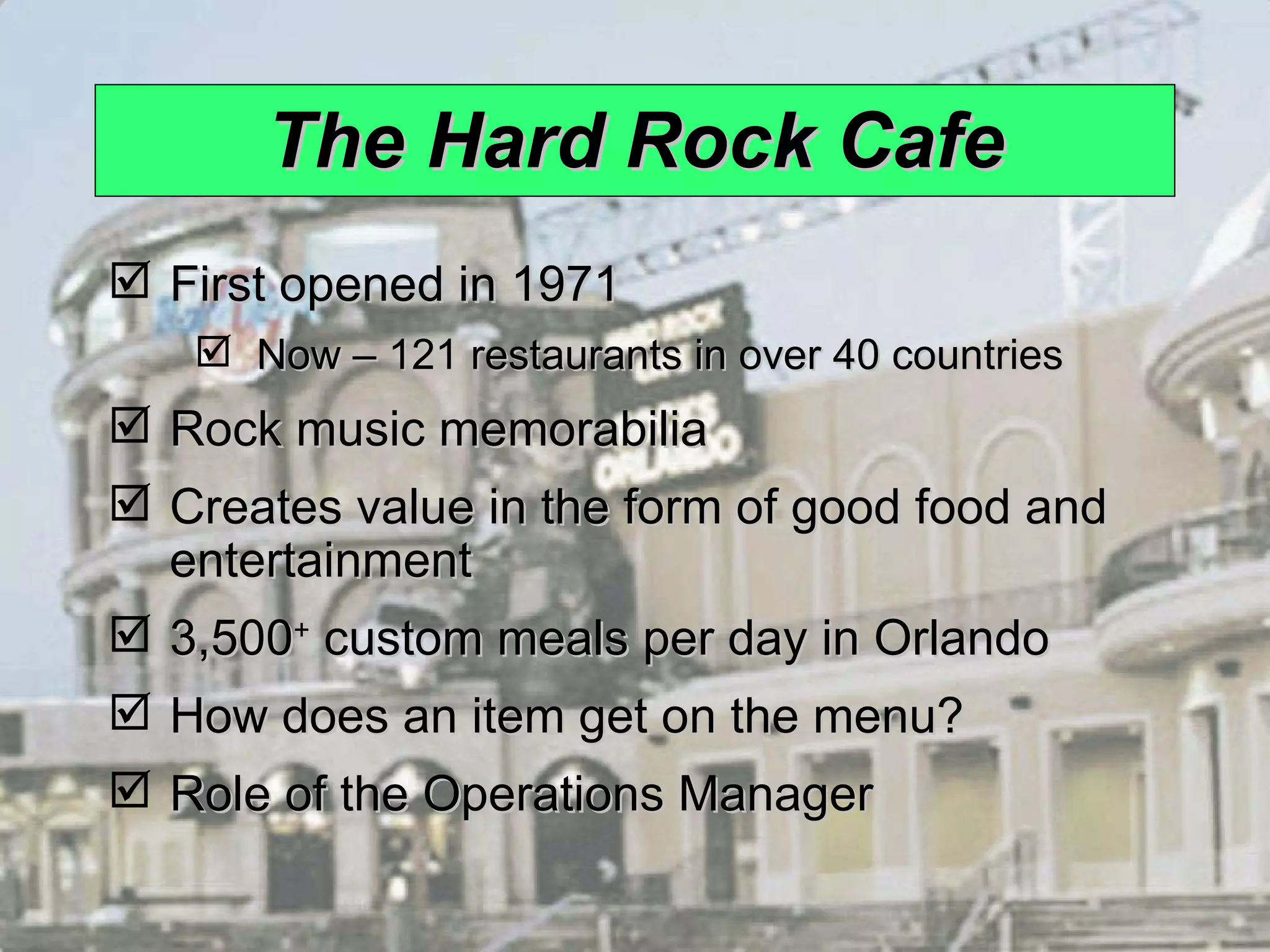
The Hard Rock Cafe First opened in 1971 Now – 121 restaurants in over 40 countries Rock music memorabilia Creates value in the form of good food and entertainment 3,500 +  custom meals per day in Orlando How does an item get on the menu? Role of the Operations Manager
What Is Operations Management? Production  is the creation of goods and services Operations management (OM)  is the set of activities that creates value in the form of goods and services by transforming inputs into outputs
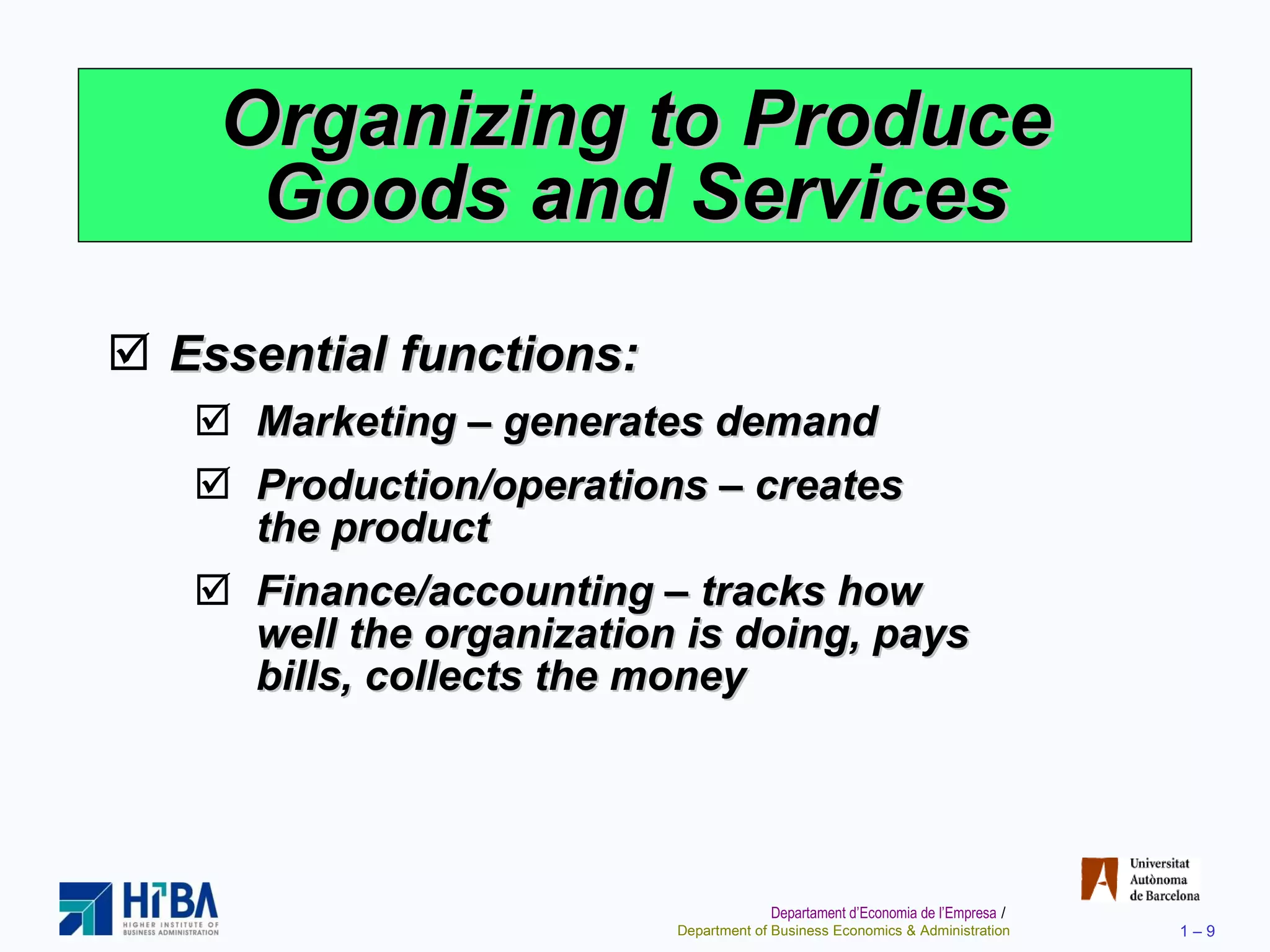
Organizing to Produce Goods and Services Essential functions: Marketing – generates demand Production/operations – creates the product Finance/accounting – tracks how well the organization is doing, pays bills, collects the money
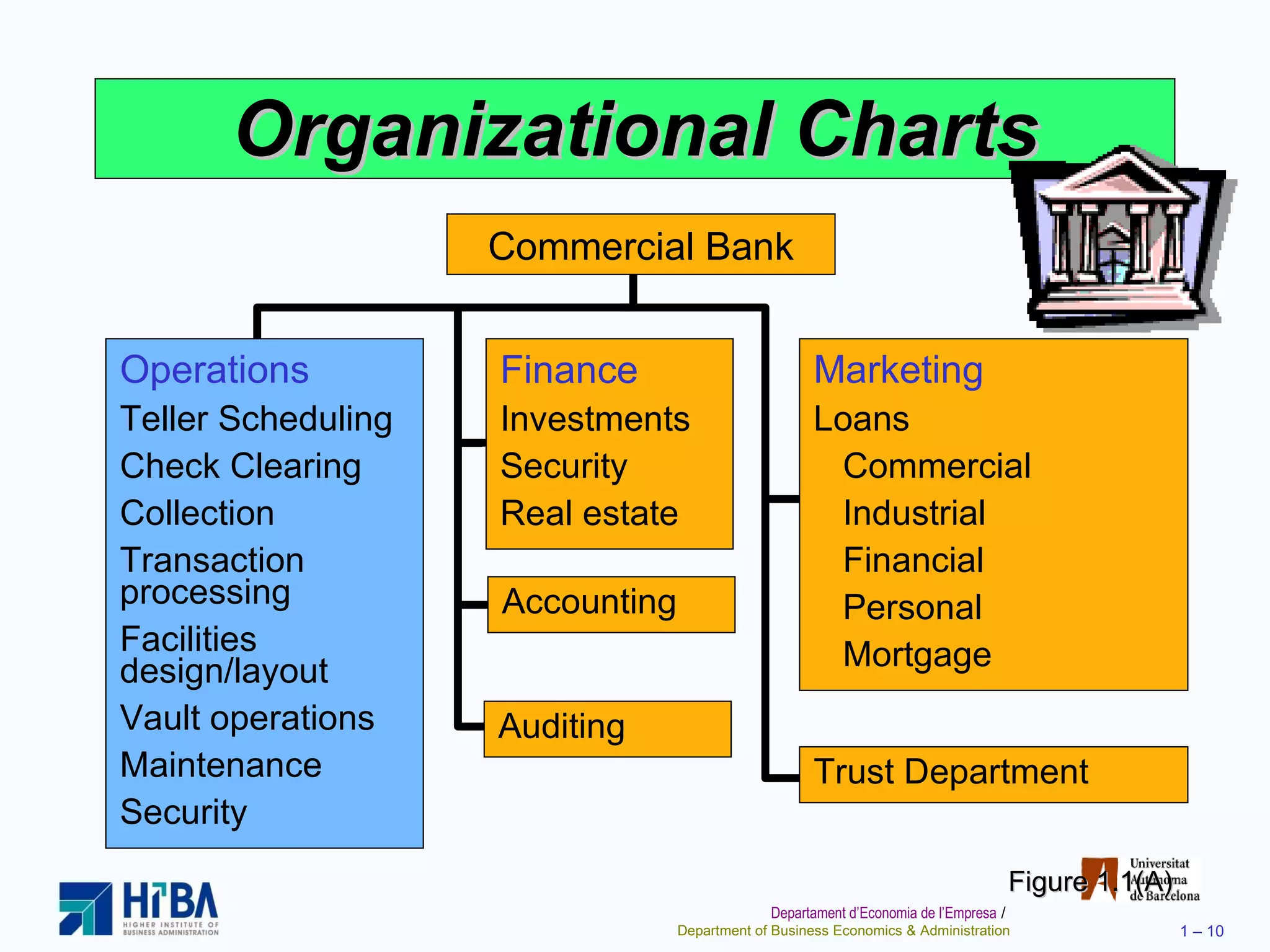
Organizational Charts Commercial Bank Figure 1.1(A) Operations Teller Scheduling Check Clearing Collection Transaction processing Facilities design/layout Vault operations Maintenance Security Finance Investments Security Real estate Accounting Auditing Marketing Loans Commercial Industrial Financial Personal Mortgage Trust Department
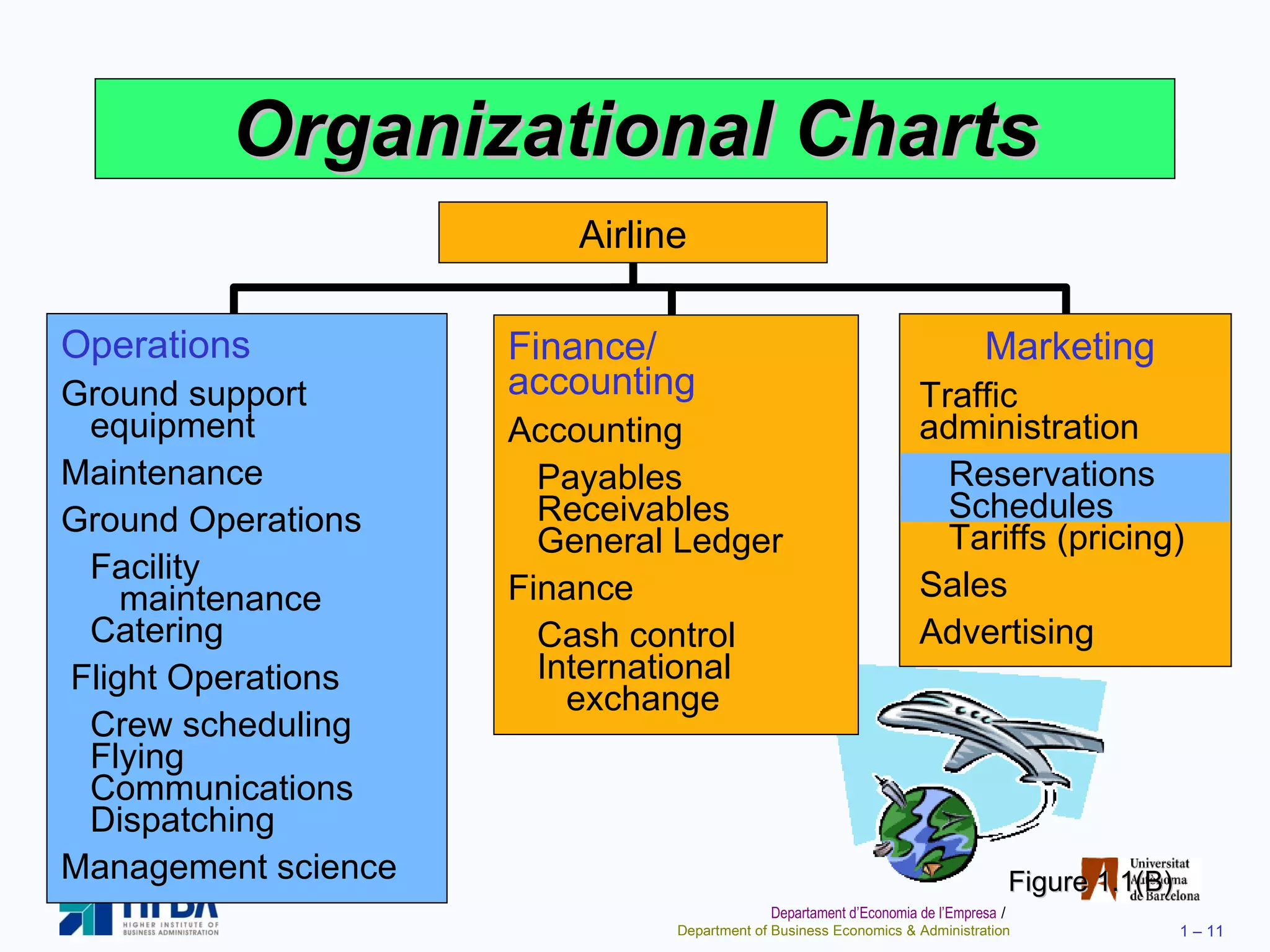
Organizational Charts Airline Figure 1.1(B) Operations Ground support   equipment Maintenance Ground Operations Facility   maintenance   Catering Flight Operations Crew scheduling   Flying   Communications   Dispatching Management science Finance/ accounting Accounting Payables   Receivables   General Ledger Finance Cash control   International   exchange Marketing Traffic administration Reservations   Schedules   Tariffs (pricing) Sales Advertising
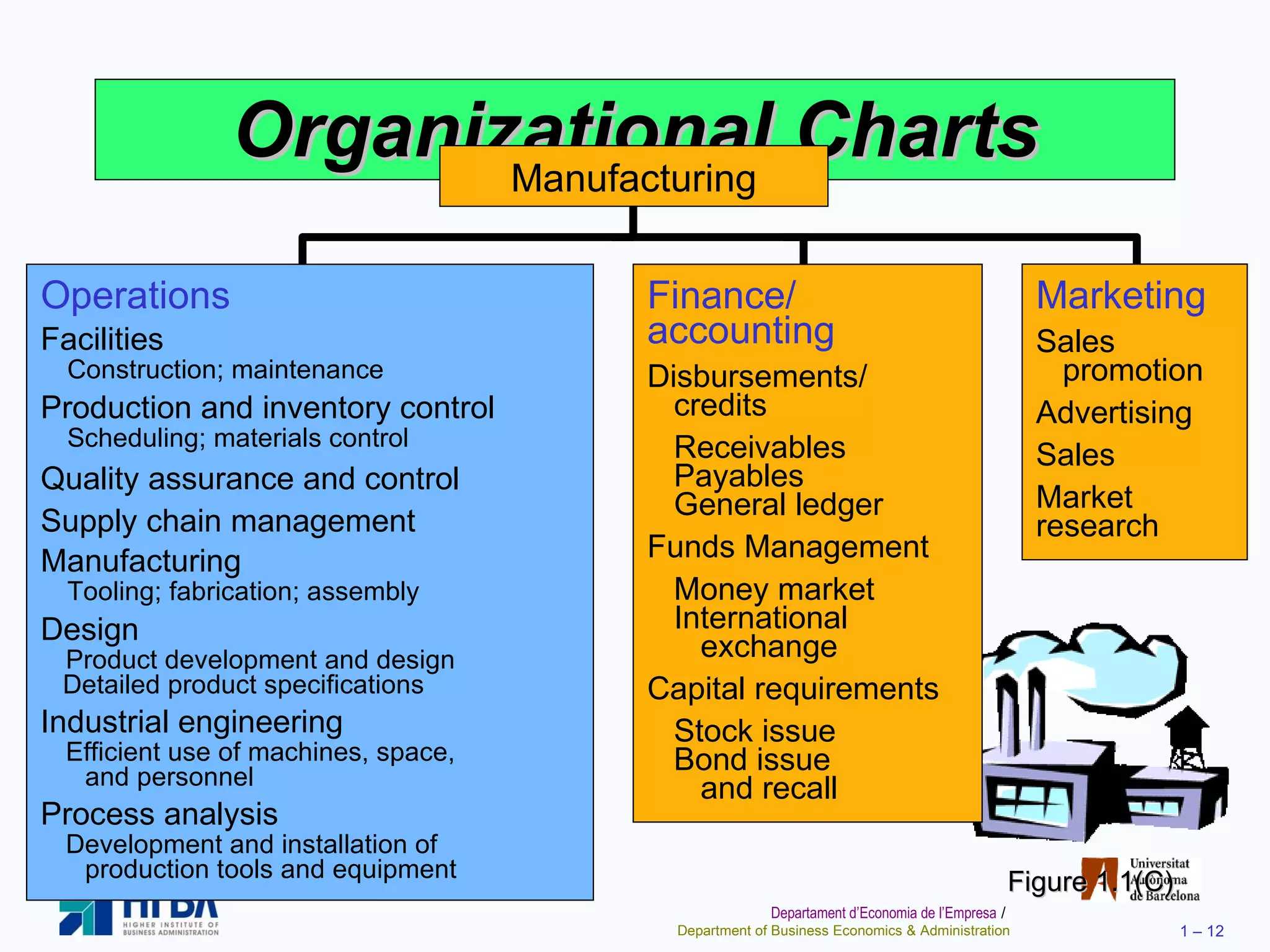
Organizational Charts Manufacturing Figure 1.1(C) Marketing Sales    promotion Advertising Sales Market research Operations Facilities   Construction; maintenance Production and inventory control   Scheduling; materials control Quality assurance and control Supply chain management Manufacturing   Tooling; fabrication; assembly Design   Product development and design   Detailed product specifications Industrial engineering   Efficient use of machines, space,    and personnel Process analysis   Development and installation of   production tools and equipment Finance/ accounting Disbursements/    credits Receivables   Payables   General ledger Funds Management Money market   International    exchange Capital requirements Stock issue   Bond issue    and recall
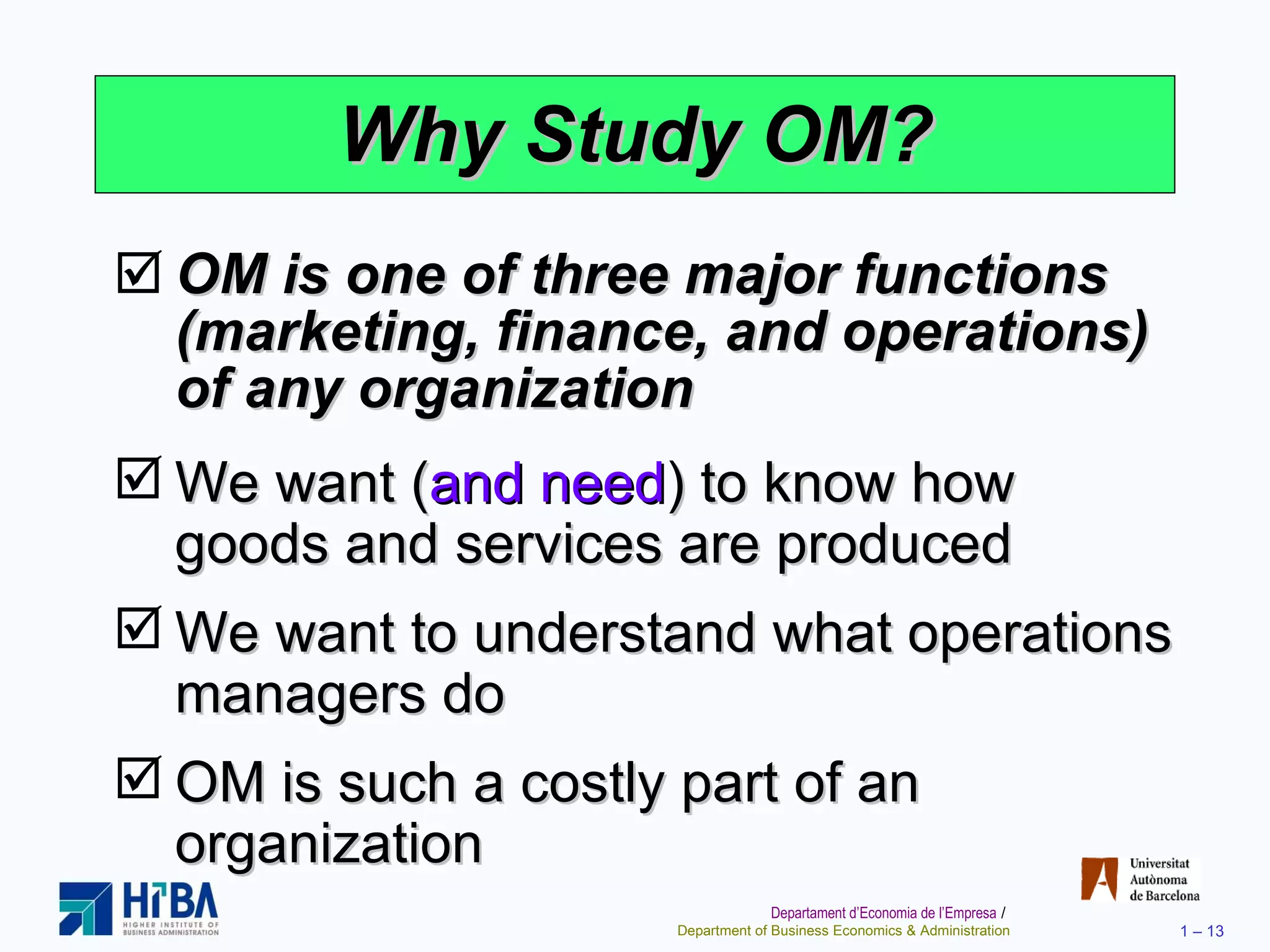
Why Study OM? OM is one of three major functions (marketing, finance, and operations) of any organization We want ( and need ) to know how goods and services are produced We want to understand what operations managers do OM is such a costly part of an organization
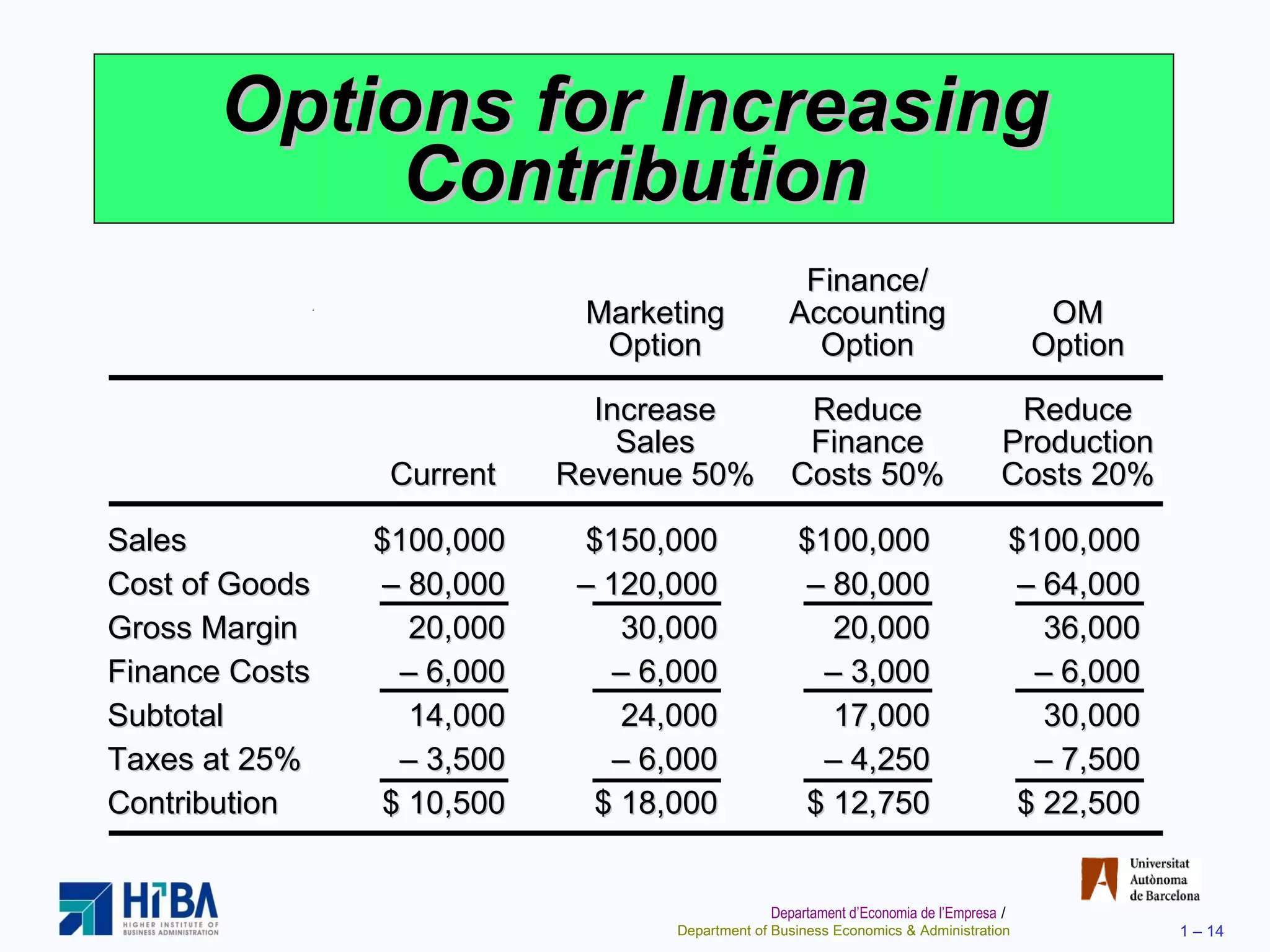
Options for Increasing Contribution Sales $100,000 $150,000 $100,000 $100,000 Cost of Goods  –  80,000 –  120,000 –  80,000 –  64,000 Gross Margin 20,000 30,000 20,000 36,000 Finance Costs –  6,000   –  6,000 –  3,000 –  6,000 Subtotal 14,000 24,000 17,000 30,000 Taxes at 25% –  3,500 –  6,000 –  4,250 –  7,500 Contribution $ 10,500 $ 18,000 $ 12,750 $ 22,500 Finance/ Marketing Accounting OM Option Option Option Increase Reduce Reduce Sales Finance Production Current Revenue 50% Costs 50% Costs 20%
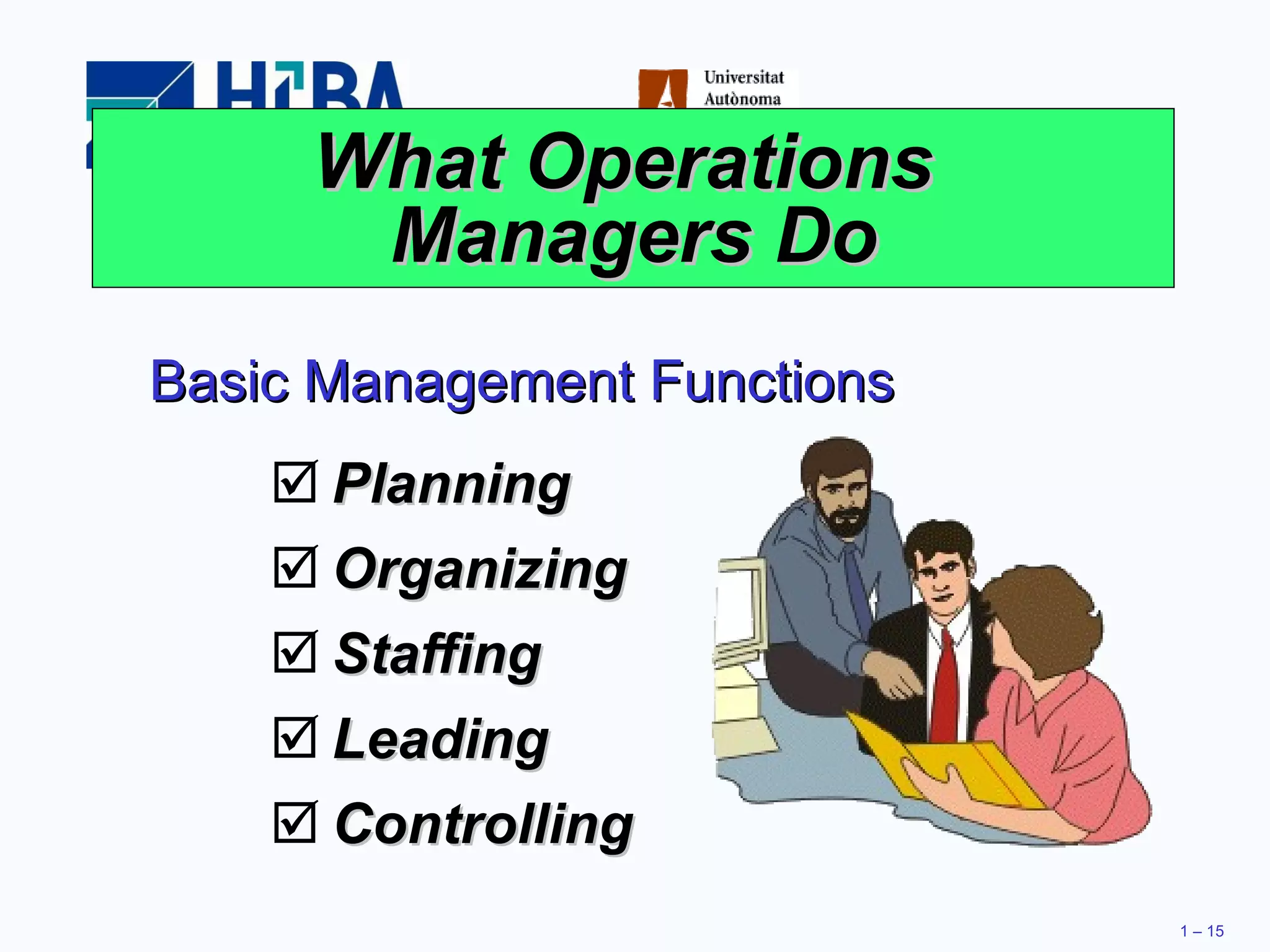
What Operations  Managers Do Planning Organizing Staffing Leading Controlling Basic Management Functions
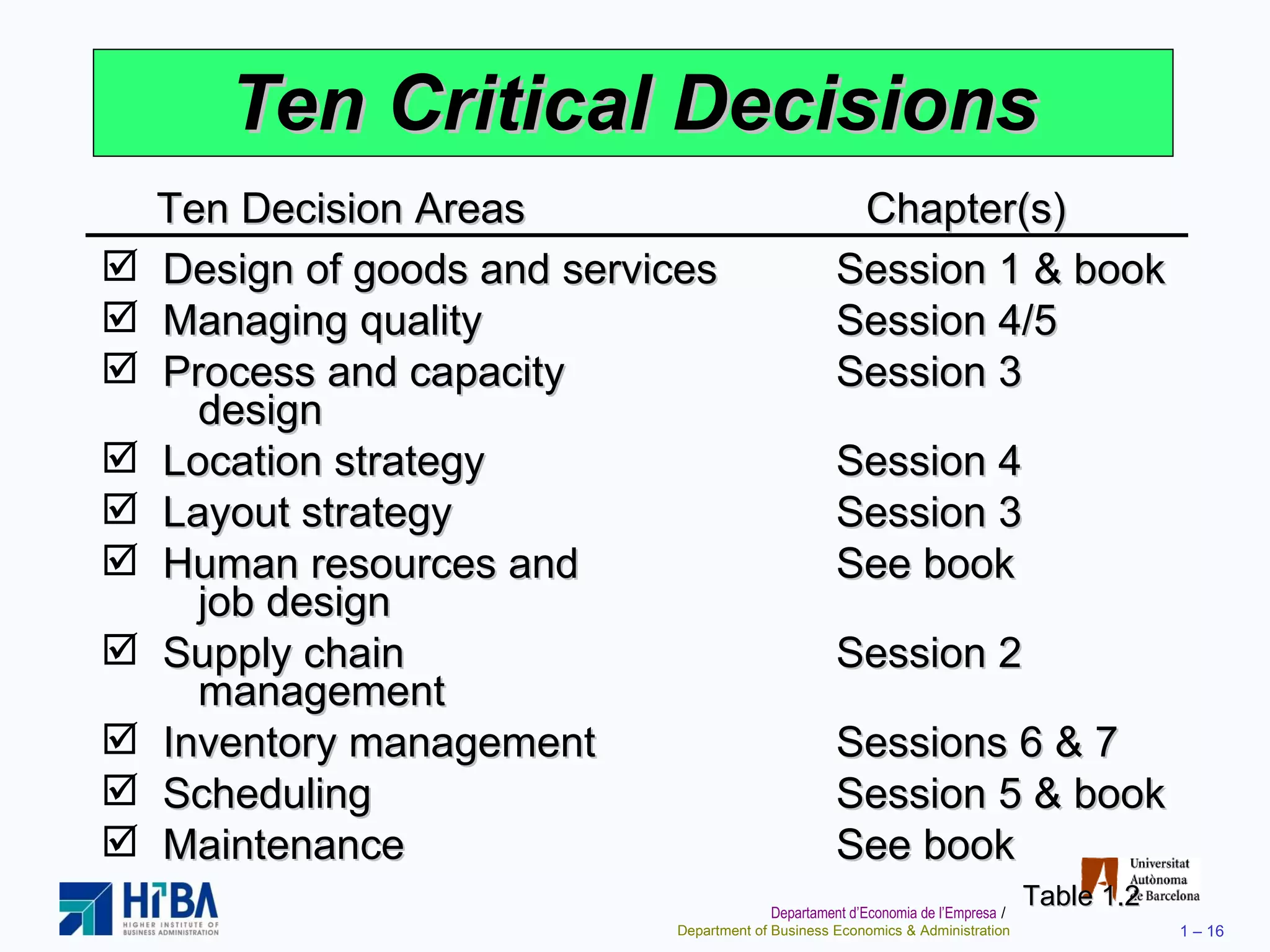
Ten Critical Decisions Table 1.2 Ten Decision Areas Chapter(s) Design of goods and services Session 1 & book Managing quality Session 4/5 Process and capacity  Session 3   design  Location strategy Session 4 Layout strategy Session 3 Human resources and  See book   job design  Supply chain  Session 2   management Inventory management Sessions 6 & 7 Scheduling Session 5 & book Maintenance See book
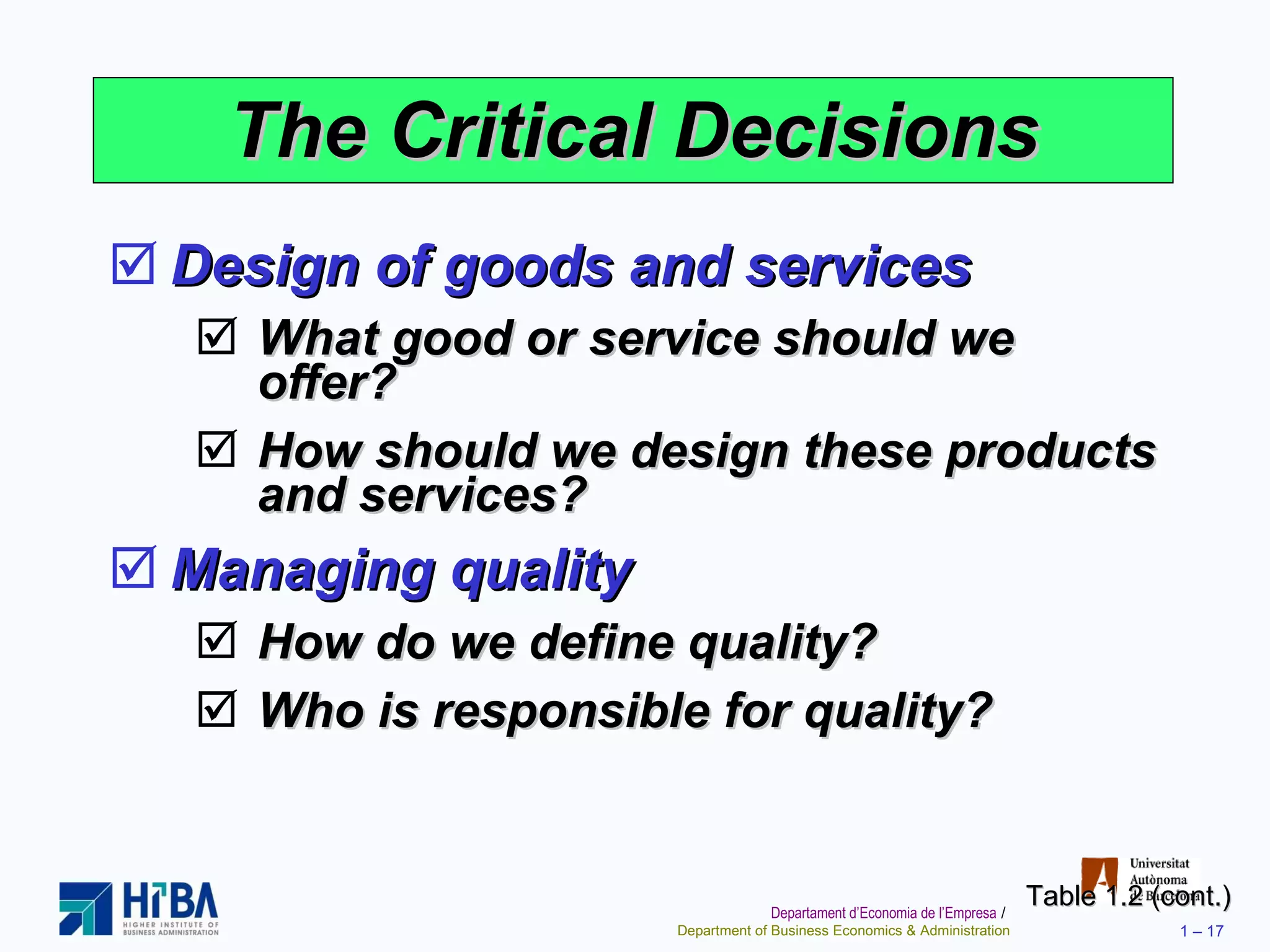
The Critical Decisions Design of goods and services What good or service should we offer? How should we design these products and services?  Managing quality How do we define quality? Who is responsible for quality? Table 1.2 (cont.)
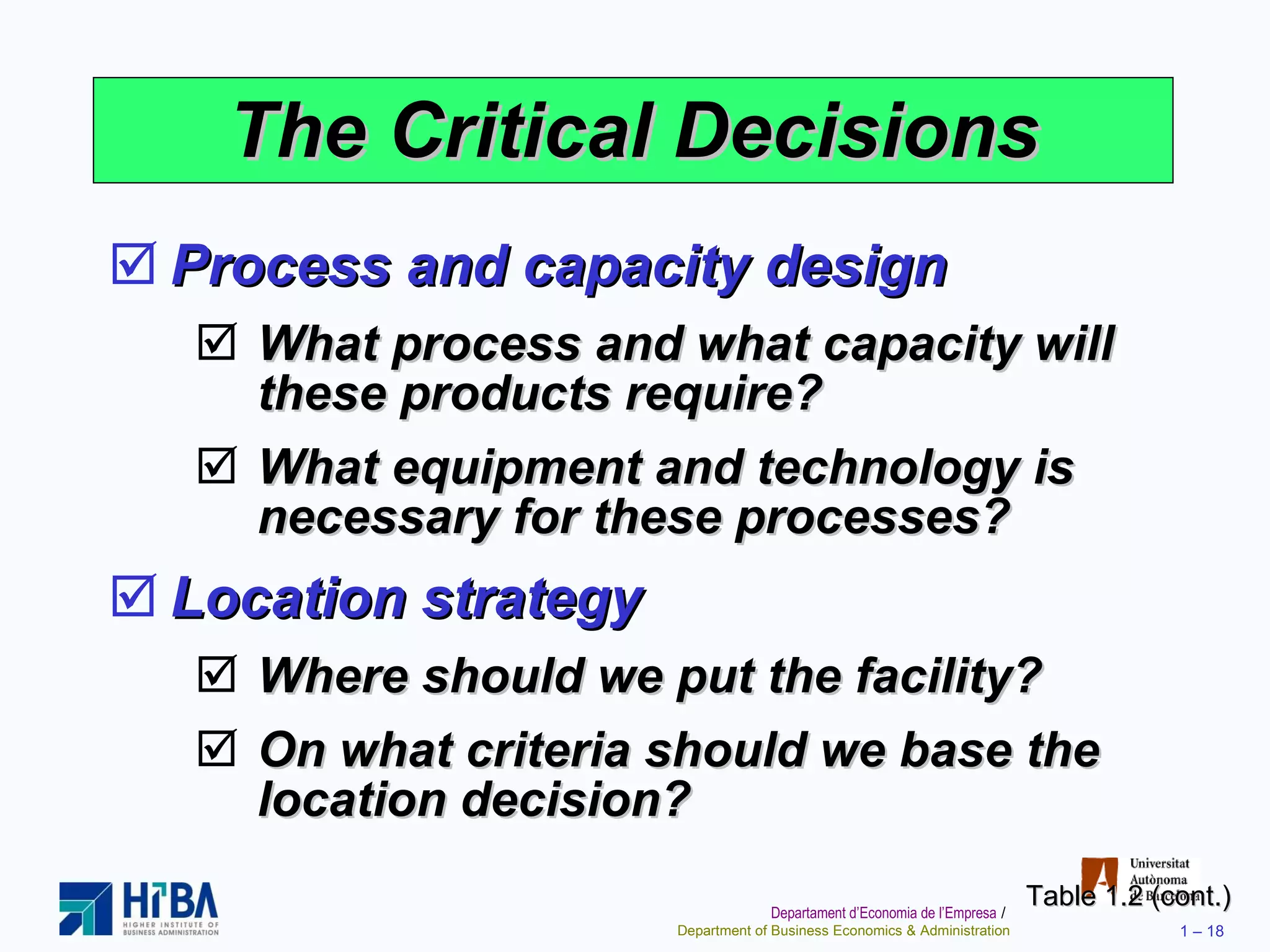
The Critical Decisions Process and capacity design What process and what capacity will these products require? What equipment and technology is necessary for these processes? Location strategy Where should we put the facility? On what criteria should we base the location decision? Table 1.2 (cont.)
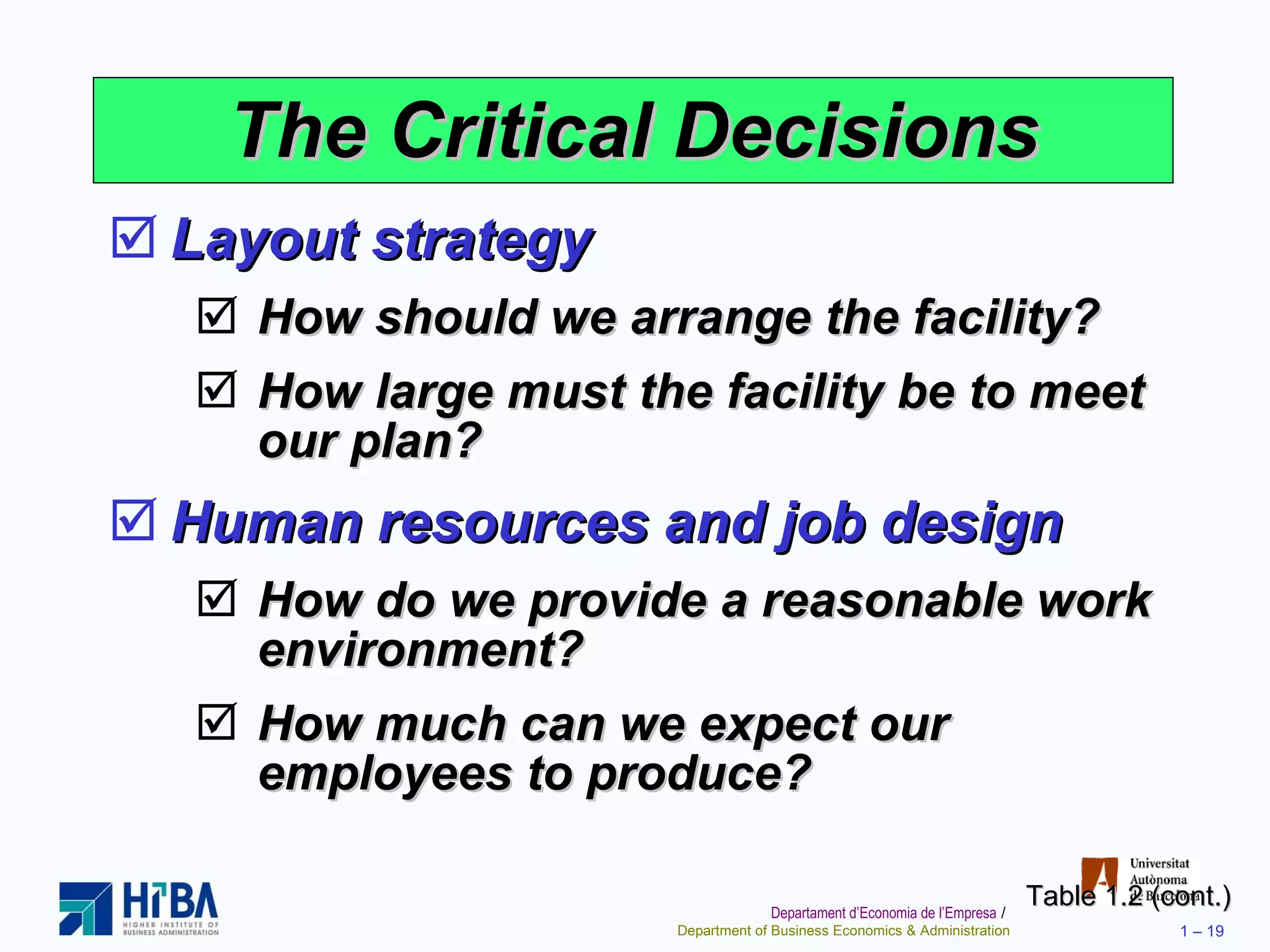
The Critical Decisions Layout strategy How should we arrange the facility? How large must the facility be to meet our plan? Human resources and job design How do we provide a reasonable work environment? How much can we expect our employees to produce? Table 1.2 (cont.)
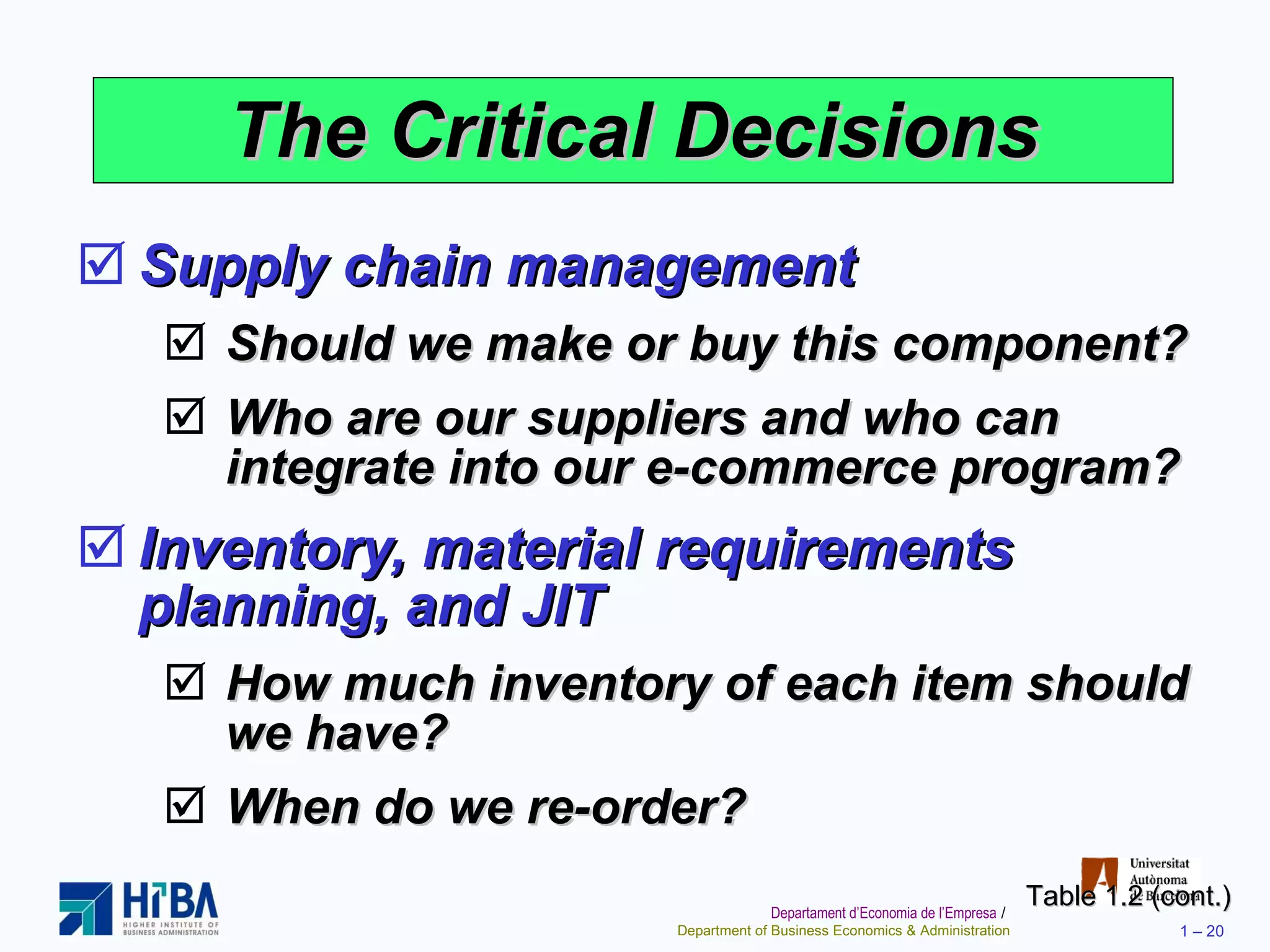
The Critical Decisions Supply chain management Should we make or buy this component? Who are our suppliers and who can integrate into our e-commerce program? Inventory, material requirements planning, and JIT How much inventory of each item should we have? When do we re-order? Table 1.2 (cont.)
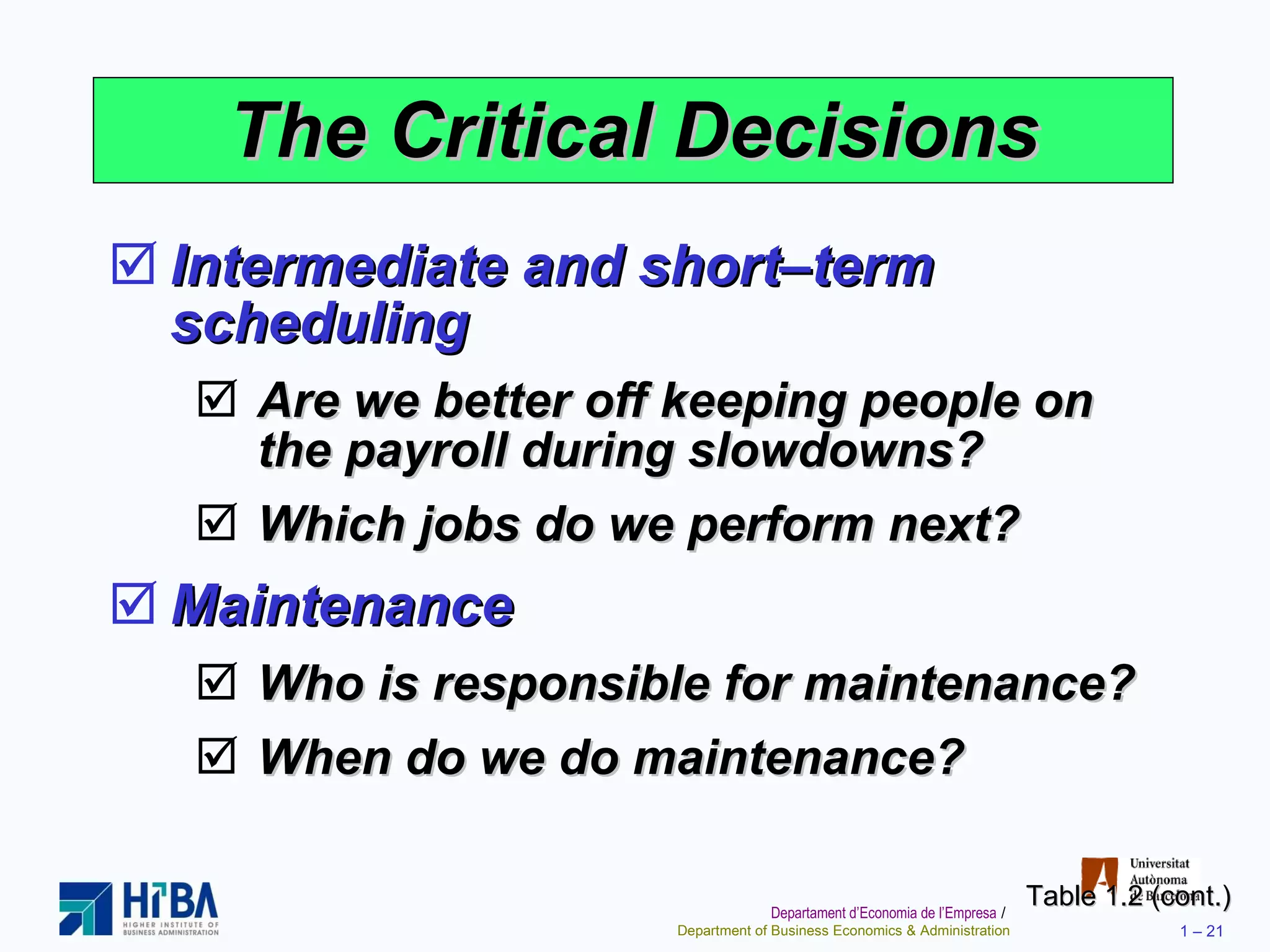
The Critical Decisions Intermediate and short – term scheduling Are we better off keeping people on the payroll during slowdowns? Which jobs do we perform next? Maintenance Who is responsible for maintenance? When do we do maintenance? Table 1.2 (cont.)
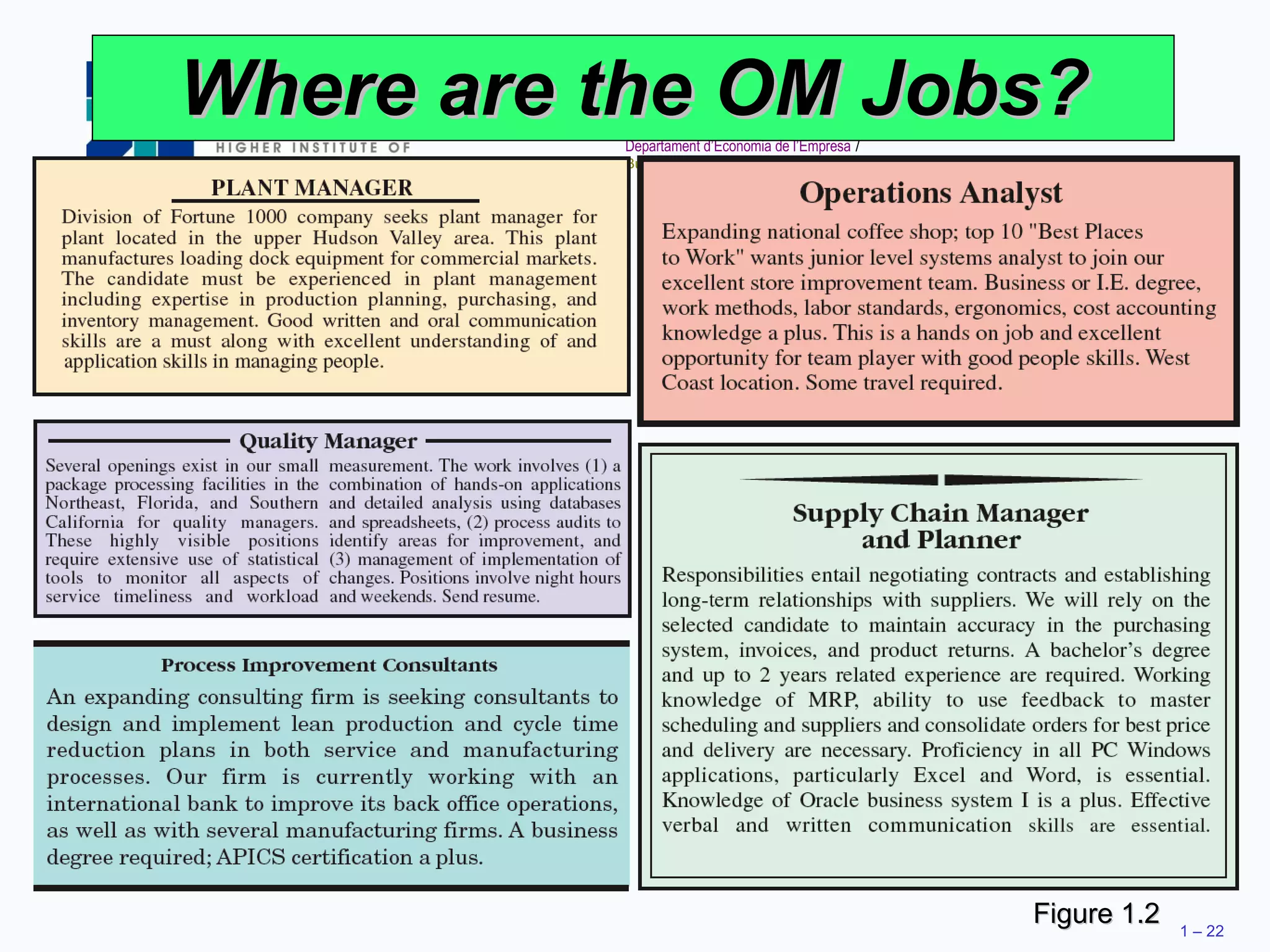
Where are the OM Jobs? Figure 1.2
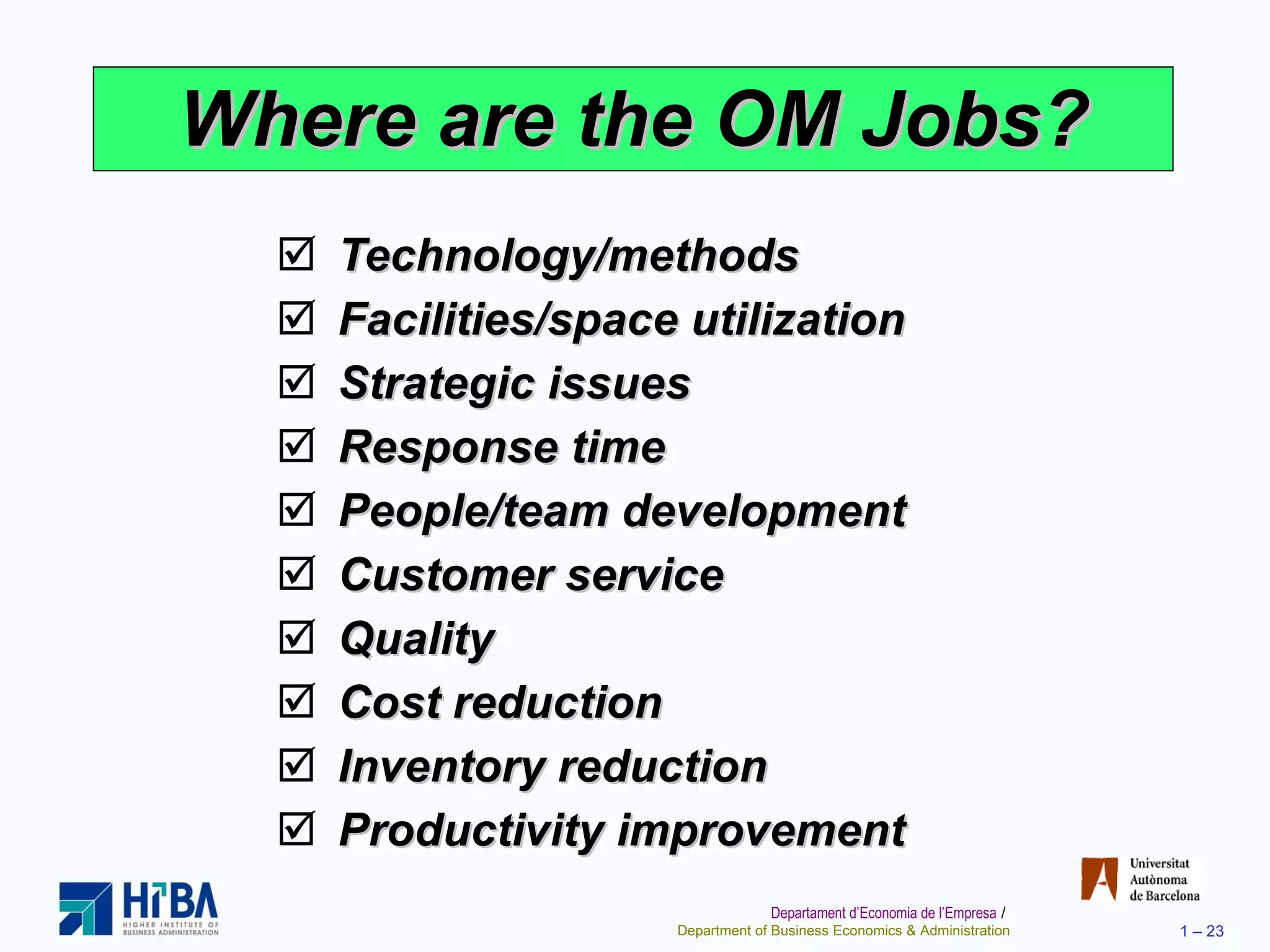
Where are the OM Jobs? Technology/methods Facilities/space utilization Strategic issues Response time People/team development Customer service Quality Cost reduction Inventory reduction Productivity improvement
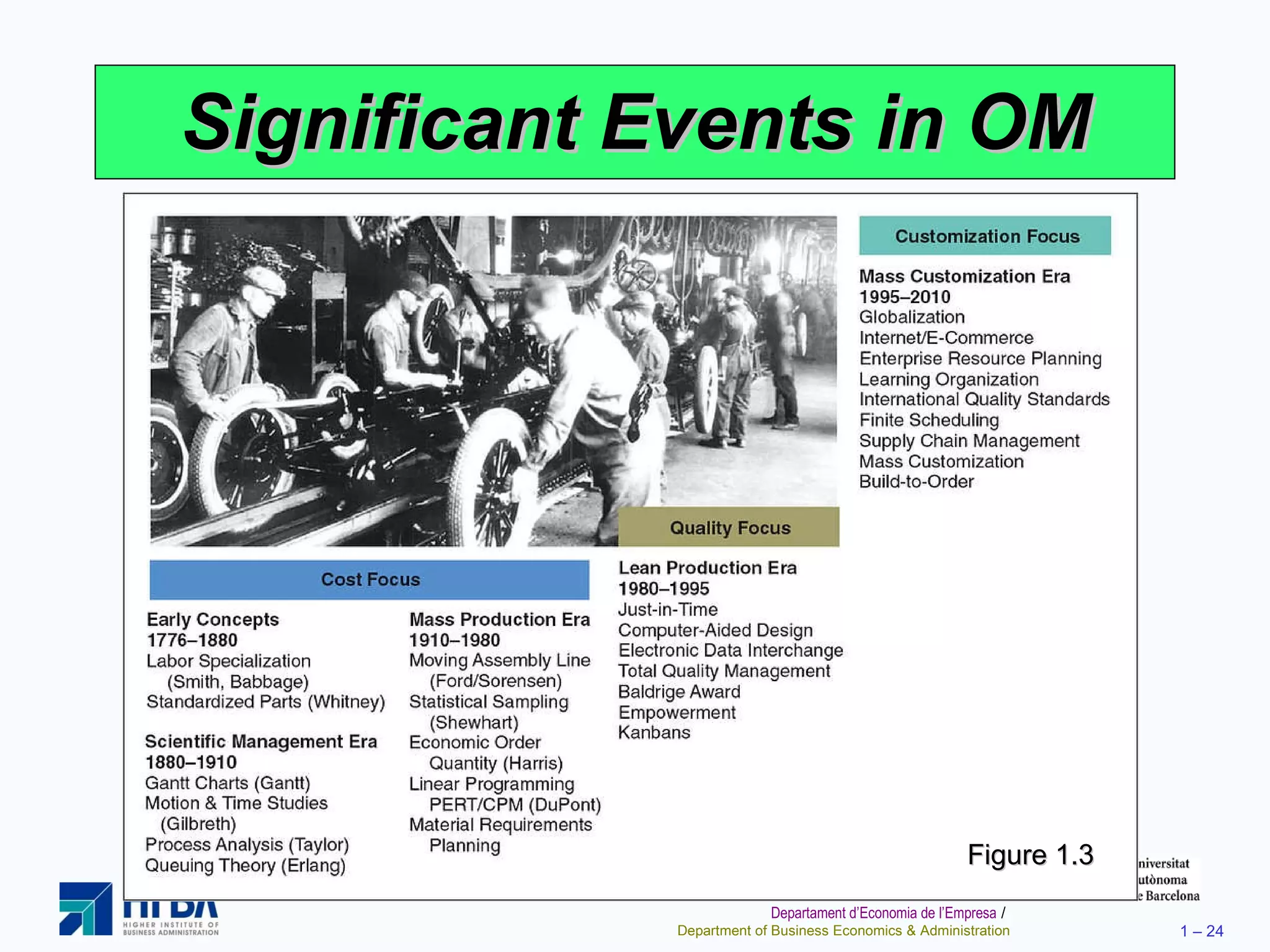
Significant Events in OM Figure 1.3
The Heritage of OM Division of labor (Adam Smith 1776; Charles Babbage 1852) Standardized parts (Whitney 1800) Scientific Management (Taylor 1881) Coordinated assembly line (Ford/ Sorenson 1913) Gantt charts (Gantt 1916) Motion study (Frank and Lillian Gilbreth 1922) Quality control (Shewhart 1924; Deming 1950)
The Heritage of OM Computer (Atanasoff 1938) CPM/PERT (DuPont 1957) Material requirements planning (Orlicky 1960) Computer aided design (CAD 1970) Flexible manufacturing system (FMS 1975) Baldrige Quality Awards (1980) Computer integrated manufacturing (1990) Globalization (1992) Internet (1995)
Eli Whitney Born 1765; died 1825 In 1798, received government contract to make 10,000 muskets Showed that machine tools could make standardized parts to exact specifications Musket parts could be used in any musket
Frederick W. Taylor Born 1856; died 1915 Known as ‘father of scientific management’ In 1881, as chief engineer for Midvale Steel, studied how tasks were done Began first motion and time studies Created efficiency principles
Taylor’s Principles Matching employees to right job Providing the proper training Providing proper work methods and tools Establishing legitimate incentives for work to be accomplished Management Should Take More Responsibility for:
Frank & Lillian Gilbreth Frank (1868-1924); Lillian (1878-1972) Husband-and-wife engineering team Further developed work measurement methods Applied efficiency methods to their home and 12 children!  Book &  Movie: “Cheaper by the Dozen,” book: “Bells on Their Toes”
Henry Ford Born 1863; died 1947 In 1903, created Ford Motor Company In 1913, first used moving assembly line to make Model T Unfinished product moved by conveyor past work station Paid workers very well for 1911 ($5/day!)
W. Edwards Deming Born 1900; died 1993 Engineer and physicist Credited with teaching Japan quality control methods in post-WW2 Used statistics to analyze process His methods involve workers in decisions
Contributions From Human factors Industrial engineering Management science Biological science Physical sciences Information technology
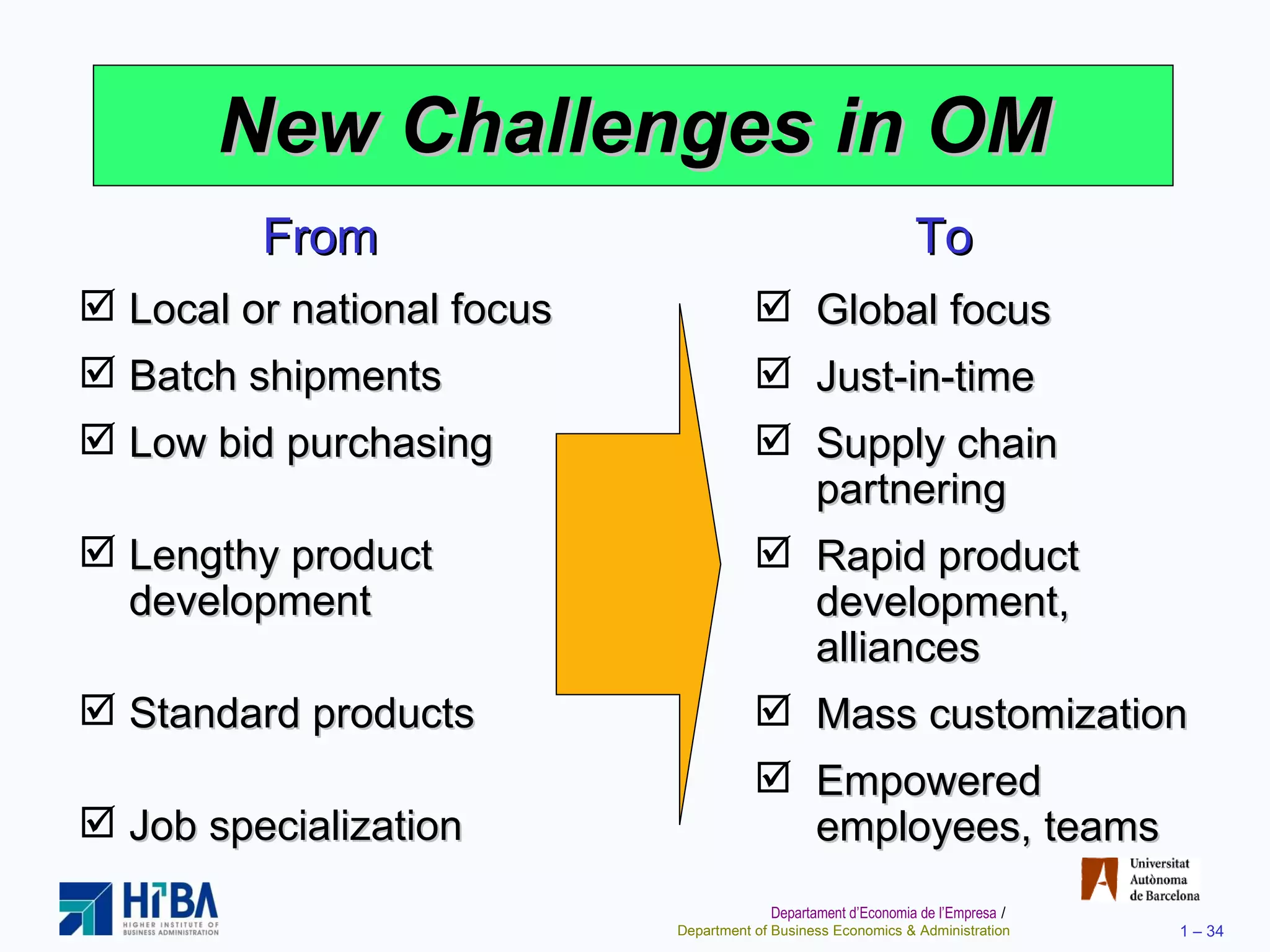
New Challenges in OM Global focus Just-in-time Supply chain partnering Rapid product development, alliances Mass customization Empowered employees, teams To From Local or national focus Batch shipments Low bid purchasing Lengthy product development Standard products Job specialization
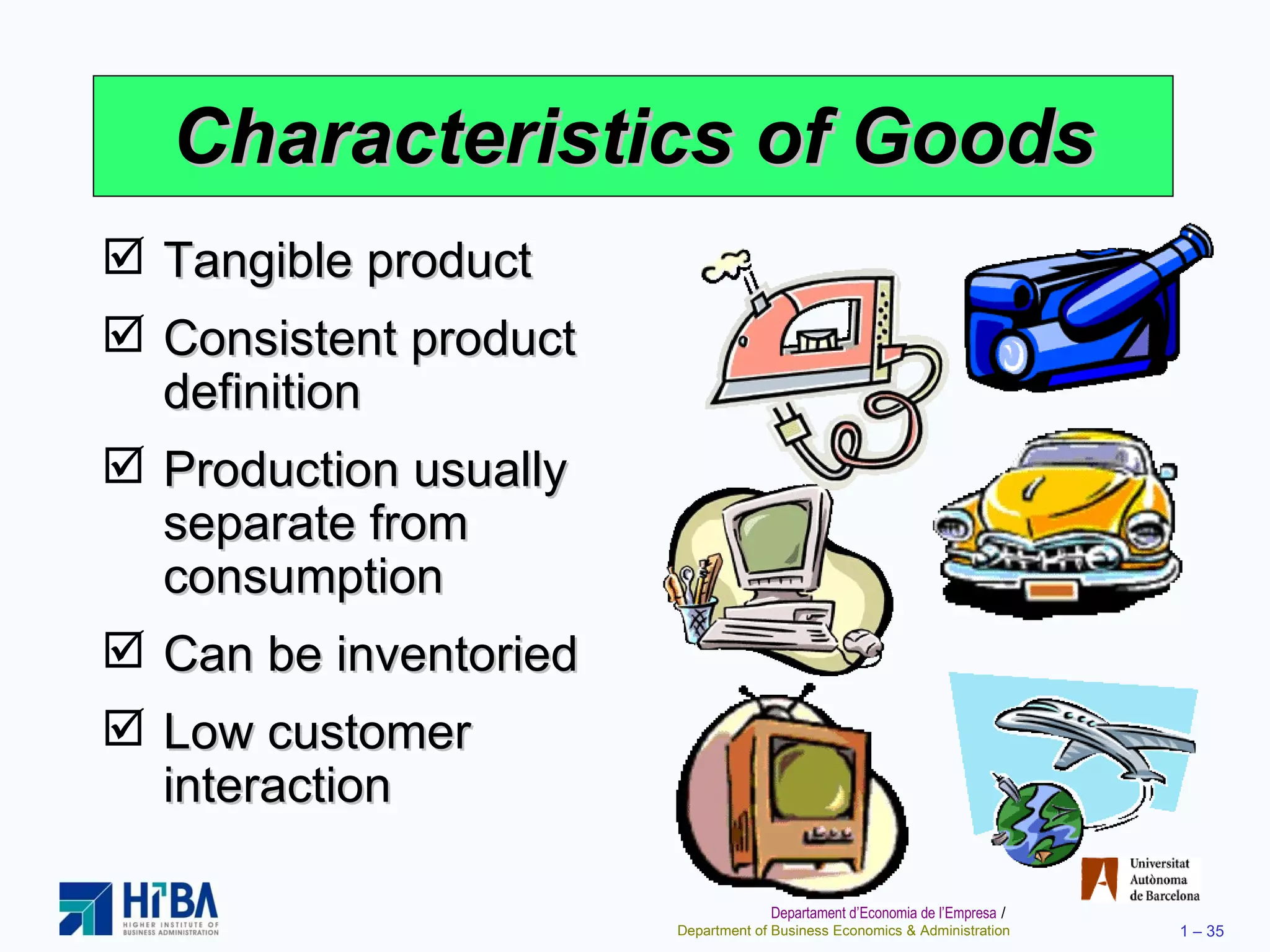
Characteristics of Goods Tangible product Consistent product definition Production usually separate from consumption Can be inventoried Low customer interaction
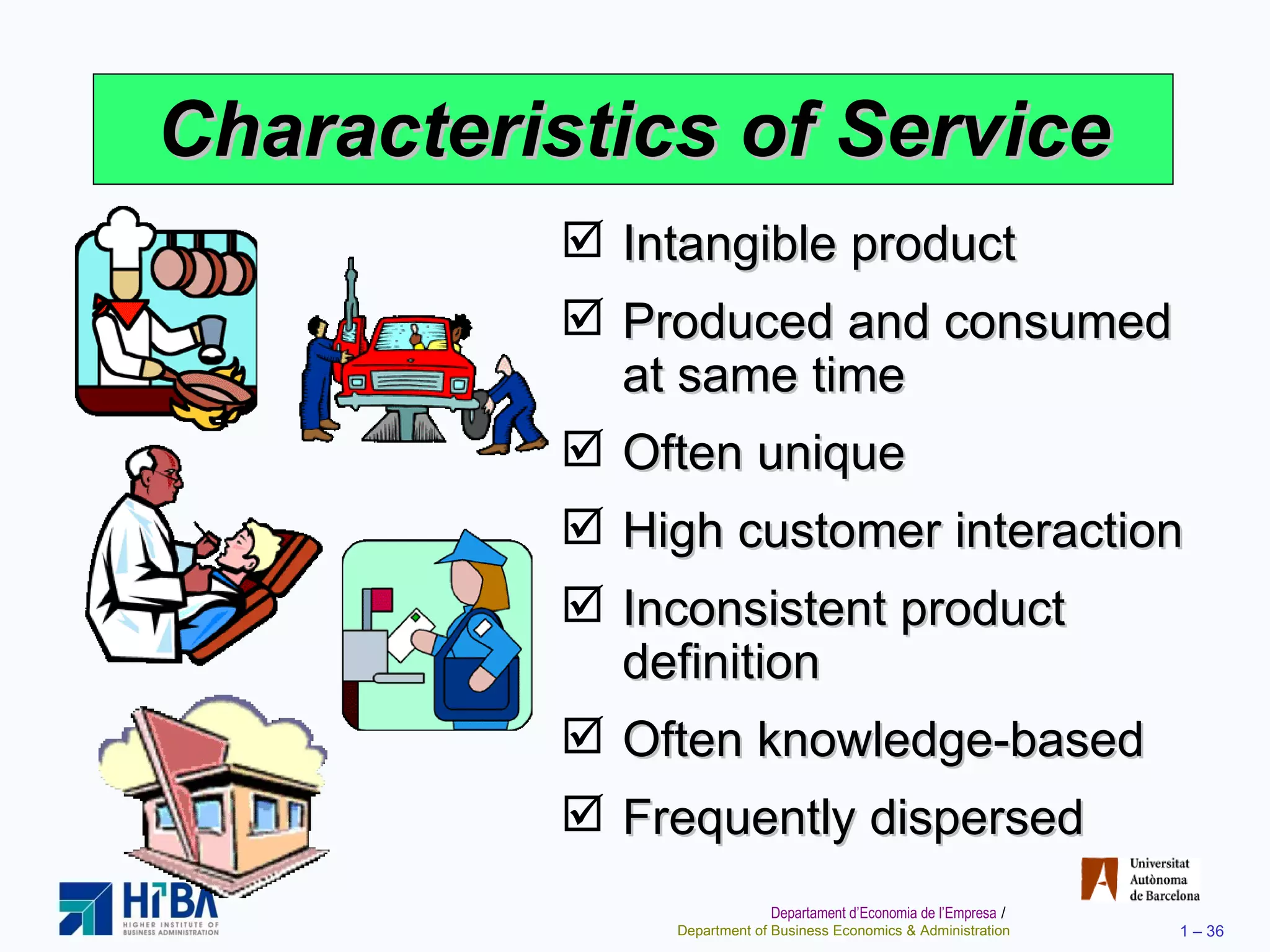
Characteristics of Service Intangible product Produced and consumed at same time Often unique High customer interaction Inconsistent product definition Often knowledge-based Frequently dispersed
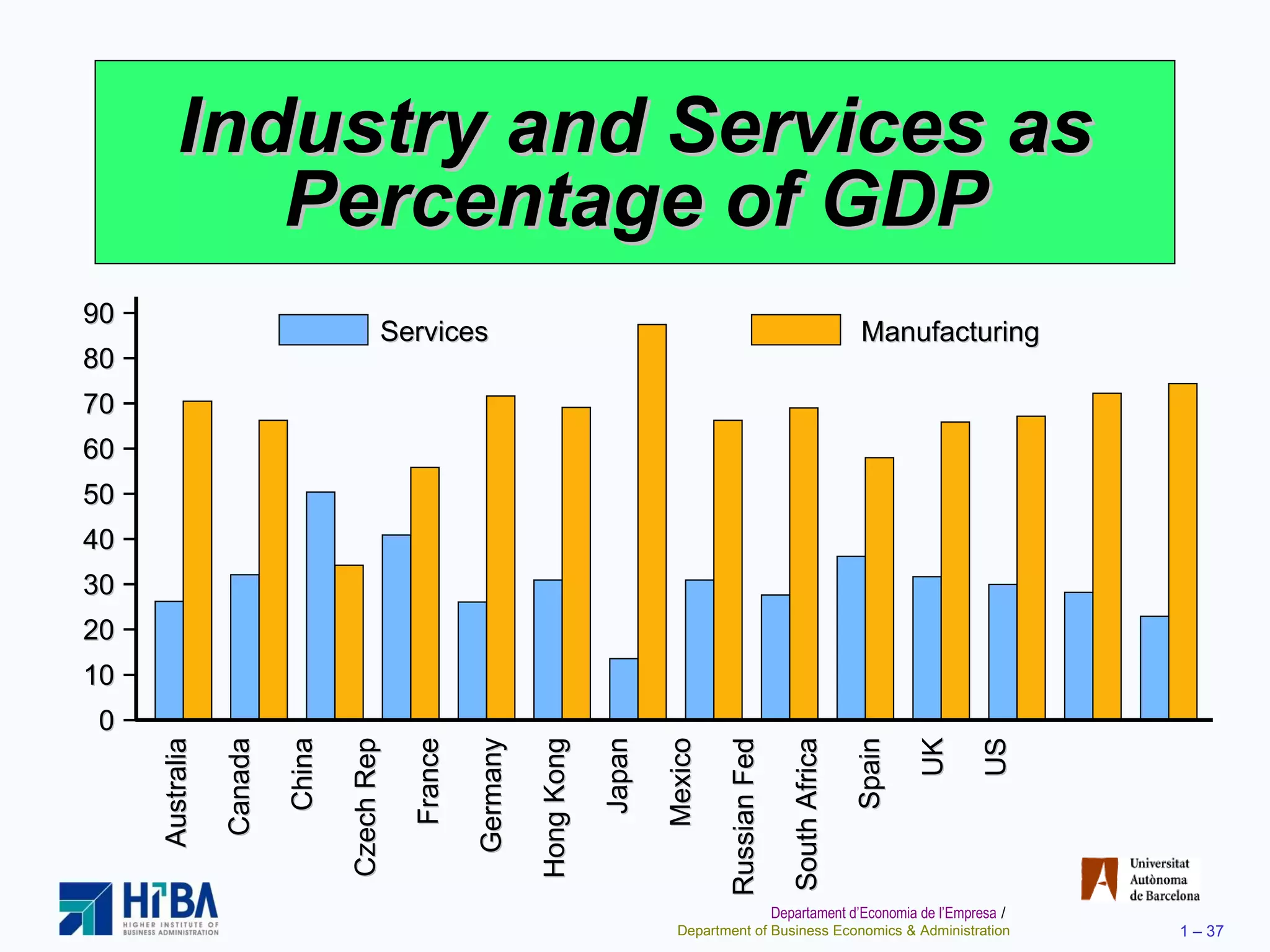
Industry and Services as Percentage of GDP Services Manufacturing Australia Canada China Czech Rep France Germany Hong Kong Japan Mexico Russian Fed South Africa Spain UK US 90  − 80  − 70  − 60  − 50  − 40  − 30  − 20  − 10  − 0  −
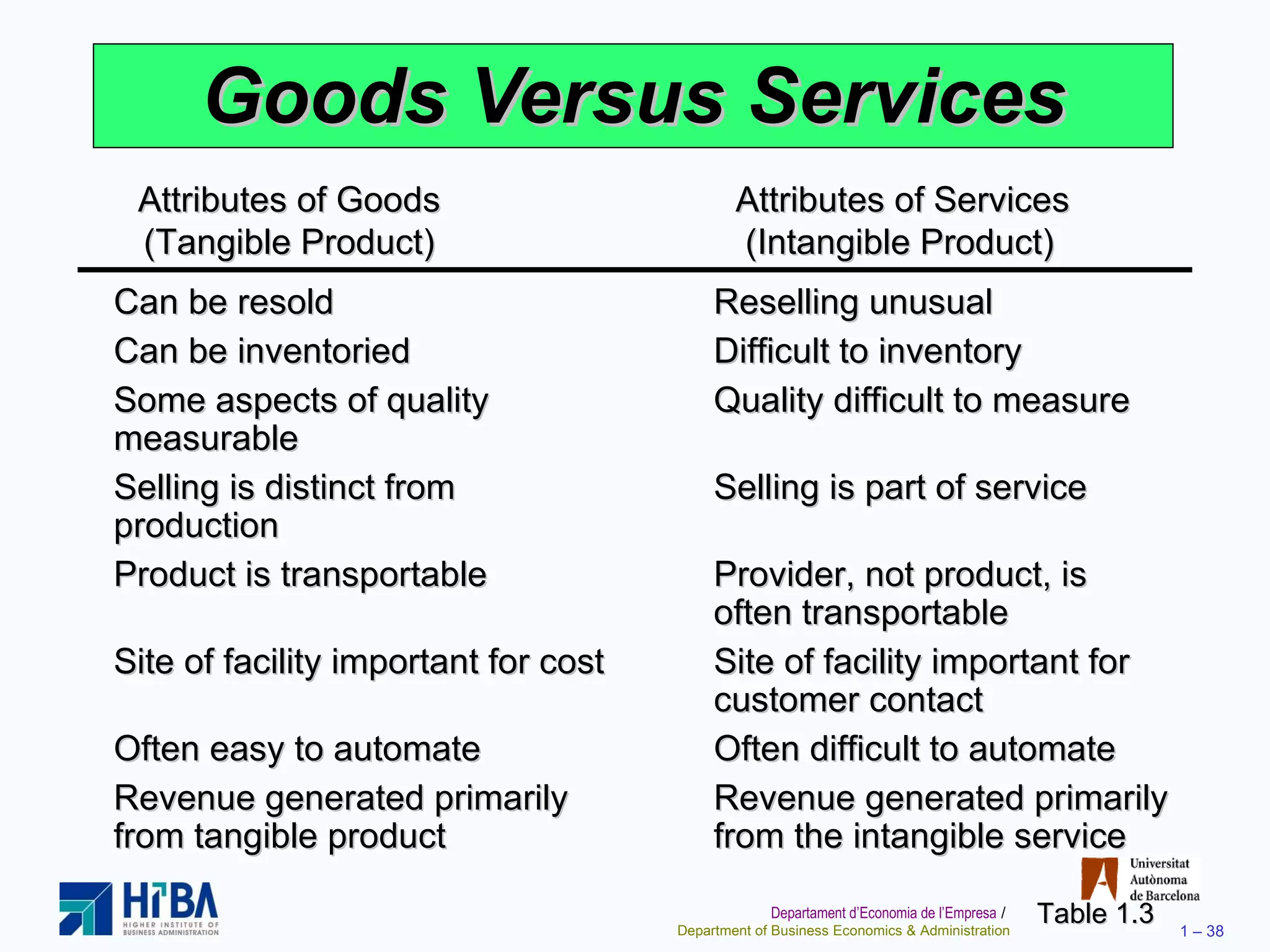
Goods Versus Services Table 1.3 Can be resold Can be inventoried Some aspects of quality  measurable Selling is distinct from  production Product is transportable Site of facility important for cost Often easy to automate Revenue generated primarily  from tangible product Attributes of Goods (Tangible Product) Attributes of Services  (Intangible Product) Reselling unusual Difficult to inventory Quality difficult to measure Selling is part of service  Provider, not product, is often transportable Site of facility important for customer contact Often difficult to automate Revenue generated primarily  from the intangible service
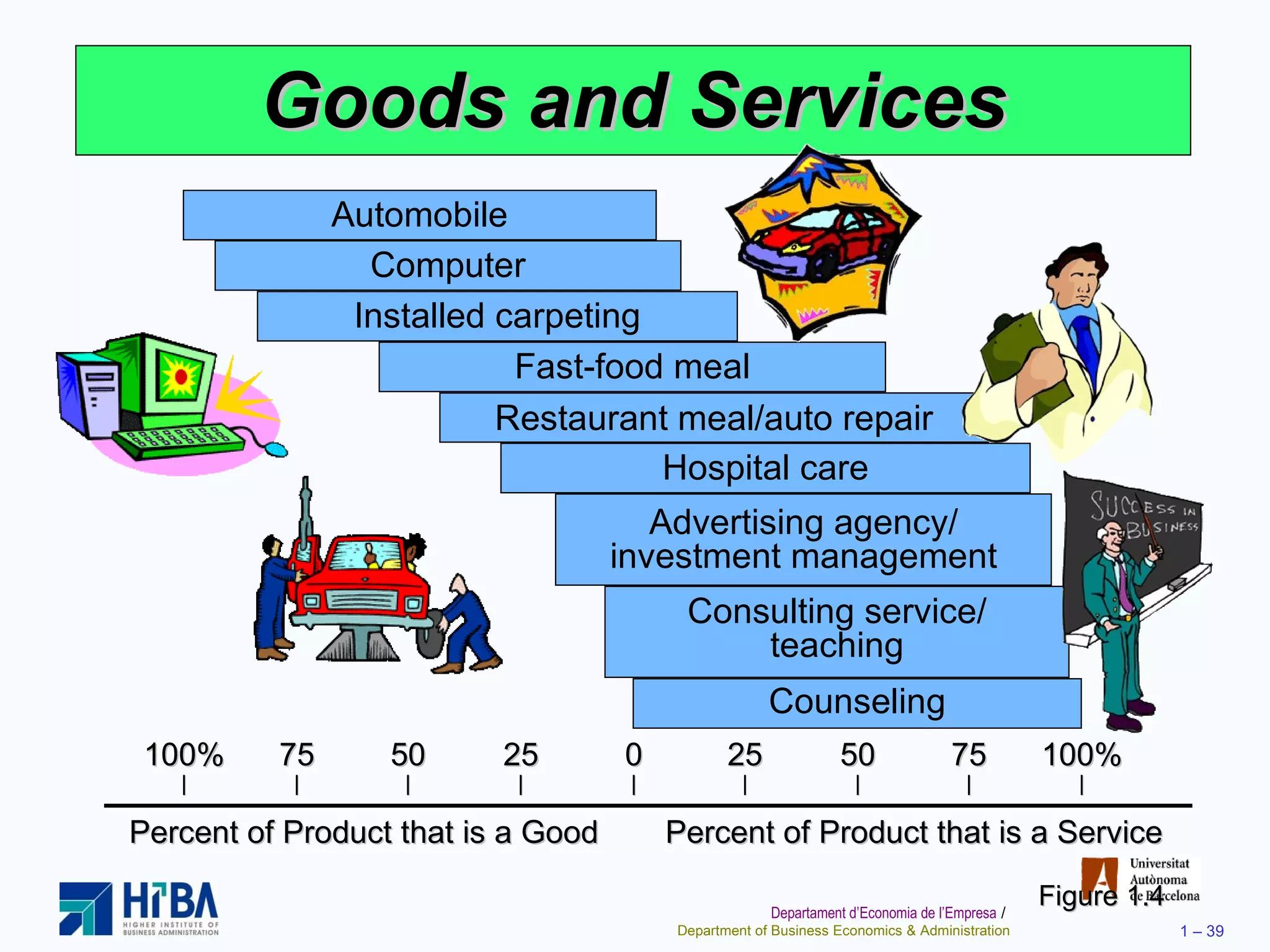
Goods and Services Figure 1.4 Automobile Computer Installed carpeting Fast-food meal Restaurant meal/auto repair Hospital care Advertising agency/ investment management Consulting service/ teaching Counseling Percent of Product that is a Good Percent of Product that is a Service 100% 75 50 25 0 25 50 75 100% | | | | | | | | |
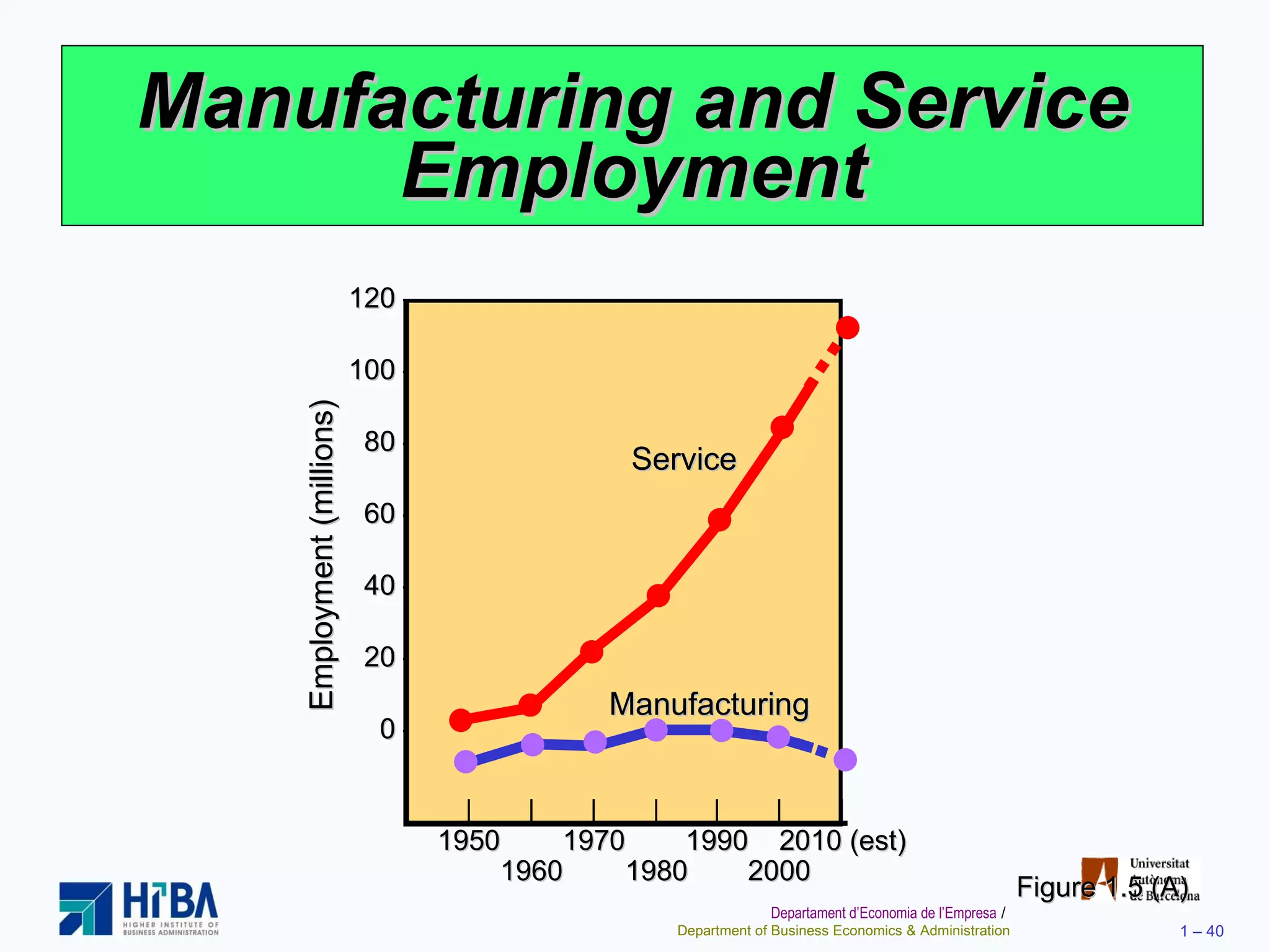
Manufacturing and Service Employment Figure 1.5 (A) 120   – 100  – 80  – 60  – 40  – 20  – 0  – | | | | | | | 1950 1970 1990 2010 (est) 1960 1980 2000 Employment (millions) Manufacturing Service
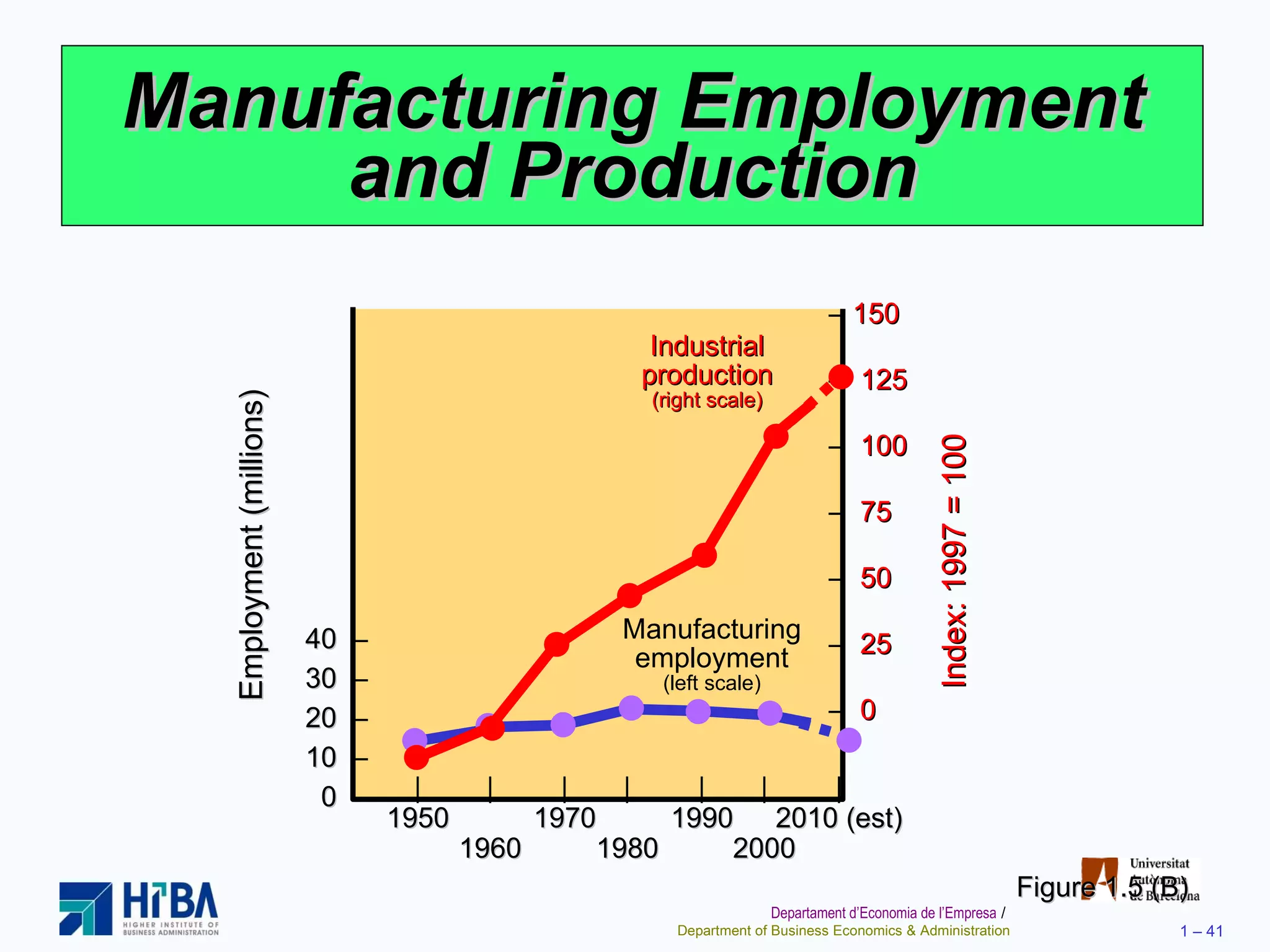
Manufacturing Employment and Production Figure 1.5 (B) 40  – 30  – 20  – 10  – 0  – | | | | | | | 1950 1970 1990 2010 (est) 1960 1980 2000 –  150 –   125 –   100 –   75 –   50 –   25 –   0 Employment (millions) Index: 1997 = 100 Manufacturing employment (left scale) Industrial production (right scale)
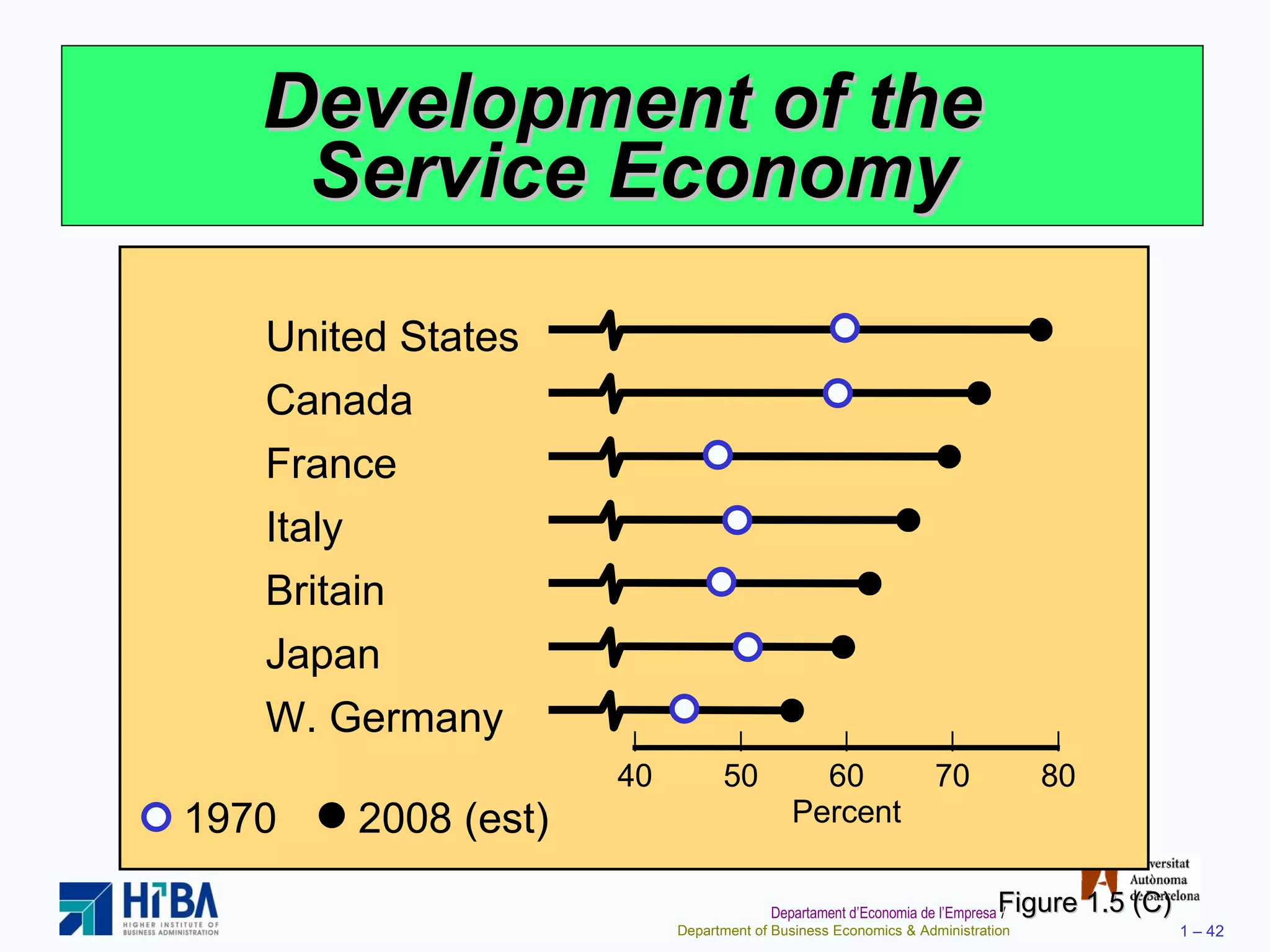
Development of the  Service Economy Figure 1.5 (C) United States Canada France Italy Britain Japan W. Germany 1970 2008 (est) | | | | | 40 50 60 70 80 Percent
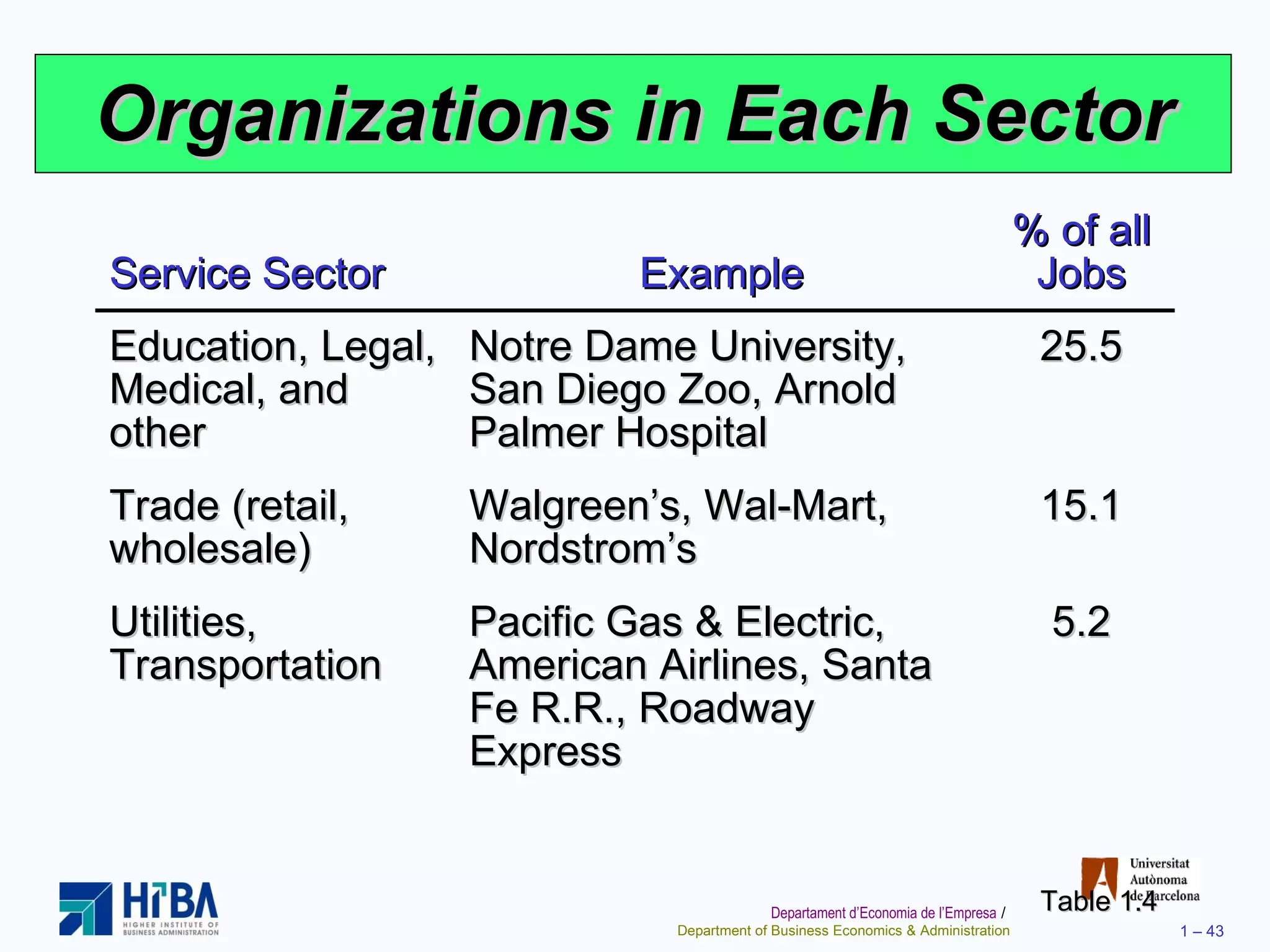
Organizations in Each Sector Table 1.4 Service Sector Example % of all Jobs Education, Legal, Medical, and other Notre Dame University, San Diego Zoo, Arnold Palmer Hospital 25.5 Trade (retail, wholesale) Walgreen’s, Wal-Mart, Nordstrom’s 15.1 Utilities, Transportation Pacific Gas & Electric, American Airlines, Santa Fe R.R., Roadway Express 5.2
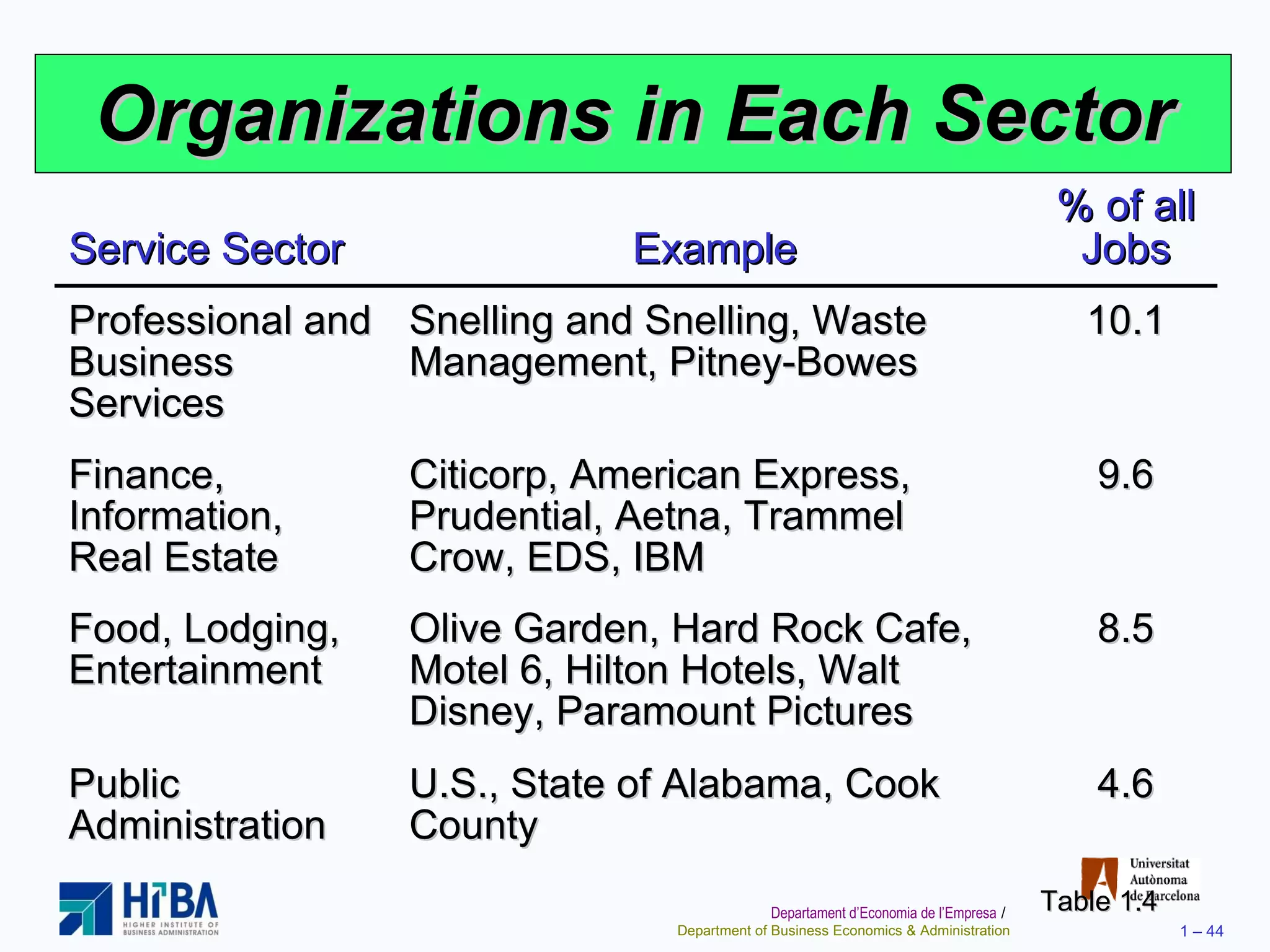
Organizations in Each Sector Table 1.4 Service Sector Example % of all Jobs Professional and Business Services Snelling and Snelling, Waste Management, Pitney-Bowes 10.1 Finance, Information,  Real Estate Citicorp, American Express, Prudential, Aetna, Trammel Crow, EDS, IBM 9.6 Food, Lodging, Entertainment Olive Garden, Hard Rock Cafe, Motel 6, Hilton Hotels, Walt Disney, Paramount Pictures 8.5 Public Administration U.S., State of Alabama, Cook County 4.6
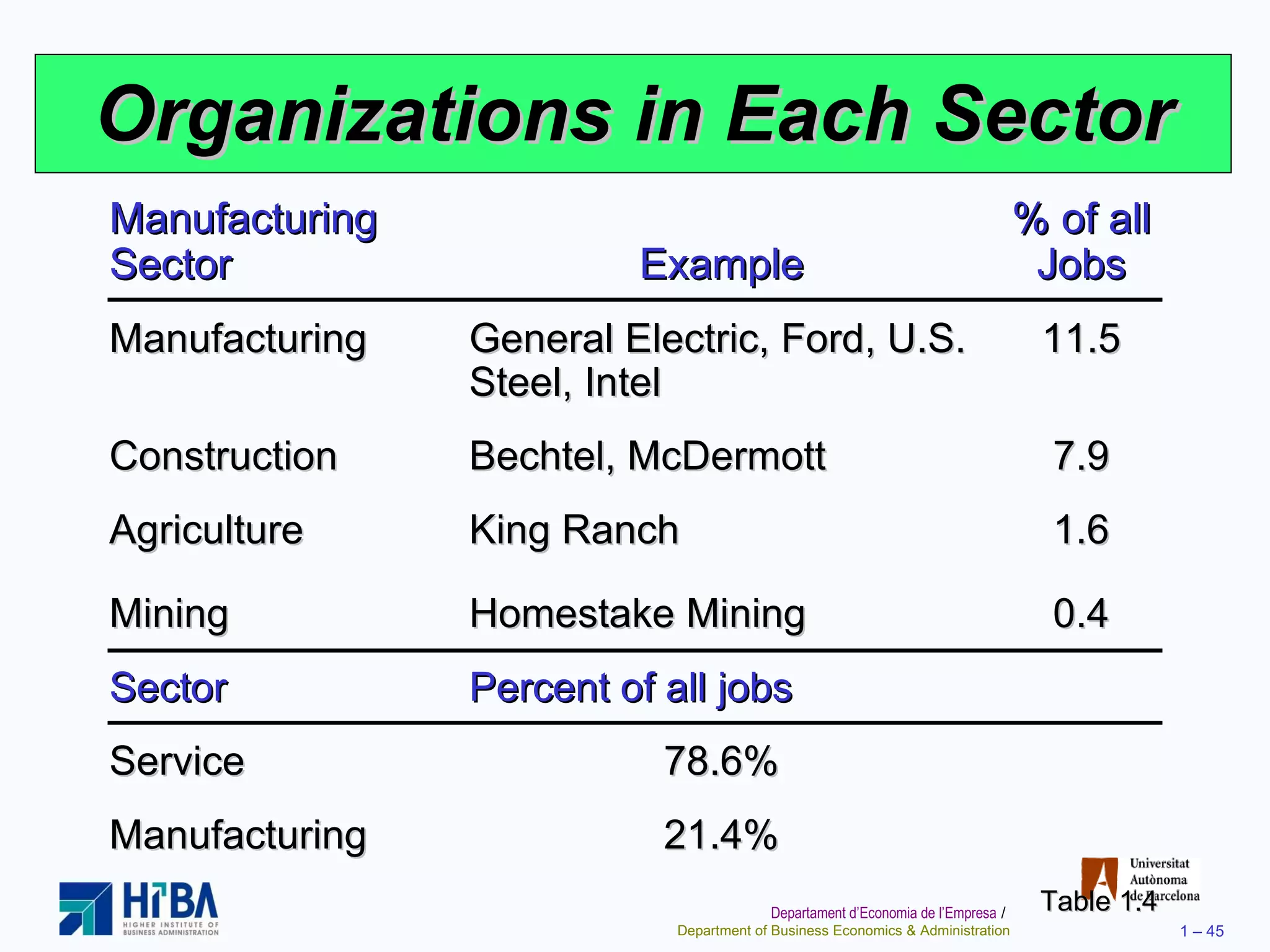
Organizations in Each Sector Table 1.4 Manufacturing Sector Example % of all Jobs Manufacturing General Electric, Ford, U.S. Steel, Intel 11.5 Construction Bechtel, McDermott 7.9 Agriculture King Ranch 1.6 Mining Homestake Mining 0.4 Sector Percent of all jobs Service 78.6% Manufacturing 21.4%
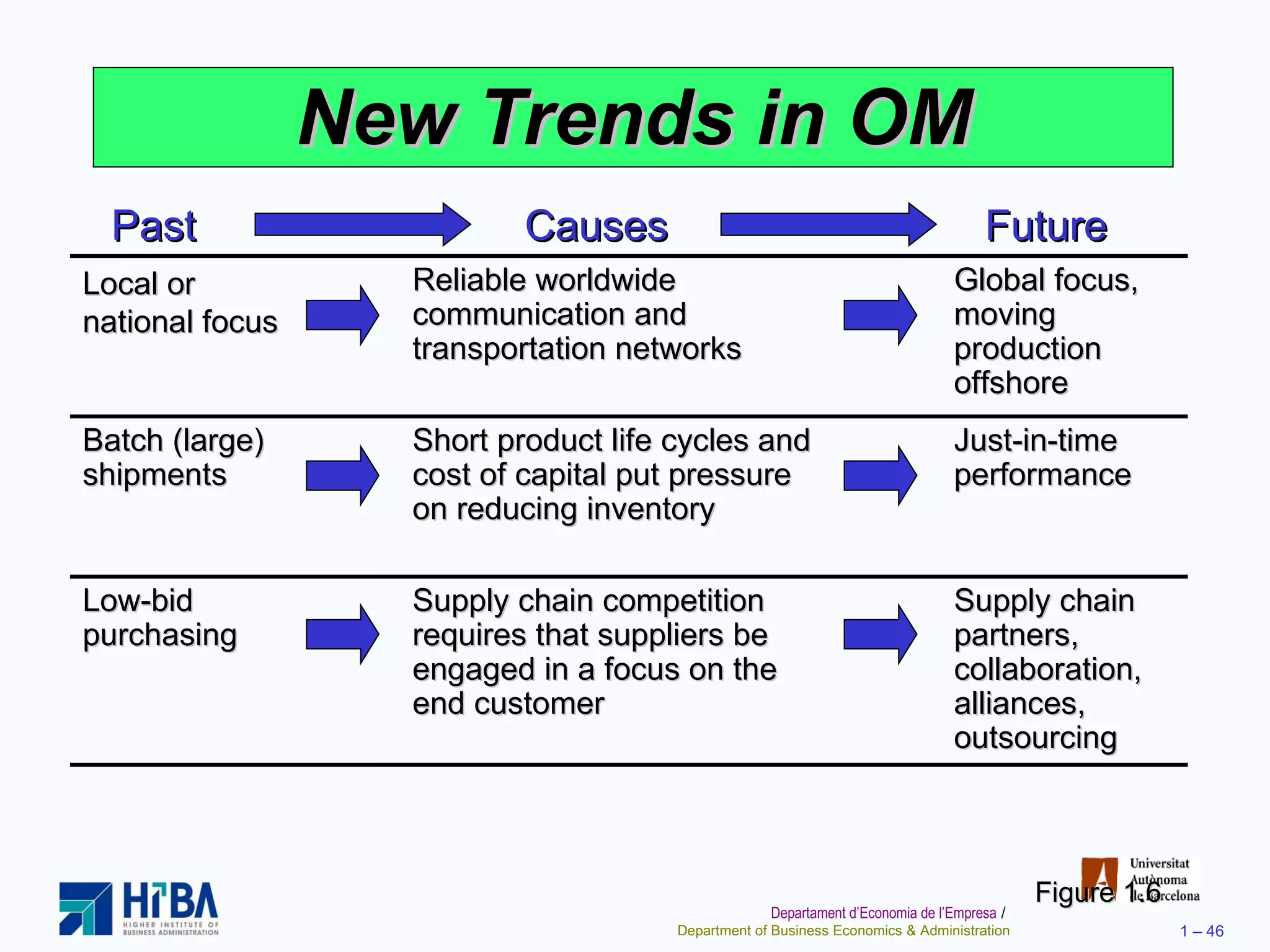
New Trends in OM Figure 1.6 Local or national focus Reliable worldwide communication and transportation networks Global focus, moving production offshore Batch (large) shipments Short product life cycles and cost of capital put pressure on reducing inventory Just-in-time performance Low-bid purchasing Supply chain competition requires that suppliers be engaged in a focus on the end customer Supply chain partners, collaboration, alliances, outsourcing Past Causes Future
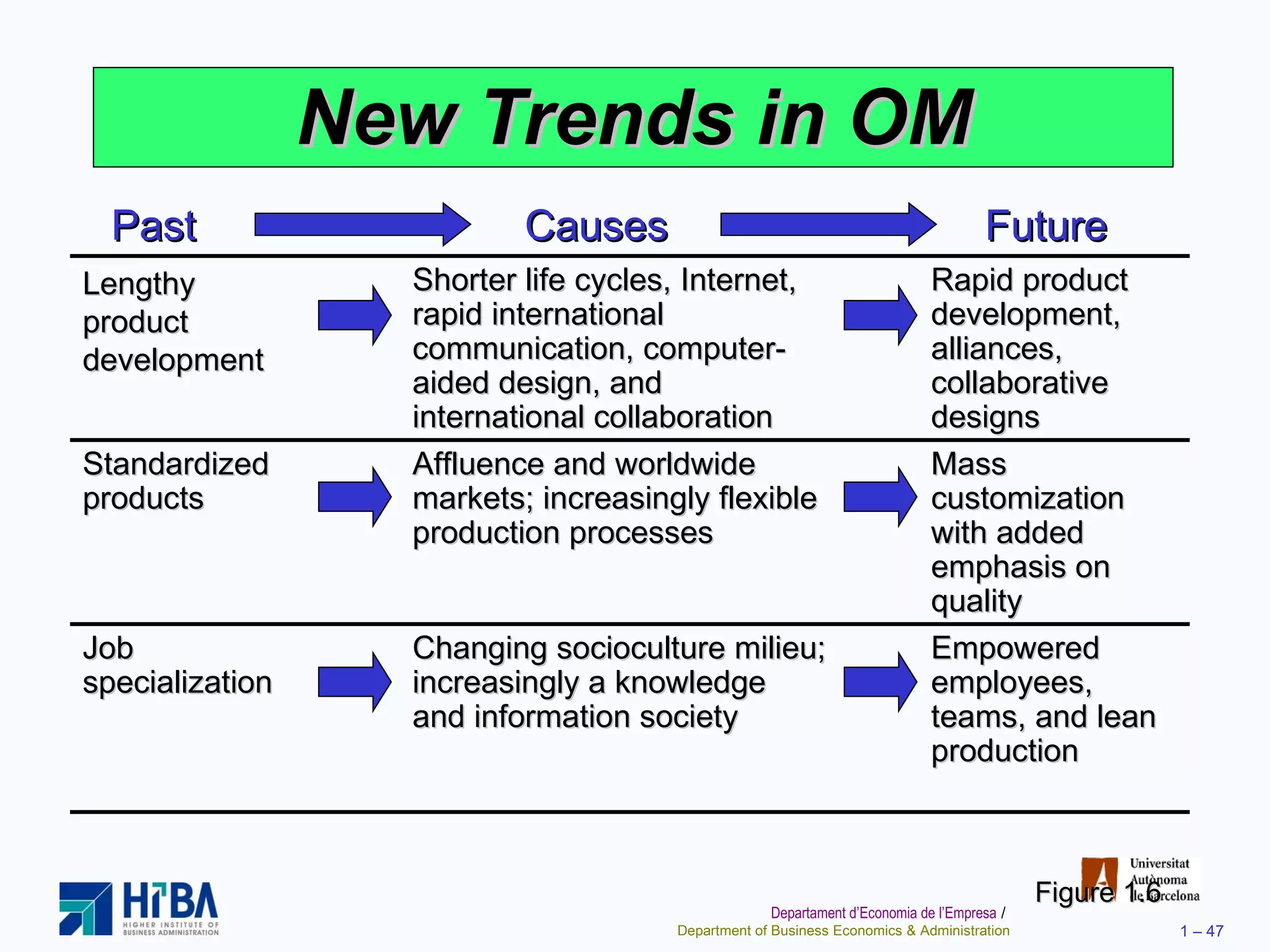
New Trends in OM Figure 1.6 Lengthy product development Shorter life cycles, Internet, rapid international communication, computer-aided design, and international collaboration Rapid product development, alliances, collaborative designs Standardized products Affluence and worldwide markets; increasingly flexible production processes Mass customization with added emphasis on quality Job specialization Changing socioculture milieu; increasingly a knowledge and information society Empowered employees, teams, and lean production Past Causes Future
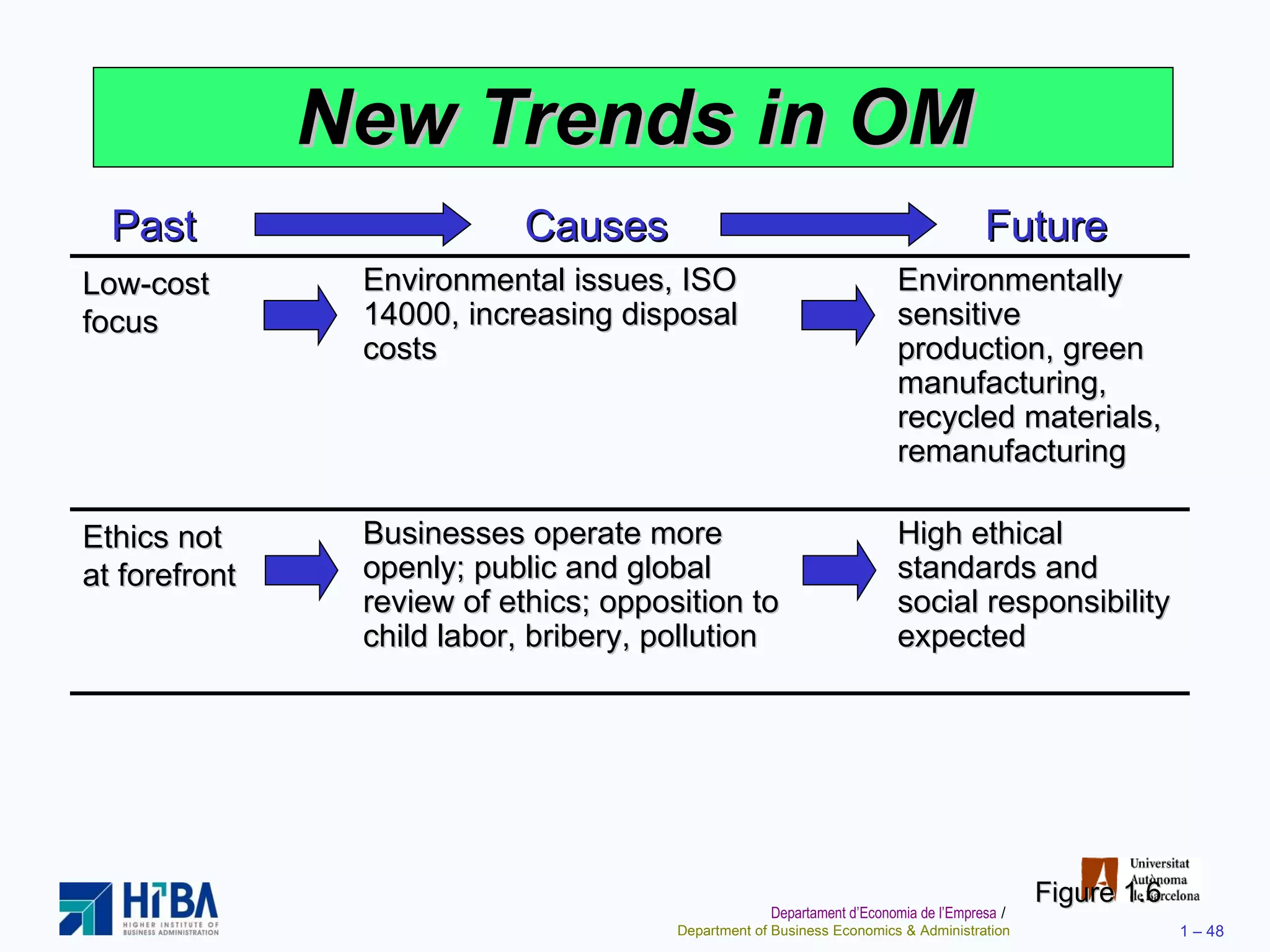
New Trends in OM Figure 1.6 Low-cost focus Environmental issues, ISO 14000, increasing disposal costs Environmentally sensitive production, green manufacturing, recycled materials, remanufacturing Ethics not at forefront Businesses operate more openly; public and global review of ethics; opposition to child labor, bribery, pollution High ethical standards and social responsibility expected Past Causes Future
New Trends in OM Global focus Just-in-time performance Supply chain partnering Rapid product development Mass customization Empowered employees Environmentally sensitive production Ethics
Productivity Challenge Productivity is the ratio of outputs (goods and services) divided by the inputs (resources such as labor and capital) The objective is to improve productivity! Important Note! Production is a measure of output only and not a measure of efficiency
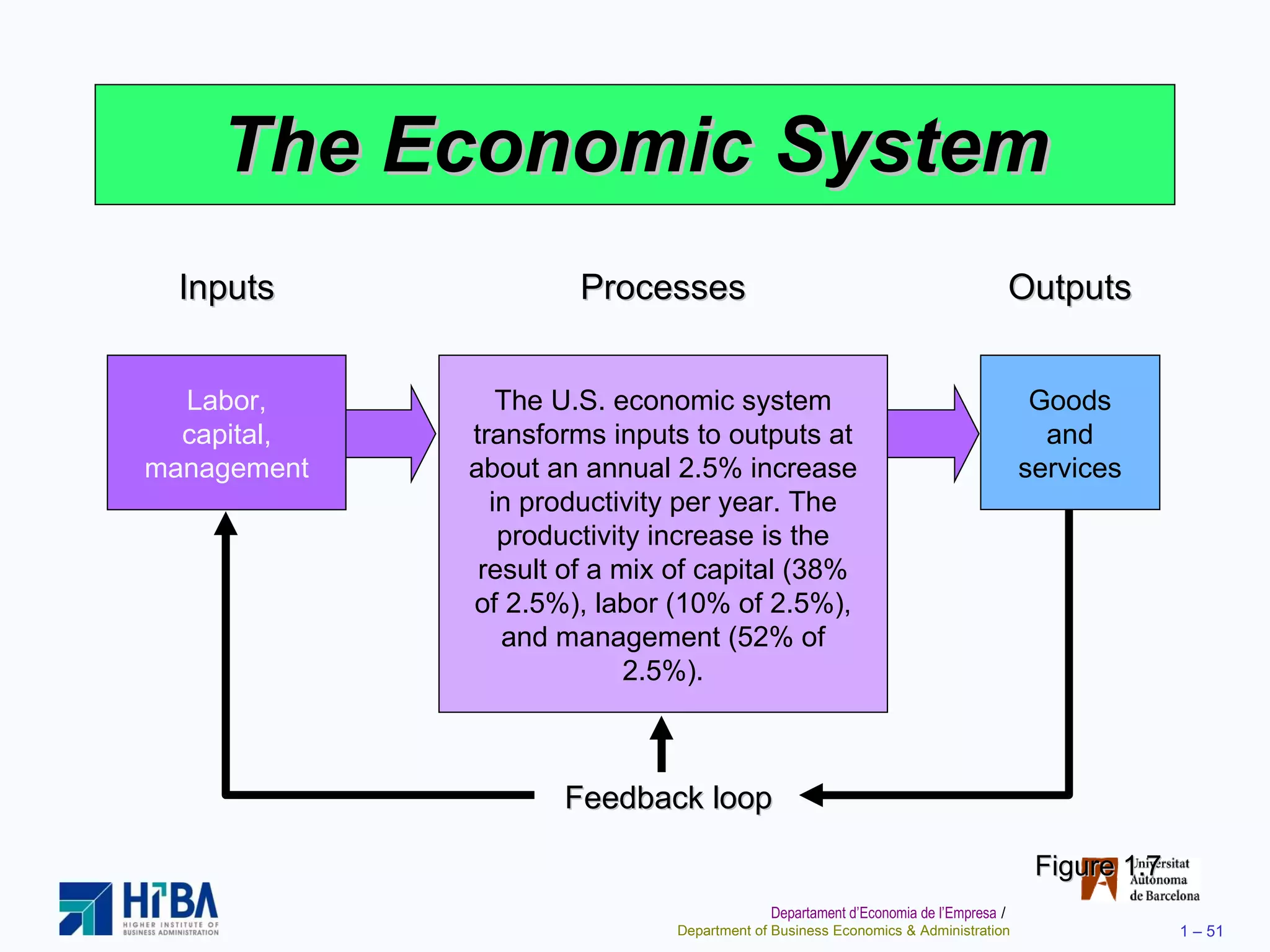
The Economic System Figure 1.7 Feedback   loop Outputs Goods and services Processes The U.S. economic system transforms inputs to outputs at about an annual 2.5% increase in productivity per year. The productivity increase is the result of a mix of capital (38% of 2.5%), labor (10% of 2.5%), and management (52% of 2.5%). Inputs Labor, capital, management
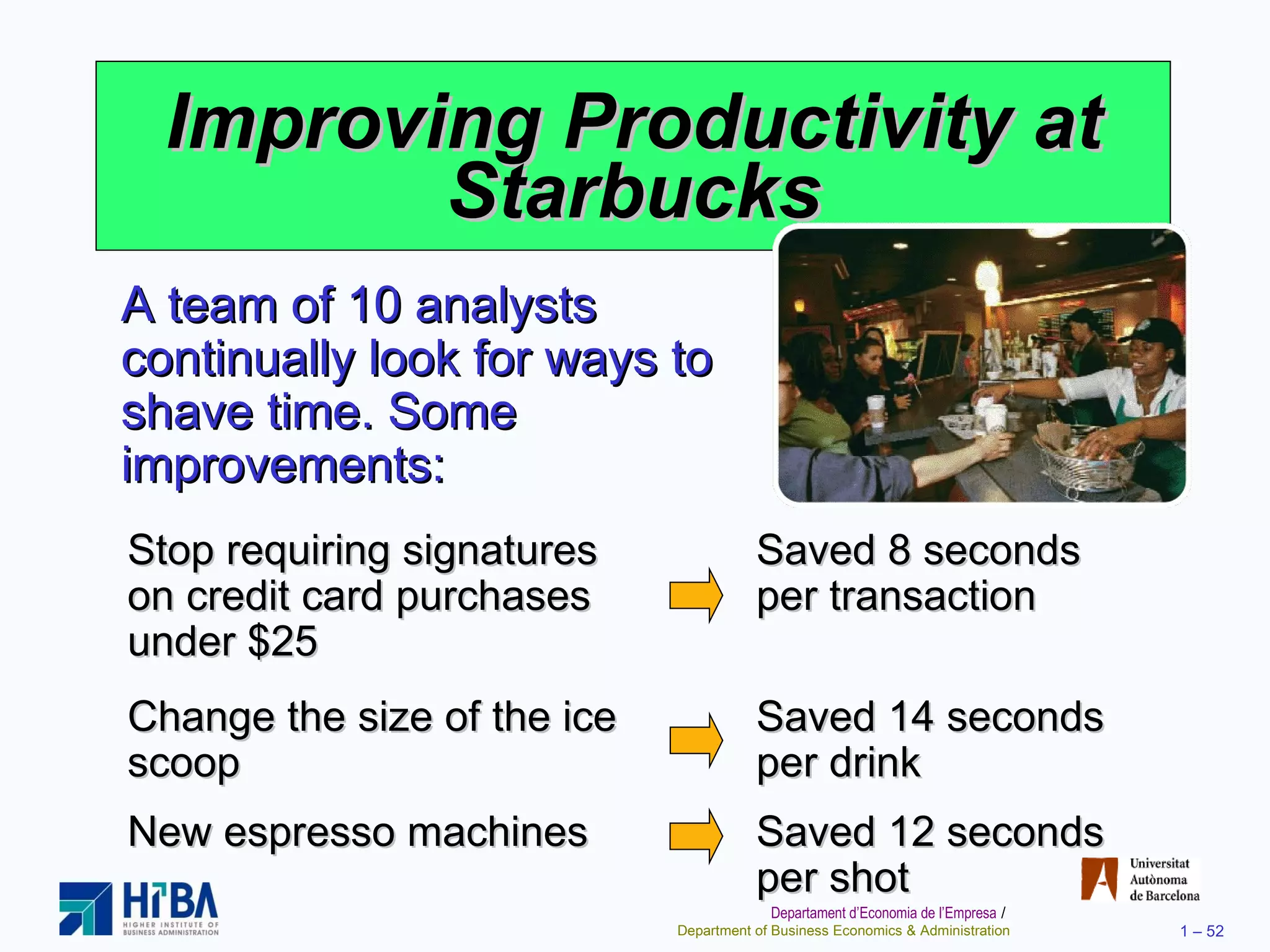
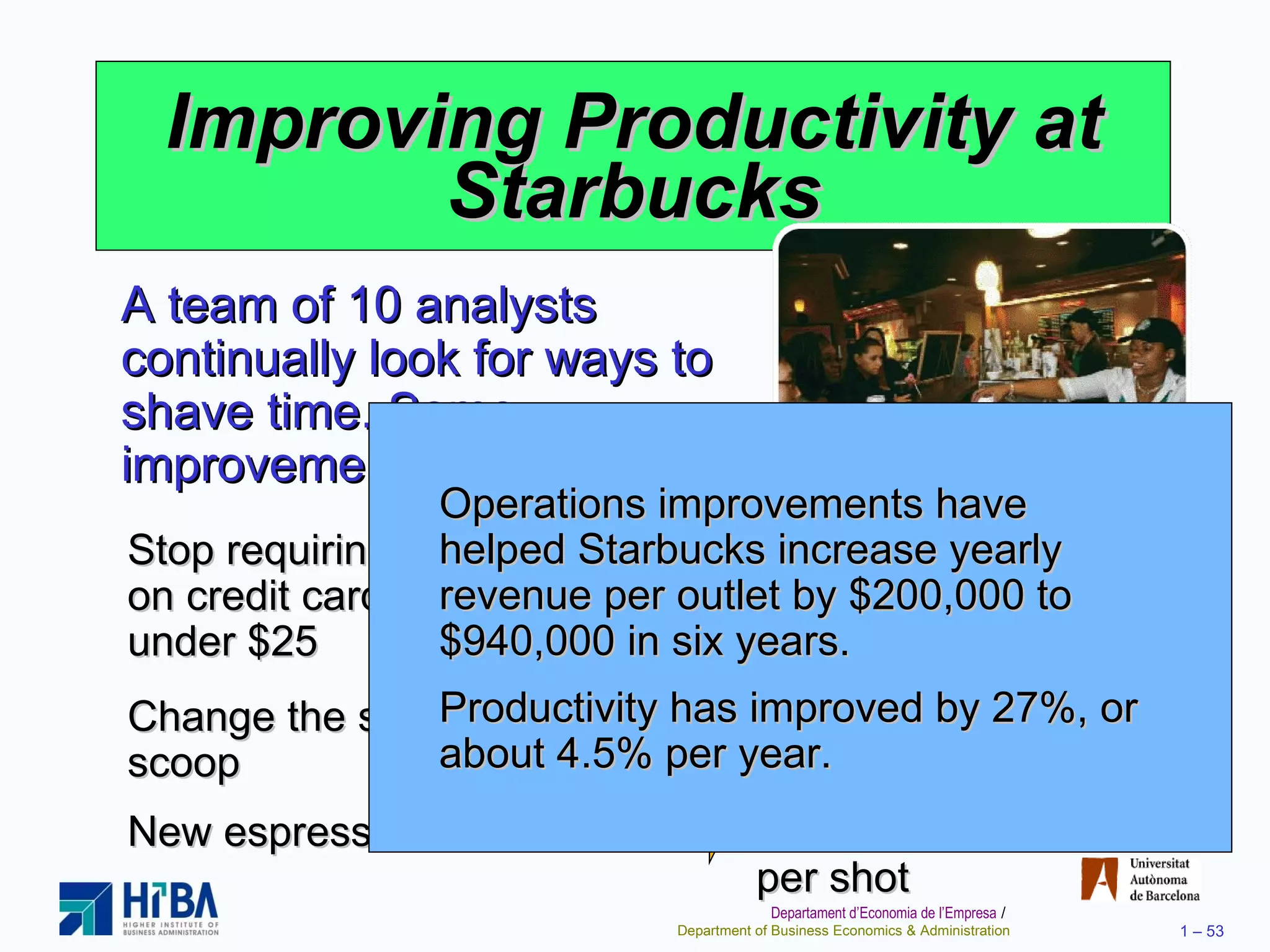
Improving Productivity at Starbucks A team of 10 analysts continually look for ways to shave time. Some improvements: Stop requiring signatures on credit card purchases under $25 Saved 8 seconds per transaction Change the size of the ice scoop Saved 14 seconds per drink New espresso machines Saved 12 seconds per shot
Improving Productivity at Starbucks A team of 10 analysts continually look for ways to shave time. Some improvements: Stop requiring signatures on credit card purchases under $25 Saved 8 seconds per transaction Change the size of the ice scoop Saved 14 seconds per drink New espresso machines Saved 12 seconds per shot Operations improvements have helped Starbucks increase yearly revenue per outlet by $200,000 to $940,000 in six years. Productivity has improved by 27%, or about 4.5% per year.
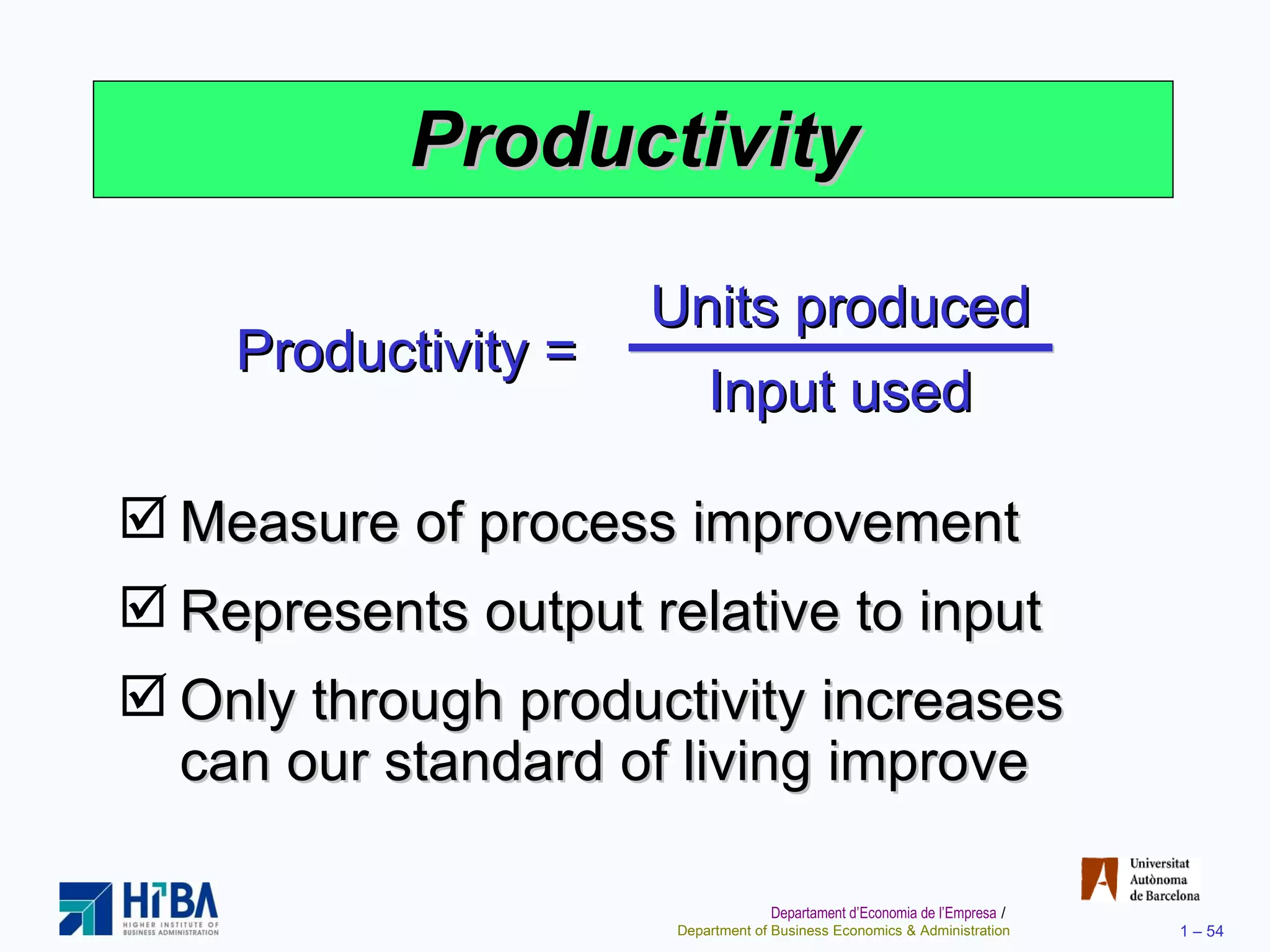
Productivity Measure of process improvement Represents output relative to input Only through productivity increases can our standard of living improve Productivity = Units produced Input used
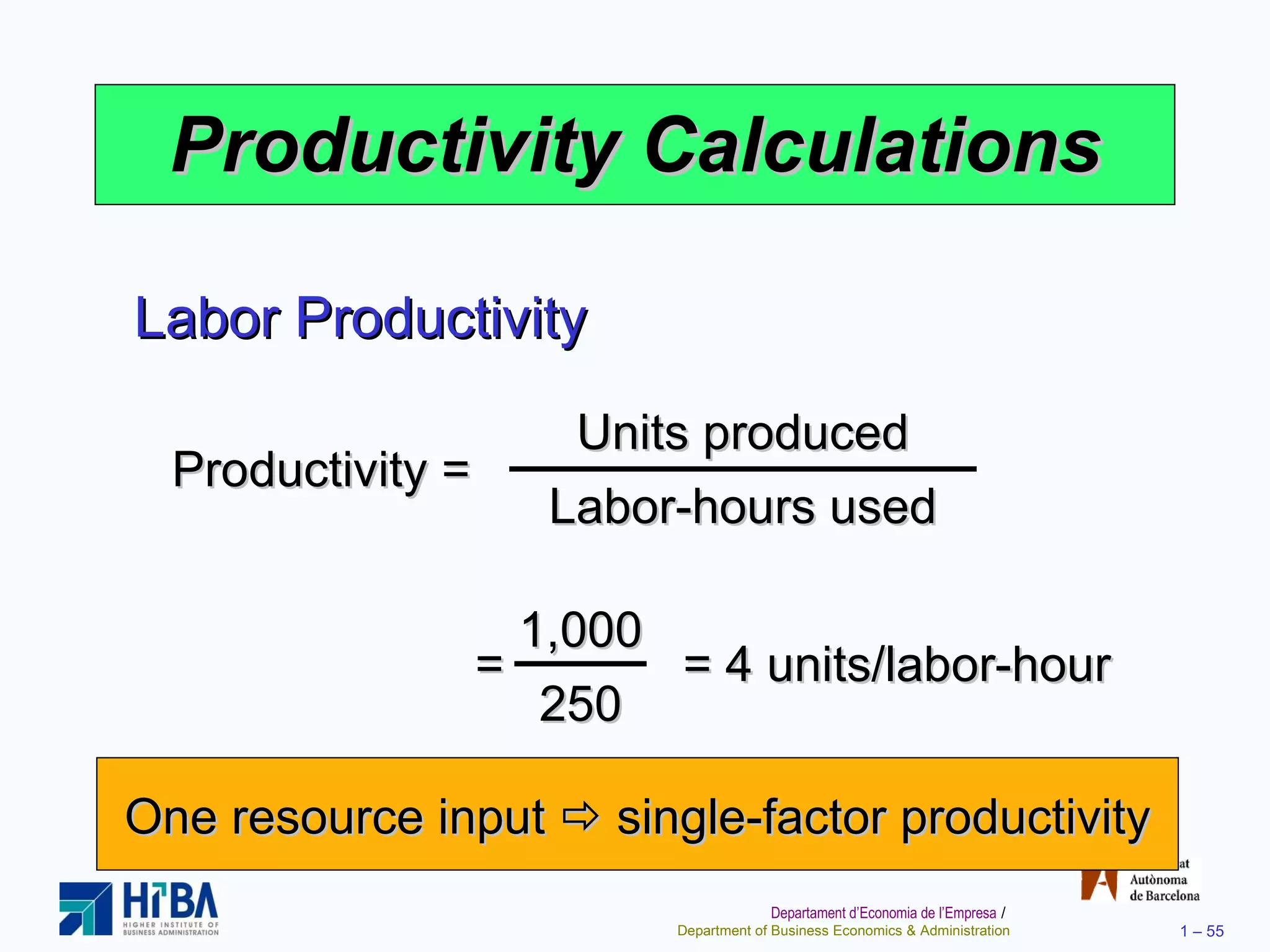
Productivity Calculations Labor Productivity One resource input    single-factor productivity Productivity = Units produced Labor-hours used =  = 4 units/labor-hour 1,000 250
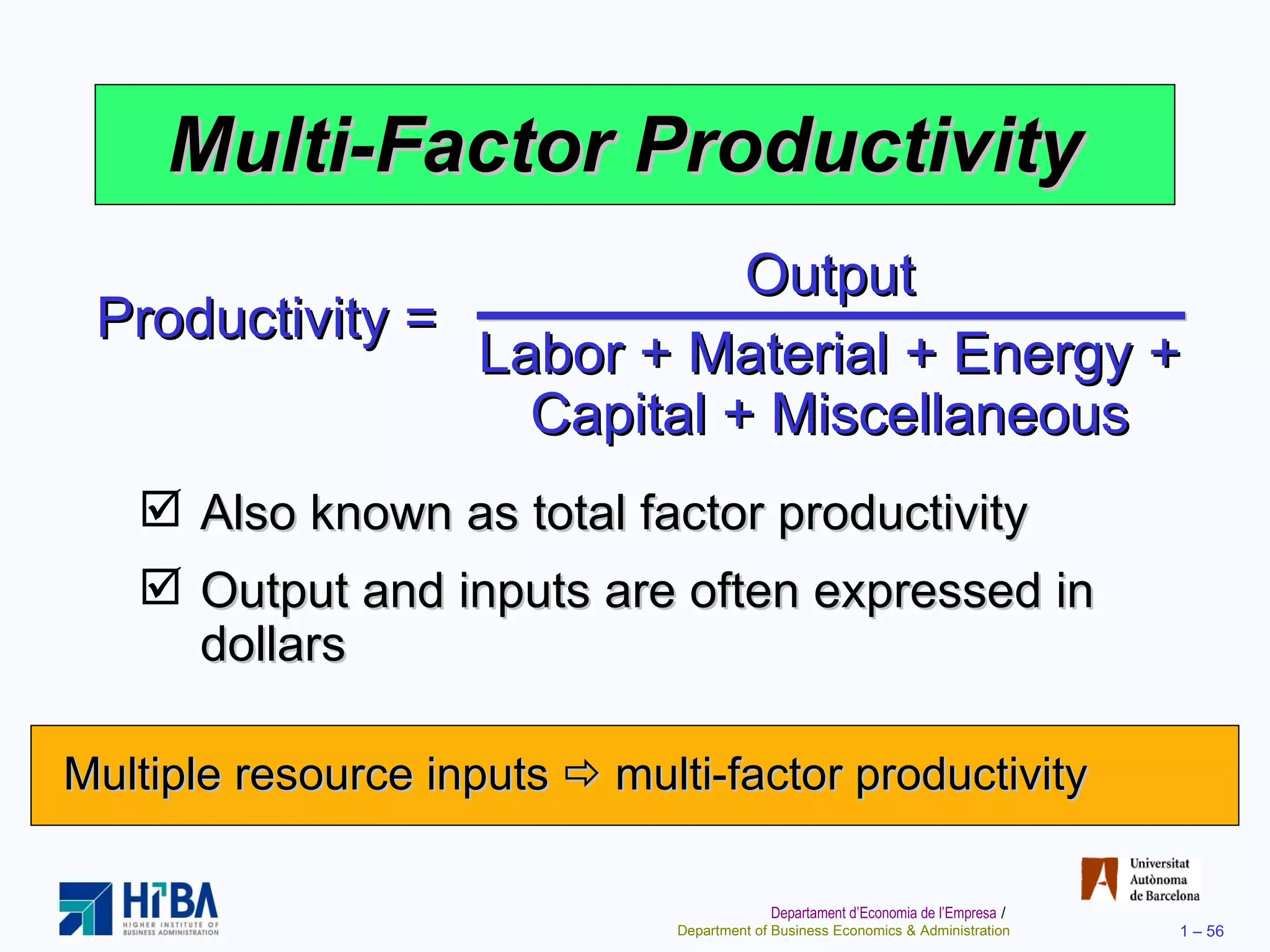
Multi-Factor Productivity  Also known as total factor productivity Output and inputs are often expressed in dollars Multiple resource inputs    multi-factor productivity Output Labor + Material + Energy + Capital + Miscellaneous Productivity =
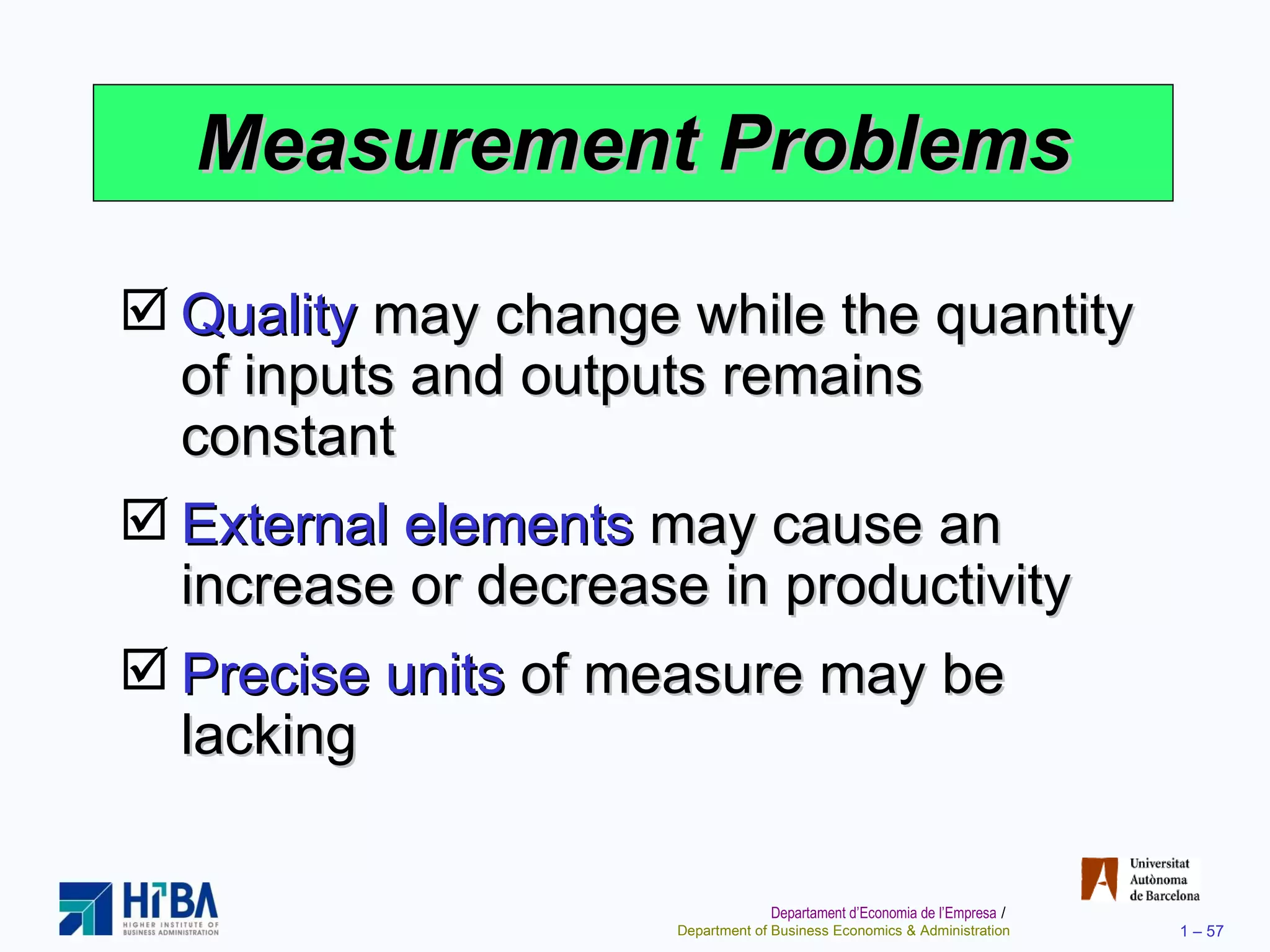
Measurement Problems Quality  may change while the quantity of inputs and outputs remains constant External elements  may cause an increase or decrease in productivity Precise units  of measure may be lacking
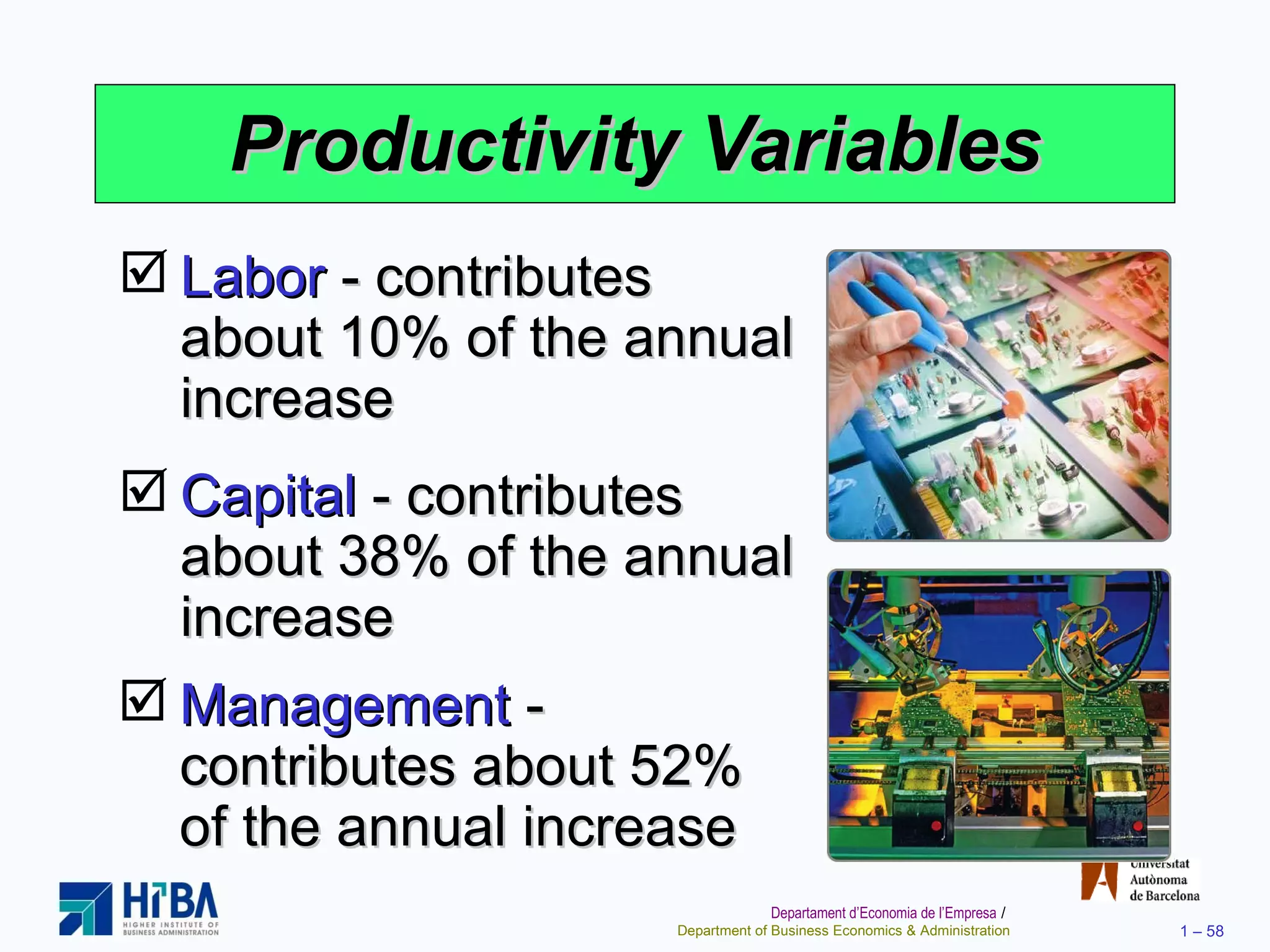
Productivity Variables Labor  - contributes about 10% of the annual increase Capital   - contributes about 38% of the annual increase Management  - contributes about 52% of the annual increase
Key Variables for Improved Labor Productivity Basic education appropriate for the labor force Diet of the labor force Social overhead that makes labor available Maintaining and enhancing skills in the midst of rapidly changing technology and knowledge
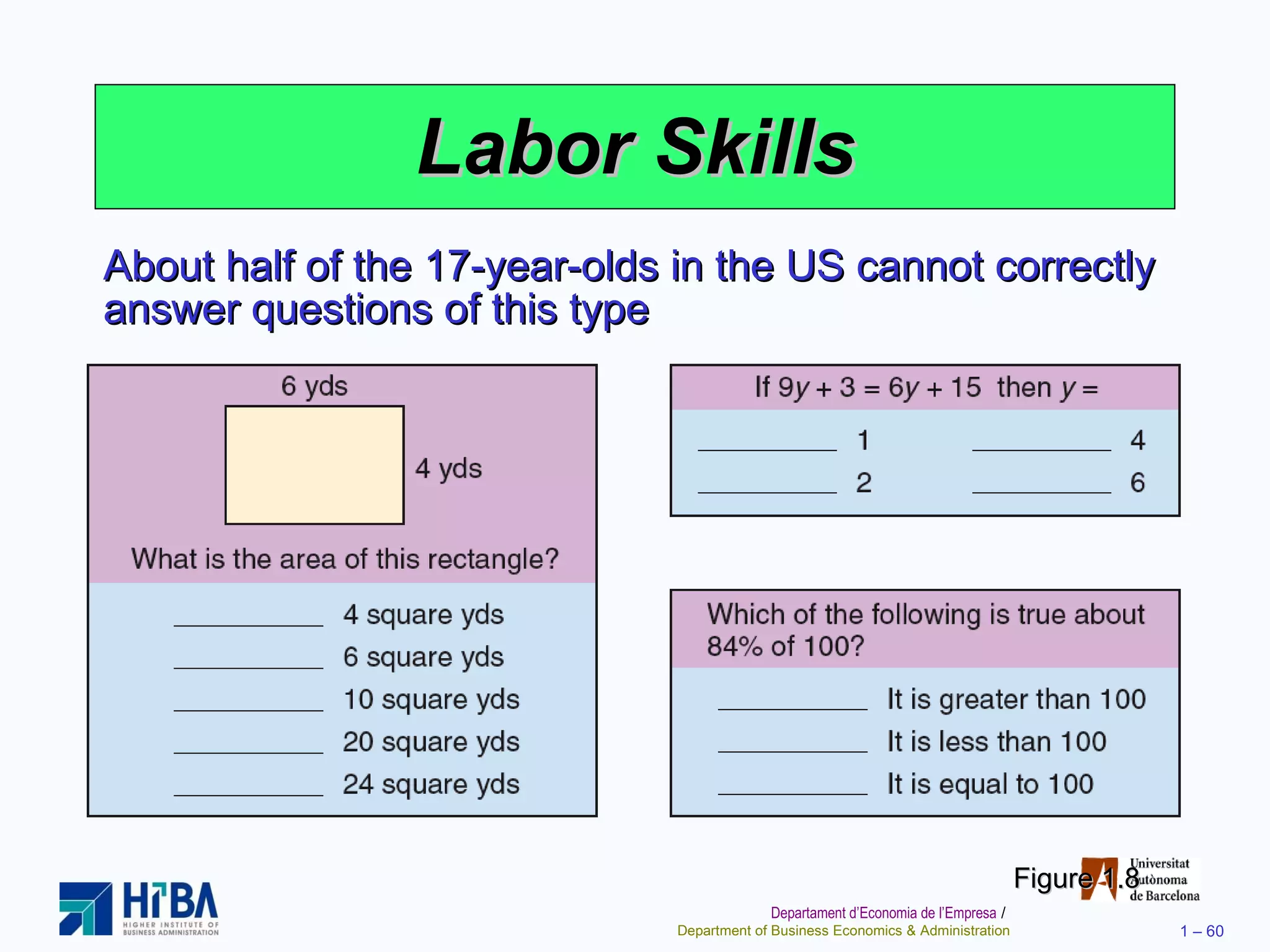
Labor Skills About half of the 17-year-olds in the US cannot correctly answer questions of this type Figure 1.8
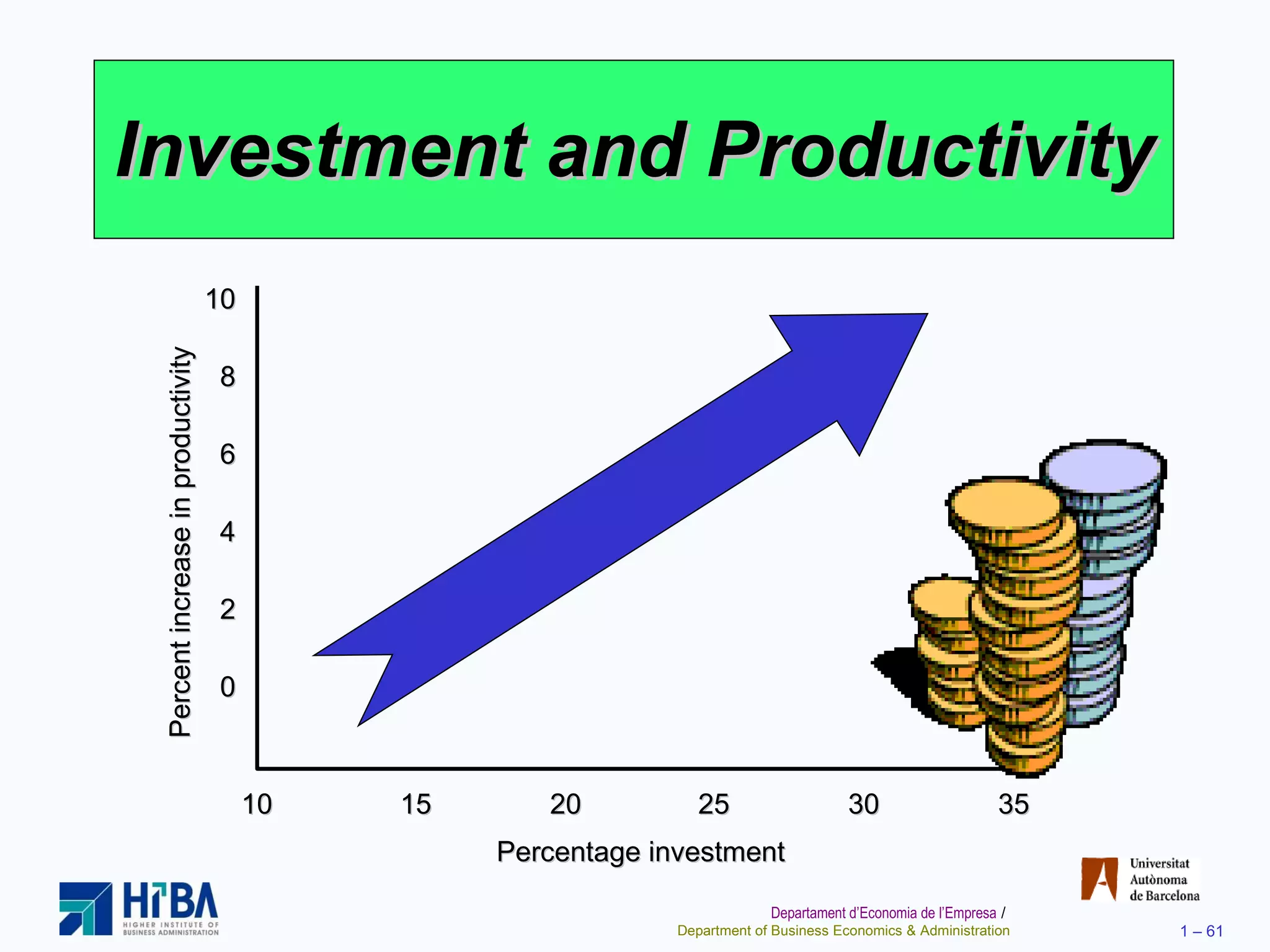
Investment and Productivity  10 8 6 4 2 0 Percent increase in productivity Percentage investment 10 15 20 25 30 35
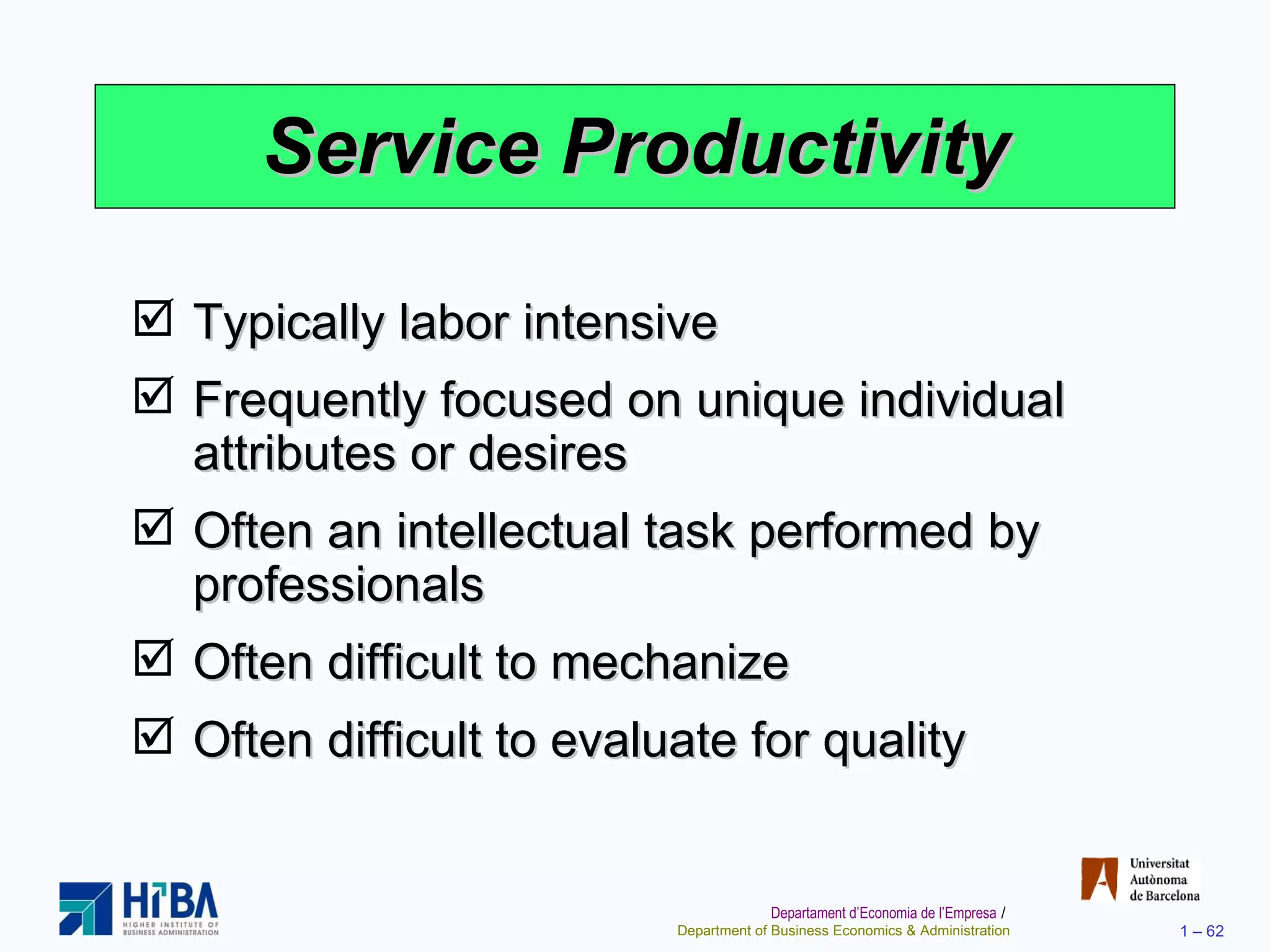
Service Productivity Typically labor intensive Frequently focused on unique individual attributes or desires Often an intellectual task performed by professionals Often difficult to mechanize Often difficult to evaluate for quality
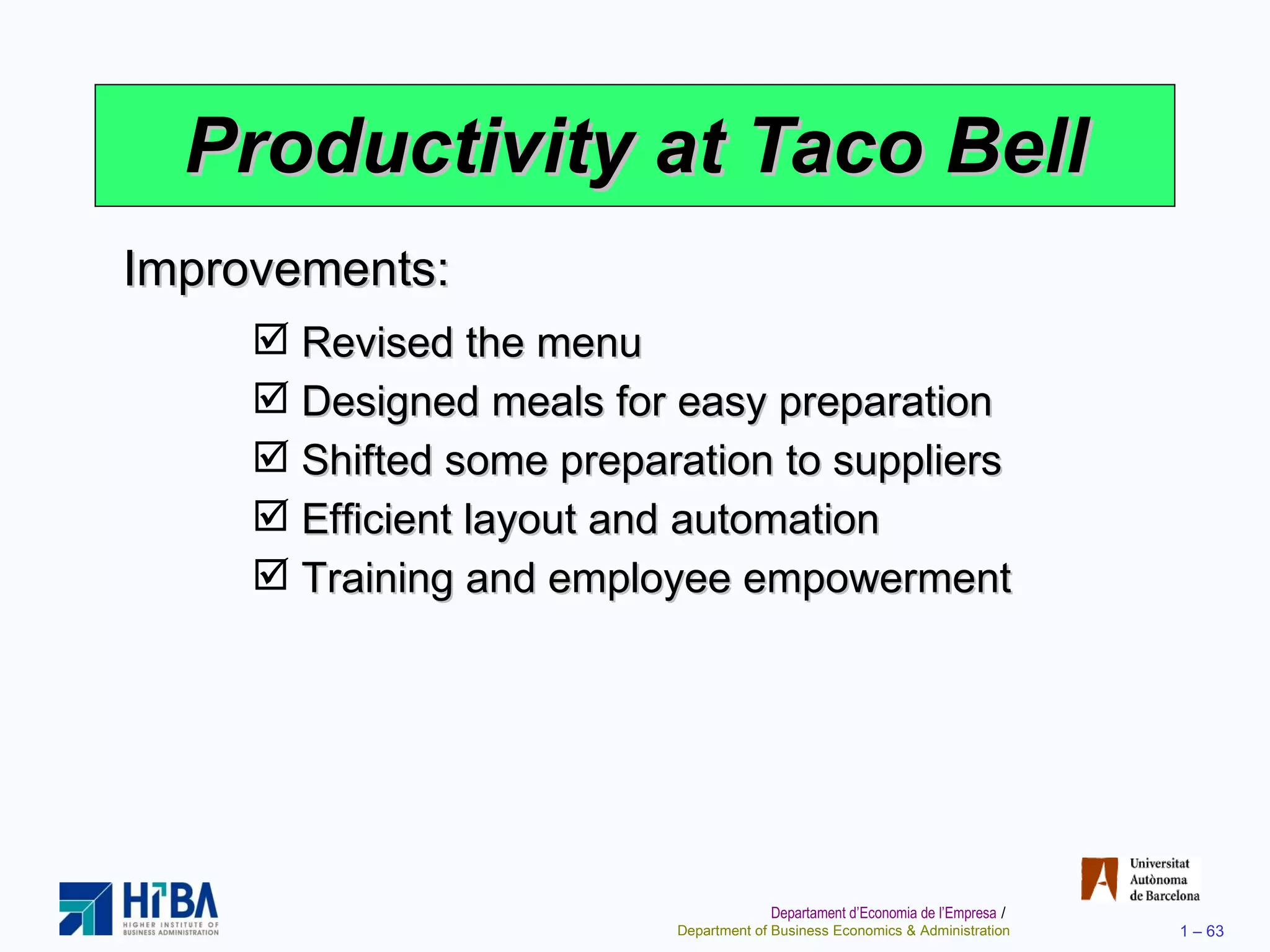
Productivity at Taco Bell Improvements: Revised the menu  Designed meals for easy preparation Shifted some preparation to suppliers Efficient layout and automation Training and employee empowerment
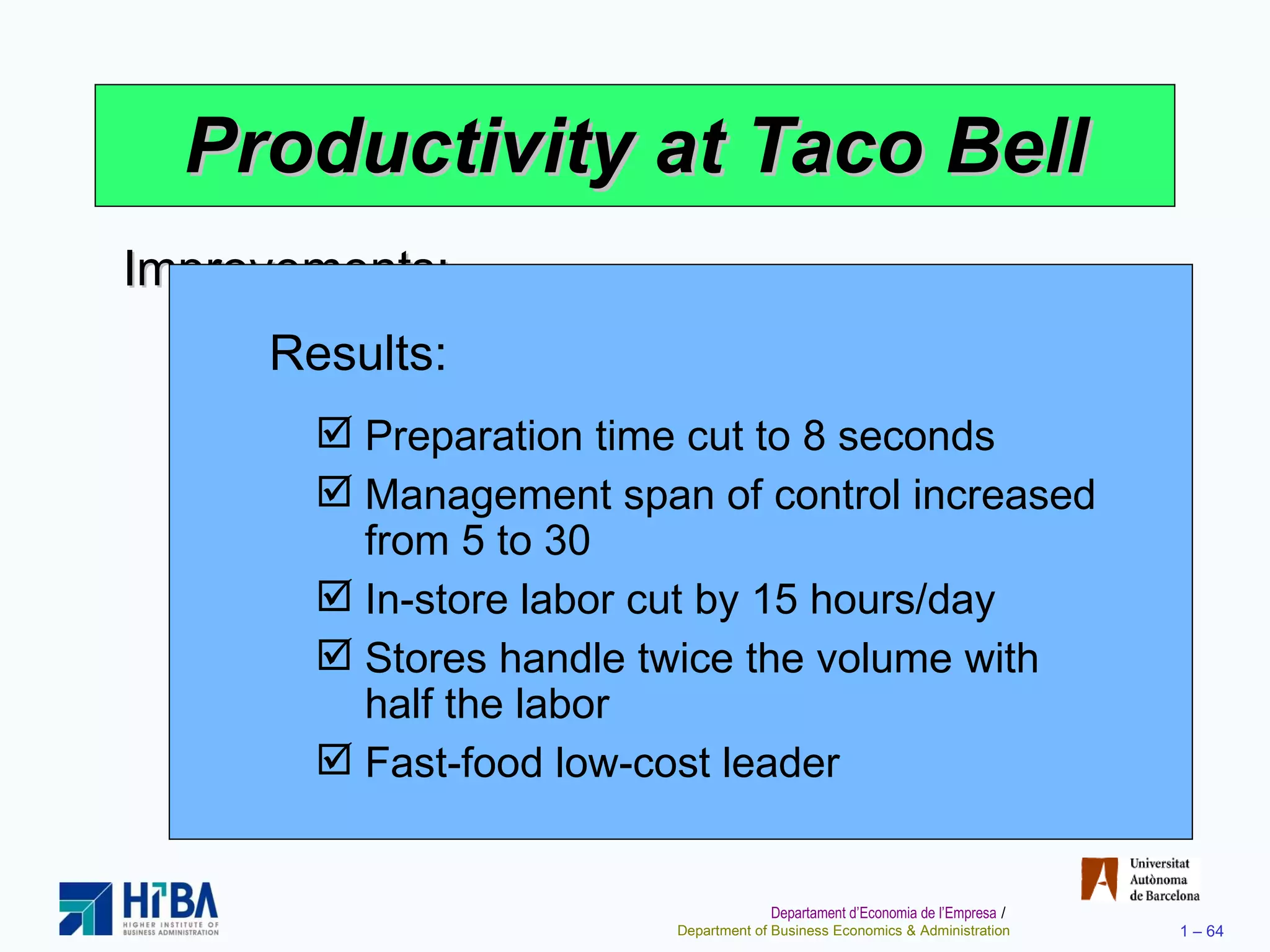
Productivity at Taco Bell Improvements: Revised the menu  Designed meals for easy preparation Shifted some preparation to suppliers Efficient layout and automation Training and employee empowerment Results: Preparation time cut to 8 seconds Management span of control increased from 5 to 30 In-store labor cut by 15 hours/day Stores handle twice the volume with half the labor Fast-food low-cost leader
Ethics and Social Responsibility Challenges facing operations managers: Developing and producing safe, quality products Maintaining a clean environment Providing a safe workplace Honoring community commitments

Operations And Productivity

  • 1.
    Operations Management Session1 – Operations and Productivity
  • 2.
    Outline Global CompanyProfile: Hard Rock Cafe What Is Operations Management? Organizing to Produce Goods and Services Why Study OM? What Operations Managers Do How This Book Is Organized
  • 3.
    Outline - ContinuedThe Heritage of Operations Management Operations in the Service Sector Differences between Goods and Services Growth of Services Service Pay Exciting New Trends in Operations Management
  • 4.
    Outline - ContinuedThe Productivity Challenge Productivity Measurement Productivity Variables Productivity and the Service Sector Ethics and Social Responsibility
  • 5.
    Learning Objectives Whenyou complete this chapter you should be able to: Define operations management Explain the distinction between goods and services Explain the difference between production and productivity
  • 6.
    Learning Objectives Whenyou complete this chapter you should be able to: Compute single-factor productivity Compute multifactor productivity Identify the critical variables in enhancing productivity
  • 7.
    The Hard RockCafe First opened in 1971 Now – 121 restaurants in over 40 countries Rock music memorabilia Creates value in the form of good food and entertainment 3,500 + custom meals per day in Orlando How does an item get on the menu? Role of the Operations Manager
  • 8.
    What Is OperationsManagement? Production is the creation of goods and services Operations management (OM) is the set of activities that creates value in the form of goods and services by transforming inputs into outputs
  • 9.
    Organizing to ProduceGoods and Services Essential functions: Marketing – generates demand Production/operations – creates the product Finance/accounting – tracks how well the organization is doing, pays bills, collects the money
  • 10.
    Organizational Charts CommercialBank Figure 1.1(A) Operations Teller Scheduling Check Clearing Collection Transaction processing Facilities design/layout Vault operations Maintenance Security Finance Investments Security Real estate Accounting Auditing Marketing Loans Commercial Industrial Financial Personal Mortgage Trust Department
  • 11.
    Organizational Charts AirlineFigure 1.1(B) Operations Ground support equipment Maintenance Ground Operations Facility maintenance Catering Flight Operations Crew scheduling Flying Communications Dispatching Management science Finance/ accounting Accounting Payables Receivables General Ledger Finance Cash control International exchange Marketing Traffic administration Reservations Schedules Tariffs (pricing) Sales Advertising
  • 12.
    Organizational Charts ManufacturingFigure 1.1(C) Marketing Sales promotion Advertising Sales Market research Operations Facilities Construction; maintenance Production and inventory control Scheduling; materials control Quality assurance and control Supply chain management Manufacturing Tooling; fabrication; assembly Design Product development and design Detailed product specifications Industrial engineering Efficient use of machines, space, and personnel Process analysis Development and installation of production tools and equipment Finance/ accounting Disbursements/ credits Receivables Payables General ledger Funds Management Money market International exchange Capital requirements Stock issue Bond issue and recall
  • 13.
    Why Study OM?OM is one of three major functions (marketing, finance, and operations) of any organization We want ( and need ) to know how goods and services are produced We want to understand what operations managers do OM is such a costly part of an organization
  • 14.
    Options for IncreasingContribution Sales $100,000 $150,000 $100,000 $100,000 Cost of Goods – 80,000 – 120,000 – 80,000 – 64,000 Gross Margin 20,000 30,000 20,000 36,000 Finance Costs – 6,000 – 6,000 – 3,000 – 6,000 Subtotal 14,000 24,000 17,000 30,000 Taxes at 25% – 3,500 – 6,000 – 4,250 – 7,500 Contribution $ 10,500 $ 18,000 $ 12,750 $ 22,500 Finance/ Marketing Accounting OM Option Option Option Increase Reduce Reduce Sales Finance Production Current Revenue 50% Costs 50% Costs 20%
  • 15.
    What Operations Managers Do Planning Organizing Staffing Leading Controlling Basic Management Functions
  • 16.
    Ten Critical DecisionsTable 1.2 Ten Decision Areas Chapter(s) Design of goods and services Session 1 & book Managing quality Session 4/5 Process and capacity Session 3 design Location strategy Session 4 Layout strategy Session 3 Human resources and See book job design Supply chain Session 2 management Inventory management Sessions 6 & 7 Scheduling Session 5 & book Maintenance See book
  • 17.
    The Critical DecisionsDesign of goods and services What good or service should we offer? How should we design these products and services? Managing quality How do we define quality? Who is responsible for quality? Table 1.2 (cont.)
  • 18.
    The Critical DecisionsProcess and capacity design What process and what capacity will these products require? What equipment and technology is necessary for these processes? Location strategy Where should we put the facility? On what criteria should we base the location decision? Table 1.2 (cont.)
  • 19.
    The Critical DecisionsLayout strategy How should we arrange the facility? How large must the facility be to meet our plan? Human resources and job design How do we provide a reasonable work environment? How much can we expect our employees to produce? Table 1.2 (cont.)
  • 20.
    The Critical DecisionsSupply chain management Should we make or buy this component? Who are our suppliers and who can integrate into our e-commerce program? Inventory, material requirements planning, and JIT How much inventory of each item should we have? When do we re-order? Table 1.2 (cont.)
  • 21.
    The Critical DecisionsIntermediate and short – term scheduling Are we better off keeping people on the payroll during slowdowns? Which jobs do we perform next? Maintenance Who is responsible for maintenance? When do we do maintenance? Table 1.2 (cont.)
  • 22.
    Where are theOM Jobs? Figure 1.2
  • 23.
    Where are theOM Jobs? Technology/methods Facilities/space utilization Strategic issues Response time People/team development Customer service Quality Cost reduction Inventory reduction Productivity improvement
  • 24.
    Significant Events inOM Figure 1.3
  • 25.
    The Heritage ofOM Division of labor (Adam Smith 1776; Charles Babbage 1852) Standardized parts (Whitney 1800) Scientific Management (Taylor 1881) Coordinated assembly line (Ford/ Sorenson 1913) Gantt charts (Gantt 1916) Motion study (Frank and Lillian Gilbreth 1922) Quality control (Shewhart 1924; Deming 1950)
  • 26.
    The Heritage ofOM Computer (Atanasoff 1938) CPM/PERT (DuPont 1957) Material requirements planning (Orlicky 1960) Computer aided design (CAD 1970) Flexible manufacturing system (FMS 1975) Baldrige Quality Awards (1980) Computer integrated manufacturing (1990) Globalization (1992) Internet (1995)
  • 27.
    Eli Whitney Born1765; died 1825 In 1798, received government contract to make 10,000 muskets Showed that machine tools could make standardized parts to exact specifications Musket parts could be used in any musket
  • 28.
    Frederick W. TaylorBorn 1856; died 1915 Known as ‘father of scientific management’ In 1881, as chief engineer for Midvale Steel, studied how tasks were done Began first motion and time studies Created efficiency principles
  • 29.
    Taylor’s Principles Matchingemployees to right job Providing the proper training Providing proper work methods and tools Establishing legitimate incentives for work to be accomplished Management Should Take More Responsibility for:
  • 30.
    Frank & LillianGilbreth Frank (1868-1924); Lillian (1878-1972) Husband-and-wife engineering team Further developed work measurement methods Applied efficiency methods to their home and 12 children! Book & Movie: “Cheaper by the Dozen,” book: “Bells on Their Toes”
  • 31.
    Henry Ford Born1863; died 1947 In 1903, created Ford Motor Company In 1913, first used moving assembly line to make Model T Unfinished product moved by conveyor past work station Paid workers very well for 1911 ($5/day!)
  • 32.
    W. Edwards DemingBorn 1900; died 1993 Engineer and physicist Credited with teaching Japan quality control methods in post-WW2 Used statistics to analyze process His methods involve workers in decisions
  • 33.
    Contributions From Humanfactors Industrial engineering Management science Biological science Physical sciences Information technology
  • 34.
    New Challenges inOM Global focus Just-in-time Supply chain partnering Rapid product development, alliances Mass customization Empowered employees, teams To From Local or national focus Batch shipments Low bid purchasing Lengthy product development Standard products Job specialization
  • 35.
    Characteristics of GoodsTangible product Consistent product definition Production usually separate from consumption Can be inventoried Low customer interaction
  • 36.
    Characteristics of ServiceIntangible product Produced and consumed at same time Often unique High customer interaction Inconsistent product definition Often knowledge-based Frequently dispersed
  • 37.
    Industry and Servicesas Percentage of GDP Services Manufacturing Australia Canada China Czech Rep France Germany Hong Kong Japan Mexico Russian Fed South Africa Spain UK US 90 − 80 − 70 − 60 − 50 − 40 − 30 − 20 − 10 − 0 −
  • 38.
    Goods Versus ServicesTable 1.3 Can be resold Can be inventoried Some aspects of quality measurable Selling is distinct from production Product is transportable Site of facility important for cost Often easy to automate Revenue generated primarily from tangible product Attributes of Goods (Tangible Product) Attributes of Services (Intangible Product) Reselling unusual Difficult to inventory Quality difficult to measure Selling is part of service Provider, not product, is often transportable Site of facility important for customer contact Often difficult to automate Revenue generated primarily from the intangible service
  • 39.
    Goods and ServicesFigure 1.4 Automobile Computer Installed carpeting Fast-food meal Restaurant meal/auto repair Hospital care Advertising agency/ investment management Consulting service/ teaching Counseling Percent of Product that is a Good Percent of Product that is a Service 100% 75 50 25 0 25 50 75 100% | | | | | | | | |
  • 40.
    Manufacturing and ServiceEmployment Figure 1.5 (A) 120 – 100 – 80 – 60 – 40 – 20 – 0 – | | | | | | | 1950 1970 1990 2010 (est) 1960 1980 2000 Employment (millions) Manufacturing Service
  • 41.
    Manufacturing Employment andProduction Figure 1.5 (B) 40 – 30 – 20 – 10 – 0 – | | | | | | | 1950 1970 1990 2010 (est) 1960 1980 2000 – 150 – 125 – 100 – 75 – 50 – 25 – 0 Employment (millions) Index: 1997 = 100 Manufacturing employment (left scale) Industrial production (right scale)
  • 42.
    Development of the Service Economy Figure 1.5 (C) United States Canada France Italy Britain Japan W. Germany 1970 2008 (est) | | | | | 40 50 60 70 80 Percent
  • 43.
    Organizations in EachSector Table 1.4 Service Sector Example % of all Jobs Education, Legal, Medical, and other Notre Dame University, San Diego Zoo, Arnold Palmer Hospital 25.5 Trade (retail, wholesale) Walgreen’s, Wal-Mart, Nordstrom’s 15.1 Utilities, Transportation Pacific Gas & Electric, American Airlines, Santa Fe R.R., Roadway Express 5.2
  • 44.
    Organizations in EachSector Table 1.4 Service Sector Example % of all Jobs Professional and Business Services Snelling and Snelling, Waste Management, Pitney-Bowes 10.1 Finance, Information, Real Estate Citicorp, American Express, Prudential, Aetna, Trammel Crow, EDS, IBM 9.6 Food, Lodging, Entertainment Olive Garden, Hard Rock Cafe, Motel 6, Hilton Hotels, Walt Disney, Paramount Pictures 8.5 Public Administration U.S., State of Alabama, Cook County 4.6
  • 45.
    Organizations in EachSector Table 1.4 Manufacturing Sector Example % of all Jobs Manufacturing General Electric, Ford, U.S. Steel, Intel 11.5 Construction Bechtel, McDermott 7.9 Agriculture King Ranch 1.6 Mining Homestake Mining 0.4 Sector Percent of all jobs Service 78.6% Manufacturing 21.4%
  • 46.
    New Trends inOM Figure 1.6 Local or national focus Reliable worldwide communication and transportation networks Global focus, moving production offshore Batch (large) shipments Short product life cycles and cost of capital put pressure on reducing inventory Just-in-time performance Low-bid purchasing Supply chain competition requires that suppliers be engaged in a focus on the end customer Supply chain partners, collaboration, alliances, outsourcing Past Causes Future
  • 47.
    New Trends inOM Figure 1.6 Lengthy product development Shorter life cycles, Internet, rapid international communication, computer-aided design, and international collaboration Rapid product development, alliances, collaborative designs Standardized products Affluence and worldwide markets; increasingly flexible production processes Mass customization with added emphasis on quality Job specialization Changing socioculture milieu; increasingly a knowledge and information society Empowered employees, teams, and lean production Past Causes Future
  • 48.
    New Trends inOM Figure 1.6 Low-cost focus Environmental issues, ISO 14000, increasing disposal costs Environmentally sensitive production, green manufacturing, recycled materials, remanufacturing Ethics not at forefront Businesses operate more openly; public and global review of ethics; opposition to child labor, bribery, pollution High ethical standards and social responsibility expected Past Causes Future
  • 49.
    New Trends inOM Global focus Just-in-time performance Supply chain partnering Rapid product development Mass customization Empowered employees Environmentally sensitive production Ethics
  • 50.
    Productivity Challenge Productivityis the ratio of outputs (goods and services) divided by the inputs (resources such as labor and capital) The objective is to improve productivity! Important Note! Production is a measure of output only and not a measure of efficiency
  • 51.
    The Economic SystemFigure 1.7 Feedback loop Outputs Goods and services Processes The U.S. economic system transforms inputs to outputs at about an annual 2.5% increase in productivity per year. The productivity increase is the result of a mix of capital (38% of 2.5%), labor (10% of 2.5%), and management (52% of 2.5%). Inputs Labor, capital, management
  • 52.
    Improving Productivity atStarbucks A team of 10 analysts continually look for ways to shave time. Some improvements: Stop requiring signatures on credit card purchases under $25 Saved 8 seconds per transaction Change the size of the ice scoop Saved 14 seconds per drink New espresso machines Saved 12 seconds per shot
  • 53.
    Improving Productivity atStarbucks A team of 10 analysts continually look for ways to shave time. Some improvements: Stop requiring signatures on credit card purchases under $25 Saved 8 seconds per transaction Change the size of the ice scoop Saved 14 seconds per drink New espresso machines Saved 12 seconds per shot Operations improvements have helped Starbucks increase yearly revenue per outlet by $200,000 to $940,000 in six years. Productivity has improved by 27%, or about 4.5% per year.
  • 54.
    Productivity Measure ofprocess improvement Represents output relative to input Only through productivity increases can our standard of living improve Productivity = Units produced Input used
  • 55.
    Productivity Calculations LaborProductivity One resource input  single-factor productivity Productivity = Units produced Labor-hours used = = 4 units/labor-hour 1,000 250
  • 56.
    Multi-Factor Productivity Also known as total factor productivity Output and inputs are often expressed in dollars Multiple resource inputs  multi-factor productivity Output Labor + Material + Energy + Capital + Miscellaneous Productivity =
  • 57.
    Measurement Problems Quality may change while the quantity of inputs and outputs remains constant External elements may cause an increase or decrease in productivity Precise units of measure may be lacking
  • 58.
    Productivity Variables Labor - contributes about 10% of the annual increase Capital - contributes about 38% of the annual increase Management - contributes about 52% of the annual increase
  • 59.
    Key Variables forImproved Labor Productivity Basic education appropriate for the labor force Diet of the labor force Social overhead that makes labor available Maintaining and enhancing skills in the midst of rapidly changing technology and knowledge
  • 60.
    Labor Skills Abouthalf of the 17-year-olds in the US cannot correctly answer questions of this type Figure 1.8
  • 61.
    Investment and Productivity 10 8 6 4 2 0 Percent increase in productivity Percentage investment 10 15 20 25 30 35
  • 62.
    Service Productivity Typicallylabor intensive Frequently focused on unique individual attributes or desires Often an intellectual task performed by professionals Often difficult to mechanize Often difficult to evaluate for quality
  • 63.
    Productivity at TacoBell Improvements: Revised the menu Designed meals for easy preparation Shifted some preparation to suppliers Efficient layout and automation Training and employee empowerment
  • 64.
    Productivity at TacoBell Improvements: Revised the menu Designed meals for easy preparation Shifted some preparation to suppliers Efficient layout and automation Training and employee empowerment Results: Preparation time cut to 8 seconds Management span of control increased from 5 to 30 In-store labor cut by 15 hours/day Stores handle twice the volume with half the labor Fast-food low-cost leader
  • 65.
    Ethics and SocialResponsibility Challenges facing operations managers: Developing and producing safe, quality products Maintaining a clean environment Providing a safe workplace Honoring community commitments

Editor's Notes

  • #20 Using this and subsequent slides, you might go through in more detail the decisions of Operations Management. While greater detail is provided by these slides than the earlier one, you may still decide to have the students contribute examples from their own experience.