Djukarna
STKIP SURYA
Serpong, Banten
Operation Amplifier (op-amp)
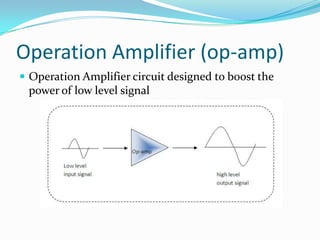
 Operation Amplifier circuit designed to boost the

power of low level signal
 Op-amp are linier devise that have all the properties

required for nearly ideal DC amplification and are
therefore used extensively in signal conditioning,
filtering or to perform mathematical operation such as
add, subtract, integration and differentiation.
Ideal Op-Amp
 Ideal op-amp is basically a three terminal devise which

consists of 2 high impedance input, one called the
inverting input marked with a negative or minus sign
(-) and the other one called the non-inverting input
marked with positive or plus sign (+).
 The third terminal represents the op-amp output
which can both sink and source either a voltage or a
current
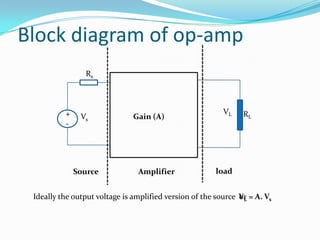
Block diagram of op-amp
Rs

+
-

Vs

Source

Gain (A)

Amplifier

VL

RL

load

Ideally the output voltage is amplified version of the source VL = A. Vs
or
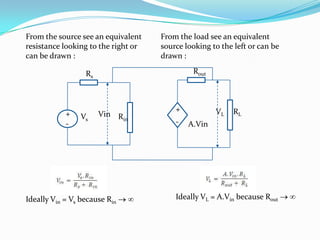
From the source see an equivalent
resistance looking to the right or
can be drawn :

From the load see an equivalent
source looking to the left or can be
drawn :
Rout

Rs

+
-

Vs

Vin R
in

Ideally Vin = Vs because Rin

+

-

VL

RL

A.Vin

Ideally VL = A.Vin because Rout
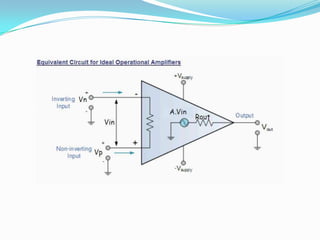
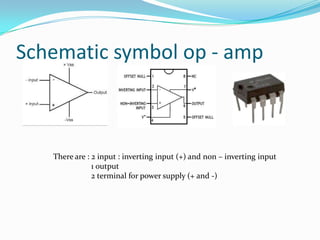
Schematic symbol op - amp

There are : 2 input : inverting input (+) and non – inverting input
1 output
2 terminal for power supply (+ and -)
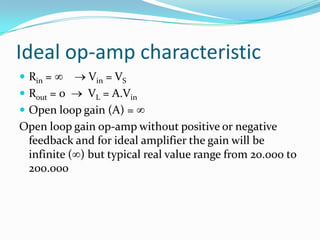
Ideal op-amp characteristic
 Rin =

Vin = VS
 Rout = 0
VL = A.Vin
 Open loop gain (A) =
Open loop gain op-amp without positive or negative
feedback and for ideal amplifier the gain will be
infinite ( ) but typical real value range from 20.000 to
200.000
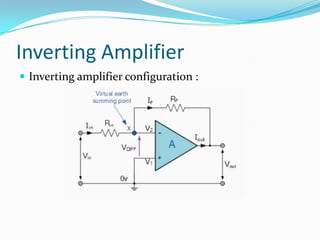
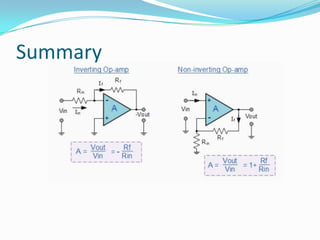
Inverting Amplifier
 Inverting amplifier configuration :
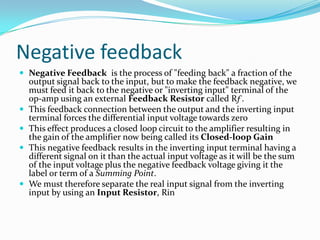
Negative feedback
 Negative Feedback is the process of "feeding back" a fraction of the







output signal back to the input, but to make the feedback negative, we
must feed it back to the negative or "inverting input" terminal of the
op-amp using an external Feedback Resistor called Rƒ.
This feedback connection between the output and the inverting input
terminal forces the differential input voltage towards zero
This effect produces a closed loop circuit to the amplifier resulting in
the gain of the amplifier now being called its Closed-loop Gain
This negative feedback results in the inverting input terminal having a
different signal on it than the actual input voltage as it will be the sum
of the input voltage plus the negative feedback voltage giving it the
label or term of a Summing Point.
We must therefore separate the real input signal from the inverting
input by using an Input Resistor, Rin
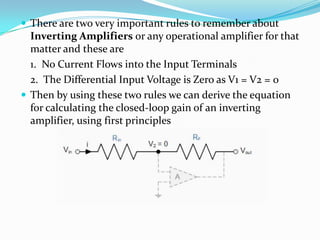
 There are two very important rules to remember about

Inverting Amplifiers or any operational amplifier for that
matter and these are
1. No Current Flows into the Input Terminals
2. The Differential Input Voltage is Zero as V1 = V2 = 0
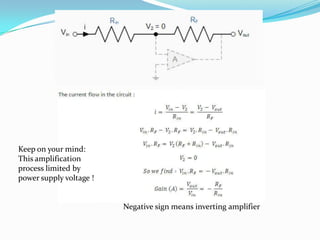
 Then by using these two rules we can derive the equation
for calculating the closed-loop gain of an inverting
amplifier, using first principles
Keep on your mind:
This amplification
process limited by
power supply voltage !

Negative sign means inverting amplifier
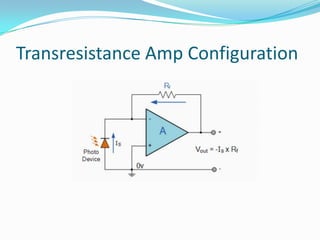
Transresistance Amplifier Circuit
 Another useful application of an inverting amplifier is

that of a "transresistance amplifier" circuit.
 A Transresistance Amplifier also known as a
"transimpedance amplifier", is basically a current-tovoltage converter (Current "in" and Voltage "out").
 They can be used in low-power applications to convert
a very small current generated by a photo-diode or
photo-detecting device etc, into a usable output
voltage which is proportional to the input current as
shown
Transresistance Amp Configuration
Non – Inverting Amplifier
 In this configuration, the input voltage signal, ( Vin ) is

applied directly to the non-inverting ( + ) input
terminal which means that the output gain of the
amplifier becomes "Positive" in value in contrast to the
"Inverting Amplifier" circuit
 The result of this is that the output signal is "in-phase"
with the input signal
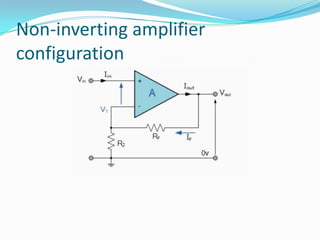
Non-inverting amplifier
configuration
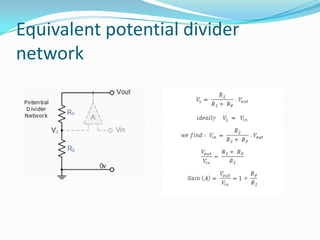
Equivalent potential divider
network
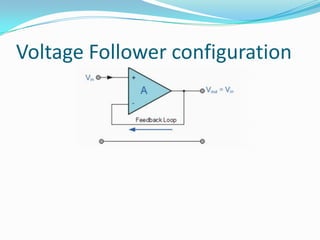
Voltage Follower
 If we made the feedback resistor, Rƒ equal to zero,

(Rƒ = 0), and resistor R2 equal to infinity, (R2 = ∞),
then the circuit would have a fixed gain of "1" as all the
output voltage would be present on the inverting input
terminal (negative feedback).
 This would then produce a special type of the noninverting amplifier circuit called a Voltage Follower
or also called a "unity gain buffer"
Voltage Follower configuration
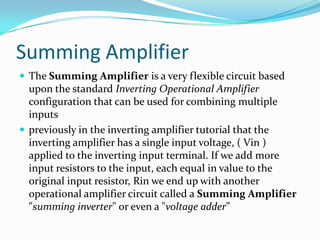
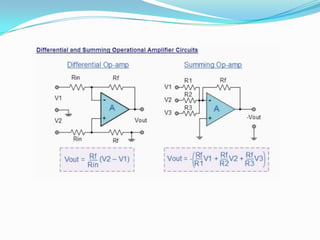
Summing Amplifier
 The Summing Amplifier is a very flexible circuit based

upon the standard Inverting Operational Amplifier
configuration that can be used for combining multiple
inputs
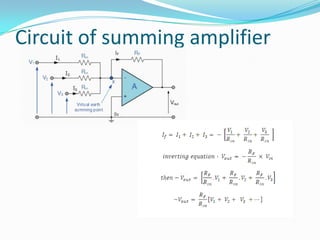
 previously in the inverting amplifier tutorial that the
inverting amplifier has a single input voltage, ( Vin )
applied to the inverting input terminal. If we add more
input resistors to the input, each equal in value to the
original input resistor, Rin we end up with another
operational amplifier circuit called a Summing Amplifier
"summing inverter" or even a "voltage adder”
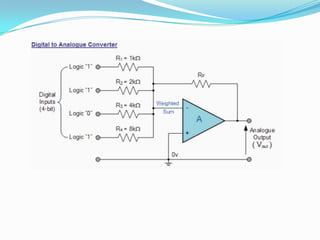
Circuit of summing amplifier
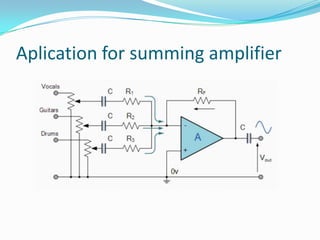
Aplication for summing amplifier
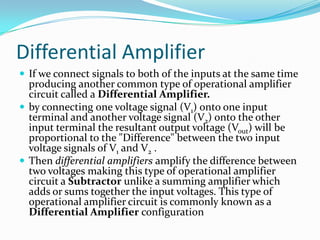
Differential Amplifier
 If we connect signals to both of the inputs at the same time

producing another common type of operational amplifier
circuit called a Differential Amplifier.
 by connecting one voltage signal (V1) onto one input
terminal and another voltage signal (V2) onto the other
input terminal the resultant output voltage (Vout) will be
proportional to the "Difference" between the two input
voltage signals of V1 and V2 .
 Then differential amplifiers amplify the difference between
two voltages making this type of operational amplifier
circuit a Subtractor unlike a summing amplifier which
adds or sums together the input voltages. This type of
operational amplifier circuit is commonly known as a
Differential Amplifier configuration
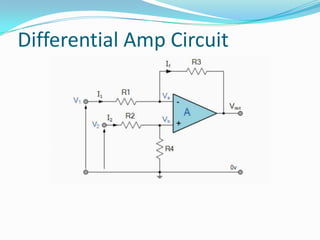
Differential Amp Circuit
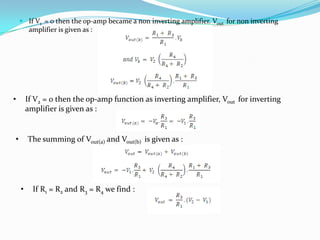
 If V1 = 0 then the op-amp became a non inverting amplifier. Vout for non inverting
amplifier is given as :

•

If V2 = 0 then the op-amp function as inverting amplifier, Vout for inverting
amplifier is given as :

•

The summing of Vout(a) and Vout(b) is given as :

•

If R1 = R2 and R3 = R4 we find :
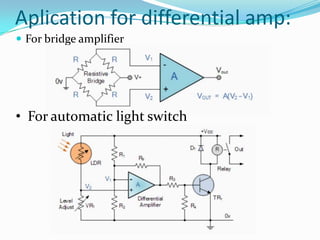
Aplication for differential amp:
 For bridge amplifier

• For automatic light switch
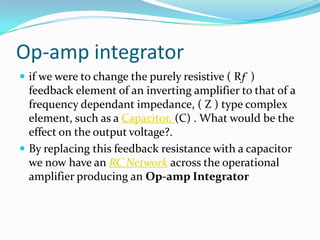
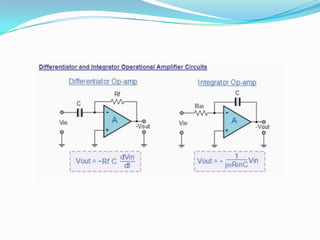
Op-amp integrator
 if we were to change the purely resistive ( Rƒ )

feedback element of an inverting amplifier to that of a
frequency dependant impedance, ( Z ) type complex
element, such as a Capacitor, (C) . What would be the
effect on the output voltage?.
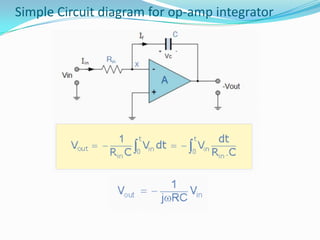
 By replacing this feedback resistance with a capacitor
we now have an RC Network across the operational
amplifier producing an Op-amp Integrator
Simple Circuit diagram for op-amp integrator
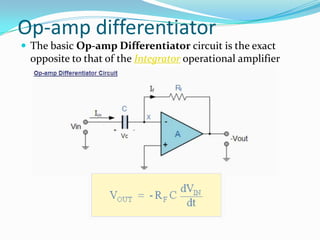
Op-amp differentiator
 The basic Op-amp Differentiator circuit is the exact

opposite to that of the Integrator operational amplifier
Summary
Operation amplifier
Operation amplifier

Operation amplifier

  • 1.
  • 2.
    Operation Amplifier (op-amp) Operation Amplifier circuit designed to boost the power of low level signal
  • 3.
     Op-amp arelinier devise that have all the properties required for nearly ideal DC amplification and are therefore used extensively in signal conditioning, filtering or to perform mathematical operation such as add, subtract, integration and differentiation.
  • 4.
    Ideal Op-Amp  Idealop-amp is basically a three terminal devise which consists of 2 high impedance input, one called the inverting input marked with a negative or minus sign (-) and the other one called the non-inverting input marked with positive or plus sign (+).  The third terminal represents the op-amp output which can both sink and source either a voltage or a current
  • 5.
    Block diagram ofop-amp Rs + - Vs Source Gain (A) Amplifier VL RL load Ideally the output voltage is amplified version of the source VL = A. Vs or
  • 6.
    From the sourcesee an equivalent resistance looking to the right or can be drawn : From the load see an equivalent source looking to the left or can be drawn : Rout Rs + - Vs Vin R in Ideally Vin = Vs because Rin + - VL RL A.Vin Ideally VL = A.Vin because Rout
  • 8.
    Schematic symbol op- amp There are : 2 input : inverting input (+) and non – inverting input 1 output 2 terminal for power supply (+ and -)
  • 9.
    Ideal op-amp characteristic Rin = Vin = VS  Rout = 0 VL = A.Vin  Open loop gain (A) = Open loop gain op-amp without positive or negative feedback and for ideal amplifier the gain will be infinite ( ) but typical real value range from 20.000 to 200.000
  • 10.
    Inverting Amplifier  Invertingamplifier configuration :
  • 11.
    Negative feedback  NegativeFeedback is the process of "feeding back" a fraction of the     output signal back to the input, but to make the feedback negative, we must feed it back to the negative or "inverting input" terminal of the op-amp using an external Feedback Resistor called Rƒ. This feedback connection between the output and the inverting input terminal forces the differential input voltage towards zero This effect produces a closed loop circuit to the amplifier resulting in the gain of the amplifier now being called its Closed-loop Gain This negative feedback results in the inverting input terminal having a different signal on it than the actual input voltage as it will be the sum of the input voltage plus the negative feedback voltage giving it the label or term of a Summing Point. We must therefore separate the real input signal from the inverting input by using an Input Resistor, Rin
  • 12.
     There aretwo very important rules to remember about Inverting Amplifiers or any operational amplifier for that matter and these are 1. No Current Flows into the Input Terminals 2. The Differential Input Voltage is Zero as V1 = V2 = 0  Then by using these two rules we can derive the equation for calculating the closed-loop gain of an inverting amplifier, using first principles
  • 13.
    Keep on yourmind: This amplification process limited by power supply voltage ! Negative sign means inverting amplifier
  • 14.
    Transresistance Amplifier Circuit Another useful application of an inverting amplifier is that of a "transresistance amplifier" circuit.  A Transresistance Amplifier also known as a "transimpedance amplifier", is basically a current-tovoltage converter (Current "in" and Voltage "out").  They can be used in low-power applications to convert a very small current generated by a photo-diode or photo-detecting device etc, into a usable output voltage which is proportional to the input current as shown
  • 15.
  • 16.
    Non – InvertingAmplifier  In this configuration, the input voltage signal, ( Vin ) is applied directly to the non-inverting ( + ) input terminal which means that the output gain of the amplifier becomes "Positive" in value in contrast to the "Inverting Amplifier" circuit  The result of this is that the output signal is "in-phase" with the input signal
  • 17.
  • 18.
  • 19.
    Voltage Follower  Ifwe made the feedback resistor, Rƒ equal to zero, (Rƒ = 0), and resistor R2 equal to infinity, (R2 = ∞), then the circuit would have a fixed gain of "1" as all the output voltage would be present on the inverting input terminal (negative feedback).  This would then produce a special type of the noninverting amplifier circuit called a Voltage Follower or also called a "unity gain buffer"
  • 20.
  • 21.
    Summing Amplifier  TheSumming Amplifier is a very flexible circuit based upon the standard Inverting Operational Amplifier configuration that can be used for combining multiple inputs  previously in the inverting amplifier tutorial that the inverting amplifier has a single input voltage, ( Vin ) applied to the inverting input terminal. If we add more input resistors to the input, each equal in value to the original input resistor, Rin we end up with another operational amplifier circuit called a Summing Amplifier "summing inverter" or even a "voltage adder”
  • 22.
  • 23.
  • 25.
    Differential Amplifier  Ifwe connect signals to both of the inputs at the same time producing another common type of operational amplifier circuit called a Differential Amplifier.  by connecting one voltage signal (V1) onto one input terminal and another voltage signal (V2) onto the other input terminal the resultant output voltage (Vout) will be proportional to the "Difference" between the two input voltage signals of V1 and V2 .  Then differential amplifiers amplify the difference between two voltages making this type of operational amplifier circuit a Subtractor unlike a summing amplifier which adds or sums together the input voltages. This type of operational amplifier circuit is commonly known as a Differential Amplifier configuration
  • 26.
  • 27.
     If V1= 0 then the op-amp became a non inverting amplifier. Vout for non inverting amplifier is given as : • If V2 = 0 then the op-amp function as inverting amplifier, Vout for inverting amplifier is given as : • The summing of Vout(a) and Vout(b) is given as : • If R1 = R2 and R3 = R4 we find :
  • 28.
    Aplication for differentialamp:  For bridge amplifier • For automatic light switch
  • 29.
    Op-amp integrator  ifwe were to change the purely resistive ( Rƒ ) feedback element of an inverting amplifier to that of a frequency dependant impedance, ( Z ) type complex element, such as a Capacitor, (C) . What would be the effect on the output voltage?.  By replacing this feedback resistance with a capacitor we now have an RC Network across the operational amplifier producing an Op-amp Integrator
  • 30.
    Simple Circuit diagramfor op-amp integrator
  • 31.
    Op-amp differentiator  Thebasic Op-amp Differentiator circuit is the exact opposite to that of the Integrator operational amplifier
  • 32.