2
Outlin
e
• Deadlock: definition
•Conditions for Deadlock
• Deadlock examples
• Starvation
• Resource types
• Methods for handling
deadlock
- Ostrich algorithm
- Deadlock detection and
recovery
- Deadlock prevention
- Deadlock avoidance
3.
3
Deadloc
k
• For manyapplications, a process needs exclusive access to
not one resource, but several.
• Suppose, for example, two processes each want to
record a scanned document on a CD.
– Process A requests permission to use the scanner and is granted
it.
– Process B is programmed differently and requests the CD recorder
first and is also granted it.
• Now A asks for the CD recorder, but the request is denied
until B releases it.
• Unfortunately, instead of releasing the CD recorder B asks
for the scanner.
• At this point both processes are blocked and will
remain so forever.
• This situation is called a deadlock.
4.
4
Deadlock
…
• Deadlock canbe defined formally as follows:
– A set of processes is deadlocked if each member
of the set of deadlocked processes is waiting
for a resource that is owned by a deadlocked
process.
– None of the processes can run,
– none of them can release any resources, and
– all the processes continue to wait forever.
5.
5
Conditions for
Deadlock
• Fourconditions must hold for there to be a
deadlock:
1. Mutual exclusion condition. Each resource is either currently
assigned to exactly one process or is available.
2. Hold and wait condition. Processes currently holding
resources granted earlier can request new resources.
3. No preemption condition. Resources previously granted cannot
be forcibly taken away from a process. They must be explicitly
released by the process holding them.
4. Circular wait condition. There must be a circular chain of two or
more processes, each of which is waiting for a resource held by
the next member of the chain.
• All four of these conditions must be present for a deadlock
to occur.
• If one of them is absent, no deadlock is possible.
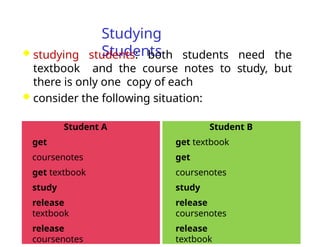
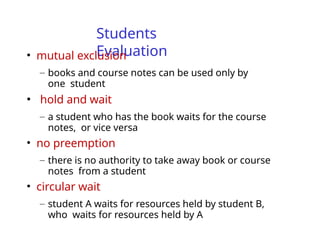
Students
Evaluation
• mutual exclusion
–books and course notes can be used only by
one student
• hold and wait
– a student who has the book waits for the course
notes, or vice versa
• no preemption
– there is no authority to take away book or course
notes from a student
• circular wait
– student A waits for resources held by student B,
who waits for resources held by A
11.
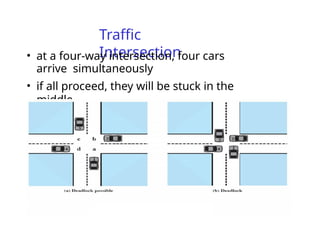
Traffic
Intersection
• at afour-way intersection, four cars
arrive simultaneously
• if all proceed, they will be stuck in the
middle
12.
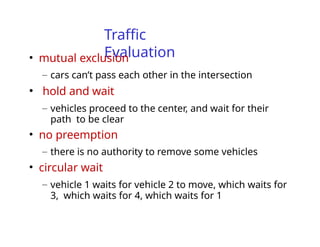
Traffic
Evaluation
• mutual exclusion
–cars can’t pass each other in the intersection
• hold and wait
– vehicles proceed to the center, and wait for their
path to be clear
• no preemption
– there is no authority to remove some vehicles
• circular wait
– vehicle 1 waits for vehicle 2 to move, which waits for
3, which waits for 4, which waits for 1
13.
Starvatio
n
• a processcan’t proceed because other
processes always have the resources it
needs
• the request of the process is never
satisfied
• in principle, it is possible to get the
resource, but doesn’t happen because of
– low priority of the process
– timing of resource requests
– ill-designed resource allocation or
scheduling algorithm
• different from deadlock
14.
Examples
Starvation
• batch processeswith low priority in a
heavily used time-sharing system
• crossing a very busy road
• trying to call a very popular phone
number
– radio station giveaways
• getting into a very popular course with
limited enrollment
15.
Solution
Starvation
• fairness: eachprocess gets its fair share of
all resources it requests
– how is fair defined?
– how is it enforced?
• aging
– the priority of a request is increased the longer
the process waits for it
16.
Starvation vs
Deadlock
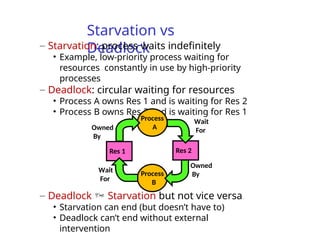
– Starvation:process waits indefinitely
• Example, low-priority process waiting for
resources constantly in use by high-priority
processes
– Deadlock: circular waiting for resources
• Process A owns Res 1 and is waiting for Res 2
• Process B owns Res 2 and is waiting for Res 1
– Deadlock Starvation but not vice versa
• Starvation can end (but doesn’t have to)
• Deadlock can’t end without external
intervention
Res 2
Res 1
Process
B
Process
A
Wait
For
Wait
For
Owned
By
Owned
By
17.
Resource
Types
• reusable resources
–can be used repeatedly by different processes
– does not imply simultaneous use
– OS examples: CPU, main memory, I/O devices,
data structures
• consumable resources
– are produced by one entity, and consumed
by another
– reuse is not possible, or impractical
– OS examples: messages
18.
Symbols
Resource-Allocation
Graph
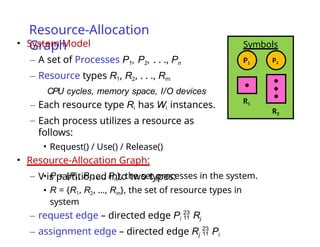
• System Model
–A set of Processes P1, P2, . . ., Pn
– Resource types R1, R2, . . ., Rm
CPU cycles, memory space, I/O devices
– Each resource type Ri has Wi instances.
– Each process utilizes a resource as
follows:
• Request() / Use() / Release()
• Resource-Allocation Graph:
– V is partitioned into two types:
• P = {P1, P2, …, Pn}, the set processes in the system.
• R = {R1, R2, …, Rm}, the set of resource types in
system
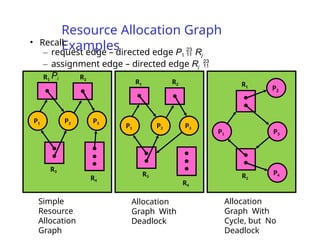
– request edge – directed edge Pi Rj
– assignment edge – directed edge Rj Pi
R1
R2
P1 P2
20
Basic
Facts
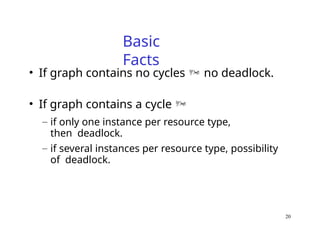
• If graphcontains no cycles no deadlock.
• If graph contains a cycle
– if only one instance per resource type,
then deadlock.
– if several instances per resource type, possibility
of deadlock.
21.
21
Methods for HandlingDeadlocks
• Ensure that the system will never enter
a deadlock state.
– have strict rules that prevent a deadlock
from occurring
• Allow the system to enter a deadlock state
and then recover.
• Ignore the problem and pretend that
deadlocks never occur in the system;
frequently used by most operating systems,
like
• Windows, MacOS, Unix, ...
22.
22
What kind of
resources?
•Resources come in two types:
– Pre-emptible and non pre-emptible.
• A pre-emptible resource is one that can be
taken away from the process owning it with no
ill effects.
– Memory is an example of a pre-emptible resource.
• A nonpreemptable resource, in contrast, is
one that cannot be taken away from its
current owner without causing the
computation to fail.
– Burning file into CD
• Deadlocks involve in nonpreemptable
23.
23
What kind of
resources?
•Potential deadlocks that involve pre-
emptible resources can usually be
resolved:
– by reallocating resources from one process to
another.
• Thus our treatment will focus on
nonpreemptable resources:
• The sequence of events required to use a
resource is given below in an abstract form.
1. Request the resource.
2. Use the resource.
3. Release the resource.
24.
24
Four strategies areused for dealing
with deadlocks:
1 Just ignore the problem altogether - Maybe if
you ignore it, it will ignore you.
2 Detection and recovery - Let deadlocks occur,
detect them, and take action.
3 Dynamic avoidance by careful resource
allocation.
4 Prevention - by structurally negating one of the
four conditions necessary to cause a deadlock.
25.
25
THE OSTRICH
ALGORITHM
• Thesimplest approach the ostrich algorithm:
• stick your head in the sand and pretend there is
no problem at all.
– Mathematicians find it totally unacceptable and say
that dead locks must be prevented at all costs.
– Engineers ask how often the problem is expected, how
often the system crashes for other reasons, and how
serious a deadlock is.
26.
26
Deadlock Detection and
Recovery
DetectionAlgorithms
– Deadlock Detection with One Resource of Each Type
– Deadlock Detection with Multiple Resources of Each
Type
Recovery from Deadlock
– Recovery through Preemption
– Recovery through Rollback
– Recovery through Killing Processes
27.
27
Deadlock Detection withOne Resource
of Each Type
• Assume that only one resource of each
type exists.
– Such a system might have one scanner, one
CD recorder, one plotter, and one tape drive.
• We can construct a resource graph.
• If this graph contains one or more cycles, a
deadlock exists.
• Any process that is part of a cycle is deadlocked.
• If no cycles exist, the system is not deadlocked.
28.
28
Deadlock Detection withOne Resource
of Each Type…
• Maintain wait - for graph
– Nodes are processes
– Pi Pj if Pi is waiting for Pj
• Periodically invoke an algorithm that
searches for a cycle in the graph.
• If there is a cycle, there exists a deadlock.
• An algorithm to detect a cycle in a graph
requires an order of n 2 operations, where n
is the number of vertices in the graph
29.
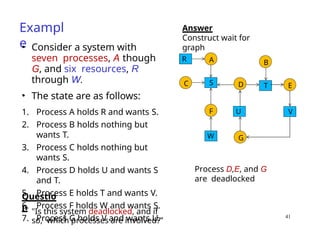
Exampl
e
• Consider asystem with
seven processes, A though
G, and six resources, R
through W.
• The state are as follows:
1. Process A holds R and wants S.
2. Process B holds nothing but
wants T.
3. Process C holds nothing but
wants S.
4. Process D holds U and wants S
and T.
5. Process E holds T and wants V.
6. Process F holds W and wants S.
7. Process G holds V and wants U.
Questio
n
• "Is this system deadlocked, and if
so, which processes are involved?”
Answer
Construct wait for
graph
R A
S
C
F
W
D T E
G
U V
B
Process D,E, and G
are deadlocked
41
30.
30
Recovery from
Deadlock
• Supposethat our deadlock detection
algorithm has succeeded and detected a
deadlock.
• What is next?
• Some way is needed to recover and get
the system going again.
• In this section, we will discuss various ways
of recovering from deadlock.
31.
31
Recovery from
Deadlock…
• Rollback each deadlocked process to
some previously defined checkpoint, and
restart all process
– Original deadlock may occur
• Successively kill deadlocked processes
until deadlock no longer exists
• Successively preempt resources until
deadlock no longer exists
32.
32
Recovery from
Deadlock:
Process
Termination
• Abortall deadlocked processes.
• Abort one process at a time until the
deadlock cycle is eliminated.
• In which order should we choose to abort?
– Priority of the process.
– How long process has computed, and how much
longer to completion.
– Resources the process has used.
– Resources process needs to complete.
– How many processes will need to be terminated.
– Is process interactive or batch?
33.
33
Recovery from Deadlock:Resource Preemption
• Selecting a victim – minimize cost.
• Rollback – return to some safe state,
restart process for that state.
• Starvation – same process may always be
picked as victim, include number of
rollback in cost factor.
34.
34
Deadlock
Prevention
• set ofrules ensures that at least one of the
four necessary conditions for deadlock
doesn’t hold
– mutual exclusion
– hold and wait
– no preemption
– circular wait
• may result in low resource utilization,
reduced system throughput
35.
35
Deadlock
Prevention…
1. Prevent thecircular-wait condition by defining a linear ordering
of resource types
• A process can be assigned resources only according to the
linear ordering (e.g., sequence number)
• Disadvantages
- Resources cannot be requested in the order that are needed
- Resources will be longer than necessary
2. Prevent the hold-and-wait condition by requiring the process
to acquire all needed resources before starting execution
• Disadvantages
– Inefficient use of resources
– Reduced concurrency
– Process can become deadlocked during the initial
resource acquisition
– Future needs of a process cannot be always predicted
36.
36
Deadlock
Prevention…
3. Denying NoPreemption
• means that processes may be preempted by the OS
– should only done when necessary
• resources of a process trying to acquire another
unavailable resource may be preempted
• preempt resources of processes waiting for
additional resources, and give some to the
requesting process
• possible only for some types of resources
– state must be easily restorable
– e.g. CPU, memory
37.
37
Deadlock
Avoidance
• Basic Principle:Requires that the system has
some additional a priori informationavailable
• Simplest and most useful model requires that each
process declare the maximum number of
resources of each type that it may need to hold
simultaneously. (maximum demand)
• The deadlock-avoidance algorithm dynamically examines
the resource-allocation state to ensure that there can
never be a circular-wait condition.
• Resource-allocation state is defined by the
number of available and allocated resources, and
the maximum demands of the processes
38.
38
Deadlock
Avoidance…
• The systemmust be able to decide whether
granting a resource is safe or not and only make
the allocation when it is safe.
• Thus, the question arises: Is there an algorithm
that can always avoid deadlock by making the
right choice all the time?
• The answer is a qualified yes-we can avoid
deadlocks.
• Algorithms
– Safe and Unsafe States
– The Bankers algorithm
39.
39
Safe
state
• When aprocess requests an available resource,
system must decide if immediate allocation leaves the
system in a safe state
• A state is safe if the system can allocate resources to
each process (up to its maximum) in some order and
still avoid a deadlock.
• We are considering a worst-case situation here.
• Even in the worst case (process requests up their
maximum at the moment), we don’t have deadlock
in a safe state.
40.
40
Basic
Facts
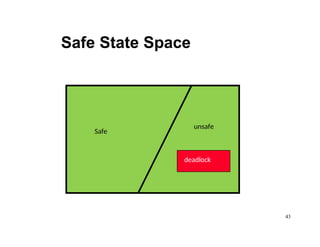
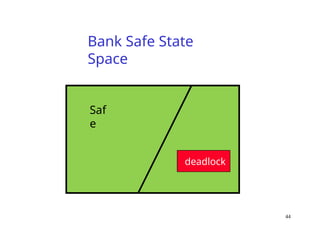
• If asystem is in safe state no deadlocks
• If a system is in unsafe state possibility of
deadlock
• Avoidance ensure that a system will never enter
an unsafe state.
– When a request is done by a process for
some resource(s):
– check before allocating resource(s);
– if it will leave the system in an unsafe state, then
do not allocate the resource(s);
– process is waited and resources are not allocated to
that process.
41.
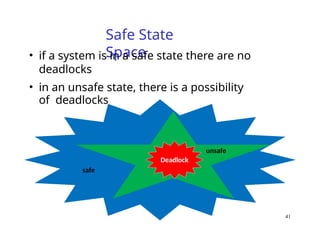
Safe State
Space
41
• ifa system is in a safe state there are no
deadlocks
• in an unsafe state, there is a possibility
of deadlocks
unsafe
Deadlock
safe
42.
42
Deadlock Avoidance
Algorithms
• Singleinstance of a resource type
– Use a resource-allocation graph
• Multiple instances of a resource
type
– Use the banker’s algorithm
45
The Banker’s
Algorithm
• beforea request is granted, check the
system’s state
– assume the request is granted
– if it is still safe, the request can be honored
– otherwise the process has to wait
– overly careful
• there are cases when the system is unsafe, but not
in a deadlock
46.
Combined Approach to
Deadlock
Handling
46
•Combine the three basic approaches
– prevention
– avoidance
– detection
allowing the use of the optimal approach for
each of resources in the system.
• Partition resources into hierarchically ordered
classes.
• Use most appropriate technique for handling
deadlocks within each class.


![3 (1) [Autosaved].ppt](https://cdn.slidesharecdn.com/ss_thumbnails/31autosaved-221227201419-17f998ab-thumbnail.jpg?width=640&height=640&fit=bounds)


