Universitat Politècnica de Catalunya
BARCELONA TECH
Madrid. March 30, 2017
Eduard Ayguadé
Dep. Arquitectura de Computadors, U. Politècnica de Catalunya
Computer Sciences Dep., Barcelona Supercomputing Center
OpenMP tasking model: from the
standard to the classroom
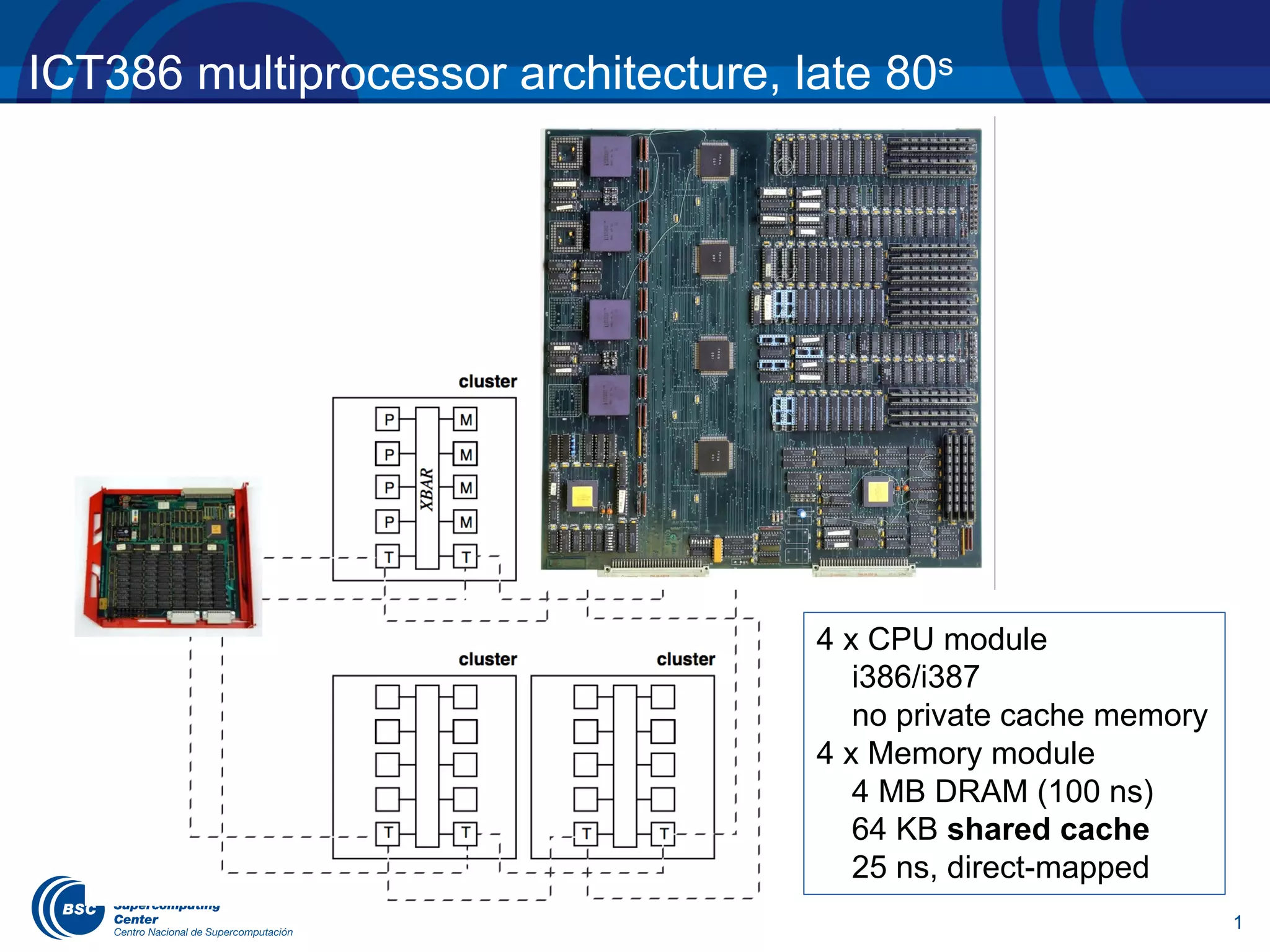
ICT386 multiprocessor architecture, late 80s
1
4 x CPU module
i386/i387
no private cache memory
4 x Memory module
4 MB DRAM (100 ns)
64 KB shared cache
25 ns, direct-mapped
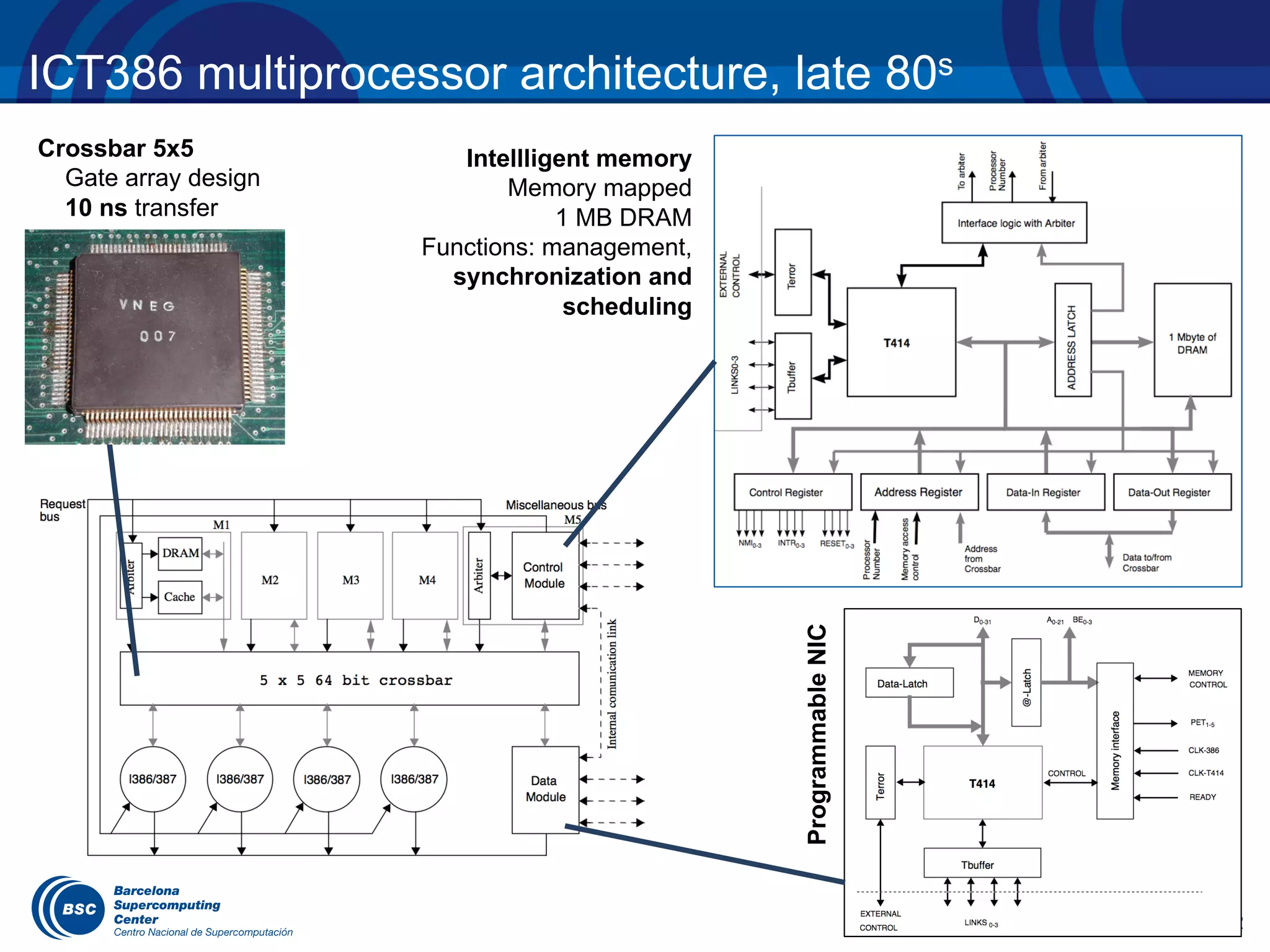
ICT386 multiprocessor architecture, late 80s
2
Crossbar 5x5
Gate array design
10 ns transfer
Intellligent memory
Memory mapped
1 MB DRAM
Functions: management,
synchronization and
scheduling
ProgrammableNIC
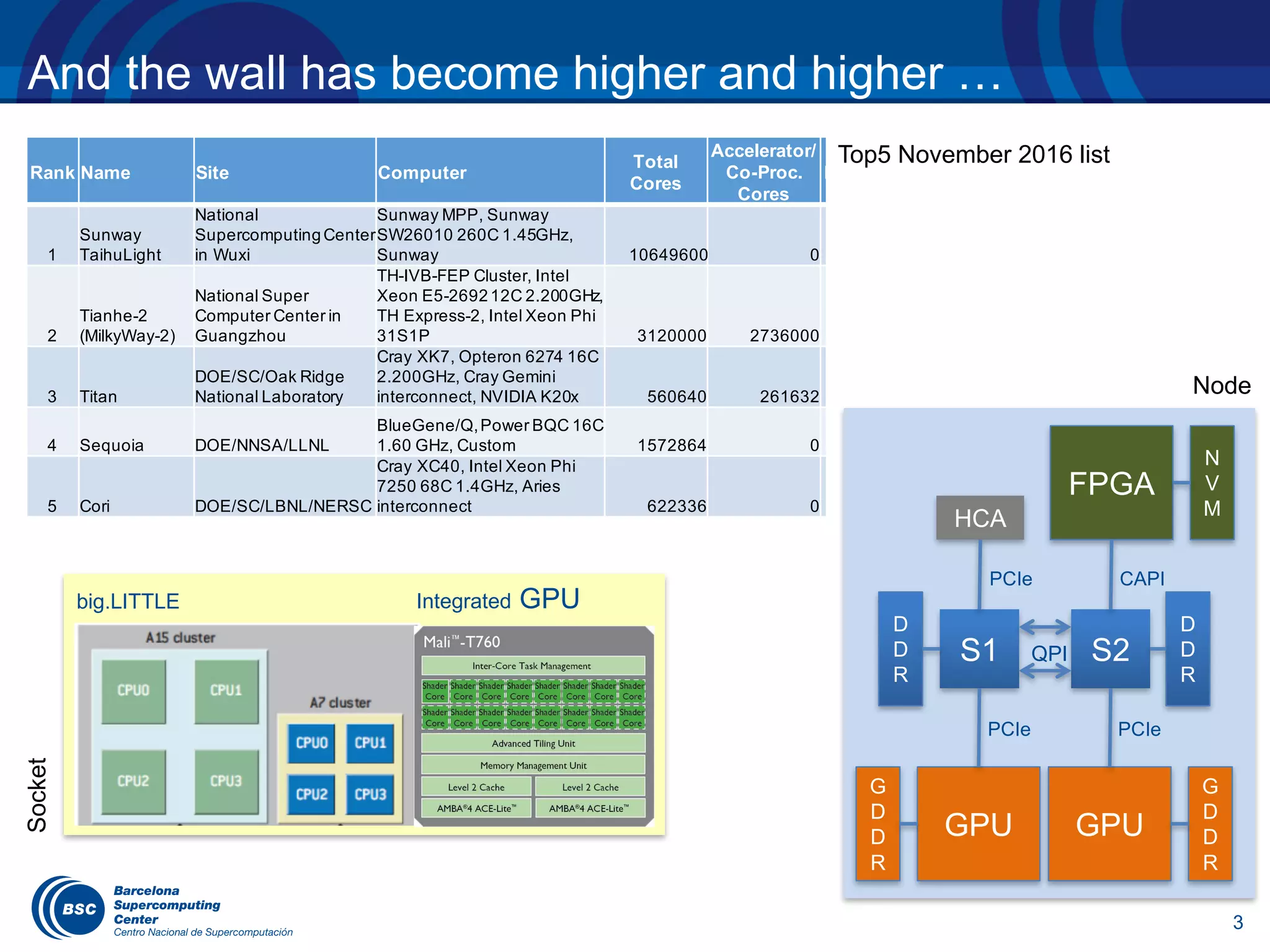
And the wall has become higher and higher …
3
big.LITTLE Integrated GPU
Socket
S1 S2
GPU
G
D
D
R
GPU
G
D
D
R
D
D
R
D
D
R
FPGA
N
V
M
HCA
CAPIPCIe
PCIePCIe
QPI
Node
Rank Name Site Computer
Total
Cores
Accelerator/
Co-Proc.
Cores
Rmax (Gflops)
Rpeak
(Gflops)
Power (KW) Mflops/Wa
1
Sunway
TaihuLight
National
SupercomputingCenter
in Wuxi
Sunway MPP, Sunway
SW26010 260C 1.45GHz,
Sunway 10649600 0 93014593,88 125435904 15371 6051,
2
Tianhe-2
(MilkyWay-2)
National Super
Computer Center in
Guangzhou
TH-IVB-FEP Cluster, Intel
Xeon E5-269212C 2.200GHz,
TH Express-2, Intel Xeon Phi
31S1P 3120000 2736000 33862700 54902400 17808 1901,
3 Titan
DOE/SC/Oak Ridge
National Laboratory
Cray XK7, Opteron 6274 16C
2.200GHz, Cray Gemini
interconnect, NVIDIA K20x 560640 261632 17590000 27112550 8209 2142,
4 Sequoia DOE/NNSA/LLNL
BlueGene/Q,Power BQC 16C
1.60 GHz, Custom 1572864 0 17173224 20132659,2 7890 2176,
5 Cori DOE/SC/LBNL/NERSC
Cray XC40, Intel Xeon Phi
7250 68C 1.4GHz, Aries
interconnect 622336 0 14014700 27880653 3939 3557,
6
Oakforest-
PACS
Joint Center for
Advanced High
Performance Computing
PRIMERGY CX1640 M1, Intel
Xeon Phi 7250 68C 1.4GHz,
Intel Omni-Path 556104 0 13554600 24913459 2718 4985,
7 K computer
RIKEN Advanced
Institute for
Computational Science
(AICS)
K computer, SPARC64 VIIIfx
2.0GHz, Tofu interconnect 705024 0 10510000 11280384 12660 830,
8 Piz Daint
Swiss National
SupercomputingCentre
(CSCS)
Cray XC50, Xeon E5-2690v3
12C 2.6GHz, Aries
interconnect , NVIDIA Tesla
P100 206720 170240 9779000 15987968 1312 7453,
9 Mira
DOE/SC/Argonne
National Laboratory
BlueGene/Q,Power BQC 16C
1.60GHz, Custom 786432 0 8586612 10066330 3945 2176,
10 Trinity DOE/NNSA/LANL/SNL
Cray XC40, Xeon E5-2698v3
16C 2.3GHz, Aries
interconnect 301056 0 8100900 11078861 4232 1913,
Top5 November 2016 list
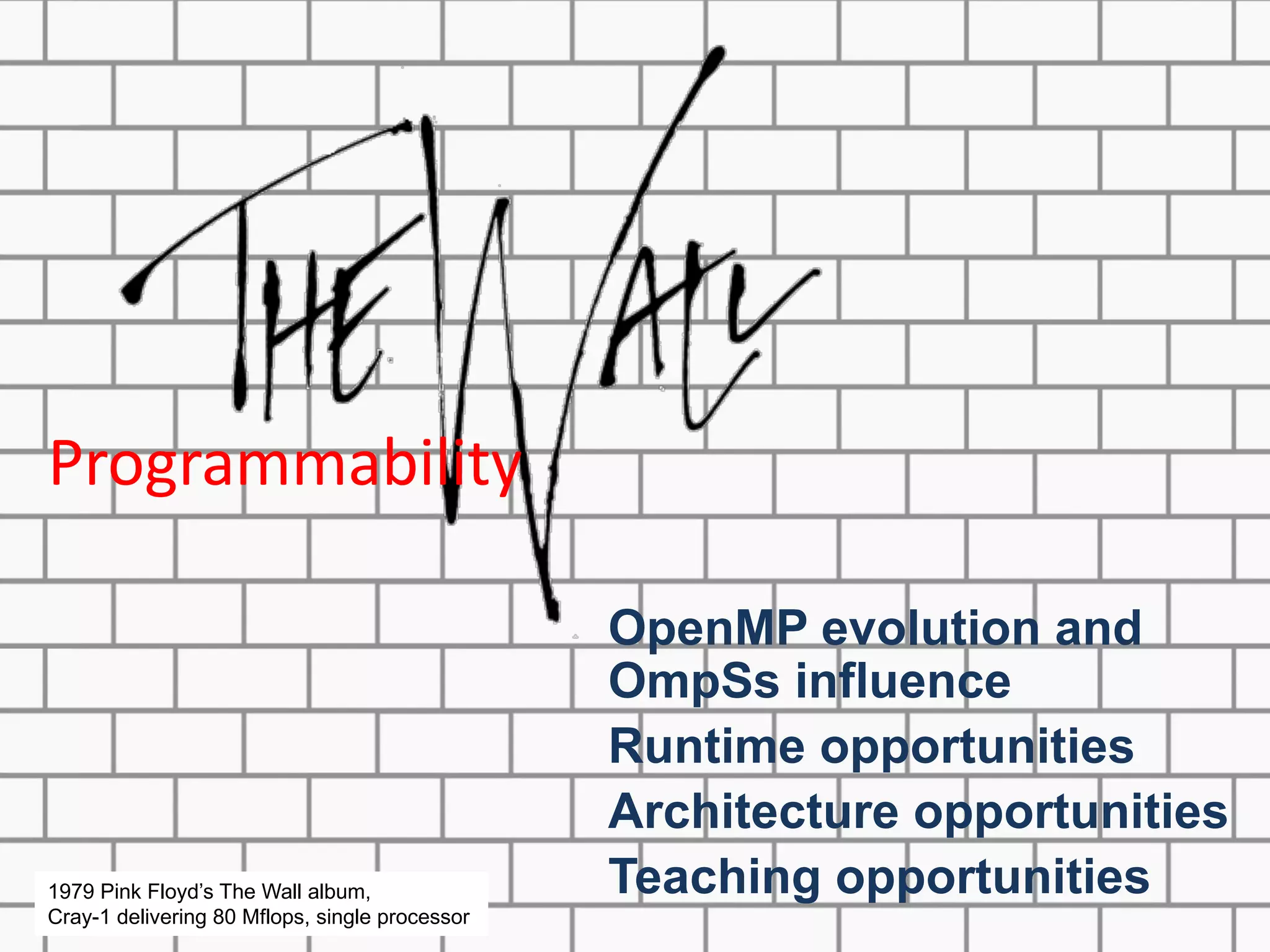
1979 Pink Floyd’s The Wall album,
Cray-1 delivering 80 Mflops, single processor
OpenMP evolution and
OmpSs influence
Runtime opportunities
Architecture opportunities
Teaching opportunities
Programmability
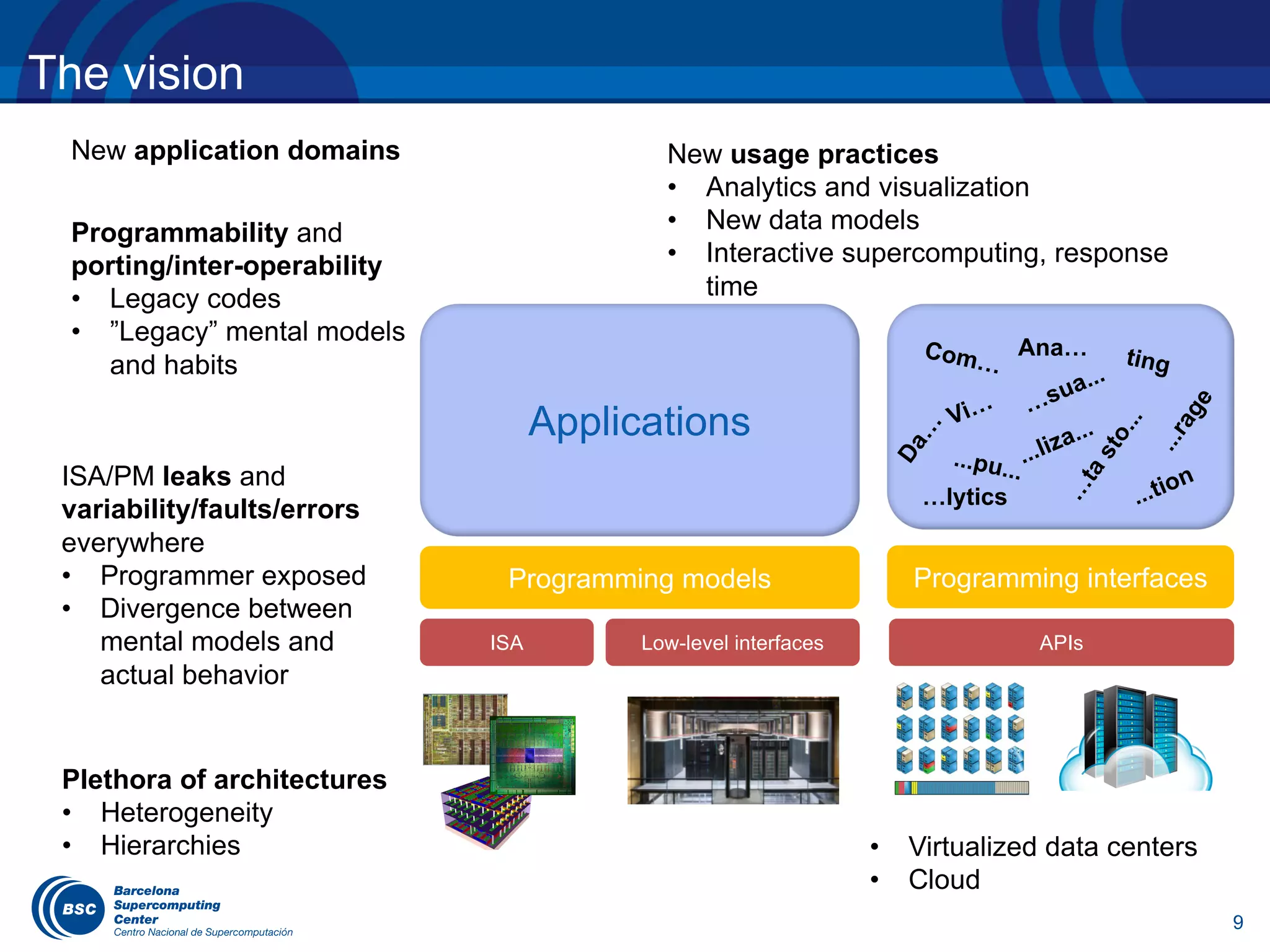
The vision
Plethora of architectures
• Heterogeneity
• Hierarchies
ISA Low-level interfaces
ISA/PM leaks and
variability/faults/errors
everywhere
• Programmer exposed
• Divergence between
mental models and
actual behavior
New application domains
Programming models
Applications
Programmability and
porting/inter-operability
• Legacy codes
• ”Legacy” mental models
and habits
APIs
New usage practices
• Analytics and visualization
• New data models
• Interactive supercomputing, response
time
• Virtualized data centers
• Cloud
Programming interfaces
Ana…
…lytics
9
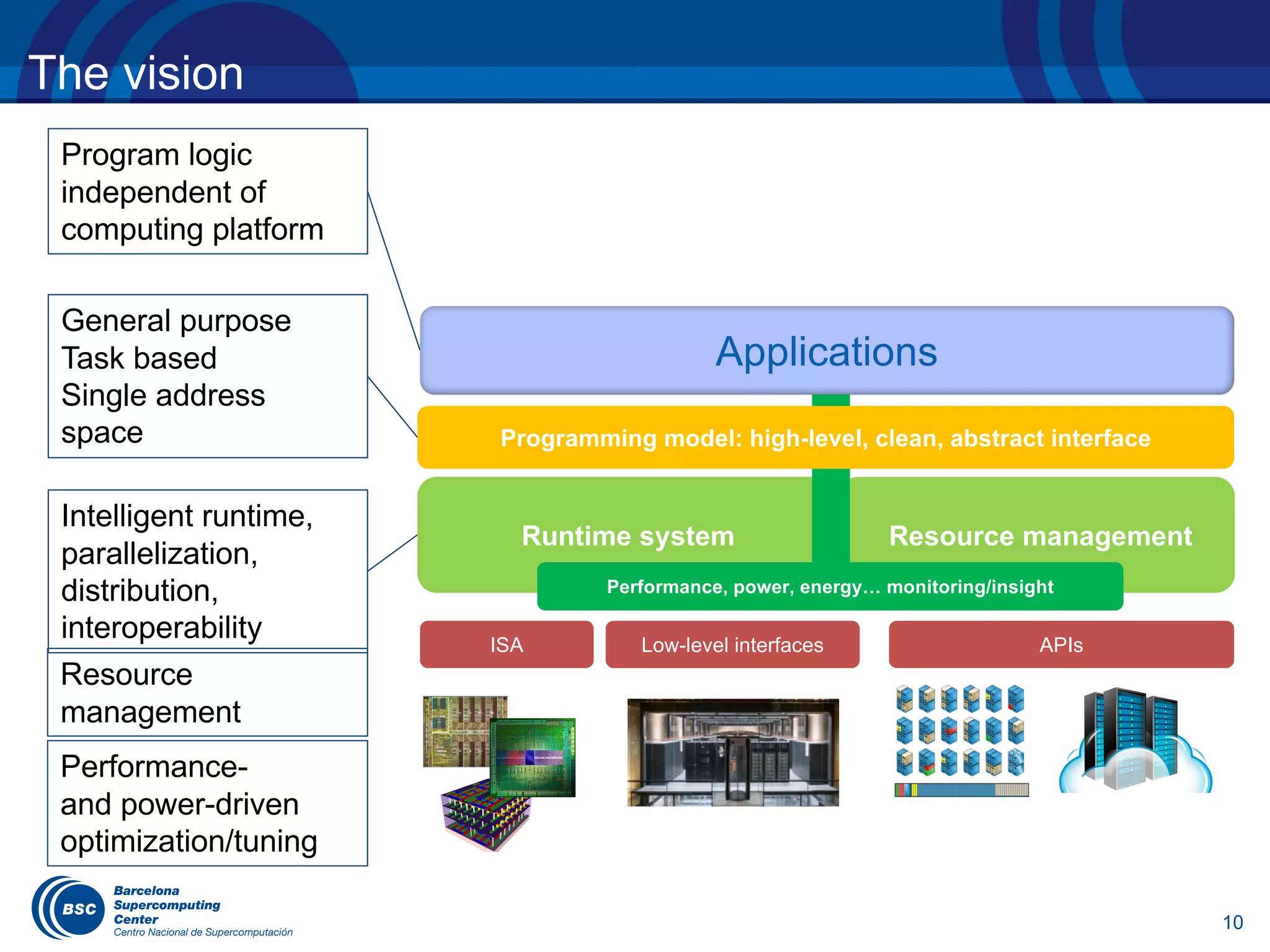
The vision
10
Intelligent runtime,
parallelization,
distribution,
interoperability
General purpose
Task based
Single address
space
Program logic
independent of
computing platform
Performance-
and power-driven
optimization/tuning
Resource
management
ISA Low-level interfaces APIs
Runtime system Resource management
Performance, power, energy… monitoring/insight
Applications
Programming model: high-level, clean, abstract interface
7
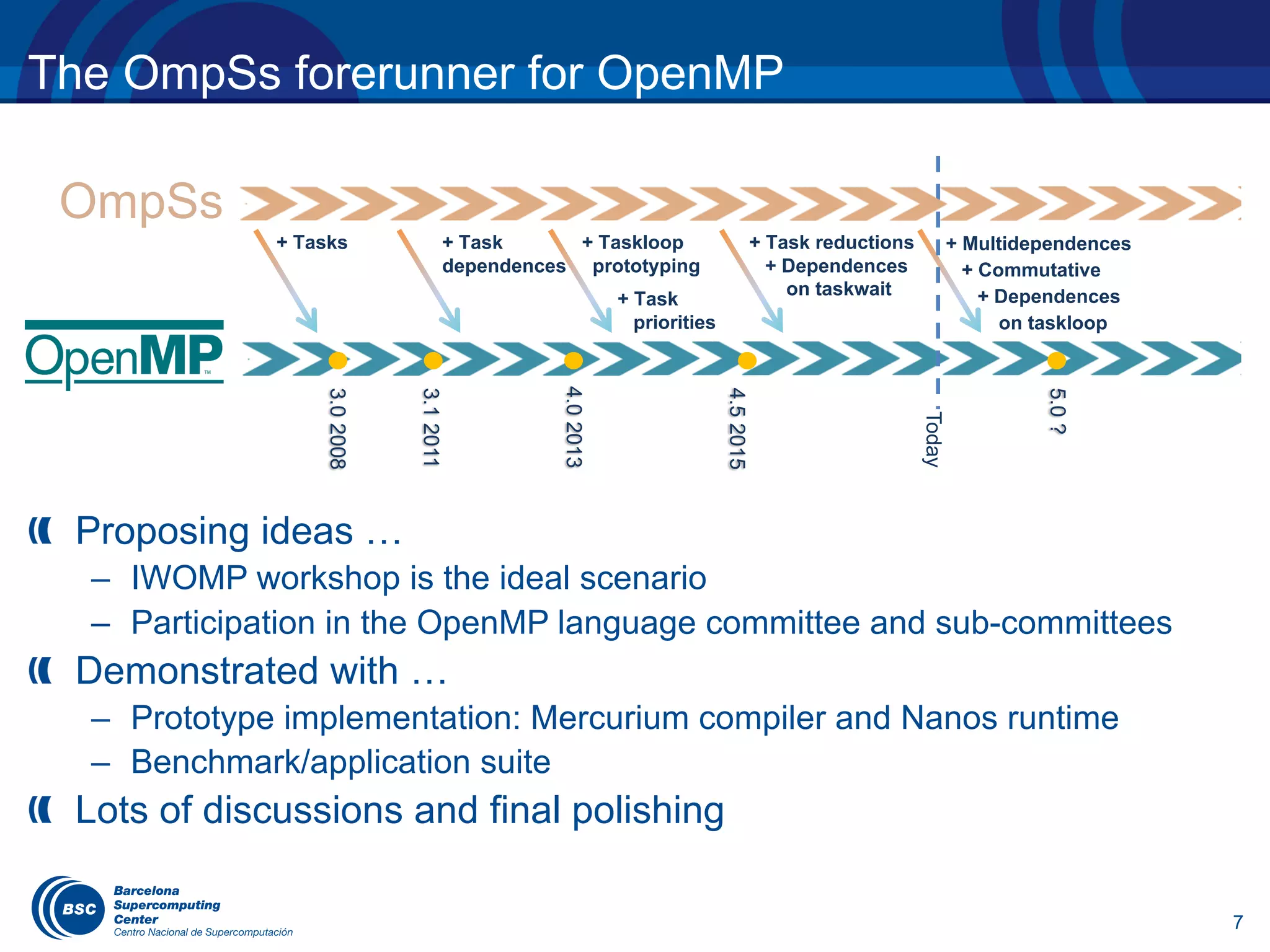
The OmpSs forerunner for OpenMP
Proposing ideas …
– IWOMP workshop is the ideal scenario
– Participation in the OpenMP language committee and sub-committees
Demonstrated with …
– Prototype implementation: Mercurium compiler and Nanos runtime
– Benchmark/application suite
Lots of discussions and final polishing
3.02008
+ Tasks + Task
dependences
+ Task
priorities
+ Taskloop
prototyping
+ Task reductions
+ Dependences
on taskwait
+ Multidependences
+ Commutative
+ Dependences
on taskloop
Today
3.12011
4.02013
4.52015
5.0?
OmpSs
8
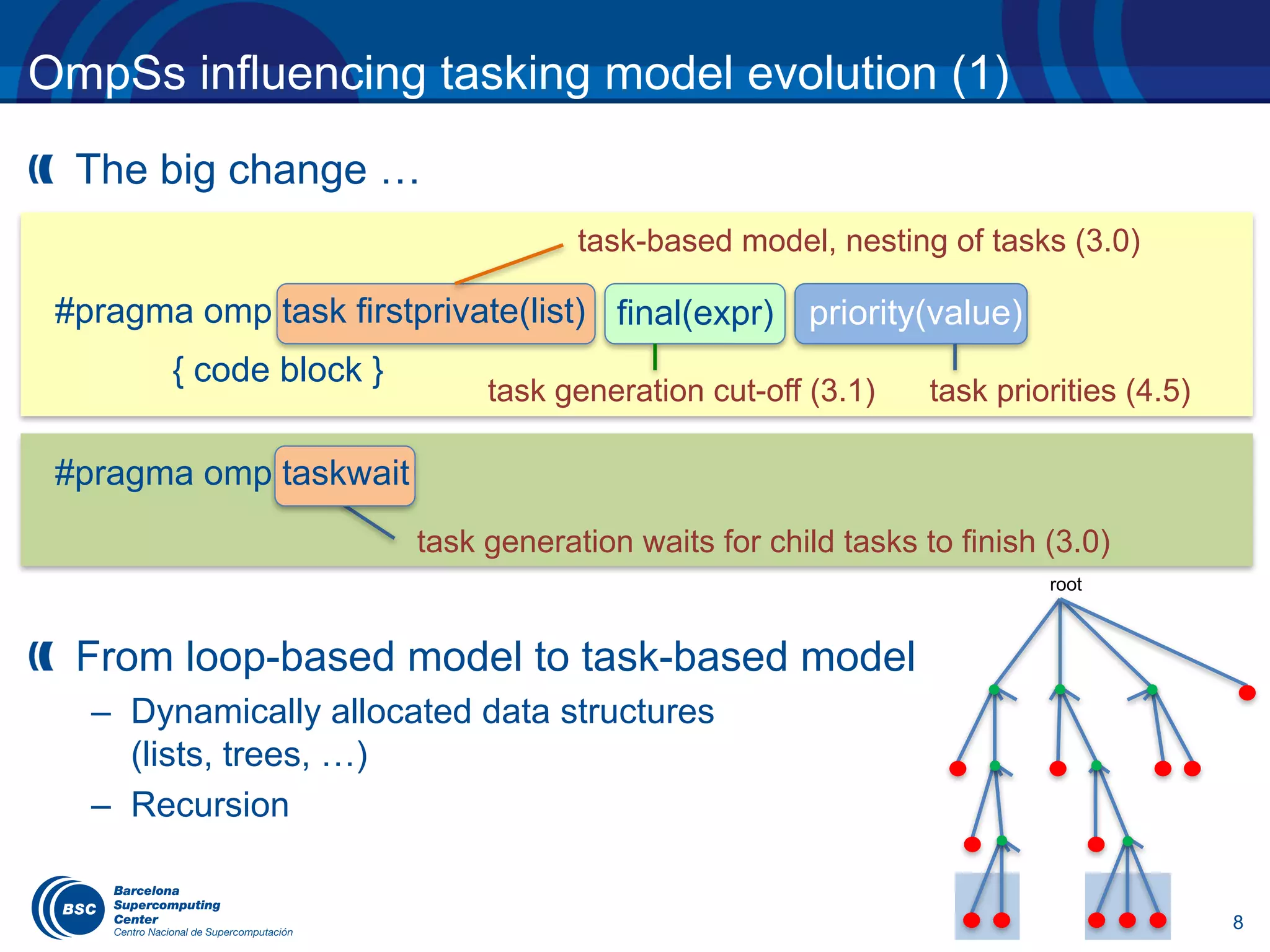
OmpSs influencing tasking model evolution (1)
The big change …
From loop-based model to task-based model
– Dynamically allocated data structures
(lists, trees, …)
– Recursion
task generation waits for child tasks to finish (3.0)
task-based model, nesting of tasks (3.0)
#pragma omp task firstprivate(list)
{ code block }
#pragma omp taskwait
task priorities (4.5)
priority(value)
task generation cut-off (3.1)
final(expr)
root
9
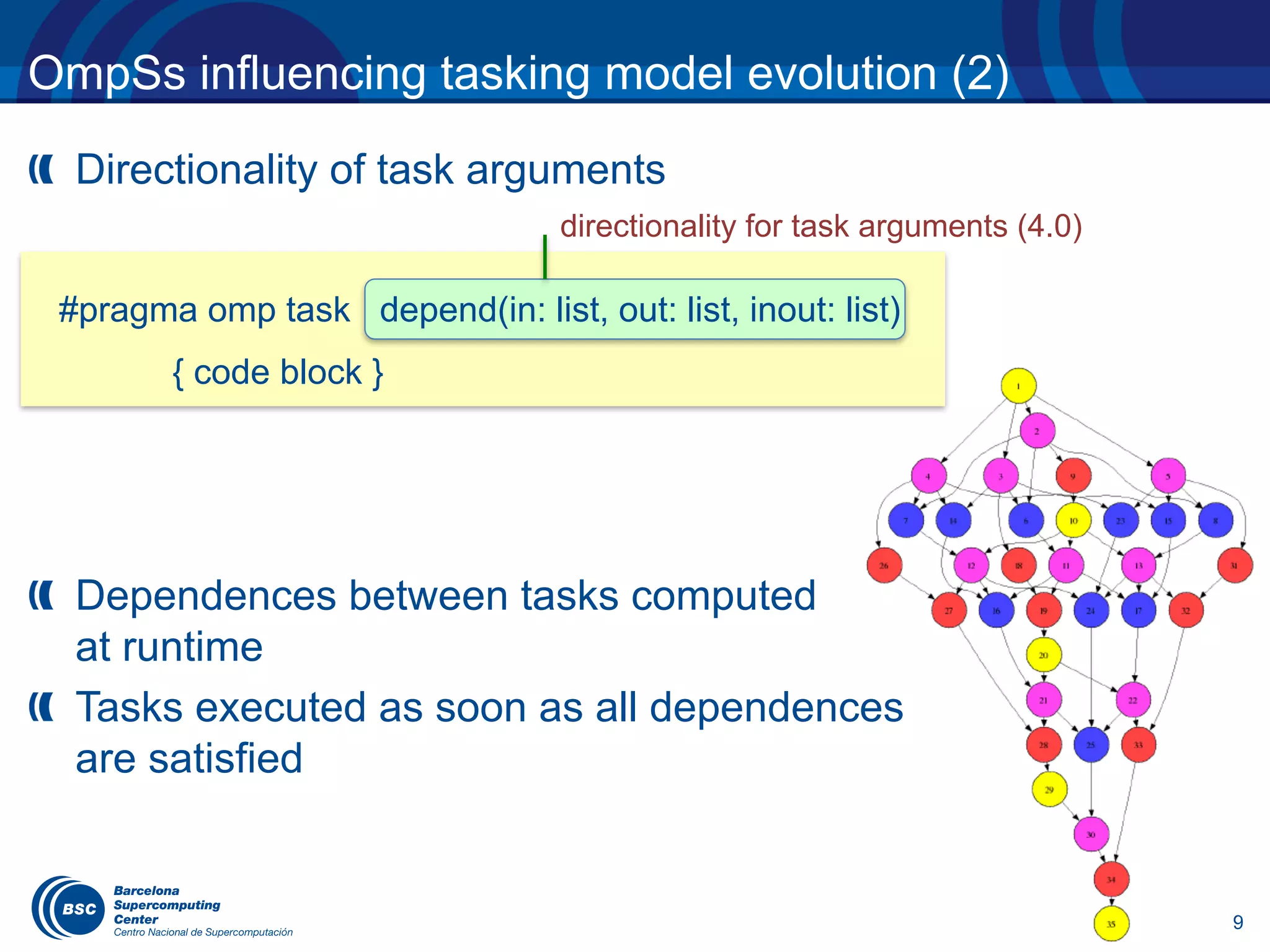
OmpSs influencing tasking model evolution (2)
Directionality of task arguments
Dependences between tasks computed
at runtime
Tasks executed as soon as all dependences
are satisfied
directionality for task arguments (4.0)
#pragma omp task depend(in: list, out: list, inout: list)
{ code block }
10
OmpSs influencing tasking model evolution (3)
Tasks become chunks of iterations of one or more associated
loops
Dependences between tasks generated in the same or
different taskloop construct under discussion
tasks out of loops and granularity control (4.5)
#pragma omp taskloop [num_tasks(value) | grainsize(value)]
for-loops
#pragma omp taskloop block(2) grainsize(B, B)
depend(in : block[i-1][j], block[i][j-1])
depend(in : block[i+1][j], block[i][j+1])
depend(out: block[i][j])
for (i=1; i<n i++)
for (j=1; j<n;j++)
foo(i, j);
T T T T
T T T T
T T T T
T T T T
11
OmpSs influencing tasking model evolution (4)
Reduction operations on task and taskloop not yet supported,
currently in discussion
#pragma omp taskgroup reduction(+: res)
{
while (node) {
#pragma omp task in_reduction(+: res)
res += node->value;
node = node->next;
}
}
#pragma omp taskloop grainsize(BS) reduction(+: res)
for (i = 0; i < N; ++i) {
res += foo(v[i]);
}
12
OmpSs influencing tasking model evolution (5)
The number of task dependences have to be constant at
compile time à multidependences proposal under discussion
for (i = 0; i < l.size(); ++i) {
#pragma omp task depend(inout: l[i]) // T1
{ ... }
}
#pragma omp task depend(in: {l[j], j=0:l.size()}) // T2
for (i = 0; i < l.size(); ++i) {
...
}
Defines an iterator with a range of values that only exists
in the context of the directive. Equivalent to:
depend(in: l[0], l[1], ..., l[l.size()-1])
T1 T1 T1 T1
T2
…
13
OmpSs influencing tasking model evolution (6)
New dependence type that relaxes the execution order of
commutative tasks but keeping mutual exclusion between
them
T1
T3
T2
T2
for (i = 0; i < l.size(); ++i) {
#pragma omp task depend(out: l[i])
// T1
}
for (i = 0; i < l.size(); ++i) {
#pragma omp task shared(x) depend(in: l[i])
depend(inout: x)
// T2
}
#pragma omp task shared(x) depend(in: x) // T3
for (i = 0; i < l.size(); ++i) {
...
}
T1
T1
T1
T2
T2
14
OmpSs influencing tasking model evolution (6)
New dependence type that relaxes the execution order of
commutative tasks but keeping mutual exclusion between
them
T1
T3
T2
T2
for (i = 0; i < l.size(); ++i) {
#pragma omp task depend(out: l[i])
// T1
}
for (i = 0; i < l.size(); ++i) {
#pragma omp task shared(x) depend(in: l[i])
depend(commutative: x)
// T2
}
#pragma omp task shared(x) depend(in: x) // T3
for (i = 0; i < l.size(); ++i) {
...
}
T1
T1
T1
T2
T2
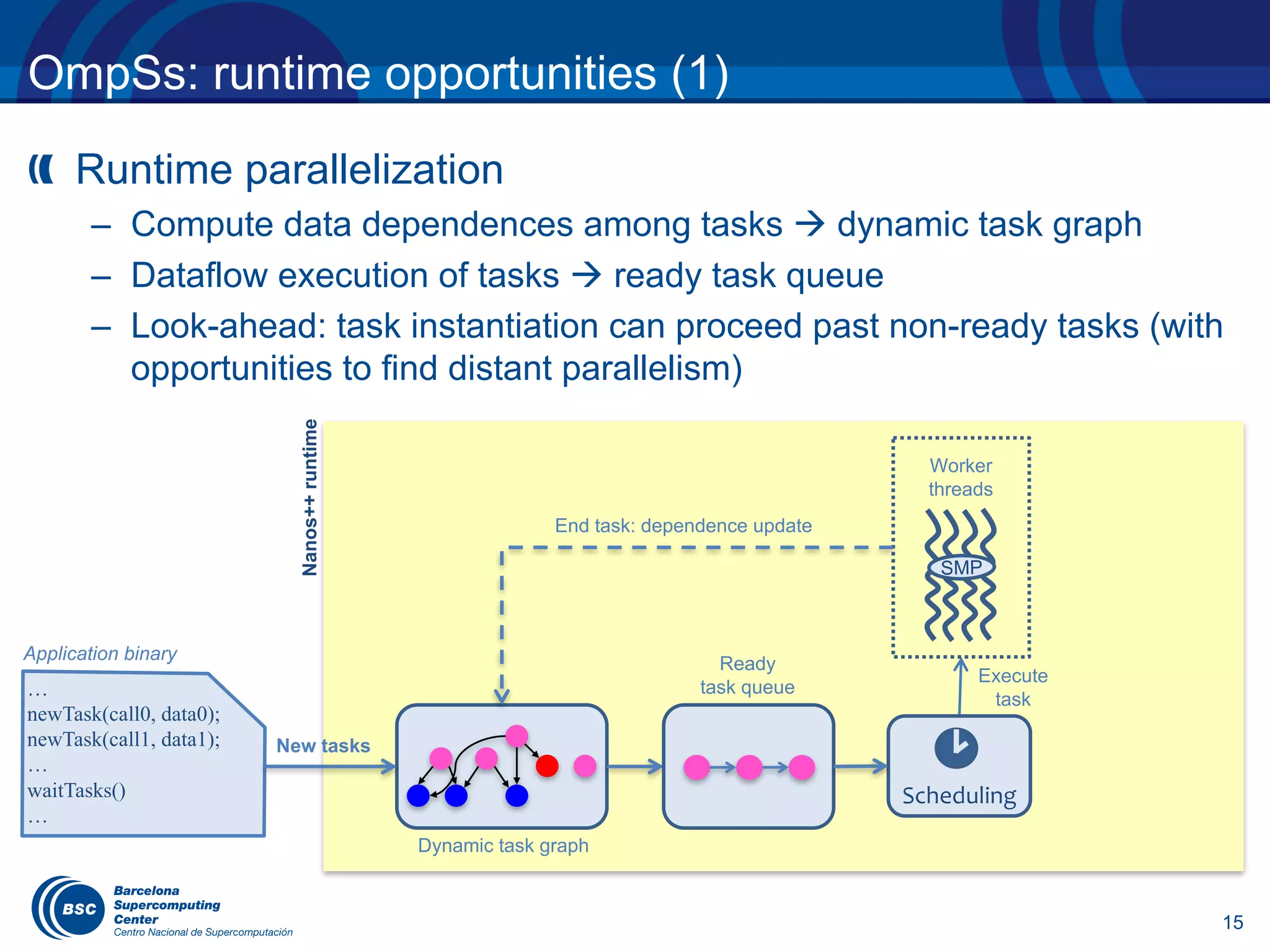
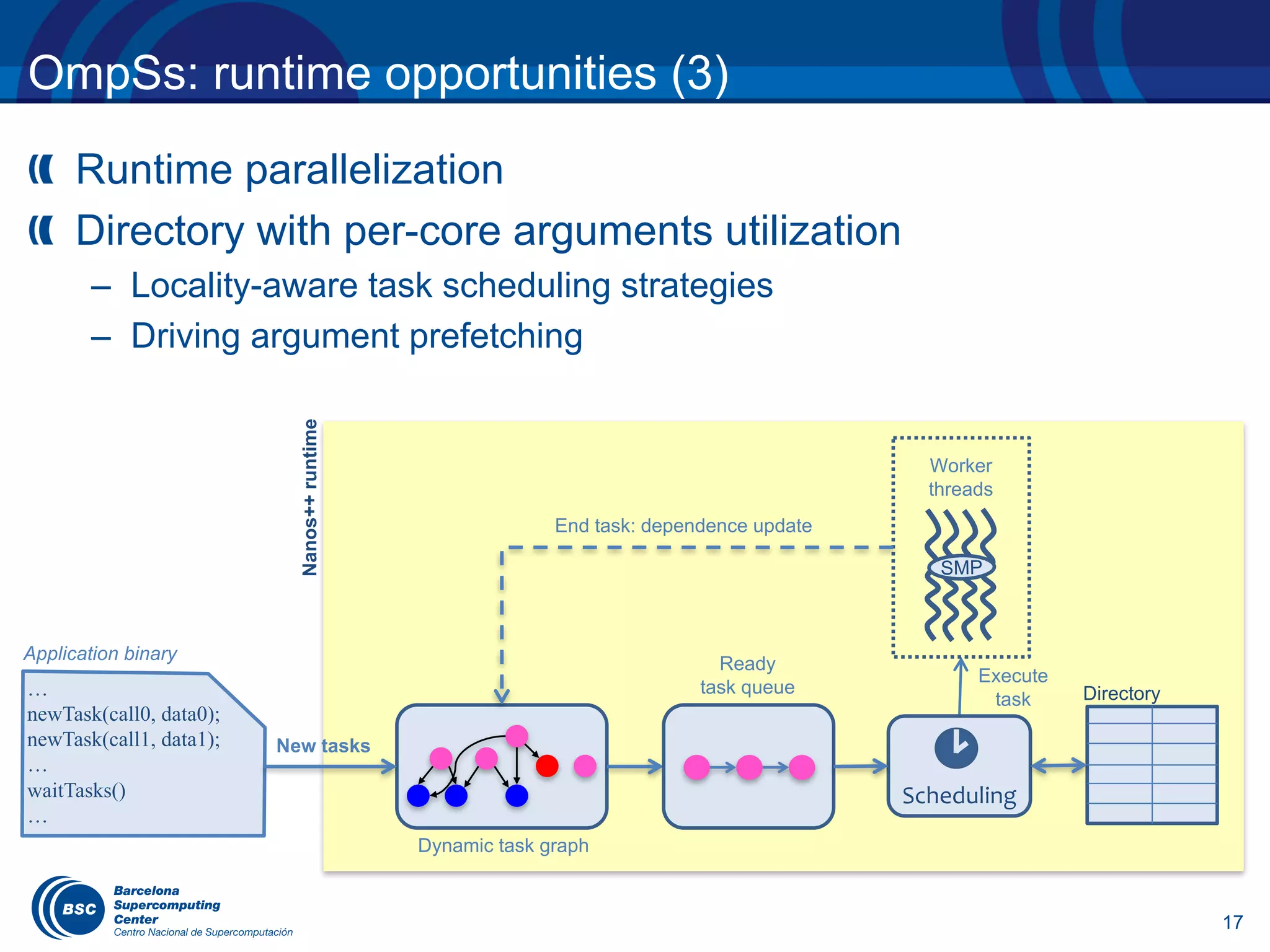
Scheduling
New tasks
Dynamic task graph
Worker
threads
Execute
task
Nanos++runtime
…
newTask(call0, data0);
newTask(call1, data1);
…
waitTasks()
…
Application binary
Ready
task queue
End task: dependence update
15
OmpSs: runtime opportunities (1)
Runtime parallelization
– Compute data dependences among tasks à dynamic task graph
– Dataflow execution of tasks à ready task queue
– Look-ahead: task instantiation can proceed past non-ready tasks (with
opportunities to find distant parallelism)
16
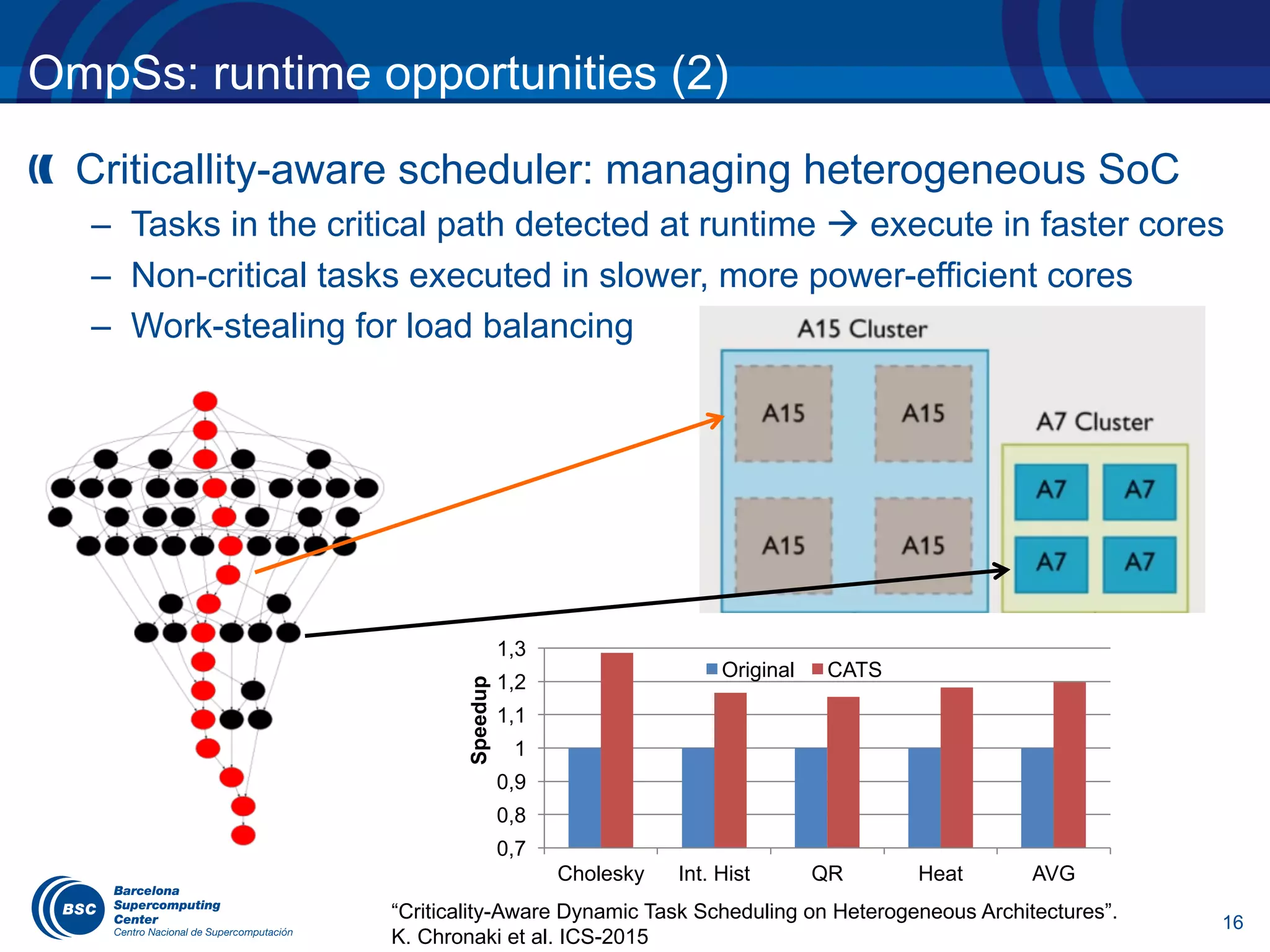
OmpSs: runtime opportunities (2)
Criticallity-aware scheduler: managing heterogeneous SoC
– Tasks in the critical path detected at runtime à execute in faster cores
– Non-critical tasks executed in slower, more power-efficient cores
– Work-stealing for load balancing
“Criticality-Aware Dynamic Task Scheduling on Heterogeneous Architectures”.
K. Chronaki et al. ICS-2015
0,7
0,8
0,9
1
1,1
1,2
1,3
Cholesky Int. Hist QR Heat AVG
Speedup
Original CATS
Scheduling
New tasks
Dynamic task graph
Worker
threads
Execute
task
Nanos++runtime
…
newTask(call0, data0);
newTask(call1, data1);
…
waitTasks()
…
Application binary
Ready
task queue
End task: dependence update
17
OmpSs: runtime opportunities (3)
Runtime parallelization
Directory with per-core arguments utilization
– Locality-aware task scheduling strategies
– Driving argument prefetching
Directory
18
OmpSs: runtime opportunities (4)
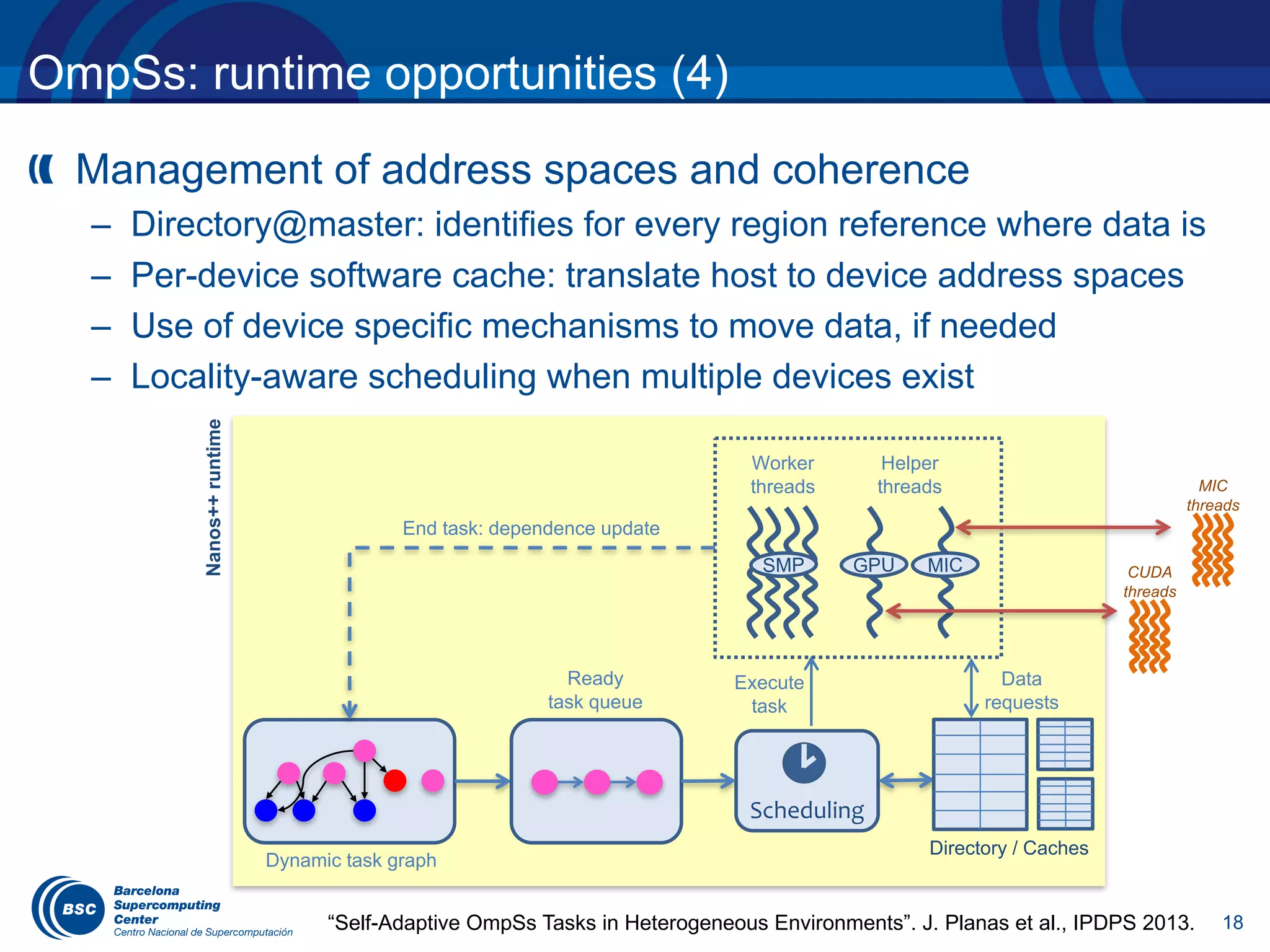
Management of address spaces and coherence
– Directory@master: identifies for every region reference where data is
– Per-device software cache: translate host to device address spaces
– Use of device specific mechanisms to move data, if needed
– Locality-aware scheduling when multiple devices exist
Scheduling
Dynamic task graph
Nanos++runtime
Ready
task queue
End task: dependence update
Worker
threads
Helper
threads
Execute
task
MIC
threads
CUDA
threads
Data
requests
Directory / Caches
“Self-Adaptive OmpSs Tasks in Heterogeneous Environments”. J. Planas et al., IPDPS 2013.
Example: nbody
#pragma omp target device(smp) copy_deps
#pragma omp task depend(out: [size]out), in: [npart]part)
void comp_force (int size, float time, int npart, Part* part, Particle *out, int gid);
#pragma omp target device(fpga) ndrange(1,size,128) copy_deps implements (comp_force)
#pragma omp task depend(out: [size]out), in: [npart]part)
__kernel void comp_force_opencl (int size, float time, int npart, __global Part* part,
__global Part* out, int gid);
#pragma omp target device(cuda) ndrange(1,size,128) copy_deps implements (comp_force)
#pragma omp task depend(out: [size]out), in: [npart]part)
__global__ void comp_force_cuda (int size, float time, int npar, Part* part, Particle *out, int gid);
void Particle_array_calculate_forces(Particle* input, Particle *output, int npart, float time) {
for (int i = 0; i < npart; i += BS )
comp_force (BS, time, npart, input, &output[i], i);
}
20
OmpSs: runtime opportunities (5)
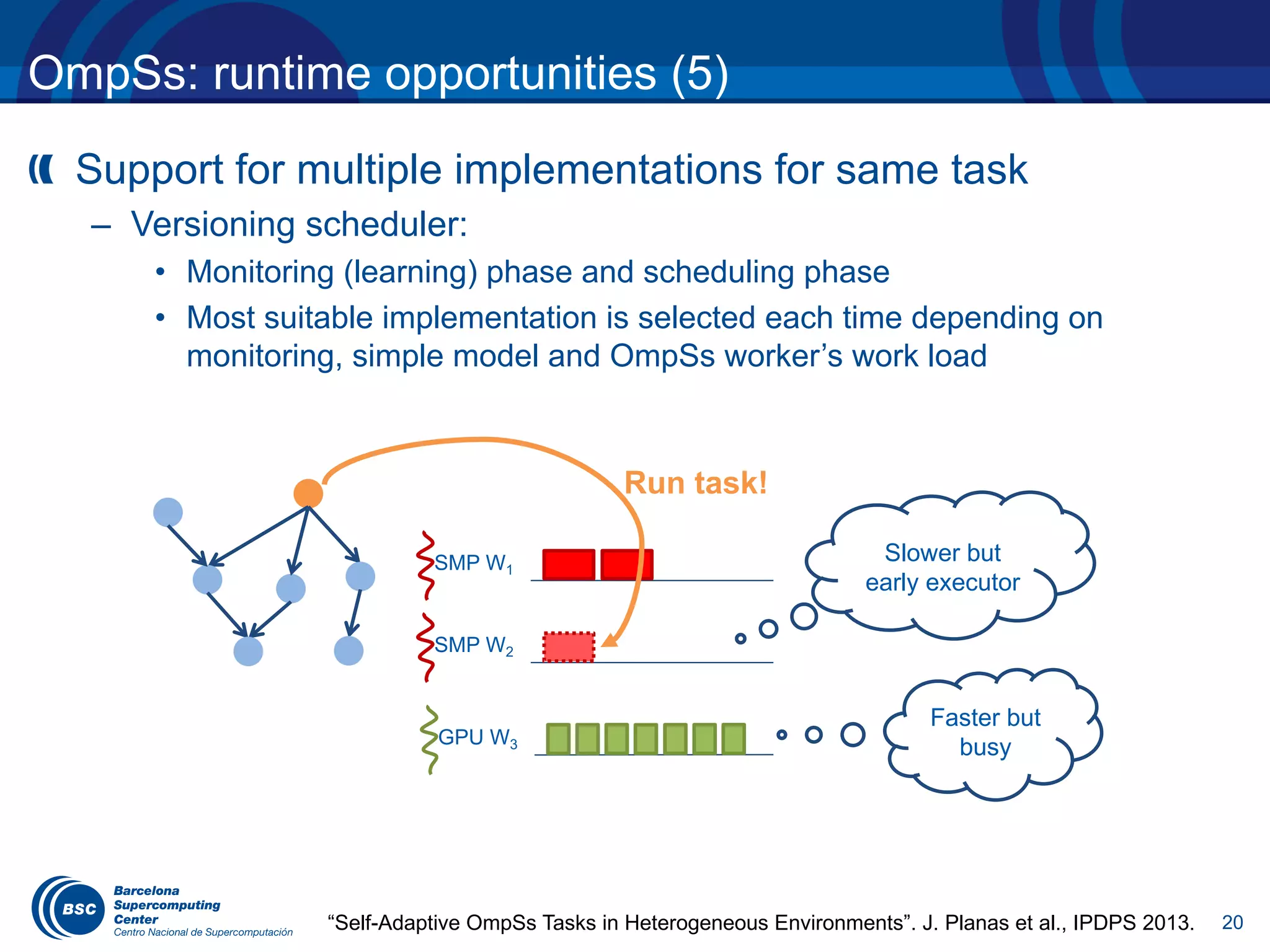
Support for multiple implementations for same task
– Versioning scheduler:
• Monitoring (learning) phase and scheduling phase
• Most suitable implementation is selected each time depending on
monitoring, simple model and OmpSs worker’s work load
SMP W1
SMP W2
GPU W3
Faster but
busy
Slower but
early executor
Run task!
“Self-Adaptive OmpSs Tasks in Heterogeneous Environments”. J. Planas et al., IPDPS 2013.
21
OmpSs: runtime opportunities (6)
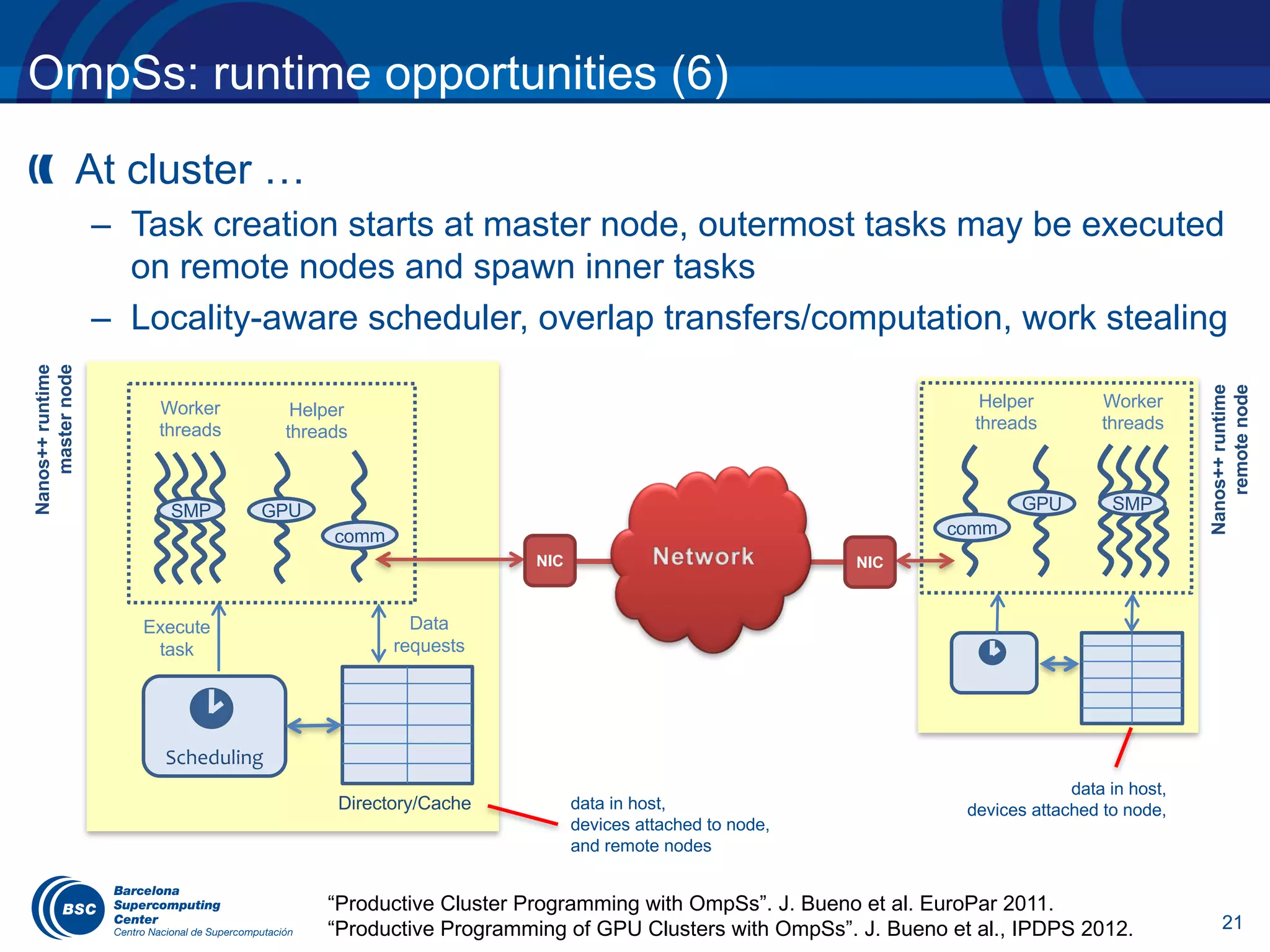
At cluster …
– Task creation starts at master node, outermost tasks may be executed
on remote nodes and spawn inner tasks
– Locality-aware scheduler, overlap transfers/computation, work stealing
Scheduling
Directory/Cache
Nanos++runtime
masternode
Worker
threads
Helper
threads
Execute
task
Data
requests
Worker
threads
Helper
threads
Nanos++runtime
remotenode
data in host,
devices attached to node,
and remote nodes
data in host,
devices attached to node,
NIC NIC
“Productive Cluster Programming with OmpSs”. J. Bueno et al. EuroPar 2011.
“Productive Programming of GPU Clusters with OmpSs”. J. Bueno et al., IPDPS 2012.
22
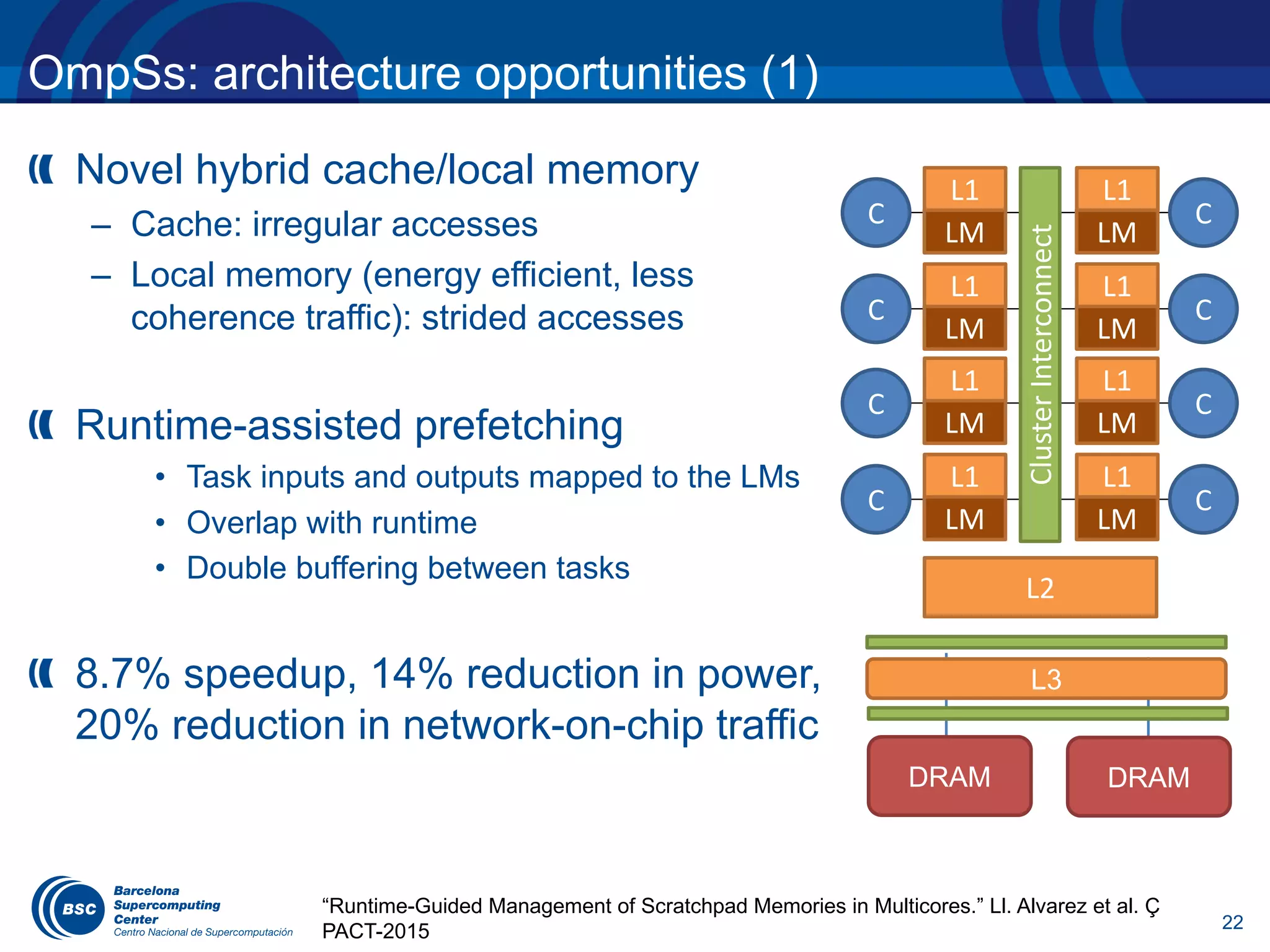
OmpSs: architecture opportunities (1)
Novel hybrid cache/local memory
– Cache: irregular accesses
– Local memory (energy efficient, less
coherence traffic): strided accesses
Runtime-assisted prefetching
• Task inputs and outputs mapped to the LMs
• Overlap with runtime
• Double buffering between tasks
8.7% speedup, 14% reduction in power,
20% reduction in network-on-chip traffic
C C
L1
Cluster	Interconnect
LM
L1
LM
C C
L1
LM
L1
LM
C C
L1
LM
L1
LM
C C
L1
LM
L1
LM
DRAM DRAM
L2
L3
“Runtime-Guided Management of Scratchpad Memories in Multicores.” Ll. Alvarez et al. Ç
PACT-2015
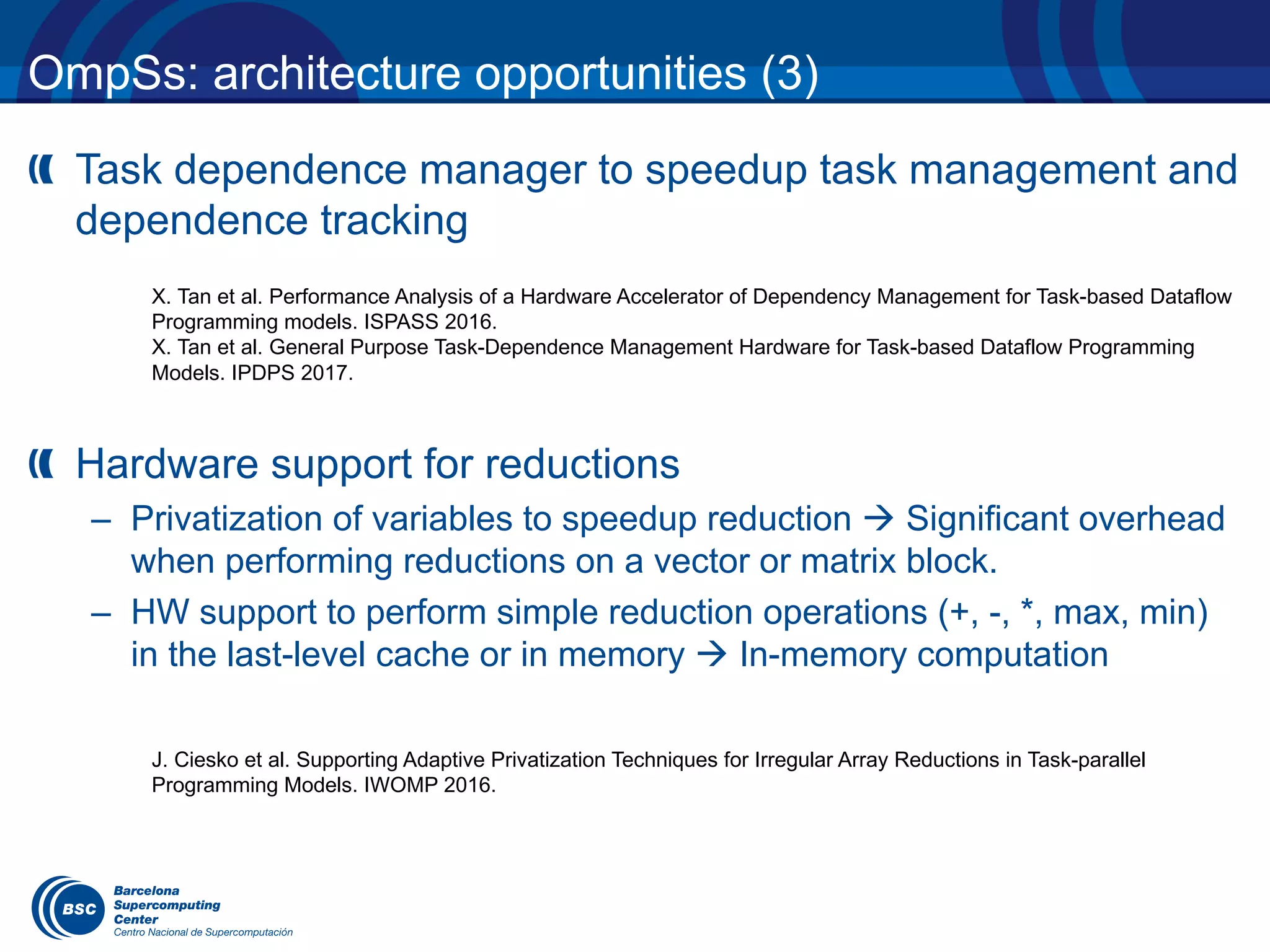
OmpSs: architecture opportunities (3)
Task dependence manager to speedup task management and
dependence tracking
Hardware support for reductions
– Privatization of variables to speedup reduction à Significant overhead
when performing reductions on a vector or matrix block.
– HW support to perform simple reduction operations (+, -, *, max, min)
in the last-level cache or in memory à In-memory computation
X. Tan et al. Performance Analysis of a Hardware Accelerator of Dependency Management for Task-based Dataflow
Programming models. ISPASS 2016.
X. Tan et al. General Purpose Task-Dependence Management Hardware for Task-based Dataflow Programming
Models. IPDPS 2017.
J. Ciesko et al. Supporting Adaptive Privatization Techniques for Irregular Array Reductions in Task-parallel
Programming Models. IWOMP 2016.
24
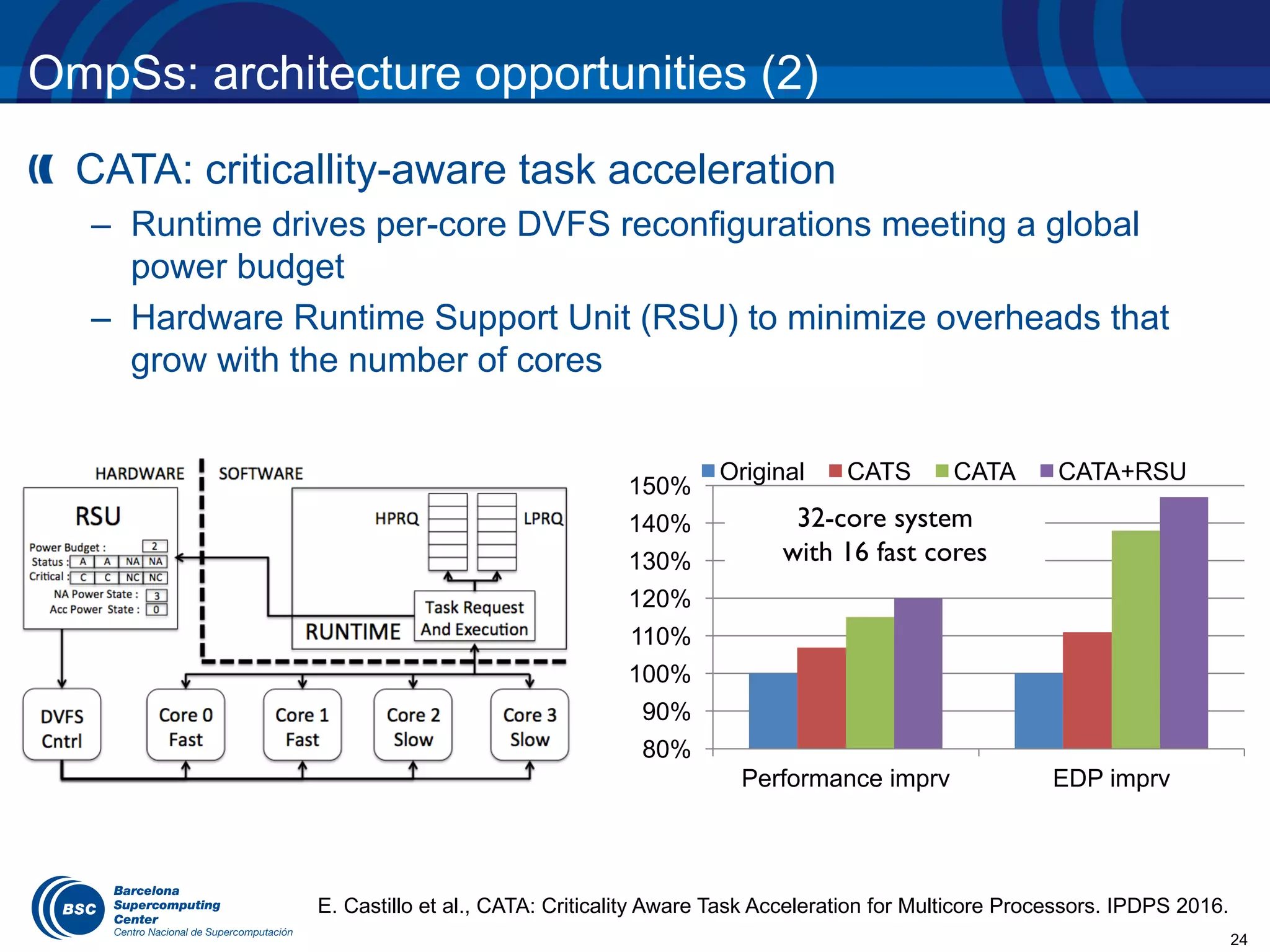
OmpSs: architecture opportunities (2)
CATA: criticallity-aware task acceleration
– Runtime drives per-core DVFS reconfigurations meeting a global
power budget
– Hardware Runtime Support Unit (RSU) to minimize overheads that
grow with the number of cores
E. Castillo et al., CATA: Criticality Aware Task Acceleration for Multicore Processors. IPDPS 2016.
80%
90%
100%
110%
120%
130%
140%
150%
Performance imprv EDP imprv
Original CATS CATA CATA+RSU
32-core system
with 16 fast cores
25
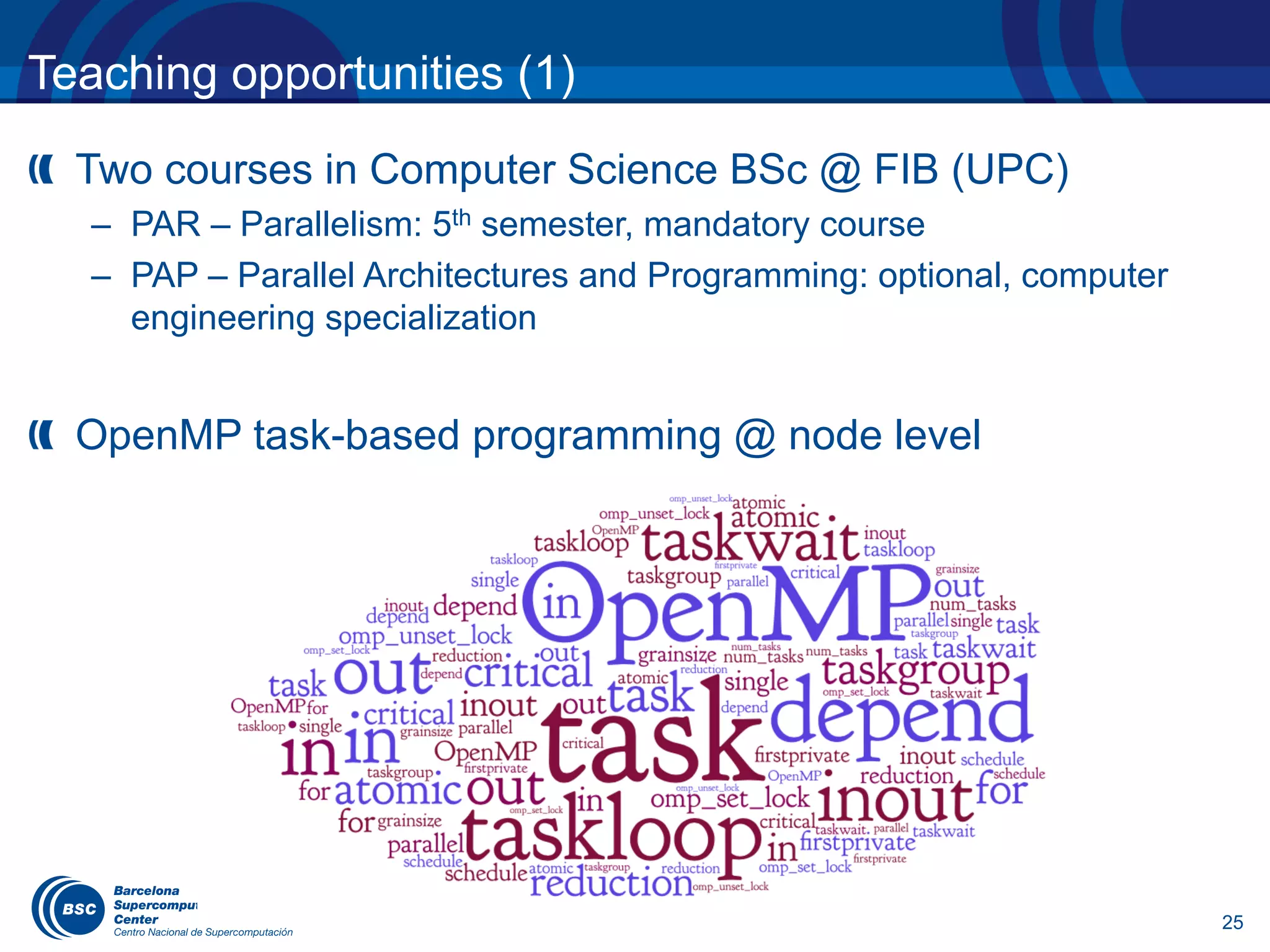
Teaching opportunities (1)
Two courses in Computer Science BSc @ FIB (UPC)
– PAR – Parallelism: 5th semester, mandatory course
– PAP – Parallel Architectures and Programming: optional, computer
engineering specialization
OpenMP task-based programming @ node level
26
Teaching opportunities (2)
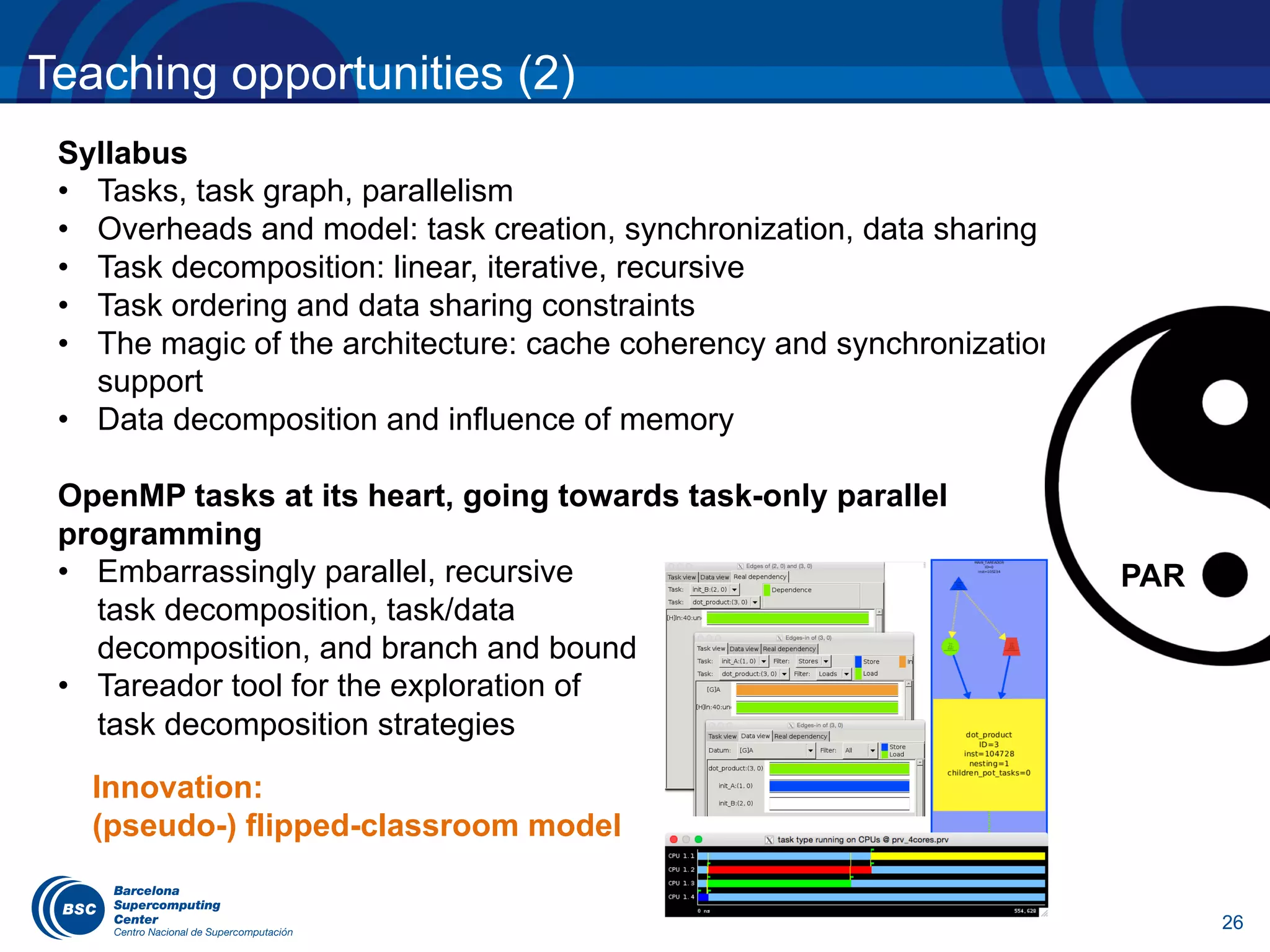
Syllabus
• Tasks, task graph, parallelism
• Overheads and model: task creation, synchronization, data sharing
• Task decomposition: linear, iterative, recursive
• Task ordering and data sharing constraints
• The magic of the architecture: cache coherency and synchronization
support
• Data decomposition and influence of memory
OpenMP tasks at its heart, going towards task-only parallel
programming
• Embarrassingly parallel, recursive
task decomposition, task/data
decomposition, and branch and bound
• Tareador tool for the exploration of
task decomposition strategies
P
PAR
Innovation:
(pseudo-) flipped-classroom model
27
Teaching opportunities (2)
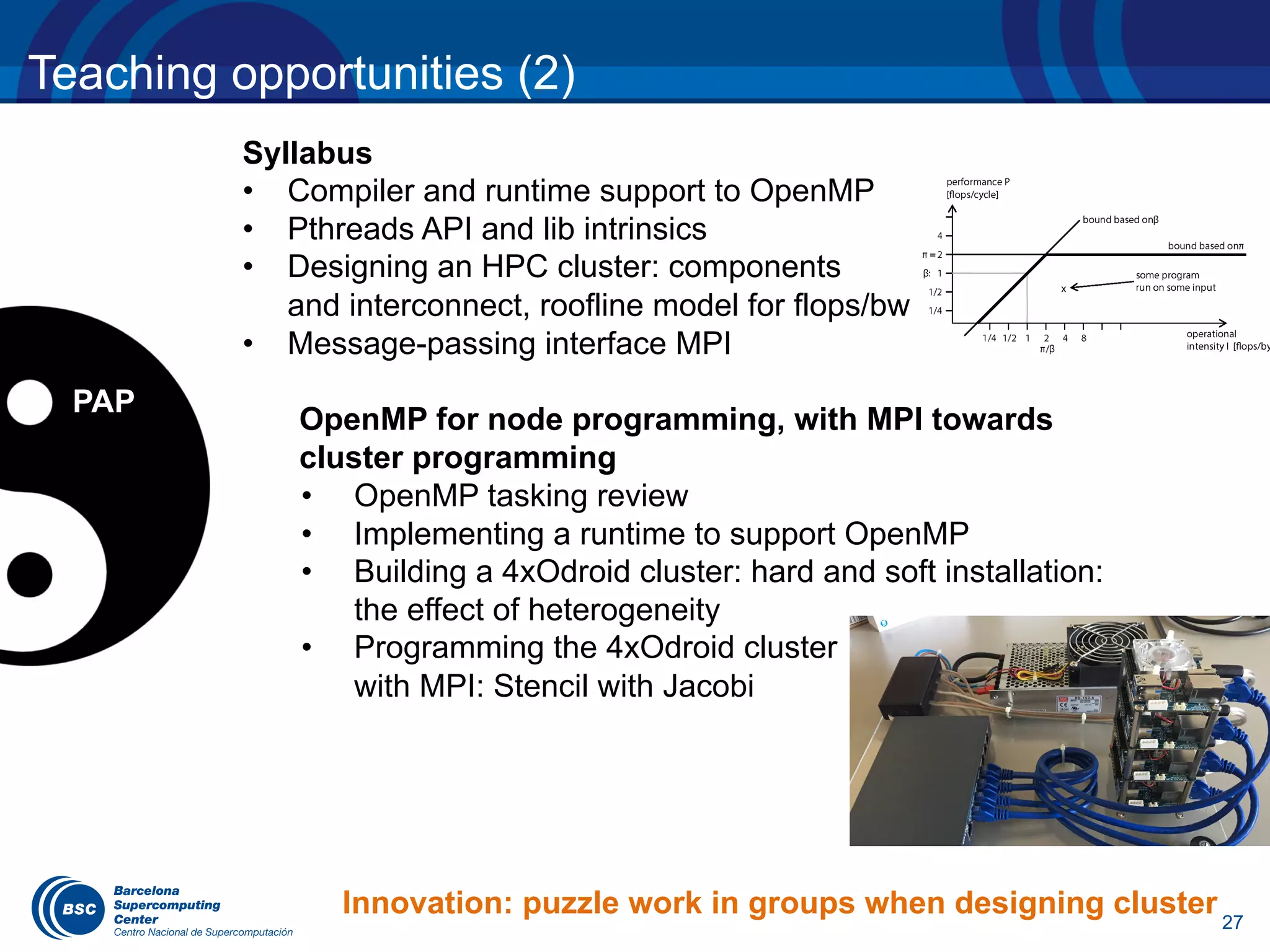
PAP
Syllabus
• Compiler and runtime support to OpenMP
• Pthreads API and lib intrinsics
• Designing an HPC cluster: components
and interconnect, roofline model for flops/bw
• Message-passing interface MPI
OpenMP for node programming, with MPI towards
cluster programming
• OpenMP tasking review
• Implementing a runtime to support OpenMP
• Building a 4xOdroid cluster: hard and soft installation:
the effect of heterogeneity
• Programming the 4xOdroid cluster
with MPI: Stencil with Jacobi
Innovation: puzzle work in groups when designing cluster
28
Thanks!
https://www.bsc.es

OpenMP tasking model: from the standard to the classroom

  • 1.
    Universitat Politècnica deCatalunya BARCELONA TECH Madrid. March 30, 2017 Eduard Ayguadé Dep. Arquitectura de Computadors, U. Politècnica de Catalunya Computer Sciences Dep., Barcelona Supercomputing Center OpenMP tasking model: from the standard to the classroom
  • 2.
    ICT386 multiprocessor architecture,late 80s 1 4 x CPU module i386/i387 no private cache memory 4 x Memory module 4 MB DRAM (100 ns) 64 KB shared cache 25 ns, direct-mapped
  • 3.
    ICT386 multiprocessor architecture,late 80s 2 Crossbar 5x5 Gate array design 10 ns transfer Intellligent memory Memory mapped 1 MB DRAM Functions: management, synchronization and scheduling ProgrammableNIC
  • 4.
    And the wallhas become higher and higher … 3 big.LITTLE Integrated GPU Socket S1 S2 GPU G D D R GPU G D D R D D R D D R FPGA N V M HCA CAPIPCIe PCIePCIe QPI Node Rank Name Site Computer Total Cores Accelerator/ Co-Proc. Cores Rmax (Gflops) Rpeak (Gflops) Power (KW) Mflops/Wa 1 Sunway TaihuLight National SupercomputingCenter in Wuxi Sunway MPP, Sunway SW26010 260C 1.45GHz, Sunway 10649600 0 93014593,88 125435904 15371 6051, 2 Tianhe-2 (MilkyWay-2) National Super Computer Center in Guangzhou TH-IVB-FEP Cluster, Intel Xeon E5-269212C 2.200GHz, TH Express-2, Intel Xeon Phi 31S1P 3120000 2736000 33862700 54902400 17808 1901, 3 Titan DOE/SC/Oak Ridge National Laboratory Cray XK7, Opteron 6274 16C 2.200GHz, Cray Gemini interconnect, NVIDIA K20x 560640 261632 17590000 27112550 8209 2142, 4 Sequoia DOE/NNSA/LLNL BlueGene/Q,Power BQC 16C 1.60 GHz, Custom 1572864 0 17173224 20132659,2 7890 2176, 5 Cori DOE/SC/LBNL/NERSC Cray XC40, Intel Xeon Phi 7250 68C 1.4GHz, Aries interconnect 622336 0 14014700 27880653 3939 3557, 6 Oakforest- PACS Joint Center for Advanced High Performance Computing PRIMERGY CX1640 M1, Intel Xeon Phi 7250 68C 1.4GHz, Intel Omni-Path 556104 0 13554600 24913459 2718 4985, 7 K computer RIKEN Advanced Institute for Computational Science (AICS) K computer, SPARC64 VIIIfx 2.0GHz, Tofu interconnect 705024 0 10510000 11280384 12660 830, 8 Piz Daint Swiss National SupercomputingCentre (CSCS) Cray XC50, Xeon E5-2690v3 12C 2.6GHz, Aries interconnect , NVIDIA Tesla P100 206720 170240 9779000 15987968 1312 7453, 9 Mira DOE/SC/Argonne National Laboratory BlueGene/Q,Power BQC 16C 1.60GHz, Custom 786432 0 8586612 10066330 3945 2176, 10 Trinity DOE/NNSA/LANL/SNL Cray XC40, Xeon E5-2698v3 16C 2.3GHz, Aries interconnect 301056 0 8100900 11078861 4232 1913, Top5 November 2016 list
  • 5.
    1979 Pink Floyd’sThe Wall album, Cray-1 delivering 80 Mflops, single processor OpenMP evolution and OmpSs influence Runtime opportunities Architecture opportunities Teaching opportunities Programmability
  • 6.
    The vision Plethora ofarchitectures • Heterogeneity • Hierarchies ISA Low-level interfaces ISA/PM leaks and variability/faults/errors everywhere • Programmer exposed • Divergence between mental models and actual behavior New application domains Programming models Applications Programmability and porting/inter-operability • Legacy codes • ”Legacy” mental models and habits APIs New usage practices • Analytics and visualization • New data models • Interactive supercomputing, response time • Virtualized data centers • Cloud Programming interfaces Ana… …lytics 9
  • 7.
    The vision 10 Intelligent runtime, parallelization, distribution, interoperability Generalpurpose Task based Single address space Program logic independent of computing platform Performance- and power-driven optimization/tuning Resource management ISA Low-level interfaces APIs Runtime system Resource management Performance, power, energy… monitoring/insight Applications Programming model: high-level, clean, abstract interface
  • 8.
    7 The OmpSs forerunnerfor OpenMP Proposing ideas … – IWOMP workshop is the ideal scenario – Participation in the OpenMP language committee and sub-committees Demonstrated with … – Prototype implementation: Mercurium compiler and Nanos runtime – Benchmark/application suite Lots of discussions and final polishing 3.02008 + Tasks + Task dependences + Task priorities + Taskloop prototyping + Task reductions + Dependences on taskwait + Multidependences + Commutative + Dependences on taskloop Today 3.12011 4.02013 4.52015 5.0? OmpSs
  • 9.
    8 OmpSs influencing taskingmodel evolution (1) The big change … From loop-based model to task-based model – Dynamically allocated data structures (lists, trees, …) – Recursion task generation waits for child tasks to finish (3.0) task-based model, nesting of tasks (3.0) #pragma omp task firstprivate(list) { code block } #pragma omp taskwait task priorities (4.5) priority(value) task generation cut-off (3.1) final(expr) root
  • 10.
    9 OmpSs influencing taskingmodel evolution (2) Directionality of task arguments Dependences between tasks computed at runtime Tasks executed as soon as all dependences are satisfied directionality for task arguments (4.0) #pragma omp task depend(in: list, out: list, inout: list) { code block }
  • 11.
    10 OmpSs influencing taskingmodel evolution (3) Tasks become chunks of iterations of one or more associated loops Dependences between tasks generated in the same or different taskloop construct under discussion tasks out of loops and granularity control (4.5) #pragma omp taskloop [num_tasks(value) | grainsize(value)] for-loops #pragma omp taskloop block(2) grainsize(B, B) depend(in : block[i-1][j], block[i][j-1]) depend(in : block[i+1][j], block[i][j+1]) depend(out: block[i][j]) for (i=1; i<n i++) for (j=1; j<n;j++) foo(i, j); T T T T T T T T T T T T T T T T
  • 12.
    11 OmpSs influencing taskingmodel evolution (4) Reduction operations on task and taskloop not yet supported, currently in discussion #pragma omp taskgroup reduction(+: res) { while (node) { #pragma omp task in_reduction(+: res) res += node->value; node = node->next; } } #pragma omp taskloop grainsize(BS) reduction(+: res) for (i = 0; i < N; ++i) { res += foo(v[i]); }
  • 13.
    12 OmpSs influencing taskingmodel evolution (5) The number of task dependences have to be constant at compile time à multidependences proposal under discussion for (i = 0; i < l.size(); ++i) { #pragma omp task depend(inout: l[i]) // T1 { ... } } #pragma omp task depend(in: {l[j], j=0:l.size()}) // T2 for (i = 0; i < l.size(); ++i) { ... } Defines an iterator with a range of values that only exists in the context of the directive. Equivalent to: depend(in: l[0], l[1], ..., l[l.size()-1]) T1 T1 T1 T1 T2 …
  • 14.
    13 OmpSs influencing taskingmodel evolution (6) New dependence type that relaxes the execution order of commutative tasks but keeping mutual exclusion between them T1 T3 T2 T2 for (i = 0; i < l.size(); ++i) { #pragma omp task depend(out: l[i]) // T1 } for (i = 0; i < l.size(); ++i) { #pragma omp task shared(x) depend(in: l[i]) depend(inout: x) // T2 } #pragma omp task shared(x) depend(in: x) // T3 for (i = 0; i < l.size(); ++i) { ... } T1 T1 T1 T2 T2
  • 15.
    14 OmpSs influencing taskingmodel evolution (6) New dependence type that relaxes the execution order of commutative tasks but keeping mutual exclusion between them T1 T3 T2 T2 for (i = 0; i < l.size(); ++i) { #pragma omp task depend(out: l[i]) // T1 } for (i = 0; i < l.size(); ++i) { #pragma omp task shared(x) depend(in: l[i]) depend(commutative: x) // T2 } #pragma omp task shared(x) depend(in: x) // T3 for (i = 0; i < l.size(); ++i) { ... } T1 T1 T1 T2 T2
  • 16.
    Scheduling New tasks Dynamic taskgraph Worker threads Execute task Nanos++runtime … newTask(call0, data0); newTask(call1, data1); … waitTasks() … Application binary Ready task queue End task: dependence update 15 OmpSs: runtime opportunities (1) Runtime parallelization – Compute data dependences among tasks à dynamic task graph – Dataflow execution of tasks à ready task queue – Look-ahead: task instantiation can proceed past non-ready tasks (with opportunities to find distant parallelism)
  • 17.
    16 OmpSs: runtime opportunities(2) Criticallity-aware scheduler: managing heterogeneous SoC – Tasks in the critical path detected at runtime à execute in faster cores – Non-critical tasks executed in slower, more power-efficient cores – Work-stealing for load balancing “Criticality-Aware Dynamic Task Scheduling on Heterogeneous Architectures”. K. Chronaki et al. ICS-2015 0,7 0,8 0,9 1 1,1 1,2 1,3 Cholesky Int. Hist QR Heat AVG Speedup Original CATS
  • 18.
    Scheduling New tasks Dynamic taskgraph Worker threads Execute task Nanos++runtime … newTask(call0, data0); newTask(call1, data1); … waitTasks() … Application binary Ready task queue End task: dependence update 17 OmpSs: runtime opportunities (3) Runtime parallelization Directory with per-core arguments utilization – Locality-aware task scheduling strategies – Driving argument prefetching Directory
  • 19.
    18 OmpSs: runtime opportunities(4) Management of address spaces and coherence – Directory@master: identifies for every region reference where data is – Per-device software cache: translate host to device address spaces – Use of device specific mechanisms to move data, if needed – Locality-aware scheduling when multiple devices exist Scheduling Dynamic task graph Nanos++runtime Ready task queue End task: dependence update Worker threads Helper threads Execute task MIC threads CUDA threads Data requests Directory / Caches “Self-Adaptive OmpSs Tasks in Heterogeneous Environments”. J. Planas et al., IPDPS 2013.
  • 20.
    Example: nbody #pragma omptarget device(smp) copy_deps #pragma omp task depend(out: [size]out), in: [npart]part) void comp_force (int size, float time, int npart, Part* part, Particle *out, int gid); #pragma omp target device(fpga) ndrange(1,size,128) copy_deps implements (comp_force) #pragma omp task depend(out: [size]out), in: [npart]part) __kernel void comp_force_opencl (int size, float time, int npart, __global Part* part, __global Part* out, int gid); #pragma omp target device(cuda) ndrange(1,size,128) copy_deps implements (comp_force) #pragma omp task depend(out: [size]out), in: [npart]part) __global__ void comp_force_cuda (int size, float time, int npar, Part* part, Particle *out, int gid); void Particle_array_calculate_forces(Particle* input, Particle *output, int npart, float time) { for (int i = 0; i < npart; i += BS ) comp_force (BS, time, npart, input, &output[i], i); }
  • 21.
    20 OmpSs: runtime opportunities(5) Support for multiple implementations for same task – Versioning scheduler: • Monitoring (learning) phase and scheduling phase • Most suitable implementation is selected each time depending on monitoring, simple model and OmpSs worker’s work load SMP W1 SMP W2 GPU W3 Faster but busy Slower but early executor Run task! “Self-Adaptive OmpSs Tasks in Heterogeneous Environments”. J. Planas et al., IPDPS 2013.
  • 22.
    21 OmpSs: runtime opportunities(6) At cluster … – Task creation starts at master node, outermost tasks may be executed on remote nodes and spawn inner tasks – Locality-aware scheduler, overlap transfers/computation, work stealing Scheduling Directory/Cache Nanos++runtime masternode Worker threads Helper threads Execute task Data requests Worker threads Helper threads Nanos++runtime remotenode data in host, devices attached to node, and remote nodes data in host, devices attached to node, NIC NIC “Productive Cluster Programming with OmpSs”. J. Bueno et al. EuroPar 2011. “Productive Programming of GPU Clusters with OmpSs”. J. Bueno et al., IPDPS 2012.
  • 23.
    22 OmpSs: architecture opportunities(1) Novel hybrid cache/local memory – Cache: irregular accesses – Local memory (energy efficient, less coherence traffic): strided accesses Runtime-assisted prefetching • Task inputs and outputs mapped to the LMs • Overlap with runtime • Double buffering between tasks 8.7% speedup, 14% reduction in power, 20% reduction in network-on-chip traffic C C L1 Cluster Interconnect LM L1 LM C C L1 LM L1 LM C C L1 LM L1 LM C C L1 LM L1 LM DRAM DRAM L2 L3 “Runtime-Guided Management of Scratchpad Memories in Multicores.” Ll. Alvarez et al. Ç PACT-2015
  • 24.
    OmpSs: architecture opportunities(3) Task dependence manager to speedup task management and dependence tracking Hardware support for reductions – Privatization of variables to speedup reduction à Significant overhead when performing reductions on a vector or matrix block. – HW support to perform simple reduction operations (+, -, *, max, min) in the last-level cache or in memory à In-memory computation X. Tan et al. Performance Analysis of a Hardware Accelerator of Dependency Management for Task-based Dataflow Programming models. ISPASS 2016. X. Tan et al. General Purpose Task-Dependence Management Hardware for Task-based Dataflow Programming Models. IPDPS 2017. J. Ciesko et al. Supporting Adaptive Privatization Techniques for Irregular Array Reductions in Task-parallel Programming Models. IWOMP 2016.
  • 25.
    24 OmpSs: architecture opportunities(2) CATA: criticallity-aware task acceleration – Runtime drives per-core DVFS reconfigurations meeting a global power budget – Hardware Runtime Support Unit (RSU) to minimize overheads that grow with the number of cores E. Castillo et al., CATA: Criticality Aware Task Acceleration for Multicore Processors. IPDPS 2016. 80% 90% 100% 110% 120% 130% 140% 150% Performance imprv EDP imprv Original CATS CATA CATA+RSU 32-core system with 16 fast cores
  • 26.
    25 Teaching opportunities (1) Twocourses in Computer Science BSc @ FIB (UPC) – PAR – Parallelism: 5th semester, mandatory course – PAP – Parallel Architectures and Programming: optional, computer engineering specialization OpenMP task-based programming @ node level
  • 27.
    26 Teaching opportunities (2) Syllabus •Tasks, task graph, parallelism • Overheads and model: task creation, synchronization, data sharing • Task decomposition: linear, iterative, recursive • Task ordering and data sharing constraints • The magic of the architecture: cache coherency and synchronization support • Data decomposition and influence of memory OpenMP tasks at its heart, going towards task-only parallel programming • Embarrassingly parallel, recursive task decomposition, task/data decomposition, and branch and bound • Tareador tool for the exploration of task decomposition strategies P PAR Innovation: (pseudo-) flipped-classroom model
  • 28.
    27 Teaching opportunities (2) PAP Syllabus •Compiler and runtime support to OpenMP • Pthreads API and lib intrinsics • Designing an HPC cluster: components and interconnect, roofline model for flops/bw • Message-passing interface MPI OpenMP for node programming, with MPI towards cluster programming • OpenMP tasking review • Implementing a runtime to support OpenMP • Building a 4xOdroid cluster: hard and soft installation: the effect of heterogeneity • Programming the 4xOdroid cluster with MPI: Stencil with Jacobi Innovation: puzzle work in groups when designing cluster
  • 29.