By, Aparna Nirmal
Agenda Introduction to Open Source History and Definition of Open Source Important Open Source Project  Open Source Risks Proxy Server Squid Proxy Server
Introduction to Open Source It is an approach to the design, development, and distribution offering practical accessibility to a product's source (goods and knowledge)   It is basically software developed by uncoordinated but collaborating programmers, using freely distributed source code and the communications facilities of the Net. It promises better quality, higher reliability, more flexibility and lower cost.
History of Open Source Free Software Movement “ Free software ”  invented by Richard Stallman ( “ free as in freedom ” ). Goal to ensure user rights to use, modify and re-distribute code. Free Software Foundation  (the  “ FSF ” ). The  General Public License  (the  “ GPL ” ). “ Copyleft ” –  uses copyright to ensure  availability of code ,instead of protection of it as private property. “ Reciprocity ”  is key to copyleft.
Why Open Source?         Quality and Reliability         if the project is being actively developed by a community of developers, peer review will encourage quality      66% of web server deployment today is Apache         Google uses Linux          Security         Because the code is available for anyone to view, and because of the scrutiny of peer developers, security problems tend to be discovered quickly…and fixed quickly          Support         Many companies offer Open Source product support         Forum, Mailing List, FAQ, online Documentation         No such thing as stop support and force customers to upgrade as always happen in commercial products Cost Effectiveness
Open Source Definition 1.  Free Redistribution 2.  Source Code Availability 3.  Derived Works Permitted 4.  Integrity of Author’s Source Code 5.  No Discrimination Against Persons or Groups   6.  No Discrimination against Fields of Endeavor 7.  Same Distribution License 8.  License not Specific to a Product 9.  License Must Not Restrict Other Software 10.  License Must be Technology Neutral
Important Open Source Projects Linux . Built on top of Linus Torvalds’ kernel, Linux distributions typically include hundreds of other open-source packages.   Programmer’s Tools . The Free Software Foundation’s GNU project has created a high-quality set of programmer’s utilities, including the gcc C compiler, the g++ C++ compiler, the emacs editor, the gdb debugger. Web Browser:  Mozilla, one of the widely used Open Source browsers
OS Projects ….contd Scripting languages : Larry Wall’s Perl language is the undisputed king of the open-source programming languages Apache : Apache by Rob McCool is one of the widely used Web Servers. Originally designed by NCSA Samba:  Samba allows UNIX and Linux systems to act as file and print servers on NT and Windows 95/98 networks
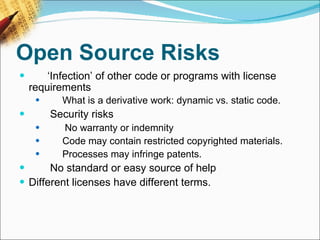
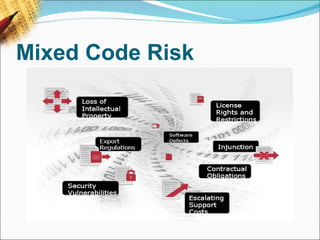
Open Source Risks         ‘ Infection’ of other code or programs with license requirements         What is a derivative work: dynamic vs. static code.          Security risks          No warranty or indemnity         Code may contain restricted copyrighted materials.         Processes may infringe patents.          No standard or easy source of help Different licenses have different terms.
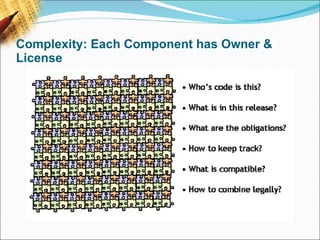
Complexity: Each Component has Owner & License
Mixed Code Risk
Open Source Open Source is NOT free. Open Source is here to stay. Stake is high and will get higher. Will complement not replace
Proxy Server What is a proxy server? A  proxy server  is a server that services the requests of its clients by forwarding requests to other servers.  A proxy server, also known as a "proxy" or "application level gateway", is a computer that acts as a gateway between a local network and a larger-scale network  Proxy servers provide increased performance and security  They monitor employees' use of outside resources
Caching Proxy Server Proxies may also cache web pages  Each time an internal user requests a URL  from outside, a temporary copy is stored locally.  The next time an internal user requests the same URL, the proxy can serve the local copy instead of retrieving the original across the network, improving performance.
Squid Caching Proxy Server Squid is an Open source high-performance Proxy caching server designed to run on Unix/Linux/Windows systems.  National Science Foundation funds squid project, Squid has its presence in numerous ISP's and corporate around the globe.  Squid can do much more than what most of the proxy servers around can do.
Configuring Squid Proxy There are three main ways that proxy caches can be configured on a network :  Standard Proxy Cache   Transparent Cache   Reverse Proxy Cache
Access Control Policies Using Squid server we can perform the following tasks Granting or Blocking access to sites Classifying users in groups for customized internet access This helps ease user administration Monitor user logs to prevent security breaches This can be done by editing few parameters in the squid configuration file, such as: http_port  acl
Are You Certified??? Networking and Administration: RHCE : Red Hat Certified Engineer MCSE : Microsoft Certified System Engineer CCNA : Cisco Certified Network Administrator Solaris : Solaris Administrator Database: Oracle  DBA  MySQL   SAP : BW, HR, FICO, MM, CRM
Any Questions? Thank you  for being a wonderful audience

Open source technology

  • 1.
  • 2.
    Agenda Introduction toOpen Source History and Definition of Open Source Important Open Source Project Open Source Risks Proxy Server Squid Proxy Server
  • 3.
    Introduction to OpenSource It is an approach to the design, development, and distribution offering practical accessibility to a product's source (goods and knowledge) It is basically software developed by uncoordinated but collaborating programmers, using freely distributed source code and the communications facilities of the Net. It promises better quality, higher reliability, more flexibility and lower cost.
  • 4.
    History of OpenSource Free Software Movement “ Free software ” invented by Richard Stallman ( “ free as in freedom ” ). Goal to ensure user rights to use, modify and re-distribute code. Free Software Foundation (the “ FSF ” ). The General Public License (the “ GPL ” ). “ Copyleft ” – uses copyright to ensure availability of code ,instead of protection of it as private property. “ Reciprocity ” is key to copyleft.
  • 5.
    Why Open Source?       Quality and Reliability        if the project is being actively developed by a community of developers, peer review will encourage quality     66% of web server deployment today is Apache        Google uses Linux         Security        Because the code is available for anyone to view, and because of the scrutiny of peer developers, security problems tend to be discovered quickly…and fixed quickly         Support        Many companies offer Open Source product support        Forum, Mailing List, FAQ, online Documentation        No such thing as stop support and force customers to upgrade as always happen in commercial products Cost Effectiveness
  • 6.
    Open Source Definition1. Free Redistribution 2. Source Code Availability 3. Derived Works Permitted 4. Integrity of Author’s Source Code 5. No Discrimination Against Persons or Groups 6. No Discrimination against Fields of Endeavor 7. Same Distribution License 8. License not Specific to a Product 9. License Must Not Restrict Other Software 10. License Must be Technology Neutral
  • 7.
    Important Open SourceProjects Linux . Built on top of Linus Torvalds’ kernel, Linux distributions typically include hundreds of other open-source packages. Programmer’s Tools . The Free Software Foundation’s GNU project has created a high-quality set of programmer’s utilities, including the gcc C compiler, the g++ C++ compiler, the emacs editor, the gdb debugger. Web Browser: Mozilla, one of the widely used Open Source browsers
  • 8.
    OS Projects ….contdScripting languages : Larry Wall’s Perl language is the undisputed king of the open-source programming languages Apache : Apache by Rob McCool is one of the widely used Web Servers. Originally designed by NCSA Samba: Samba allows UNIX and Linux systems to act as file and print servers on NT and Windows 95/98 networks
  • 9.
    Open Source Risks       ‘ Infection’ of other code or programs with license requirements        What is a derivative work: dynamic vs. static code.         Security risks         No warranty or indemnity        Code may contain restricted copyrighted materials.        Processes may infringe patents.         No standard or easy source of help Different licenses have different terms.
  • 10.
    Complexity: Each Componenthas Owner & License
  • 11.
  • 12.
    Open Source OpenSource is NOT free. Open Source is here to stay. Stake is high and will get higher. Will complement not replace
  • 13.
    Proxy Server Whatis a proxy server? A proxy server is a server that services the requests of its clients by forwarding requests to other servers. A proxy server, also known as a "proxy" or "application level gateway", is a computer that acts as a gateway between a local network and a larger-scale network Proxy servers provide increased performance and security They monitor employees' use of outside resources
  • 14.
    Caching Proxy ServerProxies may also cache web pages Each time an internal user requests a URL from outside, a temporary copy is stored locally. The next time an internal user requests the same URL, the proxy can serve the local copy instead of retrieving the original across the network, improving performance.
  • 15.
    Squid Caching ProxyServer Squid is an Open source high-performance Proxy caching server designed to run on Unix/Linux/Windows systems. National Science Foundation funds squid project, Squid has its presence in numerous ISP's and corporate around the globe. Squid can do much more than what most of the proxy servers around can do.
  • 16.
    Configuring Squid ProxyThere are three main ways that proxy caches can be configured on a network : Standard Proxy Cache Transparent Cache Reverse Proxy Cache
  • 17.
    Access Control PoliciesUsing Squid server we can perform the following tasks Granting or Blocking access to sites Classifying users in groups for customized internet access This helps ease user administration Monitor user logs to prevent security breaches This can be done by editing few parameters in the squid configuration file, such as: http_port acl
  • 18.
    Are You Certified???Networking and Administration: RHCE : Red Hat Certified Engineer MCSE : Microsoft Certified System Engineer CCNA : Cisco Certified Network Administrator Solaris : Solaris Administrator Database: Oracle DBA MySQL SAP : BW, HR, FICO, MM, CRM
  • 19.
    Any Questions? Thankyou for being a wonderful audience