WHAT IS OOP?
🞆OOPis a powerful way to approach the
task of programming.
🞆OOP encourages developers to decompose
a problem into its constituent parts.
🞆Each component becomes a self-contained
object that contains its own instructions
and data that relate to that object.
🞆So, complexity is reduced and the
programmer can manage larger programs.
2
3.
WHAT IS OOP?(CONT.)
🞆All OOP languages, including Python,
share three common defining traits:
⚫Encapsulation
🞆Binds together code and data
⚫Polymorphism
🞆Allows one interface, multiple methods
⚫Inheritance
🞆Provides hierarchical classification
🞆Permits reuse of common code and data
3
4.
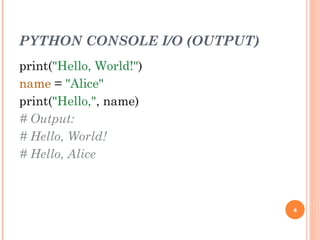
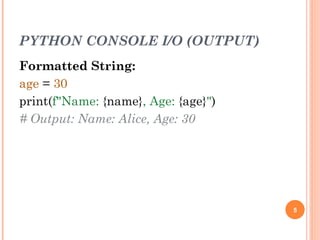
PYTHON CONSOLE I/O(OUTPUT)
print("Hello, World!")
name = "Alice"
print("Hello,", name)
# Output:
# Hello, World!
# Hello, Alice
4
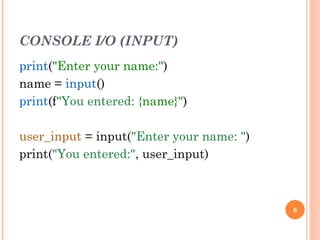
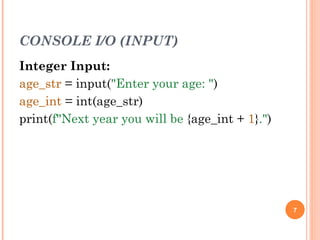
CONSOLE I/O (INPUT)
IntegerInput:
age_str = input("Enter your age: ")
age_int = int(age_str)
print(f"Next year you will be {age_int + 1}.")
7
8.
PYTHON COMMENTS
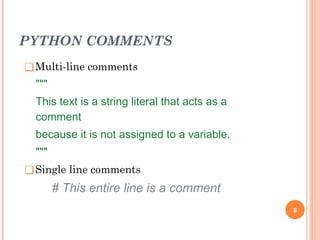
❏Multi-line comments
"""
Thistext is a string literal that acts as a
comment
because it is not assigned to a variable.
"""
❏Single line comments
# This entire line is a comment
8
9.
CLASSES: A FIRSTLOOK
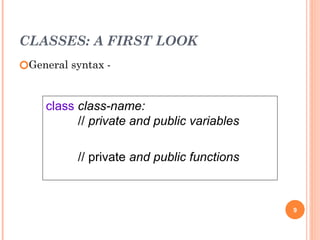
🞆General syntax -
9
class class-name:
// private and public variables
// private and public functions
10.
CLASSES: A FIRSTLOOK (CONT.)
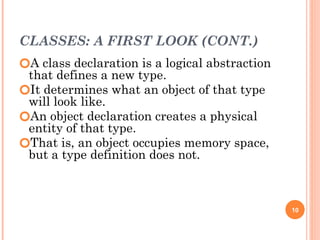
🞆A class declaration is a logical abstraction
that defines a new type.
🞆It determines what an object of that type
will look like.
🞆An object declaration creates a physical
entity of that type.
🞆That is, an object occupies memory space,
but a type definition does not.
10
11.
CLASSES: A FIRSTLOOK (CONT.)
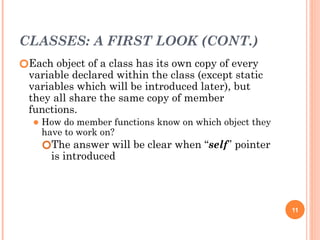
🞆Each object of a class has its own copy of every
variable declared within the class (except static
variables which will be introduced later), but
they all share the same copy of member
functions.
⚫ How do member functions know on which object they
have to work on?
🞆The answer will be clear when “self” pointer
is introduced
11
12.
POLYMORPHISM
🞆Polymorphism refers tofunctions with the
same name that can be executed on many
objects or classes.
🞆Runtime Polymorphism:
➔ Functions execution of same name is
decided in runtime.
🞆Compile-time Polymorphism:
➔ Functions execution of same name is
decided in compile time.
12
CONSTRUCTORS
🞆Every object wecreate will require some sort of
initialization.
🞆A class’s constructor is automatically called by the
compiler each time an object of that class is created.
🞆A constructor function has the same name as the
class and has no return type in most of OOP
languages.
🞆There is no explicit way to call the constructor.
15
16.
CONSTRUCTORS
🞆Python is alittle different
🞆it has a constructor and an initializer.
🞆The constructor function is rarely used.
🞆constructor (__new__) creates the object
instance
🞆while the initializer (__init__) sets the initial
state or attributes of that newly created object.
16
17.
DESTRUCTORS
🞆The complement ofa constructor is the destructor.
🞆This function is automatically called by the compiler
when an object is destroyed.
🞆The name of a destructor is the name of its class,
preceded by a ~ in most of the OOP languages.
🞆There is explicit way to call the destructor but highly
discouraged.
17
18.
DESTRUCTORS
🞆In Python, thedestructor is a special method
named __del__() that is called just before an
object is destroyed or garbage-collected
🞆Unlike in languages like C++, destructors are
not frequently needed in Python because its
automatic garbage collector handles memory
management.
18
19.
CONSTRUCTORS THAT TAKE
PARAMETERS
🞆InPython we will generally use initializer to initialize
the object.
🞆Initializer can be without any parameters
🞆And Initializer can take parameter as well.
19
20.
OBJECT POINTERS
🞆In Python,self is a parameter that acts as a
reference to the current instance of a class
🞆In C++, 'this' pointer is an implicit pointer
available inside all non-static member function
20
21.
INHERITANCE
❏ Inheritance isa core principle where a
new class (subclass/child) acquires
properties (attributes) and behaviors
(methods) from an existing class (
superclass/parent).
21
22.
TYPES OF INHERITANCEIN PYTHON
❏ Single Inheritance: A child class inherits from
only one parent class.
❏ Multiple Inheritance: A class can inherit from
more than one parent class.
❏ Multilevel Inheritance: A chain of inheritance
where a class inherits from a derived class,
creating a grandparent -parent-child
relationship.
22