SDN in the Public Cloud:
Windows Azure
Albert Greenberg
Partner Development Manager
Windows Azure Networking
albert@microsoft.com
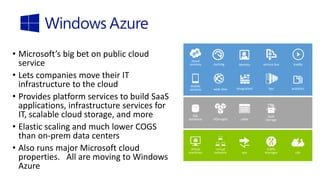
• Microsoft’s big bet on public cloud
service
• Lets companies move their IT
infrastructure to the cloud
• Provides platform services to build SaaS
applications, infrastructure services for
IT, scalable cloud storage, and more
• Elastic scaling and much lower COGS
than on-prem data centers
• Also runs major Microsoft cloud
properties. All are moving to Windows
Azure
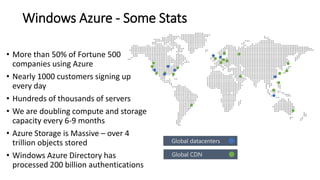
Windows Azure - Some Stats
• More than 50% of Fortune 500
companies using Azure
• Nearly 1000 customers signing up
every day
• Hundreds of thousands of servers
• We are doubling compute and storage
capacity every 6-9 months
• Azure Storage is Massive – over 4
trillion objects stored
• Windows Azure Directory has
processed 200 billion authentications
Big Bet on Enterprise:
Infrastructure as a Service (IaaS)
• Bring your own persistent VMs to the Cloud
• Anything that runs on Hyper-V runs on Azure
• Manage your infrastructure and policy as if it
was your own
• What does IaaS require of networking?
• Domain join your VMs to your domain controller
• Connect cloud DNS to on-premise DNS
• Set up a Sharepoint farm in the cloud and serve
it back to your corporate intranet
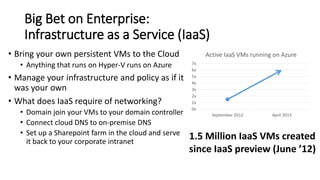
0x
1x
2x
3x
4x
5x
6x
7x
September 2012 April 2013
Active IaaS VMs running on Azure
1.5 Million IaaS VMs created
since IaaS preview (June ’12)
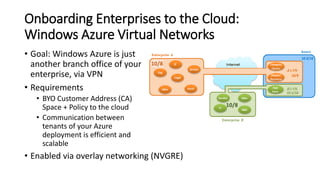
Onboarding Enterprises to the Cloud:
Windows Azure Virtual Networks
• Goal: Windows Azure is just
another branch office of your
enterprise, via VPN
• Requirements
• BYO Customer Address (CA)
Space + Policy to the cloud
• Communication between
tenants of your Azure
deployment is efficient and
scalable
• Enabled via overlay networking (NVGRE)
10/8
10/8
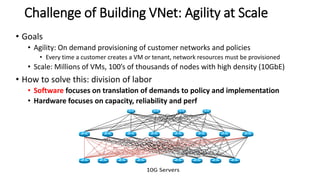
10G Servers
Challenge of Building VNet: Agility at Scale
• Goals
• Agility: On demand provisioning of customer networks and policies
• Every time a customer creates a VM or tenant, network resources must be provisioned
• Scale: Millions of VMs, 100’s of thousands of nodes with high density (10GbE)
• How to solve this: division of labor
• Software focuses on translation of demands to policy and implementation
• Hardware focuses on capacity, reliability and perf
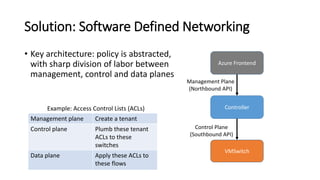
Solution: Software Defined Networking
• Key architecture: policy is abstracted,
with sharp division of labor between
management, control and data planes
Azure Frontend
Controller
VMSwitch
Management Plane
(Northbound API)
Control Plane
(Southbound API)
Management plane Create a tenant
Control plane Plumb these tenant
ACLs to these
switches
Data plane Apply these ACLs to
these flows
Example: Access Control Lists (ACLs)
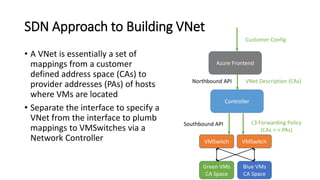
SDN Approach to Building VNet
• A VNet is essentially a set of
mappings from a customer
defined address space (CAs) to
provider addresses (PAs) of hosts
where VMs are located
• Separate the interface to specify a
VNet from the interface to plumb
mappings to VMSwitches via a
Network Controller
Azure Frontend
Controller
Customer Config
VNet Description (CAs)
L3 Forwarding Policy
(CAs <-> PAs)
VMSwitchVMSwitch
Blue VMs
CA Space
Green VMs
CA Space
Northbound API
Southbound API
Vnet Controller Model
Azure Frontend
Controller
Node1: 10.1.1.5
Blue VM1
10.1.1.2
Green VM1
10.1.1.2
Azure VMSwitch
Node2: 10.1.1.6
Red VM1
10.1.1.2
Green VM2
10.1.1.3
Azure VMSwitch
Node3: 10.1.1.7
Green S2S GW
10.1.2.1
Azure VMSwitch
Green Enterprise
Network
10.2/16
VPN GW
Customer Config
VNet Description
L3 Forwarding Policy
Secondary
Controllers
Consensus
Protocol
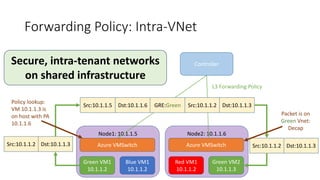
Forwarding Policy: Intra-VNet
Node1: 10.1.1.5
Blue VM1
10.1.1.2
Green VM1
10.1.1.2
Azure VMSwitch
Node2: 10.1.1.6
Red VM1
10.1.1.2
Green VM2
10.1.1.3
Azure VMSwitchSrc:10.1.1.2 Dst:10.1.1.3 Src:10.1.1.2 Dst:10.1.1.3
Policy lookup:
VM 10.1.1.3 is
on host with PA
10.1.1.6
Packet is on
Green Vnet:
Decap
Controller
Src:10.1.1.5 Dst:10.1.1.6 GRE:Green Src:10.1.1.2 Dst:10.1.1.3
L3 Forwarding Policy
Secure, intra-tenant networks
on shared infrastructure
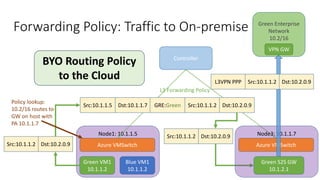
Forwarding Policy: Traffic to On-premise
Node1: 10.1.1.5
Blue VM1
10.1.1.2
Green VM1
10.1.1.2
Azure VMSwitchSrc:10.1.1.2 Dst:10.2.0.9
Src:10.1.1.2 Dst:10.2.0.9
Policy lookup:
10.2/16 routes to
GW on host with
PA 10.1.1.7
Controller
Src:10.1.1.5 Dst:10.1.1.7 GRE:Green Src:10.1.1.2 Dst:10.2.0.9
L3 Forwarding Policy
Node3: 10.1.1.7
Green S2S GW
10.1.2.1
Azure VMSwitch
Green Enterprise
Network
10.2/16
VPN GW
Src:10.1.1.2 Dst:10.2.0.9L3VPN PPP
BYO Routing Policy
to the Cloud
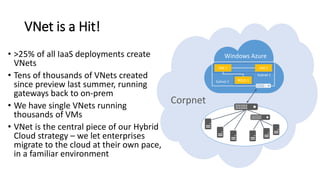
VNet is a Hit!
• >25% of all IaaS deployments create
VNets
• Tens of thousands of VNets created
since preview last summer, running
gateways back to on-prem
• We have single VNets running
thousands of VMs
• VNet is the central piece of our Hybrid
Cloud strategy – we let enterprises
migrate to the cloud at their own pace,
in a familiar environment
Corpnet
More Cloud Networking
Challenges
IaaS VM
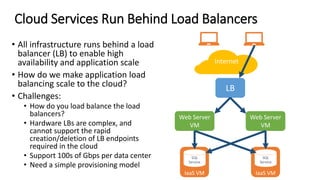
Cloud Services Run Behind Load Balancers
• All infrastructure runs behind a load
balancer (LB) to enable high
availability and application scale
• How do we make application load
balancing scale to the cloud?
• Challenges:
• How do you load balance the load
balancers?
• Hardware LBs are complex, and
cannot support the rapid
creation/deletion of LB endpoints
required in the cloud
• Support 100s of Gbps per data center
• Need a simple provisioning model
LB
Web Server
VM
Web Server
VM
SQL
Service
IaaS VM
SQL
Service
NAT
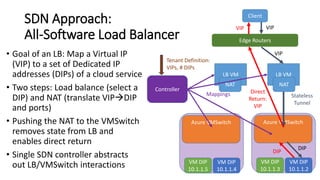
SDN Approach:
All-Software Load Balancer
LB VM
VM DIP
10.1.1.2
VM DIP
10.1.1.3
Azure VMSwitch
Stateless
Tunnel
Edge Routers
Client
VIP
VIP
DIP
DIP
Direct
Return:
VIP
VIP
LB VM
VM DIP
10.1.1.4
VM DIP
10.1.1.5
Azure VMSwitch
NAT
Controller
Tenant Definition:
VIPs, # DIPs
Mappings
• Goal of an LB: Map a Virtual IP
(VIP) to a set of Dedicated IP
addresses (DIPs) of a cloud service
• Two steps: Load balance (select a
DIP) and NAT (translate VIPDIP
and ports)
• Pushing the NAT to the VMSwitch
removes state from LB and
enables direct return
• Single SDN controller abstracts
out LB/VMSwitch interactions
NAT
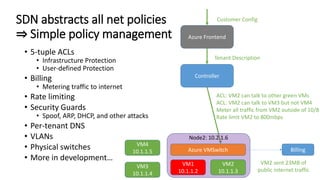
SDN abstracts all net policies
⇒ Simple policy management
• 5-tuple ACLs
• Infrastructure Protection
• User-defined Protection
• Billing
• Metering traffic to internet
• Rate limiting
• Security Guards
• Spoof, ARP, DHCP, and other attacks
• Per-tenant DNS
• VLANs
• Physical switches
• More in development…
Azure Frontend
Controller
Node2: 10.2.1.6
VM1
10.1.1.2
VM2
10.1.1.3
Azure VMSwitch
Customer Config
Tenant Description
ACL: VM2 can talk to other green VMs
ACL: VM2 can talk to VM3 but not VM4
Meter all traffic from VM2 outside of 10/8
Rate limit VM2 to 800mbps
VM3
10.1.1.4
VM4
10.1.1.5 Billing
VM2 sent 23MB of
public internet traffic
Node: 10.4.1.5
Azure VMSwitch
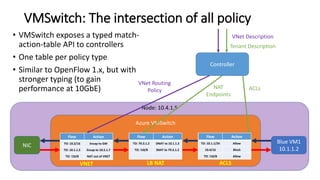
VMSwitch: The intersection of all policy
Blue VM1
10.1.1.2
NIC
Controller
Tenant Description
VNet Description
Flow Action
VNet Routing
Policy ACLsNAT
Endpoints
Flow ActionFlow Action
TO: 10.2/16 Encap to GW
TO: 10.1.1.5 Encap to 10.5.1.7
TO: !10/8 NAT out of VNET
Flow ActionFlow Action
TO: 79.3.1.2 DNAT to 10.1.1.2
TO: !10/8 SNAT to 79.3.1.2
Flow Action
TO: 10.1.1/24 Allow
10.4/16 Block
TO: !10/8 Allow
• VMSwitch exposes a typed match-
action-table API to controllers
• One table per policy type
• Similar to OpenFlow 1.x, but with
stronger typing (to gain
performance at 10GbE)
VNET LB NAT ACLS
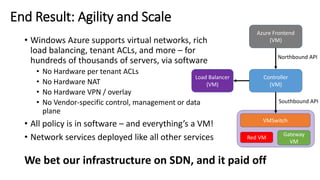
End Result: Agility and Scale
• Windows Azure supports virtual networks, rich
load balancing, tenant ACLs, and more – for
hundreds of thousands of servers, via software
• No Hardware per tenant ACLs
• No Hardware NAT
• No Hardware VPN / overlay
• No Vendor-specific control, management or data
plane
• All policy is in software – and everything’s a VM!
• Network services deployed like all other services
We bet our infrastructure on SDN, and it paid off
Azure Frontend
(VM)
Controller
(VM)
Northbound API
Southbound API
Red VM
Gateway
VM
VMSwitch
Load Balancer
(VM)
Final thoughts: Challenges Overcome
• It’s not scalable to synchronously push the entire network state to every
VMSwitch
• We have to enable eventual consistency on the network with event-driven control
plane updates
• A wire protocol back to the controller doesn’t scale – we need smart agents
• The VMSwitch is policy rich, but needs to support 10GbE/40GbE
• Extensive flow hashing is required, as well as strict table typing
• Managing latency and latency jitter is getting increasingly difficult
• SDN scales better, but it still has finite scale; need to federate controllers
• It’s a challenge to federate the controller sets and still achieve consistent policy
• Have to federate the Northbound API

SDN in the Public Cloud: Windows Azure

  • 3.
    SDN in thePublic Cloud: Windows Azure Albert Greenberg Partner Development Manager Windows Azure Networking albert@microsoft.com
  • 4.
    • Microsoft’s bigbet on public cloud service • Lets companies move their IT infrastructure to the cloud • Provides platform services to build SaaS applications, infrastructure services for IT, scalable cloud storage, and more • Elastic scaling and much lower COGS than on-prem data centers • Also runs major Microsoft cloud properties. All are moving to Windows Azure
  • 5.
    Windows Azure -Some Stats • More than 50% of Fortune 500 companies using Azure • Nearly 1000 customers signing up every day • Hundreds of thousands of servers • We are doubling compute and storage capacity every 6-9 months • Azure Storage is Massive – over 4 trillion objects stored • Windows Azure Directory has processed 200 billion authentications
  • 6.
    Big Bet onEnterprise: Infrastructure as a Service (IaaS) • Bring your own persistent VMs to the Cloud • Anything that runs on Hyper-V runs on Azure • Manage your infrastructure and policy as if it was your own • What does IaaS require of networking? • Domain join your VMs to your domain controller • Connect cloud DNS to on-premise DNS • Set up a Sharepoint farm in the cloud and serve it back to your corporate intranet 0x 1x 2x 3x 4x 5x 6x 7x September 2012 April 2013 Active IaaS VMs running on Azure 1.5 Million IaaS VMs created since IaaS preview (June ’12)
  • 7.
    Onboarding Enterprises tothe Cloud: Windows Azure Virtual Networks • Goal: Windows Azure is just another branch office of your enterprise, via VPN • Requirements • BYO Customer Address (CA) Space + Policy to the cloud • Communication between tenants of your Azure deployment is efficient and scalable • Enabled via overlay networking (NVGRE) 10/8 10/8
  • 8.
    10G Servers Challenge ofBuilding VNet: Agility at Scale • Goals • Agility: On demand provisioning of customer networks and policies • Every time a customer creates a VM or tenant, network resources must be provisioned • Scale: Millions of VMs, 100’s of thousands of nodes with high density (10GbE) • How to solve this: division of labor • Software focuses on translation of demands to policy and implementation • Hardware focuses on capacity, reliability and perf
  • 9.
    Solution: Software DefinedNetworking • Key architecture: policy is abstracted, with sharp division of labor between management, control and data planes Azure Frontend Controller VMSwitch Management Plane (Northbound API) Control Plane (Southbound API) Management plane Create a tenant Control plane Plumb these tenant ACLs to these switches Data plane Apply these ACLs to these flows Example: Access Control Lists (ACLs)
  • 10.
    SDN Approach toBuilding VNet • A VNet is essentially a set of mappings from a customer defined address space (CAs) to provider addresses (PAs) of hosts where VMs are located • Separate the interface to specify a VNet from the interface to plumb mappings to VMSwitches via a Network Controller Azure Frontend Controller Customer Config VNet Description (CAs) L3 Forwarding Policy (CAs <-> PAs) VMSwitchVMSwitch Blue VMs CA Space Green VMs CA Space Northbound API Southbound API
  • 11.
    Vnet Controller Model AzureFrontend Controller Node1: 10.1.1.5 Blue VM1 10.1.1.2 Green VM1 10.1.1.2 Azure VMSwitch Node2: 10.1.1.6 Red VM1 10.1.1.2 Green VM2 10.1.1.3 Azure VMSwitch Node3: 10.1.1.7 Green S2S GW 10.1.2.1 Azure VMSwitch Green Enterprise Network 10.2/16 VPN GW Customer Config VNet Description L3 Forwarding Policy Secondary Controllers Consensus Protocol
  • 12.
    Forwarding Policy: Intra-VNet Node1:10.1.1.5 Blue VM1 10.1.1.2 Green VM1 10.1.1.2 Azure VMSwitch Node2: 10.1.1.6 Red VM1 10.1.1.2 Green VM2 10.1.1.3 Azure VMSwitchSrc:10.1.1.2 Dst:10.1.1.3 Src:10.1.1.2 Dst:10.1.1.3 Policy lookup: VM 10.1.1.3 is on host with PA 10.1.1.6 Packet is on Green Vnet: Decap Controller Src:10.1.1.5 Dst:10.1.1.6 GRE:Green Src:10.1.1.2 Dst:10.1.1.3 L3 Forwarding Policy Secure, intra-tenant networks on shared infrastructure
  • 13.
    Forwarding Policy: Trafficto On-premise Node1: 10.1.1.5 Blue VM1 10.1.1.2 Green VM1 10.1.1.2 Azure VMSwitchSrc:10.1.1.2 Dst:10.2.0.9 Src:10.1.1.2 Dst:10.2.0.9 Policy lookup: 10.2/16 routes to GW on host with PA 10.1.1.7 Controller Src:10.1.1.5 Dst:10.1.1.7 GRE:Green Src:10.1.1.2 Dst:10.2.0.9 L3 Forwarding Policy Node3: 10.1.1.7 Green S2S GW 10.1.2.1 Azure VMSwitch Green Enterprise Network 10.2/16 VPN GW Src:10.1.1.2 Dst:10.2.0.9L3VPN PPP BYO Routing Policy to the Cloud
  • 14.
    VNet is aHit! • >25% of all IaaS deployments create VNets • Tens of thousands of VNets created since preview last summer, running gateways back to on-prem • We have single VNets running thousands of VMs • VNet is the central piece of our Hybrid Cloud strategy – we let enterprises migrate to the cloud at their own pace, in a familiar environment Corpnet
  • 15.
  • 16.
    IaaS VM Cloud ServicesRun Behind Load Balancers • All infrastructure runs behind a load balancer (LB) to enable high availability and application scale • How do we make application load balancing scale to the cloud? • Challenges: • How do you load balance the load balancers? • Hardware LBs are complex, and cannot support the rapid creation/deletion of LB endpoints required in the cloud • Support 100s of Gbps per data center • Need a simple provisioning model LB Web Server VM Web Server VM SQL Service IaaS VM SQL Service
  • 17.
    NAT SDN Approach: All-Software LoadBalancer LB VM VM DIP 10.1.1.2 VM DIP 10.1.1.3 Azure VMSwitch Stateless Tunnel Edge Routers Client VIP VIP DIP DIP Direct Return: VIP VIP LB VM VM DIP 10.1.1.4 VM DIP 10.1.1.5 Azure VMSwitch NAT Controller Tenant Definition: VIPs, # DIPs Mappings • Goal of an LB: Map a Virtual IP (VIP) to a set of Dedicated IP addresses (DIPs) of a cloud service • Two steps: Load balance (select a DIP) and NAT (translate VIPDIP and ports) • Pushing the NAT to the VMSwitch removes state from LB and enables direct return • Single SDN controller abstracts out LB/VMSwitch interactions NAT
  • 18.
    SDN abstracts allnet policies ⇒ Simple policy management • 5-tuple ACLs • Infrastructure Protection • User-defined Protection • Billing • Metering traffic to internet • Rate limiting • Security Guards • Spoof, ARP, DHCP, and other attacks • Per-tenant DNS • VLANs • Physical switches • More in development… Azure Frontend Controller Node2: 10.2.1.6 VM1 10.1.1.2 VM2 10.1.1.3 Azure VMSwitch Customer Config Tenant Description ACL: VM2 can talk to other green VMs ACL: VM2 can talk to VM3 but not VM4 Meter all traffic from VM2 outside of 10/8 Rate limit VM2 to 800mbps VM3 10.1.1.4 VM4 10.1.1.5 Billing VM2 sent 23MB of public internet traffic
  • 19.
    Node: 10.4.1.5 Azure VMSwitch VMSwitch:The intersection of all policy Blue VM1 10.1.1.2 NIC Controller Tenant Description VNet Description Flow Action VNet Routing Policy ACLsNAT Endpoints Flow ActionFlow Action TO: 10.2/16 Encap to GW TO: 10.1.1.5 Encap to 10.5.1.7 TO: !10/8 NAT out of VNET Flow ActionFlow Action TO: 79.3.1.2 DNAT to 10.1.1.2 TO: !10/8 SNAT to 79.3.1.2 Flow Action TO: 10.1.1/24 Allow 10.4/16 Block TO: !10/8 Allow • VMSwitch exposes a typed match- action-table API to controllers • One table per policy type • Similar to OpenFlow 1.x, but with stronger typing (to gain performance at 10GbE) VNET LB NAT ACLS
  • 20.
    End Result: Agilityand Scale • Windows Azure supports virtual networks, rich load balancing, tenant ACLs, and more – for hundreds of thousands of servers, via software • No Hardware per tenant ACLs • No Hardware NAT • No Hardware VPN / overlay • No Vendor-specific control, management or data plane • All policy is in software – and everything’s a VM! • Network services deployed like all other services We bet our infrastructure on SDN, and it paid off Azure Frontend (VM) Controller (VM) Northbound API Southbound API Red VM Gateway VM VMSwitch Load Balancer (VM)
  • 21.
    Final thoughts: ChallengesOvercome • It’s not scalable to synchronously push the entire network state to every VMSwitch • We have to enable eventual consistency on the network with event-driven control plane updates • A wire protocol back to the controller doesn’t scale – we need smart agents • The VMSwitch is policy rich, but needs to support 10GbE/40GbE • Extensive flow hashing is required, as well as strict table typing • Managing latency and latency jitter is getting increasingly difficult • SDN scales better, but it still has finite scale; need to federate controllers • It’s a challenge to federate the controller sets and still achieve consistent policy • Have to federate the Northbound API