a microcosm of the firms as a whole. A chance,
explains Cannon’s Mark Hirons, principal and design
director of corporate interiors, to develop a model
workplace strategy that could work across the firm.
“We wanted to think more creatively about how
we work in teams, how the office can be a catalyst for
our work and make that more effective,” says Hirons.
Compared with the previous office, where Cannon
had 7,400sq m spread over three floors, this is smaller
(at 5,500sq m) but is across one floor. “We weren’t
as integrated as we wanted to be,” Hirons remembers.
“This building gave us the opportunity to establish
a single culture and one cohesive identity, engaging
people to work together and be more connected.”
Private offices became a thing of the past, and
99% of employees, from intern to principal, were
given the same-sized desk in the new open, communal
office. Away from those desks, they can choose
from around 20 different casual and social spaces,
from high counters and cafe tables to lounge areas
and a library. Instead of lines of workstations, desks
are arranged in groups of six, each pair branching
from a triangular centre.This custom-designed
furniture, for which Cannon has coined the snappy
term ‘radial benching’, allows for a higher seat count
than traditional linear banks while inducing more
movement around the office and creating space for a
large number of in-between teamwork areas (one for
nearly every bank of desks).
FLUID THINKINGARCHITECT
Cannon Design
CLIENT
Cannon Design
LOCATION
Chicago, USA
COST
£4.8m
START DATE
May 2011
COMPLETION DATE
May 2012
FLOOR SPACE
5,500sq m
WORDS BY
Jenny Brewer
PHOTOGRAPHY
Christopher Barrett Photography
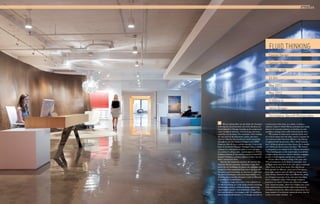
When Ludwig Mies van der Rohe left Germany
following the unceremonious end of the Bauhaus, he
found himself in Chicago, heading up the architecture
school at Illinois Institute of Technology, and soon
made the city his home.The remainder of his working
life was spent in his downtown studio, and since
then his influence has manifested itself consistently
throughout the city. Cannon Design’s new LEED
Platinum office fit out is a prime example. It lies in the
heart of downtown Chicago’s Michigan Plaza, a starkly
minimal two-building block made in steel and glass –
the architect’s calling cards – and designed in 1985 by
Fujikawa Johnson & Associates, a practice founded by
JosephY Fujikawa, a former partner in Mies van der
Rohe’s architecture firm.
Beyond this modernist exterior, the interior also
channels Miesian principles. Spanning a single floor
across the two buildings, the spaces are open plan and
designed to flow seamlessly from one to the next; the
decoration and furnishings are functional, exploiting
the latest technologies; and, most importantly, every
detail has been carefully planned to work as efficiently
as possible for its inhabitants.
Cannon is a huge firm, with 1,100 employees in
15 offices, working on a wide range of fields including
architecture, interiors, urban planning, engineering,
construction, graphics and technology design.The
Chi-town workforce is its largest, with 250 employees,
and most multi-disciplinary, so its design was seen as >>
ONSITE 075
These areas are where Cannon comes into its own.
Most centre around a projector screen linked to the
office network where workers can sit down just with a
keyboard, log in as if they are at their desks, and share
what they’ve been working on. Using a digitiser pen,
they can doodle on plans, annotate with comments
or changes, and visualise their ideas with the group,
developing projects collaboratively.These drawings
and annotations can be saved on the network to refer
back to, or shared with others working on the project.
This is where having a cutting-edge technology design
department within the same company comes in
handy. “Seeing the ideation process creates immediate
engagement and means you can share information
very quickly,” says Hirons. “That activity makes it live,
and makes the environment much more dynamic.”
It also helps the firm adhere to its proudest trait,
which it calls its Single-Firm, Multi-Office (SFMO)
approach, pooling resources across its many offices
around the country and abroad to work on the same
projects, something less tech-minded companies would
trip up on. Many other enclosed meeting rooms and
offices are also kitted out with similar technology, so
employees can log in within a small office for private,
quiet heads-down working or conduct meetings
in larger conference rooms, which also have video
conferencing capabilities.
Choosing such an archetypal Chicago building
is another way Cannon is staying true to its mission
statement, which states a dedication to designing “a
thoughtful response to the physical setting”. In this
case, that means using as many Chicago-related visual
analogies as possible. For example, downtown Chicago
has 18 articulated bridges squeezed on to a two-mile
stretch of river, and this office even features a bridge
(albeit immovable, but we’ll let that slide) in the form
of a small joining space linking the two buildings of
Michigan Plaza.This space lies at the heart of the
building, bridging, sorry, joining two sides of the office,
and acting as a social hub, housing the cafe, design and
resource library, and reception area, which features
a high-gloss polished concrete floor that is meant to
evoke the nearby Chicago river.
The Chicago-isms don’t stop there. Behind the
reception desk is a seemingly freestanding floor-to-
ceiling wave of steel, the same dark bronze colour as
those famous industrial bridges. It curves round the
corner, enclosing a large room used for conferences
and corporate events. Opposite reception is a 12m-long
translucent glass wall, on which is projected a film by
London-based video artistThomas Gray, showing
images of the city, people and buzz phrases related to
the company and city (such as ‘fluid ideation’, ‘incessant
innovation’ and ‘crossing bridges” – management-
speak is obviously still alive and well here). If that wasn’t
enough, every aspect of the office makes the most of
expansive windows overlooking the cityscape, providing
a constant reminder of the city it is celebrating.
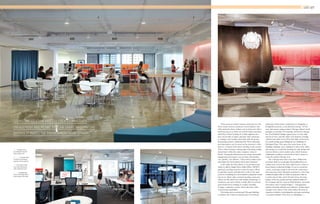
Above The glossy floors
are intended to evoke the
watery Chigaco river
Above right A bronzed ‘wave’
of metal suits the Miesian
building’s minimal aesthetic
Right Every bank of desks
has its own meeting area,
with a networked screen
Far right A meeting room
faces on to Michigan Plaza’s
steel and glass sister tower
ONSITE 077
‘SEEING THE IDEATION PROCESS CREATES IMMEDIATE
ENGAGEMENT AND MEANS YOU CAN SHARE INFORMATION
QUICKLY. IT MAKES THE ENVIRONMENT MORE DYNAMIC’

Onoffice Magazine - Chicago office relocation feature story June 2013

  • 1.
    a microcosm ofthe firms as a whole. A chance, explains Cannon’s Mark Hirons, principal and design director of corporate interiors, to develop a model workplace strategy that could work across the firm. “We wanted to think more creatively about how we work in teams, how the office can be a catalyst for our work and make that more effective,” says Hirons. Compared with the previous office, where Cannon had 7,400sq m spread over three floors, this is smaller (at 5,500sq m) but is across one floor. “We weren’t as integrated as we wanted to be,” Hirons remembers. “This building gave us the opportunity to establish a single culture and one cohesive identity, engaging people to work together and be more connected.” Private offices became a thing of the past, and 99% of employees, from intern to principal, were given the same-sized desk in the new open, communal office. Away from those desks, they can choose from around 20 different casual and social spaces, from high counters and cafe tables to lounge areas and a library. Instead of lines of workstations, desks are arranged in groups of six, each pair branching from a triangular centre.This custom-designed furniture, for which Cannon has coined the snappy term ‘radial benching’, allows for a higher seat count than traditional linear banks while inducing more movement around the office and creating space for a large number of in-between teamwork areas (one for nearly every bank of desks). FLUID THINKINGARCHITECT Cannon Design CLIENT Cannon Design LOCATION Chicago, USA COST £4.8m START DATE May 2011 COMPLETION DATE May 2012 FLOOR SPACE 5,500sq m WORDS BY Jenny Brewer PHOTOGRAPHY Christopher Barrett Photography When Ludwig Mies van der Rohe left Germany following the unceremonious end of the Bauhaus, he found himself in Chicago, heading up the architecture school at Illinois Institute of Technology, and soon made the city his home.The remainder of his working life was spent in his downtown studio, and since then his influence has manifested itself consistently throughout the city. Cannon Design’s new LEED Platinum office fit out is a prime example. It lies in the heart of downtown Chicago’s Michigan Plaza, a starkly minimal two-building block made in steel and glass – the architect’s calling cards – and designed in 1985 by Fujikawa Johnson & Associates, a practice founded by JosephY Fujikawa, a former partner in Mies van der Rohe’s architecture firm. Beyond this modernist exterior, the interior also channels Miesian principles. Spanning a single floor across the two buildings, the spaces are open plan and designed to flow seamlessly from one to the next; the decoration and furnishings are functional, exploiting the latest technologies; and, most importantly, every detail has been carefully planned to work as efficiently as possible for its inhabitants. Cannon is a huge firm, with 1,100 employees in 15 offices, working on a wide range of fields including architecture, interiors, urban planning, engineering, construction, graphics and technology design.The Chi-town workforce is its largest, with 250 employees, and most multi-disciplinary, so its design was seen as >> ONSITE 075
  • 2.
    These areas arewhere Cannon comes into its own. Most centre around a projector screen linked to the office network where workers can sit down just with a keyboard, log in as if they are at their desks, and share what they’ve been working on. Using a digitiser pen, they can doodle on plans, annotate with comments or changes, and visualise their ideas with the group, developing projects collaboratively.These drawings and annotations can be saved on the network to refer back to, or shared with others working on the project. This is where having a cutting-edge technology design department within the same company comes in handy. “Seeing the ideation process creates immediate engagement and means you can share information very quickly,” says Hirons. “That activity makes it live, and makes the environment much more dynamic.” It also helps the firm adhere to its proudest trait, which it calls its Single-Firm, Multi-Office (SFMO) approach, pooling resources across its many offices around the country and abroad to work on the same projects, something less tech-minded companies would trip up on. Many other enclosed meeting rooms and offices are also kitted out with similar technology, so employees can log in within a small office for private, quiet heads-down working or conduct meetings in larger conference rooms, which also have video conferencing capabilities. Choosing such an archetypal Chicago building is another way Cannon is staying true to its mission statement, which states a dedication to designing “a thoughtful response to the physical setting”. In this case, that means using as many Chicago-related visual analogies as possible. For example, downtown Chicago has 18 articulated bridges squeezed on to a two-mile stretch of river, and this office even features a bridge (albeit immovable, but we’ll let that slide) in the form of a small joining space linking the two buildings of Michigan Plaza.This space lies at the heart of the building, bridging, sorry, joining two sides of the office, and acting as a social hub, housing the cafe, design and resource library, and reception area, which features a high-gloss polished concrete floor that is meant to evoke the nearby Chicago river. The Chicago-isms don’t stop there. Behind the reception desk is a seemingly freestanding floor-to- ceiling wave of steel, the same dark bronze colour as those famous industrial bridges. It curves round the corner, enclosing a large room used for conferences and corporate events. Opposite reception is a 12m-long translucent glass wall, on which is projected a film by London-based video artistThomas Gray, showing images of the city, people and buzz phrases related to the company and city (such as ‘fluid ideation’, ‘incessant innovation’ and ‘crossing bridges” – management- speak is obviously still alive and well here). If that wasn’t enough, every aspect of the office makes the most of expansive windows overlooking the cityscape, providing a constant reminder of the city it is celebrating. Above The glossy floors are intended to evoke the watery Chigaco river Above right A bronzed ‘wave’ of metal suits the Miesian building’s minimal aesthetic Right Every bank of desks has its own meeting area, with a networked screen Far right A meeting room faces on to Michigan Plaza’s steel and glass sister tower ONSITE 077 ‘SEEING THE IDEATION PROCESS CREATES IMMEDIATE ENGAGEMENT AND MEANS YOU CAN SHARE INFORMATION QUICKLY. IT MAKES THE ENVIRONMENT MORE DYNAMIC’