The Impact of Online
Customization on User
Engagement
Aliiya Ross
A Journey Through
Footwear Retail
Table Of Contents
Introduction ..................... 3
Annotated Bibliography .................... 4
Research Tacticts .................. 11
Design Process .................. 20
Core Insights ................. 21
Citations .................. 22
Final Summary .................. 23
Introduction
Footwear has always been a reflection of personal style
and identity evolving throughout our time to meet taste and
aesthetics. The rise of online shopping has created a key
shift in how consumers interact with brands and products.
Online retail has opened up new opportunities for
personalization and the ability to design products that
connect to them.
Imagine creating a shoe that perfectly reflects your
personality and style. Online customization offers this level
of personal expression from selecting various colors to
different materials. Because e-commerce is dominating
retail, brands are innovating to meet this growing demand.
My project, The Impact of Online Customization on User
Engagement in Footwear Retail, explores how brands utilize
customization. This idea further enhances user engagement
and the influence it has on purchasing behavior. By
focusing on customization features this research
demonstrated the gap between technology and
individuality.
I chose this topic to understand how customization
establishes a deeper connection between consumers and
brands. This topic shows the evolution of footwear and how
it serves as a product and personal statement.
3
Annotated Bibliography
Source 1: Albert, B., & Tullis, T. (2022). Measuring the user experience: Collecting,
analyzing, and presenting UX metrics. Morgan Kaufmann.
This book provides guidance on how to collect and interpret user experience
metrics. It showcases the importance of quantifying UX to improve product design
and user satisfaction. Some of the key topics include user research methods,
analysing data effectively, and usability testing. They mention how to intergrade
the user experience metrics into business strategies and concepts. There is a big
emphasis on measurability of behaviours, attitudes, and feelings that can enhance
different perspectives. Another aspect that this book includes is detailed case
studies that highlight ways that different UX teams are measuring the experience
and how that can change the drive of an organization. This book provides an
overall insight on how user experience can be successfully integrated in design
production and the abilities to measure the data from user experience
performance.
The authors of this book are user experience experts and the publisher being
Morgan Kaufmann is a respected Tec industry. Bill Albert has more than 20 years
of experience is UX research and design, user interface design, information
architecture, qualitative and quantitative research techniques and UX strategies.
Thom Tullis has had 30+ years of experience in human-computer interface studies
and holds eight US patents related to interface inventions. Both the authors have
high credibility rankings and present immense amount of experience required to
explain the strategies of UX design.
This source adds insight to my topic because understanding the foundations of
how to measure user experience can help further aid me in connected the idea to
product development. Incorporating user experience data is a major part of
applying it to product development because it provides measurability. When a
product is going through the development process designers can take this
measured data into consideration when determining what the products purpose is.
4
Annotated Bibliography
Source 2: Chien, C. F., Kerh, R., Lin, K. Y., & Yu, A. P. I. (2016). Data-driven innovation
to capture user-experience product design: An empirical study for notebook visual
aesthetics design. Computers & Industrial Engineering, 99, 162-173.
This study examines how data-driven approaches can enhance user experience
during the product design phase, The authors explain a method that takes
consumer data and uses it to inform design decisions. This ensures that products
can meet expectations and align with the users’ aesthetic preferences, The study
highlights the role of visually appealing aesthetics and applying data analytics to
understand user preferences. Some key insights include the importance of
comprehending user expectations for visual appeal and the effect of aesthetic
design for user satisfaction. Designers can make more informed decisions by using
data which can improve the marketability and usability of a product. This study
aims to show a framework of data driven product design to effectively distinguish
the useful design concepts that consumers prefer. Providing product designs that
meet consumer needs is the key to success in the fast paces worldwide market.
Another aspect this paper touches on is the purchasing decisions that are
influenced by users' judgement and consumers distinguish similar used products.
This article was published in the Computers and Industrial Engineering peer-
reviewed journal that is highly credible. Chen-Fu Chien connects to the
department of Industrial Engineering and Engineering Management, National Tsing
Hua University, Hsinchu 30013, Taiwan, Kuo-Yi Lin connects to the Department of
Business Administration, Asia University, Taichung 41354, Taiwan. Finally, Annie Pei-
I Yu connects to the Department of Business Administration, National Chung
Cheng University, Chiayi 62102, Taiwan. The authors use quantitative analysis to
support their findings which enhances their reputation for their conclusions. The
study focuses on visual aesthetics as a transformative concept but, that could limit
the other areas of UX functionality.
This source contributes to the topic of incorporating UX into product design
because it showcases the use of data analytics to gain a better understanding of
what users prefer. It focuses on visual aesthetics to provide insight on how user
data can guide design decisions and enhance the appeal of a product.
Integrating evidence into the design process offers key information for companies
to obtain and utilize in their products that meet consumer expectations. Products
have a reputation and brand that they are connected to when consumers consider
their use. Maintaining trust with a consumer through UX data is important when
creating an innovative product.
5
Annotated Bibliography
Source 3: Codfrey, G. S., Baharum, A., Zain, N. H. M., Omar, M., & Deris, F. D. (2022).
User Experience in Product Design and Development: Perspectives and Strategies.
Mathematical Statistician and Engineering Applications, 71(2), 257-262.
This article examines multiple strategies for incorporating user experience into the
product design and development process. It combines insights from UX design
principles and mathematical models. The authors explain the role of UX in decision
making through a products lifecycle. They argue that mathematical models can
help product user behaviour and preferences that can result is more effective
product designs. Some key points include understanding user needs early in the
design process and determining strategies involving users in product design and
development. This paper explains that based on a review analysis its found that
when the designers have a clear perspective from the user the product can satisfy
many other target points. The strategies involved for gaining user input in the
development process focuses on using a standardized questioning protocols to
improve the development stages of the product. The overall objective of the study
is to know perspectives of users to determine various strategies and approaches to
efficient product development practices.
This study was published in the peer reviewed journal Mathematical Statistician
and Engineering Applications and showcases the combination of UX and
mathematical principles that promote its credibility. This perspective provides a
more analytic approach to user product development. Because this study had
more technical components of numbers and statistics, it could limit the
comprehension level for people who have less experience in that topic. This article
demonstrates how quantitative methods can enhance UX design and the values
that promote efficiency in the design process. They authors have trusted sources
listed at the bottom that enhance the credibility of their findings for UX design
application.
This source provides a unique, quantitative perspective on incorporating UX into
product design and development. It focuses on using mathematical models to
predict user behaviour and improve decision making factors. This connects to my
topic because it allows me to gain a better understanding on user experience
data analytics, statistics, and UX application in various environments. This source
broadens my comprehension of UX strategies and the different ways it can
enhance a products life cycle and other user-focused designs.
6
Annotated Bibliography
Source 4: de Oliveira Sousa, A., & Valentim, N. M. C. (2019, October). Prototyping
usability and user experience: A simple technique to agile teams. In Proceedings of the
XVIII Brazilian Symposium on Software Quality (pp. 222-227).
This paper introduces the technique for prototyping development teams and
improving usability without compromising fast paced workflows. The authors argue
that combining rapid prototyping with early usability testing can enhance the
quality of products. This strategy is successful because it helps identify the design
issues early on. When time constraints are a challenge, they highlight the
importance of collaboration between UX designers and developers in
environments. This paper outlines methods that teams can use to incorporate user
experience into their process. This could include user feedback loops and
innovative prototyping. The main idea is that integrating usability and UX testing at
the prototyping stage is key to developing user focused product successfully.
When there is clarity about user needs and elements that provide more value for
the end user, prototyping can become more productive. Their technique is
intended to enable teams to think and design software that focuses on usability
and UX in the beginning to eliminate the possibility of product failure.
This paper was presents at the XVIII Brazilian Symposium on Software Quality
which adds credibility as a peer-reviewed conference. The background of the
author shows software development and usability experience and contributes to
the insights presented. The methods specific focus on agile teams could limit the
application for projects that use other methods, It provides a clear strategy for
efficient prototyping but, it does fall short on other UX research methods. This
paper offers credible information on the integration process of user experience
and the advantage for small teams with resources that vary in advancements.
This source adds value to incorporating UX in product design because it explains
the transformation of UX principles in agile product design. The prototyping
technique mentioned in the paper shows how relevant it is in a team setting.
Product development takes multiple perspectives to ensure its viable and this
paper shows the key aspects of team collaboration for speed and flexibility of a
user-friendly product. Collaboration and continuous feedback connect with
modern product-developed practices. This provides insights on how to combine
design and consumer-based thinking. The papers approach is helpful for teams
working in fast-paced environments because the structure enhances a seamless
workflow.
7
Annotated Bibliography
Source 5: Gualtieri, M. (2009). Best practices in user experience (UX) design. Design
compelling user experiences to wow your customers, 1(1), 1-17.
This source discusses key best practices for creating user experiences that meet
functional needs and capture the attention of customers. An argument made is
that compelling UX design requires in depth understanding of a user’s journey and
motivations. Iterative design and testing and continuous refining of a product
based on user feedback is emphasized heavily in this source. The author also
advocates for the use of detailed profiles of hypothetical users to keep design
decisions focused on real world user needs. He also argues that UX must be
integrated into the overall business strategy to ensure that the user experience
align with business goals. There is long term value when companies invest in UX
because it positions themselves to gain better brand loyalty and stand out in the
competitive market. Improved user experience translates to benefits like more
customers will be willing to purchase, resist doing business with competitors, and
recommend the product.
Gualtieri is a senior analyst at Forrester Research which is a respected market
research firm leading to the credibility of his work. His experience in consulting
companies on user experience and customer satisfaction provides him with a good
foundation to discuss these UX best practices. The paper brings real world industry
examples and is grounded in knowledge rather than theoretical ideas. The
limitations of this source is shown in the timeframe being 2009 and UX design has
progressed since that time so, new information could be missing. The principles
outlined in the source are still relevant to the design industry and the credibility
remains consistent to the present time.
This source provides practical insights into how UX design can be incorporated in
product development. He emphasizes aligning UX with business objectives and
how important that strategy can be for a product. UX improvement can derive
customer satisfaction and business growth when applied to a product. The
strategies mentioned serve as steps for design teams that want to incorporate UX
in the developmental design process. This source helps me to understand the long-
term benefits of investing in user design and how to differentiate the need for a
product. By applying these best practices in the product development stage it
eliminates the need for a reconstruction of a product that is already out in the
market.
8
Annotated Bibliography
Source 6: Interaction Design Foundation - IxDF. (2024, February 6). The 7 Factors
that Influence User Experience. Interaction Design Foundation - IxDF.
https://www.interaction-design.org/literature/article/the-7-factors-that-influence-
user-experience
This article explains the seven core factors that shape UX and they include
usefulness, usability, desirability, findability, accessibility, credibility, and value.
They recognize that “useful” is up for interpretation and things can be useful if they
deliver non-practical benefits. Usability is regarded with enabling users to
effectively achieve their own objectives with a product. Findability refers to the
aspect of how easy the product can be distinguished. Credibility relates to if the
user can trust the product will perform. The desirability of a product can be shows
through branding, image, identity, aesthetics, and emotional design. These factors
are discussed in detail and provide guidance on how product designers can
optimize their designs. The article argues that UX requires attention of functional
and emotional aspects of user interaction with a product. They emphasize the
correlation between usability and desirability for a product and how engaged
users become. This article can be applied for both beginner and experienced UX
designers in guiding the core principles of UX.
The Interaction Design Foundation is a high respected platform known for its
educational resources on UX and interaction design. The foundations articles are
widely used by professionals and students. The content focuses on clear
explanations making it a trusted source and made for design professionals to
utilize. A weakness that this article shows is the broad explanations for the core
factors. Each explanation has further details but, there’s not enough details
presented to fully progress on the idea. However, this article is clear to understand
and is shown to be a valuable resource for foundational UX knowledge.
This article offers insights into the key components of user experience which
contributes to how to incorporate UX into product design. The seven key factors
that influence UX provide a framework for utilizing different features of a product
that can enhance the satisfaction for the user. This source is useful for a structured
approach to improving product design and obtaining a new perspective on how
different elements work together to create a cohesive user experience. Focusing
on the influences of user experience can expand my knowledge on useful design
strategies in the developmental process of a product.
9
Annotated Bibliography
Source 7: Patil, M. S., Desai, P., Vijayalakshmi, M., Raikar, M. M., Battur, S., Parikshit,
H., & Joshi, G. H. (2016, December). UX design to promote undergraduate projects to
products: case study. In 2016 IEEE 4th International Conference on MOOCs,
Innovation and Technology in Education (MITE) (pp. 302-307). IEEE.
This case study explores the role of UX design in helping undergraduate projects
transition into market-ready products. The authors provide real world examples of
student projects to demonstrate how UX early in the design process furthers the
usability of a product. They argue that UX design is a major factor in filling the gap
between academic ideas and consumer ready products. The paper highlights
specific UX tools and methods that students can incorporate in the development
process. It’s explained that UX design should be considered because the products
that come out of this strategy have a longer lifecycle that products that dismiss
the UX design perspective. Product consumers value services that incorporate a
culture and influence them to become more involved in using the product. This
develops a connection to the user and how they feel towards a products purpose.
UX design reduces the risk of waste and generates products with sustainable
elements that will maintain their use.
This paper was published by the IEE which is a leading authority organization
dedicates to advancing technology and befit humanity. They sponsor more than
2000 conferences and events in 190 countries. There are strengths in the case
studies that show UX in real life situations. The weakness of the paper could be
that undergraduate projects limit the insight of larger scaled professional product
development experience. Their sources come from credible establishments that
include journals, articles, and novels. The paper also includes graphics to visually
show their data findings and how they compare to other statistics.
This source offers informational insights into how UX can be utilizes in the early
stages of product development. This paper explains the application to academic
and project-based environments. It shows how UX can transform ideas into useful
user-friendly products. The emphasis on understanding how UX design impacts
product development in the usability aspect contributes to my topic because it
provides perspective on when it should be utilized. When user experience is
recognized in the beginning processes of a product it maintains the success for
the life of the product.
10
Research
Tactic 1 Mood Board
11
Research
Tactic 1 Mood Board
The first image that I added involved the adidas sambas and the tab when you choose the shoe.
Towards the bottom of the shoes page, multiple styled images represent how the shoe can be worn and
suggestions. I added this because the explanation for these suggestions encourages customers to share
their favorite shoe style for a chance to be showcased online. This feature enhances user engagement
because consumers are inspired by other people and how they use the product which impacts their
buying decisions.
1.
The second image showcases the samba shoe design from multiple different perspectives. This feature
to customize the variety of displays for the shoes enables the consumer to see how the shoe looks from
different angles. This way the consumer can get a better understanding of the design as a whole. The
decision to buy the shoe progresses as the consumer can see how they can look in the product. This
feature allows for a stronger enhancement of user engagement and future ideas for usability.
2.
The third image represents the customization of colors for this style of shoes. The user can pick from 12
colors that they can envision their product in to fit different color preferences. This variety of colors
prompts users to participate by exploring other color options that strengthen their want for the product.
If a user likes the product they are more likely to choose it in other colors rather than risking a new
product they have no prior experience with.
3.
The fourth image is the initial display for the “Gazelle Indoor Shoe” design among the other Adidas
shoes. I chose this image because it provides a quick summary that highlights the main features of the
shoe. The user can easily understand what the shoe has to offer and they can decide if that product fits
their needs effectively. The price, name, and color options are the key descriptions that influence a
user's decision and they are previewed in this image for this style.
4.
The fifth image shows the Nike blazers, more specifically the back tab. Nike provides a feature to users
that allows them to fully customize certain shoes. I chose this image because on different shoes you can
fully customize the text. This enables full user engagement and individuality knowing that the shoe is one
of a kind. A small feature of user customization in a shoe that is highly replicated is a driving factor for
product usability.
5.
The sixth image in the mood board represents the menu for the customization process of the shoe. Each
shoe has different components that a user can customize and this image summarizes the variety Nike
has to offer. The colors shown next to the different shoe details represent the corresponding colors on
the shoe design so a user can easily identify which areas can be changed. I chose this image because
user engagement can increase when these components are organized in this display.
6.
The seventh image takes a deeper dive into the part of the shoe called the quarter. This image
represents the variety of options available for the user to choose from, giving two options of materials
and color. Nike encourages the user to engage with these options as they change depending on what
the user chooses. When a material gets selected there are connecting colors that the user can pick and
the display reflects these options to preview the potential product.
7.
The eighth image is the initial display for the ”Nike Dunk Low By You” among the other customizable Nike
shoes. This preview describes the name, style, price, and color to enhance the effectiveness of the
design to the user. The main feature of these displays is the small boxes towards the top left with an
icon that represents the customization option. Anytime a user is scrolling through shoes and they view
this icon they can immediately connect it to the idea that it is fully user-customizable.
8.
The final image showcases the Nike dunk from multiple different angles. When opening the
customization feature Nike enables the user to view the shoes in an interactive 360 display. The
experience of the shoe becomes more than just an image and the user interacts with the product as if
they already have it. The role of this customization aspect increases the chances of the product fitting
the consumer's needs and their interactions with the online product.
9.
12
Research
Tactic 1 Summary
This exploration of online product customization elements for
strong Adidas and Nike shoes has given me valuable insight into
my target audience. The Adidas platform had features of user-
styled images and the ability to connect with a sharing option
that demonstrates the drive for community engagement. Users
are inspired to purchase a product when they can see real-life
applications from other consumers because it offers a sense of
belonging. The ability for users to envision themselves wearing
the product becomes a big motivator for engagement and
purchase. On the Nike and Adidas platforms, they share a
different perspective and customizable product views. This
caters to users' need for personalization and details for style
preferences. Users that receive an interactive shipping
experience can promote the idea that the product is usable
making it more reasonable to buy. Nike's ability to provide a 360
interactive view of the dunk enhances the user's closet and
examines design components like the materials and text. All the
customization options add an aspect of individuality that
connects with users' wants for unique products. These insights
show that online engaging product design for retail platforms
should use customization and visual interactive displays to
effectively influence user engagement. I learned information
about how two competing brands promote their shoe designs
and the impact that user engagement has on product success.
13
Research
Tactic 2
Competitor
Analysis
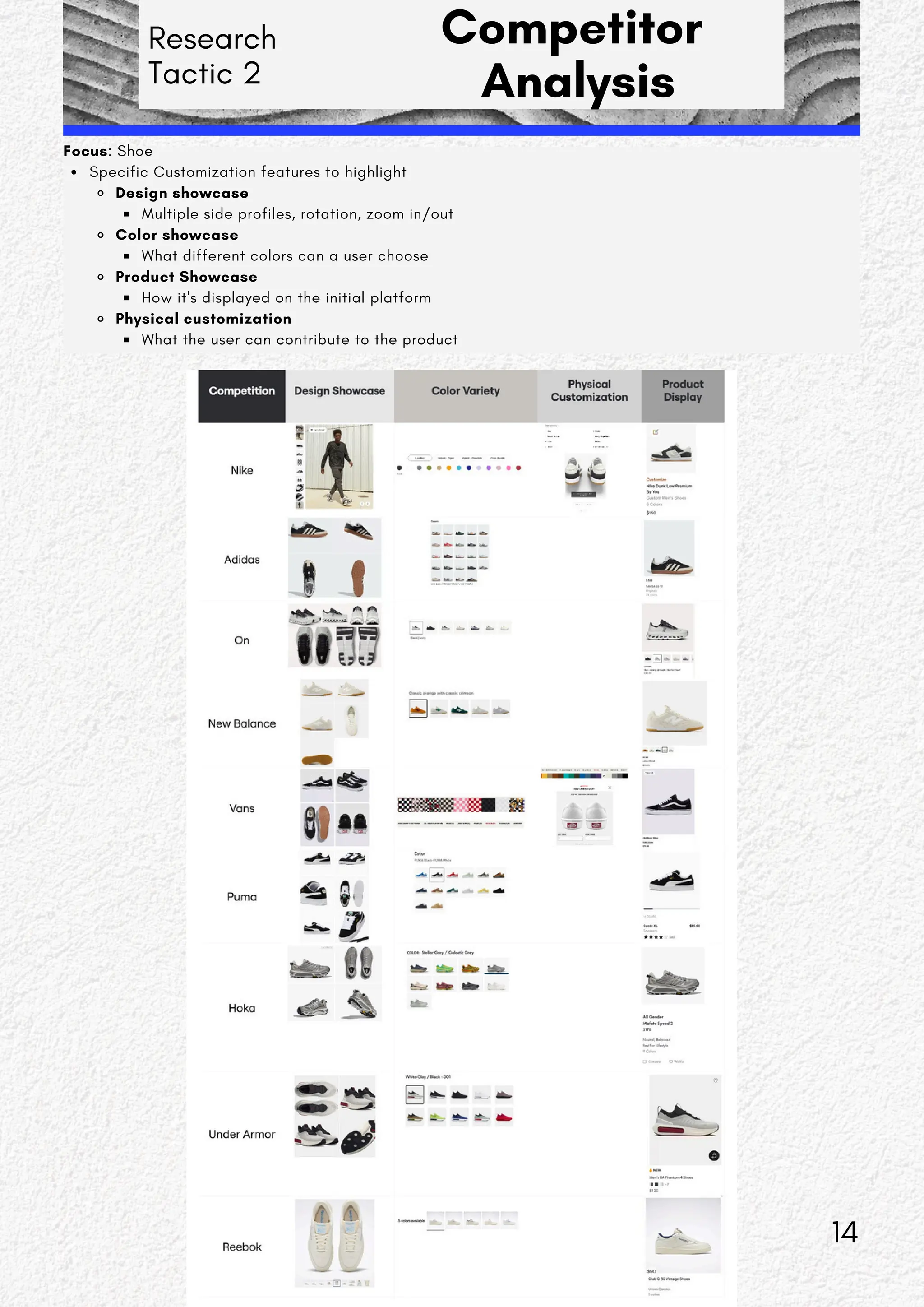
Focus: Shoe
Specific Customization features to highlight
Design showcase
Multiple side profiles, rotation, zoom in/out
Color showcase
What different colors can a user choose
Product Showcase
How it's displayed on the initial platform
Physical customization
What the user can contribute to the product
14
Research
Tactic 2
Competitor
Analysis
Nike
Competitor Profile Summary: The design showcase of Nike's shoe offered 9 different perspectives that the
shoe could be analyzed in. For each box that the consumer can choose there is a magnification spotlight to
closely view the details of the shoe. The color variety offered for the customizable shoe is a wide variety,
specifically 14 different shades. They offer physical customization where the user can contribute their text to
the design. Finally, the product showcase where you see the initial shoe
Adidas
Competitor Profile Summary: The design showcase for the Sambas offers a 4x4 display of the shoes and a
rotating view in the corner. The color variety is established with 24 different colors that the shoe can come
in. The initial product display for the shoe presents the price, the title, and the amount of colors that the
design can produce.
On Running
Competitor Profile Summary: The design showcase for this shoe highlights the different angles of the shoe in
multiple ways but, one at a time. The color variety is shown in 7 different shades and the initial product
display shows the price, title, and the colors available in a scroll format for the design.
New Balance
Competitor Profile Summary: The design showcase for this shoe is highlighted through five different
perspectives where the consumer can view a spotlight depending on the style picture chosen. There are 5
different colors available for this design. The initial product display represents the title, and price, and
features the five different images for colors.
Vans
Competitor Profile Summary: The design showcase for this shoe displays the design in a 4x4 grid where it
magnifies on each square. The color variety comes in large amounts of shades, patterns, and images
consumers can upload. They offer personalized customization for consumers to input text and their initial
showcase features the price and title.
Puma
Competitor Profile Summary: Pumas design showcase offers six different views that demonstrate the design
details of the shoe. This certain design comes in fourteen different colors that can enhance the shoe's
aesthetic. The initial product display summarizes the title, price, reviews in star form, and the number of
colors offered for that style.
Hoka
Competitor Profile Summary: Hokas design showcase contains four images that show the sides, tops, and
bottoms of the shoe design. The color variety is produced in nine different shades that range in vibrance and
patterned design. The initial product display highlights the price, name, and the number of colors provided
and the ability to compare to other products.
Under Amour
Competitor Profile Summary: The Under Armour design showcase features the shoe in 4 different panels with
the spotlight on the top design, side angle, and bottom of the shoe. There are other features that wrap
around the whole shoe if the consumer engages. The color variety is shown in 10 different shades and the
initial product display shows the price, title, and number of colors with a preview of shade ranges.
Reebok
Competitor Profile Summary: The Reebok design showcase highlights the shoe for the main screen while
presenting multiple different angles underneath the display for the consumer to change perspectives. The
colors of the style are only changed in the little features of the shoe and not the overall body but, there are
five different options. For the initial product display, Reebok shows the price, title, and the number of colors
provided.
15
Research
Tactic 2 Summary
The competitor analysis helped me learn several key insights
about how leading athletic brands approach online product
customization to enhance user engagement. Each brand
strategically uses customization to cater to consumer demands
for unique, creative, and functional needs. Nike and Vans offer
extensive customization options like color, text, and material
choices that push users to create unique products. This
customization strengthens their connection to their audience.
Adidas and On emphasized their efforts on sustainability in
their customization techniques by using materials that were on
the sustainable side and different innovative design elements.
In comparison, the brands that offer the least amount of
customization like Reebok and Under Armour, focused more on
functional and aesthetic variations. This contrast shows the
depths of engagement customization that brands can provide.
Overall, this analysis displays that flexibility in customization
options especially the tech advanced displays is essential for
building brand loyalty.
16
Research
Tactic Focus Group
How often do you purchase customizable products online, specifically shoes? Purpose: To see the interest in online customization, and
understand the participants’ baseline engagement with this feature.
Peyton Back (23): “I purchase shoes that are customizable often whether that's choosing the color, details, or material.”
Rian Heinke (22): Probably every time I go shopping once every few months
Brody Marler (22): Once every month
Kean Khouri (21): I always purchase shoes and focus on the customization of the colors that I prefer when it comes to the color.
Cate Dover (20): 3 or 4 times a year
Grace Gilmore (22): Every time I buy a shoe like 3 or 4 times a year
What aspects of a customizable shoe are most important to you (color options, patterns, materials)? Purpose: To identify which
customization features spark interest and engagement.
Peyton Back (23): I would say the color variety
Rian Heinke (22): Color variety and materials
Brody Marler (22): Color options
Grace Gilmore (22): Materials and the options that come with it
Cate Dover (20): I like it when shoes have different color options and when I can customize what areas I see them in.
Kean Khouri (21): The aspects that are most important to me are the width and color.
How important is the ability to view multiple side profiles, zoom in, and rotate the shoe when customizing and purchasing? Purpose: To
understand if visual control tools enhance user satisfaction and confidence in design choices.
Peyton Back (23): Really important because I like to see every angle multiple times
Rian Heinke (22): Very important because I like to see what the shoe looks like from every angle to get a good read on a shoe
Grace Gilmore (22): That's important because sometimes the shoes aren't what they seem to be, for exampl,e heels like chunky, stiletto, pump.
Brody Marler (22): Very important because I want to see how it compares to if I purchased the product
Cate Dover (20): It is imperative because I wanna see how the shoe fits in different settings.
Kean Khouri (21): Very important because it enables me to fully grasp all the aspects of the shoe.
What kind of color options or customization would you expect to find in an ideal online shoe customization tool? Purpose: To determine if
there’s a demand for specific color choices or color effects, and how these might contribute to user satisfaction and brand loyalty.
Peyton Back (23): Having neutrals like black, white, and gray and then some unique colors. Angles are very important when it comes to shoes
because people view shoes from all perspectives.
Grace Gilmore (22): Changing the color into a color I want and making more shoes physically customizable
Brody Marler (22): Specifically choose colors in specific spots of the shoes
Rian Heinke (22): Change the feature of durability on the shoe
Cate Dover (20): I would like to find different platform heights and different colors.
Kean Khouri (21): In the ideal customization tool I would expect neutral colors and colors that stand out. I also would like the ability to zoom in
and out of the shoe to see the details.
When customizing a product online, do you feel more engaged when you can modify physical aspects (like adding initials or choosing
materials)? Why or why not? Purpose: To view if physical customization options create a stronger connection to the product and
influence purchase decisions.
Peyton Back (23): I am more engaged by those aspects but not being able to do that with every shoe doesn’t bother me or change if I will buy
it.
Cate Dover (20): I am not more engaged because I just focus on the look of the shoe
Brody Marler (22): Yes I am more engaged because I am focused more on the details of the shoe which influences my overall decision
Rian Heinke (22): I think it matters because it gives you more than one option when I am shopping I don't even think to pick the color but since
it's an option I buy it.
Grace Gilmore (22): I feel more engaged because it feels personalized and unique to my aesthetic.
Kean Khouri (21): I feel more engaged because it connects me to the product when I am investing my attention in making it close to something I
am willing to purchase.
How important is the initial product display to influence engagement? Purpose: To understand the role of the initial display in attracting
users.
Rian Heinke (22): It is important but, not a determining factor to have all the information needed on the initial display
Brody Marler (22): It's important because I don't want to have to look through the product and go through the tabs
Cate Dover (20): It won't make or break my decision on clicking on the shoe
Grace Gilmore (22): AllIi am looking at is the picture and that will make me click on the product
Peyton Back (23): I want all necessary details to be summarized about the shoe before having to click on the shoe because it allows for faster
decision-making on products.
Kean Khouri (21): I think it's important because when the product display shows me a summary of the shoe then it makes my shopping experience
more efficient.
17
Research
Tactic Focus Group
What improvements to the design display of the product could be made to engage the user? Purpose: To identify obstacles
otouser engagement for online platforms
Peyton Back (23): A good variety of specific categories as opposed to broad categories. Giving the customer the option to filter
out specific aspects of the shoes.
Cate Dover (20): I would have a tool where you can move the screen around the shoe to see a 360 view.
Grace Gilmore (22): Adding more reviews and pictures from other customers
Rian Heinke (22): Improving the search function when you are looking for something and how user-friendly (Zara online I hate that
website)
Brody Marler (22): Personalizing it more and giving the main page a grid of things I have bought already and suggestions
Kean Khouri (21): If the platform has simple displays with layouts that direct you effectively I am more likely to explore different
products from that company's site.
What do you think of the current customization tools offered by major shoe brands (e.g., Nike, Adidas)? Purpose: To gather
competitive insights and understand what users appreciate or find frustrating in current market offerings.
Peyton Back (23): I think the good companies are offering proactive customization tools and the bad companies have confusing
and hard-to-use platforms.
Grace Gilmore (22): I like how it is right now and there isn’t anything I would add to enhance user engagement.
Brody Marler (22): I like it but I wish I could completely redo the sneaker but that's hard
Rian Heinke (22): More physical customization by the user
Cate Dover (20): I like when there's are a lott of options to choose from ifyou arer out of a size in one shoe there should be
suggestions
Kean Khouri (21): I think that the current customization tools are pretty good but, I do think companies could incorporate the use
of virtual reality or 3D modeling to give products more life.
If a customizable shoe platform could provide real-time feedback on how your design would look and feel, how would that
impact your engagement? Purpose: To explore whether real-time feedback, like visual previews or texture indications, could
enhance user engagement.
Peyton Back (23): It would impact it a lot because I would be more willing to purchase the product because I would gain more
visibility on the purpose
Rian Heinke (22): It would make me more likely to buy something because when I am online shopping the main reason I don’t buy
it is because I don’t know how it's going to look on me.
Brody Marler (22): I would be a lot more engaged and listen to more insight on what the shoe is like and if I am going to buy it.
Cate Dover (20): I would be way more inclined to buy if it tells me how it would look and feel
Grace Gilmore (22): It would increase it because it gives me more info on the shoe
Kean Khouri (21): That would impact my engagement because it would push me to explore more about the product and how it
can be incorporatedinton my life.
What other features would you like to see in a customizable shoe experience that you haven’t seen yet? Purpose: To
understand needs or ideas that could enhance engagement.
Peyton Back (23): Wearing the shoe and having a POV from the model. A more personalized experience.
Cate Dover (20): Moving around patterns and there's a base model for a shoe
Rian Heinke (22): Seeing how the shoes can be styled
Grace Gilmore (22): Glitter-infused laces
Brody Marler (22): Building a shoe from scratch picking the type of base and focusing on the customization of the structure of
the shoe as opposed to only focusing on the design.
Kean Khouri (21): I would like to see more companies allow for more user personalization on a shoe whether that's with text or
pictures.
18
Research
Tactic Summary
Using a focus group for this research enhanced my understanding
of the target demographic by understanding what users prefer and
the behaviors that consumers have with the design of the online
shopping experience. I noticed that participants who buy shoes
more often than most spend more time focusing on the choices
and view of the shoe. When it came to answering the design
questions, these participants had more detail on their reasonings.
For the participants who do less online shopping specifically for
shoes, their focus was on color variety. These participants were
unaffected by the overall design of the shopping experience but
more focused on the look of the product. The rreal-timeinteraction
with the participants helped me recognize how many different
perspectives can go into one subject. More insights were gained
when talking in a focus group because people were able to build
upon other ideas and stronger innovations started to form.
This discussion highlights the role of physical customization in
enhancing user engagement because participants feel more
connected to products they can personalize. This personalization
comes in ranges and it's important to measure where participants
view their contributions to a product. I was able to gain a better
vision of what design elements influence user engagement like
rreal-timepreviews, style guidance, 360 view, different angles, etc.
This experience showed the value of sharing preferences and
inspiration from the people around you. User-centered design
choices can be influenced by the participants' wants for
customization.
19
Presentation Design Process
20
Core Insights & Conclusions
Themes
Customization as a highlight for the shopping experience: Participants and
platforms emphasized features like color options, materials, and
personalization tools throughout all the research tactics of the mood board,
competitor profiling, and focus groups.
Interactive Displays: Most of the users and brands value the tools that
enhance the product details of the shoe like 350-degree view, zoom, and
side profiles.
Efficient and effective platform layouts: Participants found that clear and
simple displays for color options, price, and customization capabilities are
desired for a seamless shopping experience
Results
Personalizing products through options like color, material, and text allows
users to create something unique, enhancing feelings of ownership and
identity. This fosters a stronger emotional bond with the product, making it
feel more meaningful and valuable.
Interactive tools like 360-degree views, zoom features, and different product
angles help users understand the product in depth. By offering a tactile-like
experience, these displays simulate a real-world shopping environment,
which increases engagement and reduces uncertainty about purchasing.
When users can personalize a product and interact with it in an immersive
way, they form an emotional attachment, viewing the product as a reflection
of their style or needs. This emotional connection significantly influences
their purchasing decisions, often leading to stronger brand loyalty and
repeat purchases.
By analyzing how consumers engage through their perspective, brands create a
shopping experience that resonates with users’ desires for uniqueness and
control. The importance of understanding user behavior within online shopping
impacts how successful products are and the potential production of profit.
21
Citations
Albert, B., & Tullis, T. (2022). Measuring the user experience: Collecting,
analyzing, and presenting UX metrics. Morgan Kaufmann.
Patil, M. S., Desai, P., Vijayalakshmi, M., Raikar, M. M., Battur, S., Parikshit, H., &
Joshi, G. H. (2016, December). UX design to promote undergraduate projects to
products: case study. In 2016 IEEE 4th International Conference on MOOCs,
Innovation and Technology in Education (MITE) (pp. 302-307).
De Oliveira Sousa, A., & Valentim, N. M. C. (2019, October). Prototyping usability
and user experience: A simple technique to agile teams. In Proceedings of the
XVIII Brazilian Symposium on Software Quality (pp. 222-227).
Chien, C. F., Kerh, R., Lin, K. Y., & Yu, A. P. I. (2016). Data-driven innovation to
capture user-experience product design: An empirical study for notebook visual
aesthetics design. Computers & Industrial Engineering, 99, 162-173.
Codfrey, G. S., Baharum, A., Zain, N. H. M., Omar, M., & Deris, F. D. (2022). User
Experience in Product Design and Development: Perspectives and Strategies.
Mathematical Statistician and Engineering Applications, 71(2), 257- 262.
Interaction Design Foundation - IxDF. (2024, February 6). The 7 Factors that
Influence User Experience. Interaction Design Foundation - IxDF.
https://www.interaction-design.org/literature/article/the-7-factors-that
influence-user-experience
Gualtieri, M. (2009). Best practices in user experience (UX) design. Design
compelling user experiences to wow your customers, 1(1), 1-17.
Thomas, S., & Karodia, A. M. (2014). Retailing Shoes: Strategizing for a New
Niche Market. Singaporean Journal of Business, Economics and Management
Studies, 51(1123), 1-16.
Converse World class trainer II - the Deffest®. A vintage and Retro Sneaker Blog.
- vintage ads. (2020). Retrieved from https://www.thedeffest.com/vintage-
ads/tag/Converse+World+Class+Trainer+II
Great athletes remind the world there’s nothing wrong with wanting to win.
(n.d.). Retrieved from https://about.nike.com/en/newsroom/releases/winning-
isnt-for-everyone-campaign
(N.d.). Retrieved from https://www.amazon.com/Soccer-Cleats-Blueprint-
Patent-Poster/dp/B01N4UUYX3
Pin by Ela F. Mooney on wall posters: Black and white wallpaper, black and white
picture wall, black and White Photo Wall. (2021). Retrieved from
https://in.pinterest.com/pin/5981411995709070/
Pin by NB on clothes 🛍️: Shoe wall art, patent prints, framed gifts. (2024).
Retrieved from https://www.pinterest.com/pin/711639178652935242/
22
Final Summary
Online customization is a powerful tool for enhancing user engagement and
is a main driver of consumer behavior. Allowing the users to personalize
products creates a space where brands can highlight a consumer's
individuality. Customization tools highly improve the user shopping
experience. It connects them to a product and the brand associated, which
can then promote their reputation and consumer loyalty.
This research demonstrates the potential of customization in the footwear
industry. Brands should prioritize user-centered design, interactive
technologies, and sustainable practices to compete in this fast-paced
industry. The combination of innovation and user engagement will position
customization as a key aspect of success
This research established that customization does have a deeper connection
between consumers and brands because consumers get to involve themselves
in the design process. The future of shopping is about making it personal. We
want to feel connected to the products we buy as consumers and
customization offers a powerful way to do that. Brands can create
memorable shopping experiences that go beyond just a transaction by giving
us the tools to design, engage, and express ourselves.
23

OnlineCustomizationonUserEngagement .pdf

  • 1.
    The Impact ofOnline Customization on User Engagement Aliiya Ross A Journey Through Footwear Retail
  • 2.
    Table Of Contents Introduction..................... 3 Annotated Bibliography .................... 4 Research Tacticts .................. 11 Design Process .................. 20 Core Insights ................. 21 Citations .................. 22 Final Summary .................. 23
  • 3.
    Introduction Footwear has alwaysbeen a reflection of personal style and identity evolving throughout our time to meet taste and aesthetics. The rise of online shopping has created a key shift in how consumers interact with brands and products. Online retail has opened up new opportunities for personalization and the ability to design products that connect to them. Imagine creating a shoe that perfectly reflects your personality and style. Online customization offers this level of personal expression from selecting various colors to different materials. Because e-commerce is dominating retail, brands are innovating to meet this growing demand. My project, The Impact of Online Customization on User Engagement in Footwear Retail, explores how brands utilize customization. This idea further enhances user engagement and the influence it has on purchasing behavior. By focusing on customization features this research demonstrated the gap between technology and individuality. I chose this topic to understand how customization establishes a deeper connection between consumers and brands. This topic shows the evolution of footwear and how it serves as a product and personal statement. 3
  • 4.
    Annotated Bibliography Source 1:Albert, B., & Tullis, T. (2022). Measuring the user experience: Collecting, analyzing, and presenting UX metrics. Morgan Kaufmann. This book provides guidance on how to collect and interpret user experience metrics. It showcases the importance of quantifying UX to improve product design and user satisfaction. Some of the key topics include user research methods, analysing data effectively, and usability testing. They mention how to intergrade the user experience metrics into business strategies and concepts. There is a big emphasis on measurability of behaviours, attitudes, and feelings that can enhance different perspectives. Another aspect that this book includes is detailed case studies that highlight ways that different UX teams are measuring the experience and how that can change the drive of an organization. This book provides an overall insight on how user experience can be successfully integrated in design production and the abilities to measure the data from user experience performance. The authors of this book are user experience experts and the publisher being Morgan Kaufmann is a respected Tec industry. Bill Albert has more than 20 years of experience is UX research and design, user interface design, information architecture, qualitative and quantitative research techniques and UX strategies. Thom Tullis has had 30+ years of experience in human-computer interface studies and holds eight US patents related to interface inventions. Both the authors have high credibility rankings and present immense amount of experience required to explain the strategies of UX design. This source adds insight to my topic because understanding the foundations of how to measure user experience can help further aid me in connected the idea to product development. Incorporating user experience data is a major part of applying it to product development because it provides measurability. When a product is going through the development process designers can take this measured data into consideration when determining what the products purpose is. 4
  • 5.
    Annotated Bibliography Source 2:Chien, C. F., Kerh, R., Lin, K. Y., & Yu, A. P. I. (2016). Data-driven innovation to capture user-experience product design: An empirical study for notebook visual aesthetics design. Computers & Industrial Engineering, 99, 162-173. This study examines how data-driven approaches can enhance user experience during the product design phase, The authors explain a method that takes consumer data and uses it to inform design decisions. This ensures that products can meet expectations and align with the users’ aesthetic preferences, The study highlights the role of visually appealing aesthetics and applying data analytics to understand user preferences. Some key insights include the importance of comprehending user expectations for visual appeal and the effect of aesthetic design for user satisfaction. Designers can make more informed decisions by using data which can improve the marketability and usability of a product. This study aims to show a framework of data driven product design to effectively distinguish the useful design concepts that consumers prefer. Providing product designs that meet consumer needs is the key to success in the fast paces worldwide market. Another aspect this paper touches on is the purchasing decisions that are influenced by users' judgement and consumers distinguish similar used products. This article was published in the Computers and Industrial Engineering peer- reviewed journal that is highly credible. Chen-Fu Chien connects to the department of Industrial Engineering and Engineering Management, National Tsing Hua University, Hsinchu 30013, Taiwan, Kuo-Yi Lin connects to the Department of Business Administration, Asia University, Taichung 41354, Taiwan. Finally, Annie Pei- I Yu connects to the Department of Business Administration, National Chung Cheng University, Chiayi 62102, Taiwan. The authors use quantitative analysis to support their findings which enhances their reputation for their conclusions. The study focuses on visual aesthetics as a transformative concept but, that could limit the other areas of UX functionality. This source contributes to the topic of incorporating UX into product design because it showcases the use of data analytics to gain a better understanding of what users prefer. It focuses on visual aesthetics to provide insight on how user data can guide design decisions and enhance the appeal of a product. Integrating evidence into the design process offers key information for companies to obtain and utilize in their products that meet consumer expectations. Products have a reputation and brand that they are connected to when consumers consider their use. Maintaining trust with a consumer through UX data is important when creating an innovative product. 5
  • 6.
    Annotated Bibliography Source 3:Codfrey, G. S., Baharum, A., Zain, N. H. M., Omar, M., & Deris, F. D. (2022). User Experience in Product Design and Development: Perspectives and Strategies. Mathematical Statistician and Engineering Applications, 71(2), 257-262. This article examines multiple strategies for incorporating user experience into the product design and development process. It combines insights from UX design principles and mathematical models. The authors explain the role of UX in decision making through a products lifecycle. They argue that mathematical models can help product user behaviour and preferences that can result is more effective product designs. Some key points include understanding user needs early in the design process and determining strategies involving users in product design and development. This paper explains that based on a review analysis its found that when the designers have a clear perspective from the user the product can satisfy many other target points. The strategies involved for gaining user input in the development process focuses on using a standardized questioning protocols to improve the development stages of the product. The overall objective of the study is to know perspectives of users to determine various strategies and approaches to efficient product development practices. This study was published in the peer reviewed journal Mathematical Statistician and Engineering Applications and showcases the combination of UX and mathematical principles that promote its credibility. This perspective provides a more analytic approach to user product development. Because this study had more technical components of numbers and statistics, it could limit the comprehension level for people who have less experience in that topic. This article demonstrates how quantitative methods can enhance UX design and the values that promote efficiency in the design process. They authors have trusted sources listed at the bottom that enhance the credibility of their findings for UX design application. This source provides a unique, quantitative perspective on incorporating UX into product design and development. It focuses on using mathematical models to predict user behaviour and improve decision making factors. This connects to my topic because it allows me to gain a better understanding on user experience data analytics, statistics, and UX application in various environments. This source broadens my comprehension of UX strategies and the different ways it can enhance a products life cycle and other user-focused designs. 6
  • 7.
    Annotated Bibliography Source 4:de Oliveira Sousa, A., & Valentim, N. M. C. (2019, October). Prototyping usability and user experience: A simple technique to agile teams. In Proceedings of the XVIII Brazilian Symposium on Software Quality (pp. 222-227). This paper introduces the technique for prototyping development teams and improving usability without compromising fast paced workflows. The authors argue that combining rapid prototyping with early usability testing can enhance the quality of products. This strategy is successful because it helps identify the design issues early on. When time constraints are a challenge, they highlight the importance of collaboration between UX designers and developers in environments. This paper outlines methods that teams can use to incorporate user experience into their process. This could include user feedback loops and innovative prototyping. The main idea is that integrating usability and UX testing at the prototyping stage is key to developing user focused product successfully. When there is clarity about user needs and elements that provide more value for the end user, prototyping can become more productive. Their technique is intended to enable teams to think and design software that focuses on usability and UX in the beginning to eliminate the possibility of product failure. This paper was presents at the XVIII Brazilian Symposium on Software Quality which adds credibility as a peer-reviewed conference. The background of the author shows software development and usability experience and contributes to the insights presented. The methods specific focus on agile teams could limit the application for projects that use other methods, It provides a clear strategy for efficient prototyping but, it does fall short on other UX research methods. This paper offers credible information on the integration process of user experience and the advantage for small teams with resources that vary in advancements. This source adds value to incorporating UX in product design because it explains the transformation of UX principles in agile product design. The prototyping technique mentioned in the paper shows how relevant it is in a team setting. Product development takes multiple perspectives to ensure its viable and this paper shows the key aspects of team collaboration for speed and flexibility of a user-friendly product. Collaboration and continuous feedback connect with modern product-developed practices. This provides insights on how to combine design and consumer-based thinking. The papers approach is helpful for teams working in fast-paced environments because the structure enhances a seamless workflow. 7
  • 8.
    Annotated Bibliography Source 5:Gualtieri, M. (2009). Best practices in user experience (UX) design. Design compelling user experiences to wow your customers, 1(1), 1-17. This source discusses key best practices for creating user experiences that meet functional needs and capture the attention of customers. An argument made is that compelling UX design requires in depth understanding of a user’s journey and motivations. Iterative design and testing and continuous refining of a product based on user feedback is emphasized heavily in this source. The author also advocates for the use of detailed profiles of hypothetical users to keep design decisions focused on real world user needs. He also argues that UX must be integrated into the overall business strategy to ensure that the user experience align with business goals. There is long term value when companies invest in UX because it positions themselves to gain better brand loyalty and stand out in the competitive market. Improved user experience translates to benefits like more customers will be willing to purchase, resist doing business with competitors, and recommend the product. Gualtieri is a senior analyst at Forrester Research which is a respected market research firm leading to the credibility of his work. His experience in consulting companies on user experience and customer satisfaction provides him with a good foundation to discuss these UX best practices. The paper brings real world industry examples and is grounded in knowledge rather than theoretical ideas. The limitations of this source is shown in the timeframe being 2009 and UX design has progressed since that time so, new information could be missing. The principles outlined in the source are still relevant to the design industry and the credibility remains consistent to the present time. This source provides practical insights into how UX design can be incorporated in product development. He emphasizes aligning UX with business objectives and how important that strategy can be for a product. UX improvement can derive customer satisfaction and business growth when applied to a product. The strategies mentioned serve as steps for design teams that want to incorporate UX in the developmental design process. This source helps me to understand the long- term benefits of investing in user design and how to differentiate the need for a product. By applying these best practices in the product development stage it eliminates the need for a reconstruction of a product that is already out in the market. 8
  • 9.
    Annotated Bibliography Source 6:Interaction Design Foundation - IxDF. (2024, February 6). The 7 Factors that Influence User Experience. Interaction Design Foundation - IxDF. https://www.interaction-design.org/literature/article/the-7-factors-that-influence- user-experience This article explains the seven core factors that shape UX and they include usefulness, usability, desirability, findability, accessibility, credibility, and value. They recognize that “useful” is up for interpretation and things can be useful if they deliver non-practical benefits. Usability is regarded with enabling users to effectively achieve their own objectives with a product. Findability refers to the aspect of how easy the product can be distinguished. Credibility relates to if the user can trust the product will perform. The desirability of a product can be shows through branding, image, identity, aesthetics, and emotional design. These factors are discussed in detail and provide guidance on how product designers can optimize their designs. The article argues that UX requires attention of functional and emotional aspects of user interaction with a product. They emphasize the correlation between usability and desirability for a product and how engaged users become. This article can be applied for both beginner and experienced UX designers in guiding the core principles of UX. The Interaction Design Foundation is a high respected platform known for its educational resources on UX and interaction design. The foundations articles are widely used by professionals and students. The content focuses on clear explanations making it a trusted source and made for design professionals to utilize. A weakness that this article shows is the broad explanations for the core factors. Each explanation has further details but, there’s not enough details presented to fully progress on the idea. However, this article is clear to understand and is shown to be a valuable resource for foundational UX knowledge. This article offers insights into the key components of user experience which contributes to how to incorporate UX into product design. The seven key factors that influence UX provide a framework for utilizing different features of a product that can enhance the satisfaction for the user. This source is useful for a structured approach to improving product design and obtaining a new perspective on how different elements work together to create a cohesive user experience. Focusing on the influences of user experience can expand my knowledge on useful design strategies in the developmental process of a product. 9
  • 10.
    Annotated Bibliography Source 7:Patil, M. S., Desai, P., Vijayalakshmi, M., Raikar, M. M., Battur, S., Parikshit, H., & Joshi, G. H. (2016, December). UX design to promote undergraduate projects to products: case study. In 2016 IEEE 4th International Conference on MOOCs, Innovation and Technology in Education (MITE) (pp. 302-307). IEEE. This case study explores the role of UX design in helping undergraduate projects transition into market-ready products. The authors provide real world examples of student projects to demonstrate how UX early in the design process furthers the usability of a product. They argue that UX design is a major factor in filling the gap between academic ideas and consumer ready products. The paper highlights specific UX tools and methods that students can incorporate in the development process. It’s explained that UX design should be considered because the products that come out of this strategy have a longer lifecycle that products that dismiss the UX design perspective. Product consumers value services that incorporate a culture and influence them to become more involved in using the product. This develops a connection to the user and how they feel towards a products purpose. UX design reduces the risk of waste and generates products with sustainable elements that will maintain their use. This paper was published by the IEE which is a leading authority organization dedicates to advancing technology and befit humanity. They sponsor more than 2000 conferences and events in 190 countries. There are strengths in the case studies that show UX in real life situations. The weakness of the paper could be that undergraduate projects limit the insight of larger scaled professional product development experience. Their sources come from credible establishments that include journals, articles, and novels. The paper also includes graphics to visually show their data findings and how they compare to other statistics. This source offers informational insights into how UX can be utilizes in the early stages of product development. This paper explains the application to academic and project-based environments. It shows how UX can transform ideas into useful user-friendly products. The emphasis on understanding how UX design impacts product development in the usability aspect contributes to my topic because it provides perspective on when it should be utilized. When user experience is recognized in the beginning processes of a product it maintains the success for the life of the product. 10
  • 11.
  • 12.
    Research Tactic 1 MoodBoard The first image that I added involved the adidas sambas and the tab when you choose the shoe. Towards the bottom of the shoes page, multiple styled images represent how the shoe can be worn and suggestions. I added this because the explanation for these suggestions encourages customers to share their favorite shoe style for a chance to be showcased online. This feature enhances user engagement because consumers are inspired by other people and how they use the product which impacts their buying decisions. 1. The second image showcases the samba shoe design from multiple different perspectives. This feature to customize the variety of displays for the shoes enables the consumer to see how the shoe looks from different angles. This way the consumer can get a better understanding of the design as a whole. The decision to buy the shoe progresses as the consumer can see how they can look in the product. This feature allows for a stronger enhancement of user engagement and future ideas for usability. 2. The third image represents the customization of colors for this style of shoes. The user can pick from 12 colors that they can envision their product in to fit different color preferences. This variety of colors prompts users to participate by exploring other color options that strengthen their want for the product. If a user likes the product they are more likely to choose it in other colors rather than risking a new product they have no prior experience with. 3. The fourth image is the initial display for the “Gazelle Indoor Shoe” design among the other Adidas shoes. I chose this image because it provides a quick summary that highlights the main features of the shoe. The user can easily understand what the shoe has to offer and they can decide if that product fits their needs effectively. The price, name, and color options are the key descriptions that influence a user's decision and they are previewed in this image for this style. 4. The fifth image shows the Nike blazers, more specifically the back tab. Nike provides a feature to users that allows them to fully customize certain shoes. I chose this image because on different shoes you can fully customize the text. This enables full user engagement and individuality knowing that the shoe is one of a kind. A small feature of user customization in a shoe that is highly replicated is a driving factor for product usability. 5. The sixth image in the mood board represents the menu for the customization process of the shoe. Each shoe has different components that a user can customize and this image summarizes the variety Nike has to offer. The colors shown next to the different shoe details represent the corresponding colors on the shoe design so a user can easily identify which areas can be changed. I chose this image because user engagement can increase when these components are organized in this display. 6. The seventh image takes a deeper dive into the part of the shoe called the quarter. This image represents the variety of options available for the user to choose from, giving two options of materials and color. Nike encourages the user to engage with these options as they change depending on what the user chooses. When a material gets selected there are connecting colors that the user can pick and the display reflects these options to preview the potential product. 7. The eighth image is the initial display for the ”Nike Dunk Low By You” among the other customizable Nike shoes. This preview describes the name, style, price, and color to enhance the effectiveness of the design to the user. The main feature of these displays is the small boxes towards the top left with an icon that represents the customization option. Anytime a user is scrolling through shoes and they view this icon they can immediately connect it to the idea that it is fully user-customizable. 8. The final image showcases the Nike dunk from multiple different angles. When opening the customization feature Nike enables the user to view the shoes in an interactive 360 display. The experience of the shoe becomes more than just an image and the user interacts with the product as if they already have it. The role of this customization aspect increases the chances of the product fitting the consumer's needs and their interactions with the online product. 9. 12
  • 13.
    Research Tactic 1 Summary Thisexploration of online product customization elements for strong Adidas and Nike shoes has given me valuable insight into my target audience. The Adidas platform had features of user- styled images and the ability to connect with a sharing option that demonstrates the drive for community engagement. Users are inspired to purchase a product when they can see real-life applications from other consumers because it offers a sense of belonging. The ability for users to envision themselves wearing the product becomes a big motivator for engagement and purchase. On the Nike and Adidas platforms, they share a different perspective and customizable product views. This caters to users' need for personalization and details for style preferences. Users that receive an interactive shipping experience can promote the idea that the product is usable making it more reasonable to buy. Nike's ability to provide a 360 interactive view of the dunk enhances the user's closet and examines design components like the materials and text. All the customization options add an aspect of individuality that connects with users' wants for unique products. These insights show that online engaging product design for retail platforms should use customization and visual interactive displays to effectively influence user engagement. I learned information about how two competing brands promote their shoe designs and the impact that user engagement has on product success. 13
  • 14.
    Research Tactic 2 Competitor Analysis Focus: Shoe SpecificCustomization features to highlight Design showcase Multiple side profiles, rotation, zoom in/out Color showcase What different colors can a user choose Product Showcase How it's displayed on the initial platform Physical customization What the user can contribute to the product 14
  • 15.
    Research Tactic 2 Competitor Analysis Nike Competitor ProfileSummary: The design showcase of Nike's shoe offered 9 different perspectives that the shoe could be analyzed in. For each box that the consumer can choose there is a magnification spotlight to closely view the details of the shoe. The color variety offered for the customizable shoe is a wide variety, specifically 14 different shades. They offer physical customization where the user can contribute their text to the design. Finally, the product showcase where you see the initial shoe Adidas Competitor Profile Summary: The design showcase for the Sambas offers a 4x4 display of the shoes and a rotating view in the corner. The color variety is established with 24 different colors that the shoe can come in. The initial product display for the shoe presents the price, the title, and the amount of colors that the design can produce. On Running Competitor Profile Summary: The design showcase for this shoe highlights the different angles of the shoe in multiple ways but, one at a time. The color variety is shown in 7 different shades and the initial product display shows the price, title, and the colors available in a scroll format for the design. New Balance Competitor Profile Summary: The design showcase for this shoe is highlighted through five different perspectives where the consumer can view a spotlight depending on the style picture chosen. There are 5 different colors available for this design. The initial product display represents the title, and price, and features the five different images for colors. Vans Competitor Profile Summary: The design showcase for this shoe displays the design in a 4x4 grid where it magnifies on each square. The color variety comes in large amounts of shades, patterns, and images consumers can upload. They offer personalized customization for consumers to input text and their initial showcase features the price and title. Puma Competitor Profile Summary: Pumas design showcase offers six different views that demonstrate the design details of the shoe. This certain design comes in fourteen different colors that can enhance the shoe's aesthetic. The initial product display summarizes the title, price, reviews in star form, and the number of colors offered for that style. Hoka Competitor Profile Summary: Hokas design showcase contains four images that show the sides, tops, and bottoms of the shoe design. The color variety is produced in nine different shades that range in vibrance and patterned design. The initial product display highlights the price, name, and the number of colors provided and the ability to compare to other products. Under Amour Competitor Profile Summary: The Under Armour design showcase features the shoe in 4 different panels with the spotlight on the top design, side angle, and bottom of the shoe. There are other features that wrap around the whole shoe if the consumer engages. The color variety is shown in 10 different shades and the initial product display shows the price, title, and number of colors with a preview of shade ranges. Reebok Competitor Profile Summary: The Reebok design showcase highlights the shoe for the main screen while presenting multiple different angles underneath the display for the consumer to change perspectives. The colors of the style are only changed in the little features of the shoe and not the overall body but, there are five different options. For the initial product display, Reebok shows the price, title, and the number of colors provided. 15
  • 16.
    Research Tactic 2 Summary Thecompetitor analysis helped me learn several key insights about how leading athletic brands approach online product customization to enhance user engagement. Each brand strategically uses customization to cater to consumer demands for unique, creative, and functional needs. Nike and Vans offer extensive customization options like color, text, and material choices that push users to create unique products. This customization strengthens their connection to their audience. Adidas and On emphasized their efforts on sustainability in their customization techniques by using materials that were on the sustainable side and different innovative design elements. In comparison, the brands that offer the least amount of customization like Reebok and Under Armour, focused more on functional and aesthetic variations. This contrast shows the depths of engagement customization that brands can provide. Overall, this analysis displays that flexibility in customization options especially the tech advanced displays is essential for building brand loyalty. 16
  • 17.
    Research Tactic Focus Group Howoften do you purchase customizable products online, specifically shoes? Purpose: To see the interest in online customization, and understand the participants’ baseline engagement with this feature. Peyton Back (23): “I purchase shoes that are customizable often whether that's choosing the color, details, or material.” Rian Heinke (22): Probably every time I go shopping once every few months Brody Marler (22): Once every month Kean Khouri (21): I always purchase shoes and focus on the customization of the colors that I prefer when it comes to the color. Cate Dover (20): 3 or 4 times a year Grace Gilmore (22): Every time I buy a shoe like 3 or 4 times a year What aspects of a customizable shoe are most important to you (color options, patterns, materials)? Purpose: To identify which customization features spark interest and engagement. Peyton Back (23): I would say the color variety Rian Heinke (22): Color variety and materials Brody Marler (22): Color options Grace Gilmore (22): Materials and the options that come with it Cate Dover (20): I like it when shoes have different color options and when I can customize what areas I see them in. Kean Khouri (21): The aspects that are most important to me are the width and color. How important is the ability to view multiple side profiles, zoom in, and rotate the shoe when customizing and purchasing? Purpose: To understand if visual control tools enhance user satisfaction and confidence in design choices. Peyton Back (23): Really important because I like to see every angle multiple times Rian Heinke (22): Very important because I like to see what the shoe looks like from every angle to get a good read on a shoe Grace Gilmore (22): That's important because sometimes the shoes aren't what they seem to be, for exampl,e heels like chunky, stiletto, pump. Brody Marler (22): Very important because I want to see how it compares to if I purchased the product Cate Dover (20): It is imperative because I wanna see how the shoe fits in different settings. Kean Khouri (21): Very important because it enables me to fully grasp all the aspects of the shoe. What kind of color options or customization would you expect to find in an ideal online shoe customization tool? Purpose: To determine if there’s a demand for specific color choices or color effects, and how these might contribute to user satisfaction and brand loyalty. Peyton Back (23): Having neutrals like black, white, and gray and then some unique colors. Angles are very important when it comes to shoes because people view shoes from all perspectives. Grace Gilmore (22): Changing the color into a color I want and making more shoes physically customizable Brody Marler (22): Specifically choose colors in specific spots of the shoes Rian Heinke (22): Change the feature of durability on the shoe Cate Dover (20): I would like to find different platform heights and different colors. Kean Khouri (21): In the ideal customization tool I would expect neutral colors and colors that stand out. I also would like the ability to zoom in and out of the shoe to see the details. When customizing a product online, do you feel more engaged when you can modify physical aspects (like adding initials or choosing materials)? Why or why not? Purpose: To view if physical customization options create a stronger connection to the product and influence purchase decisions. Peyton Back (23): I am more engaged by those aspects but not being able to do that with every shoe doesn’t bother me or change if I will buy it. Cate Dover (20): I am not more engaged because I just focus on the look of the shoe Brody Marler (22): Yes I am more engaged because I am focused more on the details of the shoe which influences my overall decision Rian Heinke (22): I think it matters because it gives you more than one option when I am shopping I don't even think to pick the color but since it's an option I buy it. Grace Gilmore (22): I feel more engaged because it feels personalized and unique to my aesthetic. Kean Khouri (21): I feel more engaged because it connects me to the product when I am investing my attention in making it close to something I am willing to purchase. How important is the initial product display to influence engagement? Purpose: To understand the role of the initial display in attracting users. Rian Heinke (22): It is important but, not a determining factor to have all the information needed on the initial display Brody Marler (22): It's important because I don't want to have to look through the product and go through the tabs Cate Dover (20): It won't make or break my decision on clicking on the shoe Grace Gilmore (22): AllIi am looking at is the picture and that will make me click on the product Peyton Back (23): I want all necessary details to be summarized about the shoe before having to click on the shoe because it allows for faster decision-making on products. Kean Khouri (21): I think it's important because when the product display shows me a summary of the shoe then it makes my shopping experience more efficient. 17
  • 18.
    Research Tactic Focus Group Whatimprovements to the design display of the product could be made to engage the user? Purpose: To identify obstacles otouser engagement for online platforms Peyton Back (23): A good variety of specific categories as opposed to broad categories. Giving the customer the option to filter out specific aspects of the shoes. Cate Dover (20): I would have a tool where you can move the screen around the shoe to see a 360 view. Grace Gilmore (22): Adding more reviews and pictures from other customers Rian Heinke (22): Improving the search function when you are looking for something and how user-friendly (Zara online I hate that website) Brody Marler (22): Personalizing it more and giving the main page a grid of things I have bought already and suggestions Kean Khouri (21): If the platform has simple displays with layouts that direct you effectively I am more likely to explore different products from that company's site. What do you think of the current customization tools offered by major shoe brands (e.g., Nike, Adidas)? Purpose: To gather competitive insights and understand what users appreciate or find frustrating in current market offerings. Peyton Back (23): I think the good companies are offering proactive customization tools and the bad companies have confusing and hard-to-use platforms. Grace Gilmore (22): I like how it is right now and there isn’t anything I would add to enhance user engagement. Brody Marler (22): I like it but I wish I could completely redo the sneaker but that's hard Rian Heinke (22): More physical customization by the user Cate Dover (20): I like when there's are a lott of options to choose from ifyou arer out of a size in one shoe there should be suggestions Kean Khouri (21): I think that the current customization tools are pretty good but, I do think companies could incorporate the use of virtual reality or 3D modeling to give products more life. If a customizable shoe platform could provide real-time feedback on how your design would look and feel, how would that impact your engagement? Purpose: To explore whether real-time feedback, like visual previews or texture indications, could enhance user engagement. Peyton Back (23): It would impact it a lot because I would be more willing to purchase the product because I would gain more visibility on the purpose Rian Heinke (22): It would make me more likely to buy something because when I am online shopping the main reason I don’t buy it is because I don’t know how it's going to look on me. Brody Marler (22): I would be a lot more engaged and listen to more insight on what the shoe is like and if I am going to buy it. Cate Dover (20): I would be way more inclined to buy if it tells me how it would look and feel Grace Gilmore (22): It would increase it because it gives me more info on the shoe Kean Khouri (21): That would impact my engagement because it would push me to explore more about the product and how it can be incorporatedinton my life. What other features would you like to see in a customizable shoe experience that you haven’t seen yet? Purpose: To understand needs or ideas that could enhance engagement. Peyton Back (23): Wearing the shoe and having a POV from the model. A more personalized experience. Cate Dover (20): Moving around patterns and there's a base model for a shoe Rian Heinke (22): Seeing how the shoes can be styled Grace Gilmore (22): Glitter-infused laces Brody Marler (22): Building a shoe from scratch picking the type of base and focusing on the customization of the structure of the shoe as opposed to only focusing on the design. Kean Khouri (21): I would like to see more companies allow for more user personalization on a shoe whether that's with text or pictures. 18
  • 19.
    Research Tactic Summary Using afocus group for this research enhanced my understanding of the target demographic by understanding what users prefer and the behaviors that consumers have with the design of the online shopping experience. I noticed that participants who buy shoes more often than most spend more time focusing on the choices and view of the shoe. When it came to answering the design questions, these participants had more detail on their reasonings. For the participants who do less online shopping specifically for shoes, their focus was on color variety. These participants were unaffected by the overall design of the shopping experience but more focused on the look of the product. The rreal-timeinteraction with the participants helped me recognize how many different perspectives can go into one subject. More insights were gained when talking in a focus group because people were able to build upon other ideas and stronger innovations started to form. This discussion highlights the role of physical customization in enhancing user engagement because participants feel more connected to products they can personalize. This personalization comes in ranges and it's important to measure where participants view their contributions to a product. I was able to gain a better vision of what design elements influence user engagement like rreal-timepreviews, style guidance, 360 view, different angles, etc. This experience showed the value of sharing preferences and inspiration from the people around you. User-centered design choices can be influenced by the participants' wants for customization. 19
  • 20.
  • 21.
    Core Insights &Conclusions Themes Customization as a highlight for the shopping experience: Participants and platforms emphasized features like color options, materials, and personalization tools throughout all the research tactics of the mood board, competitor profiling, and focus groups. Interactive Displays: Most of the users and brands value the tools that enhance the product details of the shoe like 350-degree view, zoom, and side profiles. Efficient and effective platform layouts: Participants found that clear and simple displays for color options, price, and customization capabilities are desired for a seamless shopping experience Results Personalizing products through options like color, material, and text allows users to create something unique, enhancing feelings of ownership and identity. This fosters a stronger emotional bond with the product, making it feel more meaningful and valuable. Interactive tools like 360-degree views, zoom features, and different product angles help users understand the product in depth. By offering a tactile-like experience, these displays simulate a real-world shopping environment, which increases engagement and reduces uncertainty about purchasing. When users can personalize a product and interact with it in an immersive way, they form an emotional attachment, viewing the product as a reflection of their style or needs. This emotional connection significantly influences their purchasing decisions, often leading to stronger brand loyalty and repeat purchases. By analyzing how consumers engage through their perspective, brands create a shopping experience that resonates with users’ desires for uniqueness and control. The importance of understanding user behavior within online shopping impacts how successful products are and the potential production of profit. 21
  • 22.
    Citations Albert, B., &Tullis, T. (2022). Measuring the user experience: Collecting, analyzing, and presenting UX metrics. Morgan Kaufmann. Patil, M. S., Desai, P., Vijayalakshmi, M., Raikar, M. M., Battur, S., Parikshit, H., & Joshi, G. H. (2016, December). UX design to promote undergraduate projects to products: case study. In 2016 IEEE 4th International Conference on MOOCs, Innovation and Technology in Education (MITE) (pp. 302-307). De Oliveira Sousa, A., & Valentim, N. M. C. (2019, October). Prototyping usability and user experience: A simple technique to agile teams. In Proceedings of the XVIII Brazilian Symposium on Software Quality (pp. 222-227). Chien, C. F., Kerh, R., Lin, K. Y., & Yu, A. P. I. (2016). Data-driven innovation to capture user-experience product design: An empirical study for notebook visual aesthetics design. Computers & Industrial Engineering, 99, 162-173. Codfrey, G. S., Baharum, A., Zain, N. H. M., Omar, M., & Deris, F. D. (2022). User Experience in Product Design and Development: Perspectives and Strategies. Mathematical Statistician and Engineering Applications, 71(2), 257- 262. Interaction Design Foundation - IxDF. (2024, February 6). The 7 Factors that Influence User Experience. Interaction Design Foundation - IxDF. https://www.interaction-design.org/literature/article/the-7-factors-that influence-user-experience Gualtieri, M. (2009). Best practices in user experience (UX) design. Design compelling user experiences to wow your customers, 1(1), 1-17. Thomas, S., & Karodia, A. M. (2014). Retailing Shoes: Strategizing for a New Niche Market. Singaporean Journal of Business, Economics and Management Studies, 51(1123), 1-16. Converse World class trainer II - the Deffest®. A vintage and Retro Sneaker Blog. - vintage ads. (2020). Retrieved from https://www.thedeffest.com/vintage- ads/tag/Converse+World+Class+Trainer+II Great athletes remind the world there’s nothing wrong with wanting to win. (n.d.). Retrieved from https://about.nike.com/en/newsroom/releases/winning- isnt-for-everyone-campaign (N.d.). Retrieved from https://www.amazon.com/Soccer-Cleats-Blueprint- Patent-Poster/dp/B01N4UUYX3 Pin by Ela F. Mooney on wall posters: Black and white wallpaper, black and white picture wall, black and White Photo Wall. (2021). Retrieved from https://in.pinterest.com/pin/5981411995709070/ Pin by NB on clothes 🛍️: Shoe wall art, patent prints, framed gifts. (2024). Retrieved from https://www.pinterest.com/pin/711639178652935242/ 22
  • 23.
    Final Summary Online customizationis a powerful tool for enhancing user engagement and is a main driver of consumer behavior. Allowing the users to personalize products creates a space where brands can highlight a consumer's individuality. Customization tools highly improve the user shopping experience. It connects them to a product and the brand associated, which can then promote their reputation and consumer loyalty. This research demonstrates the potential of customization in the footwear industry. Brands should prioritize user-centered design, interactive technologies, and sustainable practices to compete in this fast-paced industry. The combination of innovation and user engagement will position customization as a key aspect of success This research established that customization does have a deeper connection between consumers and brands because consumers get to involve themselves in the design process. The future of shopping is about making it personal. We want to feel connected to the products we buy as consumers and customization offers a powerful way to do that. Brands can create memorable shopping experiences that go beyond just a transaction by giving us the tools to design, engage, and express ourselves. 23