OIL AND NATURAL GAS CORPORATION
AN OVERVIEW
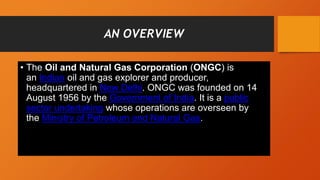
• The Oil and Natural Gas Corporation (ONGC) is
an Indian oil and gas explorer and producer,
headquartered in New Delhi. ONGC was founded on 14
August 1956 by the Government of India. It is a public
sector undertaking whose operations are overseen by
the Ministry of Petroleum and Natural Gas.
ALL ABOUT COMPANY
Type Public
Traded as •NSE: ONGC
•BSE: 500312
•BSE SENSEX Constituent
•NSE NIFTY 50 Constituent
Industry Energy: Oil and gas
Founded 14 August 1956; 65 years ago
Headquarters Dehradun, Uttarakhand, India
Key people Alka Mittal (Chairman)
Revenue ₹539,199 crore (US$71 billion) (2022)
Net income ₹47,830 crore (US$6.3 billion) (2022)
Total assets ₹585,449 crore (US$77 billion) (2022)
Total equity ₹259,502 crore (US$34 billion) (2022)
Owner Government of India (60.41%)
[3]
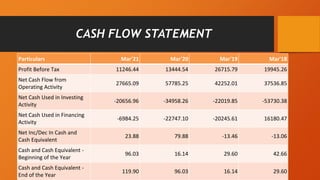
CASH FLOW STATEMENT
Particulars Mar'21 Mar'20 Mar'19 Mar'18
Profit Before Tax 11246.44 13444.54 26715.79 19945.26
Net Cash Flow from
Operating Activity
27665.09 57785.25 42252.01 37536.85
Net Cash Used in Investing
Activity
-20656.96 -34958.26 -22019.85 -53730.38
Net Cash Used in Financing
Activity
-6984.25 -22747.10 -20245.61 16180.47
Net Inc/Dec In Cash and
Cash Equivalent
23.88 79.88 -13.46 -13.06
Cash and Cash Equivalent -
Beginning of the Year
96.03 16.14 29.60 42.66
Cash and Cash Equivalent -
End of the Year
119.90 96.03 16.14 29.60
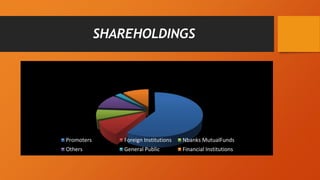
SHAREHOLDINGS
Promoters Foreign Institutions Nbanks MutualFunds
Others General Public Financial Institutions
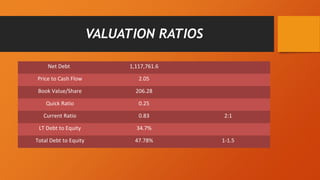
VALUATION RATIOS
Net Debt 1,117,761.6
Price to Cash Flow 2.05
Book Value/Share 206.28
Quick Ratio 0.25
Current Ratio 0.83 2:1
LT Debt to Equity 34.7%
Total Debt to Equity 47.78% 1-1.5
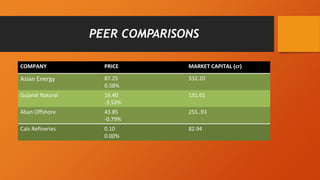
PEER COMPARISONS
COMPANY PRICE MARKET CAPITAL (cr)
Asian Energy 87.25
0.58%
332.20
Gujarat Natural 16.40
-3.53%
131.61
Aban Offshore 43.85
-0.79%
255..93
Cals Refineries 0.10
0.00%
82.94
MOAT [Competitive Advantage]
 has highly skilled human resource with excellent technical
and management capabilities.
ONGC has a unique and distinct advantage in terms of being a
horizontally integrated player, with in-house infrastructure for
oil field services.
Experienced and professionally competent manpower is
another huge advantage with ONGC.
Discounted cash flow valuation
It is a valuation method used to estimate the
value of an investment based on its expected
future cash flows
DCF of ONGC
INDUSTRY OUTLOOK
• The energy sector is capital intensive, which makes
paying special attention to leverage important.
• The four key ratios for analysts and investors to use
when analyzing the energy sector include—debt-to-
EBITDA, interest coverage ratio, debt-to-capital, and
debt-to-equity.
• Debt can increase shareholder returns, as the cost of
debt is lower than the cost of equity.
• Too much debt can become burdensome and limit a
company's ability to meet other obligations or get
financing for new projects/equipment.
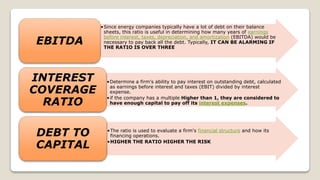
•Since energy companies typically have a lot of debt on their balance
sheets, this ratio is useful in determining how many years of earnings
before interest, taxes, depreciation, and amortization (EBITDA) would be
necessary to pay back all the debt. Typically, IT CAN BE ALARMING IF
THE RATIO IS OVER THREE
EBITDA
•Determine a firm's ability to pay interest on outstanding debt, calculated
as earnings before interest and taxes (EBIT) divided by interest
expense.
•if the company has a multiple Higher than 1, they are considered to
have enough capital to pay off its interest expenses.
INTEREST
COVERAGE
RATIO
•The ratio is used to evaluate a firm's financial structure and how its
financing operations.
•HIGHER THE RATIO HIGHER THE RISK
DEBT TO
CAPITAL
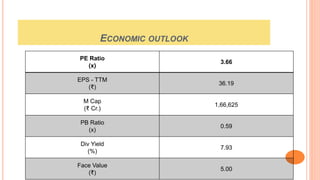
ECONOMIC OUTLOOK
PE Ratio
(x)
3.66
EPS - TTM
(₹)
36.19
M Cap
(₹ Cr.)
1,66,625
PB Ratio
(x)
0.59
Div Yield
(%)
7.93
Face Value
(₹)
5.00
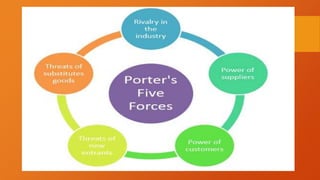
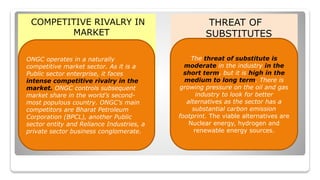
COMPETITIVE RIVALRY IN
MARKET
THREAT OF
SUBSTITUTES
ONGC operates in a naturally
competitive market sector. As it is a
Public sector enterprise, it faces
intense competitive rivalry in the
market. ONGC controls subsequent
market share in the world’s second-
most populous country. ONGC’s main
competitors are Bharat Petroleum
Corporation (BPCL), another Public
sector entity and Reliance Industries, a
private sector business conglomerate.
The threat of substitute is
moderate in the industry in the
short term, but it is high in the
medium to long term. There is
growing pressure on the oil and gas
industry to look for better
alternatives as the sector has a
substantial carbon emission
footprint. The viable alternatives are
Nuclear energy, hydrogen and
renewable energy sources.
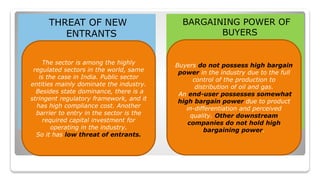
THREAT OF NEW
ENTRANTS
BARGAINING POWER OF
BUYERS
The sector is among the highly
regulated sectors in the world, same
is the case in India. Public sector
entities mainly dominate the industry.
Besides state dominance, there is a
stringent regulatory framework, and it
has high compliance cost. Another
barrier to entry in the sector is the
required capital investment for
operating in the industry.
So it has low threat of entrants.
Buyers do not possess high bargain
power in the industry due to the full
control of the production to
distribution of oil and gas.
An end-user possesses somewhat
high bargain power due to product
in-differentiation and perceived
quality. Other downstream
companies do not hold high
bargaining power.
BARGAINING POWER OF SUPPLIERS
The bargaining power of the suppliers is moderate to high in the Indian oil and
gas sector. The industry is dynamic in nature and crude oil, a significant raw material;
fluctuate due to many underlying factors.
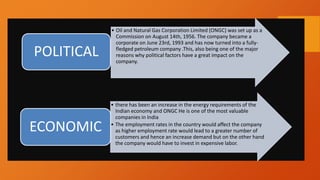
• Oil and Natural Gas Corporation Limited (ONGC) was set up as a
Commission on August 14th, 1956. The company became a
corporate on June 23rd, 1993 and has now turned into a fully-
fledged petroleum company .This, also being one of the major
reasons why political factors have a great impact on the
company.
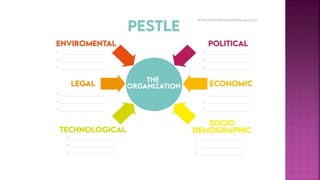
POLITICAL
• there has been an increase in the energy requirements of the
Indian economy and ONGC He is one of the most valuable
companies in India
• The employment rates in the country would affect the company
as higher employment rate would lead to a greater number of
customers and hence an increase demand but on the other hand
the company would have to invest in expensive labor.
ECONOMIC
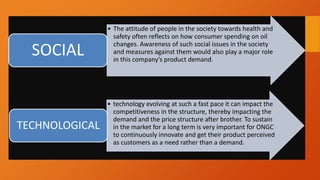
• The attitude of people in the society towards health and
safety often reflects on how consumer spending on oil
changes. Awareness of such social issues in the society
and measures against them would also play a major role
in this company’s product demand.
SOCIAL
• technology evolving at such a fast pace it can impact the
competitiveness in the structure, thereby impacting the
demand and the price structure after brother. To sustain
in the market for a long term is very important for ONGC
to continuously innovate and get their product perceived
as customers as a need rather than a demand.
TECHNOLOGICAL
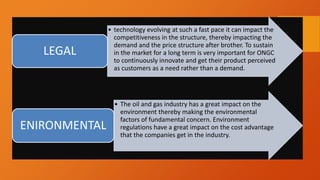
• technology evolving at such a fast pace it can impact the
competitiveness in the structure, thereby impacting the
demand and the price structure after brother. To sustain
in the market for a long term is very important for ONGC
to continuously innovate and get their product perceived
as customers as a need rather than a demand.
LEGAL
• The oil and gas industry has a great impact on the
environment thereby making the environmental
factors of fundamental concern. Environment
regulations have a great impact on the cost advantage
that the companies get in the industry.
ENIRONMENTAL

ONGC.pptx

  • 1.
    OIL AND NATURALGAS CORPORATION
  • 2.
    AN OVERVIEW • TheOil and Natural Gas Corporation (ONGC) is an Indian oil and gas explorer and producer, headquartered in New Delhi. ONGC was founded on 14 August 1956 by the Government of India. It is a public sector undertaking whose operations are overseen by the Ministry of Petroleum and Natural Gas.
  • 3.
    ALL ABOUT COMPANY TypePublic Traded as •NSE: ONGC •BSE: 500312 •BSE SENSEX Constituent •NSE NIFTY 50 Constituent Industry Energy: Oil and gas Founded 14 August 1956; 65 years ago Headquarters Dehradun, Uttarakhand, India Key people Alka Mittal (Chairman) Revenue ₹539,199 crore (US$71 billion) (2022) Net income ₹47,830 crore (US$6.3 billion) (2022) Total assets ₹585,449 crore (US$77 billion) (2022) Total equity ₹259,502 crore (US$34 billion) (2022) Owner Government of India (60.41%) [3]
  • 4.
    CASH FLOW STATEMENT ParticularsMar'21 Mar'20 Mar'19 Mar'18 Profit Before Tax 11246.44 13444.54 26715.79 19945.26 Net Cash Flow from Operating Activity 27665.09 57785.25 42252.01 37536.85 Net Cash Used in Investing Activity -20656.96 -34958.26 -22019.85 -53730.38 Net Cash Used in Financing Activity -6984.25 -22747.10 -20245.61 16180.47 Net Inc/Dec In Cash and Cash Equivalent 23.88 79.88 -13.46 -13.06 Cash and Cash Equivalent - Beginning of the Year 96.03 16.14 29.60 42.66 Cash and Cash Equivalent - End of the Year 119.90 96.03 16.14 29.60
  • 5.
    SHAREHOLDINGS Promoters Foreign InstitutionsNbanks MutualFunds Others General Public Financial Institutions
  • 7.
    VALUATION RATIOS Net Debt1,117,761.6 Price to Cash Flow 2.05 Book Value/Share 206.28 Quick Ratio 0.25 Current Ratio 0.83 2:1 LT Debt to Equity 34.7% Total Debt to Equity 47.78% 1-1.5
  • 8.
    PEER COMPARISONS COMPANY PRICEMARKET CAPITAL (cr) Asian Energy 87.25 0.58% 332.20 Gujarat Natural 16.40 -3.53% 131.61 Aban Offshore 43.85 -0.79% 255..93 Cals Refineries 0.10 0.00% 82.94
  • 9.
    MOAT [Competitive Advantage] has highly skilled human resource with excellent technical and management capabilities. ONGC has a unique and distinct advantage in terms of being a horizontally integrated player, with in-house infrastructure for oil field services. Experienced and professionally competent manpower is another huge advantage with ONGC.
  • 10.
    Discounted cash flowvaluation It is a valuation method used to estimate the value of an investment based on its expected future cash flows
  • 11.
  • 12.
    INDUSTRY OUTLOOK • Theenergy sector is capital intensive, which makes paying special attention to leverage important. • The four key ratios for analysts and investors to use when analyzing the energy sector include—debt-to- EBITDA, interest coverage ratio, debt-to-capital, and debt-to-equity. • Debt can increase shareholder returns, as the cost of debt is lower than the cost of equity. • Too much debt can become burdensome and limit a company's ability to meet other obligations or get financing for new projects/equipment.
  • 13.
    •Since energy companiestypically have a lot of debt on their balance sheets, this ratio is useful in determining how many years of earnings before interest, taxes, depreciation, and amortization (EBITDA) would be necessary to pay back all the debt. Typically, IT CAN BE ALARMING IF THE RATIO IS OVER THREE EBITDA •Determine a firm's ability to pay interest on outstanding debt, calculated as earnings before interest and taxes (EBIT) divided by interest expense. •if the company has a multiple Higher than 1, they are considered to have enough capital to pay off its interest expenses. INTEREST COVERAGE RATIO •The ratio is used to evaluate a firm's financial structure and how its financing operations. •HIGHER THE RATIO HIGHER THE RISK DEBT TO CAPITAL
  • 14.
    ECONOMIC OUTLOOK PE Ratio (x) 3.66 EPS- TTM (₹) 36.19 M Cap (₹ Cr.) 1,66,625 PB Ratio (x) 0.59 Div Yield (%) 7.93 Face Value (₹) 5.00
  • 17.
    COMPETITIVE RIVALRY IN MARKET THREATOF SUBSTITUTES ONGC operates in a naturally competitive market sector. As it is a Public sector enterprise, it faces intense competitive rivalry in the market. ONGC controls subsequent market share in the world’s second- most populous country. ONGC’s main competitors are Bharat Petroleum Corporation (BPCL), another Public sector entity and Reliance Industries, a private sector business conglomerate. The threat of substitute is moderate in the industry in the short term, but it is high in the medium to long term. There is growing pressure on the oil and gas industry to look for better alternatives as the sector has a substantial carbon emission footprint. The viable alternatives are Nuclear energy, hydrogen and renewable energy sources.
  • 18.
    THREAT OF NEW ENTRANTS BARGAININGPOWER OF BUYERS The sector is among the highly regulated sectors in the world, same is the case in India. Public sector entities mainly dominate the industry. Besides state dominance, there is a stringent regulatory framework, and it has high compliance cost. Another barrier to entry in the sector is the required capital investment for operating in the industry. So it has low threat of entrants. Buyers do not possess high bargain power in the industry due to the full control of the production to distribution of oil and gas. An end-user possesses somewhat high bargain power due to product in-differentiation and perceived quality. Other downstream companies do not hold high bargaining power.
  • 19.
    BARGAINING POWER OFSUPPLIERS The bargaining power of the suppliers is moderate to high in the Indian oil and gas sector. The industry is dynamic in nature and crude oil, a significant raw material; fluctuate due to many underlying factors.
  • 21.
    • Oil andNatural Gas Corporation Limited (ONGC) was set up as a Commission on August 14th, 1956. The company became a corporate on June 23rd, 1993 and has now turned into a fully- fledged petroleum company .This, also being one of the major reasons why political factors have a great impact on the company. POLITICAL • there has been an increase in the energy requirements of the Indian economy and ONGC He is one of the most valuable companies in India • The employment rates in the country would affect the company as higher employment rate would lead to a greater number of customers and hence an increase demand but on the other hand the company would have to invest in expensive labor. ECONOMIC
  • 22.
    • The attitudeof people in the society towards health and safety often reflects on how consumer spending on oil changes. Awareness of such social issues in the society and measures against them would also play a major role in this company’s product demand. SOCIAL • technology evolving at such a fast pace it can impact the competitiveness in the structure, thereby impacting the demand and the price structure after brother. To sustain in the market for a long term is very important for ONGC to continuously innovate and get their product perceived as customers as a need rather than a demand. TECHNOLOGICAL
  • 23.
    • technology evolvingat such a fast pace it can impact the competitiveness in the structure, thereby impacting the demand and the price structure after brother. To sustain in the market for a long term is very important for ONGC to continuously innovate and get their product perceived as customers as a need rather than a demand. LEGAL • The oil and gas industry has a great impact on the environment thereby making the environmental factors of fundamental concern. Environment regulations have a great impact on the cost advantage that the companies get in the industry. ENIRONMENTAL