Linear perspective to show depth and realism in your drawings

ONE POINT PERSPECTIVE

                                              Marsha Devine 2008
LINEAR PERSPECTIVE
   We see parallel lines as converging in the distance, although in reality they
    do not.

   The lines of buildings and other objects in a picture are slanted inward
    making them appear to extend back into space. If lengthened these lines
    will meet at a point along an imaginary horizontal line representing the eye
    level. Each such imaginary line is called an orthogonal. The point at which
    such lines meet is called a vanishing point.

   Renaissance artists achieved through careful observation of nature,
    including studies of anatomical dissections, a means to recreate the 3-
    dimensional physical reality of the human form on 2-dimensional surfaces.

   The first to carry out a series of optical experiments that led to a
    mathematical theory of perspective was the Florentine architect and
    engineer Filippo Brunelleschi in the early 1400s.
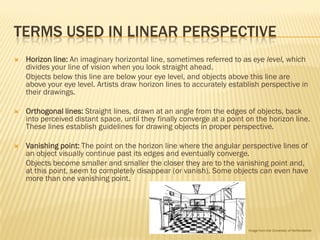
TERMS USED IN LINEAR PERSPECTIVE
   Horizon line: An imaginary horizontal line, sometimes referred to as eye level, which
    divides your line of vision when you look straight ahead.
    Objects below this line are below your eye level, and objects above this line are
    above your eye level. Artists draw horizon lines to accurately establish perspective in
    their drawings.

   Orthogonal lines: Straight lines, drawn at an angle from the edges of objects, back
    into perceived distant space, until they finally converge at a point on the horizon line.
    These lines establish guidelines for drawing objects in proper perspective.

   Vanishing point: The point on the horizon line where the angular perspective lines of
    an object visually continue past its edges and eventually converge.
    Objects become smaller and smaller the closer they are to the vanishing point and,
    at this point, seem to completely disappear (or vanish). Some objects can even have
    more than one vanishing point.


                                                                         Image from the University of Hertfordshire
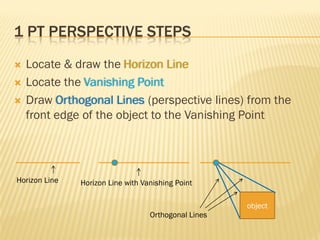
1 PT PERSPECTIVE STEPS
   Locate & draw the Horizon Line
   Locate the Vanishing Point
   Draw Orthogonal Lines (perspective lines) from the
    front edge of the object to the Vanishing Point


Horizon Line   Horizon Line with Vanishing Point

                                                      object
                                   Orthogonal Lines
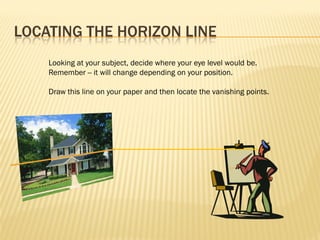
LOCATING THE HORIZON LINE
    Looking at your subject, decide where your eye level would be.
    Remember -- it will change depending on your position.

    Draw this line on your paper and then locate the vanishing points.
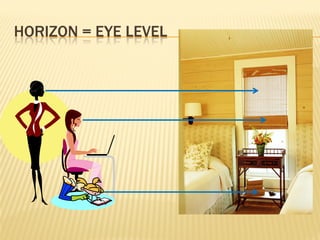
HORIZON = EYE LEVEL
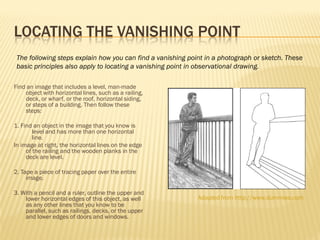
LOCATING THE VANISHING POINT
 The following steps explain how you can find a vanishing point in a photograph or sketch. These
 basic principles also apply to locating a vanishing point in observational drawing.

Find an image that includes a level, man-made
    object with horizontal lines, such as a railing,
    deck, or wharf, or the roof, horizontal siding,
    or steps of a building. Then follow these
    steps:

1. Find an object in the image that you know is
        level and has more than one horizontal
        line.
In image at right, the horizontal lines on the edge
     of the railing and the wooden planks in the
     deck are level.

2. Tape a piece of tracing paper over the entire
     image.

3. With a pencil and a ruler, outline the upper and
    lower horizontal edges of this object, as well           Adapted from http://www.dummies.com
    as any other lines that you know to be
    parallel, such as railings, decks, or the upper
    and lower edges of doors and windows.
VANISHING POINT (P.2)
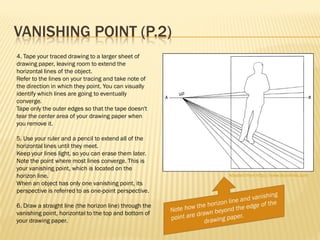
4. Tape your traced drawing to a larger sheet of
drawing paper, leaving room to extend the
horizontal lines of the object.
Refer to the lines on your tracing and take note of
the direction in which they point. You can visually
identify which lines are going to eventually
converge.
Tape only the outer edges so that the tape doesn't
tear the center area of your drawing paper when
you remove it.

5. Use your ruler and a pencil to extend all of the
horizontal lines until they meet.
Keep your lines light, so you can erase them later.
Note the point where most lines converge. This is
your vanishing point, which is located on the
horizon line.                                            Adapted from http://www.dummies.com
When an object has only one vanishing point, its
perspective is referred to as one-point perspective.

6. Draw a straight line (the horizon line) through the
vanishing point, horizontal to the top and bottom of
your drawing paper.
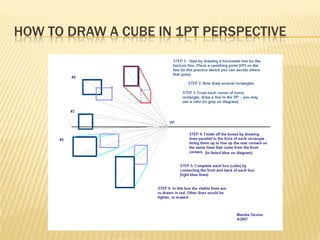
HOW TO DRAW A CUBE IN 1PT PERSPECTIVE
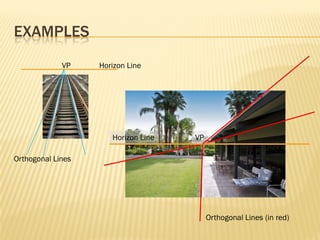
EXAMPLES
             VP    Horizon Line


                      Horizon Line   VP

Orthogonal Lines


                                          Orthogonal Lines (in red)
CHURCH OF SANTO SPIRITO

                                          Filippo Brunelleschi sketched this
                                          drawing before building the
                                          Church of Santo Spirito,
                                          using 1 point perspective.


  The actual church as it stands today.
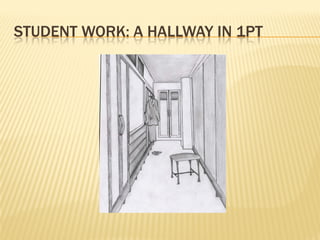
STUDENT WORK: A HALLWAY IN 1PT
RAPHAEL'S "SCHOOL OF ATHENS.“ 1518
MASSACCIO’S HOLY TRINITY


             Masaccio's Trinity, painted for S. Maria Novella in
             Florence around 1427, is usually considered to be
             the oldest surviving perspective painting.
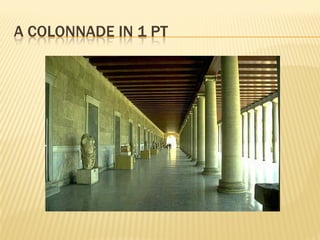
A COLONNADE IN 1 PT
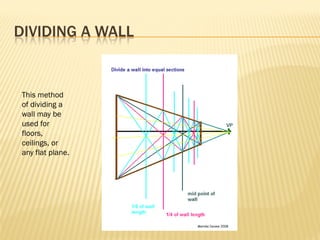
DIVIDING A WALL


This method
of dividing a
wall may be
used for
floors,
ceilings, or
any flat plane.
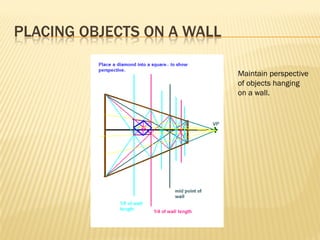
PLACING OBJECTS ON A WALL

                            Maintain perspective
                            of objects hanging
                            on a wall.
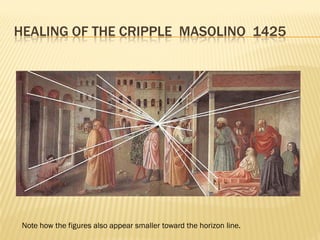
HEALING OF THE CRIPPLE MASOLINO 1425


 Note how the figures also appear smaller toward the horizon line.
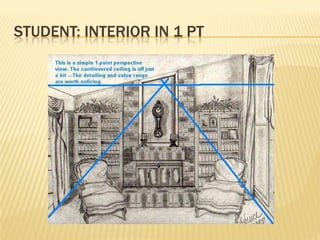
STUDENT: INTERIOR IN 1 PT
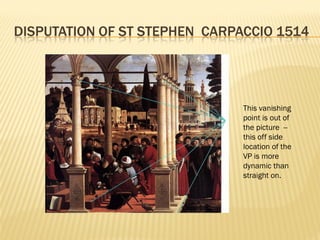
DISPUTATION OF ST STEPHEN CARPACCIO 1514


                               This vanishing
                               point is out of
                               the picture --
                               this off side
                               location of the
                               VP is more
                               dynamic than
                               straight on.
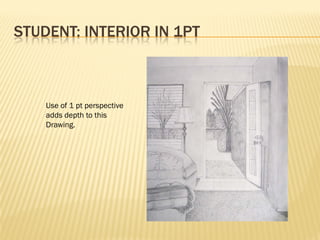
STUDENT: INTERIOR IN 1PT


    Use of 1 pt perspective
    adds depth to this
    Drawing.
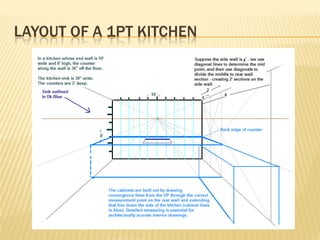
LAYOUT OF A 1PT KITCHEN
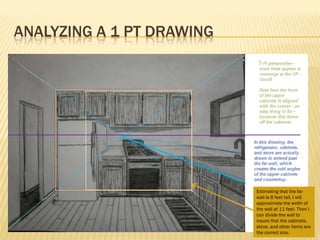
ANALYZING A 1 PT DRAWING


                           Estimating that the far
                           wall is 8 feet tall, I will
                           approximate the width of
                           the wall at 11 feet. Then I
                           can divide the wall to
                           insure that the cabinets,
                           stove, and other items are
                           the correct size.
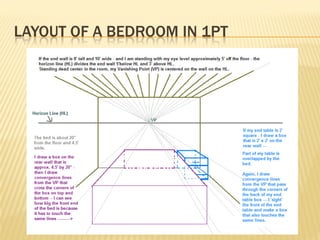
LAYOUT OF A BEDROOM IN 1PT
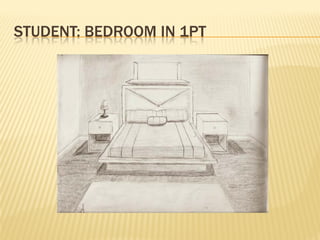
STUDENT: BEDROOM IN 1PT
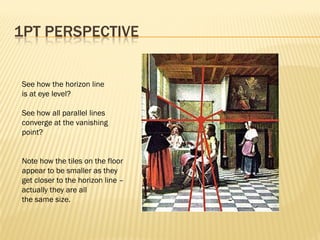
1PT PERSPECTIVE


See how the horizon line
is at eye level?

See how all parallel lines
converge at the vanishing
point?


Note how the tiles on the floor
appear to be smaller as they
get closer to the horizon line –
actually they are all
the same size.
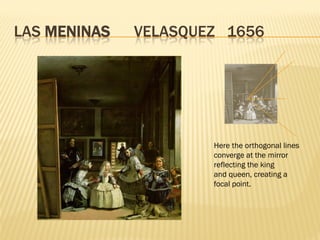
LAS MENINAS   VELASQUEZ 1656


                      Here the orthogonal lines
                      converge at the mirror
                      reflecting the king
                      and queen, creating a
                      focal point.
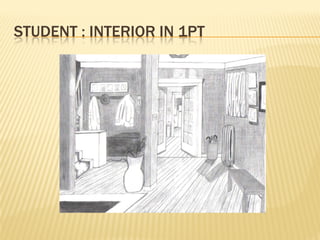
STUDENT : INTERIOR IN 1PT
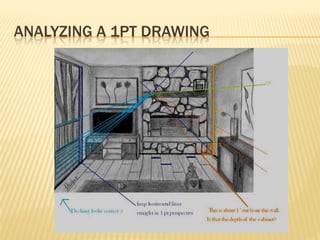
ANALYZING A 1PT DRAWING
VOCABULARY REVIEW
 Horizon Line -- The apparent intersection of the earth and sky as
 seen by an observer
 Vanishing Point -- The point in linear perspective at which all
 imaginary lines of perspective converge. The point at which parallel
 lines receding from an observer seem to converge. The point at which
 a thing disappears or ceases to exist.
 Convergence or Orthogonal Lines -- The lines that make up the sides
 of an object in a perspective drawing that relate directly back to the
 vanishing point.
 Horizontal -- Parallel to or in the plane of the horizon.
 Vertical -- Being or situated at right angles to the horizon; upright
LYDIA CROCHETING IN THE GARDEN AT MARLY.
CASSATT 1880.
OTHER REFERENCES
   http://www.cartage.org.lb/en/themes/Arts/painting/principl-tech/art-
    studio/interior/circles.htm

   http://psych.hanover.edu/krantz/art/linear.html

   http://www.dartmouth.edu/~matc/math5.geometry/unit11/unit11.html

   http://www.myamericanartist.com/2006/12/linear_perspect.html

   Behind the Scenes with David Hockney - "Hosted by famous illusionists Penn and Teller, this
    segment in a PBS art primer series for children offers insight into "how depth is created on a
    flat surface." Using multiple animated and live-action examples, Penn and Teller cattily and
    chattily illustrate principles of perspective, vanishing point, and composition." amazon.com
    review


                         "Perspective is the rein and rudder of painting"
                                       Leonardo da Vinci


                                                                         Marsha Devine 2008

One point perspective

  • 1.
    Linear perspective toshow depth and realism in your drawings ONE POINT PERSPECTIVE Marsha Devine 2008
  • 2.
    LINEAR PERSPECTIVE  We see parallel lines as converging in the distance, although in reality they do not.  The lines of buildings and other objects in a picture are slanted inward making them appear to extend back into space. If lengthened these lines will meet at a point along an imaginary horizontal line representing the eye level. Each such imaginary line is called an orthogonal. The point at which such lines meet is called a vanishing point.  Renaissance artists achieved through careful observation of nature, including studies of anatomical dissections, a means to recreate the 3- dimensional physical reality of the human form on 2-dimensional surfaces.  The first to carry out a series of optical experiments that led to a mathematical theory of perspective was the Florentine architect and engineer Filippo Brunelleschi in the early 1400s.
  • 3.
    TERMS USED INLINEAR PERSPECTIVE  Horizon line: An imaginary horizontal line, sometimes referred to as eye level, which divides your line of vision when you look straight ahead. Objects below this line are below your eye level, and objects above this line are above your eye level. Artists draw horizon lines to accurately establish perspective in their drawings.  Orthogonal lines: Straight lines, drawn at an angle from the edges of objects, back into perceived distant space, until they finally converge at a point on the horizon line. These lines establish guidelines for drawing objects in proper perspective.  Vanishing point: The point on the horizon line where the angular perspective lines of an object visually continue past its edges and eventually converge. Objects become smaller and smaller the closer they are to the vanishing point and, at this point, seem to completely disappear (or vanish). Some objects can even have more than one vanishing point. Image from the University of Hertfordshire
  • 4.
    1 PT PERSPECTIVESTEPS  Locate & draw the Horizon Line  Locate the Vanishing Point  Draw Orthogonal Lines (perspective lines) from the front edge of the object to the Vanishing Point Horizon Line Horizon Line with Vanishing Point object Orthogonal Lines
  • 5.
    LOCATING THE HORIZONLINE Looking at your subject, decide where your eye level would be. Remember -- it will change depending on your position. Draw this line on your paper and then locate the vanishing points.
  • 6.
  • 7.
    LOCATING THE VANISHINGPOINT The following steps explain how you can find a vanishing point in a photograph or sketch. These basic principles also apply to locating a vanishing point in observational drawing. Find an image that includes a level, man-made object with horizontal lines, such as a railing, deck, or wharf, or the roof, horizontal siding, or steps of a building. Then follow these steps: 1. Find an object in the image that you know is level and has more than one horizontal line. In image at right, the horizontal lines on the edge of the railing and the wooden planks in the deck are level. 2. Tape a piece of tracing paper over the entire image. 3. With a pencil and a ruler, outline the upper and lower horizontal edges of this object, as well Adapted from http://www.dummies.com as any other lines that you know to be parallel, such as railings, decks, or the upper and lower edges of doors and windows.
  • 8.
    VANISHING POINT (P.2) 4.Tape your traced drawing to a larger sheet of drawing paper, leaving room to extend the horizontal lines of the object. Refer to the lines on your tracing and take note of the direction in which they point. You can visually identify which lines are going to eventually converge. Tape only the outer edges so that the tape doesn't tear the center area of your drawing paper when you remove it. 5. Use your ruler and a pencil to extend all of the horizontal lines until they meet. Keep your lines light, so you can erase them later. Note the point where most lines converge. This is your vanishing point, which is located on the horizon line. Adapted from http://www.dummies.com When an object has only one vanishing point, its perspective is referred to as one-point perspective. 6. Draw a straight line (the horizon line) through the vanishing point, horizontal to the top and bottom of your drawing paper.
  • 9.
    HOW TO DRAWA CUBE IN 1PT PERSPECTIVE
  • 10.
    EXAMPLES VP Horizon Line Horizon Line VP Orthogonal Lines Orthogonal Lines (in red)
  • 11.
    CHURCH OF SANTOSPIRITO Filippo Brunelleschi sketched this drawing before building the Church of Santo Spirito, using 1 point perspective. The actual church as it stands today.
  • 12.
    STUDENT WORK: AHALLWAY IN 1PT
  • 13.
    RAPHAEL'S "SCHOOL OFATHENS.“ 1518
  • 14.
    MASSACCIO’S HOLY TRINITY Masaccio's Trinity, painted for S. Maria Novella in Florence around 1427, is usually considered to be the oldest surviving perspective painting.
  • 15.
  • 16.
    DIVIDING A WALL Thismethod of dividing a wall may be used for floors, ceilings, or any flat plane.
  • 17.
    PLACING OBJECTS ONA WALL Maintain perspective of objects hanging on a wall.
  • 18.
    HEALING OF THECRIPPLE MASOLINO 1425 Note how the figures also appear smaller toward the horizon line.
  • 19.
  • 20.
    DISPUTATION OF STSTEPHEN CARPACCIO 1514 This vanishing point is out of the picture -- this off side location of the VP is more dynamic than straight on.
  • 21.
    STUDENT: INTERIOR IN1PT Use of 1 pt perspective adds depth to this Drawing.
  • 22.
    LAYOUT OF A1PT KITCHEN
  • 23.
    ANALYZING A 1PT DRAWING Estimating that the far wall is 8 feet tall, I will approximate the width of the wall at 11 feet. Then I can divide the wall to insure that the cabinets, stove, and other items are the correct size.
  • 24.
    LAYOUT OF ABEDROOM IN 1PT
  • 25.
  • 26.
    1PT PERSPECTIVE See howthe horizon line is at eye level? See how all parallel lines converge at the vanishing point? Note how the tiles on the floor appear to be smaller as they get closer to the horizon line – actually they are all the same size.
  • 27.
    LAS MENINAS VELASQUEZ 1656 Here the orthogonal lines converge at the mirror reflecting the king and queen, creating a focal point.
  • 28.
  • 29.
  • 30.
    VOCABULARY REVIEW HorizonLine -- The apparent intersection of the earth and sky as seen by an observer Vanishing Point -- The point in linear perspective at which all imaginary lines of perspective converge. The point at which parallel lines receding from an observer seem to converge. The point at which a thing disappears or ceases to exist. Convergence or Orthogonal Lines -- The lines that make up the sides of an object in a perspective drawing that relate directly back to the vanishing point. Horizontal -- Parallel to or in the plane of the horizon. Vertical -- Being or situated at right angles to the horizon; upright
  • 31.
    LYDIA CROCHETING INTHE GARDEN AT MARLY. CASSATT 1880.
  • 32.
    OTHER REFERENCES  http://www.cartage.org.lb/en/themes/Arts/painting/principl-tech/art- studio/interior/circles.htm  http://psych.hanover.edu/krantz/art/linear.html  http://www.dartmouth.edu/~matc/math5.geometry/unit11/unit11.html  http://www.myamericanartist.com/2006/12/linear_perspect.html  Behind the Scenes with David Hockney - "Hosted by famous illusionists Penn and Teller, this segment in a PBS art primer series for children offers insight into "how depth is created on a flat surface." Using multiple animated and live-action examples, Penn and Teller cattily and chattily illustrate principles of perspective, vanishing point, and composition." amazon.com review "Perspective is the rein and rudder of painting" Leonardo da Vinci Marsha Devine 2008