Physical activity and cardio-vascular preventionGraziano OnderCentro Medicina dell’InvecchiamentoUniversità Cattolica del Sacro CuoreRome - Italy
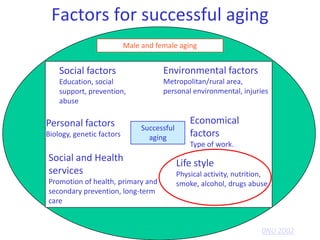
Factors for successful aging  Male and female agingEnvironmental factorsMetropolitan/rural area, personal environmental, injuries Social factorsEducation, social support, prevention, abuseEconomical factorsType of work.Personal factorsBiology, genetic factorsSuccessful aging Social and Health servicesPromotion of health, primary and secondary prevention, long-term careLife style Physical activity, nutrition, smoke, alcohol, drugs abuse 0NU 2002
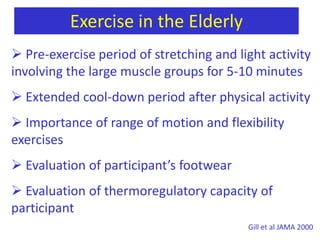
EXERCISE IN THE ELDERLYTHE ROLE OF EXERCISE IN THE ELDERLYIn the young-old, exercise has much the same function as in the young:            - prevention of disease           - maintenance of aerobic capacity 		   - maintenance of muscle strength           - psychological well-being
b) In the old-old, exercise is still used for its preventive effects, but more often for:            -  secondary or tertiary prevention           -  rehabilitation from pre-existing           chronic conditionsc) Some of the most important goals of  exercise in the frail elderly are:             - the improvement of muscle                         strength  and  endurance capacity to                    allow increased functional independence
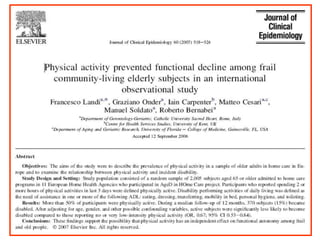
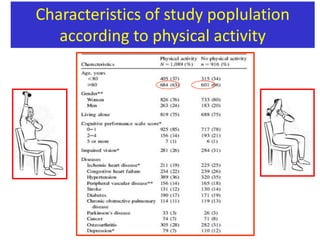
Characteristics of study poplulation according to physical activity
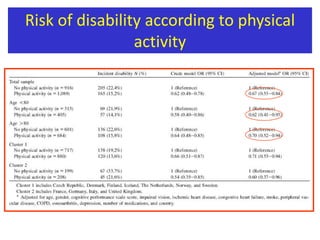
Risk of disability according to physical activity
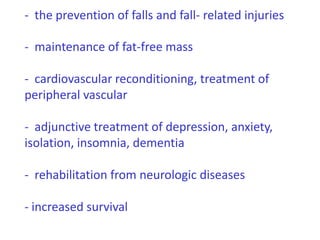
  the prevention of falls and fall- related injuries-  maintenance of fat-free mass  cardiovascular reconditioning, treatment of peripheral vascular
  adjunctive treatment of depression, anxiety, isolation, insomnia, dementia-  rehabilitation from neurologic diseases
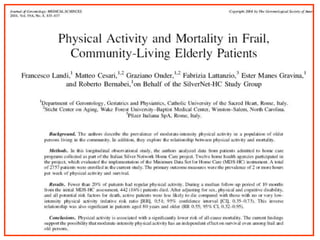
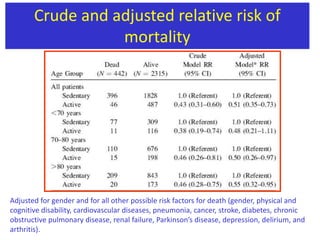
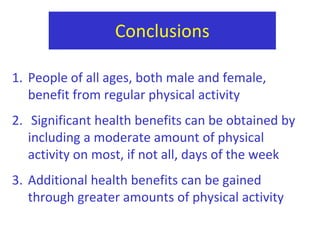
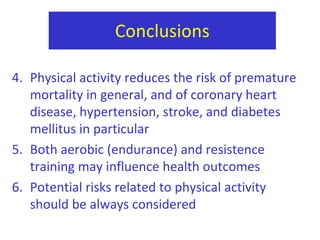
 increased survival
Crude and adjusted relative risk of mortalityAdjusted for gender and for all other possible risk factors for death (gender, physical and cognitive disability, cardiovascular diseases, pneumonia, cancer, stroke, diabetes, chronic obstructive pulmonary disease, renal failure, Parkinson’s disease, depression, delirium, and arthritis).
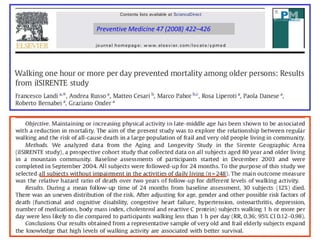
Preventive Medicine 47 (2008) 422–426
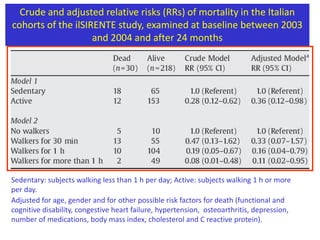
Crude and adjusted relative risks (RRs) of mortality in the Italian cohorts of the ilSIRENTE study, examined at baseline between 2003 and 2004 and after 24 monthsSedentary: subjects walking less than 1 h per day; Active: subjects walking 1 h or more per day.Adjusted for age, gender and for other possible risk factors for death (functional and cognitive disability, congestive heart failure, hypertension,  osteoarthritis, depression, number of medications, body mass index, cholesterol and C reactive protein).
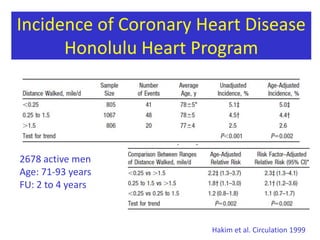
Incidence of Coronary Heart DiseaseHonolulu HeartProgram2678 activemenAge: 71-93 yearsFU: 2 to 4 yearsHakimet al. Circulation 1999
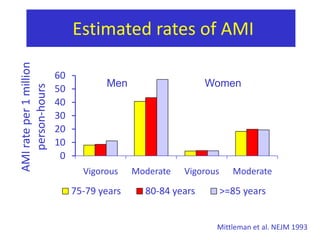
 Estimated rates of AMIMenWomenMenWomenMittleman et al. NEJM 1993
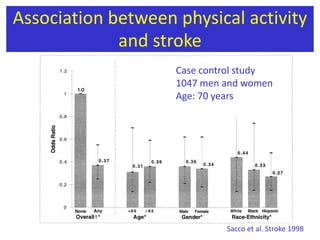
Association between physical activity and strokeCase controlstudy1047 men and womenAge: 70 yearsSacco et al. Stroke 1998
Mediators ?
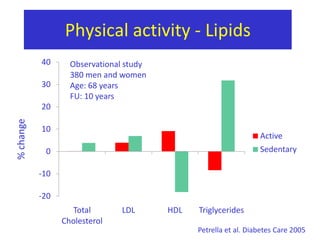
Physicalactivity - LipidsObservationalstudy380 men and womenAge: 68 yearsFU: 10 years% changePetrellaet al. Diabetes Care 2005
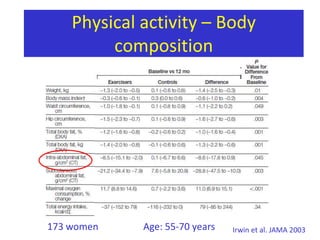
Physicalactivity – Body composition173 women		Age: 55-70 yearsIrwinet al. JAMA 2003
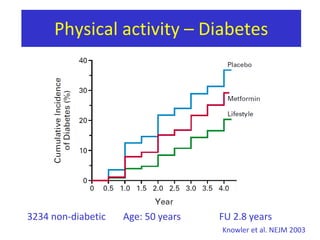
Physicalactivity – Diabetes3234 non-diabeticAge: 50 years		FU 2.8 yearsKnowleret al. NEJM 2003
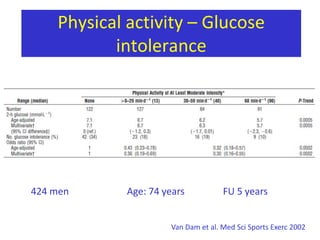
Physicalactivity – Glucoseintolerance424 menAge: 74 years		FU 5 yearsVan Dam et al. Med Sci SportsExerc 2002
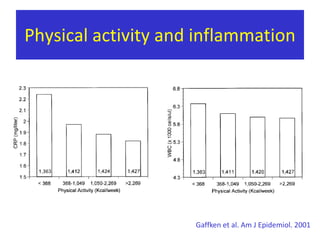
Physicalactivity and inflammationGaffkenet al. Am J Epidemiol. 2001
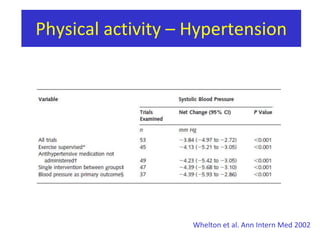
Physicalactivity – HypertensionWheltonet al. AnnInternMed 2002
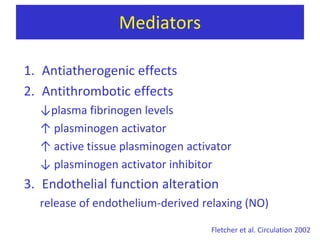
MediatorsAntiatherogeniceffectsAntithromboticeffects↓plasma fibrinogen levels↑ plasminogen activator↑ active tissue plasminogen activator↓ plasminogenactivatorinhibitorEndothelialfunctionalterationrelease of endothelium-derivedrelaxing (NO)Fletcher et al. Circulation 2002
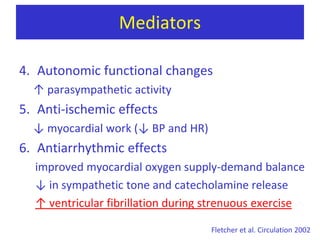
MediatorsAutonomicfunctionalchanges↑ parasympatheticactivityAnti-ischemiceffects↓ myocardial work (↓ BP and HR)Antiarrhythmiceffectsimproved myocardial oxygen supply-demand balance↓ in sympathetic tone and catecholaminerelease↑ ventricularfibrillation duringstrenuousexerciseFletcher et al. Circulation 2002
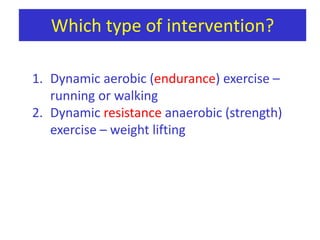
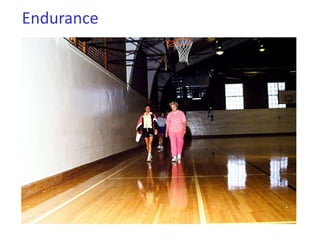
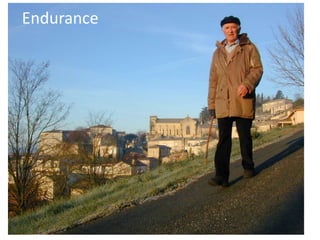
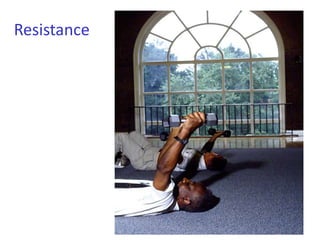
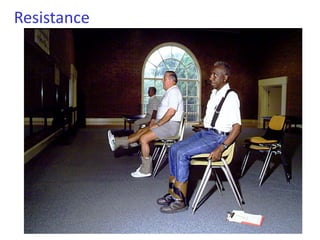
Whichtype of intervention?Dynamicaerobic (endurance) exercise – running or walkingDynamicresistanceanaerobic (strength) exercise – weight lifting
Endurance
Endurance
Resistance
Resistance
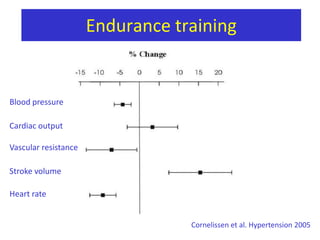
Endurance trainingBloodpressureCardiac outputVascularresistanceStroke volumeHeart rateCornelissenet al. Hypertension 2005
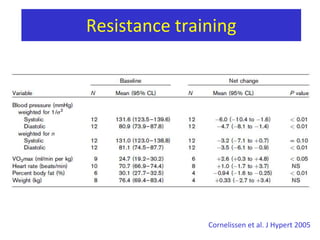
Resistance trainingCornelissenet al. J Hypert 2005
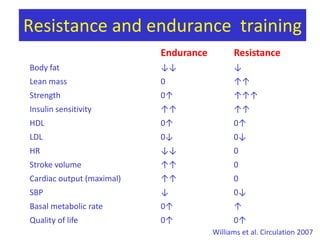
Resistance and endurance  trainingWilliams et al. Circulation 2007
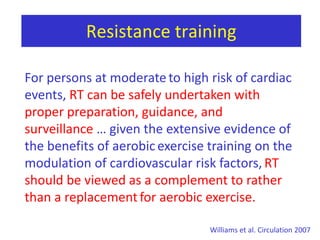
Resistance trainingFor persons at moderateto high risk of cardiac events, RT can be safely undertaken withproper preparation, guidance, and surveillance … given the extensive evidence of the benefits of aerobicexercise training on the modulation of cardiovascular risk factors,RT should be viewed as a complement to rather than a replacementfor aerobic exercise.Williams et al. Circulation 2007
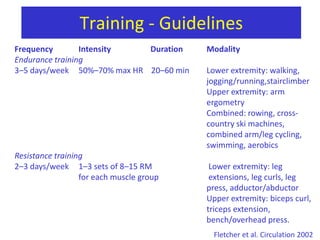
Training - GuidelinesFrequencyIntensityDurationModalityEndurance training3–5 days/week 	50%–70% max HR    20–60 min 	Lower extremity: walking, 							jogging/running,stairclimber						Upper extremity: arm 							ergometryCombined: rowing, cross-							country ski machines, 							combinedarm/leg cycling,swimming, aerobicsResistance training2–3 days/week 	1–3 sets of 8–15 RM 		 Lower extremity: leg		for each musclegroup extensions, leg curls, leg 							press, adductor/abductor						Upper extremity: biceps curl, 						triceps extension, 							bench/overhead press. Fletcher et al. Circulation 2002
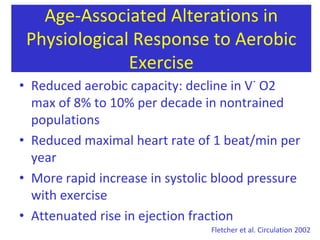
Age-AssociatedAlterations in PhysiologicalResponsetoAerobicExerciseReduced aerobic capacity: decline in V˙ O2 max of 8% to 10% per decade in nontrainedpopulationsReduced maximal heart rate of 1 beat/min per yearMore rapid increase in systolic blood pressure with exerciseAttenuated rise in ejection fractionFletcher et al. Circulation 2002
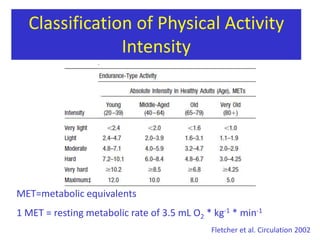
Classification of Physical Activity IntensityMET=metabolic equivalents1 MET = resting metabolic rate of 3.5 mL O2 * kg-1 * min-1Fletcher et al. Circulation 2002
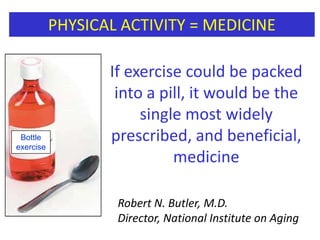
BottleexercisePHYSICAL ACTIVITY = MEDICINE If exercise could be packed into a pill, it would be the single most widelyprescribed, and beneficial,medicineRobert N. Butler, M.D. Director, National Institute on Aging
Potential risksGeneral Muscle soreness
 Soft tissue injury
 Falls
 Fractures Resistance training  Detached retina
 Hernia
 Hemorrhage
 Lumbar disk hernia Potential risks Vigorous exercise Sudden death
 Acute myocardial infarction
 Hypoglycemia in persons with diabetes
 Orthostatic hypotension

Onder

  • 1.
    Physical activity andcardio-vascular preventionGraziano OnderCentro Medicina dell’InvecchiamentoUniversità Cattolica del Sacro CuoreRome - Italy
  • 2.
    Factors for successfulaging Male and female agingEnvironmental factorsMetropolitan/rural area, personal environmental, injuries Social factorsEducation, social support, prevention, abuseEconomical factorsType of work.Personal factorsBiology, genetic factorsSuccessful aging Social and Health servicesPromotion of health, primary and secondary prevention, long-term careLife style Physical activity, nutrition, smoke, alcohol, drugs abuse 0NU 2002
  • 3.
    EXERCISE IN THEELDERLYTHE ROLE OF EXERCISE IN THE ELDERLYIn the young-old, exercise has much the same function as in the young: - prevention of disease - maintenance of aerobic capacity - maintenance of muscle strength - psychological well-being
  • 4.
    b) In theold-old, exercise is still used for its preventive effects, but more often for: - secondary or tertiary prevention - rehabilitation from pre-existing chronic conditionsc) Some of the most important goals of exercise in the frail elderly are: - the improvement of muscle strength and endurance capacity to allow increased functional independence
  • 6.
    Characteristics of studypoplulation according to physical activity
  • 7.
    Risk of disabilityaccording to physical activity
  • 8.
    theprevention of falls and fall- related injuries- maintenance of fat-free mass cardiovascular reconditioning, treatment of peripheral vascular
  • 9.
    adjunctivetreatment of depression, anxiety, isolation, insomnia, dementia- rehabilitation from neurologic diseases
  • 10.
  • 11.
    Crude and adjustedrelative risk of mortalityAdjusted for gender and for all other possible risk factors for death (gender, physical and cognitive disability, cardiovascular diseases, pneumonia, cancer, stroke, diabetes, chronic obstructive pulmonary disease, renal failure, Parkinson’s disease, depression, delirium, and arthritis).
  • 12.
    Preventive Medicine 47(2008) 422–426
  • 13.
    Crude and adjustedrelative risks (RRs) of mortality in the Italian cohorts of the ilSIRENTE study, examined at baseline between 2003 and 2004 and after 24 monthsSedentary: subjects walking less than 1 h per day; Active: subjects walking 1 h or more per day.Adjusted for age, gender and for other possible risk factors for death (functional and cognitive disability, congestive heart failure, hypertension, osteoarthritis, depression, number of medications, body mass index, cholesterol and C reactive protein).
  • 14.
    Incidence of CoronaryHeart DiseaseHonolulu HeartProgram2678 activemenAge: 71-93 yearsFU: 2 to 4 yearsHakimet al. Circulation 1999
  • 15.
    Estimated ratesof AMIMenWomenMenWomenMittleman et al. NEJM 1993
  • 16.
    Association between physicalactivity and strokeCase controlstudy1047 men and womenAge: 70 yearsSacco et al. Stroke 1998
  • 17.
  • 18.
    Physicalactivity - LipidsObservationalstudy380men and womenAge: 68 yearsFU: 10 years% changePetrellaet al. Diabetes Care 2005
  • 19.
    Physicalactivity – Bodycomposition173 women Age: 55-70 yearsIrwinet al. JAMA 2003
  • 20.
    Physicalactivity – Diabetes3234non-diabeticAge: 50 years FU 2.8 yearsKnowleret al. NEJM 2003
  • 21.
    Physicalactivity – Glucoseintolerance424menAge: 74 years FU 5 yearsVan Dam et al. Med Sci SportsExerc 2002
  • 22.
  • 23.
  • 24.
    MediatorsAntiatherogeniceffectsAntithromboticeffects↓plasma fibrinogen levels↑plasminogen activator↑ active tissue plasminogen activator↓ plasminogenactivatorinhibitorEndothelialfunctionalterationrelease of endothelium-derivedrelaxing (NO)Fletcher et al. Circulation 2002
  • 25.
    MediatorsAutonomicfunctionalchanges↑ parasympatheticactivityAnti-ischemiceffects↓ myocardialwork (↓ BP and HR)Antiarrhythmiceffectsimproved myocardial oxygen supply-demand balance↓ in sympathetic tone and catecholaminerelease↑ ventricularfibrillation duringstrenuousexerciseFletcher et al. Circulation 2002
  • 26.
    Whichtype of intervention?Dynamicaerobic(endurance) exercise – running or walkingDynamicresistanceanaerobic (strength) exercise – weight lifting
  • 27.
  • 28.
  • 29.
  • 30.
  • 31.
    Endurance trainingBloodpressureCardiac outputVascularresistanceStrokevolumeHeart rateCornelissenet al. Hypertension 2005
  • 32.
  • 33.
    Resistance and endurance trainingWilliams et al. Circulation 2007
  • 34.
    Resistance trainingFor personsat moderateto high risk of cardiac events, RT can be safely undertaken withproper preparation, guidance, and surveillance … given the extensive evidence of the benefits of aerobicexercise training on the modulation of cardiovascular risk factors,RT should be viewed as a complement to rather than a replacementfor aerobic exercise.Williams et al. Circulation 2007
  • 35.
    Training - GuidelinesFrequencyIntensityDurationModalityEndurancetraining3–5 days/week 50%–70% max HR 20–60 min Lower extremity: walking, jogging/running,stairclimber Upper extremity: arm ergometryCombined: rowing, cross- country ski machines, combinedarm/leg cycling,swimming, aerobicsResistance training2–3 days/week 1–3 sets of 8–15 RM Lower extremity: leg for each musclegroup extensions, leg curls, leg press, adductor/abductor Upper extremity: biceps curl, triceps extension, bench/overhead press. Fletcher et al. Circulation 2002
  • 36.
    Age-AssociatedAlterations in PhysiologicalResponsetoAerobicExerciseReducedaerobic capacity: decline in V˙ O2 max of 8% to 10% per decade in nontrainedpopulationsReduced maximal heart rate of 1 beat/min per yearMore rapid increase in systolic blood pressure with exerciseAttenuated rise in ejection fractionFletcher et al. Circulation 2002
  • 37.
    Classification of PhysicalActivity IntensityMET=metabolic equivalents1 MET = resting metabolic rate of 3.5 mL O2 * kg-1 * min-1Fletcher et al. Circulation 2002
  • 38.
    BottleexercisePHYSICAL ACTIVITY =MEDICINE If exercise could be packed into a pill, it would be the single most widelyprescribed, and beneficial,medicineRobert N. Butler, M.D. Director, National Institute on Aging
  • 39.
  • 40.
  • 41.
  • 42.
    Fractures Resistancetraining Detached retina
  • 43.
  • 44.
  • 45.
    Lumbar diskhernia Potential risks Vigorous exercise Sudden death
  • 46.
  • 47.
    Hypoglycemia inpersons with diabetes
  • 48.