PROCESS DESIGN
Process Strategy
• The pattern of decisions made in managing
processes so that they will achieve their
competitive priorities
• A process involves the use of an
organization’s resources to provide
something of value
• Guides a variety of process decisions, and
in turn, is guided by operations strategy
Process Strategy (contd.)
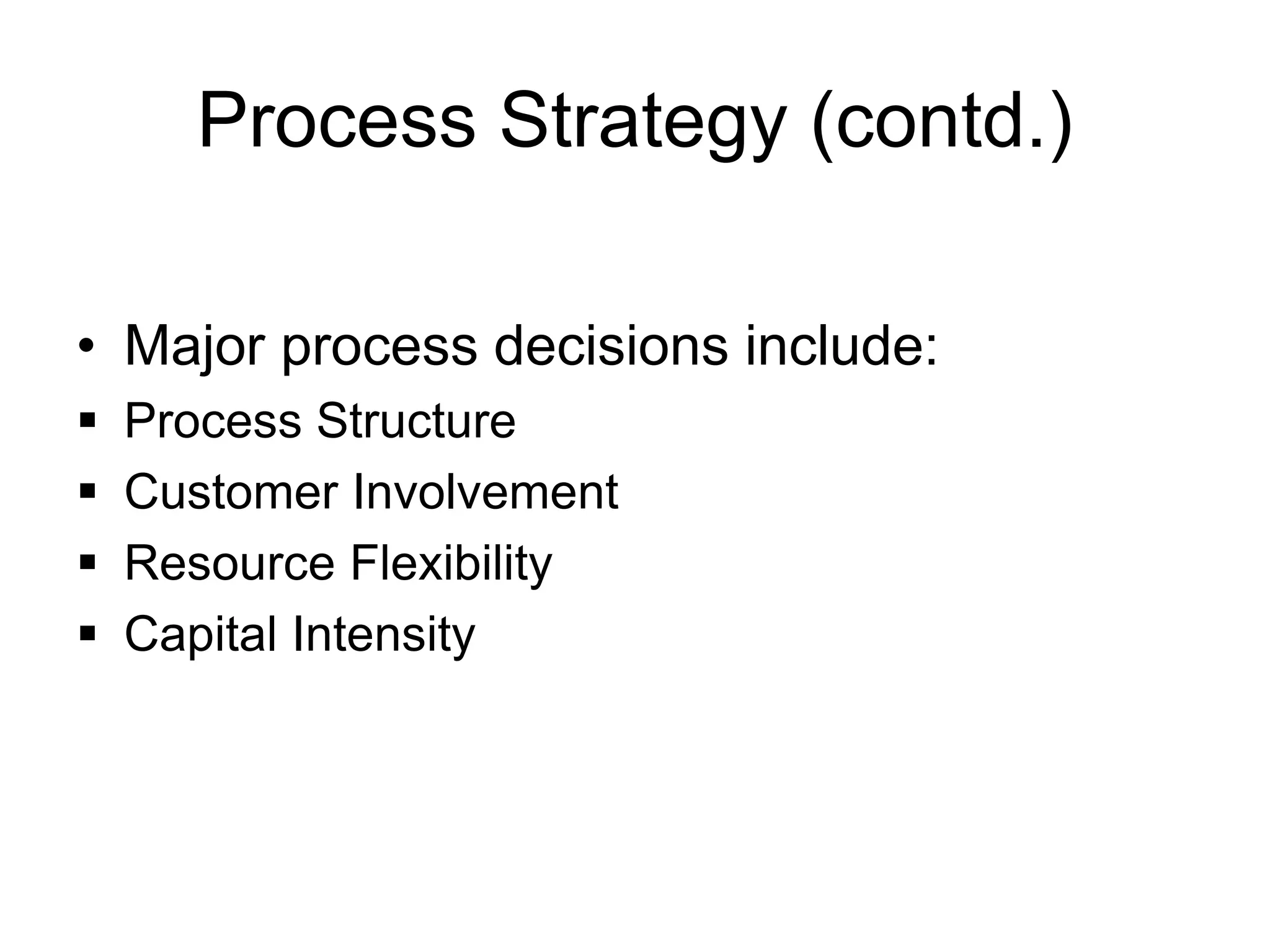
• Major process decisions include:
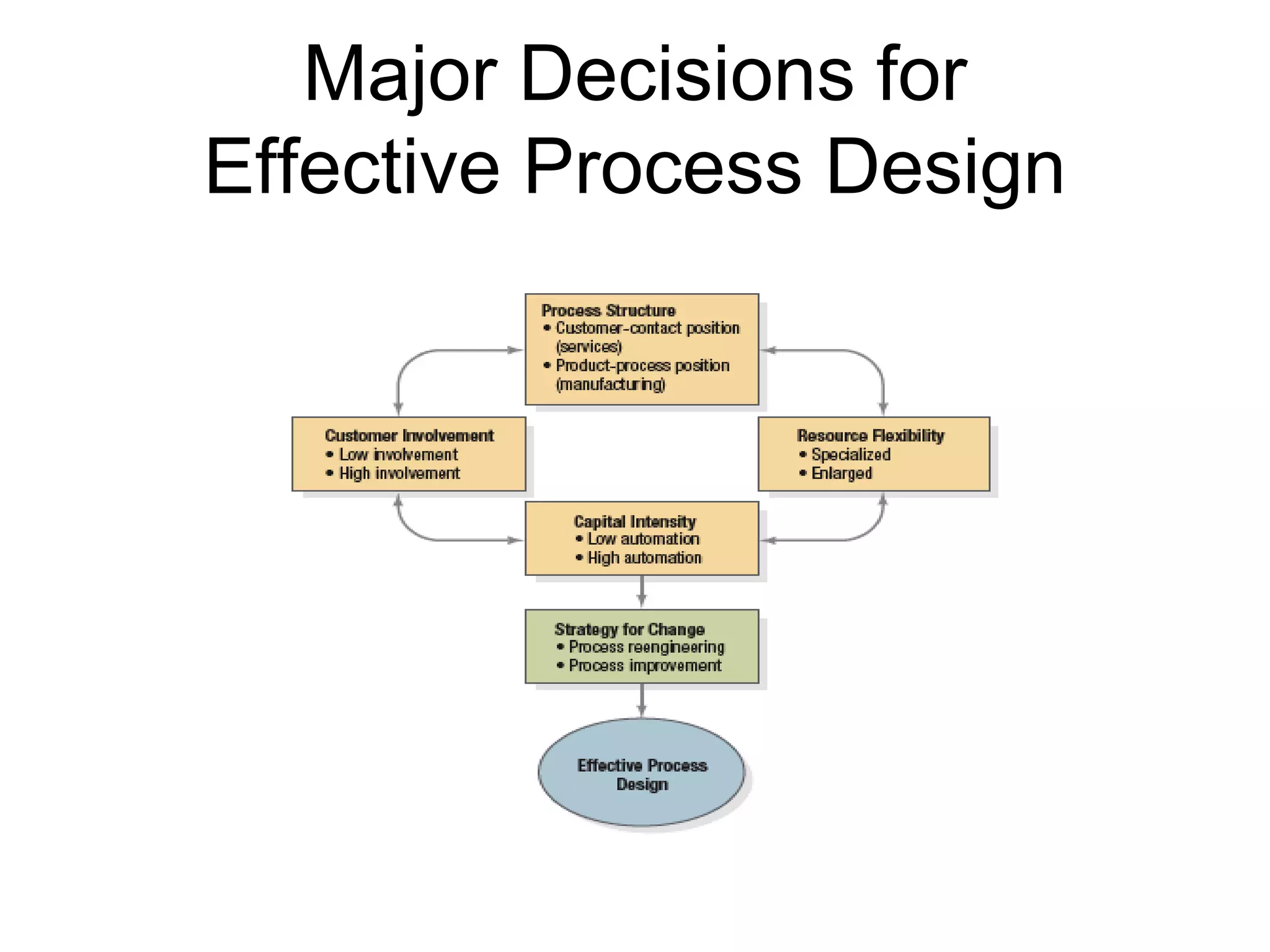
 Process Structure
 Customer Involvement
 Resource Flexibility
 Capital Intensity
Major Decisions for
Effective Process Design
Major Process Decisions (contd.)
• Process Structure: Determines how
processes are designed relative to the
kinds of resources needed, how resources
are partitioned between them, and their
key characteristics
• Customer Involvement: Refers to the
ways in which customers become part of
the process and the extent of their
participation
Major Process Decisions
(contd.)
• Resource flexibility: The ease with which
employees and equipment can handle a
wide variety of products, output levels,
duties, and functions
• Capital intensity: The mix of equipment
and human skills in a process
Process Structure In Services
• An effective service process strategy in
one situation can be a poor choice in
another
• Strategy chosen for a fast food restaurant
may not work for a five-star restaurant,
where customers seek leisurely dining
experience
• A good process strategy for a service
process depends first and foremost on the
type and amount of customer contact
Process Structure
In Services (contd.)
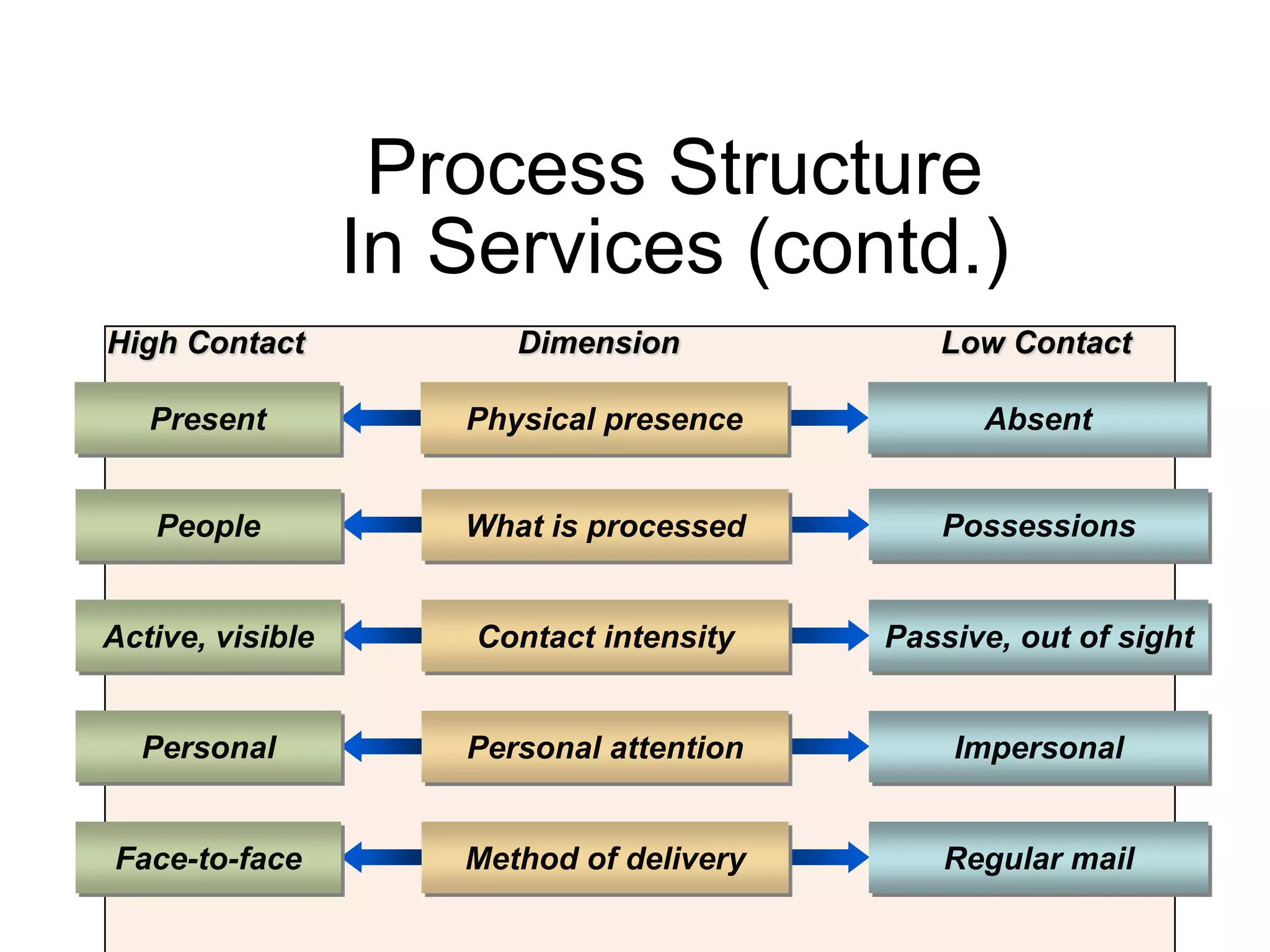
• Customer contact is the extent to which the
customer is present, is actively involved,
and receives personal attention during the
service process
• At this stage, customer’s perceptions about
the quality of the service provided are
shaped
People What is processed Possessions
Active, visible Contact intensity Passive, out of sight
Personal Personal attention Impersonal
Face-to-face Method of delivery Regular mail
Present Physical presence Absent
High Contact Dimension Low Contact
Process Structure
In Services (contd.)
Customer Contact
And Process Elements
• Active Contact: The customer is very
much part of the creation of the service
and affects the service process itself
• Passive Contact: The customer is not
involved in tailoring the process to meet
special needs or in how the process is
performed
Customer Contact
And Process Elements (contd.)
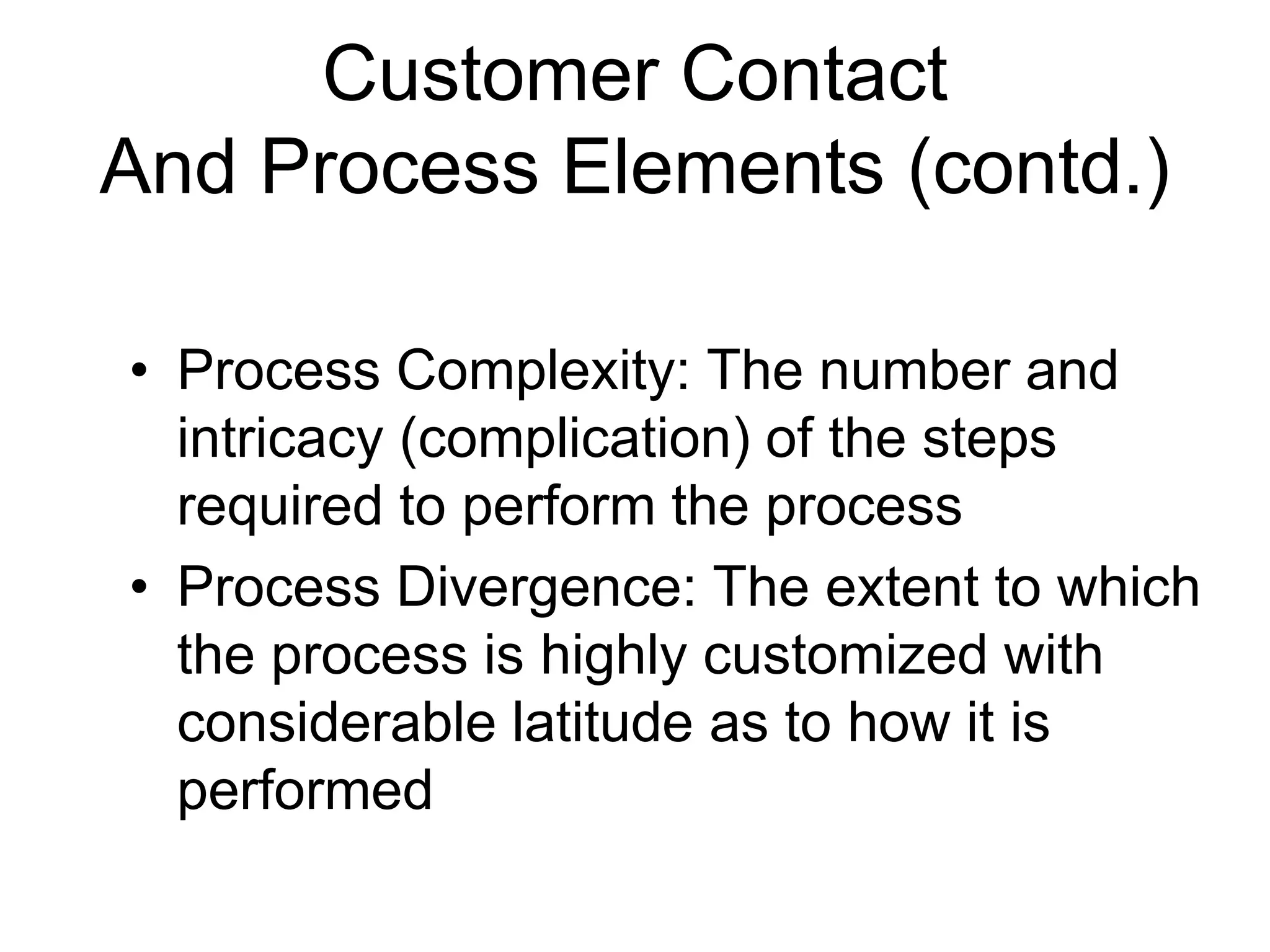
• Process Complexity: The number and
intricacy (complication) of the steps
required to perform the process
• Process Divergence: The extent to which
the process is highly customized with
considerable latitude as to how it is
performed
Customer Contact
And Process Elements (contd.)
• Flexible Flow: The customers, materials
or information move in diverse ways, with
the path of one customer or job often
crisscrossing the path that the next one
takes
• Line Flow: The customers, materials or
information move linearly from one
operation to the next, according to a fixed
sequence
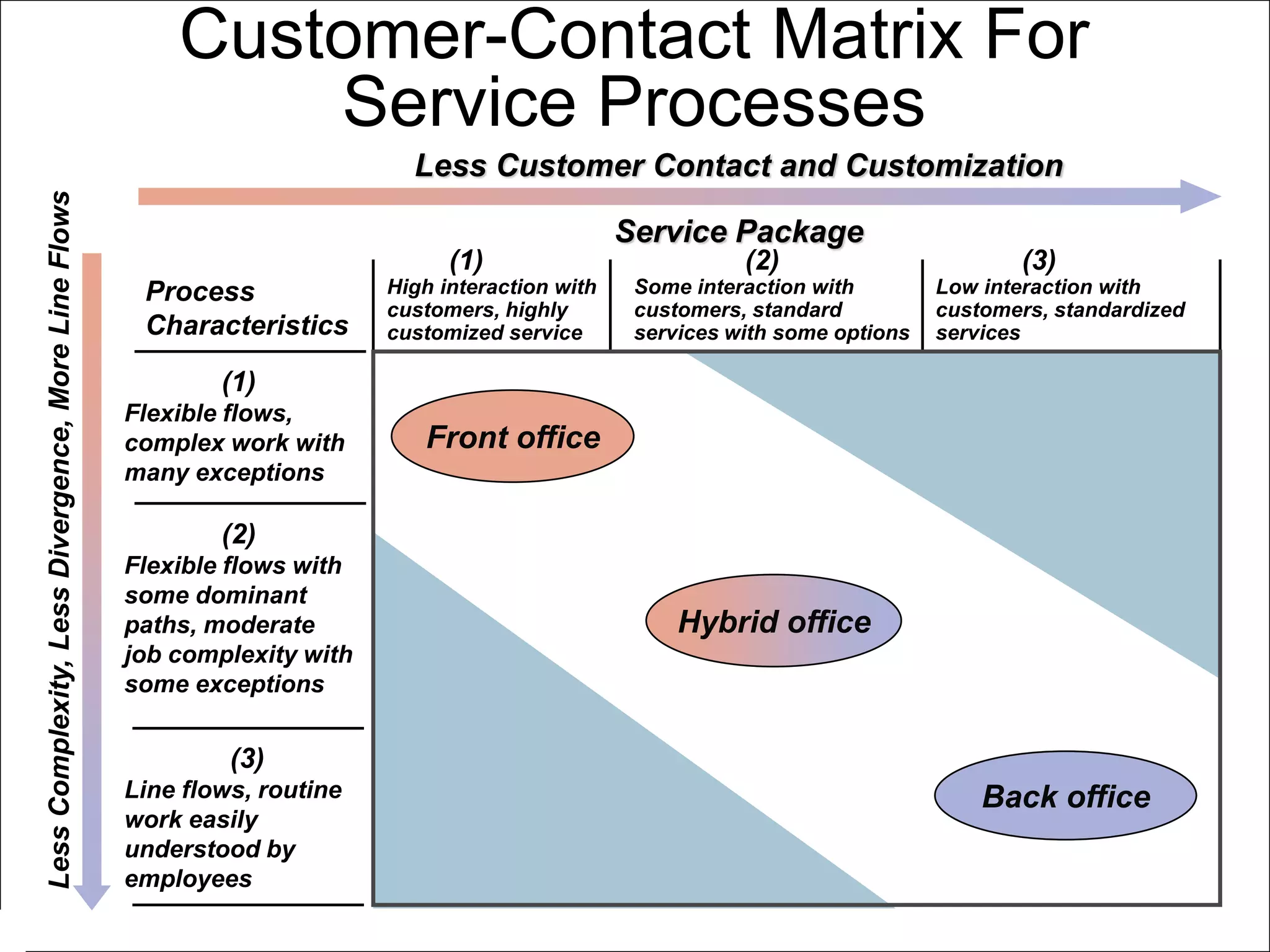
Customer-Contact Matrix For
Service Processes
Less Customer Contact and Customization
Service Package
Front office
Hybrid office
Back office
(1) (2) (3)
High interaction with Some interaction with Low interaction with
customers, highly customers, standard customers, standardized
customized service services with some options services
Process
Characteristics
(1)
Flexible flows,
complex work with
many exceptions
(2)
Flexible flows with
some dominant
paths, moderate
job complexity with
some exceptions
(3)
Line flows, routine
work easily
understood by
employees
Less
Complexity,
Less
Divergence,
More
Line
Flows
Process Structure
In Manufacturing
• Since products differ from services, a different
view on process structure is needed
• Product-Process Matrix
• Synchronizes the product to be manufactured
with the manufacturing process itself
• Volume
• Product customization
• Process characteristics
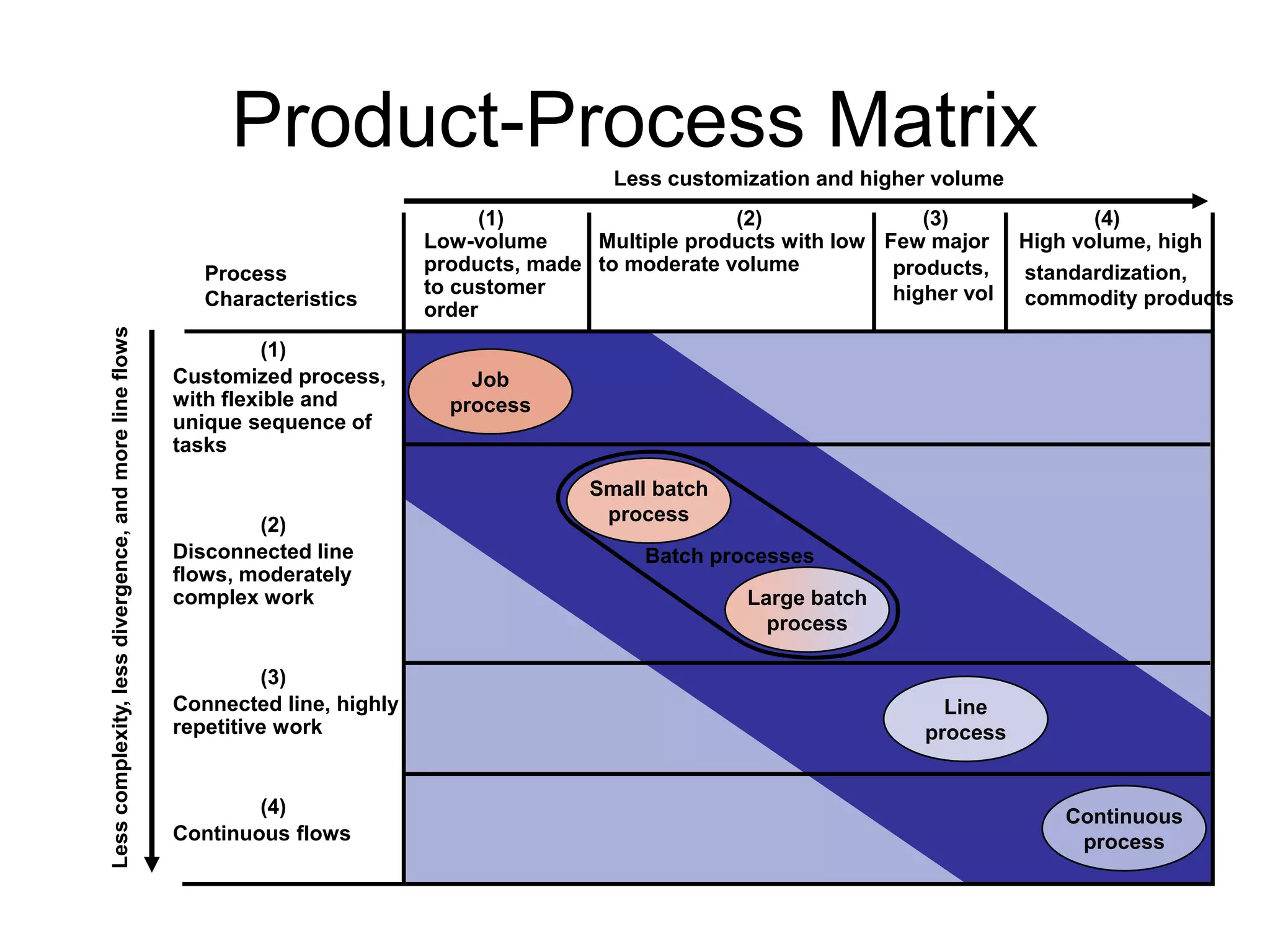
Product-Process Matrix
Continuous
process
Job
process
Line
process
Large batch
process
Small batch
process
(1) (2) (3) (4)
Low-volume Multiple products with low Few major High volume, high
products, made to moderate volume
to customer
order
Process
Characteristics
(1)
Customized process,
with flexible and
unique sequence of
tasks
(2)
Disconnected line
flows, moderately
complex work
(3)
Connected line, highly
repetitive work
(4)
Continuous flows
Less
complexity,
less
divergence,
and
more
line
flows
Less customization and higher volume
Batch processes
standardization,
commodity products
products,
higher vol
Product-Process Matrix (contd.)
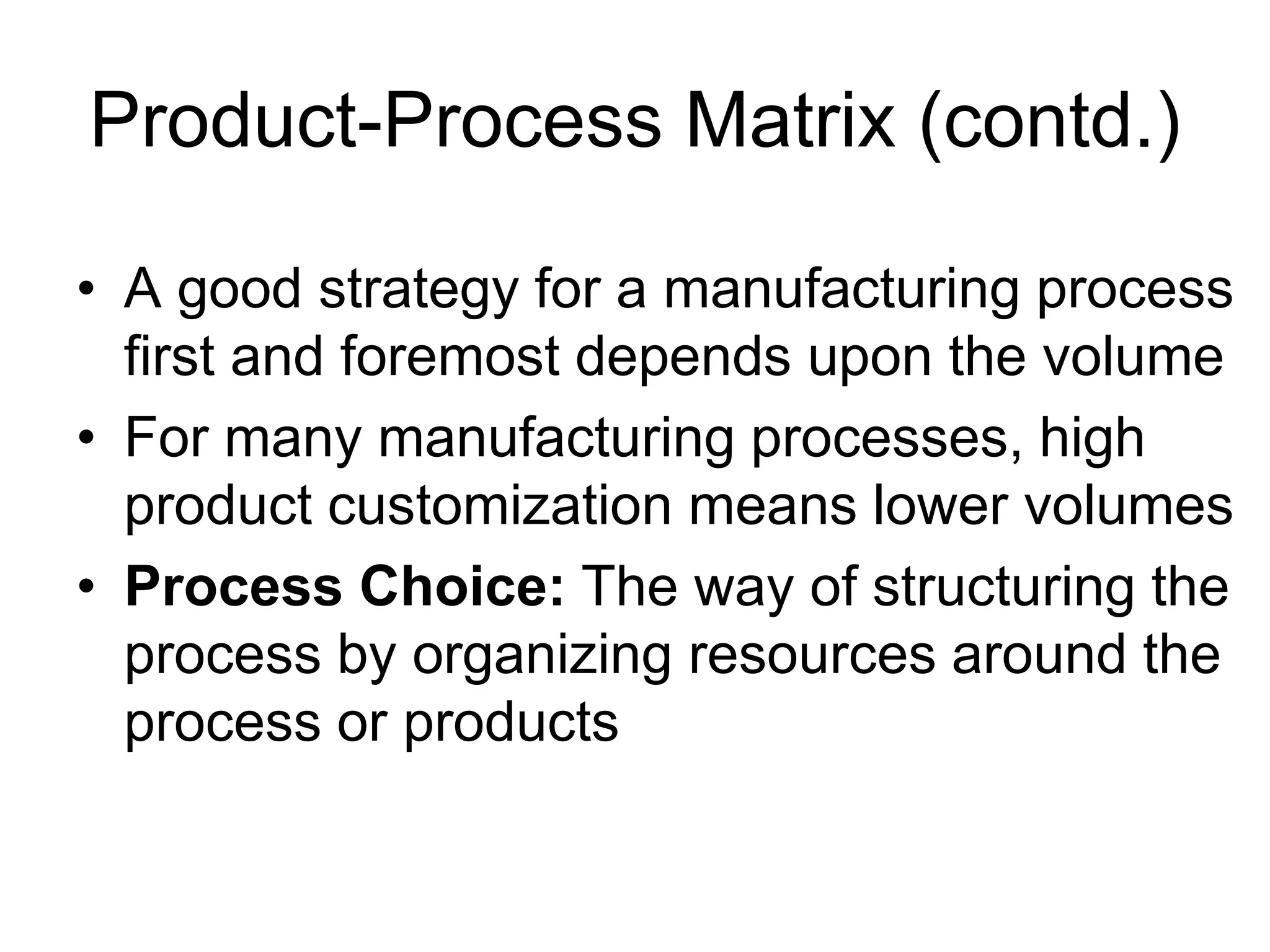
• A good strategy for a manufacturing process
first and foremost depends upon the volume
• For many manufacturing processes, high
product customization means lower volumes
• Process Choice: The way of structuring the
process by organizing resources around the
process or products
Product-Process Matrix (contd.)
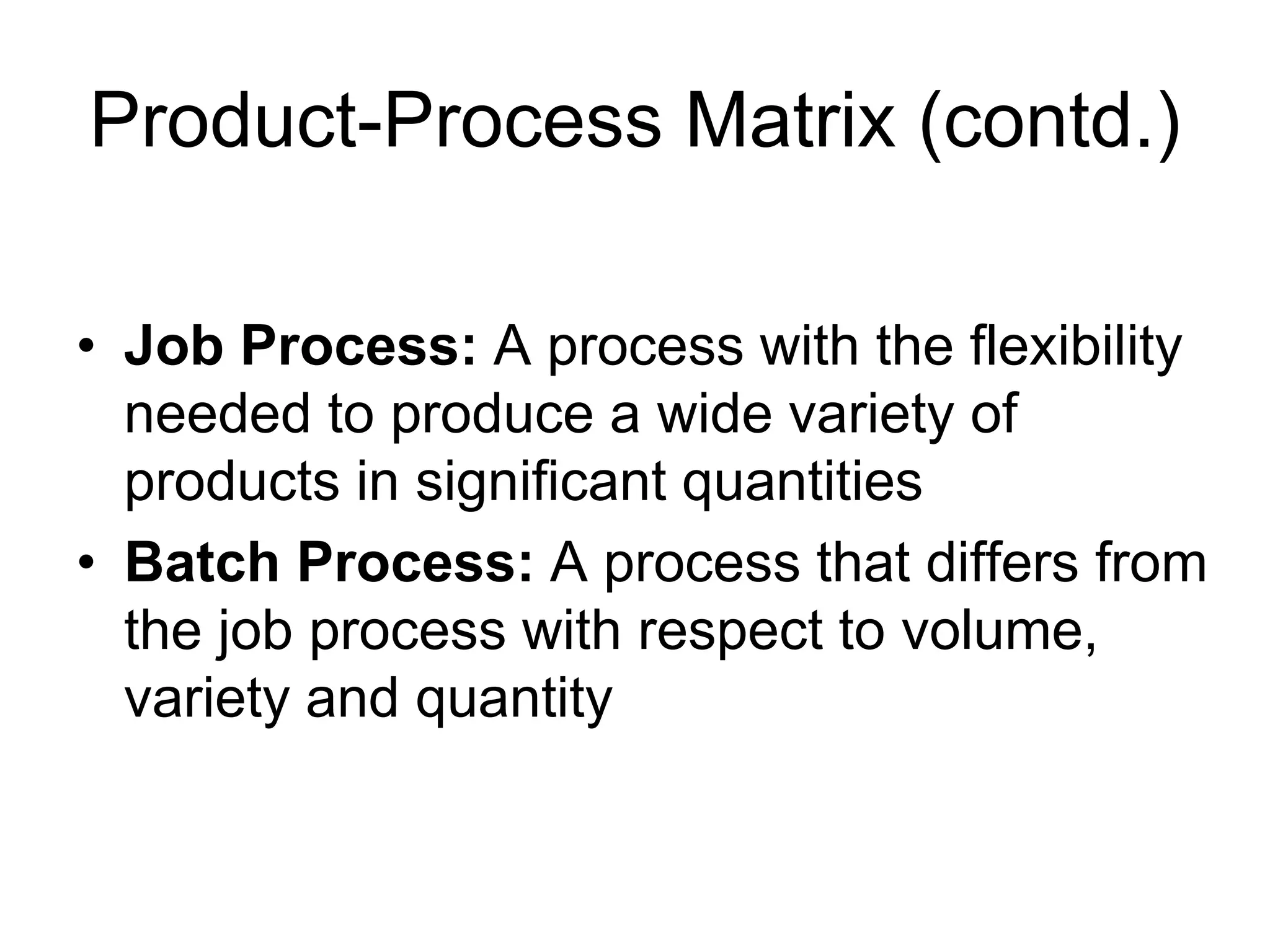
• Job Process: A process with the flexibility
needed to produce a wide variety of
products in significant quantities
• Batch Process: A process that differs from
the job process with respect to volume,
variety and quantity
Product-Process Matrix (contd.)
• Line Process: A process in which the
volumes are high and the products are
standardized allowing resources to be
organized around particular products
• Continuous Flow Process: The extreme
end of high volume standardized production
and rigid line flows, with production not
starting and stopping for long time intervals
Production And
Inventory Strategies
• Make-to-Order Strategy
• Assemble-to-Order Strategy
 Postponement
• Make-to-Stock Strategy
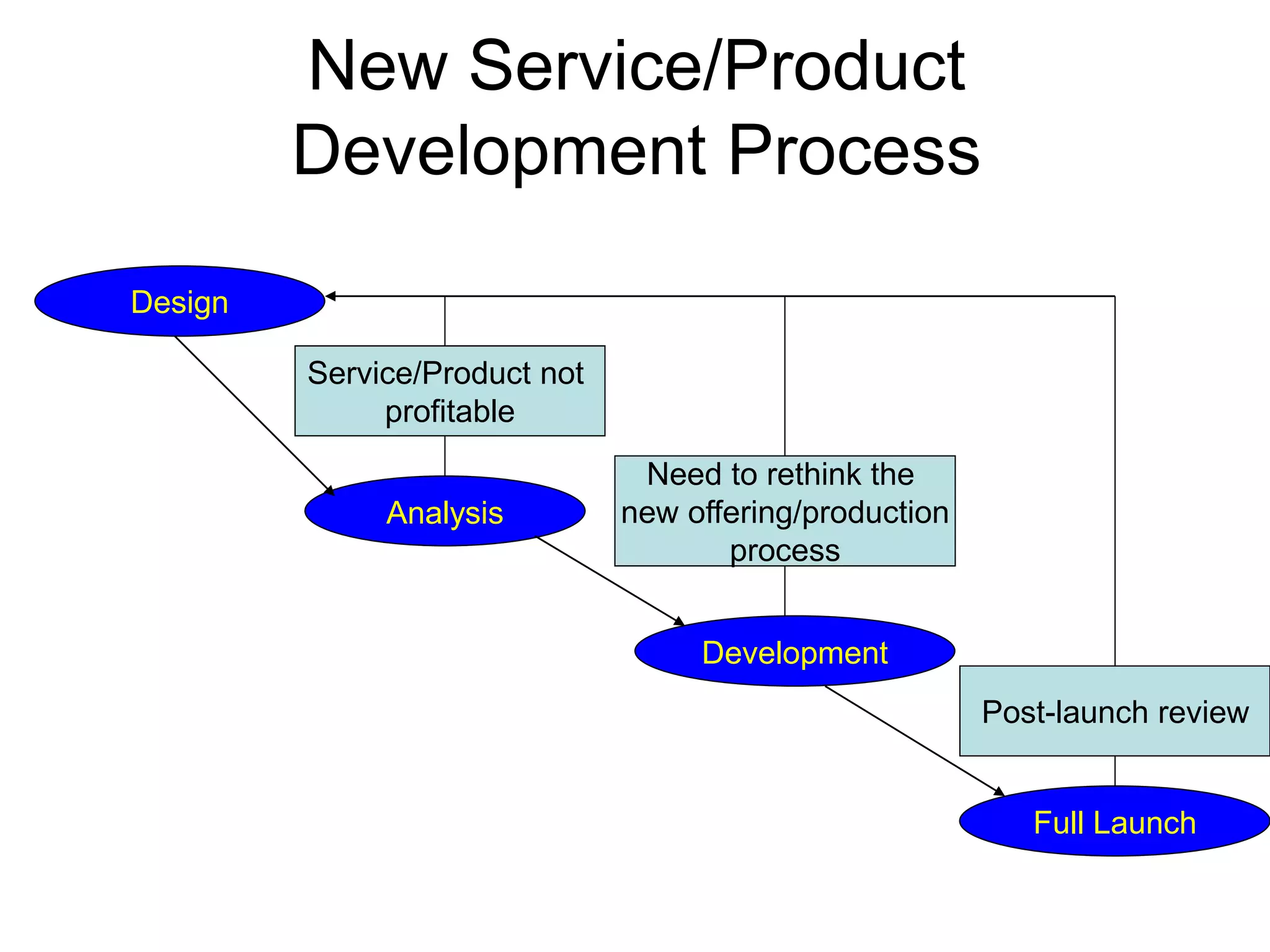
New Service/Product
Development Process
Design
Analysis
Development
Full Launch
Service/Product not
profitable
Post-launch review
Need to rethink the
new offering/production
process
New Service/Product
Development Process (contd.)
• Competitive priorities help managers
develop products and services that
customers want
• Development of new products/services is
vital to the long-term survival of the firm
• New may either mean introducing a brand
new concept or implementing major
changes to the existing products/services
I. Design Stage
• Critical stage as it links the creation of new
services/products to the corporate strategy
of the firm
• The corporate strategy specifies the long-
term objectives of the firm
• Ideas for new offerings are proposed and
screened for feasibility and market
worthiness
I. Design Stage (contd.)
• The ideas specify:
 how the customer connects with the service
or manufacturing firm;
 the benefits and outcomes for the customer;
and
 the value of the service/product
• The proposals also specify how the new
offering will be delivered
II. Analysis Stage
• Involves critical review of the new offering and
how it will be produced to make sure that:
 it fits the corporate strategy;
 is compatible with regulatory standards;
 presents an acceptable market risk; and
 satisfies the needs of the intended customers
• The resource requirements for the new
offering must be examined
II. Analysis Stage (contd.)
• The firm must examine the need to
acquire additional resources or expand the
supply chain by forming strategic
partnership with other firms
• If the analysis reveals that the new offering
has a good market potential and the firm
has the capability, the authorization is
given to proceed to the development stage
III. Development Stage
• Required competitive priorities are used as
inputs to the design of the processes that will
be involved in delivering the new offering
• Each activity is designed to meet its required
competitive priorities as well as to add value
• After process designing, the market program
can be designed
• Finally, personnel are trained and pilot runs
are conducted
Concurrent Engineering
• Used in order to avoid costly mismatches
between the design of a new offering and
the capability of the processes
• Brings product engineers, process
engineers, marketers, buyers, information
specialists, quality specialists and
suppliers together to design a product and
the processes that will meet customer
expectations
IV. Full Launch Stage
• Involves coordination of many internal
processes as well as those both upstream
and downstream in the supply chain
• Promotion for the new offering starts
• Briefing to sales personnel is done
• Distribution process is activated
• Withdrawal of old products/services
• Post-launch review (inputs from customers)
Quality Function Deployment
• As described by Dr. Yoki Akao, QFD is a
method to:
transform user demands into design quality;
deploy the functions forming quality;
deploy methods for achieving the design
quality into subsystems and component
parts, and ultimately to specific elements of
the manufacturing process
QFD (contd.)
• Refers to both:
determining what will satisfy the customer;
and
translating those customer desires into the
target design
• The idea is to capture a rich understanding of
customer wants and to identify alternative
process solutions
QFD (contd.)
• Used early in the design process to help
determine what will satisfy the customer and
where to deploy quality efforts
• A process for determining customer
requirements (customer “wants”) and
translating them into the attributes (the
“hows”) that each functional area can
understand and act on
House Of Quality
• One of the tools of QFD
• A graphic technique for defining the
relationship between customer desires and
the product (or service)
• By defining this relationship, operations
managers can build products and processes
with features desired by customers
• Defining this relationship is the first step in
building a world-class production system
Steps To Building House Of Quality
• Identify customer wants (what do prospective
customers want in this product?)
• Identify how the good/service will satisfy
customer wants (identify specific product
characteristics, features, or attributes and
show how they will satisfy customer wants)
• Relate customer wants to product hows
(building matrix)
Steps (contd.)
• Identify relationships between the firm’s
hows (how do our hows tie together?)
• Develop importance ratings
• Evaluate competing products (how well do
competing products meet customer wants?)
• Determine the desirable technical attributes,
your performance, and the competitor’s
performance against these attributes
You’ve been assigned
temporarily to a QFD
team. The goal of the
team is to develop a
new camera design.
Build a House of
Quality.
© 1984-1994 T/Maker Co.
House of Quality Example
House Of Quality (contd.)

OM_2.ppt

  • 1.
  • 2.
    Process Strategy • Thepattern of decisions made in managing processes so that they will achieve their competitive priorities • A process involves the use of an organization’s resources to provide something of value • Guides a variety of process decisions, and in turn, is guided by operations strategy
  • 3.
    Process Strategy (contd.) •Major process decisions include:  Process Structure  Customer Involvement  Resource Flexibility  Capital Intensity
  • 4.
  • 5.
    Major Process Decisions(contd.) • Process Structure: Determines how processes are designed relative to the kinds of resources needed, how resources are partitioned between them, and their key characteristics • Customer Involvement: Refers to the ways in which customers become part of the process and the extent of their participation
  • 6.
    Major Process Decisions (contd.) •Resource flexibility: The ease with which employees and equipment can handle a wide variety of products, output levels, duties, and functions • Capital intensity: The mix of equipment and human skills in a process
  • 7.
    Process Structure InServices • An effective service process strategy in one situation can be a poor choice in another • Strategy chosen for a fast food restaurant may not work for a five-star restaurant, where customers seek leisurely dining experience • A good process strategy for a service process depends first and foremost on the type and amount of customer contact
  • 8.
    Process Structure In Services(contd.) • Customer contact is the extent to which the customer is present, is actively involved, and receives personal attention during the service process • At this stage, customer’s perceptions about the quality of the service provided are shaped
  • 9.
    People What isprocessed Possessions Active, visible Contact intensity Passive, out of sight Personal Personal attention Impersonal Face-to-face Method of delivery Regular mail Present Physical presence Absent High Contact Dimension Low Contact Process Structure In Services (contd.)
  • 10.
    Customer Contact And ProcessElements • Active Contact: The customer is very much part of the creation of the service and affects the service process itself • Passive Contact: The customer is not involved in tailoring the process to meet special needs or in how the process is performed
  • 11.
    Customer Contact And ProcessElements (contd.) • Process Complexity: The number and intricacy (complication) of the steps required to perform the process • Process Divergence: The extent to which the process is highly customized with considerable latitude as to how it is performed
  • 12.
    Customer Contact And ProcessElements (contd.) • Flexible Flow: The customers, materials or information move in diverse ways, with the path of one customer or job often crisscrossing the path that the next one takes • Line Flow: The customers, materials or information move linearly from one operation to the next, according to a fixed sequence
  • 13.
    Customer-Contact Matrix For ServiceProcesses Less Customer Contact and Customization Service Package Front office Hybrid office Back office (1) (2) (3) High interaction with Some interaction with Low interaction with customers, highly customers, standard customers, standardized customized service services with some options services Process Characteristics (1) Flexible flows, complex work with many exceptions (2) Flexible flows with some dominant paths, moderate job complexity with some exceptions (3) Line flows, routine work easily understood by employees Less Complexity, Less Divergence, More Line Flows
  • 14.
    Process Structure In Manufacturing •Since products differ from services, a different view on process structure is needed • Product-Process Matrix • Synchronizes the product to be manufactured with the manufacturing process itself • Volume • Product customization • Process characteristics
  • 15.
    Product-Process Matrix Continuous process Job process Line process Large batch process Smallbatch process (1) (2) (3) (4) Low-volume Multiple products with low Few major High volume, high products, made to moderate volume to customer order Process Characteristics (1) Customized process, with flexible and unique sequence of tasks (2) Disconnected line flows, moderately complex work (3) Connected line, highly repetitive work (4) Continuous flows Less complexity, less divergence, and more line flows Less customization and higher volume Batch processes standardization, commodity products products, higher vol
  • 16.
    Product-Process Matrix (contd.) •A good strategy for a manufacturing process first and foremost depends upon the volume • For many manufacturing processes, high product customization means lower volumes • Process Choice: The way of structuring the process by organizing resources around the process or products
  • 17.
    Product-Process Matrix (contd.) •Job Process: A process with the flexibility needed to produce a wide variety of products in significant quantities • Batch Process: A process that differs from the job process with respect to volume, variety and quantity
  • 18.
    Product-Process Matrix (contd.) •Line Process: A process in which the volumes are high and the products are standardized allowing resources to be organized around particular products • Continuous Flow Process: The extreme end of high volume standardized production and rigid line flows, with production not starting and stopping for long time intervals
  • 19.
    Production And Inventory Strategies •Make-to-Order Strategy • Assemble-to-Order Strategy  Postponement • Make-to-Stock Strategy
  • 20.
    New Service/Product Development Process Design Analysis Development FullLaunch Service/Product not profitable Post-launch review Need to rethink the new offering/production process
  • 21.
    New Service/Product Development Process(contd.) • Competitive priorities help managers develop products and services that customers want • Development of new products/services is vital to the long-term survival of the firm • New may either mean introducing a brand new concept or implementing major changes to the existing products/services
  • 22.
    I. Design Stage •Critical stage as it links the creation of new services/products to the corporate strategy of the firm • The corporate strategy specifies the long- term objectives of the firm • Ideas for new offerings are proposed and screened for feasibility and market worthiness
  • 23.
    I. Design Stage(contd.) • The ideas specify:  how the customer connects with the service or manufacturing firm;  the benefits and outcomes for the customer; and  the value of the service/product • The proposals also specify how the new offering will be delivered
  • 24.
    II. Analysis Stage •Involves critical review of the new offering and how it will be produced to make sure that:  it fits the corporate strategy;  is compatible with regulatory standards;  presents an acceptable market risk; and  satisfies the needs of the intended customers • The resource requirements for the new offering must be examined
  • 25.
    II. Analysis Stage(contd.) • The firm must examine the need to acquire additional resources or expand the supply chain by forming strategic partnership with other firms • If the analysis reveals that the new offering has a good market potential and the firm has the capability, the authorization is given to proceed to the development stage
  • 26.
    III. Development Stage •Required competitive priorities are used as inputs to the design of the processes that will be involved in delivering the new offering • Each activity is designed to meet its required competitive priorities as well as to add value • After process designing, the market program can be designed • Finally, personnel are trained and pilot runs are conducted
  • 27.
    Concurrent Engineering • Usedin order to avoid costly mismatches between the design of a new offering and the capability of the processes • Brings product engineers, process engineers, marketers, buyers, information specialists, quality specialists and suppliers together to design a product and the processes that will meet customer expectations
  • 28.
    IV. Full LaunchStage • Involves coordination of many internal processes as well as those both upstream and downstream in the supply chain • Promotion for the new offering starts • Briefing to sales personnel is done • Distribution process is activated • Withdrawal of old products/services • Post-launch review (inputs from customers)
  • 29.
    Quality Function Deployment •As described by Dr. Yoki Akao, QFD is a method to: transform user demands into design quality; deploy the functions forming quality; deploy methods for achieving the design quality into subsystems and component parts, and ultimately to specific elements of the manufacturing process
  • 30.
    QFD (contd.) • Refersto both: determining what will satisfy the customer; and translating those customer desires into the target design • The idea is to capture a rich understanding of customer wants and to identify alternative process solutions
  • 31.
    QFD (contd.) • Usedearly in the design process to help determine what will satisfy the customer and where to deploy quality efforts • A process for determining customer requirements (customer “wants”) and translating them into the attributes (the “hows”) that each functional area can understand and act on
  • 32.
    House Of Quality •One of the tools of QFD • A graphic technique for defining the relationship between customer desires and the product (or service) • By defining this relationship, operations managers can build products and processes with features desired by customers • Defining this relationship is the first step in building a world-class production system
  • 33.
    Steps To BuildingHouse Of Quality • Identify customer wants (what do prospective customers want in this product?) • Identify how the good/service will satisfy customer wants (identify specific product characteristics, features, or attributes and show how they will satisfy customer wants) • Relate customer wants to product hows (building matrix)
  • 34.
    Steps (contd.) • Identifyrelationships between the firm’s hows (how do our hows tie together?) • Develop importance ratings • Evaluate competing products (how well do competing products meet customer wants?) • Determine the desirable technical attributes, your performance, and the competitor’s performance against these attributes
  • 35.
    You’ve been assigned temporarilyto a QFD team. The goal of the team is to develop a new camera design. Build a House of Quality. © 1984-1994 T/Maker Co. House of Quality Example
  • 36.