


Offline vs. Online Retail:
Development – Comparisons – Consumer View
Whitepaper 2017
The future of classic retail in times of an
increasingly connected world
2
According to Statista’s Digital Market Outlook, worldwide
e-Commerce revenue will grow from US$1,179,203 million in 2016
to US$2,108,097 million in 2021.
e-Commerce is booming, and with it more and more physical
stores, especially shops on the high street, are concerned about
what lies ahead. Around the globe, physical stores are fighting to
remain relevant in a world where the modern consumer expects
more and can shop via smartphone at all times.
To make shopping online even more attractive, e-Commerce
companies are working on optimizing their delivery processes and
are providing improved delivery methods, such as same-day-
delivery, more frequently. Amazon drone delivery has already been
tested in the UK and the courier company Postmates has begun
testing deliveries with Starship Technology robots.
As a result of these improvements within e-Commerce, and
subsequently growing numbers of e-shoppers, physical stores have
to ensure that their services can keep up with what’s offered
online. In short, an increasing number of consumers expects a
huge selection that can be shopped at all times.
The trend toward e-Commerce needn't have to have negative
effects for physical stores. It can also provide another distribution
and advertising channel for retailers with offline roots.
This whitepaper shows how well traditional retail truly fares
against online retail, and provides information on the barriers
and chances for both offline retail and e-Commerce.
Background
More at Statista.com
Traditional retail continues to dominate – yet,
the future is looking increasingly digital
3
1. Traditional retail is far from dead: However, e-Commerce is on
the rise
2. Where Amazon swallows most offline sales: Surprisingly, the
US is not in pole position
3. The more generic a product is, the greater its potential for e-
Commerce
4. More important than price: e-Commerce is especially popular
due to its 24/7 availability
5. Main offline advantage: not being able to see and try products
deters online shoppers
Key Takeaways
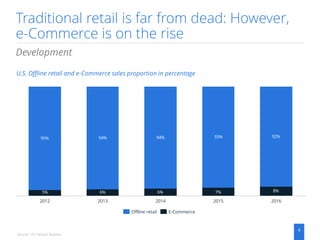
Traditional retail is far from dead: However,
e-Commerce is on the rise
4
Development
U.S. Offline retail and e-Commerce sales proportion in percentage
Source: US Census Bureau
8%
94% 94% 93% 92%
7%6%6%5%
95%
201620132012 2014 2015
E-CommerceOffline retail
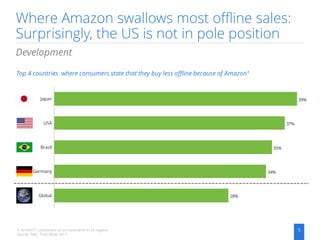
Where Amazon swallows most offline sales:
Surprisingly, the US is not in pole position
5
Development
Top 4 countries where consumers state that they buy less offline because of Amazon¹
1: N=24,471 consumers on six continents in 29 regions
Source: PwC, Total Retail 2017
28%
34%
35%
37%
39%
Brazil
USA
Japan
Global
Germany
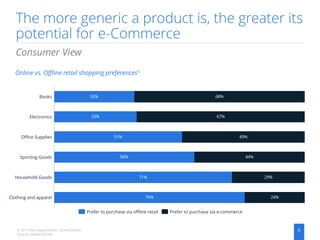
The more generic a product is, the greater its
potential for e-Commerce
6
Consumer View
Online vs. Offline retail shopping preferences¹
1: N=1,433 respondents; United States
Source: Walker Sands
32%
33%
51%
56%
71%
76%
68%
67%
49%
44%
29%
24%
Sporting Goods
Office Supplies
Electronics
Books
Clothing and apparel
Household Goods
Prefer to purchase via e-commercePrefer to purchase via offline retail
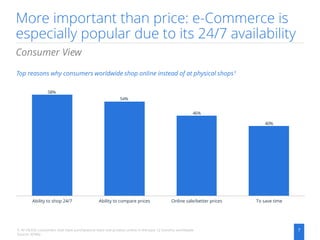
More important than price: e-Commerce is
especially popular due to its 24/7 availability
7
Consumer View
Top reasons why consumers worldwide shop online instead of at physical shops¹
1: N=18,430 consumers that have purchased at least one product online in the past 12 months; worldwide
Source: KPMG
46%
54%
58%
40%
Ability to shop 24/7 Online sale/better prices To save timeAbility to compare prices
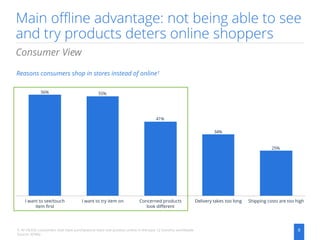
Main offline advantage: not being able to see
and try products deters online shoppers
8
Consumer View
Reasons consumers shop in stores instead of online¹
1: N=18,430 consumers that have purchased at least one product online in the past 12 months; worldwide
Source: KPMG
25%
34%
41%
55%56%
Concerned products
look different
I want to try item onI want to see/touch
item first
Shipping costs are too highDelivery takes too long
About the Digital Market Outlook
9
This paper provides insights on e-Commerce and Offline retail.
Further information on e-Commerce topics can be found via
Statista‘s Digital Market Outlook.
The Digital Market Outlook provides direct access and download of
revenue forecasts, user count & penetration, as well as cross-
country comparisons.
It includes data on 9 digital markets, Digital Media, Digital
Advertising, e-Commerce, eServices, Smart Home, FinTech, eHealth,
Connected Car, eTravel and covers 50 countries worldwide.
The e-Commerce market includes data on Fashion, Electronics &
Media, Food & Personal Care, Furniture & Appliances and Toys,
Hobby & DIY.
The Digital Market Outlook is exclusively available on statista.com
and is included in Statista Corporate Account and Statista
Enterprise Account.
9 markets, 34 segments, 50 countries
Further Data Contact
Tobias Bohnhoff
Head of Market Analytics
Tobias.Bohnhoff@statista.com
More at Statista.com
Tobias Bohnhoff studied Geography and Innovation Management.
He gathered deep knowledge of digital transformation processes
and innovative business models in numerous research and
consulting projects before he started to build up the Digital Market
Outlook team at Statista.
Imprint
Statista ▪ Johannes-Brahms-Platz 1 ▪ 20355 Hamburg ▪ +49 40 413 49 89 0 ▪ www.statista.com
Disclaimer
This study is based on survey and research data of the previously mentioned sources. The forecasts and market analysis presented were researched and prepared by Statista
with great care.
For the presented survey data, estimations and forecasts Statista can not assume any warranty of any kind. Surveys and forecasts contain information not naturally
representing a reliable basis for decisions in individual cases and may be in need of further interpretation. Therefore Statista is not liable for any damage arising from the use
of statistics and data provided in this report.

Offline vs. Online Retail: Development - Comparisons - Consumer View; Whitepaper 2017

  • 1.
    Offline vs. OnlineRetail: Development – Comparisons – Consumer View Whitepaper 2017
  • 2.
    The future ofclassic retail in times of an increasingly connected world 2 According to Statista’s Digital Market Outlook, worldwide e-Commerce revenue will grow from US$1,179,203 million in 2016 to US$2,108,097 million in 2021. e-Commerce is booming, and with it more and more physical stores, especially shops on the high street, are concerned about what lies ahead. Around the globe, physical stores are fighting to remain relevant in a world where the modern consumer expects more and can shop via smartphone at all times. To make shopping online even more attractive, e-Commerce companies are working on optimizing their delivery processes and are providing improved delivery methods, such as same-day- delivery, more frequently. Amazon drone delivery has already been tested in the UK and the courier company Postmates has begun testing deliveries with Starship Technology robots. As a result of these improvements within e-Commerce, and subsequently growing numbers of e-shoppers, physical stores have to ensure that their services can keep up with what’s offered online. In short, an increasing number of consumers expects a huge selection that can be shopped at all times. The trend toward e-Commerce needn't have to have negative effects for physical stores. It can also provide another distribution and advertising channel for retailers with offline roots. This whitepaper shows how well traditional retail truly fares against online retail, and provides information on the barriers and chances for both offline retail and e-Commerce. Background More at Statista.com
  • 3.
    Traditional retail continuesto dominate – yet, the future is looking increasingly digital 3 1. Traditional retail is far from dead: However, e-Commerce is on the rise 2. Where Amazon swallows most offline sales: Surprisingly, the US is not in pole position 3. The more generic a product is, the greater its potential for e- Commerce 4. More important than price: e-Commerce is especially popular due to its 24/7 availability 5. Main offline advantage: not being able to see and try products deters online shoppers Key Takeaways
  • 4.
    Traditional retail isfar from dead: However, e-Commerce is on the rise 4 Development U.S. Offline retail and e-Commerce sales proportion in percentage Source: US Census Bureau 8% 94% 94% 93% 92% 7%6%6%5% 95% 201620132012 2014 2015 E-CommerceOffline retail
  • 5.
    Where Amazon swallowsmost offline sales: Surprisingly, the US is not in pole position 5 Development Top 4 countries where consumers state that they buy less offline because of Amazon¹ 1: N=24,471 consumers on six continents in 29 regions Source: PwC, Total Retail 2017 28% 34% 35% 37% 39% Brazil USA Japan Global Germany
  • 6.
    The more generica product is, the greater its potential for e-Commerce 6 Consumer View Online vs. Offline retail shopping preferences¹ 1: N=1,433 respondents; United States Source: Walker Sands 32% 33% 51% 56% 71% 76% 68% 67% 49% 44% 29% 24% Sporting Goods Office Supplies Electronics Books Clothing and apparel Household Goods Prefer to purchase via e-commercePrefer to purchase via offline retail
  • 7.
    More important thanprice: e-Commerce is especially popular due to its 24/7 availability 7 Consumer View Top reasons why consumers worldwide shop online instead of at physical shops¹ 1: N=18,430 consumers that have purchased at least one product online in the past 12 months; worldwide Source: KPMG 46% 54% 58% 40% Ability to shop 24/7 Online sale/better prices To save timeAbility to compare prices
  • 8.
    Main offline advantage:not being able to see and try products deters online shoppers 8 Consumer View Reasons consumers shop in stores instead of online¹ 1: N=18,430 consumers that have purchased at least one product online in the past 12 months; worldwide Source: KPMG 25% 34% 41% 55%56% Concerned products look different I want to try item onI want to see/touch item first Shipping costs are too highDelivery takes too long
  • 9.
    About the DigitalMarket Outlook 9 This paper provides insights on e-Commerce and Offline retail. Further information on e-Commerce topics can be found via Statista‘s Digital Market Outlook. The Digital Market Outlook provides direct access and download of revenue forecasts, user count & penetration, as well as cross- country comparisons. It includes data on 9 digital markets, Digital Media, Digital Advertising, e-Commerce, eServices, Smart Home, FinTech, eHealth, Connected Car, eTravel and covers 50 countries worldwide. The e-Commerce market includes data on Fashion, Electronics & Media, Food & Personal Care, Furniture & Appliances and Toys, Hobby & DIY. The Digital Market Outlook is exclusively available on statista.com and is included in Statista Corporate Account and Statista Enterprise Account. 9 markets, 34 segments, 50 countries Further Data Contact Tobias Bohnhoff Head of Market Analytics Tobias.Bohnhoff@statista.com More at Statista.com Tobias Bohnhoff studied Geography and Innovation Management. He gathered deep knowledge of digital transformation processes and innovative business models in numerous research and consulting projects before he started to build up the Digital Market Outlook team at Statista.
  • 10.
    Imprint Statista ▪ Johannes-Brahms-Platz1 ▪ 20355 Hamburg ▪ +49 40 413 49 89 0 ▪ www.statista.com Disclaimer This study is based on survey and research data of the previously mentioned sources. The forecasts and market analysis presented were researched and prepared by Statista with great care. For the presented survey data, estimations and forecasts Statista can not assume any warranty of any kind. Surveys and forecasts contain information not naturally representing a reliable basis for decisions in individual cases and may be in need of further interpretation. Therefore Statista is not liable for any damage arising from the use of statistics and data provided in this report.