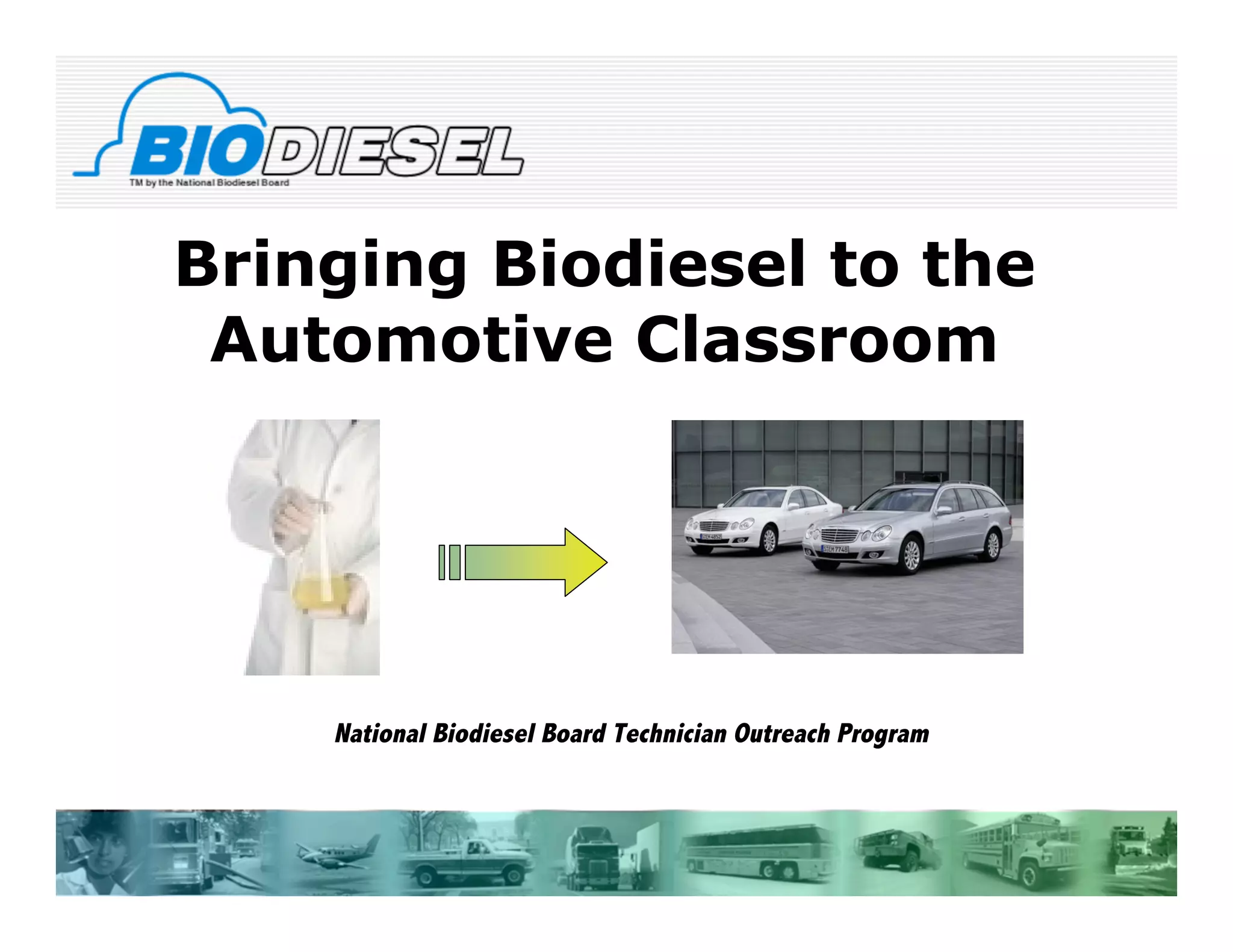
Bringing Biodiesel to the
 Automotive Classroom


    National Biodiesel Board Technician Outreach Program
Biodiesel Driving Forces
   Reduce dependence on imported crude oil and petrodiesel
    from unstable parts of the world
   Reduce global warming by using a renewable fuel
   Reduce harmful emissions from diesel engines
   Can be used in any diesel engine without modifications,
    existing fueling stations can be used
   Easy to use--drop in substitute for petroleum diesel fuel
   Produces over 3 times more energy than it takes to grow
    and process the fuel
   Engine and vehicle companies approve the fuel for use
   Over 100 million miles of on-road trouble-free use both
    here and abroad
Biodiesel (B100) Attributes
   High Cetane (avg. over 50)
   Ultra Low Sulfur (avg. ~ 2 ppm)
   High Lubricity, even in blends as low as 1-2%
   High Energy Balance (3.5 to 1)
   Renewable, Sustainable, Domestically Produced
   Increases overall fuel production capacity in USA
   Reduces HC, PM, CO in existing diesel engines
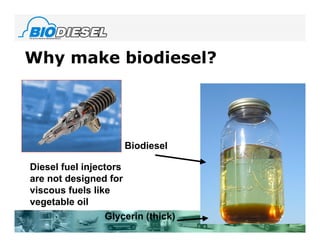
Why make biodiesel?


                      Biodiesel

Diesel fuel injectors
are not designed for
viscous fuels like
vegetable oil
                  Glycerin (thick)
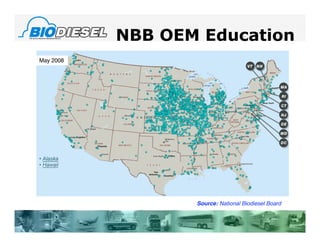
NBB OEM Education
May 2008


                  Source: National Biodiesel Board
Summary
 Biodiesel in the classroom
 Existing Curriculum

 Biodiesel in the shop

 Hands-on labs

 On-vehicle diagnosis

 Training resources
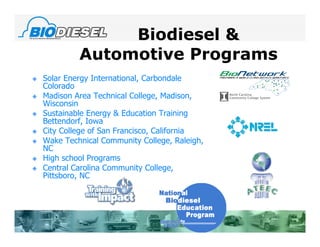
Biodiesel &
             Automotive Programs
   Solar Energy International, Carbondale
    Colorado
   Madison Area Technical College, Madison,
    Wisconsin
   Sustainable Energy & Education Training
    Bettendorf, Iowa
   City College of San Francisco, California
   Wake Technical Community College, Raleigh,
    NC
   High school Programs
   Central Carolina Community College,
    Pittsboro, NC
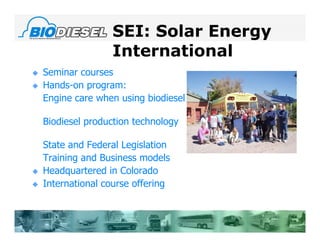
SEI: Solar Energy
                   International
   Seminar courses
   Hands-on program:
    Engine care when using biodiesel

    Biodiesel production technology

    State and Federal Legislation
    Training and Business models
   Headquartered in Colorado
   International course offering
MATC: Madison Area Tech
   National Science Foundation grant
   Instructors Ken Walz and Paul Morschauser
   Renewable Energy Certificate, a 12-credit
    program offered through the Consortium of
    Education in Renewable Energy Technology
    (CERET)
   Multi-disciplinary (Chemistry and Diesel
    Technology)
EPA Fleet Curriculum
   Collaborative effort: Community Fuels, City College of
    San Francisco, San Francisco Department of the
    Environment, and Biofuel Oasis
   Curriculum for fuel distributors, fleet operators,
    mechanics and drivers of trucking, municipal,
    construction and agricultural fleets.
   Eight pilot fleets will use biodiesel blends and
    their experience will be monitored.
SEET: Sustainable Energy
Education & Training
    Developed by the Advanced Technology
    Environmental Education Center (ATEEC) and
    partners
    Build the capacity of energy and environmental
    technicians
   Professional development training for 50 upper
    level high school and community college
    technology instructors.
   http://www.ateec.org/profdev/seet/index.htm
Central Carolina
                          Community College
   First Biofuel Class Offered at CCCC in 2002
   Over $700,000 in funding for biofuel program since 2004
   Extensive ASTM Biofuel Testing Lab
   New Sustainable Technologies Building in 2009
    •$3.8 million; 18,000 sq. ft. classroom and laboratory building for
    Biofuels, Sustainable Agriculture, Green Building, & Culinary Arts.
    •LEED Certified Silver: green roof, on-site wastewater treatment, &
    photovoltaics.
    •Will house a state of the art fuel production lab that will include seed
    crushing, biodiesel production, and ethanol production.
 For more information go to www.cccc.edu/biofuels
Alternative Energy Technologies: Biofuels begins Fall
                         2008!
Wake Tech
        Community College
    National Alternative Fuels Training
    Consortium Partner
    Heavy Duty Diesel Equipment
    Program
    Two day and one day biodiesel
    courses in Continuing Education
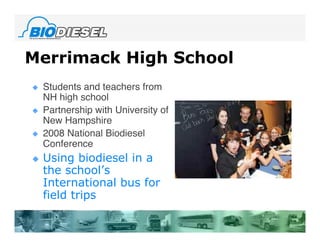
Merrimack High School
   Students and teachers from
    NH high school
   Partnership with University of
    New Hampshire
   2008 National Biodiesel
    Conference
   Using biodiesel in a
    the school’s
    International bus for
    field trips
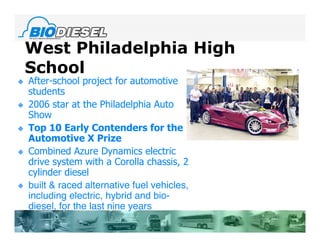
West Philadelphia High
    School
   After-school project for automotive
    students
   2006 star at the Philadelphia Auto
    Show
   Top 10 Early Contenders for the
    Automotive X Prize
   Combined Azure Dynamics electric
    drive system with a Corolla chassis, 2
    cylinder diesel
   built & raced alternative fuel vehicles,
    including electric, hybrid and bio-
    diesel, for the last nine years
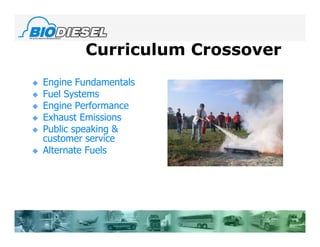
Curriculum Crossover
   Engine Fundamentals
   Fuel Systems
   Engine Performance
   Exhaust Emissions
   Public speaking &
    customer service
   Alternate Fuels
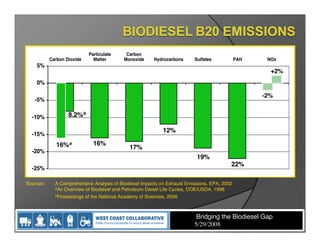
Particulate    Carbon
           Carbon Dioxide     Matter      Monoxide      Hydrocarbons     Sulfates            PAH    NOx
    5%
                                                                                                     +2%
    0%

                                                                                                   -2%
   -5%

  -10%             8.2%b

                                                           12%
  -15%
              16%a            16%
                                             17%
  -20%
                                                                          19%
                                                                                         22%
  -25%

Sources:     A Comprehensive Analysis of Biodiesel Impacts on Exhaust Emissions, EPA, 2002
             a
               An Overview of Biodiesel and Petroleum Diesel Life Cycles, DOE/USDA, 1998
             b
               Proceedings of the National Academy of Sciences, 2006


                                                                          Bridging the Biodiesel Gap
                                                                         5/29/2008
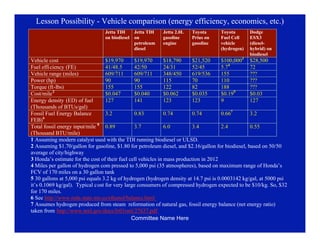
Lesson Possibility - Vehicle comparison (energy efficiency, economics, etc.)
                                 Jetta TDI    Jetta TDI   Jetta 2.0L   Toyota       Toyota       Dodge
                                 on biodiesel on          gasoline     Prius on     Fuel Cell    ESX3
                                              petroleum   engine       gasoline     vehicle      (diesel-
                                              diesel                                (hydrogen)   hybrid) on
                                                                                                 biodiesel
Vehicle cost                       $19,970      $19,970        $18,790    $21,520      $100,0003 $28,500
Fuel effi ciency (FE)              41/48.5      42/50          24/31      52/45        5.74        72
Vehicle range (miles)              609/711      609/711        348/450    619/536      155         ???
Power (hp)                         90           90             115        70           110         ???
Torque (ft-lbs)                    155          155            122        82           188         ???
           2                                                                                 5
Cost/mile                          $0.047       $0.040         $0.062     $0.035       $0.19       $0.03
Energy density (ED) of fuel        127          141            123        123          9           127
(Thousands of BTUs/gal)
Fossil Fuel Energy Balance         3.2          0.83           0.74       0.74         0.667       3.2
       6
FEB)
Total fossil energy input/mile 8 0.89           3.7            6.0        3.4          2.4         0.55
(Thousand BTU/mile)
1 Assuming modern catalyst used with the TDI running biodiesel or ULSD.
2 Assuming $1.70/gallon for gasoline, $1.80 for petroleum diesel, and $2.16/gallon for biodiesel, based on 50/50
average of city/highway
3 Honda’s estimate for the cost of their fuel cell vehicles in mass production in 2012
4 Miles per gallon of hydrogen com pressed to 5,000 psi (35 atmospheres), based on maximum range of Honda’s
FCV of 170 miles on a 30 gallon tank
5 30 gallons at 5,000 psi equals 3.2 kg of hydrogen (hydrogen density at 14.7 psi is 0.0003142 kg/gal, at 5000 psi
it’s 0.1069 kg/gal). Typical c ost for very large consumers of compressed hydrogen expected to be $10/kg. So, $32
for 170 miles.
6 See http://www.mda.state.mn.us/ethanol/balance.html
7 Assumes hydrogen produced from steam reformation of natural gas, fossil energy balance (net energy ratio)
taken from http://www.nrel.gov/docs/fy01osti/27637.pdf
                                               Committee Name Here
Comparison of Biodiesel and Hydrogen as
                                Fuels of the Future
                                    Biodiesel                              Hydrogen
Technological Readiness             Can be used in existing diesel         Electrolyzing water (most likely
                                    engines, which have already been in    using fossil fuel energy) or
                                    use for 100 years                      reforming fossil fuels. Most likely
                                                                           non-renewable methods with large
                                                                           net CO2 emissions
Fuel Distribution System            Can be distributed with existing       No system currently exists, would
                                    filling stations with no changes.      take decades to develop. Would
                                                                           cost $176 billion to put one
                                                                           hydrogen pump at each of the filling
                                                                           stations in the US.
Fossil Energy Balance [higher is    3.2 units (soy)                        0.66 units (steam reforming of
better]                             4.3 units (rapeseed)                   natural gas)

Large scale fuel development cost   For an estimated $1691 billion,        To produce enough clean hydrogen
analysis                            enough algae farms could be built to   for our transportation needs would
                                    completely replace petroleum           cost $2.5 trillion (wind power) or
                                    transportation fuels with biodiesel    $25 trillion (solar)
Safety                              Flash point over 300° F (considered    Highly flammable, high pressure
                                    “not flammable”)                       storage tanks pose a large risk due
                                                                           to store mechanical energy, as well
                                                                           as flammability/explosiveness
Time scale for wide scale use       5-15 years                             30-70 years optimistic assumption

Cost of engines                     Comparable to existing vehicles        Currently 50-100 times as expensive
                                                                           as existing engines.
Tank capacity required for 1,000    20 gallons                             268 gallons
mile range in conventional sedan
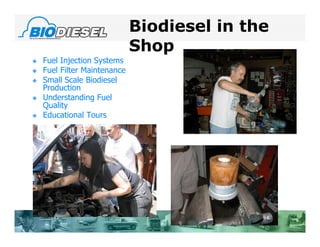
Biodiesel in the
                              Shop
   Fuel Injection Systems
   Fuel Filter Maintenance
   Small Scale Biodiesel
    Production
   Understanding Fuel
    Quality
   Educational Tours
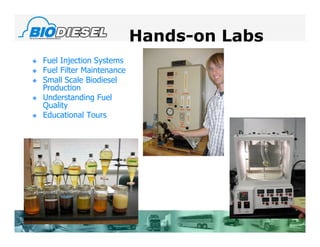
Hands-on Labs
   Fuel Injection Systems
   Fuel Filter Maintenance
   Small Scale Biodiesel
    Production
   Understanding Fuel
    Quality
   Educational Tours
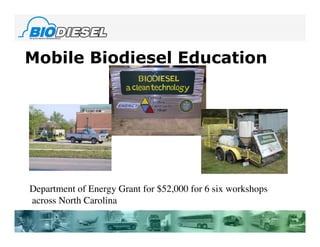
Mobile Biodiesel Education


Department of Energy Grant for $52,000 for 6 six workshops
across North Carolina
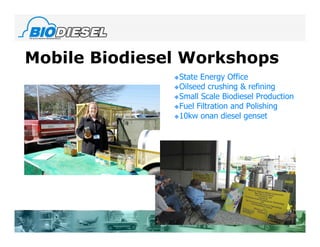
Mobile Biodiesel Workshops
               State Energy Office
               Oilseed crushing & refining
               Small Scale Biodiesel Production
               Fuel Filtration and Polishing
               10kw onan diesel genset
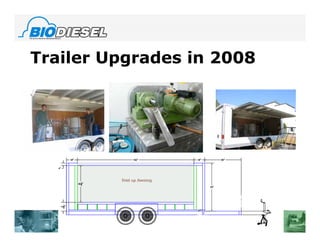
Trailer Upgrades in 2008
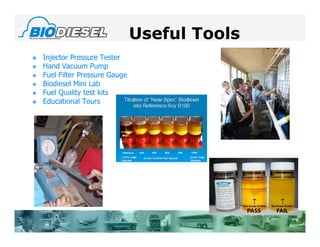
Useful Tools
   Injector Pressure Tester
   Hand Vacuum Pump
   Fuel Filter Pressure Gauge
   Biodiesel Mini Lab
   Fuel Quality test kits
   Educational Tours
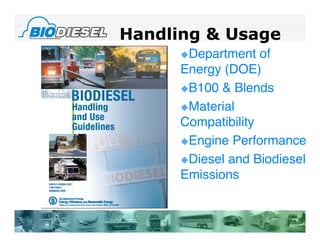
Handling & Usage
      Department   of
      Energy (DOE)
      B100 & Blends

      Material
      Compatibility
      Engine Performance

      Diesel and Biodiesel
      Emissions
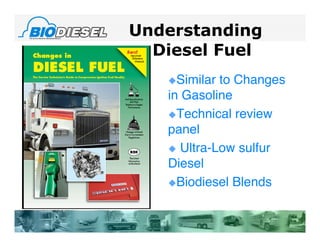
Understanding
  Diesel Fuel
   Similar to Changes
   in Gasoline
   Technical review
   panel
    Ultra-Low sulfur
   Diesel
   Biodiesel Blends
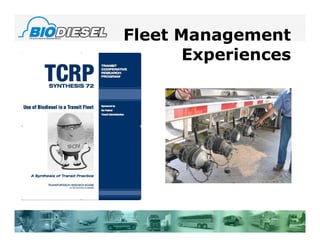
Fleet Management
       Experiences
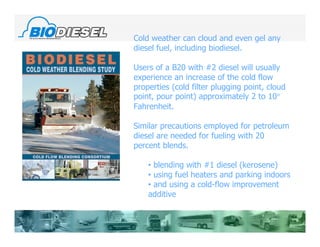
Cold weather can cloud and even gel any
diesel fuel, including biodiesel.

Users of a B20 with #2 diesel will usually
experience an increase of the cold flow
properties (cold filter plugging point, cloud
point, pour point) approximately 2 to 10°
Fahrenheit.

Similar precautions employed for petroleum
diesel are needed for fueling with 20
percent blends.

    • blending with #1 diesel (kerosene)
    • using fuel heaters and parking indoors
    • and using a cold-flow improvement
    additive
Biodiesel Education
                           Resources
   http://biofuels.coop/
   www.biodiesel.org
   http://www.bq-9000.org
   www.nearbio.com - Where Can I buy it?
   www.me.iastate.edu/biodiesel
   http://www.uidaho.edu/bioenergy/index.html
   1- 866-BIODIESEL Hotline is staffed 24/7
    www.nrel.gov
          • NREL Handling & Use Guidelines
   http://www.biodieselmagazine.com
   www.bbibiofuels.com
     • Biodiesel Magazine
     • Biofuel Magazine
NBB Resources

•www.biodiesel.org
  • Curriculum
  • Technical Library
  • Biodiesel Bulletin
  • Educational Videos Available
  • Informational Resources
  • Technical Resources
  • On-line Database & Spec Sheets

•www.BQ-9000.org
  • Biodiesel Quality Certification Program for
  Accredited Producers and Certified Marketers

Biodiesel in the Classroom

  • 1.
    Bringing Biodiesel tothe Automotive Classroom National Biodiesel Board Technician Outreach Program
  • 2.
    Biodiesel Driving Forces  Reduce dependence on imported crude oil and petrodiesel from unstable parts of the world  Reduce global warming by using a renewable fuel  Reduce harmful emissions from diesel engines  Can be used in any diesel engine without modifications, existing fueling stations can be used  Easy to use--drop in substitute for petroleum diesel fuel  Produces over 3 times more energy than it takes to grow and process the fuel  Engine and vehicle companies approve the fuel for use  Over 100 million miles of on-road trouble-free use both here and abroad
  • 3.
    Biodiesel (B100) Attributes  High Cetane (avg. over 50)  Ultra Low Sulfur (avg. ~ 2 ppm)  High Lubricity, even in blends as low as 1-2%  High Energy Balance (3.5 to 1)  Renewable, Sustainable, Domestically Produced  Increases overall fuel production capacity in USA  Reduces HC, PM, CO in existing diesel engines
  • 4.
    Why make biodiesel? Biodiesel Diesel fuel injectors are not designed for viscous fuels like vegetable oil Glycerin (thick)
  • 5.
    NBB OEM Education May2008 Source: National Biodiesel Board
  • 6.
    Summary  Biodiesel inthe classroom  Existing Curriculum  Biodiesel in the shop  Hands-on labs  On-vehicle diagnosis  Training resources
  • 7.
    Biodiesel & Automotive Programs  Solar Energy International, Carbondale Colorado  Madison Area Technical College, Madison, Wisconsin  Sustainable Energy & Education Training Bettendorf, Iowa  City College of San Francisco, California  Wake Technical Community College, Raleigh, NC  High school Programs  Central Carolina Community College, Pittsboro, NC
  • 8.
    SEI: Solar Energy International  Seminar courses  Hands-on program: Engine care when using biodiesel Biodiesel production technology State and Federal Legislation Training and Business models  Headquartered in Colorado  International course offering
  • 9.
    MATC: Madison AreaTech  National Science Foundation grant  Instructors Ken Walz and Paul Morschauser  Renewable Energy Certificate, a 12-credit program offered through the Consortium of Education in Renewable Energy Technology (CERET)  Multi-disciplinary (Chemistry and Diesel Technology)
  • 10.
    EPA Fleet Curriculum  Collaborative effort: Community Fuels, City College of San Francisco, San Francisco Department of the Environment, and Biofuel Oasis  Curriculum for fuel distributors, fleet operators, mechanics and drivers of trucking, municipal, construction and agricultural fleets.  Eight pilot fleets will use biodiesel blends and their experience will be monitored.
  • 11.
    SEET: Sustainable Energy Education& Training   Developed by the Advanced Technology Environmental Education Center (ATEEC) and partners  Build the capacity of energy and environmental technicians  Professional development training for 50 upper level high school and community college technology instructors.  http://www.ateec.org/profdev/seet/index.htm
  • 12.
    Central Carolina Community College  First Biofuel Class Offered at CCCC in 2002  Over $700,000 in funding for biofuel program since 2004  Extensive ASTM Biofuel Testing Lab  New Sustainable Technologies Building in 2009 •$3.8 million; 18,000 sq. ft. classroom and laboratory building for Biofuels, Sustainable Agriculture, Green Building, & Culinary Arts. •LEED Certified Silver: green roof, on-site wastewater treatment, & photovoltaics. •Will house a state of the art fuel production lab that will include seed crushing, biodiesel production, and ethanol production.  For more information go to www.cccc.edu/biofuels Alternative Energy Technologies: Biofuels begins Fall 2008!
  • 13.
    Wake Tech Community College   National Alternative Fuels Training Consortium Partner  Heavy Duty Diesel Equipment Program  Two day and one day biodiesel courses in Continuing Education
  • 14.
    Merrimack High School  Students and teachers from NH high school  Partnership with University of New Hampshire  2008 National Biodiesel Conference  Using biodiesel in a the school’s International bus for field trips
  • 15.
    West Philadelphia High School  After-school project for automotive students  2006 star at the Philadelphia Auto Show  Top 10 Early Contenders for the Automotive X Prize  Combined Azure Dynamics electric drive system with a Corolla chassis, 2 cylinder diesel  built & raced alternative fuel vehicles, including electric, hybrid and bio- diesel, for the last nine years
  • 16.
    Curriculum Crossover  Engine Fundamentals  Fuel Systems  Engine Performance  Exhaust Emissions  Public speaking & customer service  Alternate Fuels
  • 17.
    Particulate Carbon Carbon Dioxide Matter Monoxide Hydrocarbons Sulfates PAH NOx 5% +2% 0% -2% -5% -10% 8.2%b 12% -15% 16%a 16% 17% -20% 19% 22% -25% Sources: A Comprehensive Analysis of Biodiesel Impacts on Exhaust Emissions, EPA, 2002 a An Overview of Biodiesel and Petroleum Diesel Life Cycles, DOE/USDA, 1998 b Proceedings of the National Academy of Sciences, 2006 Bridging the Biodiesel Gap 5/29/2008
  • 18.
    Lesson Possibility -Vehicle comparison (energy efficiency, economics, etc.) Jetta TDI Jetta TDI Jetta 2.0L Toyota Toyota Dodge on biodiesel on gasoline Prius on Fuel Cell ESX3 petroleum engine gasoline vehicle (diesel- diesel (hydrogen) hybrid) on biodiesel Vehicle cost $19,970 $19,970 $18,790 $21,520 $100,0003 $28,500 Fuel effi ciency (FE) 41/48.5 42/50 24/31 52/45 5.74 72 Vehicle range (miles) 609/711 609/711 348/450 619/536 155 ??? Power (hp) 90 90 115 70 110 ??? Torque (ft-lbs) 155 155 122 82 188 ??? 2 5 Cost/mile $0.047 $0.040 $0.062 $0.035 $0.19 $0.03 Energy density (ED) of fuel 127 141 123 123 9 127 (Thousands of BTUs/gal) Fossil Fuel Energy Balance 3.2 0.83 0.74 0.74 0.667 3.2 6 FEB) Total fossil energy input/mile 8 0.89 3.7 6.0 3.4 2.4 0.55 (Thousand BTU/mile) 1 Assuming modern catalyst used with the TDI running biodiesel or ULSD. 2 Assuming $1.70/gallon for gasoline, $1.80 for petroleum diesel, and $2.16/gallon for biodiesel, based on 50/50 average of city/highway 3 Honda’s estimate for the cost of their fuel cell vehicles in mass production in 2012 4 Miles per gallon of hydrogen com pressed to 5,000 psi (35 atmospheres), based on maximum range of Honda’s FCV of 170 miles on a 30 gallon tank 5 30 gallons at 5,000 psi equals 3.2 kg of hydrogen (hydrogen density at 14.7 psi is 0.0003142 kg/gal, at 5000 psi it’s 0.1069 kg/gal). Typical c ost for very large consumers of compressed hydrogen expected to be $10/kg. So, $32 for 170 miles. 6 See http://www.mda.state.mn.us/ethanol/balance.html 7 Assumes hydrogen produced from steam reformation of natural gas, fossil energy balance (net energy ratio) taken from http://www.nrel.gov/docs/fy01osti/27637.pdf Committee Name Here
  • 19.
    Comparison of Biodieseland Hydrogen as Fuels of the Future Biodiesel Hydrogen Technological Readiness Can be used in existing diesel Electrolyzing water (most likely engines, which have already been in using fossil fuel energy) or use for 100 years reforming fossil fuels. Most likely non-renewable methods with large net CO2 emissions Fuel Distribution System Can be distributed with existing No system currently exists, would filling stations with no changes. take decades to develop. Would cost $176 billion to put one hydrogen pump at each of the filling stations in the US. Fossil Energy Balance [higher is 3.2 units (soy) 0.66 units (steam reforming of better] 4.3 units (rapeseed) natural gas) Large scale fuel development cost For an estimated $1691 billion, To produce enough clean hydrogen analysis enough algae farms could be built to for our transportation needs would completely replace petroleum cost $2.5 trillion (wind power) or transportation fuels with biodiesel $25 trillion (solar) Safety Flash point over 300° F (considered Highly flammable, high pressure “not flammable”) storage tanks pose a large risk due to store mechanical energy, as well as flammability/explosiveness Time scale for wide scale use 5-15 years 30-70 years optimistic assumption Cost of engines Comparable to existing vehicles Currently 50-100 times as expensive as existing engines. Tank capacity required for 1,000 20 gallons 268 gallons mile range in conventional sedan
  • 20.
    Biodiesel in the Shop  Fuel Injection Systems  Fuel Filter Maintenance  Small Scale Biodiesel Production  Understanding Fuel Quality  Educational Tours
  • 21.
    Hands-on Labs  Fuel Injection Systems  Fuel Filter Maintenance  Small Scale Biodiesel Production  Understanding Fuel Quality  Educational Tours
  • 22.
    Mobile Biodiesel Education Departmentof Energy Grant for $52,000 for 6 six workshops across North Carolina
  • 23.
    Mobile Biodiesel Workshops State Energy Office Oilseed crushing & refining Small Scale Biodiesel Production Fuel Filtration and Polishing 10kw onan diesel genset
  • 24.
  • 25.
    Useful Tools  Injector Pressure Tester  Hand Vacuum Pump  Fuel Filter Pressure Gauge  Biodiesel Mini Lab  Fuel Quality test kits  Educational Tours
  • 26.
    Handling & Usage Department of Energy (DOE) B100 & Blends Material Compatibility Engine Performance Diesel and Biodiesel Emissions
  • 27.
    Understanding DieselFuel Similar to Changes in Gasoline Technical review panel  Ultra-Low sulfur Diesel Biodiesel Blends
  • 28.
    Fleet Management Experiences
  • 29.
    Cold weather cancloud and even gel any diesel fuel, including biodiesel. Users of a B20 with #2 diesel will usually experience an increase of the cold flow properties (cold filter plugging point, cloud point, pour point) approximately 2 to 10° Fahrenheit. Similar precautions employed for petroleum diesel are needed for fueling with 20 percent blends. • blending with #1 diesel (kerosene) • using fuel heaters and parking indoors • and using a cold-flow improvement additive
  • 30.
    Biodiesel Education Resources  http://biofuels.coop/  www.biodiesel.org  http://www.bq-9000.org  www.nearbio.com - Where Can I buy it?  www.me.iastate.edu/biodiesel  http://www.uidaho.edu/bioenergy/index.html  1- 866-BIODIESEL Hotline is staffed 24/7  www.nrel.gov • NREL Handling & Use Guidelines  http://www.biodieselmagazine.com  www.bbibiofuels.com • Biodiesel Magazine • Biofuel Magazine
  • 31.
    NBB Resources •www.biodiesel.org • Curriculum • Technical Library • Biodiesel Bulletin • Educational Videos Available • Informational Resources • Technical Resources • On-line Database & Spec Sheets •www.BQ-9000.org • Biodiesel Quality Certification Program for Accredited Producers and Certified Marketers