By: Amanda LeBlanc
         Kayla Parr
     Savannah Durr
         Emily Vela
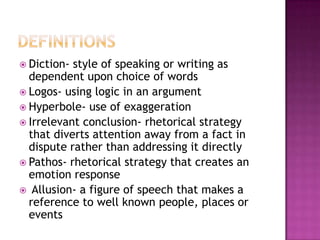
 Diction- style of speaking or writing as
  dependent upon choice of words
 Logos- using logic in an argument
 Hyperbole- use of exaggeration
 Irrelevant conclusion- rhetorical strategy
  that diverts attention away from a fact in
  dispute rather than addressing it directly
 Pathos- rhetorical strategy that creates an
  emotion response
 Allusion- a figure of speech that makes a
  reference to well known people, places or
  events
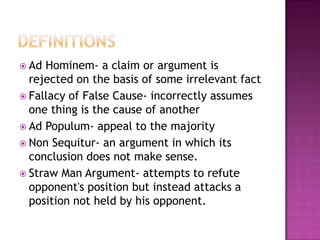
 Ad Hominem- a claim or argument is
  rejected on the basis of some irrelevant fact
 Fallacy of False Cause- incorrectly assumes
  one thing is the cause of another
 Ad Populum- appeal to the majority
 Non Sequitur- an argument in which its
  conclusion does not make sense.
 Straw Man Argument- attempts to refute
  opponent's position but instead attacks a
  position not held by his opponent.
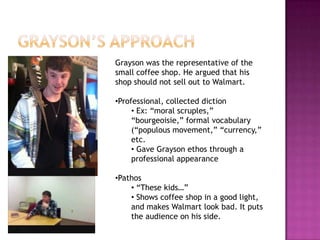
Grayson was the representative of the
small coffee shop. He argued that his
shop should not sell out to Walmart.

•Professional, collected diction
     • Ex: “moral scruples,”
     “bourgeoisie,” formal vocabulary
     (“populous movement,” “currency,”
     etc.
     • Gave Grayson ethos through a
     professional appearance

•Pathos
    • “These kids…”
    • Shows coffee shop in a good light,
    and makes Walmart look bad. It puts
    the audience on his side.
 Logos
     Gas prices
     Walmart destroying American currency
     Gives Grayson credibility, makes Walmart look
      bad
 Allusions
     “Les Mis,” “Occupy Wall Street,” “Dante’s
      Inferno”
     Appeal to the population (ad populus), fights for
      empathy
 Irrelevant       conclusions (fallacy)
     “You belong in the 10th circle of hell!”
          (Dante’s Inferno)
         Tries to show how Calen is bad, but the argument is
          irrelevant to the conversation at hand. Slight ad
          hominem
 Resorted       to physical violence (fallacy)
     Let emotions get the better of him. This
      argument was supposed to be verbal.
     Damaged his credibility as a composed
      businessman
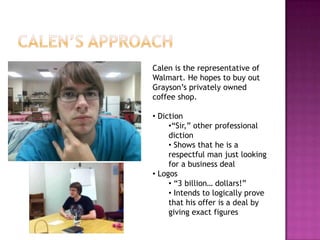
Calen is the representative of
Walmart. He hopes to buy out
Grayson’s privately owned
coffee shop.

• Diction
     •“Sir,” other professional
     diction
     • Shows that he is a
     respectful man just looking
     for a business deal
• Logos
     • “3 billion… dollars!”
     • Intends to logically prove
     that his offer is a deal by
     giving exact figures
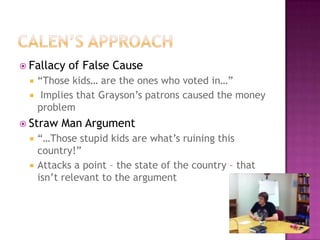
 Fallacy   of False Cause
    “Those kids… are the ones who voted in…”
     Implies that Grayson’s patrons caused the money
     problem
 Straw   Man Argument
    “…Those stupid kids are what’s ruining this
     country!”
    Attacks a point – the state of the country – that
     isn’t relevant to the argument
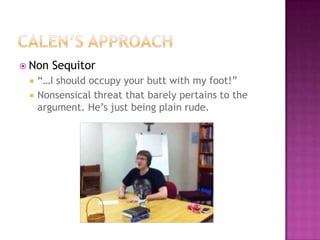
 Non   Sequitor
    “…I should occupy your butt with my foot!”
    Nonsensical threat that barely pertains to the
     argument. He’s just being plain rude.
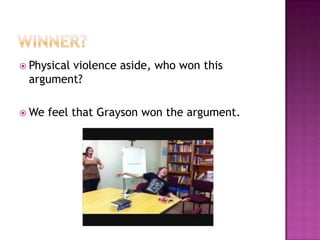
 Physical
        violence aside, who won this
 argument?

 We   feel that Grayson won the argument.
 In presenting his argument, Grayson focused
  on using rhetorical devices such as diction,
  logos, and allusions to prove his point.
  Although he resorted to ad hominem and
  irrelevant conclusions, we feel that his
  argument was better supported and
  presented. His strong points outweighed his
  fallacies.
 Calen mainly used fallacies to make his
  point, which destroyed his credibility and
  emphasized Grayson’s points.
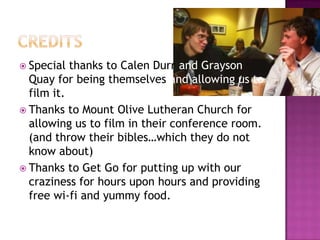
 Special  thanks to Calen Durr and Grayson
  Quay for being themselves and allowing us to
  film it.
 Thanks to Mount Olive Lutheran Church for
  allowing us to film in their conference room.
  (and throw their bibles…which they do not
  know about)
 Thanks to Get Go for putting up with our
  craziness for hours upon hours and providing
  free wi-fi and yummy food.
An appeal to pathos…

Occupy Walmart

  • 1.
    By: Amanda LeBlanc Kayla Parr Savannah Durr Emily Vela
  • 3.
     Diction- styleof speaking or writing as dependent upon choice of words  Logos- using logic in an argument  Hyperbole- use of exaggeration  Irrelevant conclusion- rhetorical strategy that diverts attention away from a fact in dispute rather than addressing it directly  Pathos- rhetorical strategy that creates an emotion response  Allusion- a figure of speech that makes a reference to well known people, places or events
  • 4.
     Ad Hominem-a claim or argument is rejected on the basis of some irrelevant fact  Fallacy of False Cause- incorrectly assumes one thing is the cause of another  Ad Populum- appeal to the majority  Non Sequitur- an argument in which its conclusion does not make sense.  Straw Man Argument- attempts to refute opponent's position but instead attacks a position not held by his opponent.
  • 5.
    Grayson was therepresentative of the small coffee shop. He argued that his shop should not sell out to Walmart. •Professional, collected diction • Ex: “moral scruples,” “bourgeoisie,” formal vocabulary (“populous movement,” “currency,” etc. • Gave Grayson ethos through a professional appearance •Pathos • “These kids…” • Shows coffee shop in a good light, and makes Walmart look bad. It puts the audience on his side.
  • 6.
     Logos  Gas prices  Walmart destroying American currency  Gives Grayson credibility, makes Walmart look bad  Allusions  “Les Mis,” “Occupy Wall Street,” “Dante’s Inferno”  Appeal to the population (ad populus), fights for empathy
  • 7.
     Irrelevant conclusions (fallacy)  “You belong in the 10th circle of hell!”  (Dante’s Inferno)  Tries to show how Calen is bad, but the argument is irrelevant to the conversation at hand. Slight ad hominem  Resorted to physical violence (fallacy)  Let emotions get the better of him. This argument was supposed to be verbal.  Damaged his credibility as a composed businessman
  • 8.
    Calen is therepresentative of Walmart. He hopes to buy out Grayson’s privately owned coffee shop. • Diction •“Sir,” other professional diction • Shows that he is a respectful man just looking for a business deal • Logos • “3 billion… dollars!” • Intends to logically prove that his offer is a deal by giving exact figures
  • 9.
     Fallacy of False Cause  “Those kids… are the ones who voted in…”  Implies that Grayson’s patrons caused the money problem  Straw Man Argument  “…Those stupid kids are what’s ruining this country!”  Attacks a point – the state of the country – that isn’t relevant to the argument
  • 10.
     Non Sequitor  “…I should occupy your butt with my foot!”  Nonsensical threat that barely pertains to the argument. He’s just being plain rude.
  • 11.
     Physical violence aside, who won this argument?  We feel that Grayson won the argument.
  • 12.
     In presentinghis argument, Grayson focused on using rhetorical devices such as diction, logos, and allusions to prove his point. Although he resorted to ad hominem and irrelevant conclusions, we feel that his argument was better supported and presented. His strong points outweighed his fallacies.  Calen mainly used fallacies to make his point, which destroyed his credibility and emphasized Grayson’s points.
  • 13.
     Special thanks to Calen Durr and Grayson Quay for being themselves and allowing us to film it.  Thanks to Mount Olive Lutheran Church for allowing us to film in their conference room. (and throw their bibles…which they do not know about)  Thanks to Get Go for putting up with our craziness for hours upon hours and providing free wi-fi and yummy food.
  • 14.
    An appeal topathos…