Obstetric Forceps
Dr. Sourav Chowdhury
Senior Resident OBG, IQCMC
History
• ANKUSH – Vedic era
• WILLIAM CHAMBERLAIN – Fled from France in 1569 &
practiced forceps delivery as a family secret in
Southampton. This was kept as a family secret for over
100yrs and four generations.
• Hugh (son of Hugh)-who was highly educated and respected had
patients from best families including Duke of Buckingham
allowed the family secret to leak.
• Levret (1747)-introduced the pelvic curve
• Smellie (1751)- reinforced pelvic curve & introduced English
lock and used in aftercoming head.
• Tarnier (1877)-introduced axis traction.
• Barton and Kielland - introduced the two specialized forceps.
CLASSIFICATION OF FORCEPS
Classical
Low or Outlet Forceps-
Mid-Forceps
High Forceps
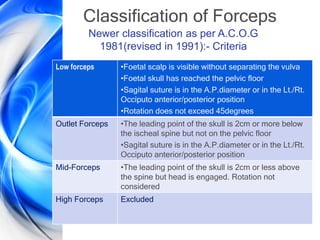
Classification of Forceps
Newer classification as per A.C.O.G
1981(revised in 1991):- Criteria
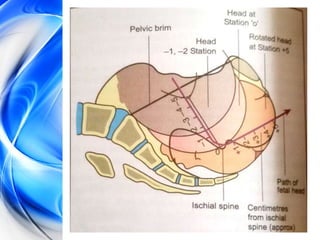
Low forceps •Foetal scalp is visible without separating the vulva
•Foetal skull has reached the pelvic floor
•Sagital suture is in the A.P.diameter or in the Lt./Rt.
Occiputo anterior/posterior position
•Rotation does not exceed 45degrees
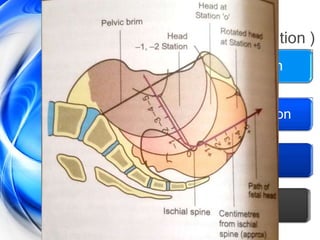
Outlet Forceps •The leading point of the skull is 2cm or more below
the ischeal spine but not on the pelvic floor
•Sagital suture is in the A.P.diameter or in the Lt./Rt.
Occiputo anterior/posterior position
Mid-Forceps •The leading point of the skull is 2cm or less above
the spine but head is engaged. Rotation not
considered
High Forceps Excluded
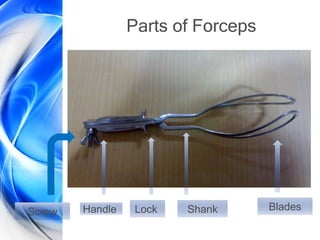
Parts of Forceps
BladesShankLockHandleScrew
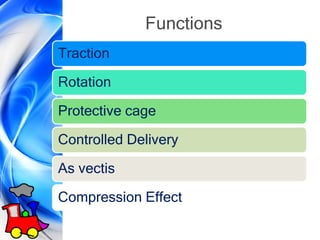
Functions
• Traction
Traction
Rotation
Protective cage
Controlled Delivery
As vectis
Compression Effect
Indications of Forceps
• Cut-short 2nd stage eclampsia preeclampsia
• Maternal exhaustion
• Conditions where expulsive efforts are
Prohibited
• Prolonged second stage
Maternal
• Non-reassuring FHS
• After coming of head in Breech
• Suspicion of fetal compromise
• Low Birth wt. &
• Post-maturity
Fetal
Contraindications
Incompletely dilated cervix
Floating Head
Obstructed labour due to contracted pelvis
Malpresentation like brow, mentoanterior, face
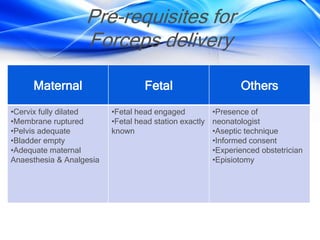
Pre-requisites for
Forceps delivery
Maternal Fetal Others
•Cervix fully dilated
•Membrane ruptured
•Pelvis adequate
•Bladder empty
•Adequate maternal
Anaesthesia & Analgesia
•Fetal head engaged
•Fetal head station exactly
known
•Presence of
neonatologist
•Aseptic technique
•Informed consent
•Experienced obstetrician
•Episiotomy
Types of Application of Forceps
Cephalic-
Pelvic-
Technique
(of low & outlet forceps application )
Step I-Identification & Application
Step II-Locking of Blades & Fixation
Step III-Traction
Step IV- Removal of Blades
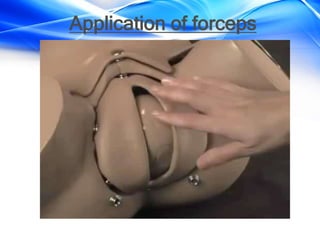
Application of forceps
Forceps for After coming of Head
Pipers Forceps
Forceps to be applied when the occiput lies
against the back of the symphysis
Blades to be applied from below after raising the legs.
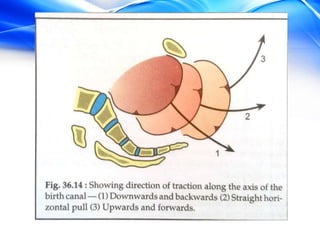
Traction to be maintained in an arc,
which follows the axis of the birth canal.
Maternal Complications
Injury
Nerve Injury
Post-partum Haemorrrhage
Anaesthesia Complications
Puerperal Sepsis
Maternal Morbidity
Fetal Complications
Asphyxia
Facial bruising, Intracranial Haemorrhage
Cephalohaematome
Facial Palsy
Skull # & Cervical Spine Injury
Prophylactic Forceps
This refers to delivery by forceps application to
shorten second stage of labour when maternal and
fetal complications are anticipated.
Eclampsia
Heart disease
Post C/S
LBW
Under Epidural Anaesthesia
Trial Forceps
IT’S A TENATIVE ATTEMPT OF FORCEPS
DELIVERY IN A CASE OF SUSPECTED
MIDPELVIC CONTRACTION WITH A PREAMBLE
DECLARATION OF ABANDONING IT IN FAVOUR
OF CAESAREAN SECTION IF MODERATE
TRACTION FAILS TO OVERCOME RESISTANCE.
Failed Forceps
When deliberate attempt in a vaginal delivery
with forceps has failed to expedite the process, it is
called failed forceps.
Common causes:-
•Incompletely dilated cervix
•Unrotated occipito-posterior
•CPD
•Unrecognised malrotation
•Big baby
•Maternal BMI >30
Management :-
•To assess
•IV fluid RL and arrange BT
•Administer antibiotic
•Exclude Uterine rupture
•Abandon & Em-LSCS
•Laparotomy in Rupture
U can GO back to……….
Z z z z z z z z
Obstetric forceps and complication

Obstetric forceps and complication

  • 1.
    Obstetric Forceps Dr. SouravChowdhury Senior Resident OBG, IQCMC
  • 2.
    History • ANKUSH –Vedic era • WILLIAM CHAMBERLAIN – Fled from France in 1569 & practiced forceps delivery as a family secret in Southampton. This was kept as a family secret for over 100yrs and four generations. • Hugh (son of Hugh)-who was highly educated and respected had patients from best families including Duke of Buckingham allowed the family secret to leak. • Levret (1747)-introduced the pelvic curve • Smellie (1751)- reinforced pelvic curve & introduced English lock and used in aftercoming head. • Tarnier (1877)-introduced axis traction. • Barton and Kielland - introduced the two specialized forceps.
  • 3.
    CLASSIFICATION OF FORCEPS Classical Lowor Outlet Forceps- Mid-Forceps High Forceps
  • 4.
    Classification of Forceps Newerclassification as per A.C.O.G 1981(revised in 1991):- Criteria Low forceps •Foetal scalp is visible without separating the vulva •Foetal skull has reached the pelvic floor •Sagital suture is in the A.P.diameter or in the Lt./Rt. Occiputo anterior/posterior position •Rotation does not exceed 45degrees Outlet Forceps •The leading point of the skull is 2cm or more below the ischeal spine but not on the pelvic floor •Sagital suture is in the A.P.diameter or in the Lt./Rt. Occiputo anterior/posterior position Mid-Forceps •The leading point of the skull is 2cm or less above the spine but head is engaged. Rotation not considered High Forceps Excluded
  • 6.
  • 7.
  • 8.
    Indications of Forceps •Cut-short 2nd stage eclampsia preeclampsia • Maternal exhaustion • Conditions where expulsive efforts are Prohibited • Prolonged second stage Maternal • Non-reassuring FHS • After coming of head in Breech • Suspicion of fetal compromise • Low Birth wt. & • Post-maturity Fetal
  • 9.
    Contraindications Incompletely dilated cervix FloatingHead Obstructed labour due to contracted pelvis Malpresentation like brow, mentoanterior, face
  • 10.
    Pre-requisites for Forceps delivery MaternalFetal Others •Cervix fully dilated •Membrane ruptured •Pelvis adequate •Bladder empty •Adequate maternal Anaesthesia & Analgesia •Fetal head engaged •Fetal head station exactly known •Presence of neonatologist •Aseptic technique •Informed consent •Experienced obstetrician •Episiotomy
  • 11.
    Types of Applicationof Forceps Cephalic- Pelvic-
  • 12.
    Technique (of low &outlet forceps application ) Step I-Identification & Application Step II-Locking of Blades & Fixation Step III-Traction Step IV- Removal of Blades
  • 14.
  • 15.
    Forceps for Aftercoming of Head Pipers Forceps Forceps to be applied when the occiput lies against the back of the symphysis Blades to be applied from below after raising the legs. Traction to be maintained in an arc, which follows the axis of the birth canal.
  • 16.
    Maternal Complications Injury Nerve Injury Post-partumHaemorrrhage Anaesthesia Complications Puerperal Sepsis Maternal Morbidity
  • 17.
    Fetal Complications Asphyxia Facial bruising,Intracranial Haemorrhage Cephalohaematome Facial Palsy Skull # & Cervical Spine Injury
  • 18.
    Prophylactic Forceps This refersto delivery by forceps application to shorten second stage of labour when maternal and fetal complications are anticipated. Eclampsia Heart disease Post C/S LBW Under Epidural Anaesthesia
  • 19.
    Trial Forceps IT’S ATENATIVE ATTEMPT OF FORCEPS DELIVERY IN A CASE OF SUSPECTED MIDPELVIC CONTRACTION WITH A PREAMBLE DECLARATION OF ABANDONING IT IN FAVOUR OF CAESAREAN SECTION IF MODERATE TRACTION FAILS TO OVERCOME RESISTANCE.
  • 20.
    Failed Forceps When deliberateattempt in a vaginal delivery with forceps has failed to expedite the process, it is called failed forceps. Common causes:- •Incompletely dilated cervix •Unrotated occipito-posterior •CPD •Unrecognised malrotation •Big baby •Maternal BMI >30 Management :- •To assess •IV fluid RL and arrange BT •Administer antibiotic •Exclude Uterine rupture •Abandon & Em-LSCS •Laparotomy in Rupture
  • 21.
    U can GOback to………. Z z z z z z z z