Unit 7 – Business Strategies

   Lecture 01 - Strategic contexts and
         terminology – missions,
     visions, objectives, goals, core
            competencies (P1)
What is mission statement?
A mission statement is a role, or purpose, by which
   an organization intends to serve its
   stakeholders.
It describes what the organization does (current
   capabilities), who it to serve (stakeholders), and
   what makes the organization unique (justification
   for existence).
Mission statements always exist at the top level of
   an organization, but may also be set for different
   organizational levels or components.
A mission statement is simply an organization's
   reason for existing.
What does mission statement do?
It tells a company’s stories and ideals in less
   than 30 seconds.
It provides the focus on the main business
   activities
If it is written well, it can help reduce “clutter”
   in other documents and processes.
It can be described as “The best way to
   make a fire with two sticks is to make sure
   one of them is a match.”
Missions
For developing missions of any project or
   organisation, the following two questions’
   answers should be written:
1. What are we going to do?
2. How are we going to do it
Examples of mission statement
Farm fresh company –
To become the number one produce store in
 Main Street by selling the highest quality,
 freshest farm produce, from farm to
 customer in under 24 hours on 75% of our
 range and with 98% customer satisfaction
What is a Vision Statement?
Vision statement identifies where the organization
    intends to be in the future or where it should be
    to best meet the needs of stakeholders.
Incorporates a shared understanding of the nature
    and purpose of the organization and uses this
    understanding to move the organization toward
    a greater purpose.
It is a business’s guiding image of success.
    “Destiny is not a matter of chance, but of choice.
    Not something to wish for, but to attain.
Why do we need vision?
Vision statement is a tool to inspire and
  provide a sense of direction and purpose.
A vision provides the fabric for working
  together and accomplishing our goals.
A good vision statement will help when there
  are no clear answers, or for critical
  decisions that will fundamentally impact
  your products or services. Control your
  destiny or someone else will!
What makes a good vision
           statement?
It would be short, simple and powerful.
Remember a vision is meant to inspire, has
   an emotional impact.
It must give a clear direction or mental
   image to anyone that reads it.
Provide a sense of belonging to the
   stakeholders. “We provide the world’s
   builders”.
How to write mission statement?
Write down your ideas for why you need
 mission statement for your company.
This is your dream, the thought of success
 over the next 5 to 10 years.
This is the emotion.
This the path or goal we all must meet.
 “Knowledge is limited. Imagination
 encircles the world”.
Examples of visions
1. McDonald’s - We are committed To
   doing what is right. To being a good
   neighbour and partner in the community
   To conduct our business with the
   environment in mind
2. Ford – our company delivers excellent
   products and services and strives to
   make the world a better place.
Difference between mission and
               vision
As a group of two, write at least two
 differences between mission and vision,
 and discuss with tutor
Difference between mission and
            vision (cont.)
A mission statement describes the *present* state
  of a person or organization: "Who are you? Why
  are you here? Why do you exist?"

  The vision statement describes *future* state:
  "Who do I want to be? Where do we want to
  go?" The vision should be inspirational and
  slightly out of reach. Typically, it is a person or
  organization's vision that provides a framework
  for planning.
Objectives
After developing mission statement, objectives are
  required to define. Objectives are much specific
  than mission statement
For example- I want to finish my assignment by 10
  o’clock this morning. This indicates to perform a
  number of tasks including typing text into
  computer, reviewing some questions/criteria that
  have already be written, printing out the
  assignment for proofreading and so on.
Objectives (cont.)
Objectives must be evaluated by SMARTER tool:
Specific
Measurable
Attainable
Realistic
Timeframe
Extending
Rewarding
What is goal?
• Goal is a target to achieve within a specific
  time. Without goal or aim, you cannot live
  (lead) your life happily and with the feeling
  of satisfaction.
• Goal can be one or more objectives that
  need to be achieved by specific time.
• Goal makes one to get clarification to do a
  specific task choosing from various
  options what one thinks of about his future
Types of goals
• Uniform goals
• Performance based goals
• Potential based goals
Types of goals - Uniform
• A single goal is set for all organizations
  within the Company.
• Every organization is expected to meet the
  same goal.
Types of goals - Performance
            based goals
• Every organization is given a goal that
  reflects an increment on last year’s
  performance
• Increments are chosen to represent equal
  effort for organizations at different starting
  points
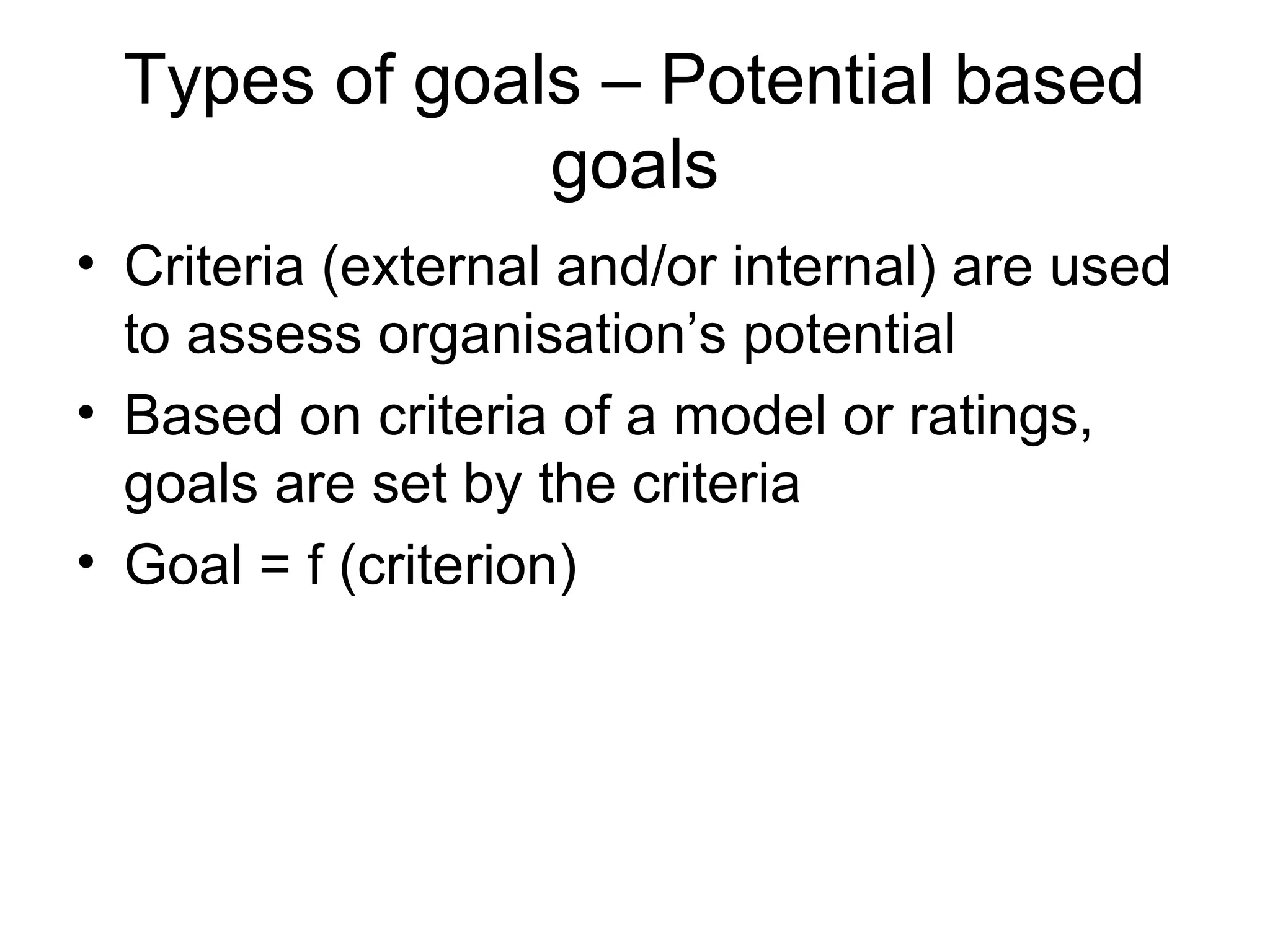
Types of goals – Potential based
              goals
• Criteria (external and/or internal) are used
  to assess organisation’s potential
• Based on criteria of a model or ratings,
  goals are set by the criteria
• Goal = f (criterion)
Core competencies
• The objective of strategic planning process is to assess
  the core competencies of a company
• Core competencies are a set of unique internal skills
  processes and system provide competitive advantage in
  the market.
• A company should list functions, activities and skills that
  add values to both products and services better than
  competitors.
• For example, one function such as research, distribution,
  marketing or selling can add value to a product and this
  function needs to be improved continuously to stay
  ahead than other competitors
Core competencies (cont.)
• Core competencies can be defined as the unique
  combination of the resources and experiences of a
  particular firm. It takes time to build these core
  competencies and they are difficult to imitate. Critical to
  sustaining these core competencies are their:
• Durability - their life span is longer than individual
  product or technology life-cycles, as are the life spans of
  resources used to generate them, including people.
• Intransparency - it is difficult for competitors to imitate
  these competencies quickly.
• Immobility - these capabilities and resources are difficult
  to transfer.

Objectives., mission and vision

  • 1.
    Unit 7 –Business Strategies Lecture 01 - Strategic contexts and terminology – missions, visions, objectives, goals, core competencies (P1)
  • 2.
    What is missionstatement? A mission statement is a role, or purpose, by which an organization intends to serve its stakeholders. It describes what the organization does (current capabilities), who it to serve (stakeholders), and what makes the organization unique (justification for existence). Mission statements always exist at the top level of an organization, but may also be set for different organizational levels or components. A mission statement is simply an organization's reason for existing.
  • 3.
    What does missionstatement do? It tells a company’s stories and ideals in less than 30 seconds. It provides the focus on the main business activities If it is written well, it can help reduce “clutter” in other documents and processes. It can be described as “The best way to make a fire with two sticks is to make sure one of them is a match.”
  • 4.
    Missions For developing missionsof any project or organisation, the following two questions’ answers should be written: 1. What are we going to do? 2. How are we going to do it
  • 5.
    Examples of missionstatement Farm fresh company – To become the number one produce store in Main Street by selling the highest quality, freshest farm produce, from farm to customer in under 24 hours on 75% of our range and with 98% customer satisfaction
  • 6.
    What is aVision Statement? Vision statement identifies where the organization intends to be in the future or where it should be to best meet the needs of stakeholders. Incorporates a shared understanding of the nature and purpose of the organization and uses this understanding to move the organization toward a greater purpose. It is a business’s guiding image of success. “Destiny is not a matter of chance, but of choice. Not something to wish for, but to attain.
  • 7.
    Why do weneed vision? Vision statement is a tool to inspire and provide a sense of direction and purpose. A vision provides the fabric for working together and accomplishing our goals. A good vision statement will help when there are no clear answers, or for critical decisions that will fundamentally impact your products or services. Control your destiny or someone else will!
  • 8.
    What makes agood vision statement? It would be short, simple and powerful. Remember a vision is meant to inspire, has an emotional impact. It must give a clear direction or mental image to anyone that reads it. Provide a sense of belonging to the stakeholders. “We provide the world’s builders”.
  • 9.
    How to writemission statement? Write down your ideas for why you need mission statement for your company. This is your dream, the thought of success over the next 5 to 10 years. This is the emotion. This the path or goal we all must meet. “Knowledge is limited. Imagination encircles the world”.
  • 10.
    Examples of visions 1.McDonald’s - We are committed To doing what is right. To being a good neighbour and partner in the community To conduct our business with the environment in mind 2. Ford – our company delivers excellent products and services and strives to make the world a better place.
  • 11.
    Difference between missionand vision As a group of two, write at least two differences between mission and vision, and discuss with tutor
  • 12.
    Difference between missionand vision (cont.) A mission statement describes the *present* state of a person or organization: "Who are you? Why are you here? Why do you exist?" The vision statement describes *future* state: "Who do I want to be? Where do we want to go?" The vision should be inspirational and slightly out of reach. Typically, it is a person or organization's vision that provides a framework for planning.
  • 13.
    Objectives After developing missionstatement, objectives are required to define. Objectives are much specific than mission statement For example- I want to finish my assignment by 10 o’clock this morning. This indicates to perform a number of tasks including typing text into computer, reviewing some questions/criteria that have already be written, printing out the assignment for proofreading and so on.
  • 14.
    Objectives (cont.) Objectives mustbe evaluated by SMARTER tool: Specific Measurable Attainable Realistic Timeframe Extending Rewarding
  • 15.
    What is goal? •Goal is a target to achieve within a specific time. Without goal or aim, you cannot live (lead) your life happily and with the feeling of satisfaction. • Goal can be one or more objectives that need to be achieved by specific time. • Goal makes one to get clarification to do a specific task choosing from various options what one thinks of about his future
  • 16.
    Types of goals •Uniform goals • Performance based goals • Potential based goals
  • 17.
    Types of goals- Uniform • A single goal is set for all organizations within the Company. • Every organization is expected to meet the same goal.
  • 18.
    Types of goals- Performance based goals • Every organization is given a goal that reflects an increment on last year’s performance • Increments are chosen to represent equal effort for organizations at different starting points
  • 19.
    Types of goals– Potential based goals • Criteria (external and/or internal) are used to assess organisation’s potential • Based on criteria of a model or ratings, goals are set by the criteria • Goal = f (criterion)
  • 20.
    Core competencies • Theobjective of strategic planning process is to assess the core competencies of a company • Core competencies are a set of unique internal skills processes and system provide competitive advantage in the market. • A company should list functions, activities and skills that add values to both products and services better than competitors. • For example, one function such as research, distribution, marketing or selling can add value to a product and this function needs to be improved continuously to stay ahead than other competitors
  • 21.
    Core competencies (cont.) •Core competencies can be defined as the unique combination of the resources and experiences of a particular firm. It takes time to build these core competencies and they are difficult to imitate. Critical to sustaining these core competencies are their: • Durability - their life span is longer than individual product or technology life-cycles, as are the life spans of resources used to generate them, including people. • Intransparency - it is difficult for competitors to imitate these competencies quickly. • Immobility - these capabilities and resources are difficult to transfer.

Editor's Notes

  • #5 This information has been taken from “Fundamentals of Project Management: Developing Core Competencies to Help Outperform the Competition” by James P. Lewis (2 nd edition, AMACOM publisher in 2001). It is required to write reference.
  • #14 This information has been taken from “Fundamentals of Project Management: Developing Core Competencies to Help Outperform the Competition” by James P. Lewis (2 nd edition, AMACOM publisher in 2001). It is required to write reference.
  • #15 This information has been taken from “Fundamentals of Project Management: Developing Core Competencies to Help Outperform the Competition” by James P. Lewis (2 nd edition, AMACOM publisher in 2001). It is required to write reference.
  • #21 Information found at http://www.bdi-ltd.net/Article_5.pdf
  • #22 Found at http://www.ifm.eng.cam.ac.uk/dstools/paradigm/compet.html