•
•
•
•

https://www.facebook.com/Oxus20

oxus20@gmail.com

Classes and Objects
Encapsulation
Inheritance
Polymorphism

Object
Oriented
Programming
Abdul Rahman Sherzad
Agenda
» Object Oriented Programming
» Definition and Demo
˃ Class
˃ Object
˃ Encapsulation (Information Hiding)
˃ Inheritance
˃ Polymorphism
˃ The instanceof Operator
2

https://www.facebook.com/Oxus20
Object Oriented Programming (OOP)
» OOP makes it easier for programmers to structure
and form software programs.
» For the reason that individual objects can be
modified without touching other aspects of the
program.
˃ It is also easier to update and modify programs written in object-oriented
languages.

» As software programs have grown larger over the
years, OOP has made developing these large
programs more manageable.
3

https://www.facebook.com/Oxus20
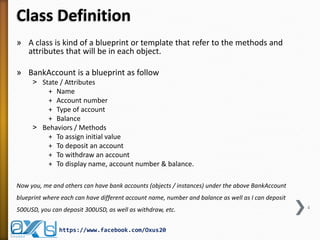
Class Definition
» A class is kind of a blueprint or template that refer to the methods and
attributes that will be in each object.
» BankAccount is a blueprint as follow
˃ State / Attributes
+ Name
+ Account number
+ Type of account
+ Balance
˃ Behaviors / Methods
+ To assign initial value
+ To deposit an account
+ To withdraw an account
+ To display name, account number & balance.
Now you, me and others can have bank accounts (objects / instances) under the above BankAccount
blueprint where each can have different account name, number and balance as well as I can deposit
500USD, you can deposit 300USD, as well as withdraw, etc.
https://www.facebook.com/Oxus20

4
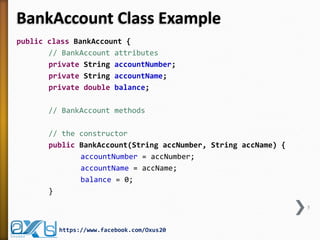
BankAccount Class Example
public class BankAccount {
// BankAccount attributes
private String accountNumber;
private String accountName;
private double balance;
// BankAccount methods
// the constructor
public BankAccount(String accNumber, String accName) {
accountNumber = accNumber;
accountName = accName;
balance = 0;
}
5

https://www.facebook.com/Oxus20
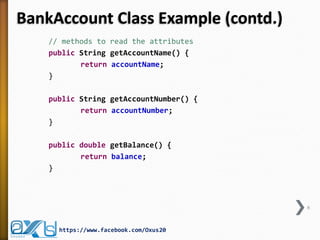
BankAccount Class Example (contd.)
// methods to read the attributes
public String getAccountName() {
return accountName;
}
public String getAccountNumber() {
return accountNumber;
}
public double getBalance() {
return balance;
}

6

https://www.facebook.com/Oxus20
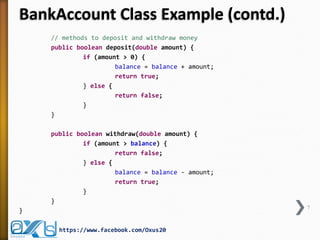
BankAccount Class Example (contd.)
// methods to deposit and withdraw money
public boolean deposit(double amount) {
if (amount > 0) {
balance = balance + amount;
return true;
} else {
return false;
}
}
public boolean withdraw(double amount) {
if (amount > balance) {
return false;
} else {
balance = balance - amount;
return true;
}
}
7

}
https://www.facebook.com/Oxus20
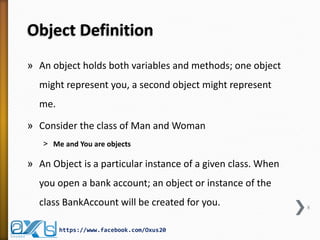
Object Definition
» An object holds both variables and methods; one object
might represent you, a second object might represent
me.
» Consider the class of Man and Woman
˃ Me and You are objects

» An Object is a particular instance of a given class. When
you open a bank account; an object or instance of the
class BankAccount will be created for you.
https://www.facebook.com/Oxus20

8
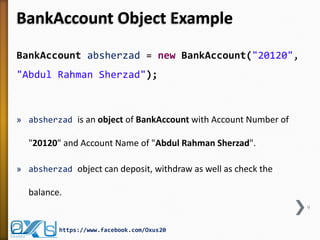
BankAccount Object Example
BankAccount absherzad = new BankAccount("20120",
"Abdul Rahman Sherzad");

» absherzad is an object of BankAccount with Account Number of

"20120" and Account Name of "Abdul Rahman Sherzad".
» absherzad object can deposit, withdraw as well as check the

balance.
9

https://www.facebook.com/Oxus20
BankAccount Demo
public class BankAccountDemo {
public static void main(String[] args) {
BankAccount absherzad = new BankAccount("20120",

"Abdul Rahman Sherzad");

absherzad.deposit(500);
absherzad.deposit(1500);
System.out.println("Balance is: " + absherzad.getBalance()); //2000

absherzad.withdraw(400);
System.out.println("Balance is: " + absherzad.getBalance()); //1600
}
}
10

https://www.facebook.com/Oxus20
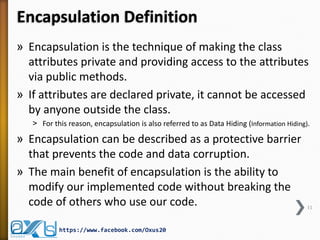
Encapsulation Definition
» Encapsulation is the technique of making the class
attributes private and providing access to the attributes
via public methods.
» If attributes are declared private, it cannot be accessed
by anyone outside the class.
˃ For this reason, encapsulation is also referred to as Data Hiding (Information Hiding).

» Encapsulation can be described as a protective barrier
that prevents the code and data corruption.
» The main benefit of encapsulation is the ability to
modify our implemented code without breaking the
code of others who use our code.
https://www.facebook.com/Oxus20

11
Encapsulation Benefit Demo
public class EncapsulationDemo {
public static void main(String[] args) {
BankAccount absherzad = new BankAccount("20120",
absherzad.deposit(500);

"Abdul Rahman Sherzad");

// Not possible because withdraw() check the withdraw amount with balance
// Because current balance is 500 and less than withdraw amount is 1000

absherzad.withdraw(1000); // Encapsulation Benefit

// Not possible because class balance is private
// and not accessible directly outside the BankAccount class
absherzad.balance = 120000; // Encapsulation Benefit
}
}
12

https://www.facebook.com/Oxus20
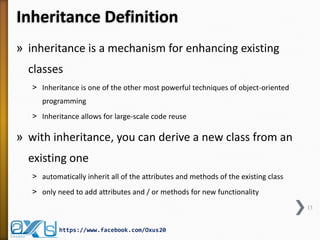
Inheritance Definition
» inheritance is a mechanism for enhancing existing
classes
˃ Inheritance is one of the other most powerful techniques of object-oriented
programming
˃ Inheritance allows for large-scale code reuse

» with inheritance, you can derive a new class from an

existing one
˃ automatically inherit all of the attributes and methods of the existing class
˃ only need to add attributes and / or methods for new functionality
13

https://www.facebook.com/Oxus20
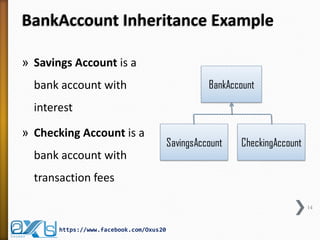
BankAccount Inheritance Example
» Savings Account is a
bank account with
interest
» Checking Account is a

bank account with
transaction fees
14

https://www.facebook.com/Oxus20
Specialty Bank Accounts
» now we want to implement SavingsAccount and
CheckingAccount
˃ A SavingsAccount is a bank account with an associated interest
rate, interest is calculated and added to the balance periodically
˃ could copy-and-paste the code for BankAccount, then add an
attribute for interest rate and a method for adding interest

˃ A CheckingAccount is a bank account with some number of free
transactions, with a fee charged for subsequent transactions
˃ could copy-and-paste the code for BankAccount, then add an
attribute to keep track of the number of transactions and a
method for deducting fees
15

https://www.facebook.com/Oxus20
Disadvantages of the copy-and-paste Approach

» tedious and boring work
» lots of duplicate and redundant code
˃ if you change the code in one place, you have to change it
everywhere or else lose consistency (e.g., add customer

name to the bank account info)

» limits polymorphism (will explain later)
16

https://www.facebook.com/Oxus20
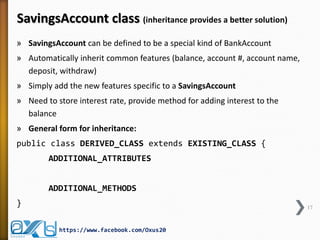
SavingsAccount class (inheritance provides a better solution)
» SavingsAccount can be defined to be a special kind of BankAccount
» Automatically inherit common features (balance, account #, account name,
deposit, withdraw)
» Simply add the new features specific to a SavingsAccount
» Need to store interest rate, provide method for adding interest to the
balance
» General form for inheritance:
public class DERIVED_CLASS extends EXISTING_CLASS {
ADDITIONAL_ATTRIBUTES
ADDITIONAL_METHODS
}

17

https://www.facebook.com/Oxus20
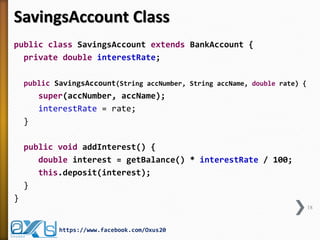
SavingsAccount Class
public class SavingsAccount extends BankAccount {
private double interestRate;
public SavingsAccount(String accNumber, String accName, double rate) {

super(accNumber, accName);
interestRate = rate;
}
public void addInterest() {
double interest = getBalance() * interestRate / 100;
this.deposit(interest);
}
}
18

https://www.facebook.com/Oxus20
SavingsAccount Demo
public class SavingsAccountDemo {
public static void main(String[] args) {
SavingsAccount saving = new SavingsAccount("20120",
"Abdul Rahman Sherzad", 10);
// deposit() is inherited from BankAccount (PARENT CLASS)

saving.deposit(500);
// getBalance() is also inherited from BankAccount (PARENT CLASS)

System.out.println("Before Interest: " + saving.getBalance());
saving.addInterest();
System.out.println("After Interest: " + saving.getBalance());
}
}

19

https://www.facebook.com/Oxus20
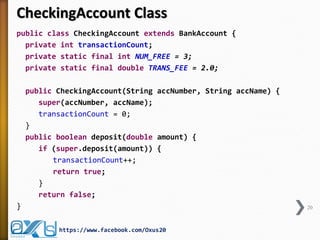
CheckingAccount Class
public class CheckingAccount extends BankAccount {
private int transactionCount;
private static final int NUM_FREE = 3;
private static final double TRANS_FEE = 2.0;
public CheckingAccount(String accNumber, String accName) {
super(accNumber, accName);
transactionCount = 0;
}
public boolean deposit(double amount) {
if (super.deposit(amount)) {
transactionCount++;
return true;
}
return false;
}

20

https://www.facebook.com/Oxus20
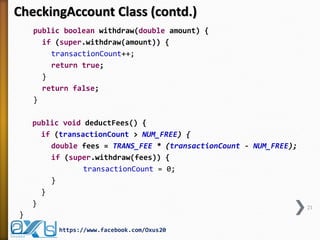
CheckingAccount Class (contd.)
public boolean withdraw(double amount) {
if (super.withdraw(amount)) {
transactionCount++;
return true;
}
return false;
}
public void deductFees() {
if (transactionCount > NUM_FREE) {
double fees = TRANS_FEE * (transactionCount - NUM_FREE);
if (super.withdraw(fees)) {
transactionCount = 0;
}
}
}
}
https://www.facebook.com/Oxus20

21
CheckingAccount Demo
public class CheckingAccountDemo {
public static void main(String[] args) {
CheckingAccount checking = new CheckingAccount("20120",
"Abdul Rahman Sherzad");
checking.deposit(500);
checking.withdraw(200);
checking.deposit(700);
// No deduction fee because we had only 3 transactions

checking.deductFees();
System.out.println("transactions <= 3: " + checking.getBalance());
// One more transaction

checking.deposit(200);
// Deduction fee occurs because we have had 4 transactions

checking.deductFees();
System.out.println("transactions > 3: " + checking.getBalance());
}

22

}
https://www.facebook.com/Oxus20
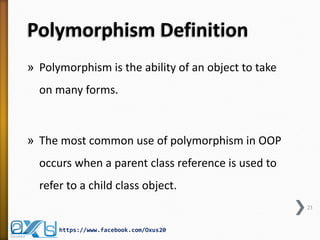
Polymorphism Definition
» Polymorphism is the ability of an object to take
on many forms.

» The most common use of polymorphism in OOP
occurs when a parent class reference is used to
refer to a child class object.
23

https://www.facebook.com/Oxus20
Polymorphism In BankAccount
» A SavingsAccount IS_A BankAccount (with some extra functionality)
» A CheckingAccount IS_A BankAccount (with some extra functionality)

» Whatever you can do to a BankAccount (i.e. deposit, withdraw); you can
do with a SavingsAccount or CheckingAccount
» Derived classes can certainly do more (i.e. addInterest) for
SavingsAccount)
» Derived classes may do things differently (i.e. deposit for
CheckingAccount)
24

https://www.facebook.com/Oxus20
Polymorphism In BankAccount Example
public class BankAccountPolymorphismDemo {
public static void main(String[] args) {
BankAccount firstAccount = new SavingsAccount("20120",
"Abdul Rahman Sherzad", 10);
BankAccount secondAccount = new CheckingAccount("20120",
"Abdul Rahman Sherzad");
// calls the method defined in BankAccount

firstAccount.deposit(100.0);
// calls the method defined in CheckingAccount
// because deposit() is overridden in CheckingAccount

secondAccount.deposit(100.0);
}
}
25

https://www.facebook.com/Oxus20
Instanceof Operator
» if you need to determine the specific type
of an object
˃ use the instanceof operator
˃ can then downcast from the general to the more specific type
˃ For example the object from BankAccount Parent Class will be
casted to either SavingsAccount and/or CheckingAccount

26

https://www.facebook.com/Oxus20
END

27

https://www.facebook.com/Oxus20

Object Oriented Programming with Real World Examples

  • 1.
  • 2.
    Agenda » Object OrientedProgramming » Definition and Demo ˃ Class ˃ Object ˃ Encapsulation (Information Hiding) ˃ Inheritance ˃ Polymorphism ˃ The instanceof Operator 2 https://www.facebook.com/Oxus20
  • 3.
    Object Oriented Programming(OOP) » OOP makes it easier for programmers to structure and form software programs. » For the reason that individual objects can be modified without touching other aspects of the program. ˃ It is also easier to update and modify programs written in object-oriented languages. » As software programs have grown larger over the years, OOP has made developing these large programs more manageable. 3 https://www.facebook.com/Oxus20
  • 4.
    Class Definition » Aclass is kind of a blueprint or template that refer to the methods and attributes that will be in each object. » BankAccount is a blueprint as follow ˃ State / Attributes + Name + Account number + Type of account + Balance ˃ Behaviors / Methods + To assign initial value + To deposit an account + To withdraw an account + To display name, account number & balance. Now you, me and others can have bank accounts (objects / instances) under the above BankAccount blueprint where each can have different account name, number and balance as well as I can deposit 500USD, you can deposit 300USD, as well as withdraw, etc. https://www.facebook.com/Oxus20 4
  • 5.
    BankAccount Class Example publicclass BankAccount { // BankAccount attributes private String accountNumber; private String accountName; private double balance; // BankAccount methods // the constructor public BankAccount(String accNumber, String accName) { accountNumber = accNumber; accountName = accName; balance = 0; } 5 https://www.facebook.com/Oxus20
  • 6.
    BankAccount Class Example(contd.) // methods to read the attributes public String getAccountName() { return accountName; } public String getAccountNumber() { return accountNumber; } public double getBalance() { return balance; } 6 https://www.facebook.com/Oxus20
  • 7.
    BankAccount Class Example(contd.) // methods to deposit and withdraw money public boolean deposit(double amount) { if (amount > 0) { balance = balance + amount; return true; } else { return false; } } public boolean withdraw(double amount) { if (amount > balance) { return false; } else { balance = balance - amount; return true; } } 7 } https://www.facebook.com/Oxus20
  • 8.
    Object Definition » Anobject holds both variables and methods; one object might represent you, a second object might represent me. » Consider the class of Man and Woman ˃ Me and You are objects » An Object is a particular instance of a given class. When you open a bank account; an object or instance of the class BankAccount will be created for you. https://www.facebook.com/Oxus20 8
  • 9.
    BankAccount Object Example BankAccountabsherzad = new BankAccount("20120", "Abdul Rahman Sherzad"); » absherzad is an object of BankAccount with Account Number of "20120" and Account Name of "Abdul Rahman Sherzad". » absherzad object can deposit, withdraw as well as check the balance. 9 https://www.facebook.com/Oxus20
  • 10.
    BankAccount Demo public classBankAccountDemo { public static void main(String[] args) { BankAccount absherzad = new BankAccount("20120", "Abdul Rahman Sherzad"); absherzad.deposit(500); absherzad.deposit(1500); System.out.println("Balance is: " + absherzad.getBalance()); //2000 absherzad.withdraw(400); System.out.println("Balance is: " + absherzad.getBalance()); //1600 } } 10 https://www.facebook.com/Oxus20
  • 11.
    Encapsulation Definition » Encapsulationis the technique of making the class attributes private and providing access to the attributes via public methods. » If attributes are declared private, it cannot be accessed by anyone outside the class. ˃ For this reason, encapsulation is also referred to as Data Hiding (Information Hiding). » Encapsulation can be described as a protective barrier that prevents the code and data corruption. » The main benefit of encapsulation is the ability to modify our implemented code without breaking the code of others who use our code. https://www.facebook.com/Oxus20 11
  • 12.
    Encapsulation Benefit Demo publicclass EncapsulationDemo { public static void main(String[] args) { BankAccount absherzad = new BankAccount("20120", absherzad.deposit(500); "Abdul Rahman Sherzad"); // Not possible because withdraw() check the withdraw amount with balance // Because current balance is 500 and less than withdraw amount is 1000 absherzad.withdraw(1000); // Encapsulation Benefit // Not possible because class balance is private // and not accessible directly outside the BankAccount class absherzad.balance = 120000; // Encapsulation Benefit } } 12 https://www.facebook.com/Oxus20
  • 13.
    Inheritance Definition » inheritanceis a mechanism for enhancing existing classes ˃ Inheritance is one of the other most powerful techniques of object-oriented programming ˃ Inheritance allows for large-scale code reuse » with inheritance, you can derive a new class from an existing one ˃ automatically inherit all of the attributes and methods of the existing class ˃ only need to add attributes and / or methods for new functionality 13 https://www.facebook.com/Oxus20
  • 14.
    BankAccount Inheritance Example »Savings Account is a bank account with interest » Checking Account is a bank account with transaction fees 14 https://www.facebook.com/Oxus20
  • 15.
    Specialty Bank Accounts »now we want to implement SavingsAccount and CheckingAccount ˃ A SavingsAccount is a bank account with an associated interest rate, interest is calculated and added to the balance periodically ˃ could copy-and-paste the code for BankAccount, then add an attribute for interest rate and a method for adding interest ˃ A CheckingAccount is a bank account with some number of free transactions, with a fee charged for subsequent transactions ˃ could copy-and-paste the code for BankAccount, then add an attribute to keep track of the number of transactions and a method for deducting fees 15 https://www.facebook.com/Oxus20
  • 16.
    Disadvantages of thecopy-and-paste Approach » tedious and boring work » lots of duplicate and redundant code ˃ if you change the code in one place, you have to change it everywhere or else lose consistency (e.g., add customer name to the bank account info) » limits polymorphism (will explain later) 16 https://www.facebook.com/Oxus20
  • 17.
    SavingsAccount class (inheritanceprovides a better solution) » SavingsAccount can be defined to be a special kind of BankAccount » Automatically inherit common features (balance, account #, account name, deposit, withdraw) » Simply add the new features specific to a SavingsAccount » Need to store interest rate, provide method for adding interest to the balance » General form for inheritance: public class DERIVED_CLASS extends EXISTING_CLASS { ADDITIONAL_ATTRIBUTES ADDITIONAL_METHODS } 17 https://www.facebook.com/Oxus20
  • 18.
    SavingsAccount Class public classSavingsAccount extends BankAccount { private double interestRate; public SavingsAccount(String accNumber, String accName, double rate) { super(accNumber, accName); interestRate = rate; } public void addInterest() { double interest = getBalance() * interestRate / 100; this.deposit(interest); } } 18 https://www.facebook.com/Oxus20
  • 19.
    SavingsAccount Demo public classSavingsAccountDemo { public static void main(String[] args) { SavingsAccount saving = new SavingsAccount("20120", "Abdul Rahman Sherzad", 10); // deposit() is inherited from BankAccount (PARENT CLASS) saving.deposit(500); // getBalance() is also inherited from BankAccount (PARENT CLASS) System.out.println("Before Interest: " + saving.getBalance()); saving.addInterest(); System.out.println("After Interest: " + saving.getBalance()); } } 19 https://www.facebook.com/Oxus20
  • 20.
    CheckingAccount Class public classCheckingAccount extends BankAccount { private int transactionCount; private static final int NUM_FREE = 3; private static final double TRANS_FEE = 2.0; public CheckingAccount(String accNumber, String accName) { super(accNumber, accName); transactionCount = 0; } public boolean deposit(double amount) { if (super.deposit(amount)) { transactionCount++; return true; } return false; } 20 https://www.facebook.com/Oxus20
  • 21.
    CheckingAccount Class (contd.) publicboolean withdraw(double amount) { if (super.withdraw(amount)) { transactionCount++; return true; } return false; } public void deductFees() { if (transactionCount > NUM_FREE) { double fees = TRANS_FEE * (transactionCount - NUM_FREE); if (super.withdraw(fees)) { transactionCount = 0; } } } } https://www.facebook.com/Oxus20 21
  • 22.
    CheckingAccount Demo public classCheckingAccountDemo { public static void main(String[] args) { CheckingAccount checking = new CheckingAccount("20120", "Abdul Rahman Sherzad"); checking.deposit(500); checking.withdraw(200); checking.deposit(700); // No deduction fee because we had only 3 transactions checking.deductFees(); System.out.println("transactions <= 3: " + checking.getBalance()); // One more transaction checking.deposit(200); // Deduction fee occurs because we have had 4 transactions checking.deductFees(); System.out.println("transactions > 3: " + checking.getBalance()); } 22 } https://www.facebook.com/Oxus20
  • 23.
    Polymorphism Definition » Polymorphismis the ability of an object to take on many forms. » The most common use of polymorphism in OOP occurs when a parent class reference is used to refer to a child class object. 23 https://www.facebook.com/Oxus20
  • 24.
    Polymorphism In BankAccount »A SavingsAccount IS_A BankAccount (with some extra functionality) » A CheckingAccount IS_A BankAccount (with some extra functionality) » Whatever you can do to a BankAccount (i.e. deposit, withdraw); you can do with a SavingsAccount or CheckingAccount » Derived classes can certainly do more (i.e. addInterest) for SavingsAccount) » Derived classes may do things differently (i.e. deposit for CheckingAccount) 24 https://www.facebook.com/Oxus20
  • 25.
    Polymorphism In BankAccountExample public class BankAccountPolymorphismDemo { public static void main(String[] args) { BankAccount firstAccount = new SavingsAccount("20120", "Abdul Rahman Sherzad", 10); BankAccount secondAccount = new CheckingAccount("20120", "Abdul Rahman Sherzad"); // calls the method defined in BankAccount firstAccount.deposit(100.0); // calls the method defined in CheckingAccount // because deposit() is overridden in CheckingAccount secondAccount.deposit(100.0); } } 25 https://www.facebook.com/Oxus20
  • 26.
    Instanceof Operator » ifyou need to determine the specific type of an object ˃ use the instanceof operator ˃ can then downcast from the general to the more specific type ˃ For example the object from BankAccount Parent Class will be casted to either SavingsAccount and/or CheckingAccount 26 https://www.facebook.com/Oxus20
  • 27.