What is GROUP?


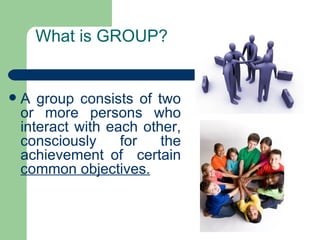
   A group consists of two
    or more persons who
    interact with each other,
    consciously     for   the
    achievement of certain
    common objectives.
GROUP can also be defined as :


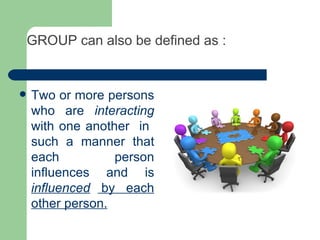
   Two or more persons
    who are interacting
    with one another in
    such a manner that
    each          person
    influences and is
    influenced by each
    other person.
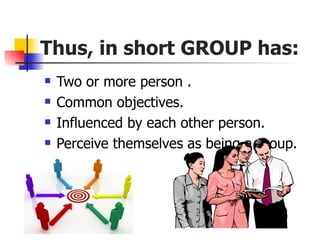
Thus, in short GROUP has:
   Two or more person .
   Common objectives.
   Influenced by each other person.
   Perceive themselves as being a group.
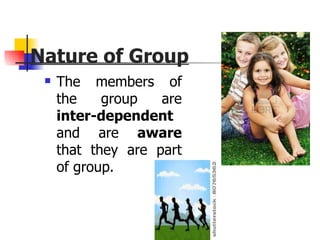
Nature of Group
    The members of
     the    group   are
     inter-dependent
     and are aware
     that they are part
     of group.
   People must be psychologically aware
    of one another.
   People must perceive themselves to be
    a group.
   A feeling of belongingness &
    Feeling of Security
Consent ,solving problems and helping others.
Effective communication
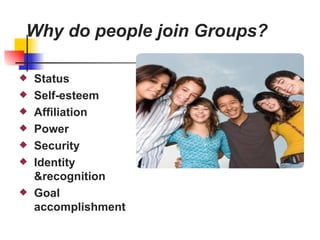
Why do people join Groups?

   Status
   Self-esteem
   Affiliation
   Power
   Security
   Identity
    &recognition
   Goal
    accomplishment
OTHER REASONS FOR GROUP FORMATION


1.   COMPANIONSHIP
2.   SENSE OF IDENTIFICATION
3.   SOURCE OF INFORMATION
4.   JOB SATISFACTION
5.   PROTECTION OF MEMBERS
6.   OUTLET FOR FRUSTATION
7.   PERPETUATION OF CULTURAL
     VALUES
8.   GENERATION OF NEW IDEAS
Characteristics of Groups

 Norms: standard of behaviour that
  every member of the group is
  expected to follow.

 Conformity:  behaviour or actions that
  follow the norms.

 Cohesiveness:   forming a united
  whole
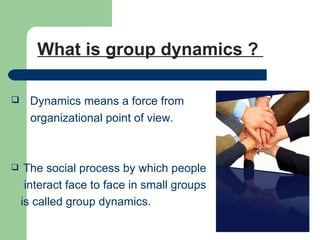
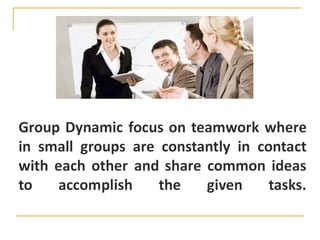
What is group dynamics ?

    Dynamics means a force from
     organizational point of view.


    The social process by which people
     interact face to face in small groups
    is called group dynamics.
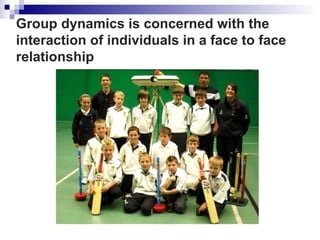
Group dynamics is concerned with the
interaction of individuals in a face to face
relationship
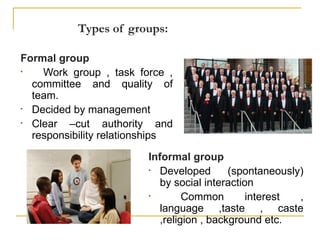
Types of groups:

Formal group
•   Work group , task force ,
  committee and quality of
  team.
• Decided by management

• Clear  –cut authority and
  responsibility relationships

                         Informal group
                         • Developed        (spontaneously)
                            by social interaction
                         •        Common        interest  ,
                            language ,taste , caste
                            ,religion , background etc.
TYPES OF GROUPS

Command Group : A group composed of the
 individuals who report directly to a given
 manger.

Task Group : People working together to
 complete a job task

Interest Group : People working together to
 attain a specific objective with which each is
 concerned.

Friendship Group : people brought together
 because they share one or more common
 characteristics.
Stages of Group Development

Forming : When members have begun to think of
   themselves as part of group. (uncertainty ).

Storming: There will be a relatively clear hierarchy
   of leadership within the group. (intragroup
   conflict)

Norming : When the group structure solidifies and
   the group has assimilated a common set of
   expectations of what defines correct member
   behaviour. (Close Relationship &
   Cohesiveness).
Performing: Group energy has moved from
   getting to know and understand each
   other to performing the task at hand.

Adjourning:       The final stage in group
   development for temporary groups
   ,characterized by concern with wrapping
   up    activities   rather    than  task
   performance.
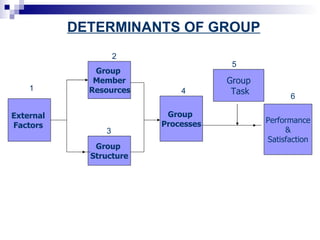
DETERMINANTS OF GROUP
                    2
                                      5
              Group
              Member                 Group
    1        Resources       4        Task
                                                   6

External                  Group
                         Processes           Performance
Factors
                3                                 &
                                             Satisfaction
              Group
             Structure
1.External Factors :
   Corporate Strategy
   Organizational structure
   Rules and Regulations
   Organizational Resources
   Staffing Policies
   Appraisal
   Reward System
   Organizational Culture
   Physical work Environment such as lay out ,
    interior decoration , seating arrangement ,
    temperature etc.
2.Group Member Resources


   Abilities of members
    ( Intellectual abilities & Task relevant Ability )

   Personality Characteristics
     ( sociability , self reliance , and
    independence
                              Vs
     Authoritarianism , dominance, and
    manipulation )
3.Group Structure :


2.    Leadership
3.    Goals
4.    Communication
5.    Role Relationship
6.    Group Norms
7.    Group Status
8.    Group Size
9.    Group Composition
10.   Group Cohesiveness
Norms
Acceptable standards of behavior within a group
that are shared by the group’s members.


Classes of Norms:
• Performance norms
• Appearance/Behavioural norms
• Social arrangement norms
• Allocation of resources norms
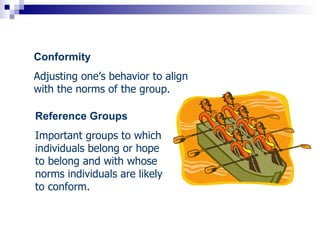
Conformity
Adjusting one’s behavior to align
with the norms of the group.

Reference Groups
Important groups to which
individuals belong or hope
to belong and with whose
norms individuals are likely
to conform.
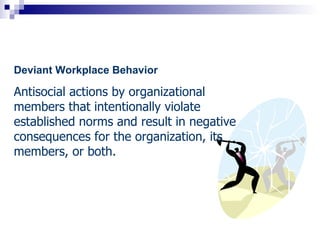
Deviant Workplace Behavior

Antisocial actions by organizational
members that intentionally violate
established norms and result in negative
consequences for the organization, its
members, or both.
Status
A socially defined position or rank given to groups or
group members by others.
Group cohesiveness
 The degree of attachment of the
  members to their group.
 Factors Influencing Group Cohesiveness

   ( nature of the group , size of the group ,
  location of the group , communication ,
  Status of the group , outside pressures ,
  Inter-dependency , Leadership of the
  group , Success , Management behavior)
Quality Circles
   A quality circle is a small group of
    employees doing similar or related work
    who meet regularly to identify , analyze,
    and solve product-quality problems and to
    improve general operations .

   The Concept of QC emerged from quality
    control & quite popular in Japan .
 The Quality circles are relatively
  autonomous units (ideally about 10
  workers), usually led by a supervisor or a
  senior worker and organized as work unit .
 The workers, who have a shared area of
  responsibility ,meet periodically to discuss,
  analyze      and propose solutions         to
  ongoing problems.
Objectives &benefits of QC
 Overall improvement of quality of products
  manufactured by the enterprise.
 Improvement of production methods and
  productivity of the enterprise
 Development of the employees who take
  part in quality circles.
 Building high morale of employees by
  developing team-work in the organization.
4. GROUP PROCESSES
Group processes refers to the
 communication patterns used by members
 group decision processes, leader
 behavior, power dynamics, conflict
 interactions.

It refers to the understanding of the behavior
   of people in groups.
5. GROUP TASKS
 DECISION MAKING
 Large groups facilitate the pooling of information
  about complex tasks
 Smaller groups are better suited in coordinating
  and facilitating the implementation of complex
  tasks.
 Simple tasks reduce the requirement that the
  group possesses to be effective in order to
  perform well.
OB.Group

OB.Group

  • 2.
    What is GROUP?  A group consists of two or more persons who interact with each other, consciously for the achievement of certain common objectives.
  • 3.
    GROUP can alsobe defined as :  Two or more persons who are interacting with one another in such a manner that each person influences and is influenced by each other person.
  • 4.
    Thus, in shortGROUP has:  Two or more person .  Common objectives.  Influenced by each other person.  Perceive themselves as being a group.
  • 5.
    Nature of Group  The members of the group are inter-dependent and are aware that they are part of group.
  • 7.
    People must be psychologically aware of one another.  People must perceive themselves to be a group.
  • 8.
    A feeling of belongingness & Feeling of Security
  • 9.
    Consent ,solving problemsand helping others.
  • 10.
  • 11.
    Why do peoplejoin Groups?  Status  Self-esteem  Affiliation  Power  Security  Identity &recognition  Goal accomplishment
  • 12.
    OTHER REASONS FORGROUP FORMATION 1. COMPANIONSHIP 2. SENSE OF IDENTIFICATION 3. SOURCE OF INFORMATION 4. JOB SATISFACTION 5. PROTECTION OF MEMBERS 6. OUTLET FOR FRUSTATION 7. PERPETUATION OF CULTURAL VALUES 8. GENERATION OF NEW IDEAS
  • 13.
    Characteristics of Groups Norms: standard of behaviour that every member of the group is expected to follow.  Conformity: behaviour or actions that follow the norms.  Cohesiveness: forming a united whole
  • 14.
    What is groupdynamics ?  Dynamics means a force from organizational point of view.  The social process by which people interact face to face in small groups is called group dynamics.
  • 15.
    Group dynamics isconcerned with the interaction of individuals in a face to face relationship
  • 17.
    Types of groups: Formalgroup • Work group , task force , committee and quality of team. • Decided by management • Clear –cut authority and responsibility relationships Informal group • Developed (spontaneously) by social interaction • Common interest , language ,taste , caste ,religion , background etc.
  • 18.
    TYPES OF GROUPS CommandGroup : A group composed of the individuals who report directly to a given manger. Task Group : People working together to complete a job task Interest Group : People working together to attain a specific objective with which each is concerned. Friendship Group : people brought together because they share one or more common characteristics.
  • 19.
    Stages of GroupDevelopment Forming : When members have begun to think of themselves as part of group. (uncertainty ). Storming: There will be a relatively clear hierarchy of leadership within the group. (intragroup conflict) Norming : When the group structure solidifies and the group has assimilated a common set of expectations of what defines correct member behaviour. (Close Relationship & Cohesiveness).
  • 20.
    Performing: Group energyhas moved from getting to know and understand each other to performing the task at hand. Adjourning: The final stage in group development for temporary groups ,characterized by concern with wrapping up activities rather than task performance.
  • 21.
    DETERMINANTS OF GROUP 2 5 Group Member Group 1 Resources 4 Task 6 External Group Processes Performance Factors 3 & Satisfaction Group Structure
  • 22.
    1.External Factors :  Corporate Strategy  Organizational structure  Rules and Regulations  Organizational Resources  Staffing Policies  Appraisal  Reward System  Organizational Culture  Physical work Environment such as lay out , interior decoration , seating arrangement , temperature etc.
  • 23.
    2.Group Member Resources  Abilities of members ( Intellectual abilities & Task relevant Ability )  Personality Characteristics ( sociability , self reliance , and independence Vs Authoritarianism , dominance, and manipulation )
  • 24.
    3.Group Structure : 2. Leadership 3. Goals 4. Communication 5. Role Relationship 6. Group Norms 7. Group Status 8. Group Size 9. Group Composition 10. Group Cohesiveness
  • 25.
    Norms Acceptable standards ofbehavior within a group that are shared by the group’s members. Classes of Norms: • Performance norms • Appearance/Behavioural norms • Social arrangement norms • Allocation of resources norms
  • 26.
    Conformity Adjusting one’s behaviorto align with the norms of the group. Reference Groups Important groups to which individuals belong or hope to belong and with whose norms individuals are likely to conform.
  • 27.
    Deviant Workplace Behavior Antisocialactions by organizational members that intentionally violate established norms and result in negative consequences for the organization, its members, or both.
  • 28.
    Status A socially definedposition or rank given to groups or group members by others.
  • 29.
    Group cohesiveness  Thedegree of attachment of the members to their group.  Factors Influencing Group Cohesiveness ( nature of the group , size of the group , location of the group , communication , Status of the group , outside pressures , Inter-dependency , Leadership of the group , Success , Management behavior)
  • 30.
    Quality Circles  A quality circle is a small group of employees doing similar or related work who meet regularly to identify , analyze, and solve product-quality problems and to improve general operations .  The Concept of QC emerged from quality control & quite popular in Japan .
  • 31.
     The Qualitycircles are relatively autonomous units (ideally about 10 workers), usually led by a supervisor or a senior worker and organized as work unit .  The workers, who have a shared area of responsibility ,meet periodically to discuss, analyze and propose solutions to ongoing problems.
  • 32.
    Objectives &benefits ofQC  Overall improvement of quality of products manufactured by the enterprise.  Improvement of production methods and productivity of the enterprise  Development of the employees who take part in quality circles.  Building high morale of employees by developing team-work in the organization.
  • 33.
    4. GROUP PROCESSES Groupprocesses refers to the communication patterns used by members group decision processes, leader behavior, power dynamics, conflict interactions. It refers to the understanding of the behavior of people in groups.
  • 34.
    5. GROUP TASKS DECISION MAKING  Large groups facilitate the pooling of information about complex tasks  Smaller groups are better suited in coordinating and facilitating the implementation of complex tasks.  Simple tasks reduce the requirement that the group possesses to be effective in order to perform well.