10/12/2016
1
Unit – 4 CHAPTER - 14
Leadership
MBA 12 ORGANIZATIONAL
BEHAVIOUR - 1
Delivered By,
Dr. S. Gokula Krishnan, PhD.,
Associate Professor – OB, HR & Data Analytics,
Nehru School of Management,
Nehru College of Engineering & Research Centre.
E-mail : prof.gokulakrishnan@gmail.com
Discussions on
Dr. S. GOKULA KRISHNAN,Associate Professor @NSM2
 Leadership
 LeadershipTheories
 Developing Leadership Skills
 Leadership Styles
Reference:
Stephen P Robbins,TimothyA Judge & NeharikaVohra, Organizational
Behaviour, 15th ed., p. 393-424
10/12/2016
2
Dr. S. GOKULA KRISHNAN,Associate Professor @NSM3
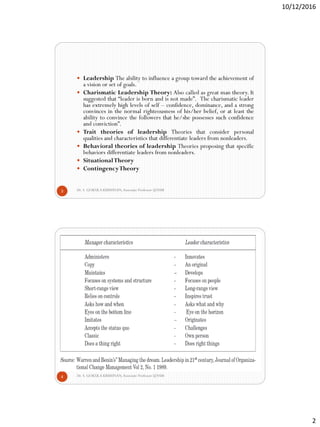
 Leadership The ability to influence a group toward the achievement of
a vision or set of goals.
 Charismatic Leadership Theory: Also called as great man theory. It
suggested that “leader is born and is not made”. The charismatic leader
has extremely high levels of self – confidence, dominance, and a strong
convinces in the normal righteousness of his/her belief, or at least the
ability to convince the followers that he/she possesses such confidence
and conviction”.
 Trait theories of leadership Theories that consider personal
qualities and characteristics that differentiate leaders from nonleaders.
 Behavioral theories of leadership Theories proposing that specific
behaviors differentiate leaders from nonleaders.
 SituationalTheory
 ContingencyTheory
Dr. S. GOKULA KRISHNAN,Associate Professor @NSM4
10/12/2016
3
Ingredients of Leadership
Dr. S. GOKULA KRISHNAN,Associate Professor @NSM5
 1.The ability to use power effectively
 2.An ability to comprehend
 3.Ability to inspire
 Leadership style
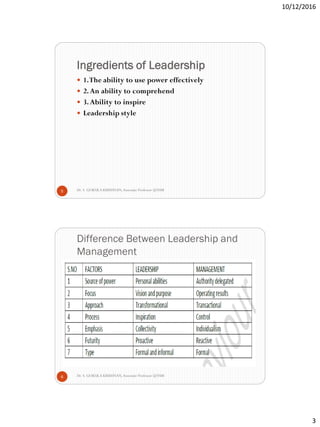
Difference Between Leadership and
Management
Dr. S. GOKULA KRISHNAN,Associate Professor @NSM6
10/12/2016
4
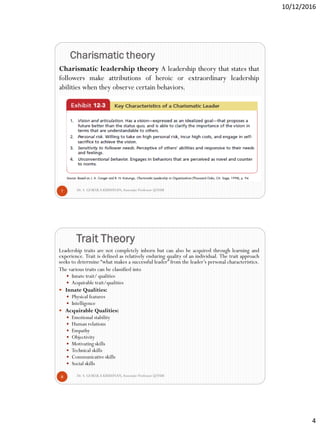
Charismatic theory
Dr. S. GOKULA KRISHNAN,Associate Professor @NSM7
Charismatic leadership theory A leadership theory that states that
followers make attributions of heroic or extraordinary leadership
abilities when they observe certain behaviors.
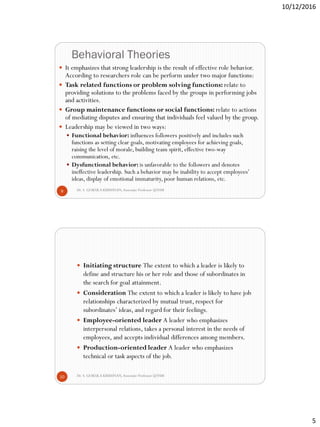
Trait Theory
Dr. S. GOKULA KRISHNAN,Associate Professor @NSM8
Leadership traits are not completely inborn but can also be acquired through learning and
experience. Trait is defined as relatively enduring quality of an individual. The trait approach
seeks to determine “what makes a successful leader” from the leader’s personal characteristics.
The various traits can be classified into
 Innate trait/ qualities
 Acquirable trait/qualities
 Innate Qualities:
 Physical features
 Intelligence
 Acquirable Qualities:
 Emotional stability
 Human relations
 Empathy
 Objectivity
 Motivating skills
 Technical skills
 Communicative skills
 Social skills
10/12/2016
5
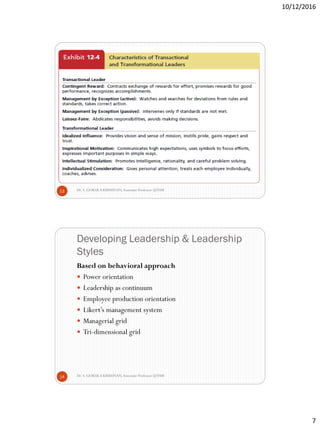
Behavioral Theories
Dr. S. GOKULA KRISHNAN,Associate Professor @NSM9
 It emphasizes that strong leadership is the result of effective role behavior.
According to researchers role can be perform under two major functions:
 Task related functions or problem solving functions: relate to
providing solutions to the problems faced by the groups in performing jobs
and activities.
 Group maintenance functions or social functions: relate to actions
of mediating disputes and ensuring that individuals feel valued by the group.
 Leadership may be viewed in two ways:
 Functional behavior: influences followers positively and includes such
functions as setting clear goals, motivating employees for achieving goals,
raising the level of morale, building team spirit, effective two-way
communication, etc.
 Dysfunctional behavior: is unfavorable to the followers and denotes
ineffective leadership. Such a behavior may be inability to accept employees’
ideas, display of emotional immaturity, poor human relations, etc.
Dr. S. GOKULA KRISHNAN,Associate Professor @NSM10
 Initiating structure The extent to which a leader is likely to
define and structure his or her role and those of subordinates in
the search for goal attainment.
 Consideration The extent to which a leader is likely to have job
relationships characterized by mutual trust, respect for
subordinates’ ideas, and regard for their feelings.
 Employee-oriented leader A leader who emphasizes
interpersonal relations, takes a personal interest in the needs of
employees, and accepts individual differences among members.
 Production-oriented leader A leader who emphasizes
technical or task aspects of the job.
10/12/2016
6
Situational theory
Dr. S. GOKULA KRISHNAN,Associate Professor @NSM11
 Situational LeadershipTheory (SLT): A contingency
theory that focuses on followers’readiness.
 Leader’s behavior:
 i. Leader’s characteristics
 ii. Leader’s hierarchical position
 Situational factors:
 i. Subordinate’s characteristics
 ii. Leader’s situation
 iii. Group factors
 iv. Organizational factors
Contingency Theories
Dr. S. GOKULA KRISHNAN,Associate Professor @NSM12
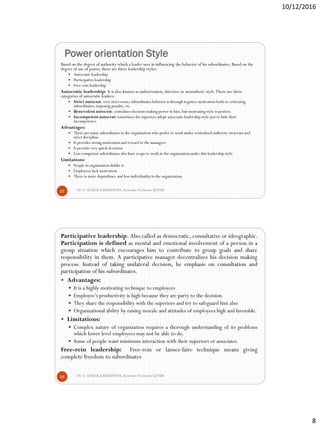
 Fiedler Contingency Model: The theory that effective groups depend on a
proper match between a leader’s style of interacting with subordinates and the degree
to which the situation gives control and influence to the leader
 Path GoalTheory: A theory that states that it is the leader’s job to assist
followers in attaining their goals and to provide the necessary direction and/or
support to ensure that their goals are compatible with the overall objectives of the
group or organization
 Leader- participation Model: A leadership theory that provides a set of
rules to determine the form and amount of participative decision making in different
situations.
 Leader-member ExchangeTheory(LMX): A theory that supports leaders’
creation of in-groups and out-groups;subordinates with in-group status will have
higher performance ratings,less turnover,and greater job satisfaction
 Transformational Leadership
 Transactional Leadership
10/12/2016
7
Dr. S. GOKULA KRISHNAN,Associate Professor @NSM13
Developing Leadership & Leadership
Styles
Dr. S. GOKULA KRISHNAN,Associate Professor @NSM14
Based on behavioral approach
 Power orientation
 Leadership as continuum
 Employee production orientation
 Likert’s management system
 Managerial grid
 Tri-dimensional grid
10/12/2016
8
Power orientation Style
Dr. S. GOKULA KRISHNAN,Associate Professor @NSM15
Based on the degree of authority which a leader uses in influencing the behavior of his subordinates. Based on the
degree of use of power, there are three leadership styles:
 Autocraticleadership
 Participativeleadership
 Free-rein leadership
Autocratic leadership: It is also known as authorization, directive or monothetic style.There are three
categories of autocratic leaders:
 Strict autocrat: very strict sense; subordinates behavior is through negative motivation leads to criticizing
subordinates, imposing penalty, etc.
 Benevolent autocrat: centralizes decision making power in him, but motivating style is positive.
 Incompetent autocrat: sometimes the superiors adopt autocraticleadership style just to hide their
incompetence.
Advantages:
 There are many subordinates in the organization who prefer to work under centralized authority structure and
strict discipline.
 It provides strong motivation and reward to the managers
 It permits very quick decisions
 Less competent subordinates also have scope to work in the organizationunder this leadership style.
Limitations:
 People in organizationdislike it.
 Employees lack motivation
 There is more dependence and less individuality in the organization.
Dr. S. GOKULA KRISHNAN,Associate Professor @NSM16
Participative leadership: Also called as democratic, consultative or ideographic.
Participation is defined as mental and emotional involvement of a person in a
group situation which encourages him to contribute to group goals and share
responsibility in them. A participative manager decentralizes his decision making
process. Instead of taking unilateral decision, he emphasis on consultation and
participation of his subordinates.
 Advantages:
 It is a highly motivating technique to employees
 Employee’s productivity is high because they are party to the decision.
 They share the responsibility with the superiors and try to safeguard him also
 Organizational ability by raising morale and attitudes of employees high and favorable.
 Limitations:
 Complex nature of organization requires a thorough understanding of its problems
which lower level employees may not be able to do.
 Some of people want minimum interaction with their superiors or associates.
Free-rein leadership: Free-rein or laissez-faire technique means giving
complete freedom to subordinates
10/12/2016
9
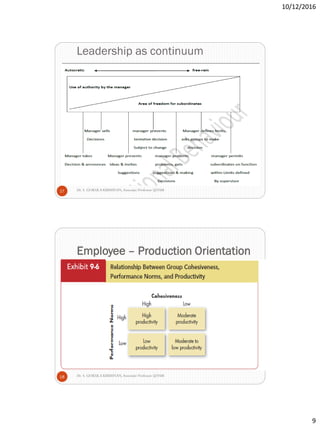
Leadership as continuum
Dr. S. GOKULA KRISHNAN,Associate Professor @NSM17
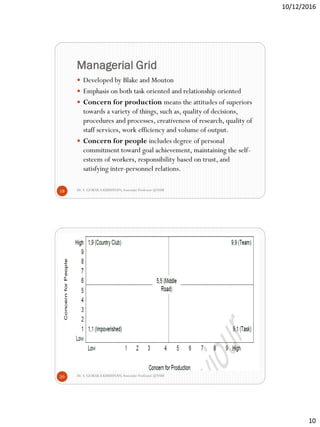
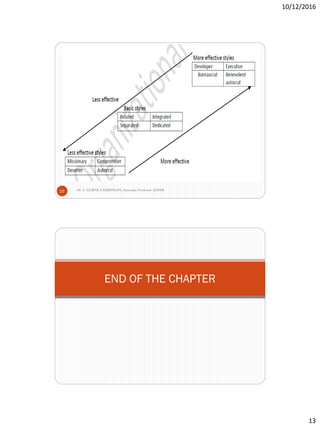
Employee – Production Orientation
Dr. S. GOKULA KRISHNAN,Associate Professor @NSM18
10/12/2016
10
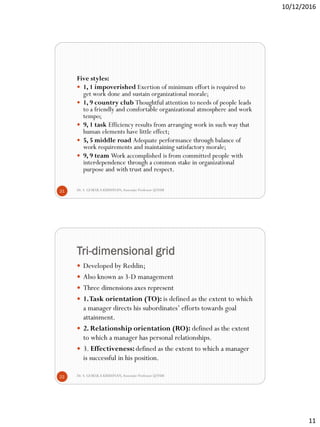
Managerial Grid
Dr. S. GOKULA KRISHNAN,Associate Professor @NSM19
 Developed by Blake and Mouton
 Emphasis on both task oriented and relationship oriented
 Concern for production means the attitudes of superiors
towards a variety of things, such as, quality of decisions,
procedures and processes, creativeness of research, quality of
staff services, work efficiency and volume of output.
 Concern for people includes degree of personal
commitment toward goal achievement, maintaining the self-
esteem of workers, responsibility based on trust, and
satisfying inter-personnel relations.
Dr. S. GOKULA KRISHNAN,Associate Professor @NSM20
10/12/2016
11
Dr. S. GOKULA KRISHNAN,Associate Professor @NSM21
Five styles:
 1, 1 impoverished Exertion of minimum effort is required to
get work done and sustain organizational morale;
 1, 9 country club Thoughtful attention to needs of people leads
to a friendly and comfortable organizational atmosphere and work
tempo;
 9, 1 task Efficiency results from arranging work in such way that
human elements have little effect;
 5, 5 middle road Adequate performance through balance of
work requirements and maintaining satisfactory morale;
 9, 9 team Work accomplished is from committed people with
interdependence through a common stake in organizational
purpose and with trust and respect.
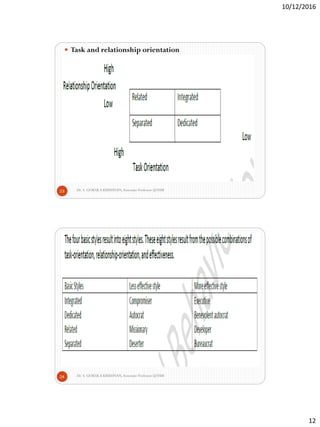
Tri-dimensional grid
Dr. S. GOKULA KRISHNAN,Associate Professor @NSM22
 Developed by Reddin;
 Also known as 3-D management
 Three dimensions axes represent
 1.Task orientation (TO): is defined as the extent to which
a manager directs his subordinates’ efforts towards goal
attainment.
 2. Relationship orientation (RO): defined as the extent
to which a manager has personal relationships.
 3. Effectiveness: defined as the extent to which a manager
is successful in his position.
10/12/2016
12
Dr. S. GOKULA KRISHNAN,Associate Professor @NSM23
 Task and relationship orientation
Dr. S. GOKULA KRISHNAN,Associate Professor @NSM24
10/12/2016
13
Dr. S. GOKULA KRISHNAN,Associate Professor @NSM25
END OF THE CHAPTER

Ob1 unit 4 chapter - 14 - leadership

  • 1.
    10/12/2016 1 Unit – 4CHAPTER - 14 Leadership MBA 12 ORGANIZATIONAL BEHAVIOUR - 1 Delivered By, Dr. S. Gokula Krishnan, PhD., Associate Professor – OB, HR & Data Analytics, Nehru School of Management, Nehru College of Engineering & Research Centre. E-mail : prof.gokulakrishnan@gmail.com Discussions on Dr. S. GOKULA KRISHNAN,Associate Professor @NSM2  Leadership  LeadershipTheories  Developing Leadership Skills  Leadership Styles Reference: Stephen P Robbins,TimothyA Judge & NeharikaVohra, Organizational Behaviour, 15th ed., p. 393-424
  • 2.
    10/12/2016 2 Dr. S. GOKULAKRISHNAN,Associate Professor @NSM3  Leadership The ability to influence a group toward the achievement of a vision or set of goals.  Charismatic Leadership Theory: Also called as great man theory. It suggested that “leader is born and is not made”. The charismatic leader has extremely high levels of self – confidence, dominance, and a strong convinces in the normal righteousness of his/her belief, or at least the ability to convince the followers that he/she possesses such confidence and conviction”.  Trait theories of leadership Theories that consider personal qualities and characteristics that differentiate leaders from nonleaders.  Behavioral theories of leadership Theories proposing that specific behaviors differentiate leaders from nonleaders.  SituationalTheory  ContingencyTheory Dr. S. GOKULA KRISHNAN,Associate Professor @NSM4
  • 3.
    10/12/2016 3 Ingredients of Leadership Dr.S. GOKULA KRISHNAN,Associate Professor @NSM5  1.The ability to use power effectively  2.An ability to comprehend  3.Ability to inspire  Leadership style Difference Between Leadership and Management Dr. S. GOKULA KRISHNAN,Associate Professor @NSM6
  • 4.
    10/12/2016 4 Charismatic theory Dr. S.GOKULA KRISHNAN,Associate Professor @NSM7 Charismatic leadership theory A leadership theory that states that followers make attributions of heroic or extraordinary leadership abilities when they observe certain behaviors. Trait Theory Dr. S. GOKULA KRISHNAN,Associate Professor @NSM8 Leadership traits are not completely inborn but can also be acquired through learning and experience. Trait is defined as relatively enduring quality of an individual. The trait approach seeks to determine “what makes a successful leader” from the leader’s personal characteristics. The various traits can be classified into  Innate trait/ qualities  Acquirable trait/qualities  Innate Qualities:  Physical features  Intelligence  Acquirable Qualities:  Emotional stability  Human relations  Empathy  Objectivity  Motivating skills  Technical skills  Communicative skills  Social skills
  • 5.
    10/12/2016 5 Behavioral Theories Dr. S.GOKULA KRISHNAN,Associate Professor @NSM9  It emphasizes that strong leadership is the result of effective role behavior. According to researchers role can be perform under two major functions:  Task related functions or problem solving functions: relate to providing solutions to the problems faced by the groups in performing jobs and activities.  Group maintenance functions or social functions: relate to actions of mediating disputes and ensuring that individuals feel valued by the group.  Leadership may be viewed in two ways:  Functional behavior: influences followers positively and includes such functions as setting clear goals, motivating employees for achieving goals, raising the level of morale, building team spirit, effective two-way communication, etc.  Dysfunctional behavior: is unfavorable to the followers and denotes ineffective leadership. Such a behavior may be inability to accept employees’ ideas, display of emotional immaturity, poor human relations, etc. Dr. S. GOKULA KRISHNAN,Associate Professor @NSM10  Initiating structure The extent to which a leader is likely to define and structure his or her role and those of subordinates in the search for goal attainment.  Consideration The extent to which a leader is likely to have job relationships characterized by mutual trust, respect for subordinates’ ideas, and regard for their feelings.  Employee-oriented leader A leader who emphasizes interpersonal relations, takes a personal interest in the needs of employees, and accepts individual differences among members.  Production-oriented leader A leader who emphasizes technical or task aspects of the job.
  • 6.
    10/12/2016 6 Situational theory Dr. S.GOKULA KRISHNAN,Associate Professor @NSM11  Situational LeadershipTheory (SLT): A contingency theory that focuses on followers’readiness.  Leader’s behavior:  i. Leader’s characteristics  ii. Leader’s hierarchical position  Situational factors:  i. Subordinate’s characteristics  ii. Leader’s situation  iii. Group factors  iv. Organizational factors Contingency Theories Dr. S. GOKULA KRISHNAN,Associate Professor @NSM12  Fiedler Contingency Model: The theory that effective groups depend on a proper match between a leader’s style of interacting with subordinates and the degree to which the situation gives control and influence to the leader  Path GoalTheory: A theory that states that it is the leader’s job to assist followers in attaining their goals and to provide the necessary direction and/or support to ensure that their goals are compatible with the overall objectives of the group or organization  Leader- participation Model: A leadership theory that provides a set of rules to determine the form and amount of participative decision making in different situations.  Leader-member ExchangeTheory(LMX): A theory that supports leaders’ creation of in-groups and out-groups;subordinates with in-group status will have higher performance ratings,less turnover,and greater job satisfaction  Transformational Leadership  Transactional Leadership
  • 7.
    10/12/2016 7 Dr. S. GOKULAKRISHNAN,Associate Professor @NSM13 Developing Leadership & Leadership Styles Dr. S. GOKULA KRISHNAN,Associate Professor @NSM14 Based on behavioral approach  Power orientation  Leadership as continuum  Employee production orientation  Likert’s management system  Managerial grid  Tri-dimensional grid
  • 8.
    10/12/2016 8 Power orientation Style Dr.S. GOKULA KRISHNAN,Associate Professor @NSM15 Based on the degree of authority which a leader uses in influencing the behavior of his subordinates. Based on the degree of use of power, there are three leadership styles:  Autocraticleadership  Participativeleadership  Free-rein leadership Autocratic leadership: It is also known as authorization, directive or monothetic style.There are three categories of autocratic leaders:  Strict autocrat: very strict sense; subordinates behavior is through negative motivation leads to criticizing subordinates, imposing penalty, etc.  Benevolent autocrat: centralizes decision making power in him, but motivating style is positive.  Incompetent autocrat: sometimes the superiors adopt autocraticleadership style just to hide their incompetence. Advantages:  There are many subordinates in the organization who prefer to work under centralized authority structure and strict discipline.  It provides strong motivation and reward to the managers  It permits very quick decisions  Less competent subordinates also have scope to work in the organizationunder this leadership style. Limitations:  People in organizationdislike it.  Employees lack motivation  There is more dependence and less individuality in the organization. Dr. S. GOKULA KRISHNAN,Associate Professor @NSM16 Participative leadership: Also called as democratic, consultative or ideographic. Participation is defined as mental and emotional involvement of a person in a group situation which encourages him to contribute to group goals and share responsibility in them. A participative manager decentralizes his decision making process. Instead of taking unilateral decision, he emphasis on consultation and participation of his subordinates.  Advantages:  It is a highly motivating technique to employees  Employee’s productivity is high because they are party to the decision.  They share the responsibility with the superiors and try to safeguard him also  Organizational ability by raising morale and attitudes of employees high and favorable.  Limitations:  Complex nature of organization requires a thorough understanding of its problems which lower level employees may not be able to do.  Some of people want minimum interaction with their superiors or associates. Free-rein leadership: Free-rein or laissez-faire technique means giving complete freedom to subordinates
  • 9.
    10/12/2016 9 Leadership as continuum Dr.S. GOKULA KRISHNAN,Associate Professor @NSM17 Employee – Production Orientation Dr. S. GOKULA KRISHNAN,Associate Professor @NSM18
  • 10.
    10/12/2016 10 Managerial Grid Dr. S.GOKULA KRISHNAN,Associate Professor @NSM19  Developed by Blake and Mouton  Emphasis on both task oriented and relationship oriented  Concern for production means the attitudes of superiors towards a variety of things, such as, quality of decisions, procedures and processes, creativeness of research, quality of staff services, work efficiency and volume of output.  Concern for people includes degree of personal commitment toward goal achievement, maintaining the self- esteem of workers, responsibility based on trust, and satisfying inter-personnel relations. Dr. S. GOKULA KRISHNAN,Associate Professor @NSM20
  • 11.
    10/12/2016 11 Dr. S. GOKULAKRISHNAN,Associate Professor @NSM21 Five styles:  1, 1 impoverished Exertion of minimum effort is required to get work done and sustain organizational morale;  1, 9 country club Thoughtful attention to needs of people leads to a friendly and comfortable organizational atmosphere and work tempo;  9, 1 task Efficiency results from arranging work in such way that human elements have little effect;  5, 5 middle road Adequate performance through balance of work requirements and maintaining satisfactory morale;  9, 9 team Work accomplished is from committed people with interdependence through a common stake in organizational purpose and with trust and respect. Tri-dimensional grid Dr. S. GOKULA KRISHNAN,Associate Professor @NSM22  Developed by Reddin;  Also known as 3-D management  Three dimensions axes represent  1.Task orientation (TO): is defined as the extent to which a manager directs his subordinates’ efforts towards goal attainment.  2. Relationship orientation (RO): defined as the extent to which a manager has personal relationships.  3. Effectiveness: defined as the extent to which a manager is successful in his position.
  • 12.
    10/12/2016 12 Dr. S. GOKULAKRISHNAN,Associate Professor @NSM23  Task and relationship orientation Dr. S. GOKULA KRISHNAN,Associate Professor @NSM24
  • 13.
    10/12/2016 13 Dr. S. GOKULAKRISHNAN,Associate Professor @NSM25 END OF THE CHAPTER