NUTRITIONAL
NEEDS
IMPORTANCE OF NUTRITION
● Nutrition is the basic component of health.
● It is essential for normal growth & development,
tissue maintenance & repair, cellular metabolism &
organ function.
● An adequate supply of nutrients is needed for the
essential function of cells.
BASAL METABOLIC RATE
● It is the energy needed to maintain life sustaining
activities (Breathing, circulation, heart rate &
temperature) for a specific period of time at rest.
RESTING ENERGY EXPENDITURE
● Otherwise called RESTING METABOLIC RATE
● It is the amount of energy an individual needs to
consume over a 24 hour period for the body to
maintain all its internal working activities while at rest.
CALORIE NEED
● One calorie per hour for each kilogram of body weight
is needed to carry on the basic body functions of
respiration, blood circulation, urine formation, & the
regulation of body temperature.
● Depending on the type of activity, the requirement for
calories changes.
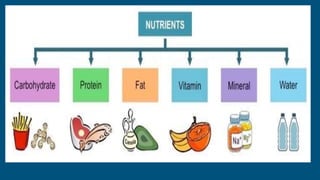
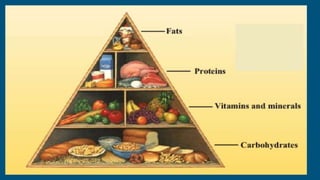
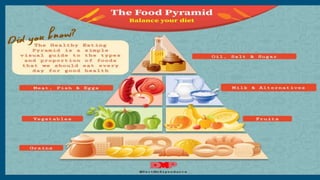
● 1 gm of Carbohydrate gives 4 kcal
● 1 gm of Protein gives 4 kcal
● 1 gm of Fat gives 9 kcal
● Water makes upto 60-70% of total body weight
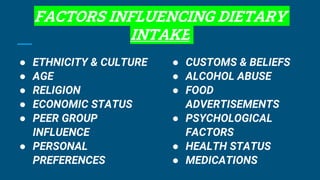
FACTORS INFLUENCING DIETARY
INTAKE
● ETHNICITY & CULTURE
● AGE
● RELIGION
● ECONOMIC STATUS
● PEER GROUP
INFLUENCE
● PERSONAL
PREFERENCES
● CUSTOMS & BELIEFS
● ALCOHOL ABUSE
● FOOD
ADVERTISEMENTS
● PSYCHOLOGICAL
FACTORS
● HEALTH STATUS
● MEDICATIONS
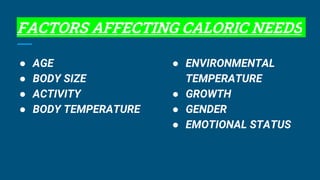
FACTORS AFFECTING CALORIC NEEDS
● AGE
● BODY SIZE
● ACTIVITY
● BODY TEMPERATURE
● ENVIRONMENTAL
TEMPERATURE
● GROWTH
● GENDER
● EMOTIONAL STATUS
PRINCIPLES RELEVANT TO
NUTRITION
● An adequate intake of essential nutrients & energy
giving foods is required for optimal health
● An individual’s nutritional status is determined by the
adequacy of the specific nutrients & energy giving
foods taken into the body, absorbed & utilized.
● Nutritional needs depend on an individual’s age, sex,
body frame, the amount & kind of daily activity,
secretions of endocrine glands & the status of health.
● Nutritional needs are usually altered in illness
● Food has a psychological meaning for people
● Food habits are learned
● Food habits are related to cultural, religious & moral
beliefs.
ASSESSMENT OF
NUTRITIONAL STATUS
1. ANTHROPOMETRIC
MEASUREMENTS
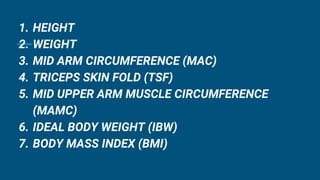
1. HEIGHT
2. WEIGHT
3. MID ARM CIRCUMFERENCE (MAC)
4. TRICEPS SKIN FOLD (TSF)
5. MID UPPER ARM MUSCLE CIRCUMFERENCE
(MAMC)
6. IDEAL BODY WEIGHT (IBW)
7. BODY MASS INDEX (BMI)
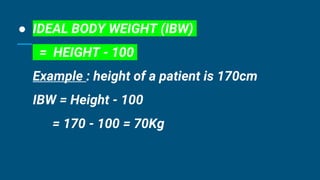
● IDEAL BODY WEIGHT (IBW)
= HEIGHT - 100
Example : height of a patient is 170cm
IBW = Height - 100
= 170 - 100 = 70Kg
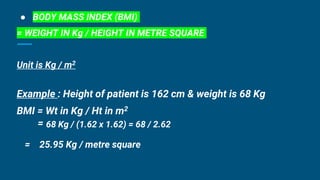
● BODY MASS INDEX (BMI)
= WEIGHT IN Kg / HEIGHT IN METRE SQUARE
Unit is Kg / m2
Example : Height of patient is 162 cm & weight is 68 Kg
BMI = Wt in Kg / Ht in m2
= 68 Kg / (1.62 x 1.62) = 68 / 2.62
= 25.95 Kg / metre square
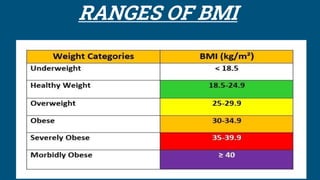
RANGES OF BMI
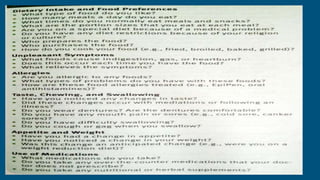
2. DIETARY HISTORY &
HEALTH HISTORY
3. SCREENING FOR
MALNUTRITION
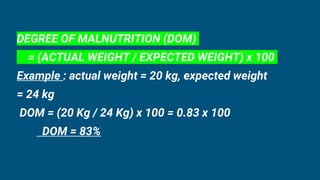
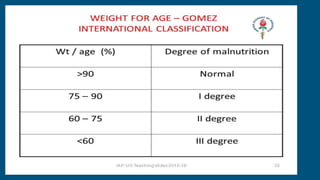
DEGREE OF MALNUTRITION (DOM)
= (ACTUAL WEIGHT / EXPECTED WEIGHT) x 100
Example : actual weight = 20 kg, expected weight
= 24 kg
DOM = (20 Kg / 24 Kg) x 100 = 0.83 x 100
DOM = 83%
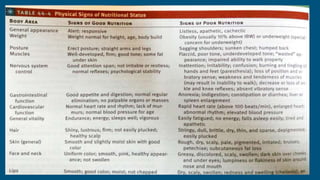
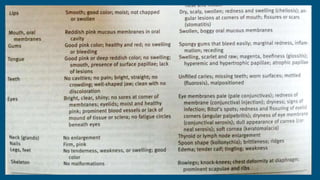
4. PHYSICAL EXAMINATION
5. LABORATORY &
BIOCHEMICAL TESTS
DYSPHAGIA
It refers to
difficulty
when
swallowing.
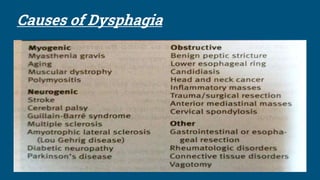
Causes of Dysphagia
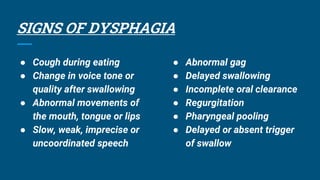
SIGNS OF DYSPHAGIA
● Cough during eating
● Change in voice tone or
quality after swallowing
● Abnormal movements of
the mouth, tongue or lips
● Slow, weak, imprecise or
uncoordinated speech
● Abnormal gag
● Delayed swallowing
● Incomplete oral clearance
● Regurgitation
● Pharyngeal pooling
● Delayed or absent trigger
of swallow
Complications of Dysphagia
● ASPIRATION PNEUMONIA
● DEHYDRATION
● DECREASED NUTRITIONAL STATUS
● WEIGHT LOSS
NURSING
DIAGNOSIS
● RISK FOR ASPIRATION RELATED TO DYSPHAGIA
● CONSTIPATION RELATED TO LOW FIBRE INTAKE
● DIARRHEA RELATED TO FOOD INTOLERANCE
● IMBALANCED NUTRITION LESS THAN BODY
REQUIREMENTS RELATED TO DECREASED ABILITY TO
INGEST FOOD AS A RESULT OF DEPRESSION
● OBESITY RELATED TO INTAKE OF UNHEALTHY FOOD
● OVERWEIGHT
● RISK FOR OVERWEIGHT
● IMPAIRED SWALLOWING RELATED TO TRAUMA TO
ESOPHAGUS
● FEEDING SELF CARE DEFICIT
IMBALANCED NUTRITION LESS THAN BODY REQUIREMENTS
RELATED TO DECREASED ABILITY TO INGEST FOOD AS A
RESULT OF DEPRESSION
● Assess the general condition of the patient
● Assess the height & weight of the patient
● Assess for any weight loss
● Perform physical examination
● Enquire about the dietary intake
● Assess the likes & dislikes of the patient
● Encourage to take small frequent meals
● Encourage fluid intake
● Plan a dietary menu for the patient
● Give health education on importance of well balanced diet
ACUTE CARE OF PATIENTS
WITH NUTRITIONAL NEEDS
1. ADVANCING DIETS
● CLEAR LIQUIDS
(coffee,tea, fruit juices)
● FULL LIQUIDS
(vegetable juice, ice
cream)
● PUREED (scrambled
eggs)
● MECHANICAL SOFT
(cooked vegetables,
mashed potatoes)
● SOFT / LOW RESIDUE
(low fibre diet)
● HIGH FIBRE
● LOW SODIUM(4gm,
2gm)
● LOW CHOLESTEROL
(300mg/day)
● DIABETIC DIET
● DASH DIET
● REGULAR
2. PROMOTING APPETITE
● Provide an environment that promotes nutritional
intake which includes keeping patient’s room
environment free of odors
● Provide a calm environment
● Provide oral hygiene
● Assess likes & dislikes of patient
● Plan for small frequent meals
● Plan a meal time appropriate for the patient
● Provide proper positions & comfort devices
● Plan & administer the mediactions
3. ASSISTING PATIENTS
WITH ORAL FEEDING
● When patients need assistance while eating, it is
important to protect the patient’s safety, independence
& dignity.
● Assess the patient’s risk for aspiration
● Provide a 30 minute rest period before eating
● Position in an upright ( High fowler’s or semi fowler's).
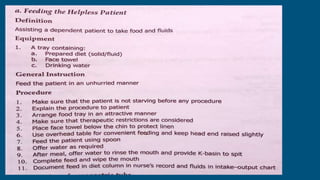
FEEDING THE HELPLESS
PATIENT
4. ENTERAL TUBE FEEDING
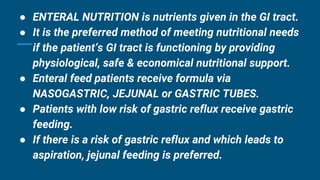
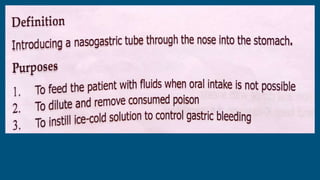
● ENTERAL NUTRITION is nutrients given in the GI tract.
● It is the preferred method of meeting nutritional needs
if the patient’s GI tract is functioning by providing
physiological, safe & economical nutritional support.
● Enteral feed patients receive formula via
NASOGASTRIC, JEJUNAL or GASTRIC TUBES.
● Patients with low risk of gastric reflux receive gastric
feeding.
● If there is a risk of gastric reflux and which leads to
aspiration, jejunal feeding is preferred.
TYPES OF ENTERAL FORMULAS
1. POLYMERIC FORMULA
2. MODULAR FORMULA
3. ELEMENTAL FORMULA
4. SPECIALTY FORMULA
POLYMERIC FORMULA
● It provides 1-2 kcal / ml
● It include milk based blenderized foods prepared by
hospital dietary staff
● For this to be effective, GI tract needs to be able to
absorb whole nutrients.
MODULAR FORMULA
● It provides 3.8 - 4 kcal / ml
● They are single macronutrient ( protein, glucose,
polymers or lipids) preparations & are not nutritionally
complete.
● This is usually added to other foods for meeting the
patient’s nutritional needs.
ELEMENTAL FORMULA
● It provides 1-3 kcal / ml
● It contains predigested nutrients that are easier for a
partially dysfunctional GI tract to absorb.
SPECIALTY FORMULA
● It provides 1-2 kcal / ml.
● They are designed to meet specific nutritional needs in
certain illness. ( liver failure, pulmonary disease or HIV

infection).
● Tube feedings are typically started at full strength at
slow rates.
● Increase the hourly rate every 8-12 hours if no signs of
intolerance appear.
● Signs of intolerance are: high gastric residuals,
nausea, vomiting, cramping & diarrhea.
● Enteral feedings are much beneficial than parenteral
feedings.
● It reduces Sepsis, minimizes the hypermetabolic
response to trauma & maintains intestinal structure &
function.
● Serious complication of enteral feeding is
ASPIRATION of formula into the tracheobronchial tree.
● This can further leads to NECROTIZING INFECTION,
PNEUMONIA, & POTENTIAL ABSCESS FORMATION.
● ACUTE RESPIRATORY DISTRESS SYNDROME (ARDS)
is an outcome associated with pulmonary aspiration.
● Common conditions that can cause aspiration are:
COUGHING, NASOTRACHEAL SUCTIONING, AN
ARTIFICIAL AIRWAY, DECREASED LEVEL OF
CONSCIOUSNESS & LYING FLAT.
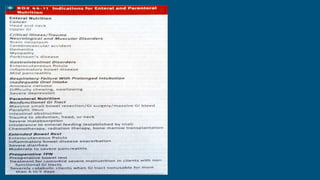
INDICATIONS FOR ENTERAL
& PARENTERAL NUTRITION
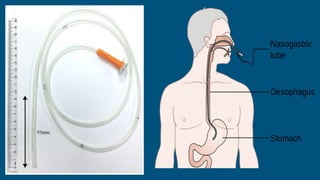
● Feeding tubes are inserted through the nose
(NASOGASTRIC or NASO INTESTINAL), surgically
(GASTROSTOMY or JEJUNOSTOMY) or endoscopically
(PERCUTANEOUS ENDOSCOPIC GASTROSTOMY[PEG]
or JEJUNOSTOMY [PEJ]).
● If enteral nutrition therapy is less than 4 weeks total,
NG or NJ feeding tubes may be used.
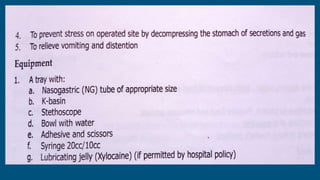
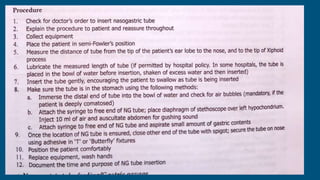
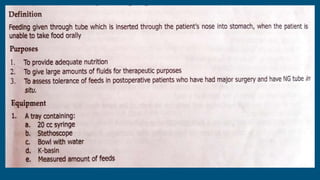
INSERTION OF
NASOGASTRIC TUBE
NASOGASTRIC TUBE
FEEDING / GASTRIC
GAVAGE
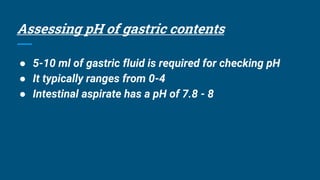
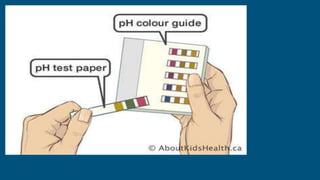
Assessing pH of gastric contents
● 5-10 ml of gastric fluid is required for checking pH
● It typically ranges from 0-4
● Intestinal aspirate has a pH of 7.8 - 8
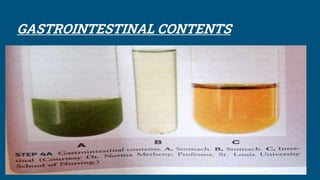
GASTROINTESTINAL CONTENTS
COMPLICATIONS OF ENTERAL TUBE FEEDING
● Pulmonary aspiration
● Diarrhea
● Constipation
● Tube occlusion
● Tube displacement
● Fluid overload
● Abdominal cramping
● Nausea/ vomiting
● Delayed gastric
emptying
● Serum electrolyte
imbalance
● Hyperosmolar
dehydration
5. PARENTERAL NUTRITION
(PN)
● It is a form of specialised nutrition support in which
nutrients are provided INTRAVENOUSLY
● Safe administration of PN requires appropriate
assessment of nutrition needs, meticulous
management of central venous catheter (CVC) &
careful monitoring to prevent or treat metabolic
complications.
● Adhere to principles of asepsis & infusion
management to ensure safe nutrition support.
● Patients who are unable to digest or absorb enteral
nutrition benefits from PN.
● Indications for PN are patients with SEPSIS, HEAD
INJURY or BURNS.
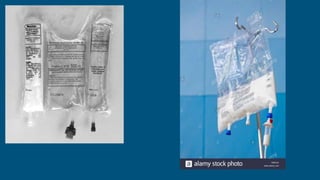
● LIPID EMULSIONS provide supplemental kilocalories &
prevent essential fatty acid deficiencies.
● Administer these emulsions through a separate
peripheral line, through the central line by Y- connector
tubing or as an admixture to the PN solution.
● The addition of lipid emulsion to the PN solution is
called 3-in -1 admixture.
● The patient receives this over a 24 hour period.
● Do not use the admixture if oil droplets or an oil or
creamy layer on the surface of the admixture is
observed.
● This indicates that the emulsion has broken into large
lipid droplets that cause fat emboli.
● Lipid emulsions are WHITE & OPAQUE
METABOLIC COMPLICATIONS OF PN
● Electrolyte imbalance
● Hypercapnia
● Hypoglycemia
● Hyperglycaemia
● Hyperglycaemic
hyperosmolar
nonketotic
dehydration/coma
(HHNC)
6. MEDICAL NUTRITION
THERAPY
{MNT}
● MNT is the use of specific nutritional therapies to treat
an illness, injury or condition.
● It is necessary to assist the body's ability to metabolize
certain nutrients, correct nutritional deficiencies
related to the disease, & eliminate foods that may
exacerbate disease symptoms
NUTRITIONAL NEEDS.pptx

NUTRITIONAL NEEDS.pptx

  • 1.
  • 2.
    IMPORTANCE OF NUTRITION ●Nutrition is the basic component of health. ● It is essential for normal growth & development, tissue maintenance & repair, cellular metabolism & organ function. ● An adequate supply of nutrients is needed for the essential function of cells.
  • 3.
    BASAL METABOLIC RATE ●It is the energy needed to maintain life sustaining activities (Breathing, circulation, heart rate & temperature) for a specific period of time at rest.
  • 4.
    RESTING ENERGY EXPENDITURE ●Otherwise called RESTING METABOLIC RATE ● It is the amount of energy an individual needs to consume over a 24 hour period for the body to maintain all its internal working activities while at rest.
  • 5.
    CALORIE NEED ● Onecalorie per hour for each kilogram of body weight is needed to carry on the basic body functions of respiration, blood circulation, urine formation, & the regulation of body temperature. ● Depending on the type of activity, the requirement for calories changes.
  • 7.
    ● 1 gmof Carbohydrate gives 4 kcal ● 1 gm of Protein gives 4 kcal ● 1 gm of Fat gives 9 kcal ● Water makes upto 60-70% of total body weight
  • 10.
    FACTORS INFLUENCING DIETARY INTAKE ●ETHNICITY & CULTURE ● AGE ● RELIGION ● ECONOMIC STATUS ● PEER GROUP INFLUENCE ● PERSONAL PREFERENCES ● CUSTOMS & BELIEFS ● ALCOHOL ABUSE ● FOOD ADVERTISEMENTS ● PSYCHOLOGICAL FACTORS ● HEALTH STATUS ● MEDICATIONS
  • 11.
    FACTORS AFFECTING CALORICNEEDS ● AGE ● BODY SIZE ● ACTIVITY ● BODY TEMPERATURE ● ENVIRONMENTAL TEMPERATURE ● GROWTH ● GENDER ● EMOTIONAL STATUS
  • 12.
    PRINCIPLES RELEVANT TO NUTRITION ●An adequate intake of essential nutrients & energy giving foods is required for optimal health ● An individual’s nutritional status is determined by the adequacy of the specific nutrients & energy giving foods taken into the body, absorbed & utilized. ● Nutritional needs depend on an individual’s age, sex, body frame, the amount & kind of daily activity, secretions of endocrine glands & the status of health.
  • 13.
    ● Nutritional needsare usually altered in illness ● Food has a psychological meaning for people ● Food habits are learned ● Food habits are related to cultural, religious & moral beliefs.
  • 14.
  • 15.
  • 16.
    1. HEIGHT 2. WEIGHT 3.MID ARM CIRCUMFERENCE (MAC) 4. TRICEPS SKIN FOLD (TSF) 5. MID UPPER ARM MUSCLE CIRCUMFERENCE (MAMC) 6. IDEAL BODY WEIGHT (IBW) 7. BODY MASS INDEX (BMI)
  • 17.
    ● IDEAL BODYWEIGHT (IBW) = HEIGHT - 100 Example : height of a patient is 170cm IBW = Height - 100 = 170 - 100 = 70Kg
  • 18.
    ● BODY MASSINDEX (BMI) = WEIGHT IN Kg / HEIGHT IN METRE SQUARE Unit is Kg / m2 Example : Height of patient is 162 cm & weight is 68 Kg BMI = Wt in Kg / Ht in m2 = 68 Kg / (1.62 x 1.62) = 68 / 2.62 = 25.95 Kg / metre square
  • 19.
  • 20.
    2. DIETARY HISTORY& HEALTH HISTORY
  • 22.
  • 23.
    DEGREE OF MALNUTRITION(DOM) = (ACTUAL WEIGHT / EXPECTED WEIGHT) x 100 Example : actual weight = 20 kg, expected weight = 24 kg DOM = (20 Kg / 24 Kg) x 100 = 0.83 x 100 DOM = 83%
  • 25.
  • 28.
  • 29.
  • 30.
  • 31.
    SIGNS OF DYSPHAGIA ●Cough during eating ● Change in voice tone or quality after swallowing ● Abnormal movements of the mouth, tongue or lips ● Slow, weak, imprecise or uncoordinated speech ● Abnormal gag ● Delayed swallowing ● Incomplete oral clearance ● Regurgitation ● Pharyngeal pooling ● Delayed or absent trigger of swallow
  • 32.
    Complications of Dysphagia ●ASPIRATION PNEUMONIA ● DEHYDRATION ● DECREASED NUTRITIONAL STATUS ● WEIGHT LOSS
  • 33.
  • 34.
    ● RISK FORASPIRATION RELATED TO DYSPHAGIA ● CONSTIPATION RELATED TO LOW FIBRE INTAKE ● DIARRHEA RELATED TO FOOD INTOLERANCE ● IMBALANCED NUTRITION LESS THAN BODY REQUIREMENTS RELATED TO DECREASED ABILITY TO INGEST FOOD AS A RESULT OF DEPRESSION ● OBESITY RELATED TO INTAKE OF UNHEALTHY FOOD ● OVERWEIGHT ● RISK FOR OVERWEIGHT ● IMPAIRED SWALLOWING RELATED TO TRAUMA TO ESOPHAGUS ● FEEDING SELF CARE DEFICIT
  • 35.
    IMBALANCED NUTRITION LESSTHAN BODY REQUIREMENTS RELATED TO DECREASED ABILITY TO INGEST FOOD AS A RESULT OF DEPRESSION ● Assess the general condition of the patient ● Assess the height & weight of the patient ● Assess for any weight loss ● Perform physical examination ● Enquire about the dietary intake ● Assess the likes & dislikes of the patient ● Encourage to take small frequent meals ● Encourage fluid intake ● Plan a dietary menu for the patient ● Give health education on importance of well balanced diet
  • 36.
    ACUTE CARE OFPATIENTS WITH NUTRITIONAL NEEDS
  • 37.
  • 38.
    ● CLEAR LIQUIDS (coffee,tea,fruit juices) ● FULL LIQUIDS (vegetable juice, ice cream) ● PUREED (scrambled eggs) ● MECHANICAL SOFT (cooked vegetables, mashed potatoes) ● SOFT / LOW RESIDUE (low fibre diet) ● HIGH FIBRE ● LOW SODIUM(4gm, 2gm) ● LOW CHOLESTEROL (300mg/day) ● DIABETIC DIET ● DASH DIET ● REGULAR
  • 39.
  • 40.
    ● Provide anenvironment that promotes nutritional intake which includes keeping patient’s room environment free of odors ● Provide a calm environment ● Provide oral hygiene ● Assess likes & dislikes of patient ● Plan for small frequent meals ● Plan a meal time appropriate for the patient ● Provide proper positions & comfort devices ● Plan & administer the mediactions
  • 41.
  • 42.
    ● When patientsneed assistance while eating, it is important to protect the patient’s safety, independence & dignity. ● Assess the patient’s risk for aspiration ● Provide a 30 minute rest period before eating ● Position in an upright ( High fowler’s or semi fowler's).
  • 43.
  • 46.
  • 47.
    ● ENTERAL NUTRITIONis nutrients given in the GI tract. ● It is the preferred method of meeting nutritional needs if the patient’s GI tract is functioning by providing physiological, safe & economical nutritional support. ● Enteral feed patients receive formula via NASOGASTRIC, JEJUNAL or GASTRIC TUBES. ● Patients with low risk of gastric reflux receive gastric feeding. ● If there is a risk of gastric reflux and which leads to aspiration, jejunal feeding is preferred.
  • 48.
    TYPES OF ENTERALFORMULAS 1. POLYMERIC FORMULA 2. MODULAR FORMULA 3. ELEMENTAL FORMULA 4. SPECIALTY FORMULA
  • 49.
    POLYMERIC FORMULA ● Itprovides 1-2 kcal / ml ● It include milk based blenderized foods prepared by hospital dietary staff ● For this to be effective, GI tract needs to be able to absorb whole nutrients.
  • 50.
    MODULAR FORMULA ● Itprovides 3.8 - 4 kcal / ml ● They are single macronutrient ( protein, glucose, polymers or lipids) preparations & are not nutritionally complete. ● This is usually added to other foods for meeting the patient’s nutritional needs.
  • 51.
    ELEMENTAL FORMULA ● Itprovides 1-3 kcal / ml ● It contains predigested nutrients that are easier for a partially dysfunctional GI tract to absorb.
  • 52.
    SPECIALTY FORMULA ● Itprovides 1-2 kcal / ml. ● They are designed to meet specific nutritional needs in certain illness. ( liver failure, pulmonary disease or HIV infection).
  • 53.
    ● Tube feedingsare typically started at full strength at slow rates. ● Increase the hourly rate every 8-12 hours if no signs of intolerance appear. ● Signs of intolerance are: high gastric residuals, nausea, vomiting, cramping & diarrhea. ● Enteral feedings are much beneficial than parenteral feedings. ● It reduces Sepsis, minimizes the hypermetabolic response to trauma & maintains intestinal structure & function.
  • 54.
    ● Serious complicationof enteral feeding is ASPIRATION of formula into the tracheobronchial tree. ● This can further leads to NECROTIZING INFECTION, PNEUMONIA, & POTENTIAL ABSCESS FORMATION. ● ACUTE RESPIRATORY DISTRESS SYNDROME (ARDS) is an outcome associated with pulmonary aspiration. ● Common conditions that can cause aspiration are: COUGHING, NASOTRACHEAL SUCTIONING, AN ARTIFICIAL AIRWAY, DECREASED LEVEL OF CONSCIOUSNESS & LYING FLAT.
  • 55.
    INDICATIONS FOR ENTERAL &PARENTERAL NUTRITION
  • 57.
    ● Feeding tubesare inserted through the nose (NASOGASTRIC or NASO INTESTINAL), surgically (GASTROSTOMY or JEJUNOSTOMY) or endoscopically (PERCUTANEOUS ENDOSCOPIC GASTROSTOMY[PEG] or JEJUNOSTOMY [PEJ]). ● If enteral nutrition therapy is less than 4 weeks total, NG or NJ feeding tubes may be used.
  • 58.
  • 63.
  • 69.
    Assessing pH ofgastric contents ● 5-10 ml of gastric fluid is required for checking pH ● It typically ranges from 0-4 ● Intestinal aspirate has a pH of 7.8 - 8
  • 71.
  • 72.
    COMPLICATIONS OF ENTERALTUBE FEEDING ● Pulmonary aspiration ● Diarrhea ● Constipation ● Tube occlusion ● Tube displacement ● Fluid overload ● Abdominal cramping ● Nausea/ vomiting ● Delayed gastric emptying ● Serum electrolyte imbalance ● Hyperosmolar dehydration
  • 73.
  • 74.
    ● It isa form of specialised nutrition support in which nutrients are provided INTRAVENOUSLY ● Safe administration of PN requires appropriate assessment of nutrition needs, meticulous management of central venous catheter (CVC) & careful monitoring to prevent or treat metabolic complications. ● Adhere to principles of asepsis & infusion management to ensure safe nutrition support.
  • 75.
    ● Patients whoare unable to digest or absorb enteral nutrition benefits from PN. ● Indications for PN are patients with SEPSIS, HEAD INJURY or BURNS. ● LIPID EMULSIONS provide supplemental kilocalories & prevent essential fatty acid deficiencies. ● Administer these emulsions through a separate peripheral line, through the central line by Y- connector tubing or as an admixture to the PN solution.
  • 76.
    ● The additionof lipid emulsion to the PN solution is called 3-in -1 admixture. ● The patient receives this over a 24 hour period. ● Do not use the admixture if oil droplets or an oil or creamy layer on the surface of the admixture is observed. ● This indicates that the emulsion has broken into large lipid droplets that cause fat emboli.
  • 77.
    ● Lipid emulsionsare WHITE & OPAQUE
  • 79.
    METABOLIC COMPLICATIONS OFPN ● Electrolyte imbalance ● Hypercapnia ● Hypoglycemia ● Hyperglycaemia ● Hyperglycaemic hyperosmolar nonketotic dehydration/coma (HHNC)
  • 80.
  • 81.
    ● MNT isthe use of specific nutritional therapies to treat an illness, injury or condition. ● It is necessary to assist the body's ability to metabolize certain nutrients, correct nutritional deficiencies related to the disease, & eliminate foods that may exacerbate disease symptoms