Nutrition Care Process (NCP)
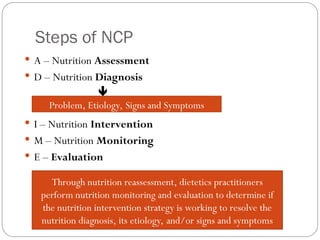
Steps of NCP
 A – Nutrition Assessment
 D – Nutrition Diagnosis

 I – Nutrition Intervention
 M – Nutrition Monitoring
 E – Evaluation
Problem, Etiology, Signs and Symptoms
Through nutrition reassessment, dietetics practitioners
perform nutrition monitoring and evaluation to determine if
the nutrition intervention strategy is working to resolve the
nutrition diagnosis, its etiology, and/or signs and symptoms
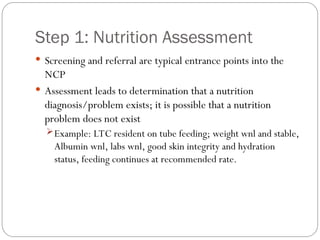
Step 1: Nutrition Assessment
 Screening and referral are typical entrance points into the
NCP
 Assessment leads to determination that a nutrition
diagnosis/problem exists; it is possible that a nutrition
problem does not exist
Example: LTC resident on tube feeding; weight wnl and stable,
Albumin wnl, labs wnl, good skin integrity and hydration
status, feeding continues at recommended rate.
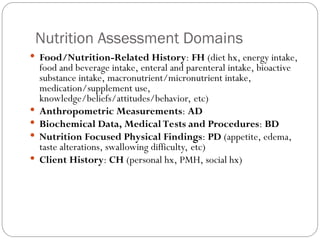
Nutrition Assessment Domains
 Food/Nutrition-Related History: FH (diet hx, energy intake,
food and beverage intake, enteral and parenteral intake, bioactive
substance intake, macronutrient/micronutrient intake,
medication/supplement use,
knowledge/beliefs/attitudes/behavior, etc)
 Anthropometric Measurements: AD
 Biochemical Data, Medical Tests and Procedures: BD
 Nutrition Focused Physical Findings: PD (appetite, edema,
taste alterations, swallowing difficulty, etc)
 Client History: CH (personal hx, PMH, social hx)
Nutrition Assessment, Monitoring and
Evaluation Comparative Standards
 Estimated Energy Needs (formula)
 Estimated Fat, Protein, and CHO needs
 Estimated Fiber Needs (AI)
 Estimated Fluid Needs (AI)
 Estimated Vitamin and Mineral Needs (RDA…)
 Recommended Body Weight /BMI/Growth (peds)
Example: Food Intake
Indications: amount of food, types of food/meals; meal/snack
patterns, diet quality, food variety
Measurement methods: food intake records, 24-hour recall, food
frequency, MyPyramid Tracker
 Typically used to monitor and evaluate change in the following nutrition dx:
excessive or inadequate oral food/bev intake, underweight, overweight/obesity,
limited access to food
 Evaluation – comparison to goal or reference standard
 1) Goal: Pt currently eats ~10% of kcal from saturated fat Goal  to
<7% of daily kcal
 2) Reference standard: Pt’s current intake of fat not meeting AHA
criteria to consume <7% of kcal from sat. fat
??!!
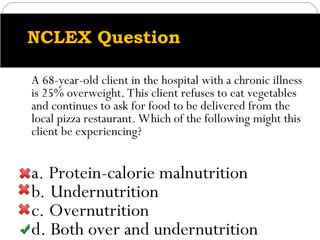
NCLEX Question
A 68-year-old client in the hospital with a chronic illness
is 25% overweight. This client refuses to eat vegetables
and continues to ask for food to be delivered from the
local pizza restaurant. Which of the following might this
client be experiencing?
a. Protein-calorie malnutrition
b. Undernutrition
c. Overnutrition
d. Both over and undernutrition
??!!
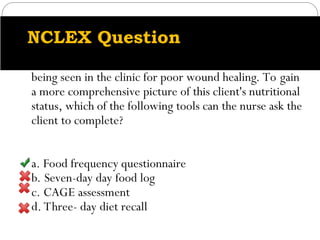
NCLEX Question
An obese client with an alteration in nutritional status is
being seen in the clinic for poor wound healing. To gain
a more comprehensive picture of this client's nutritional
status, which of the following tools can the nurse ask the
client to complete?
a. Food frequency questionnaire
b. Seven-day day food log
c. CAGE assessment
d. Three- day diet recall
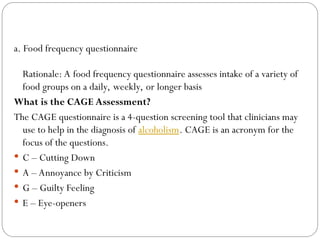
a. Food frequency questionnaire
Rationale: A food frequency questionnaire assesses intake of a variety of
food groups on a daily, weekly, or longer basis
What is the CAGE Assessment?
The CAGE questionnaire is a 4-question screening tool that clinicians may
use to help in the diagnosis of alcoholism. CAGE is an acronym for the
focus of the questions.
 C – Cutting Down
 A – Annoyance by Criticism
 G – Guilty Feeling
 E – Eye-openers
??!!
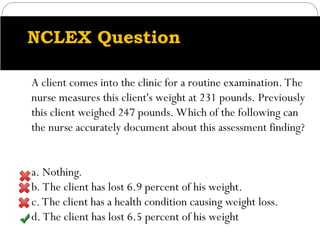
NCLEX Question
A client comes into the clinic for a routine examination. The
nurse measures this client's weight at 231 pounds. Previously
this client weighed 247 pounds. Which of the following can
the nurse accurately document about this assessment finding?
a. Nothing.
b. The client has lost 6.9 percent of his weight.
c. The client has a health condition causing weight loss.
d. The client has lost 6.5 percent of his weight
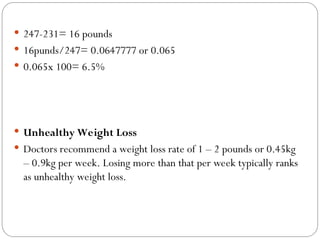
 247-231= 16 pounds
 16punds/247= 0.0647777 or 0.065
 0.065x 100= 6.5%
 Unhealthy Weight Loss
 Doctors recommend a weight loss rate of 1 – 2 pounds or 0.45kg
– 0.9kg per week. Losing more than that per week typically ranks
as unhealthy weight loss.
??!!
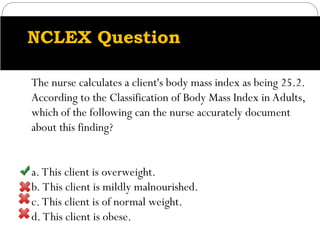
NCLEX Question
The nurse calculates a client's body mass index as being 25.2.
According to the Classification of Body Mass Index in Adults,
which of the following can the nurse accurately document
about this finding?
a. This client is overweight.
b. This client is mildly malnourished.
c. This client is of normal weight.
d. This client is obese.
Step 2: Nutrition Diagnosis
1. Problem (Diagnostic Label) such as, Excessive oral
food/beverage intake (NI-2.2)
2. Etiology (Cause/Contributing Factor) such as, related to
lack of food planning, purchasing, and preparation skills
3. Signs/Symptoms defining characteristics) such as, as
evidenced by BMI of 32, intake of high caloric-density
foods/beverages at meals and snacks.
Nutrition Diagnosis - Domains
 Intake (NI) – actual problems related to intake of energy,
nutrients, fluids, bioactive substances through oral diet or
nutrition support
 Clinical (NC) – Nutritional finding/problems identified
that relate to medical or physical conditions
 Behavioral – Environmental (NB) – Nutritional
findings/problems identified that related to knowledge,
attitudes/beliefs, physical environment, access to food, or
food safety
Nutrition Dx: Problem, Etiology, Signs and
Symptoms
 Inadequate energy intake (NI-
2.1) related to decreased ability
to consume sufficient energy
due to ESRD and dialysis as
evidenced by significant weight
loss of 5% in past month, and
lack of interest in food
 Involuntary weight gain
(NC-3.4) related to
antipsychotic medication as
evidenced by increase weight
of 11% in 6 months.
 Self-feeding difficulty (NB-
2.6) related to impaired
cognitive ability as
evidenced by weight loss of
6% in last month and
dropping cups and food
from utensil.
Step 3: Nutrition Intervention
 Involves planning and implementation
Planning
Prioritizing the nutrition diagnoses, setting goals and defining
the intervention strategy and
Detailing the nutrition prescription (states pt/client’s
recommended dietary intake of energy, nutrients, etc)
Using the ADA’s evidence-based practice guidelines
Setting goals that are measurable, achievable and time-
defined
Implementation – carrying out and communicating the
plan of care
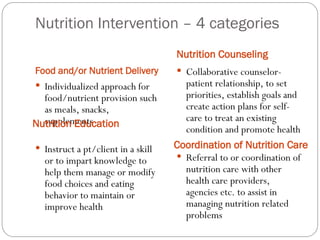
Nutrition Intervention – 4 categories
Food and/or Nutrient Delivery
Nutrition Counseling
 Individualized approach for
food/nutrient provision such
as meals, snacks,
supplements
 Instruct a pt/client in a skill
or to impart knowledge to
help them manage or modify
food choices and eating
behavior to maintain or
improve health
 Collaborative counselor-
patient relationship, to set
priorities, establish goals and
create action plans for self-
care to treat an existing
condition and promote health
 Referral to or coordination of
nutrition care with other
health care providers,
agencies etc. to assist in
managing nutrition related
problems
Nutrition Education
Coordination of Nutrition Care
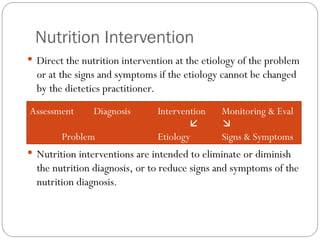
Nutrition Intervention
 Direct the nutrition intervention at the etiology of the problem
or at the signs and symptoms if the etiology cannot be changed
by the dietetics practitioner.
 Nutrition interventions are intended to eliminate or diminish
the nutrition diagnosis, or to reduce signs and symptoms of the
nutrition diagnosis.
Assessment Diagnosis Intervention Monitoring & Eval
 
Problem Etiology Signs & Symptoms
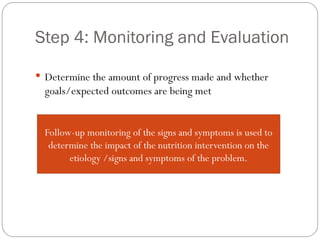
Step 4: Monitoring and Evaluation
 Determine the amount of progress made and whether
goals/expected outcomes are being met
Follow-up monitoring of the signs and symptoms is used to
determine the impact of the nutrition intervention on the
etiology /signs and symptoms of the problem.
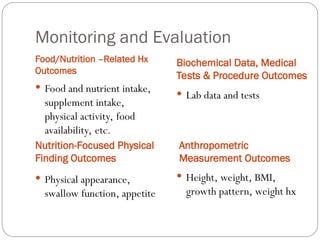
Monitoring and Evaluation
Food/Nutrition –Related Hx
Outcomes
Biochemical Data, Medical
Tests & Procedure Outcomes
 Food and nutrient intake,
supplement intake,
physical activity, food
availability, etc.
 Physical appearance,
swallow function, appetite
 Lab data and tests
 Height, weight, BMI,
growth pattern, weight hx
Nutrition-Focused Physical
Finding Outcomes
Anthropometric
Measurement Outcomes
Prepared by Sandy Sarcona, MS, RD
Nutrition Care Process (NCP)

Nutrition Care Process for Nursing Students.

  • 1.
  • 2.
    Steps of NCP A – Nutrition Assessment  D – Nutrition Diagnosis   I – Nutrition Intervention  M – Nutrition Monitoring  E – Evaluation Problem, Etiology, Signs and Symptoms Through nutrition reassessment, dietetics practitioners perform nutrition monitoring and evaluation to determine if the nutrition intervention strategy is working to resolve the nutrition diagnosis, its etiology, and/or signs and symptoms
  • 3.
    Step 1: NutritionAssessment  Screening and referral are typical entrance points into the NCP  Assessment leads to determination that a nutrition diagnosis/problem exists; it is possible that a nutrition problem does not exist Example: LTC resident on tube feeding; weight wnl and stable, Albumin wnl, labs wnl, good skin integrity and hydration status, feeding continues at recommended rate.
  • 4.
    Nutrition Assessment Domains Food/Nutrition-Related History: FH (diet hx, energy intake, food and beverage intake, enteral and parenteral intake, bioactive substance intake, macronutrient/micronutrient intake, medication/supplement use, knowledge/beliefs/attitudes/behavior, etc)  Anthropometric Measurements: AD  Biochemical Data, Medical Tests and Procedures: BD  Nutrition Focused Physical Findings: PD (appetite, edema, taste alterations, swallowing difficulty, etc)  Client History: CH (personal hx, PMH, social hx)
  • 5.
    Nutrition Assessment, Monitoringand Evaluation Comparative Standards  Estimated Energy Needs (formula)  Estimated Fat, Protein, and CHO needs  Estimated Fiber Needs (AI)  Estimated Fluid Needs (AI)  Estimated Vitamin and Mineral Needs (RDA…)  Recommended Body Weight /BMI/Growth (peds)
  • 6.
    Example: Food Intake Indications:amount of food, types of food/meals; meal/snack patterns, diet quality, food variety Measurement methods: food intake records, 24-hour recall, food frequency, MyPyramid Tracker  Typically used to monitor and evaluate change in the following nutrition dx: excessive or inadequate oral food/bev intake, underweight, overweight/obesity, limited access to food  Evaluation – comparison to goal or reference standard  1) Goal: Pt currently eats ~10% of kcal from saturated fat Goal  to <7% of daily kcal  2) Reference standard: Pt’s current intake of fat not meeting AHA criteria to consume <7% of kcal from sat. fat
  • 7.
  • 8.
    NCLEX Question A 68-year-oldclient in the hospital with a chronic illness is 25% overweight. This client refuses to eat vegetables and continues to ask for food to be delivered from the local pizza restaurant. Which of the following might this client be experiencing? a. Protein-calorie malnutrition b. Undernutrition c. Overnutrition d. Both over and undernutrition
  • 9.
  • 10.
    NCLEX Question An obeseclient with an alteration in nutritional status is being seen in the clinic for poor wound healing. To gain a more comprehensive picture of this client's nutritional status, which of the following tools can the nurse ask the client to complete? a. Food frequency questionnaire b. Seven-day day food log c. CAGE assessment d. Three- day diet recall
  • 11.
    a. Food frequencyquestionnaire Rationale: A food frequency questionnaire assesses intake of a variety of food groups on a daily, weekly, or longer basis What is the CAGE Assessment? The CAGE questionnaire is a 4-question screening tool that clinicians may use to help in the diagnosis of alcoholism. CAGE is an acronym for the focus of the questions.  C – Cutting Down  A – Annoyance by Criticism  G – Guilty Feeling  E – Eye-openers
  • 12.
  • 13.
    NCLEX Question A clientcomes into the clinic for a routine examination. The nurse measures this client's weight at 231 pounds. Previously this client weighed 247 pounds. Which of the following can the nurse accurately document about this assessment finding? a. Nothing. b. The client has lost 6.9 percent of his weight. c. The client has a health condition causing weight loss. d. The client has lost 6.5 percent of his weight
  • 14.
     247-231= 16pounds  16punds/247= 0.0647777 or 0.065  0.065x 100= 6.5%  Unhealthy Weight Loss  Doctors recommend a weight loss rate of 1 – 2 pounds or 0.45kg – 0.9kg per week. Losing more than that per week typically ranks as unhealthy weight loss.
  • 15.
  • 16.
    NCLEX Question The nursecalculates a client's body mass index as being 25.2. According to the Classification of Body Mass Index in Adults, which of the following can the nurse accurately document about this finding? a. This client is overweight. b. This client is mildly malnourished. c. This client is of normal weight. d. This client is obese.
  • 17.
    Step 2: NutritionDiagnosis 1. Problem (Diagnostic Label) such as, Excessive oral food/beverage intake (NI-2.2) 2. Etiology (Cause/Contributing Factor) such as, related to lack of food planning, purchasing, and preparation skills 3. Signs/Symptoms defining characteristics) such as, as evidenced by BMI of 32, intake of high caloric-density foods/beverages at meals and snacks.
  • 18.
    Nutrition Diagnosis -Domains  Intake (NI) – actual problems related to intake of energy, nutrients, fluids, bioactive substances through oral diet or nutrition support  Clinical (NC) – Nutritional finding/problems identified that relate to medical or physical conditions  Behavioral – Environmental (NB) – Nutritional findings/problems identified that related to knowledge, attitudes/beliefs, physical environment, access to food, or food safety
  • 19.
    Nutrition Dx: Problem,Etiology, Signs and Symptoms  Inadequate energy intake (NI- 2.1) related to decreased ability to consume sufficient energy due to ESRD and dialysis as evidenced by significant weight loss of 5% in past month, and lack of interest in food  Involuntary weight gain (NC-3.4) related to antipsychotic medication as evidenced by increase weight of 11% in 6 months.  Self-feeding difficulty (NB- 2.6) related to impaired cognitive ability as evidenced by weight loss of 6% in last month and dropping cups and food from utensil.
  • 20.
    Step 3: NutritionIntervention  Involves planning and implementation Planning Prioritizing the nutrition diagnoses, setting goals and defining the intervention strategy and Detailing the nutrition prescription (states pt/client’s recommended dietary intake of energy, nutrients, etc) Using the ADA’s evidence-based practice guidelines Setting goals that are measurable, achievable and time- defined Implementation – carrying out and communicating the plan of care
  • 21.
    Nutrition Intervention –4 categories Food and/or Nutrient Delivery Nutrition Counseling  Individualized approach for food/nutrient provision such as meals, snacks, supplements  Instruct a pt/client in a skill or to impart knowledge to help them manage or modify food choices and eating behavior to maintain or improve health  Collaborative counselor- patient relationship, to set priorities, establish goals and create action plans for self- care to treat an existing condition and promote health  Referral to or coordination of nutrition care with other health care providers, agencies etc. to assist in managing nutrition related problems Nutrition Education Coordination of Nutrition Care
  • 22.
    Nutrition Intervention  Directthe nutrition intervention at the etiology of the problem or at the signs and symptoms if the etiology cannot be changed by the dietetics practitioner.  Nutrition interventions are intended to eliminate or diminish the nutrition diagnosis, or to reduce signs and symptoms of the nutrition diagnosis. Assessment Diagnosis Intervention Monitoring & Eval   Problem Etiology Signs & Symptoms
  • 23.
    Step 4: Monitoringand Evaluation  Determine the amount of progress made and whether goals/expected outcomes are being met Follow-up monitoring of the signs and symptoms is used to determine the impact of the nutrition intervention on the etiology /signs and symptoms of the problem.
  • 24.
    Monitoring and Evaluation Food/Nutrition–Related Hx Outcomes Biochemical Data, Medical Tests & Procedure Outcomes  Food and nutrient intake, supplement intake, physical activity, food availability, etc.  Physical appearance, swallow function, appetite  Lab data and tests  Height, weight, BMI, growth pattern, weight hx Nutrition-Focused Physical Finding Outcomes Anthropometric Measurement Outcomes
  • 25.
    Prepared by SandySarcona, MS, RD Nutrition Care Process (NCP)