NUCLEOTIDE CHEMISTRY
Dr. Aamir Ali Khan
PhD Biochemistry
Principal Ghazali Institute of Medical Sciences Peshawar
Introduction
Nucleotides are organic compounds made up of a PO4
group, nitrogenous base & a sugar molecule.
These are the building blocks of nucleic
acids (DNA and RNA).
They serve as sources of chemical energy (ATP, GTP),
participate in cellular signalling (cAMP, cGMP) and
function as important cofactors of enzymatic reactions
(CoA, FAD, FMN, NAD+).
SUGARS
Two main sugars
Present in furanose form
Lacks 2’-OH group
Bases
Purines :
Adenine (A)
Guanine (G)
 Pyrimidines :
Cytosine (C)
Uracil (U)
Thymine (T)
 The bases are abbreviated by their first letters (A, G, C, T, U).
 The purines (A, G) occur in both RNA & DNA.
 Among the pyrimidines, C occurs in both RNA & DNA, but
 T occurs in DNA, and U occurs in RNA.
 DNA: A,G,C,T
 RNA: A,G,C,U
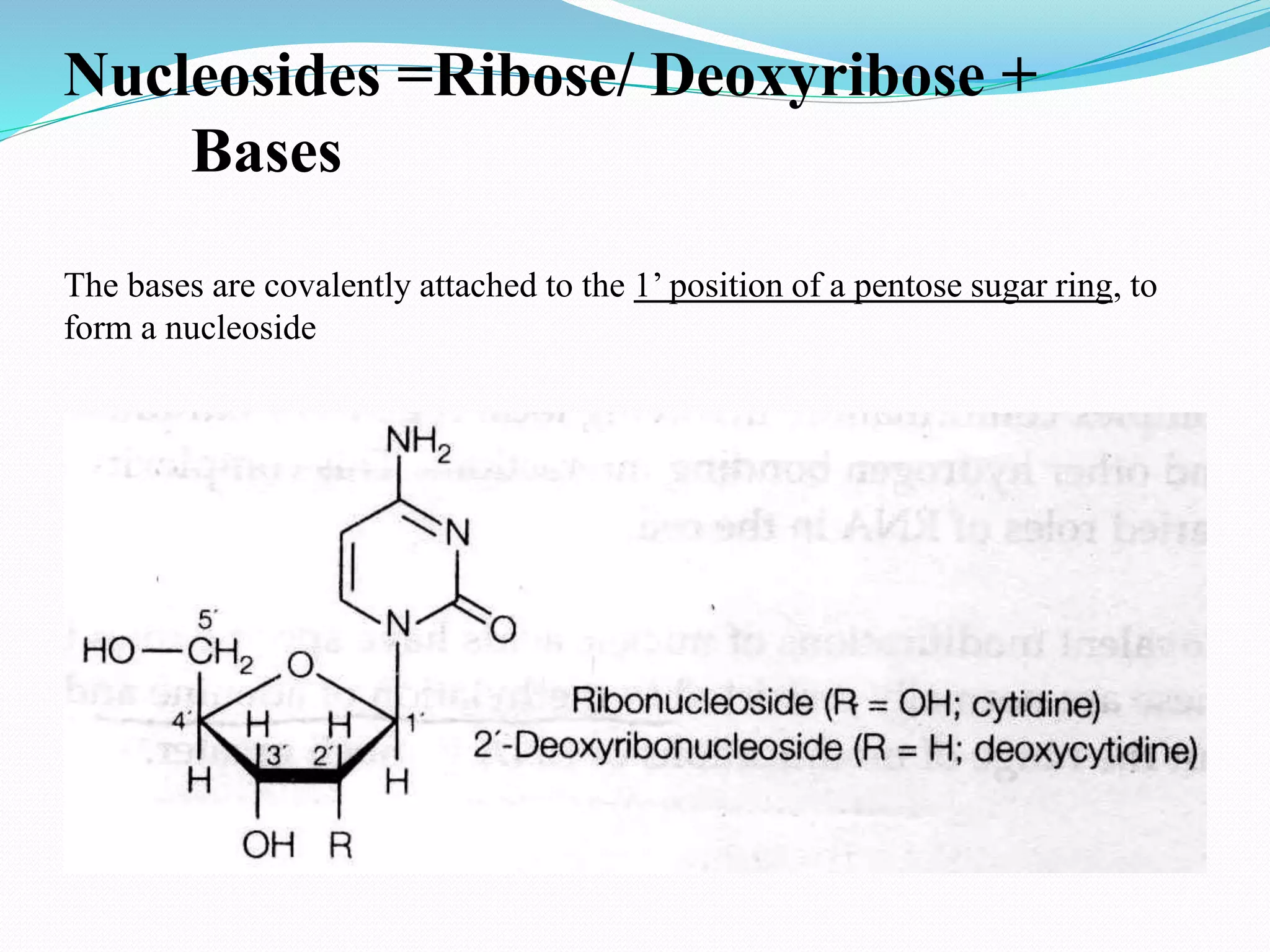
Nucleosides =Ribose/ Deoxyribose +
Bases
The bases are covalently attached to the 1’ position of a pentose sugar ring, to
form a nucleoside
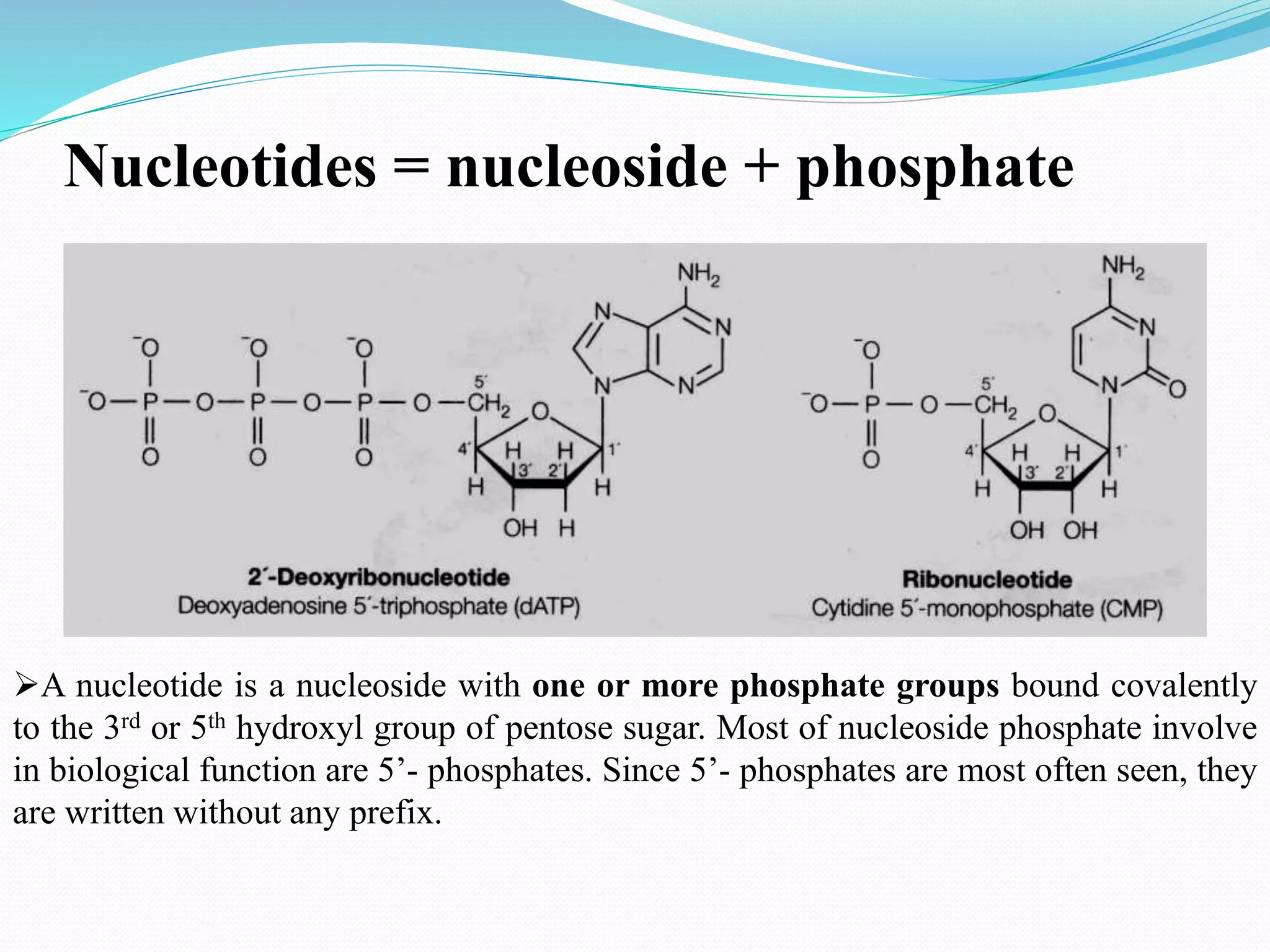
Nucleotides = nucleoside + phosphate
A nucleotide is a nucleoside with one or more phosphate groups bound covalently
to the 3rd or 5th hydroxyl group of pentose sugar. Most of nucleoside phosphate involve
in biological function are 5’- phosphates. Since 5’- phosphates are most often seen, they
are written without any prefix.
H
H
Ribonucleotide Deoxy-ribonucleotide
Nucleoside
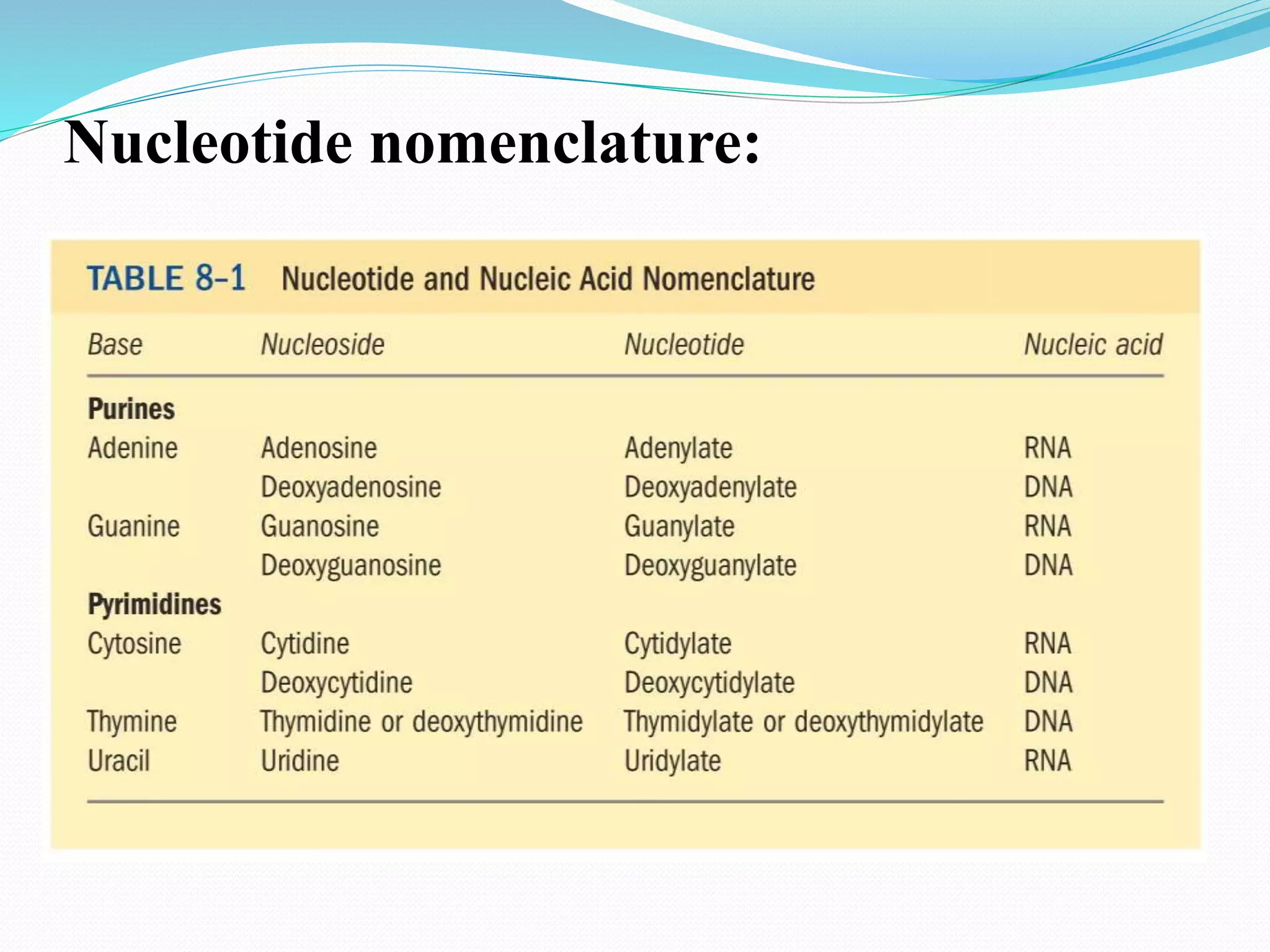
NOMENCLATURE
Nucleosides phosphorylated on the 3’ or 5’ C of ribose are
termed ; nucleoside 3’- monophoshate & nucleoside 5’-
monophoshate.
‘5’ is by convention omitted when naming nucleotide.
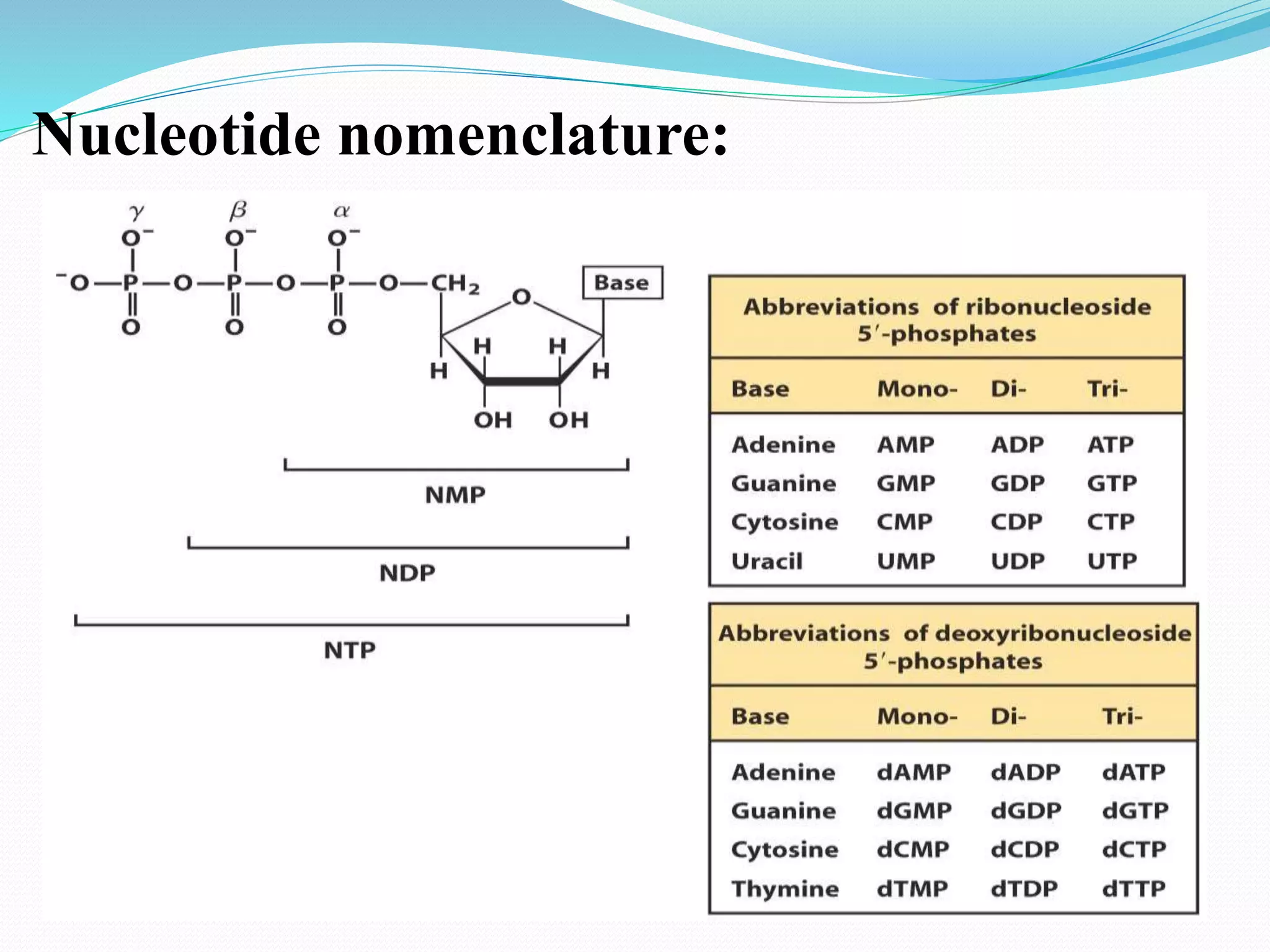
Abbreviations such as AMP, GTP denotes the phosphate is
esterified to 5’ of pentose.
Additional phosphate group is attached to preexisting
phosphate of mononucleotide ,
 - Nucleotide diphosphate – ADP
 - Nucleotide triphosphate – ATP
Nucleotide nomenclature:
Individual properties
PROPERTIES OF PURINE BASES:-
Sparingly soluble in water
Absorb light in UV region at 260 nm. (detection &
quantization of nucleotides)
Capable of forming hydrogen bond
Properties of pyrimidine bases
Soluble at body pH
Also absorb UV light at 260 nm
Capable of forming hydrogen bond
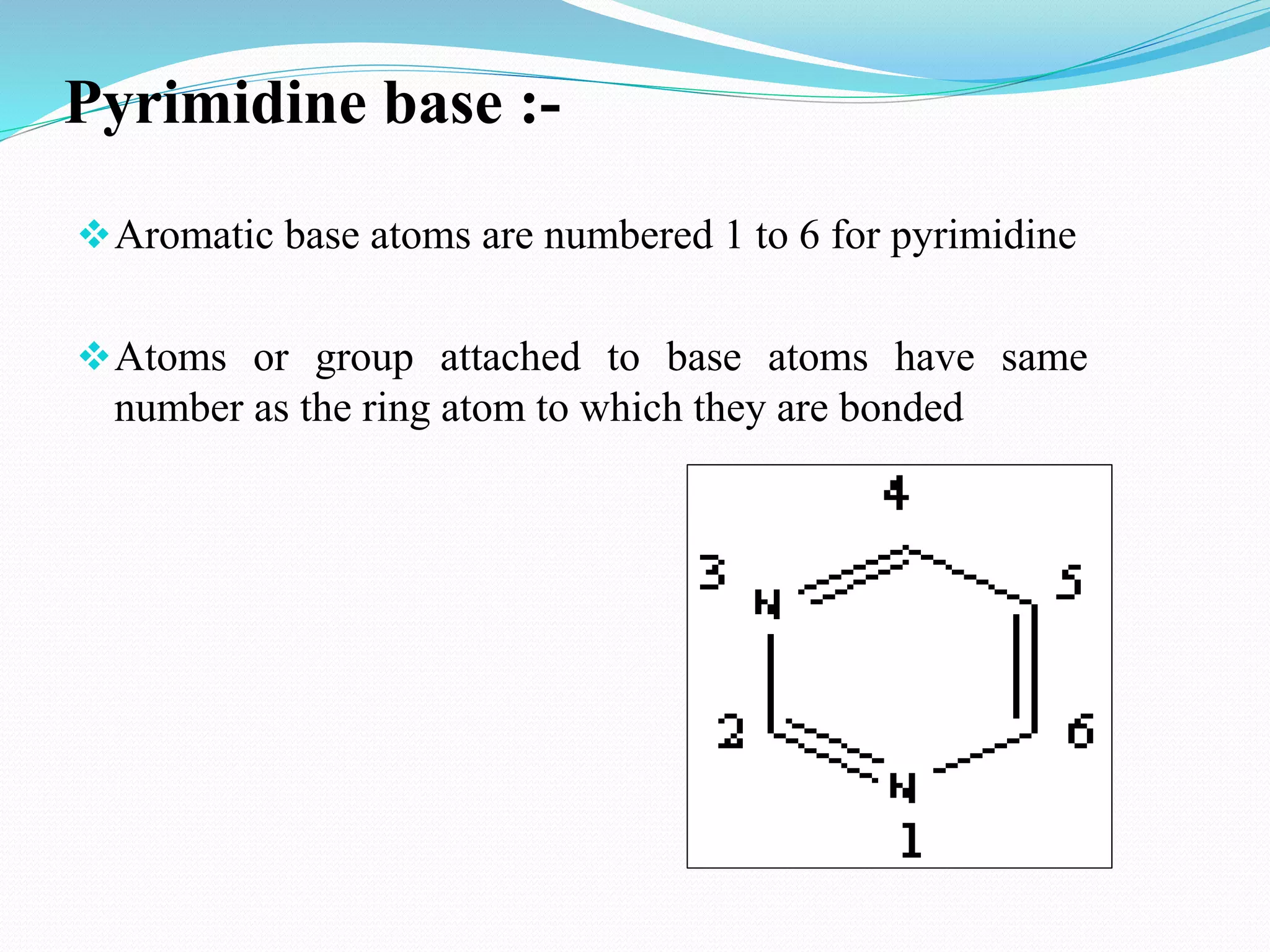
Pyrimidine base :-
Aromatic base atoms are numbered 1 to 6 for pyrimidine
Atoms or group attached to base atoms have same
number as the ring atom to which they are bonded
Cytosine :-
Chemically is 2-oxy ,4-amino pyrimidine
Exist both lactam or lactim form
Thymine :-
Chemically is 2,4 dioxy ,5-methyl pyrimidine
Occurs only in DNA
URACIL :-
Chemically is 2,4 dioxy Pyrimidine
Found only in RNA
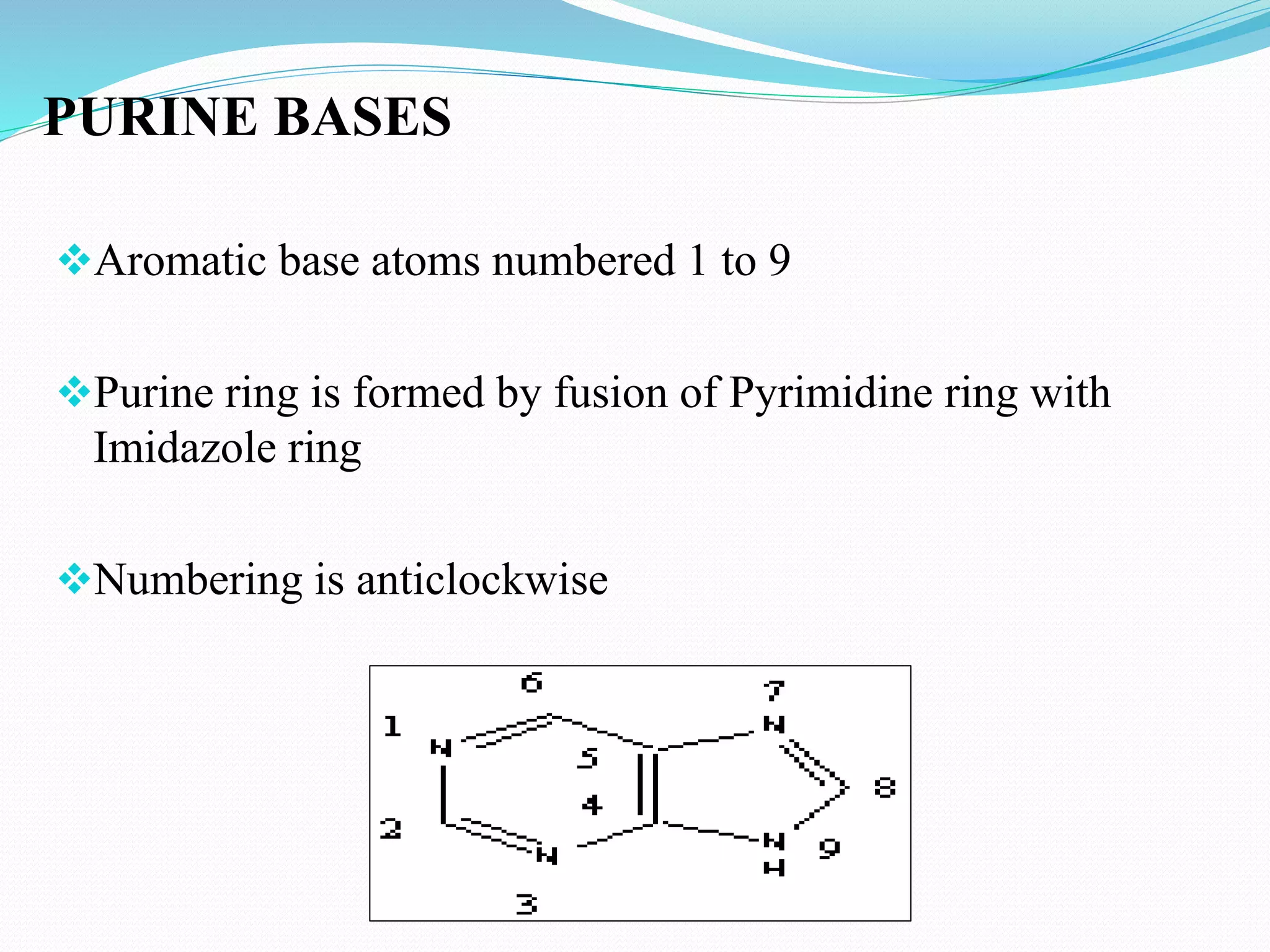
PURINE BASES
Aromatic base atoms numbered 1 to 9
Purine ring is formed by fusion of Pyrimidine ring with
Imidazole ring
Numbering is anticlockwise
ADENINE
Chemically it is 6-aminopurine
Guanine :-
Chemically is 2-amino,6-oxy purine
Can be present as lactam & lactim form
CLASSIFICATION:
Adenosine
nucleotides
ATP, ADP, AMP, Cyclic AMP
Guanosine
nucleotides
GTP, GDP, GMP, Cyclic GMP
Uridine
nucleotides
UTP, UDP, UMP, UDP-G
Cytosine
nucleotides
CTP, CDP, CMP and certain deoxy CDP
derivatives of glucose, choline and
ethanolamine
Miscellaneous PAPS (active sulphate), SAM (active
methionine), certain coenzymes like NAD+,
FAD, FMN, Cobamide coenzyme, CoA
ADENOSINE CONTAINING
NUCLEOTIDES
ATP (ADENOSINE TRIPHOSPHATE)
 Many synthetic reactions requires energy, e.g. arginosuccinate synthetase
reaction in urea cycle.
 ATP is required for the synthesis of Phospho creatine from creatine,
synthesis of FA from acetyl CoA, formation of glucose from pyruvic acid,
etc.
 ATP is an important source of energy for muscle contraction, transmission
of nerve impulses, transport of nutrients across cell membrane, motility
of spermatozoa.
 ATP is required for the formation of active Methionine, which is required
for methylation reaction
 ATP donates phosphate for a variety of phosphotransferase reactions e.g.,
hexokinase reaction.
ADENOSINE DI PHOSPHATE (ADP)
ADP plays an important role as a primary PO4 acceptor in
oxidative phosphorylation and muscle contraction, etc
ADP is also important as an activator of the enzyme glutamate
dehydrogenase
ADENOSINE MONO PHOSPHATE
(AMP)
In the glycolytic pathway, the enzyme phosphofructokinase is
inhibited by ATP but the inhibition is reversed by AMP.
AMP can also act as an inhibitor of certain enzymes like
fructose-1-6- bisphosphatase and adenylosuccinate synthetase.
In resting muscles, AMP is formed from ADP, by adenylate
kinase, the AMP produced activates the phosphorylase b
enzyme of muscle and increase breakdown of glycogen.
AMP ROLE IN REGULATION
Miscellaneous :-
PAPS - Phospho Adenosine Phospho Sulphate
(active sulphate) formed in liver
 Sulfates enzymes which catalyze introduction of
SO4 group
 In biosynthesis of chondroitin sulfate
 Formation of sulpholipids
SAM:- S- Adenosyl Methionine
 Active methionine
Nucleotide

Nucleotide

  • 1.
    NUCLEOTIDE CHEMISTRY Dr. AamirAli Khan PhD Biochemistry Principal Ghazali Institute of Medical Sciences Peshawar
  • 2.
    Introduction Nucleotides are organiccompounds made up of a PO4 group, nitrogenous base & a sugar molecule. These are the building blocks of nucleic acids (DNA and RNA). They serve as sources of chemical energy (ATP, GTP), participate in cellular signalling (cAMP, cGMP) and function as important cofactors of enzymatic reactions (CoA, FAD, FMN, NAD+).
  • 3.
    SUGARS Two main sugars Presentin furanose form Lacks 2’-OH group
  • 4.
    Bases Purines : Adenine (A) Guanine(G)  Pyrimidines : Cytosine (C) Uracil (U) Thymine (T)  The bases are abbreviated by their first letters (A, G, C, T, U).  The purines (A, G) occur in both RNA & DNA.  Among the pyrimidines, C occurs in both RNA & DNA, but  T occurs in DNA, and U occurs in RNA.  DNA: A,G,C,T  RNA: A,G,C,U
  • 6.
    Nucleosides =Ribose/ Deoxyribose+ Bases The bases are covalently attached to the 1’ position of a pentose sugar ring, to form a nucleoside
  • 7.
    Nucleotides = nucleoside+ phosphate A nucleotide is a nucleoside with one or more phosphate groups bound covalently to the 3rd or 5th hydroxyl group of pentose sugar. Most of nucleoside phosphate involve in biological function are 5’- phosphates. Since 5’- phosphates are most often seen, they are written without any prefix.
  • 8.
  • 9.
    NOMENCLATURE Nucleosides phosphorylated onthe 3’ or 5’ C of ribose are termed ; nucleoside 3’- monophoshate & nucleoside 5’- monophoshate. ‘5’ is by convention omitted when naming nucleotide. Abbreviations such as AMP, GTP denotes the phosphate is esterified to 5’ of pentose. Additional phosphate group is attached to preexisting phosphate of mononucleotide ,  - Nucleotide diphosphate – ADP  - Nucleotide triphosphate – ATP
  • 10.
  • 11.
  • 12.
    Individual properties PROPERTIES OFPURINE BASES:- Sparingly soluble in water Absorb light in UV region at 260 nm. (detection & quantization of nucleotides) Capable of forming hydrogen bond
  • 13.
    Properties of pyrimidinebases Soluble at body pH Also absorb UV light at 260 nm Capable of forming hydrogen bond
  • 14.
    Pyrimidine base :- Aromaticbase atoms are numbered 1 to 6 for pyrimidine Atoms or group attached to base atoms have same number as the ring atom to which they are bonded
  • 15.
    Cytosine :- Chemically is2-oxy ,4-amino pyrimidine Exist both lactam or lactim form
  • 16.
    Thymine :- Chemically is2,4 dioxy ,5-methyl pyrimidine Occurs only in DNA
  • 17.
    URACIL :- Chemically is2,4 dioxy Pyrimidine Found only in RNA
  • 18.
    PURINE BASES Aromatic baseatoms numbered 1 to 9 Purine ring is formed by fusion of Pyrimidine ring with Imidazole ring Numbering is anticlockwise
  • 19.
  • 20.
    Guanine :- Chemically is2-amino,6-oxy purine Can be present as lactam & lactim form
  • 21.
    CLASSIFICATION: Adenosine nucleotides ATP, ADP, AMP,Cyclic AMP Guanosine nucleotides GTP, GDP, GMP, Cyclic GMP Uridine nucleotides UTP, UDP, UMP, UDP-G Cytosine nucleotides CTP, CDP, CMP and certain deoxy CDP derivatives of glucose, choline and ethanolamine Miscellaneous PAPS (active sulphate), SAM (active methionine), certain coenzymes like NAD+, FAD, FMN, Cobamide coenzyme, CoA
  • 22.
  • 23.
    ATP (ADENOSINE TRIPHOSPHATE) Many synthetic reactions requires energy, e.g. arginosuccinate synthetase reaction in urea cycle.  ATP is required for the synthesis of Phospho creatine from creatine, synthesis of FA from acetyl CoA, formation of glucose from pyruvic acid, etc.  ATP is an important source of energy for muscle contraction, transmission of nerve impulses, transport of nutrients across cell membrane, motility of spermatozoa.  ATP is required for the formation of active Methionine, which is required for methylation reaction  ATP donates phosphate for a variety of phosphotransferase reactions e.g., hexokinase reaction.
  • 24.
    ADENOSINE DI PHOSPHATE(ADP) ADP plays an important role as a primary PO4 acceptor in oxidative phosphorylation and muscle contraction, etc ADP is also important as an activator of the enzyme glutamate dehydrogenase
  • 25.
    ADENOSINE MONO PHOSPHATE (AMP) Inthe glycolytic pathway, the enzyme phosphofructokinase is inhibited by ATP but the inhibition is reversed by AMP. AMP can also act as an inhibitor of certain enzymes like fructose-1-6- bisphosphatase and adenylosuccinate synthetase. In resting muscles, AMP is formed from ADP, by adenylate kinase, the AMP produced activates the phosphorylase b enzyme of muscle and increase breakdown of glycogen.
  • 26.
    AMP ROLE INREGULATION
  • 27.
    Miscellaneous :- PAPS -Phospho Adenosine Phospho Sulphate (active sulphate) formed in liver  Sulfates enzymes which catalyze introduction of SO4 group  In biosynthesis of chondroitin sulfate  Formation of sulpholipids SAM:- S- Adenosyl Methionine  Active methionine