NUCLEAR ENERGY
2.The nuclear energy is released
mainly in the form of the
heat(and some light)
3.Nuclear energy is also called
atomic energy as it is
considered to be coming from
the atom
Radioactive Substance
• Element that has an unstable nucleus
• Will decay and emits radioactive radiation
and heat to form a new element which is
more stable. This process is called
radioactive decay.
• Nucleus of radioactive substance is not
stable and radiates alpha (α)particles, beta
(β) particles or gamma (γ)rays to form a
more stable nucleus.
• Examples of radioactive substances are
uranium, radium and carbon-14.
TWO WAYS TO
OBTAIN NUCLEAR
ENERGY:
When atoms are joined together to
form a larger atom is commonly
referred to as nuclear fusion. The sun
produces energy through nuclear
fusion where the nuclei of hydrogen
atoms are fused into helium atoms.
 Nuclear fusion: light nuclei fuse together to
form a heavier nucleus
proto
nneutr
helium
nucleus
neutr
on
energ
y
deuterium
nucleus
tritium
nucleus
H-2 + H-3  He-4 + n +
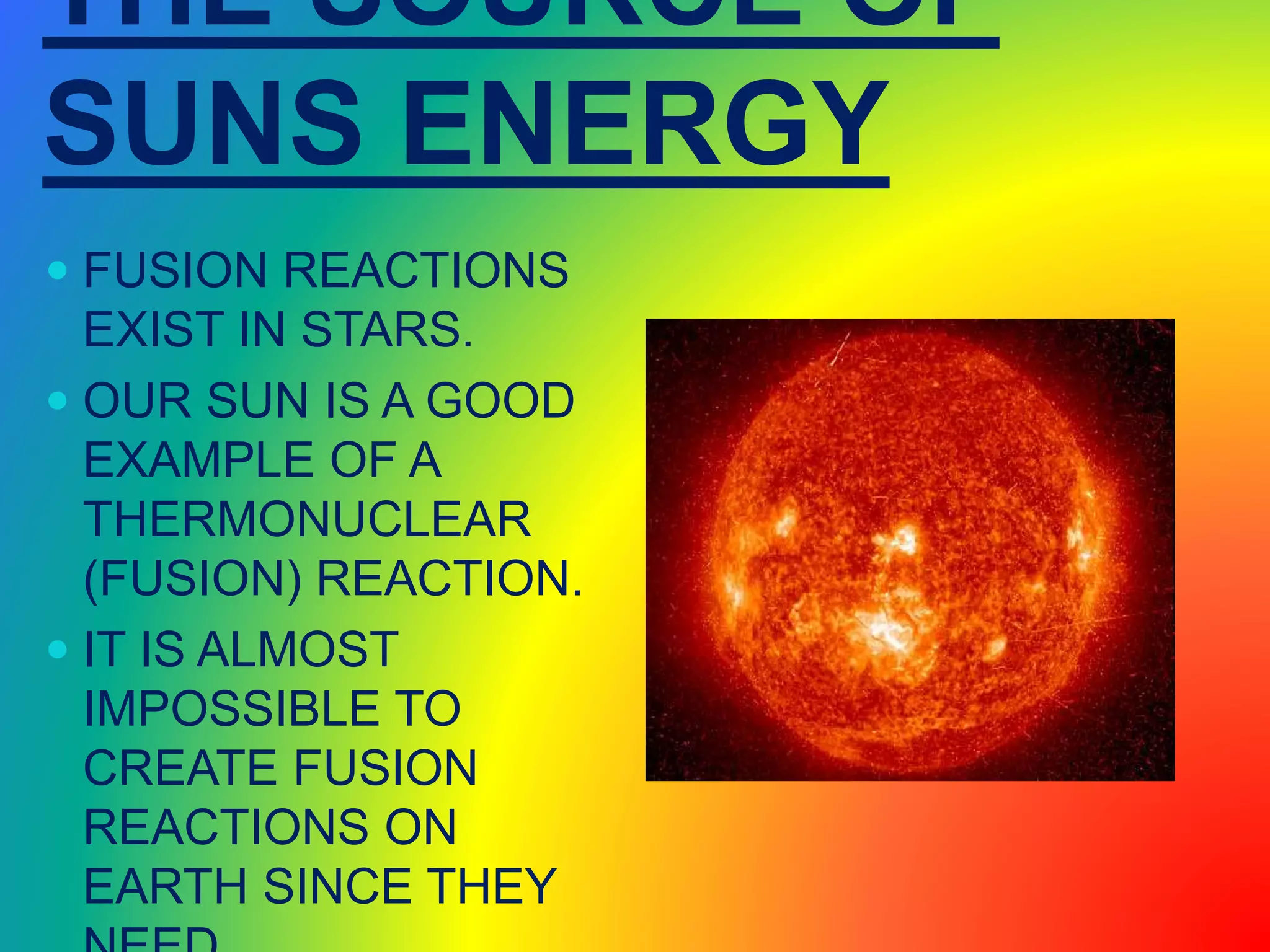
THE SOURCE OF
SUNS ENERGY
 FUSION REACTIONS
EXIST IN STARS.
 OUR SUN IS A GOOD
EXAMPLE OF A
THERMONUCLEAR
(FUSION) REACTION.
 IT IS ALMOST
IMPOSSIBLE TO
CREATE FUSION
REACTIONS ON
EARTH SINCE THEY
Nuclear fusion
produces less
nuclear waste
than nuclear
fission and the
materials are
easier to obtain.
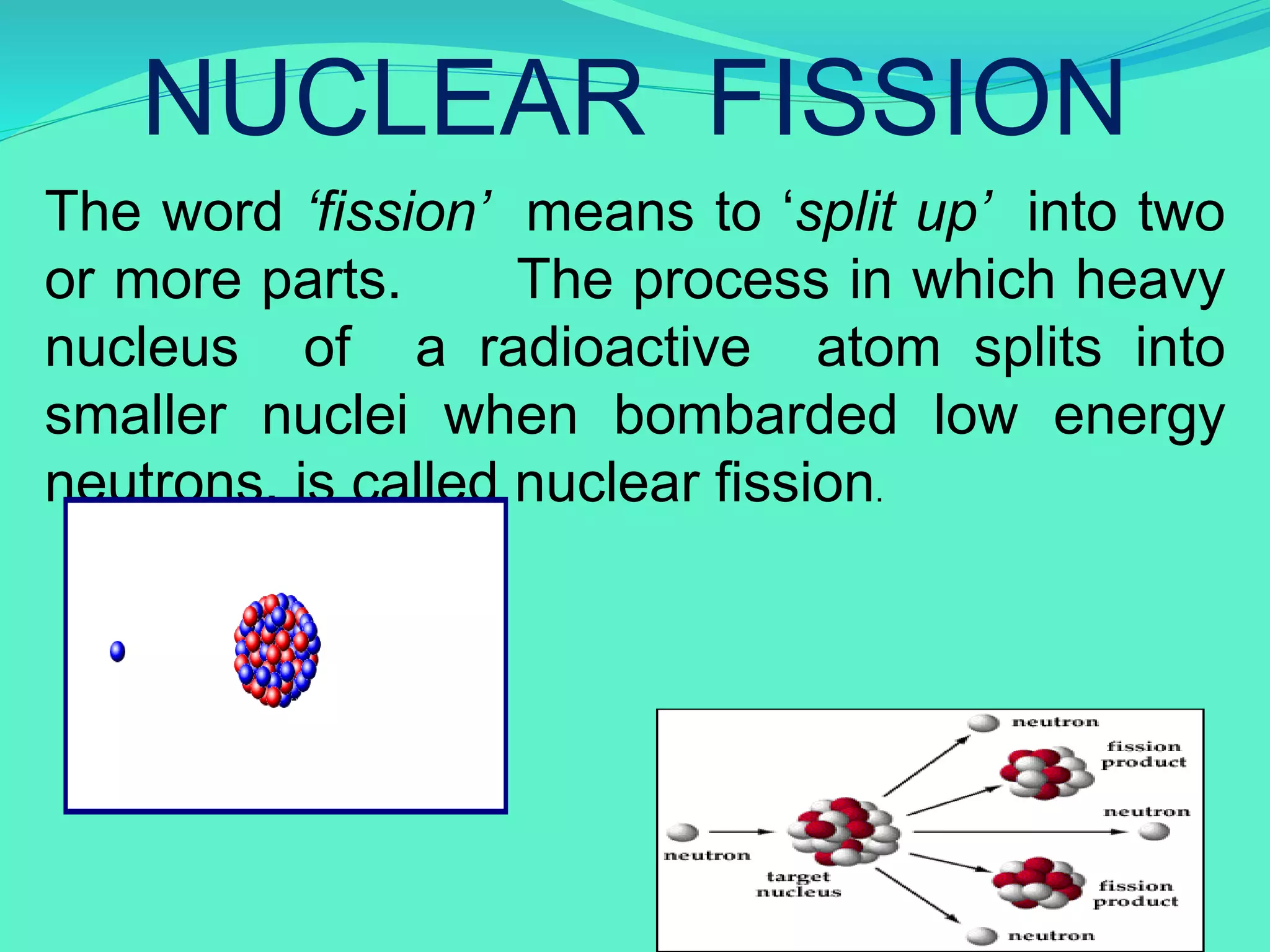
NUCLEAR FISSION
The word ‘fission’ means to ‘split up’ into two
or more parts. The process in which heavy
nucleus of a radioactive atom splits into
smaller nuclei when bombarded low energy
neutrons, is called nuclear fission.
 Nuclear fission: heavy nuclei split into two smaller
parts in order to become more stable
proton
neutron
U-235 nucleus
Kr-92 nucleus
Ba-141 nucleus
energy
CHAIN REACTION
 URANIUM EXISTS AS AN ISOTOPE IN THE
FORM OF U235 WHICH IS
UNSTABLE.
 WHEN THE NUCLEUS OF AN ATOM OF
URANIUM IS SPLIT, THE NEUTRONS
RELEASED HIT OTHER ATOMS AND
SPLIT THEM IN TURN. MORE ENERGY IS
RELEASED EACH TIME ANOTHER ATOM
SPLITS. THIS IS CALLED A CHAIN
REACTION.
 Neutrons released in fission trigger the fissions of
other nuclei
PROTON
NEUTRO
N
U-235 NUCLEUS
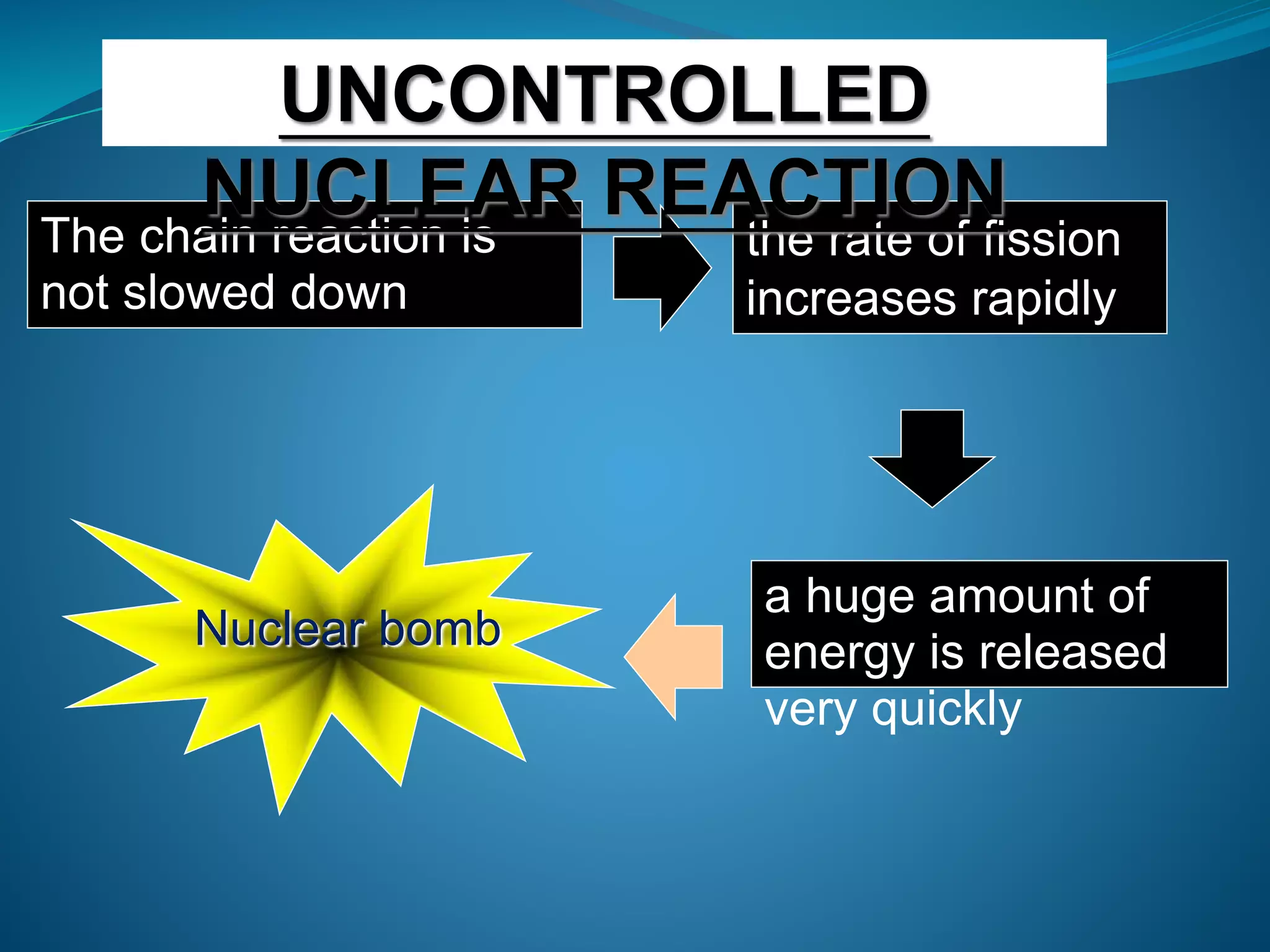
The chain reaction is
not slowed down
a huge amount of
energy is released
very quickly
the rate of fission
increases rapidly
Nuclear bomb
UNCONTROLLED
NUCLEAR REACTION
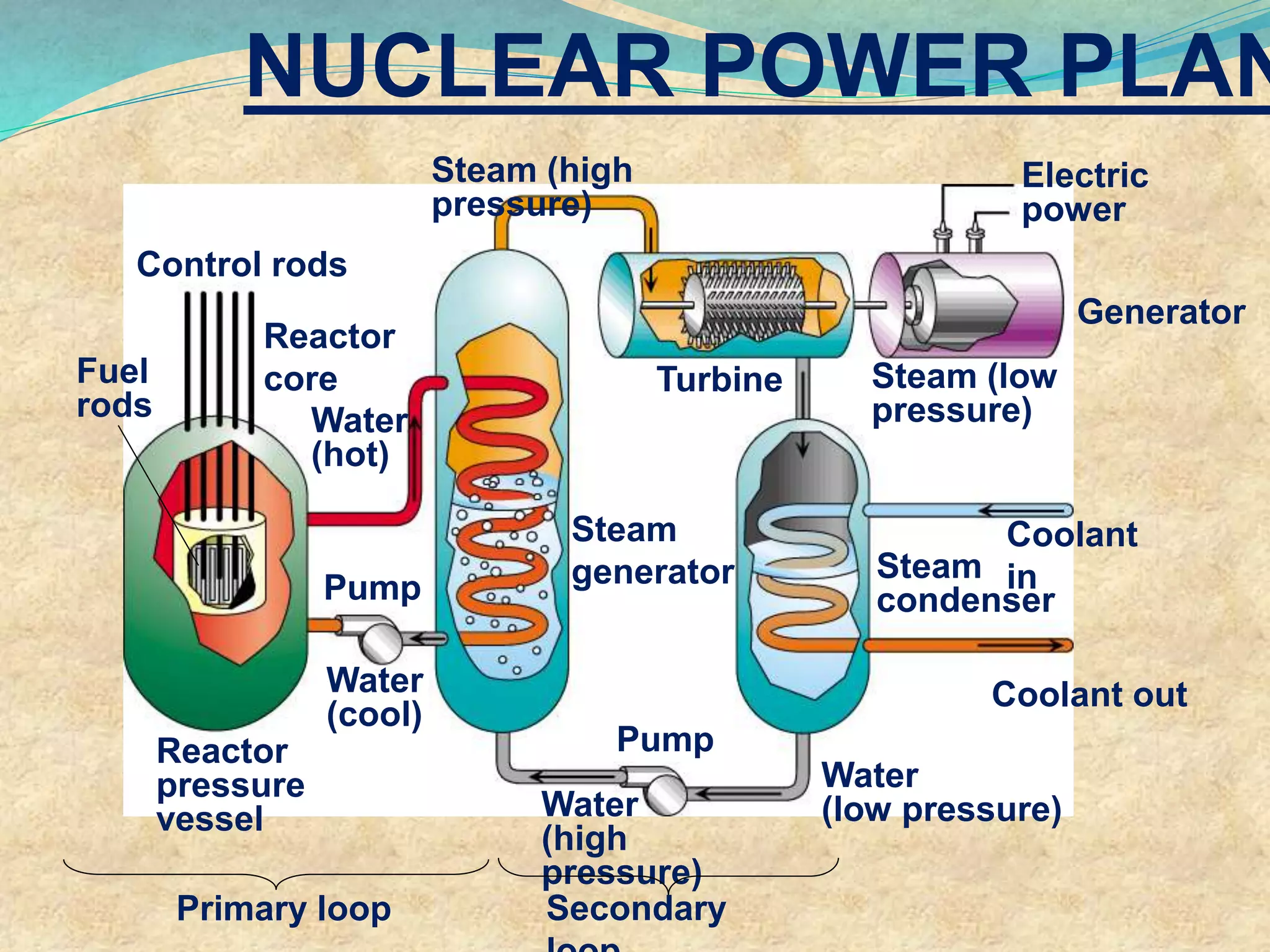
NUCLEAR POWER PLAN
Control rods
Fuel
rods
Reactor
pressure
vessel
Water
(cool)
Water
(hot)
Water
(high
pressure)
Water
(low pressure)
Coolant out
Coolant
inSteam
condenser
Steam (low
pressure)
Turbine
Electric
power
Steam
generator
Steam (high
pressure)
Pump
Primary loop Secondary
Generator
Reactor
core
Pump
control rods
reactor
pressure
vessel
water
(cool)
water
(hot)
water (high
pressure)
water (low
pressure)
coolant out
coolant in
steam condenser
steam (low
pressure)
turbine
electric
power
steam
generator
steam (high pressure)
pump
primary loop secondary loop
fuel rods  They contain the nuclear fuel:
uranium (U-235)
 They are surrounded by a
moderator (water or graphite) to
slow down the neutrons released.
control rods
reactor
pressure
vessel
water
(cool)
water
(hot)
water (high
pressure)
water (low
pressure)
coolant out
coolant in
steam condenser
steam (low
pressure)
turbine
electric
power
steam
generator
steam (high pressure)
pump
primary loop secondary loop
fuel rods
 They control the rate of reaction by
moving in and out of the reactor.
 Move in: rate of reaction 
 Move out: rate of reaction 
 All are moved in: the reactor is
shut down
 They are made of boron or
cadmium that can absorb neutrons.
steam
generator
control rods
reactor
pressure
vessel water (high
pressure)
water (low
pressure)
coolant out
coolant in
steam condenser
steam (high
pressure)
pump
primary loop secondary loop
fuel rods
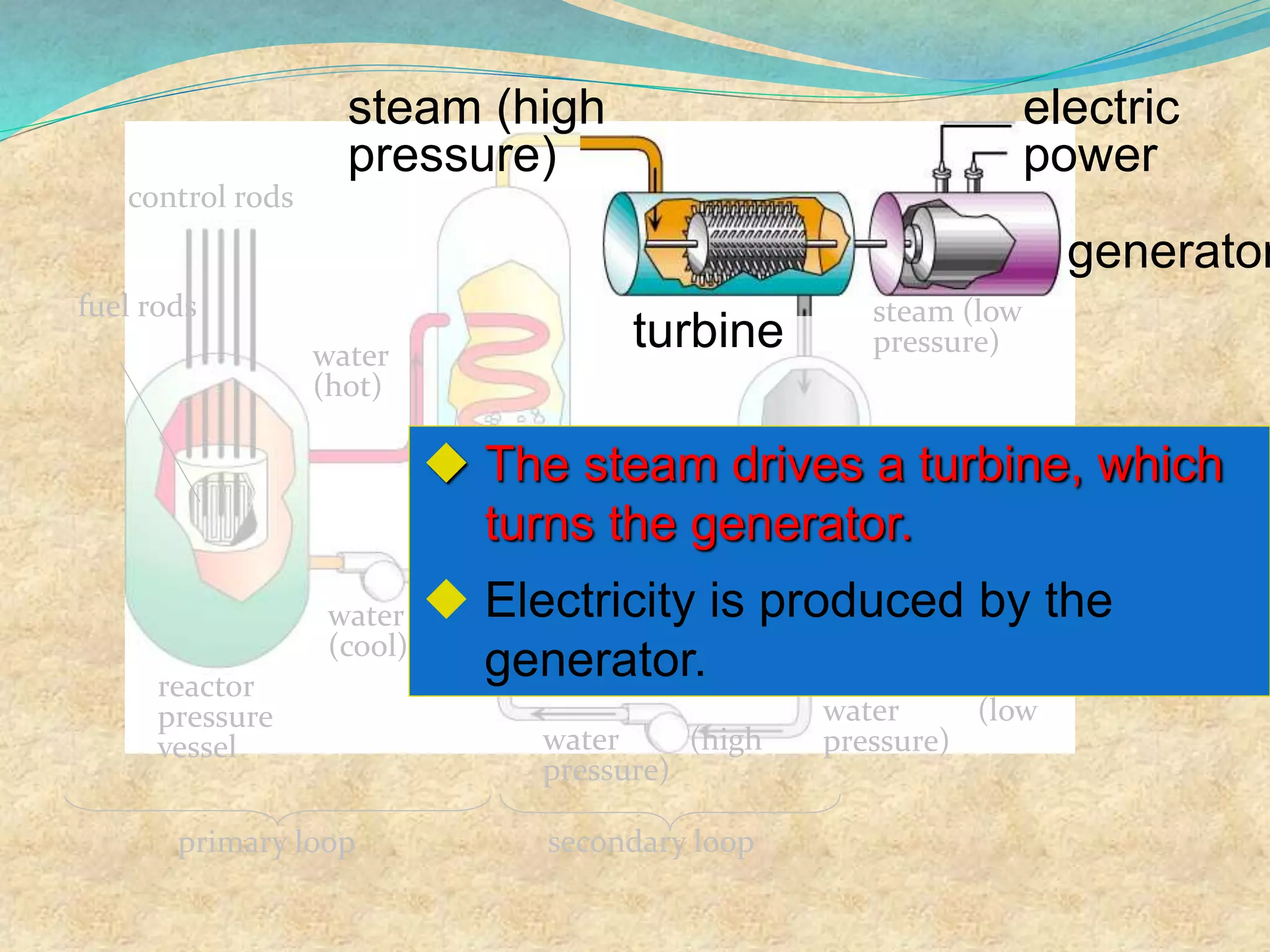
 The steam drives a turbine, which
turns the generator.
 Electricity is produced by the
generator.
water
(hot)
water
(cool)
steam (low
pressure)turbine
electric
power
generator
control rods
fuel rods
reactor
pressure
vessel
water
(cool)
water
(hot)
water (high
pressure)
water (low
pressure)
coolant out
coolant in
steam condenser
steam (low
pressure)
turbine
electric
power
steam
generator
steam (high pressure)
pump
primary loop secondary loop
 Two separate water systems are used to avoid
radioactive substances to reach the turbine.
control rods
reactor
pressure
vessel water (high
pressure)
water (low
pressure)
coolant out
coolant in
steam condenser
steam (low
pressure)
turbine
electric
power
pump
primary loop secondary loop
fuel rods
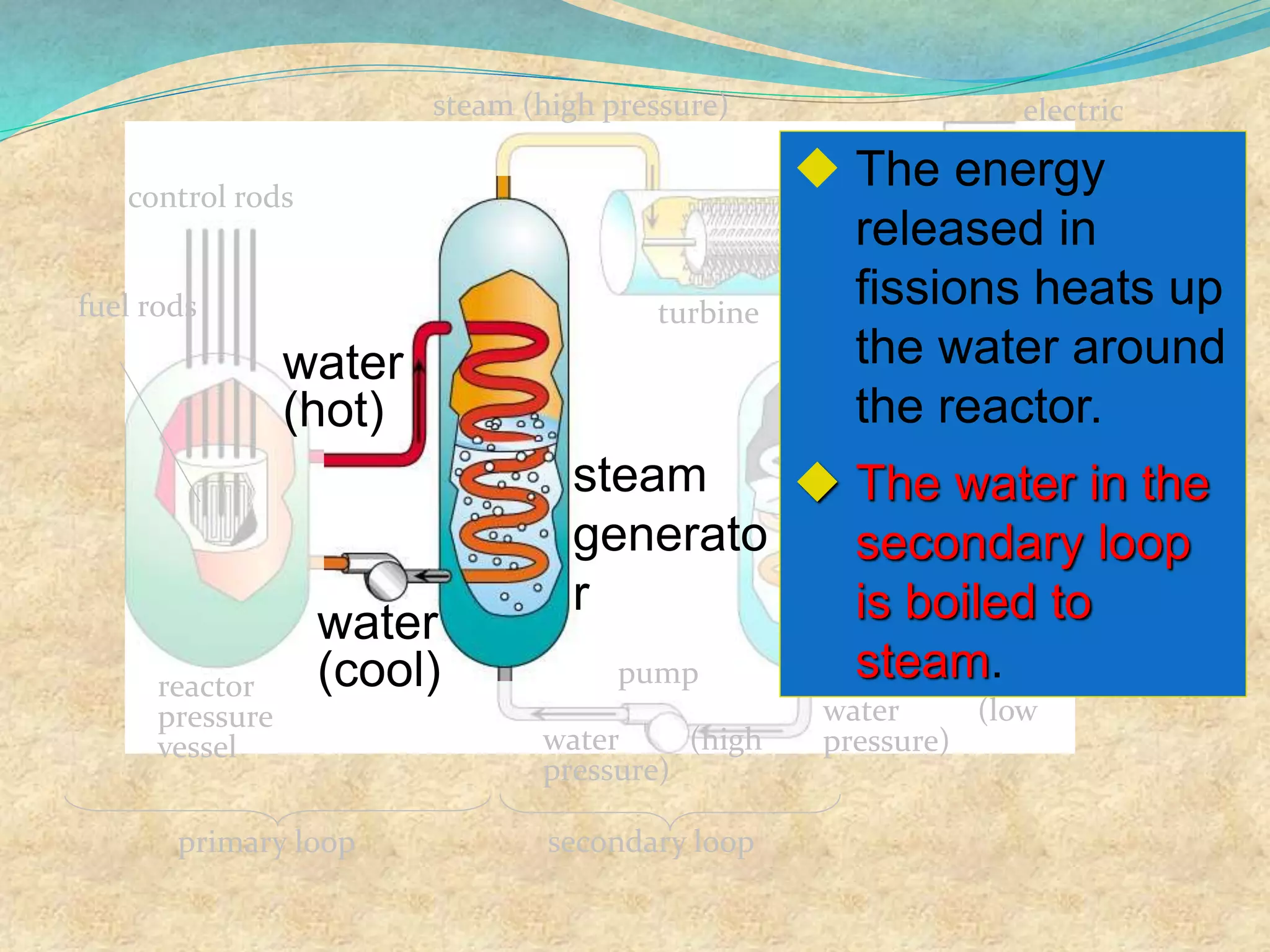
 The energy
released in
fissions heats up
the water around
the reactor.
 The water in the
secondary loop
is boiled to
steam.
water
(hot)
water
(cool)
steam
generato
r
steam (high pressure)
 Madras
 Kaiga
 Kakrapar
 Rajasthan
 Narora
 Kanupp
 Chasnupp
 Tarapur
 Kudankulum
NUCLEAR POWER PLANTS IN
INDIA
ADVANTAGES OF
NUCLEAR ENERGY
 Almost 0 emissions (very low greenhouse
gas emissions).
 They can be sited almost anywhere unlike oil
which is mostly imported.
 The plants almost never experience problems
if not from human error, which almost never
happens anyway because the plant only
needs like 10 people to operate it.
 A small amount of matter creates a large
amount of energy.
 A lot of energy is generated from a single
power plant. Current nuclear waste in the US
is over 90% Uranium.
NUCLEAR ENERGY
 Nuclear plants are more expensive
to build and maintain.
 Waste products are dangerous and
need to be carefully stored for long
periods of time. The spent fuel is
highly radioactive and has to be
carefully stored for many years or
decades after use. This adds to the
costs.
 There is presently no adequate
safe long-term storage for
radioactive and chemical waste
Nuclear energy
Nuclear energy

Nuclear energy

  • 1.
  • 2.
    2.The nuclear energyis released mainly in the form of the heat(and some light) 3.Nuclear energy is also called atomic energy as it is considered to be coming from the atom
  • 3.
    Radioactive Substance • Elementthat has an unstable nucleus • Will decay and emits radioactive radiation and heat to form a new element which is more stable. This process is called radioactive decay. • Nucleus of radioactive substance is not stable and radiates alpha (α)particles, beta (β) particles or gamma (γ)rays to form a more stable nucleus. • Examples of radioactive substances are uranium, radium and carbon-14.
  • 4.
    TWO WAYS TO OBTAINNUCLEAR ENERGY:
  • 5.
    When atoms arejoined together to form a larger atom is commonly referred to as nuclear fusion. The sun produces energy through nuclear fusion where the nuclei of hydrogen atoms are fused into helium atoms.
  • 6.
     Nuclear fusion:light nuclei fuse together to form a heavier nucleus proto nneutr helium nucleus neutr on energ y deuterium nucleus tritium nucleus H-2 + H-3  He-4 + n +
  • 7.
    THE SOURCE OF SUNSENERGY  FUSION REACTIONS EXIST IN STARS.  OUR SUN IS A GOOD EXAMPLE OF A THERMONUCLEAR (FUSION) REACTION.  IT IS ALMOST IMPOSSIBLE TO CREATE FUSION REACTIONS ON EARTH SINCE THEY
  • 8.
    Nuclear fusion produces less nuclearwaste than nuclear fission and the materials are easier to obtain.
  • 9.
    NUCLEAR FISSION The word‘fission’ means to ‘split up’ into two or more parts. The process in which heavy nucleus of a radioactive atom splits into smaller nuclei when bombarded low energy neutrons, is called nuclear fission.
  • 10.
     Nuclear fission:heavy nuclei split into two smaller parts in order to become more stable proton neutron U-235 nucleus Kr-92 nucleus Ba-141 nucleus energy
  • 11.
    CHAIN REACTION  URANIUMEXISTS AS AN ISOTOPE IN THE FORM OF U235 WHICH IS UNSTABLE.  WHEN THE NUCLEUS OF AN ATOM OF URANIUM IS SPLIT, THE NEUTRONS RELEASED HIT OTHER ATOMS AND SPLIT THEM IN TURN. MORE ENERGY IS RELEASED EACH TIME ANOTHER ATOM SPLITS. THIS IS CALLED A CHAIN REACTION.
  • 12.
     Neutrons releasedin fission trigger the fissions of other nuclei PROTON NEUTRO N U-235 NUCLEUS
  • 13.
    The chain reactionis not slowed down a huge amount of energy is released very quickly the rate of fission increases rapidly Nuclear bomb UNCONTROLLED NUCLEAR REACTION
  • 14.
    NUCLEAR POWER PLAN Controlrods Fuel rods Reactor pressure vessel Water (cool) Water (hot) Water (high pressure) Water (low pressure) Coolant out Coolant inSteam condenser Steam (low pressure) Turbine Electric power Steam generator Steam (high pressure) Pump Primary loop Secondary Generator Reactor core Pump
  • 15.
    control rods reactor pressure vessel water (cool) water (hot) water (high pressure) water(low pressure) coolant out coolant in steam condenser steam (low pressure) turbine electric power steam generator steam (high pressure) pump primary loop secondary loop fuel rods  They contain the nuclear fuel: uranium (U-235)  They are surrounded by a moderator (water or graphite) to slow down the neutrons released.
  • 16.
    control rods reactor pressure vessel water (cool) water (hot) water (high pressure) water(low pressure) coolant out coolant in steam condenser steam (low pressure) turbine electric power steam generator steam (high pressure) pump primary loop secondary loop fuel rods  They control the rate of reaction by moving in and out of the reactor.  Move in: rate of reaction   Move out: rate of reaction   All are moved in: the reactor is shut down  They are made of boron or cadmium that can absorb neutrons.
  • 17.
    steam generator control rods reactor pressure vessel water(high pressure) water (low pressure) coolant out coolant in steam condenser steam (high pressure) pump primary loop secondary loop fuel rods  The steam drives a turbine, which turns the generator.  Electricity is produced by the generator. water (hot) water (cool) steam (low pressure)turbine electric power generator
  • 18.
    control rods fuel rods reactor pressure vessel water (cool) water (hot) water(high pressure) water (low pressure) coolant out coolant in steam condenser steam (low pressure) turbine electric power steam generator steam (high pressure) pump primary loop secondary loop  Two separate water systems are used to avoid radioactive substances to reach the turbine.
  • 19.
    control rods reactor pressure vessel water(high pressure) water (low pressure) coolant out coolant in steam condenser steam (low pressure) turbine electric power pump primary loop secondary loop fuel rods  The energy released in fissions heats up the water around the reactor.  The water in the secondary loop is boiled to steam. water (hot) water (cool) steam generato r steam (high pressure)
  • 20.
     Madras  Kaiga Kakrapar  Rajasthan  Narora  Kanupp  Chasnupp  Tarapur  Kudankulum NUCLEAR POWER PLANTS IN INDIA
  • 21.
    ADVANTAGES OF NUCLEAR ENERGY Almost 0 emissions (very low greenhouse gas emissions).  They can be sited almost anywhere unlike oil which is mostly imported.  The plants almost never experience problems if not from human error, which almost never happens anyway because the plant only needs like 10 people to operate it.  A small amount of matter creates a large amount of energy.  A lot of energy is generated from a single power plant. Current nuclear waste in the US is over 90% Uranium.
  • 22.
    NUCLEAR ENERGY  Nuclearplants are more expensive to build and maintain.  Waste products are dangerous and need to be carefully stored for long periods of time. The spent fuel is highly radioactive and has to be carefully stored for many years or decades after use. This adds to the costs.  There is presently no adequate safe long-term storage for radioactive and chemical waste