Presentation
on
NoSQL
What is RDBMS
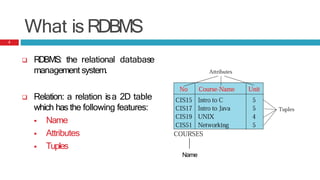
 RDBMS: the relational database
management system.
 Relation: a relation isa 2D table
which has the following features:
 Name
 Attributes
 Tuples
Name
2
Issues with RDBMS- Scalability
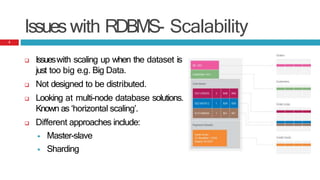
 Issueswith scaling up when the dataset is
just too big e.g. Big Data.
 Not designed to be distributed.
 Looking at multi-node database solutions.
Known as ‘horizontal scaling’.
 Different approaches include:
 Master-slave
 Sharding
3
What is NoSQL
 Standsfor Not Only SQL. T
ermwas redefined by Eric Evansafter Carlo
Strozzi.
 Class of non-relational data storage system
s.
 Do not require a fixed table schema nor do they usethe concept of joins.
 Relaxation for oneor moreof theACIDproperties (Atomicity,Consistency,
Isolation, Durability) using CAP theorem.
5
Need of NoSQL
 Explosion of social media sites (Facebook, Twitter, Google etc.) with large
data needs. (Sharding isa problem)
 Rise of cloud-based solutions such as Amazon S3 (simple storage solution).
 Just as moving to dynamically-typed languages (Ruby/Groovy), a shift to
dynamically-typed data with frequent schema changes.
 Expansion of Open-source community.
 NoSQL solution is more acceptable to a client now than a year ago.
6
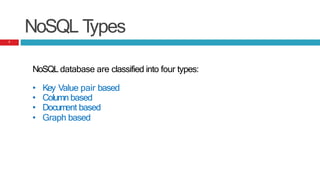
NoSQL T
ypes
NoSQL database are classified into four types:
• Key Value pair based
• Column based
• Document based
• Graph based
7
Key Value P
air Based
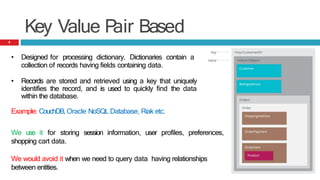
• Designed for processing dictionary. Dictionaries contain a
collection of records having fields containing data.
• Records are stored and retrieved using a key that uniquely
identifies the record, and is used to quickly find the data
within the database.
Example: CouchDB, Oracle NoSQL Database, Riak etc.
We use it for storing session information, user profiles, preferences,
shopping cart data.
We would avoid it when we need to query data having relationships
between entities.
8
Column based
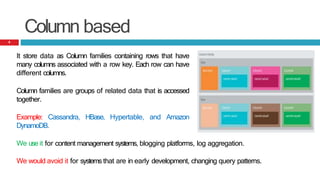
It store data as Column families containing rows that have
many columns associated with a row key. Each row can have
different columns.
Column families are groups of related data that is accessed
together.
Example: Cassandra, HBase, Hypertable, and Amazon
DynamoDB.
We use it for content management systems, blogging platforms, log aggregation.
We would avoid it for systems that are in early development, changing query patterns.
9
Document Based
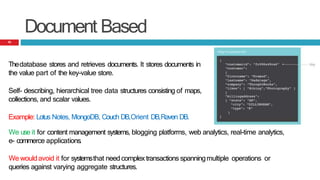
Thedatabase stores and retrieves documents. It stores documents in
the value part of the key-value store.
Self- describing, hierarchical tree data structures consisting of maps,
collections, and scalar values.
Example: Lotus Notes, MongoDB, Couch DB,Orient DB,Raven DB.
We use it for content management systems, blogging platforms, web analytics, real-time analytics,
e- commerce applications.
We wouldavoid it for systemsthat need complex transactions spanningmultiple operations or
queries against varying aggregate structures.
10
Graph Based
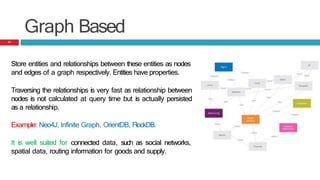
Store entities and relationships between these entities as nodes
and edges of a graph respectively. Entities have properties.
Traversing the relationships is very fast as relationship between
nodes is not calculated at query time but is actually persisted
as a relationship.
Example: Neo4J, Infinite Graph, OrientDB, FlockDB.
It is well suited for connected data, such as social networks,
spatial data, routing information for goods and supply.
11
Advantages of NoSQL
 Cheap and easy to implement (open source)
 Data are replicated to multiple nodes (therefore identical and fault-
tolerant) and can be partitioned
 When data is written, the latest version is on at least one node and then
replicated to other nodes
 No single point of failure
 Easy to distribute
 Don't require a schema
13
Conclusion
 All the choices provided by the rise of NoSQL databases does not mean the demise
of RDBMSdatabases as R
elational databases are a powerful tool.
 We are entering anera of Polyglot persistence,a techniquethat usesdifferent data
storage technologies to handle varying data storage needs.It canapply acrossan
enterprise or within an individual application.
16
Thank
You

NoSQL powerpoint presentation difference with rdbms

  • 1.
  • 2.
    What is RDBMS RDBMS: the relational database management system.  Relation: a relation isa 2D table which has the following features:  Name  Attributes  Tuples Name 2
  • 3.
    Issues with RDBMS-Scalability  Issueswith scaling up when the dataset is just too big e.g. Big Data.  Not designed to be distributed.  Looking at multi-node database solutions. Known as ‘horizontal scaling’.  Different approaches include:  Master-slave  Sharding 3
  • 4.
    What is NoSQL Standsfor Not Only SQL. T ermwas redefined by Eric Evansafter Carlo Strozzi.  Class of non-relational data storage system s.  Do not require a fixed table schema nor do they usethe concept of joins.  Relaxation for oneor moreof theACIDproperties (Atomicity,Consistency, Isolation, Durability) using CAP theorem. 5
  • 5.
    Need of NoSQL Explosion of social media sites (Facebook, Twitter, Google etc.) with large data needs. (Sharding isa problem)  Rise of cloud-based solutions such as Amazon S3 (simple storage solution).  Just as moving to dynamically-typed languages (Ruby/Groovy), a shift to dynamically-typed data with frequent schema changes.  Expansion of Open-source community.  NoSQL solution is more acceptable to a client now than a year ago. 6
  • 6.
    NoSQL T ypes NoSQL databaseare classified into four types: • Key Value pair based • Column based • Document based • Graph based 7
  • 7.
    Key Value P airBased • Designed for processing dictionary. Dictionaries contain a collection of records having fields containing data. • Records are stored and retrieved using a key that uniquely identifies the record, and is used to quickly find the data within the database. Example: CouchDB, Oracle NoSQL Database, Riak etc. We use it for storing session information, user profiles, preferences, shopping cart data. We would avoid it when we need to query data having relationships between entities. 8
  • 8.
    Column based It storedata as Column families containing rows that have many columns associated with a row key. Each row can have different columns. Column families are groups of related data that is accessed together. Example: Cassandra, HBase, Hypertable, and Amazon DynamoDB. We use it for content management systems, blogging platforms, log aggregation. We would avoid it for systems that are in early development, changing query patterns. 9
  • 9.
    Document Based Thedatabase storesand retrieves documents. It stores documents in the value part of the key-value store. Self- describing, hierarchical tree data structures consisting of maps, collections, and scalar values. Example: Lotus Notes, MongoDB, Couch DB,Orient DB,Raven DB. We use it for content management systems, blogging platforms, web analytics, real-time analytics, e- commerce applications. We wouldavoid it for systemsthat need complex transactions spanningmultiple operations or queries against varying aggregate structures. 10
  • 10.
    Graph Based Store entitiesand relationships between these entities as nodes and edges of a graph respectively. Entities have properties. Traversing the relationships is very fast as relationship between nodes is not calculated at query time but is actually persisted as a relationship. Example: Neo4J, Infinite Graph, OrientDB, FlockDB. It is well suited for connected data, such as social networks, spatial data, routing information for goods and supply. 11
  • 11.
    Advantages of NoSQL Cheap and easy to implement (open source)  Data are replicated to multiple nodes (therefore identical and fault- tolerant) and can be partitioned  When data is written, the latest version is on at least one node and then replicated to other nodes  No single point of failure  Easy to distribute  Don't require a schema 13
  • 12.
    Conclusion  All thechoices provided by the rise of NoSQL databases does not mean the demise of RDBMSdatabases as R elational databases are a powerful tool.  We are entering anera of Polyglot persistence,a techniquethat usesdifferent data storage technologies to handle varying data storage needs.It canapply acrossan enterprise or within an individual application. 16
  • 13.