NON -VERBAL
COMMUNICATION
Prashant Bhati
FMS (University of Delhi)
Definition and Forms
• Body Language
• Space Proximities
• Touch
• Time
• Voice Issues
• Office,Environment
Non-verbal communication
includes pitch, speed ,tone,
and volume of voice,
gestures and facial
expressions, body posture,
stance, and proximity to the
listener, eye movements
and contact .
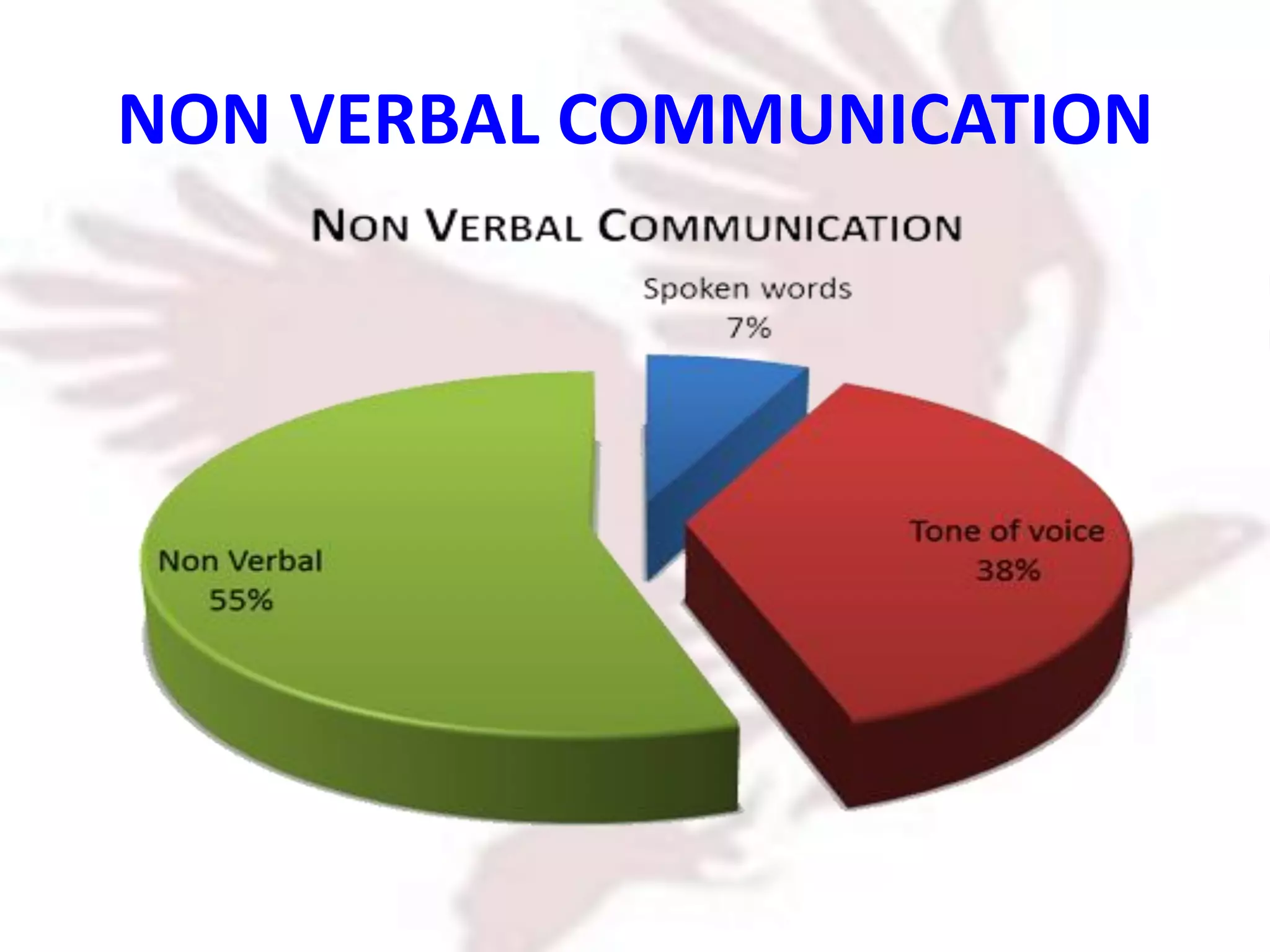
NON VERBAL COMMUNICATION
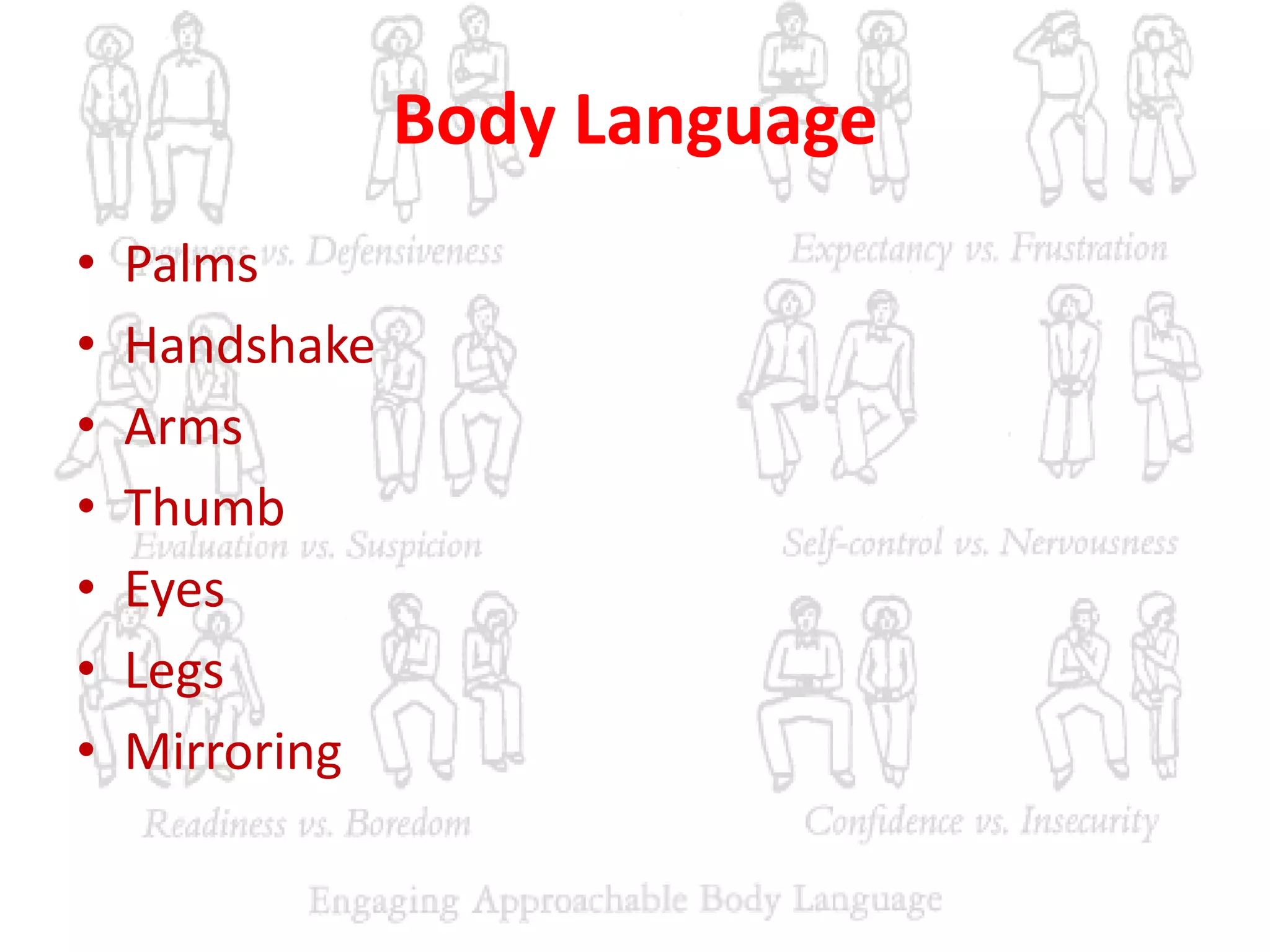
Body Language
Body Language
• Palms
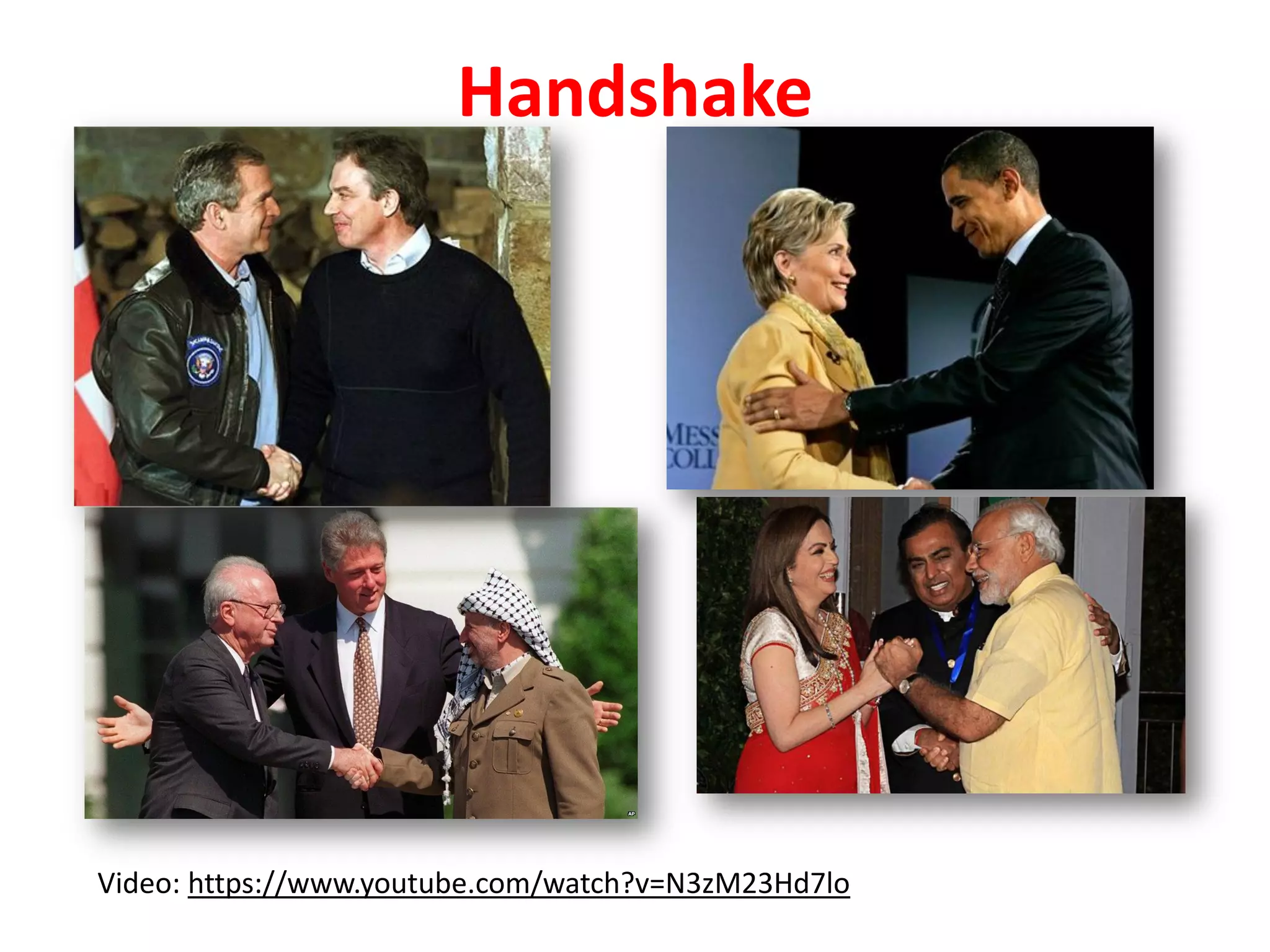
• Handshake
• Arms
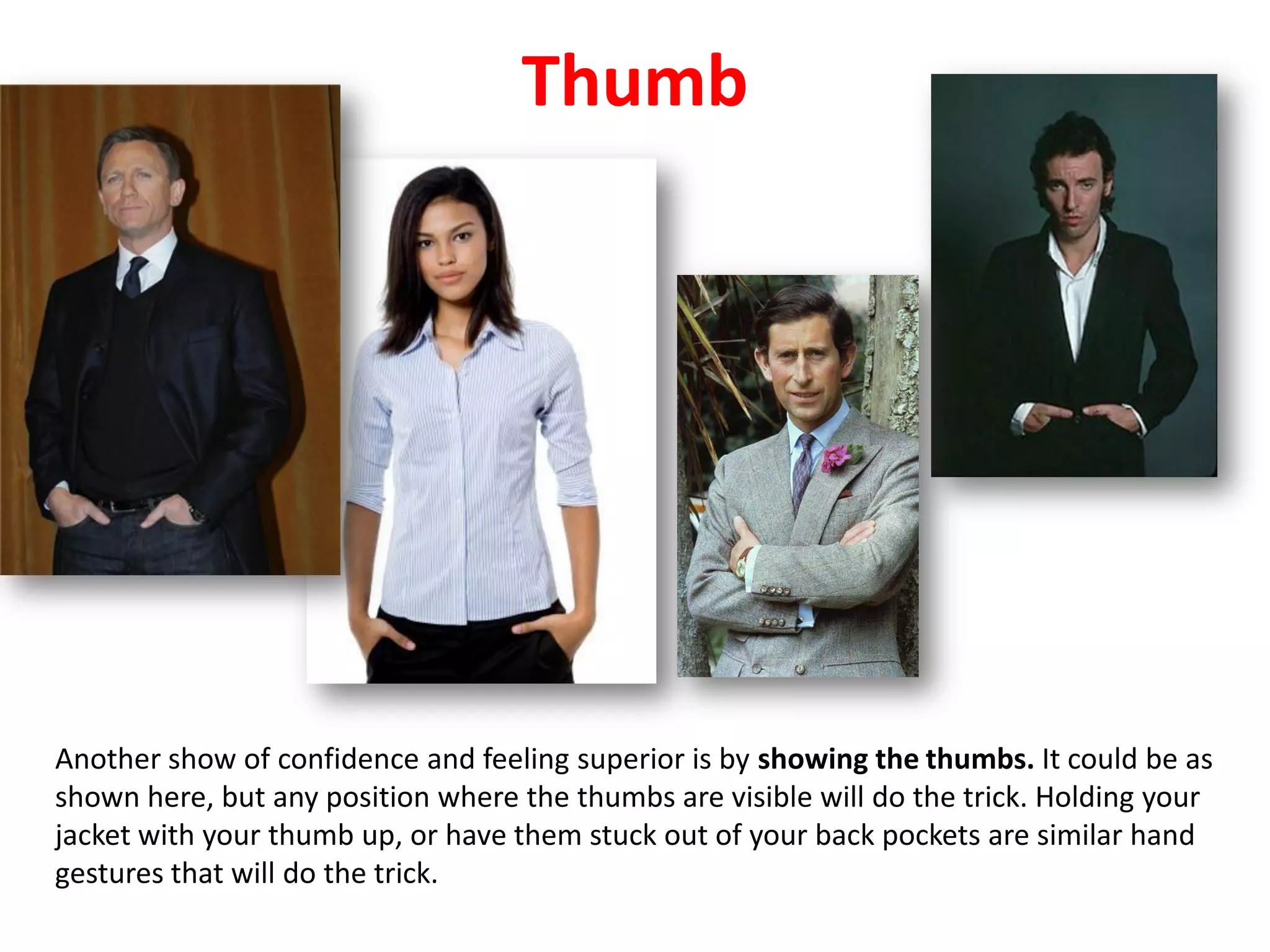
• Thumb
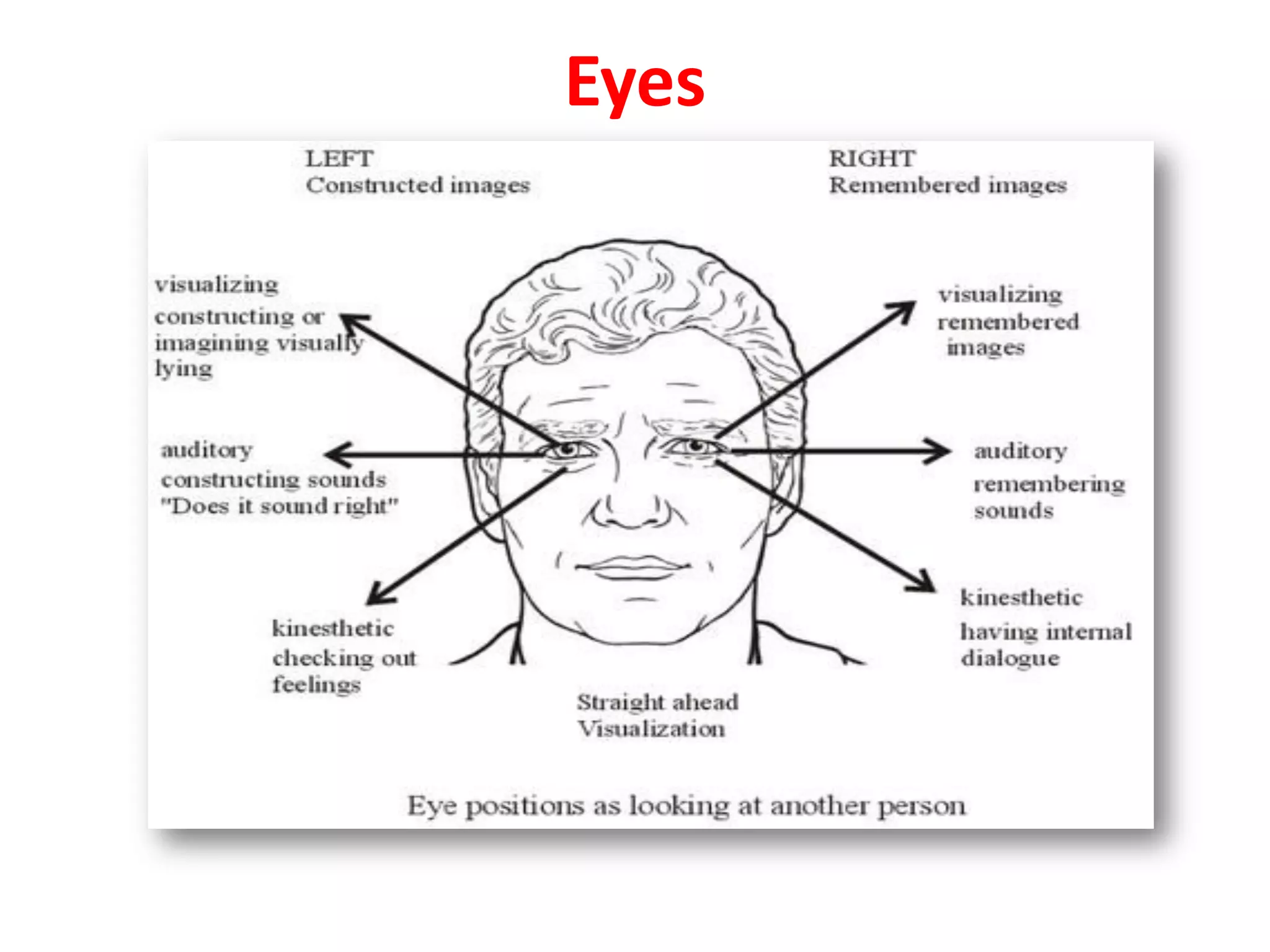
• Eyes
• Legs
• Mirroring
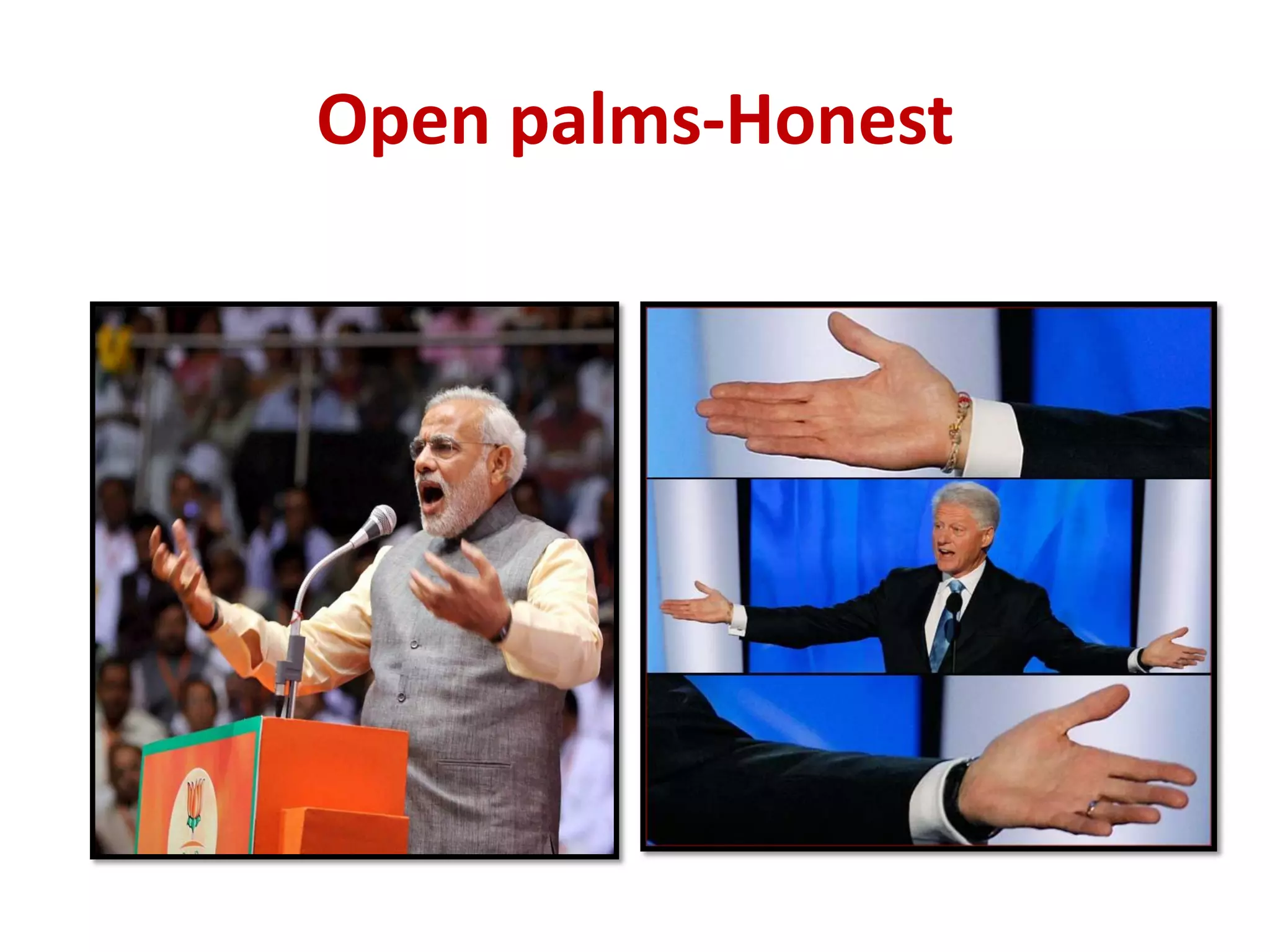
Open palms-Honest
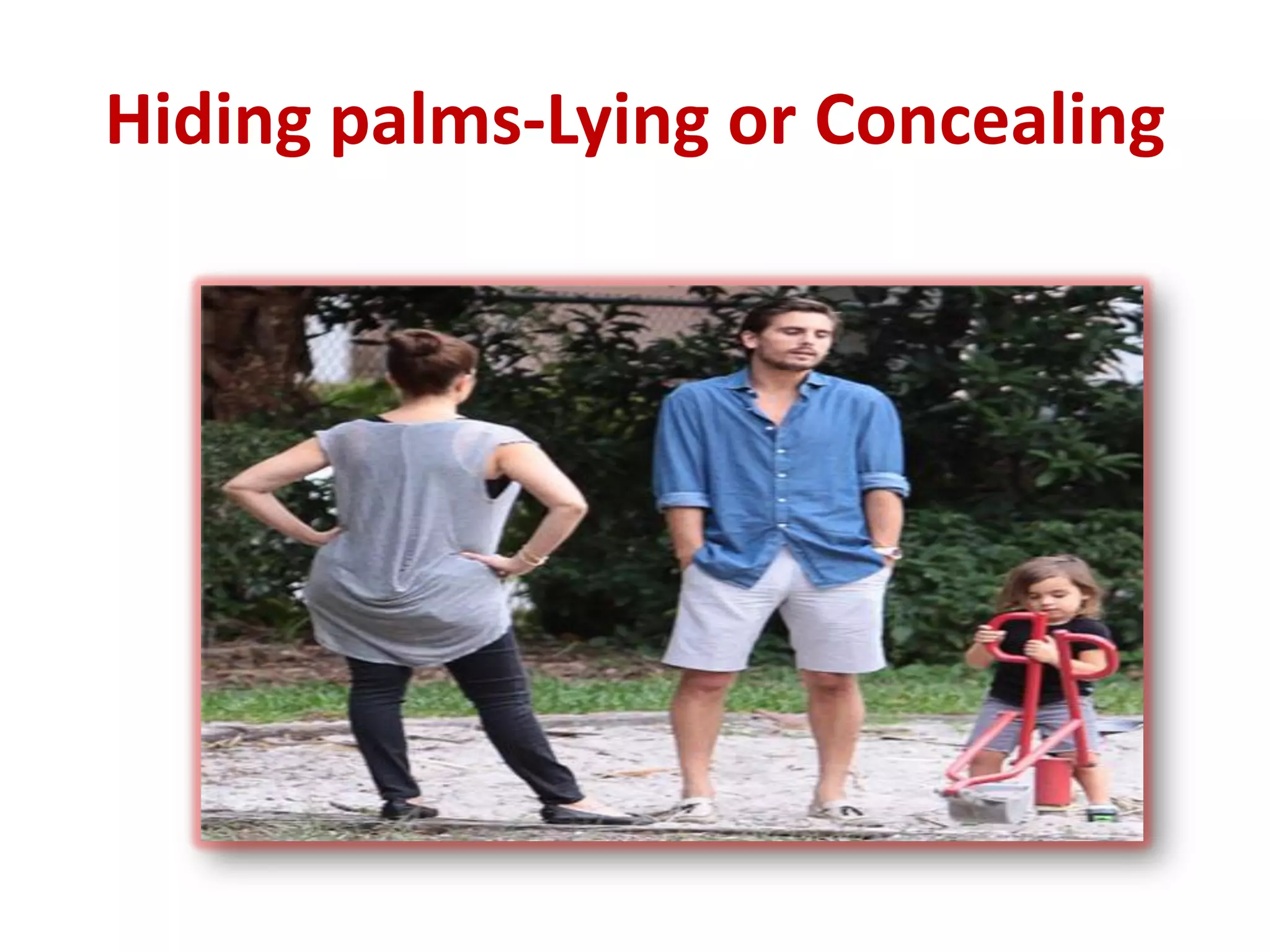
Hiding palms-Lying or Concealing
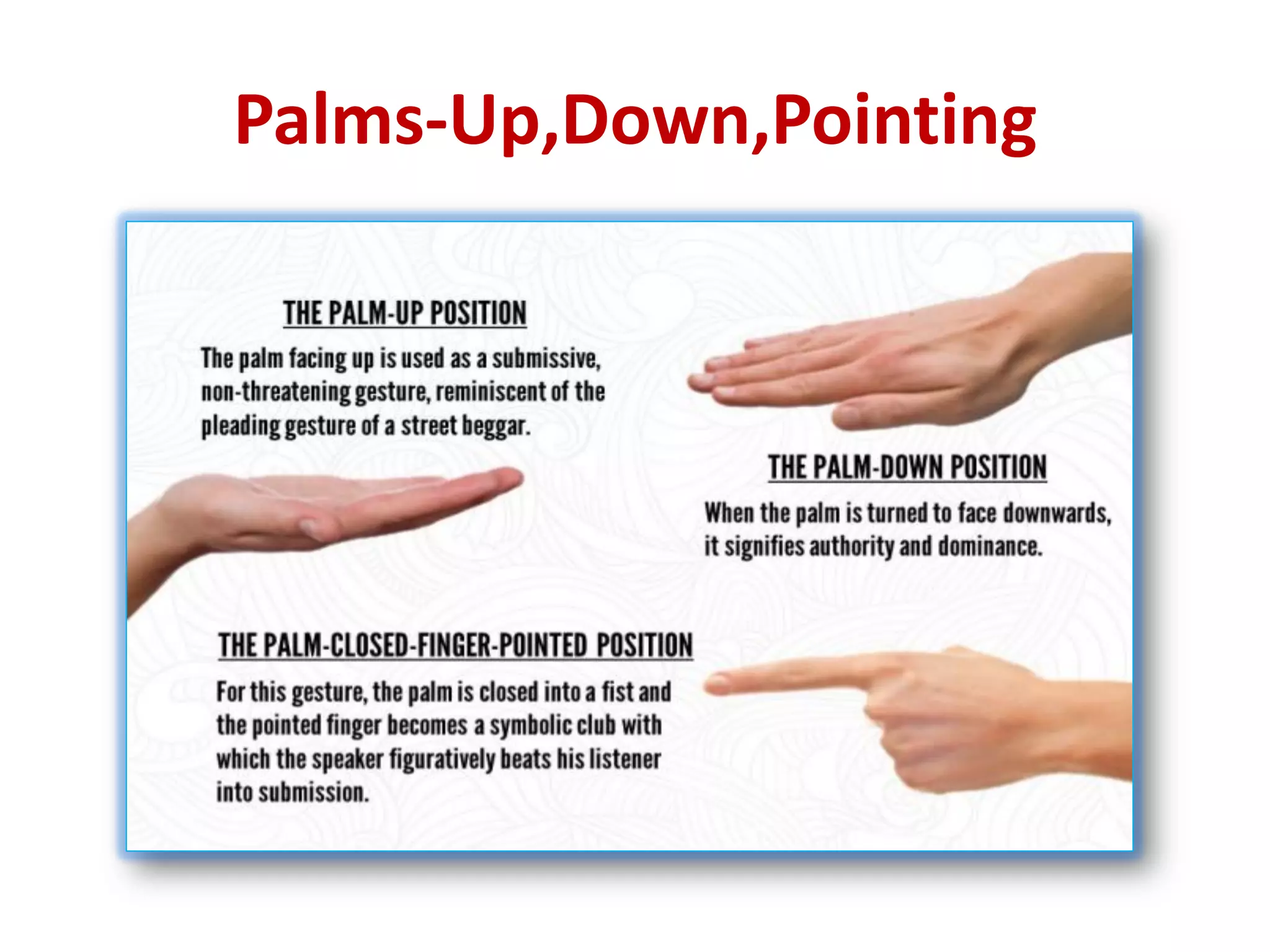
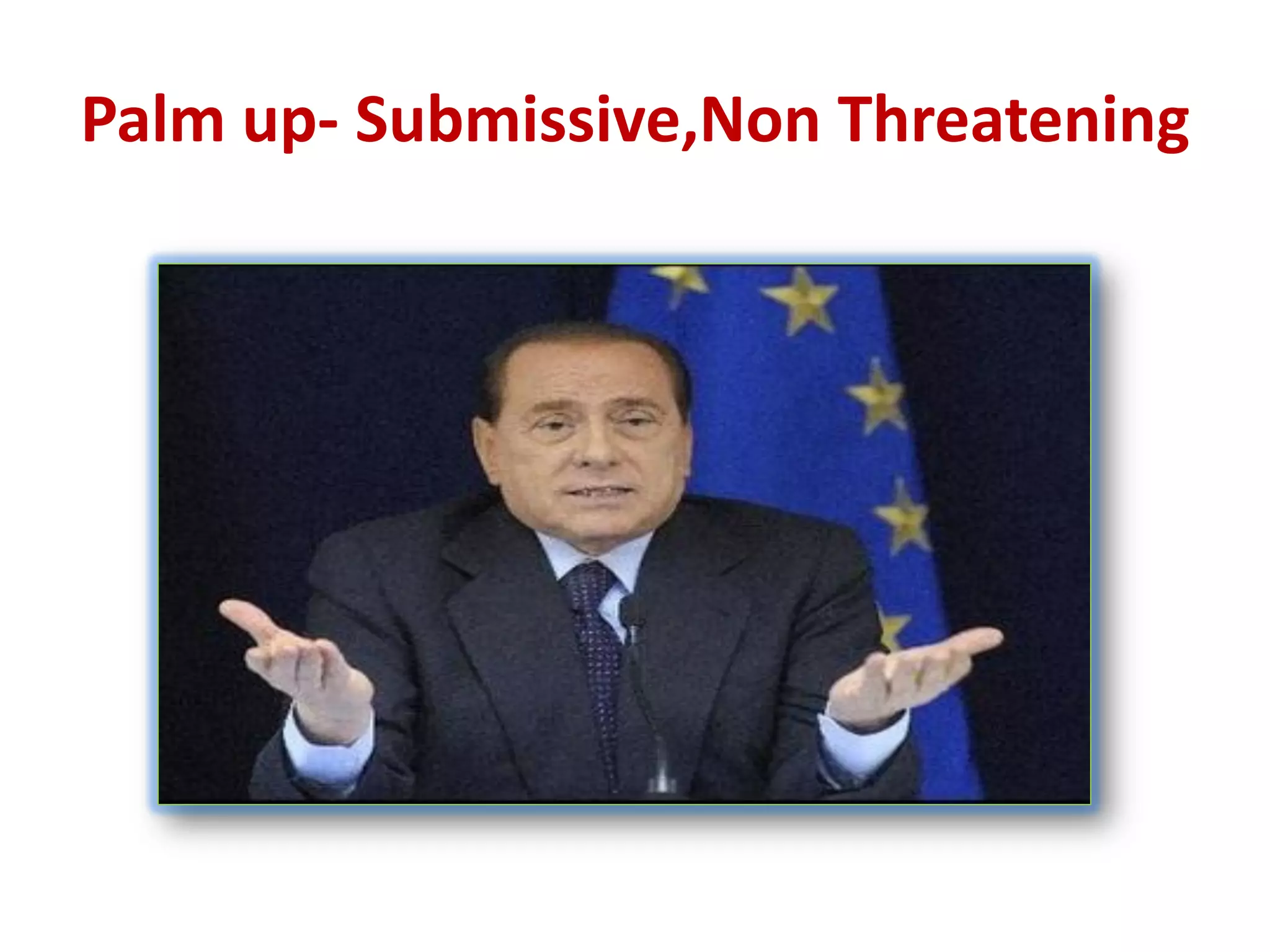
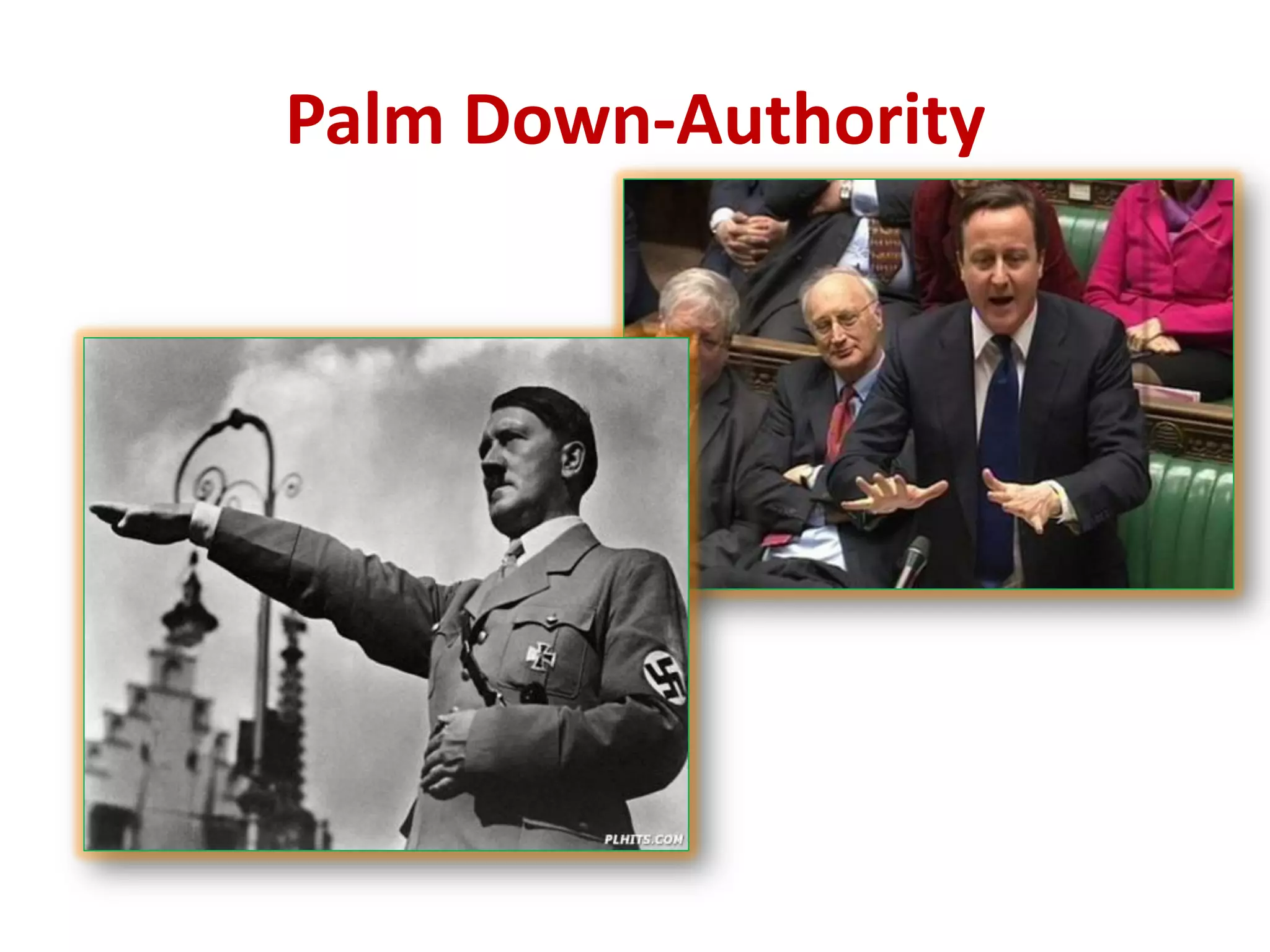
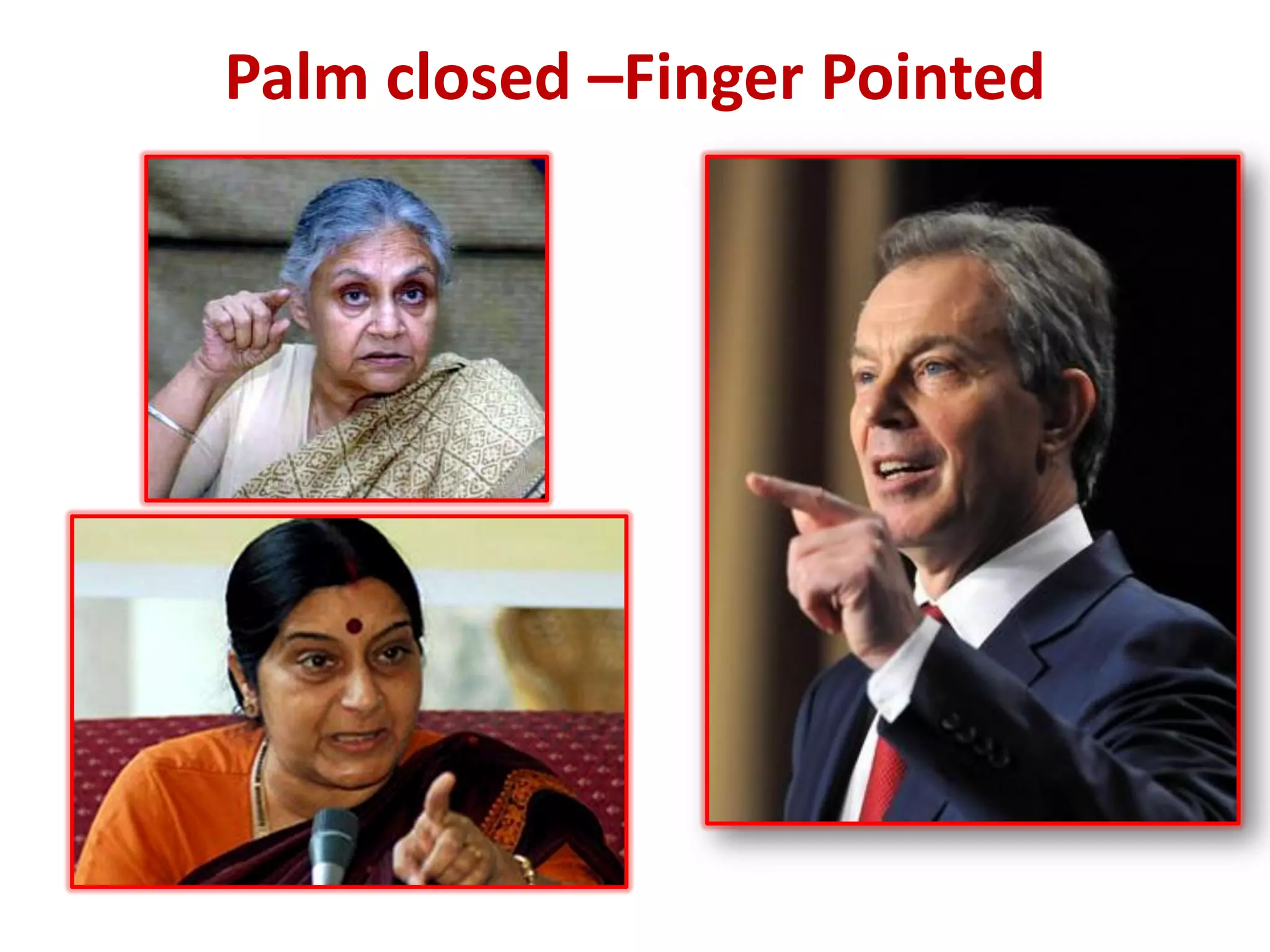
Palms-Up,Down,Pointing
Palm up- Submissive,Non Threatening
Palm Down-Authority
Palm closed –Finger Pointed
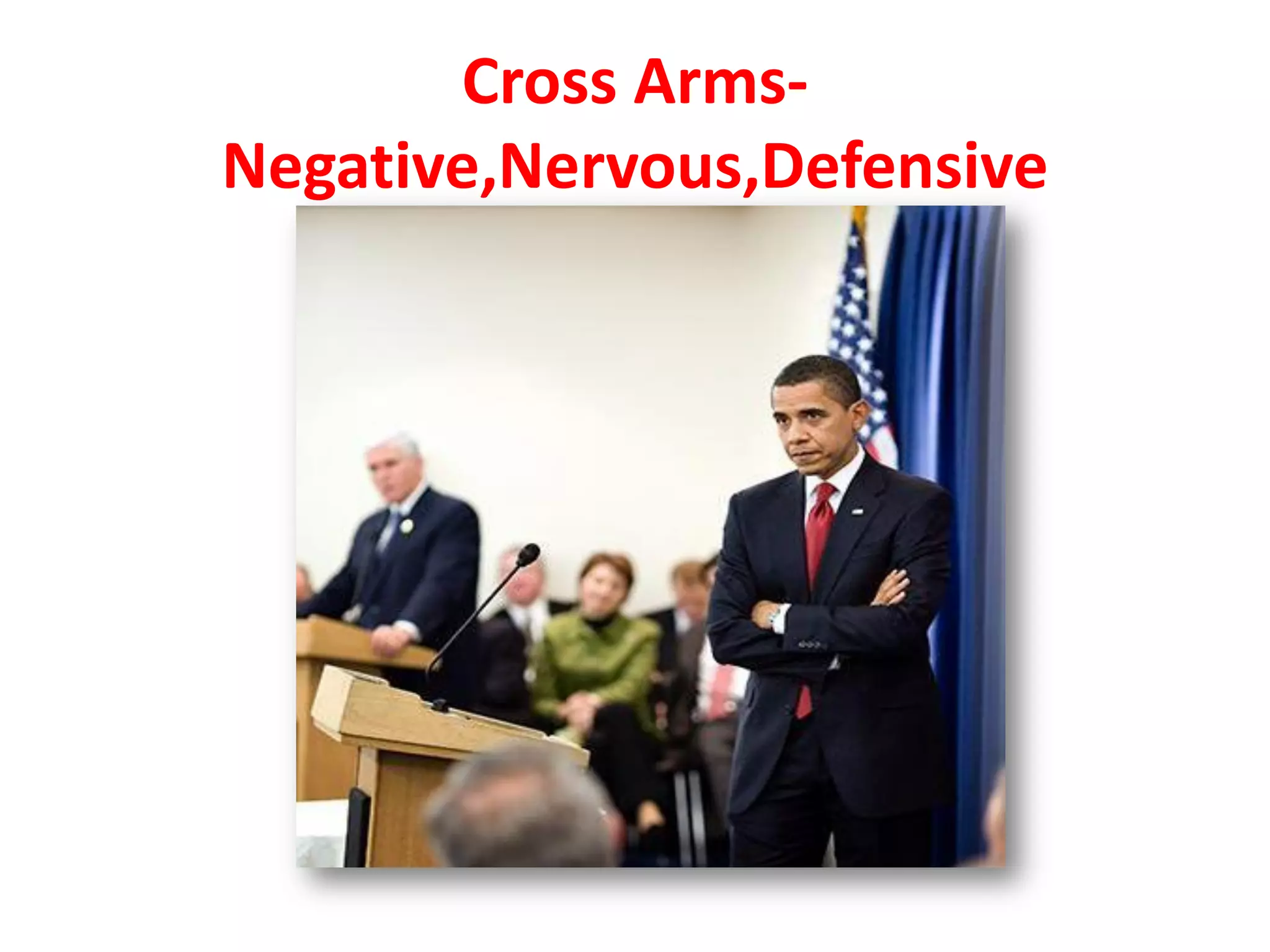
Cross Arms-
Negative,Nervous,Defensive
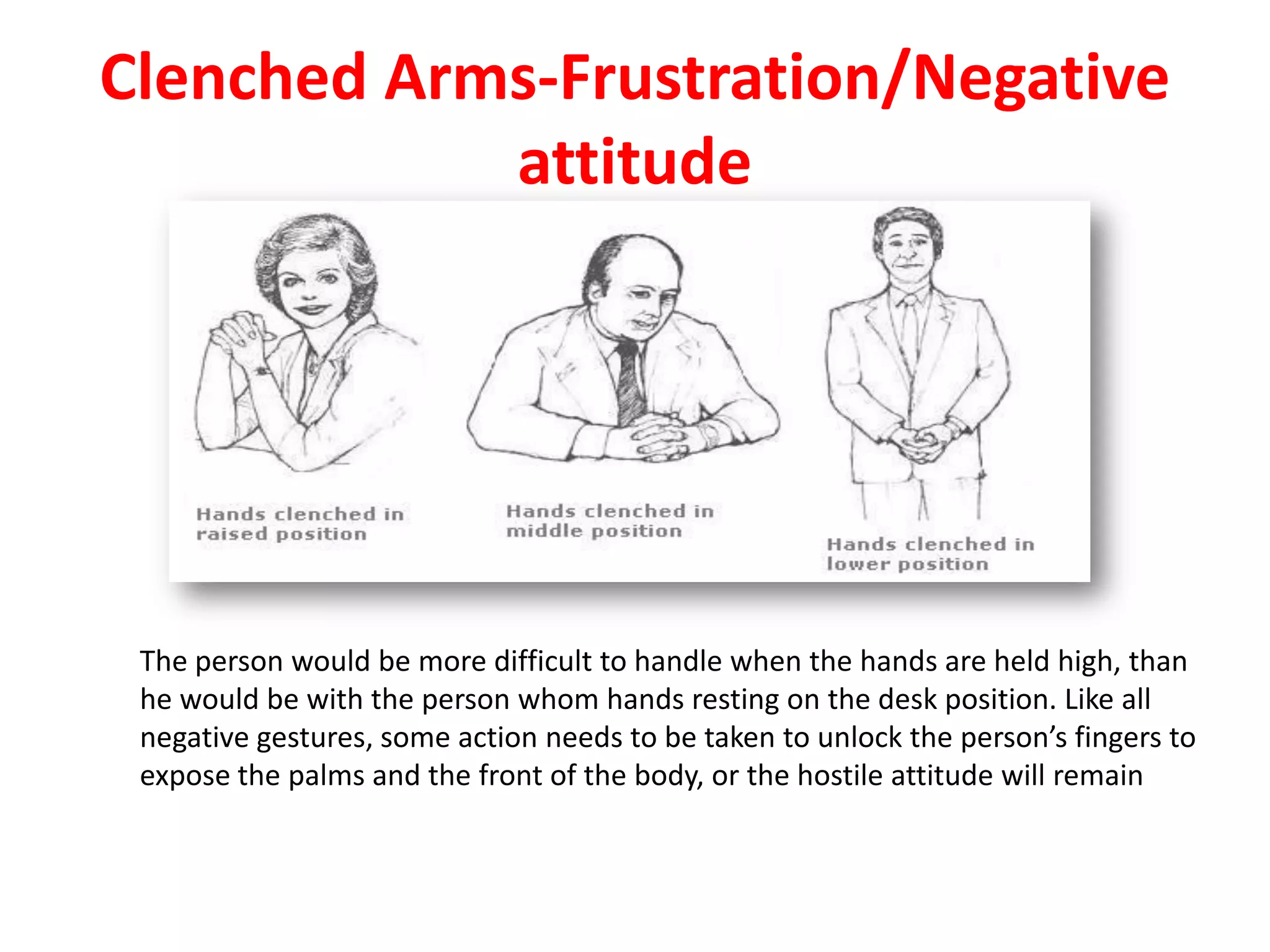
Clenched Arms-Frustration/Negative
attitude
The person would be more difficult to handle when the hands are held high, than
he would be with the person whom hands resting on the desk position. Like all
negative gestures, some action needs to be taken to unlock the person’s fingers to
expose the palms and the front of the body, or the hostile attitude will remain
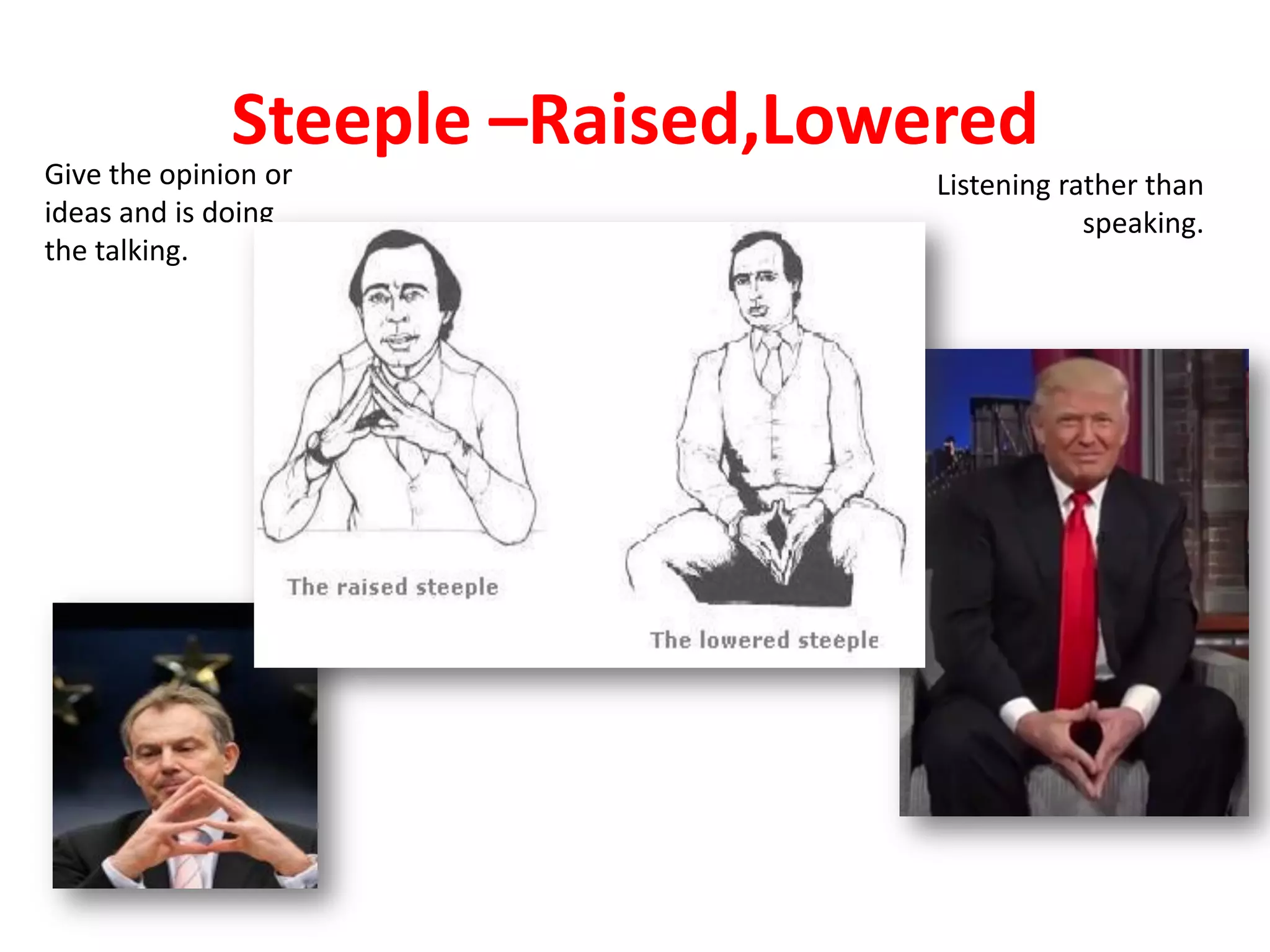
Steeple –Raised,Lowered
Give the opinion or
ideas and is doing
the talking.
Listening rather than
speaking.
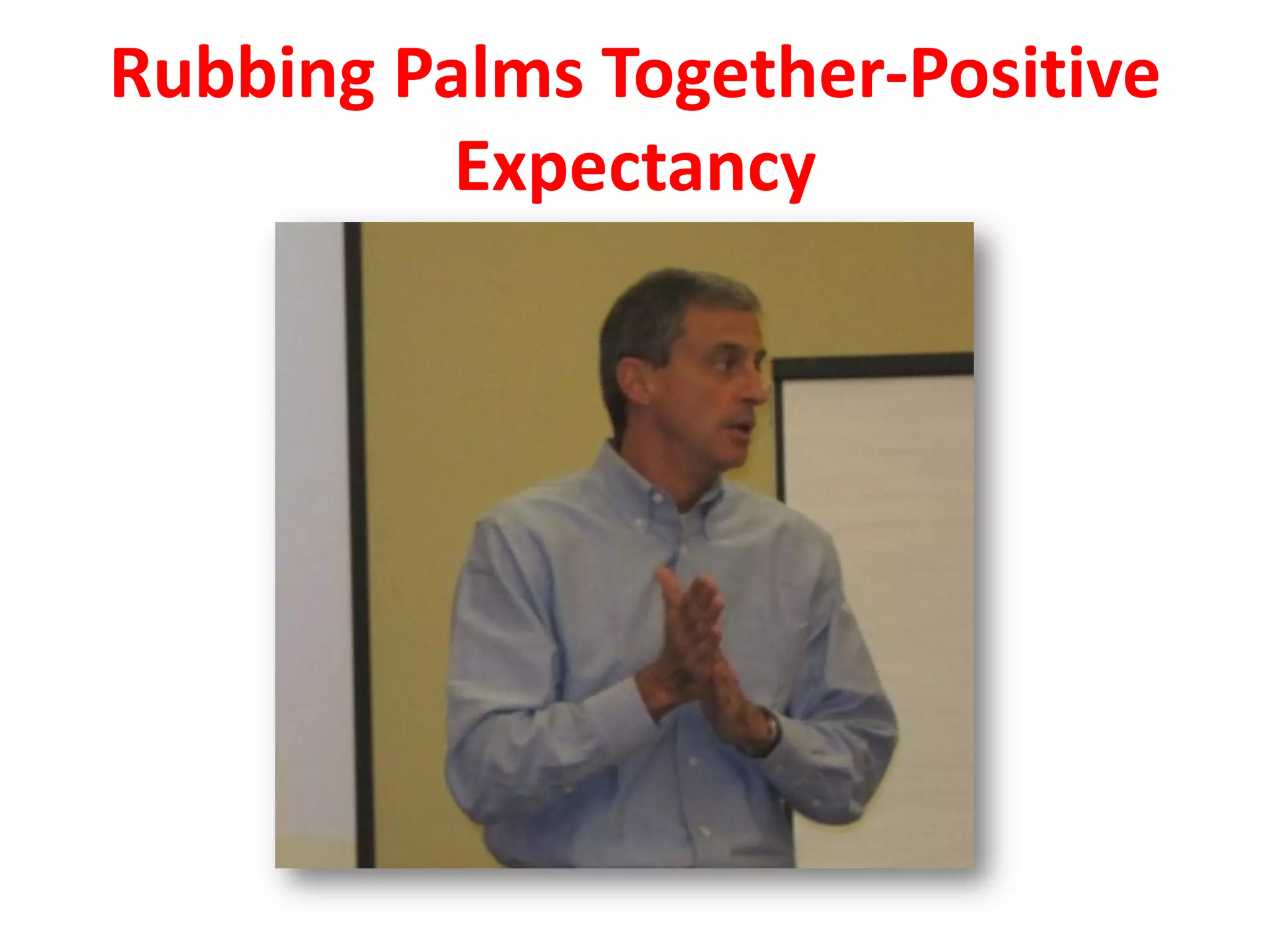
Rubbing Palms Together-Positive
Expectancy
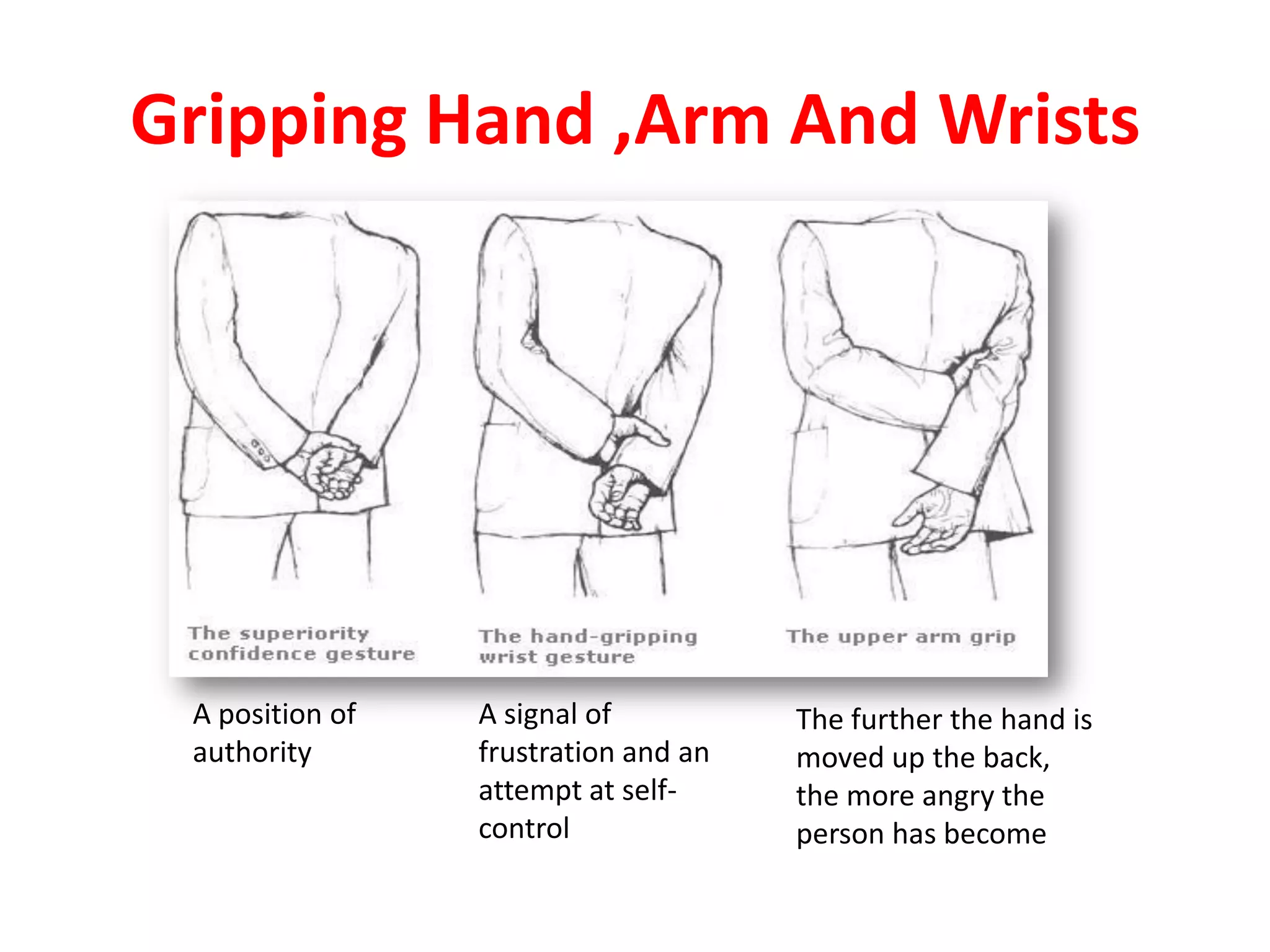
Gripping Hand ,Arm And Wrists
A position of
authority
The further the hand is
moved up the back,
the more angry the
person has become
A signal of
frustration and an
attempt at self-
control
Handshake
Video: https://www.youtube.com/watch?v=N3zM23Hd7lo
Thumb
Another show of confidence and feeling superior is by showing the thumbs. It could be as
shown here, but any position where the thumbs are visible will do the trick. Holding your
jacket with your thumb up, or have them stuck out of your back pockets are similar hand
gestures that will do the trick.
Eyes
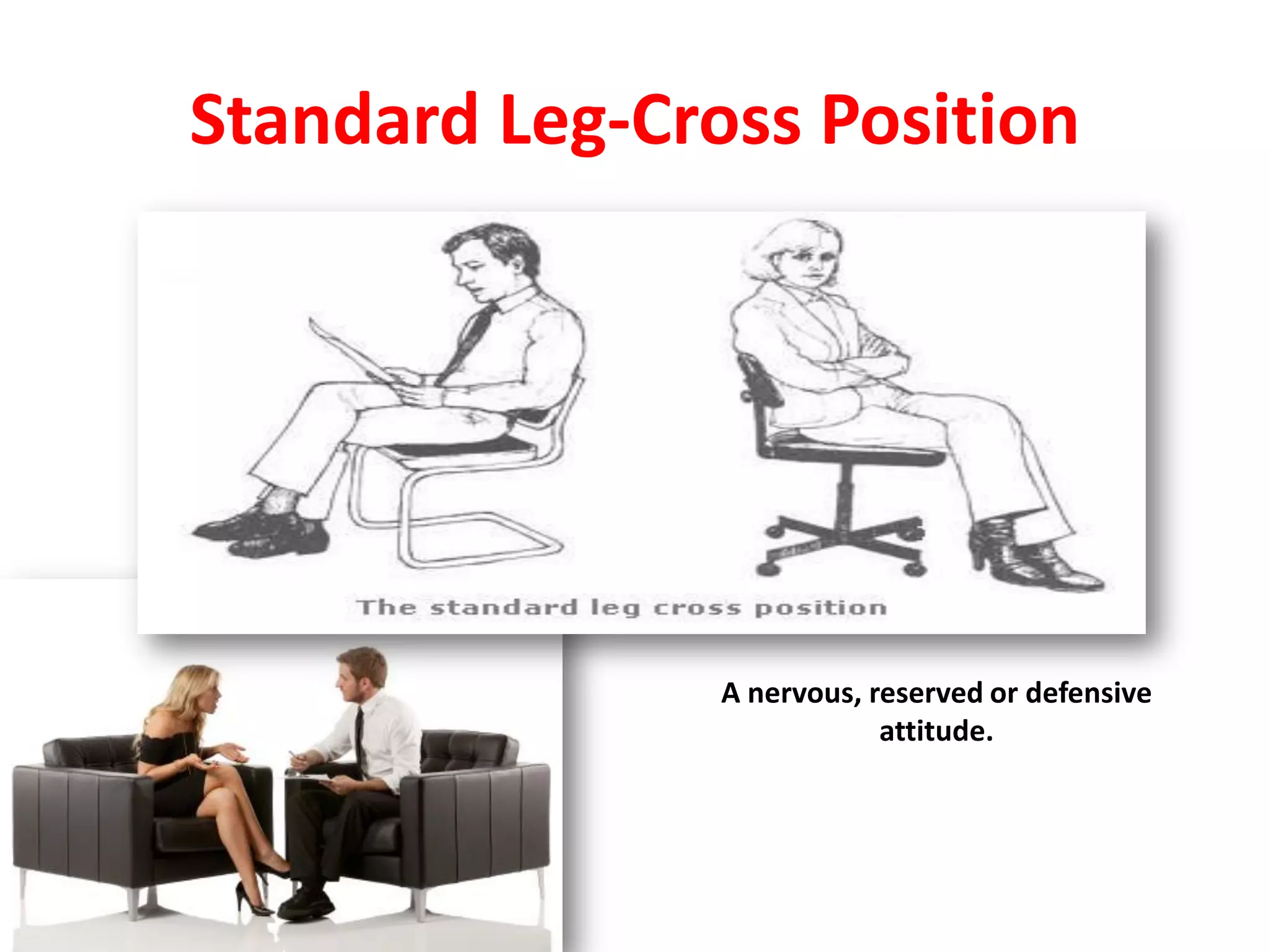
Standard Leg-Cross Position
A nervous, reserved or defensive
attitude.
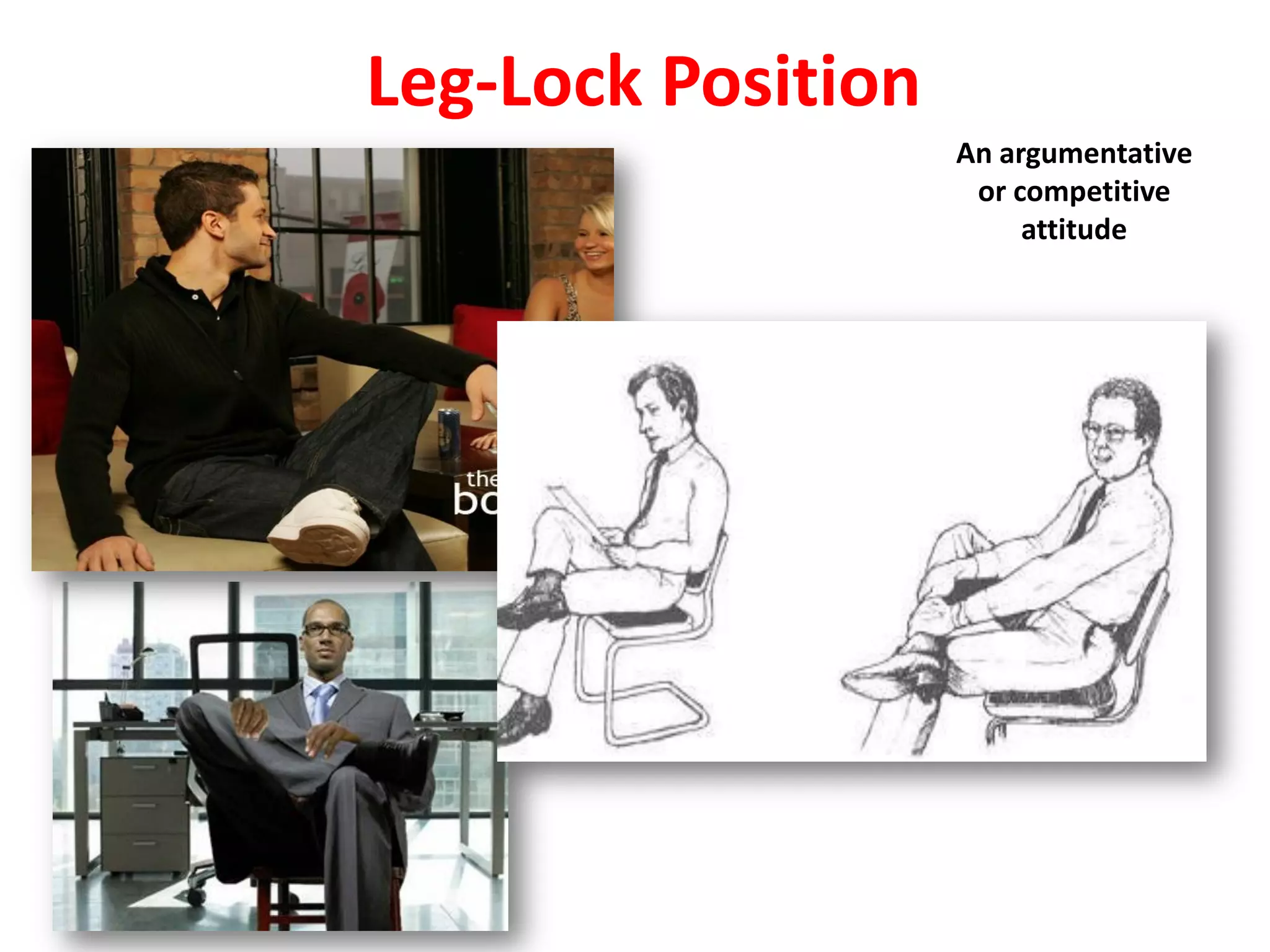
Leg-Lock Position
An argumentative
or competitive
attitude
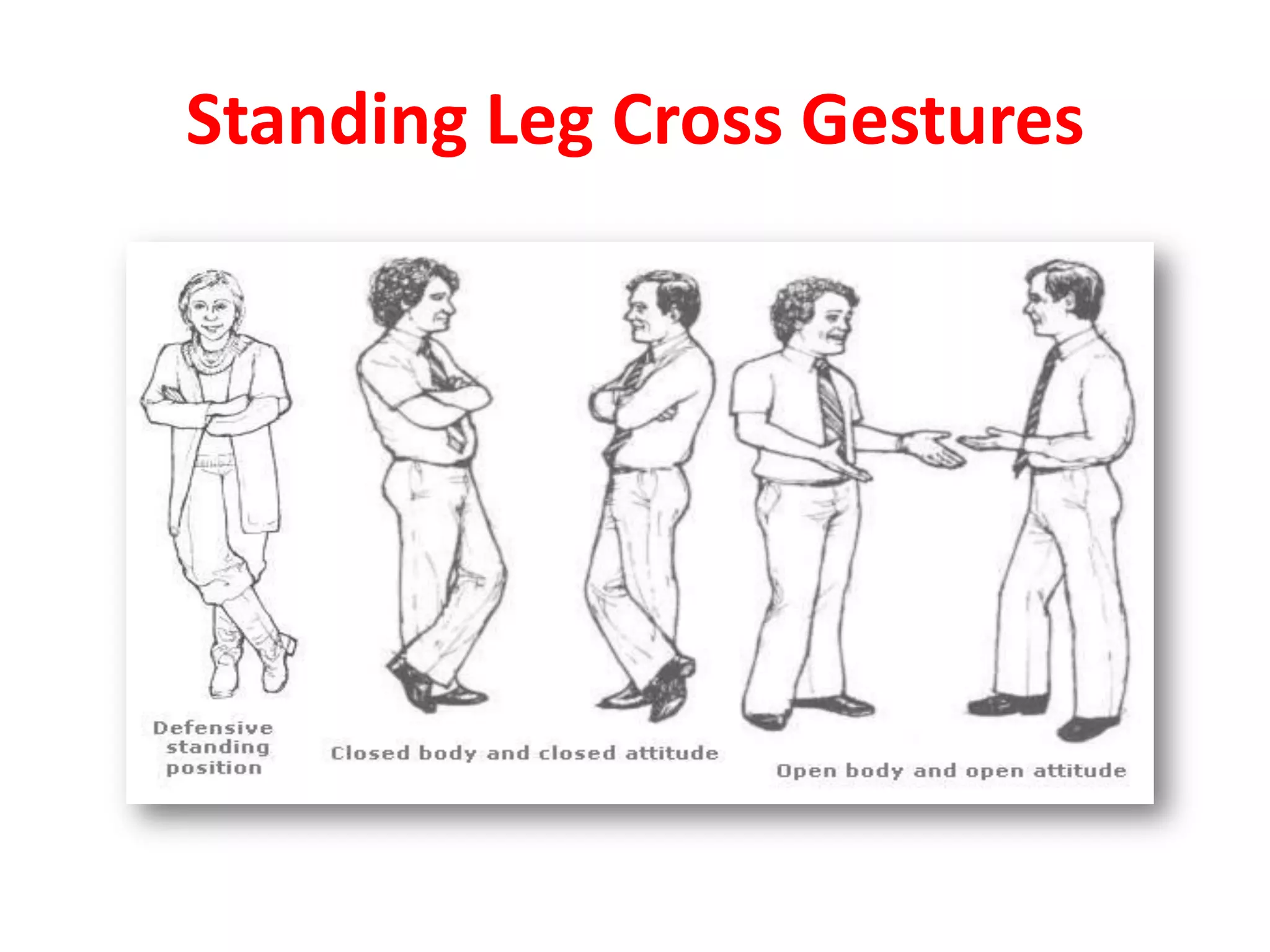
Standing Leg Cross Gestures
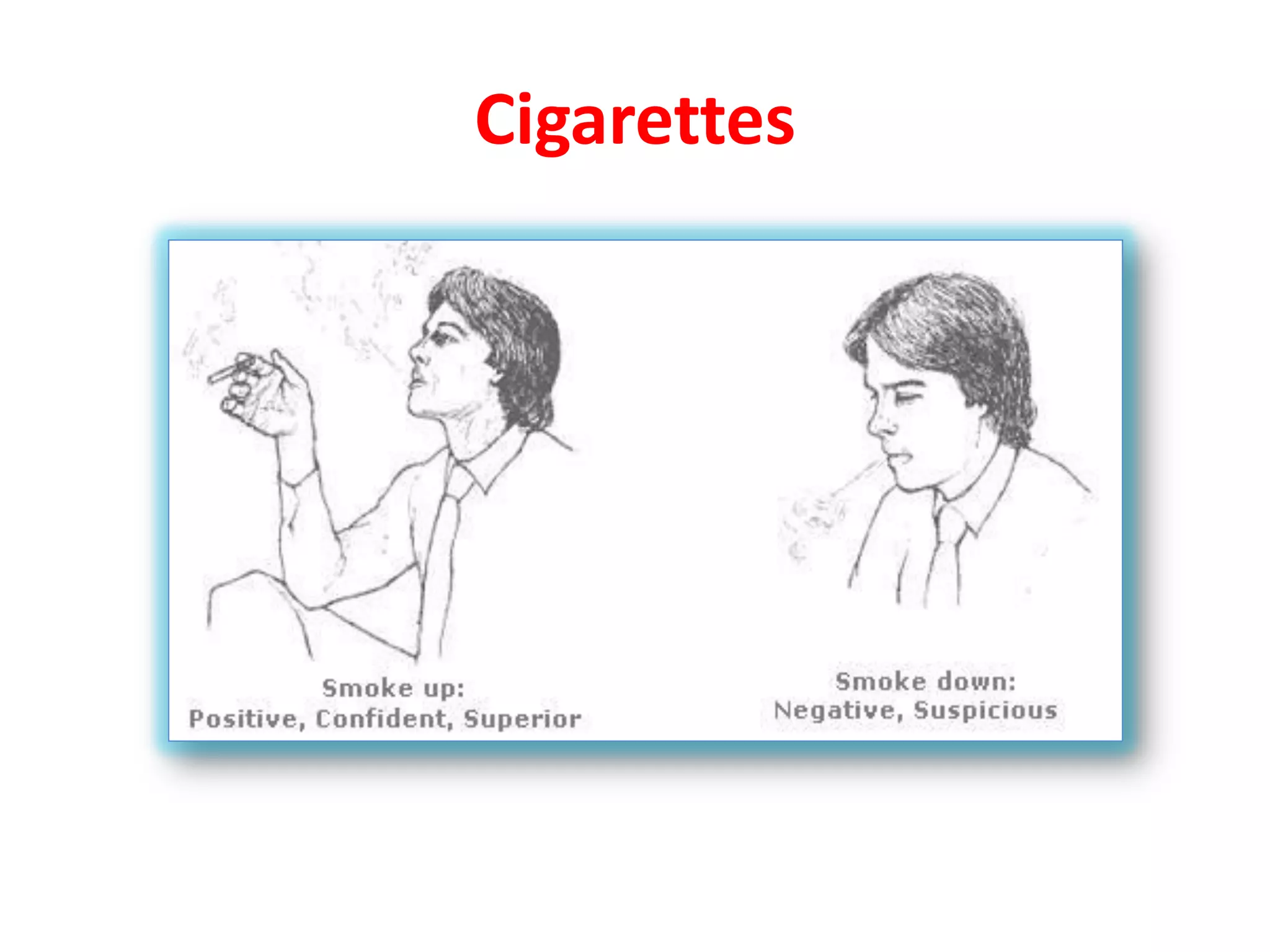
Cigarettes
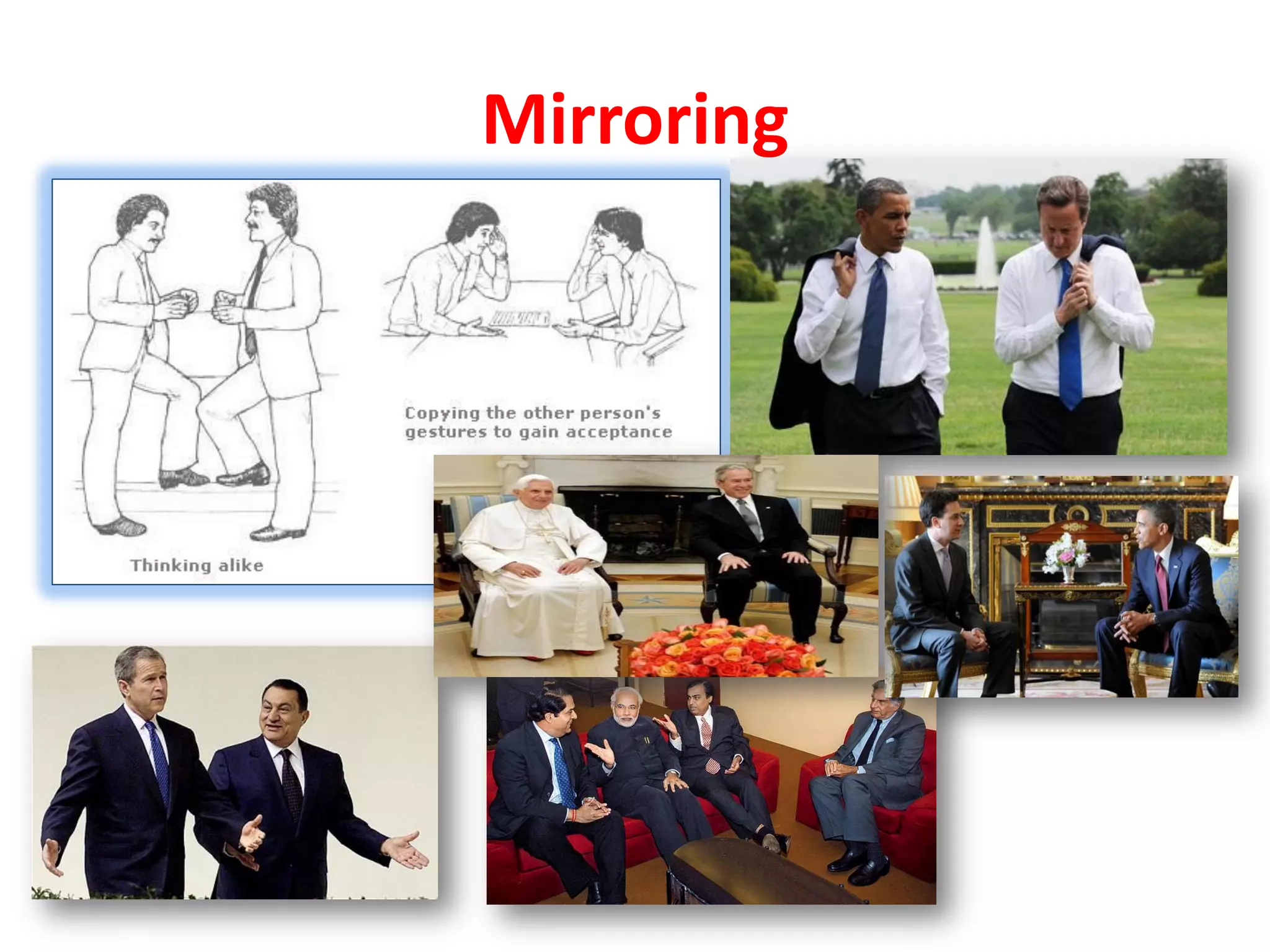
Mirroring
Space Proximities
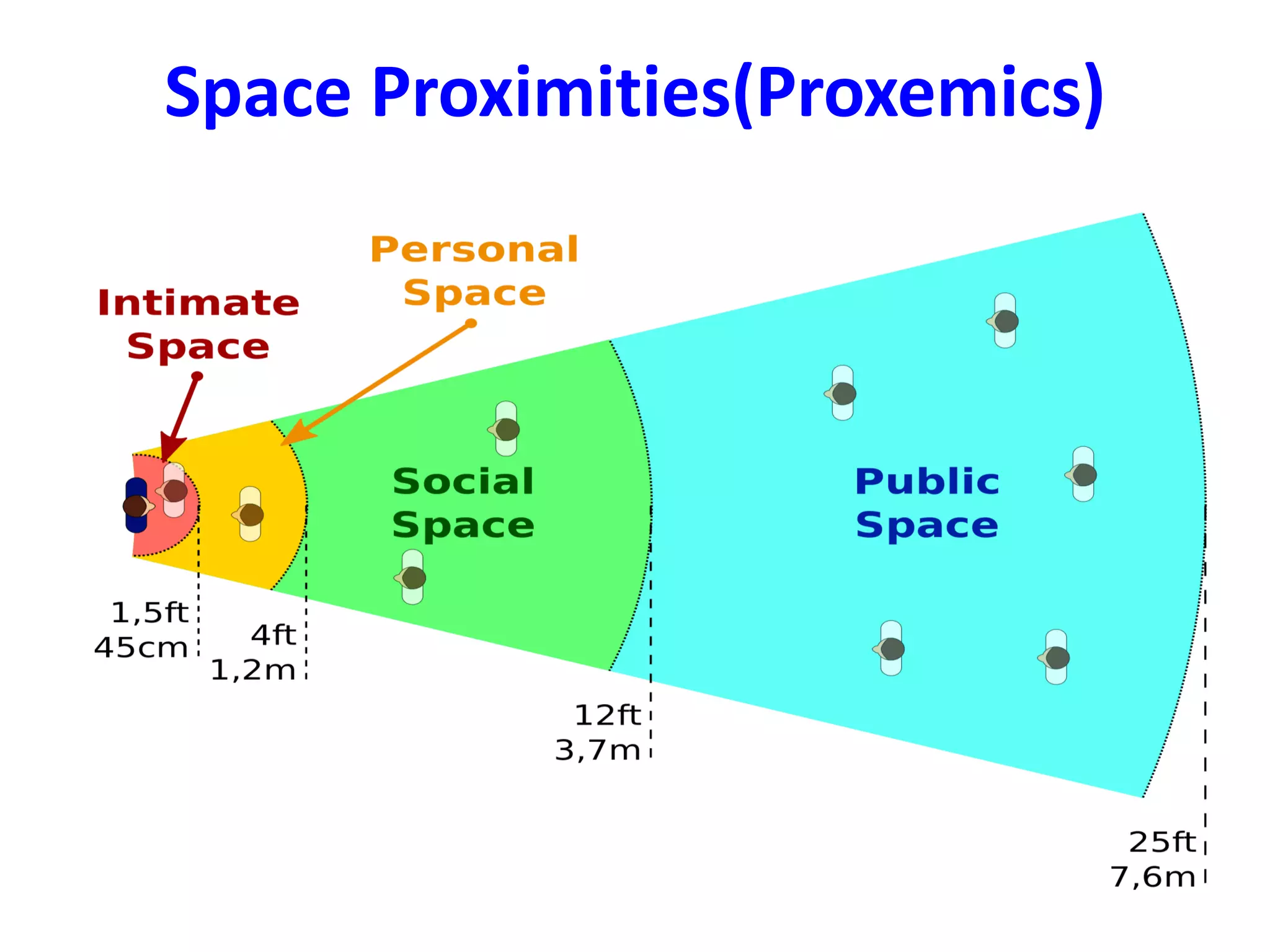
Space Proximities(Proxemics)
Intimate space
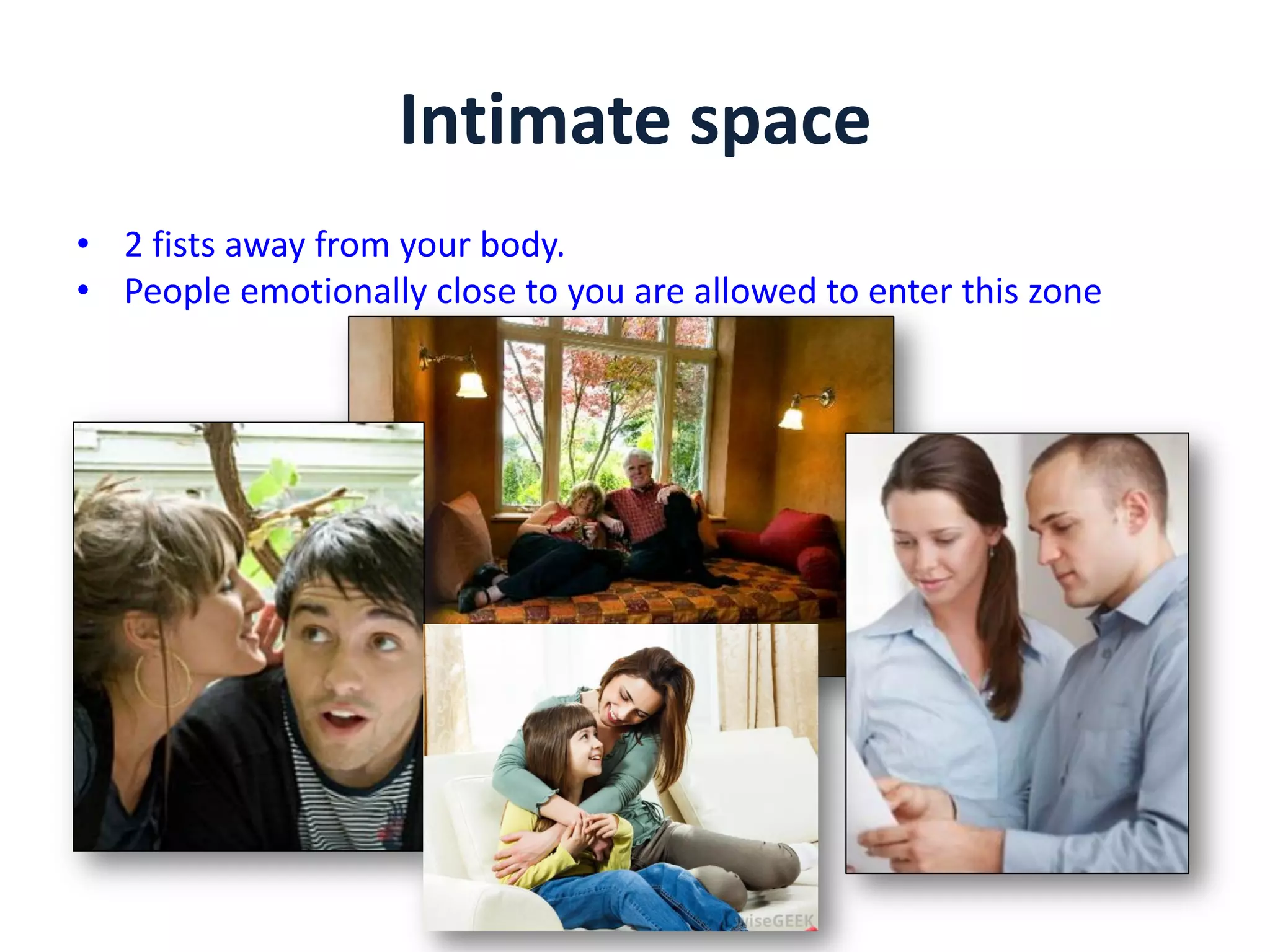
• 2 fists away from your body.
• People emotionally close to you are allowed to enter this zone
Personal space
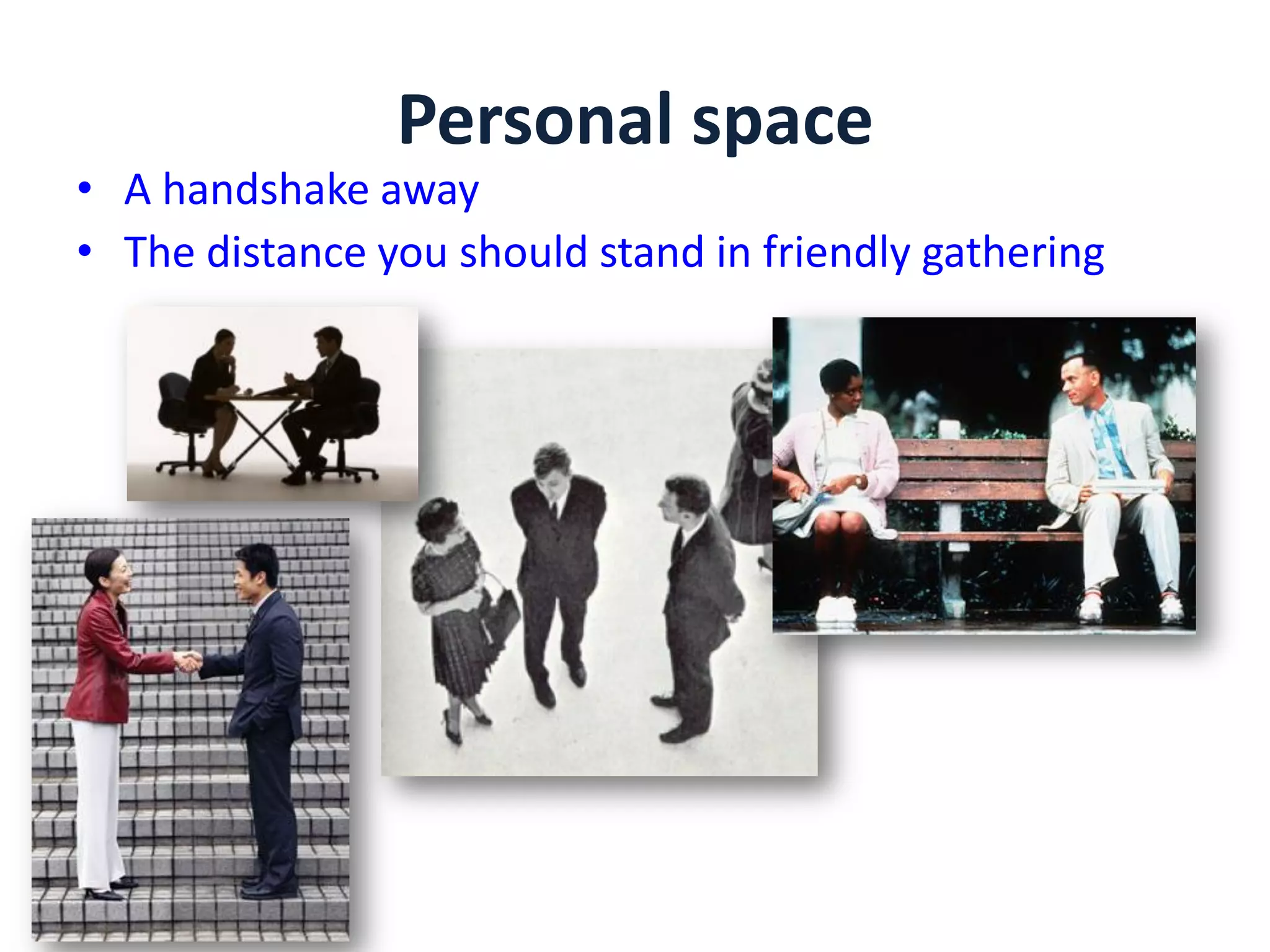
• A handshake away
• The distance you should stand in friendly gathering
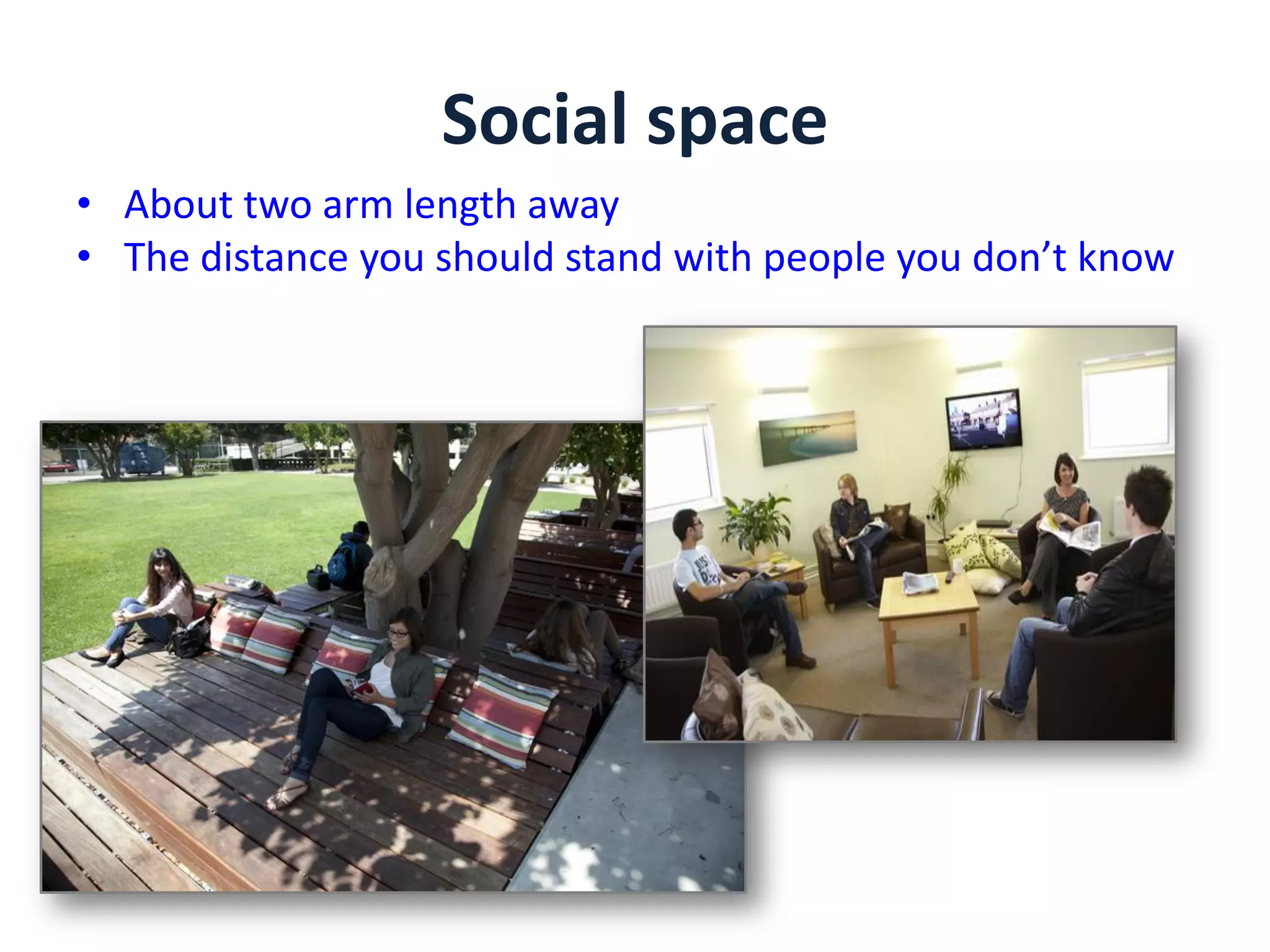
Social space
• About two arm length away
• The distance you should stand with people you don’t know
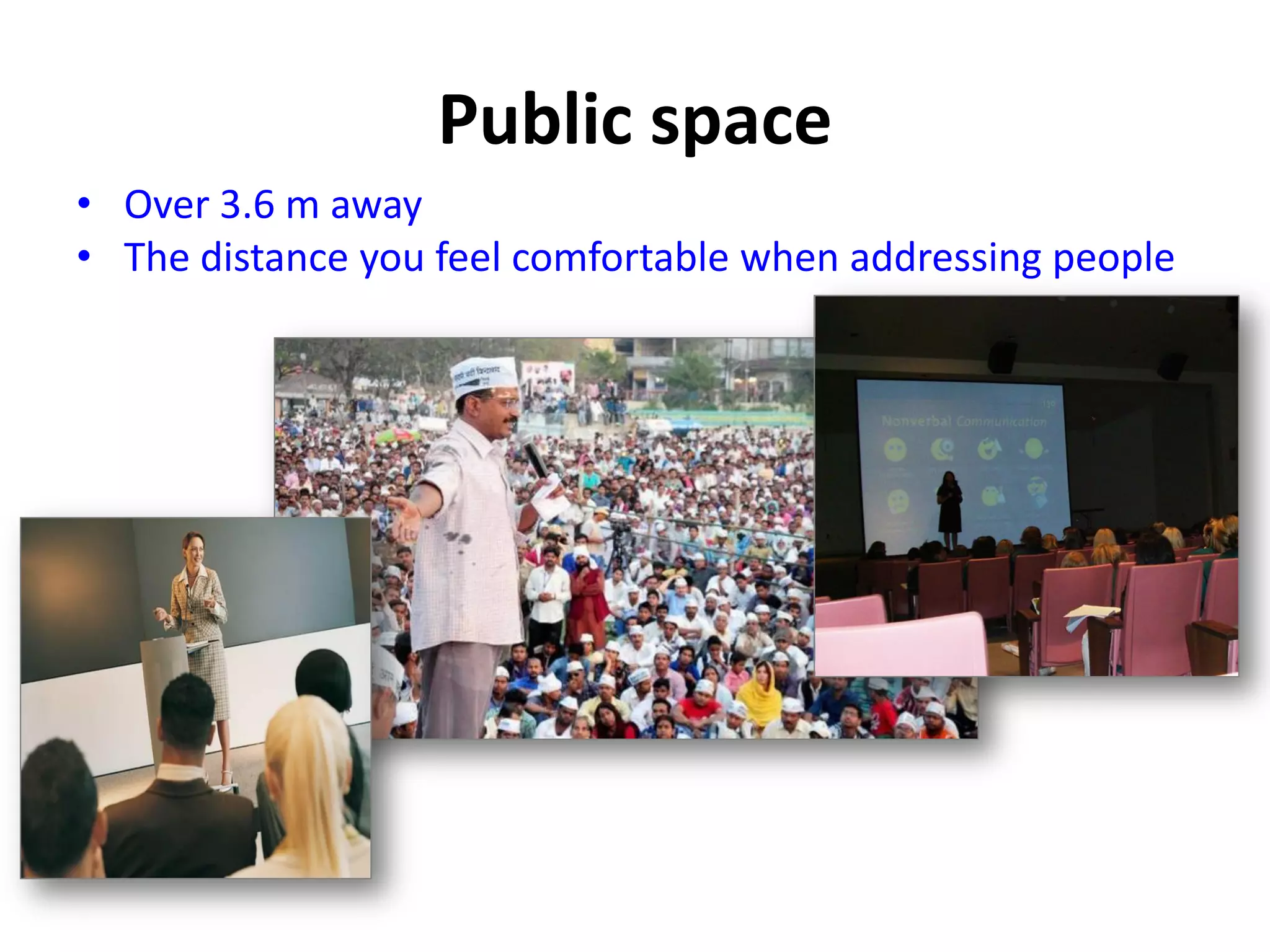
Public space
• Over 3.6 m away
• The distance you feel comfortable when addressing people
Touch
Touch(Haptic Communication)
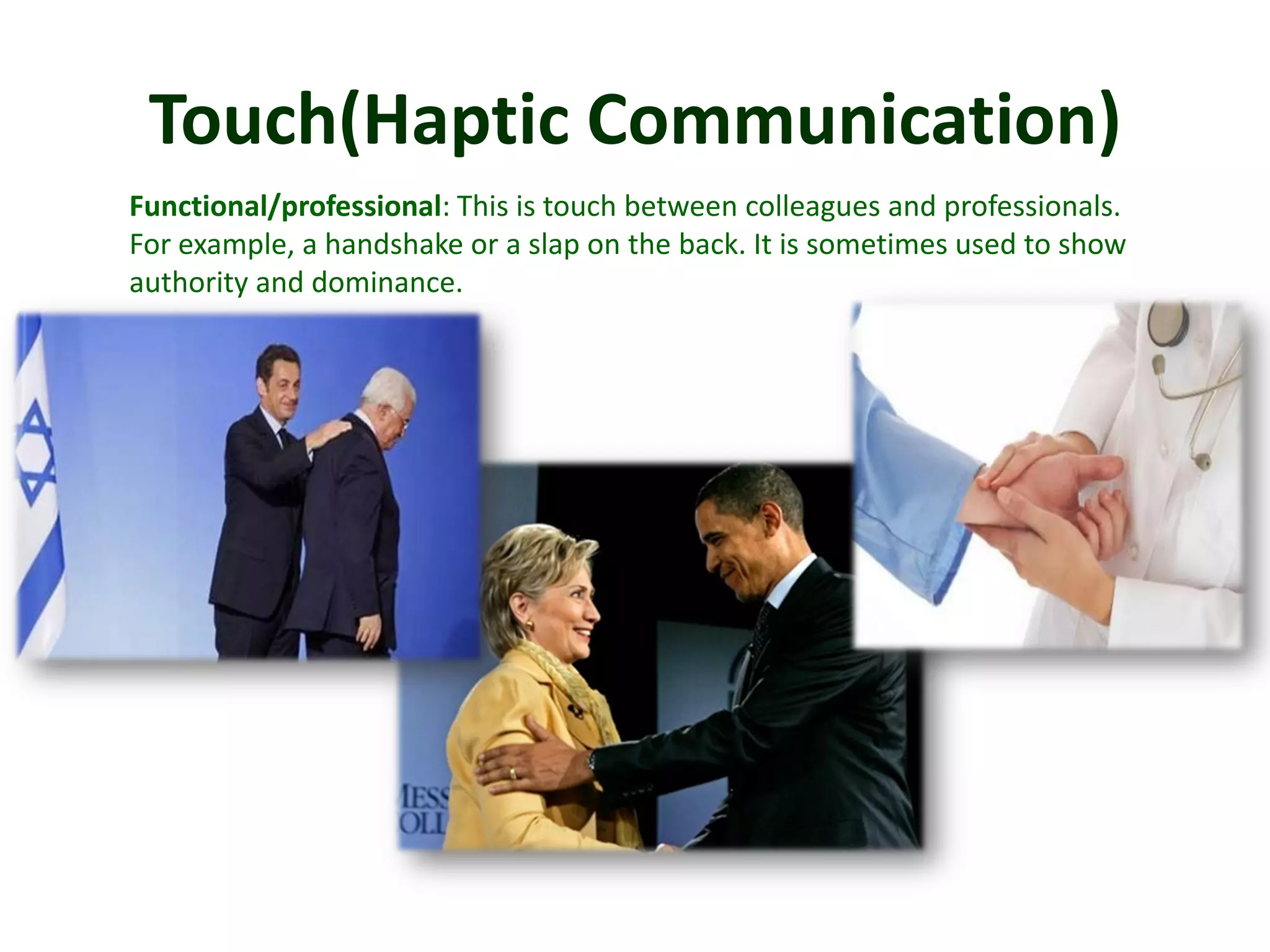
Functional/professional: This is touch between colleagues and professionals.
For example, a handshake or a slap on the back. It is sometimes used to show
authority and dominance.
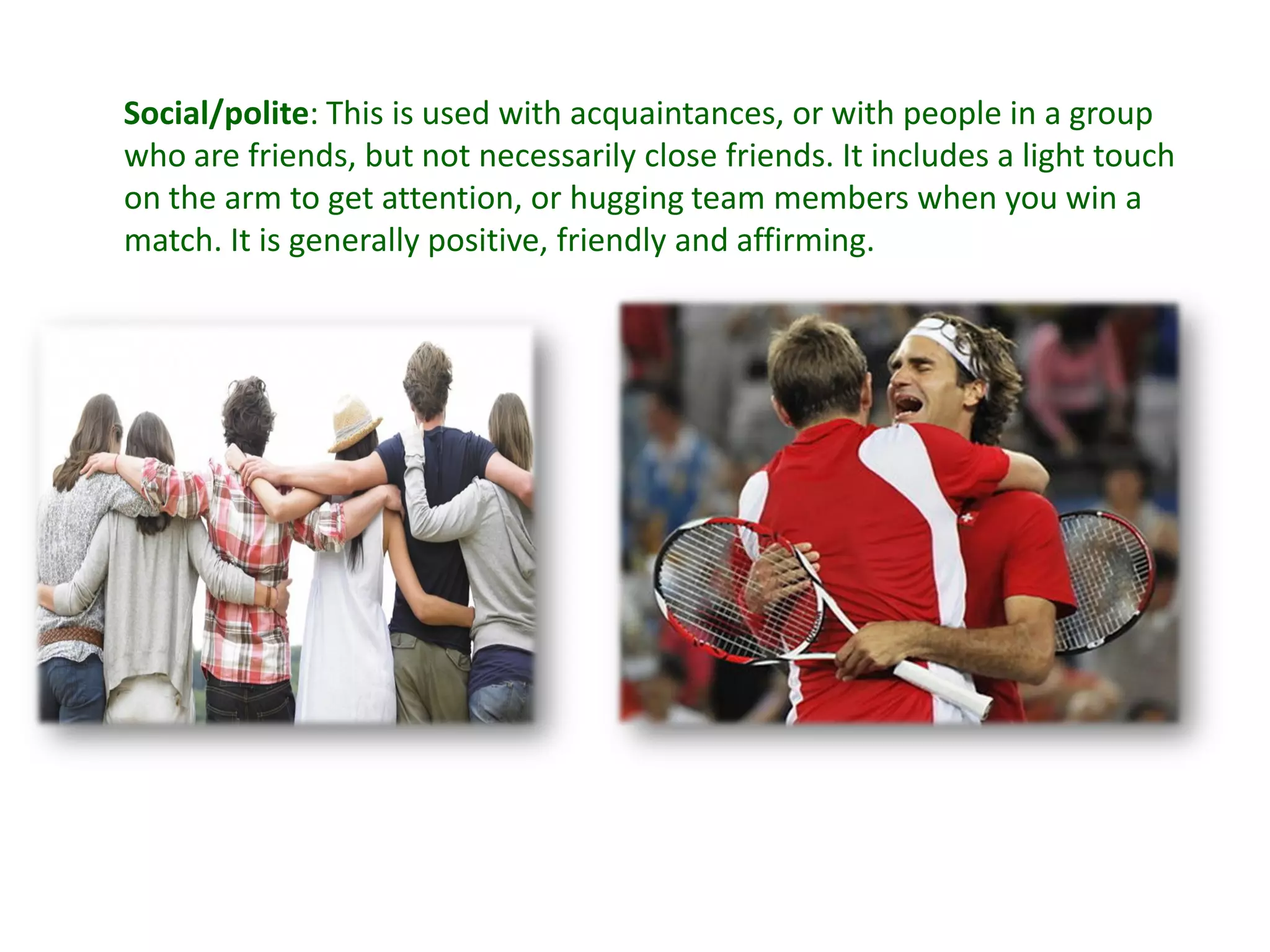
Social/polite: This is used with acquaintances, or with people in a group
who are friends, but not necessarily close friends. It includes a light touch
on the arm to get attention, or hugging team members when you win a
match. It is generally positive, friendly and affirming.
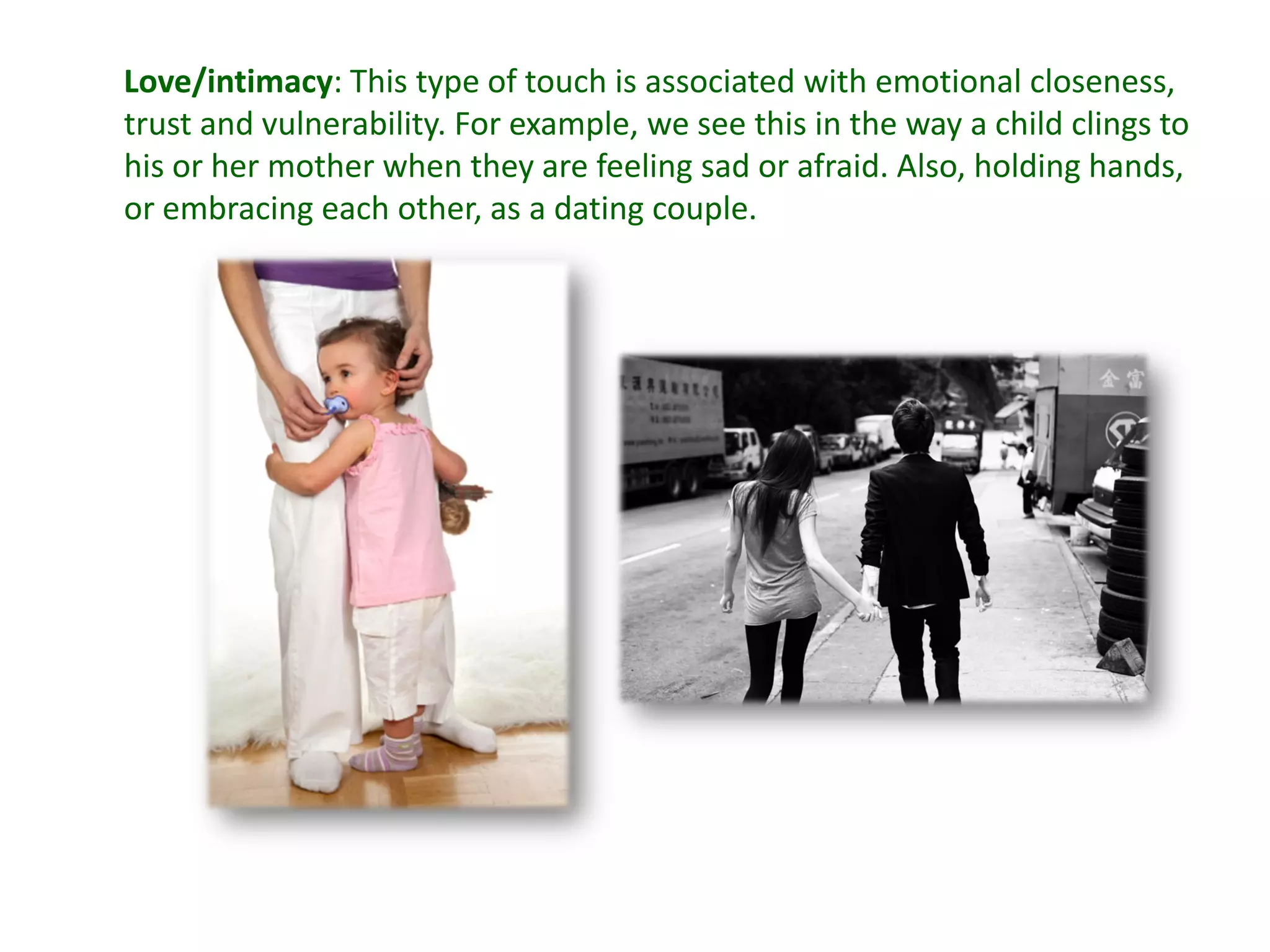
Friendship/warmth: Touch here includes many of the lighthearted
gestures that show you like, and understand, each other. For example,
“high 5-ing” a friend when you see each other, or giving them hug when
they share bad news.
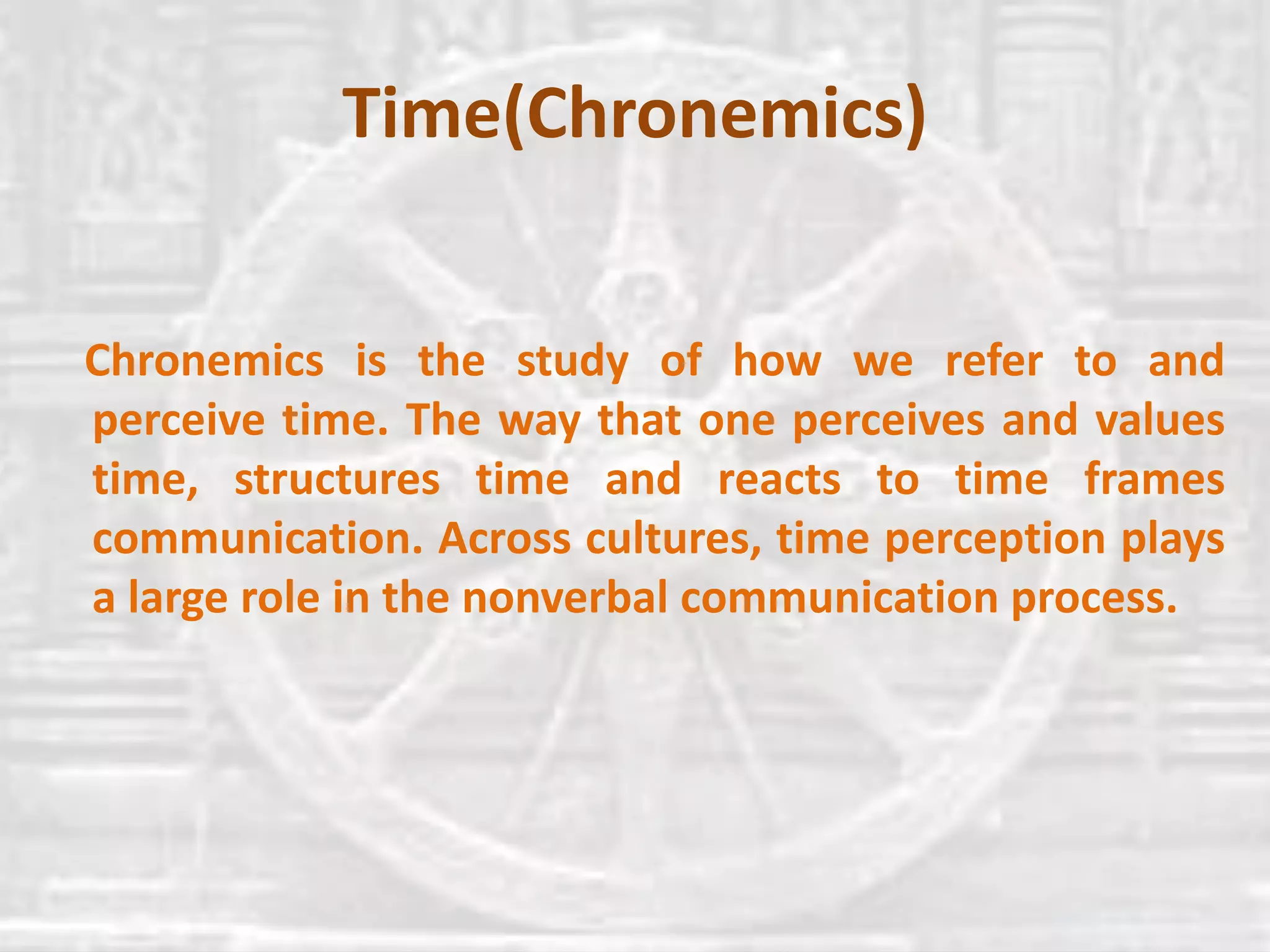
Love/intimacy: This type of touch is associated with emotional closeness,
trust and vulnerability. For example, we see this in the way a child clings to
his or her mother when they are feeling sad or afraid. Also, holding hands,
or embracing each other, as a dating couple.
Time
Time(Chronemics)
Chronemics is the study of how we refer to and
perceive time. The way that one perceives and values
time, structures time and reacts to time frames
communication. Across cultures, time perception plays
a large role in the nonverbal communication process.
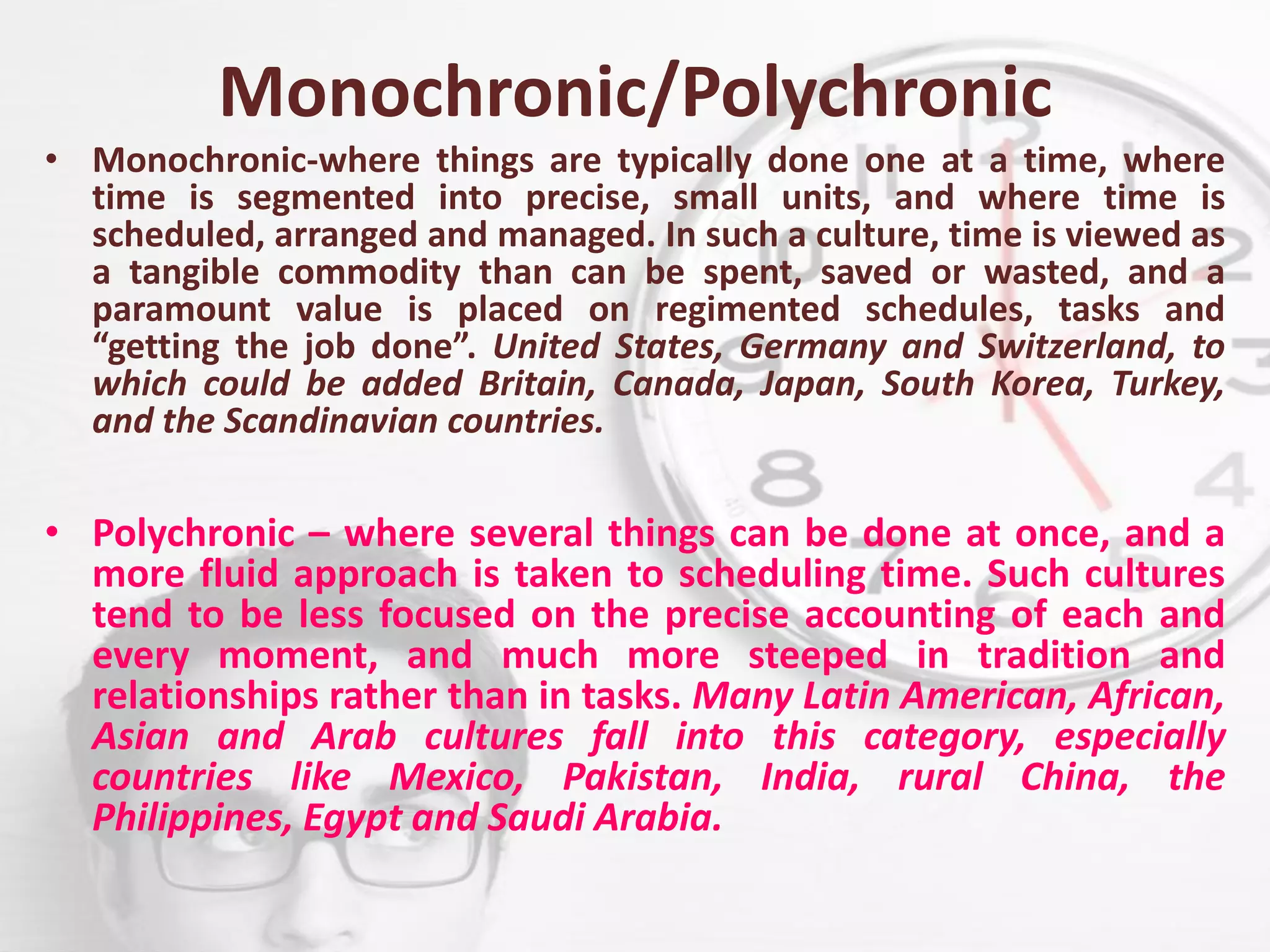
Monochronic/Polychronic
• Monochronic-where things are typically done one at a time, where
time is segmented into precise, small units, and where time is
scheduled, arranged and managed. In such a culture, time is viewed as
a tangible commodity than can be spent, saved or wasted, and a
paramount value is placed on regimented schedules, tasks and
“getting the job done”. United States, Germany and Switzerland, to
which could be added Britain, Canada, Japan, South Korea, Turkey,
and the Scandinavian countries.
• Polychronic – where several things can be done at once, and a
more fluid approach is taken to scheduling time. Such cultures
tend to be less focused on the precise accounting of each and
every moment, and much more steeped in tradition and
relationships rather than in tasks. Many Latin American, African,
Asian and Arab cultures fall into this category, especially
countries like Mexico, Pakistan, India, rural China, the
Philippines, Egypt and Saudi Arabia.
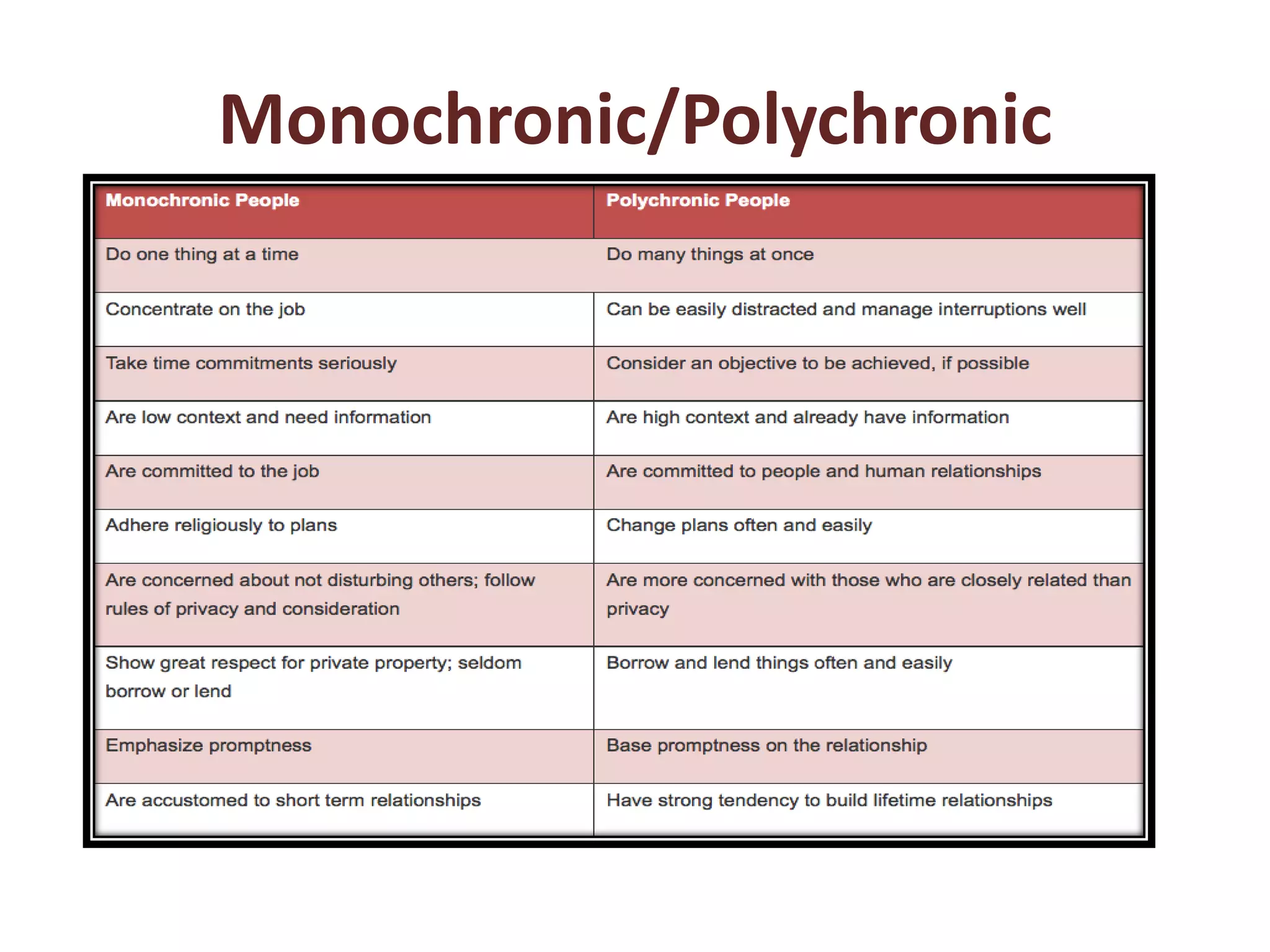
Monochronic/Polychronic
Voice
Voice(Paralanguage)
Paralanguage involves verbal and nonverbal aspects of speech
that influence meaning, including tone, intensity, pausing, and
even silence. Various acoustic properties of speech such as tone,
pitch and accent, collectively known as prosody, can all give off
nonverbal cues.
Paralanguage may change the meaning of words .Prosody may
reflect various features of the speaker or the utterance:
- The emotional state of a speaker;
- Whether an utterance is a statement, a question, or a command;
-Whether the speaker is being ironic or sarcastic; emphasis, contrast,
and focus
Other elements of language that may not be encoded by grammar or
choice of vocabulary.
Voice(Paralanguage)
• Volume Quality:articulation, nasality, accent, pitch, range
of voice and resonance.
• Vocal characteristics:tone variations, inflections, the speed
at which you speak, whether your voice projects and
whatever emotion you may be conveying through tone and
inflection and so on.
• Voice qualifiers :bright, soft, round, light, cold or hot,
strength or weakness, breathy, texture, thick, old or child-
like and attitude (angry, chilling, seductive, convincing).
• Voice segregates are all the noises listeners make to signify
that they are listening: "uh-huh" or "um" or silences.
Video: https://www.youtube.com/watch?v=0O3nPzuNIPo
Office
Office & Environment
Environment involves the physical and psychological
aspects of the communication context. More than the
tables and chairs in an office, environment is an important
part of the dynamic communication process. The
perception of one’s environment influences one’s reaction
to it.
• Physical : Physical context includes the environmental
factors in a communication encounter. The size, layout,
temperature, and lighting of a space influence our
communication.
• Psychological: Psychological context includes the mental
and emotional factors in a communication encounter.
Stress, anxiety, and emotions are just some examples of
psychological influences that can affect our
communication.
Chair Size and Accessories:
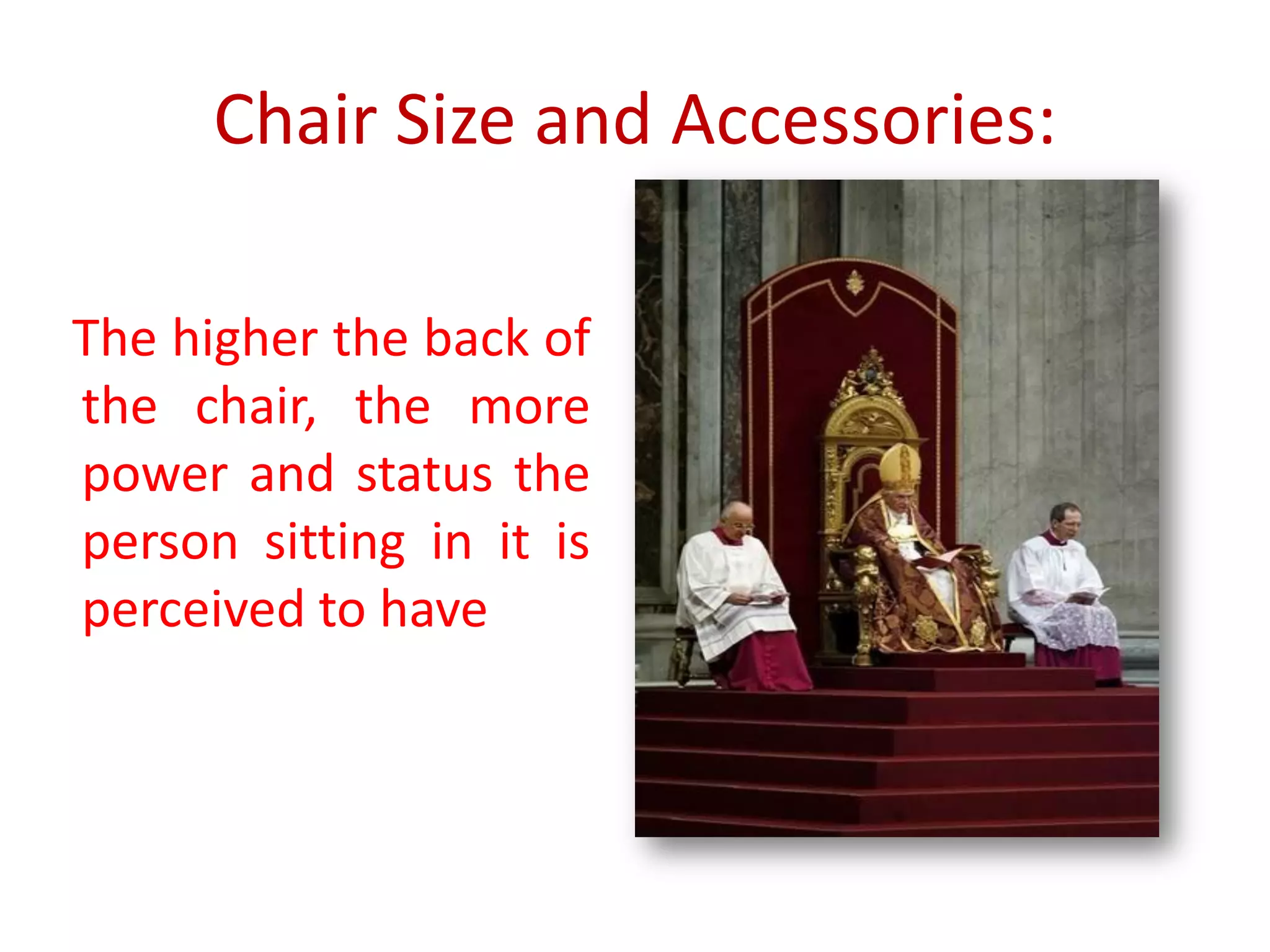
The higher the back of
the chair, the more
power and status the
person sitting in it is
perceived to have
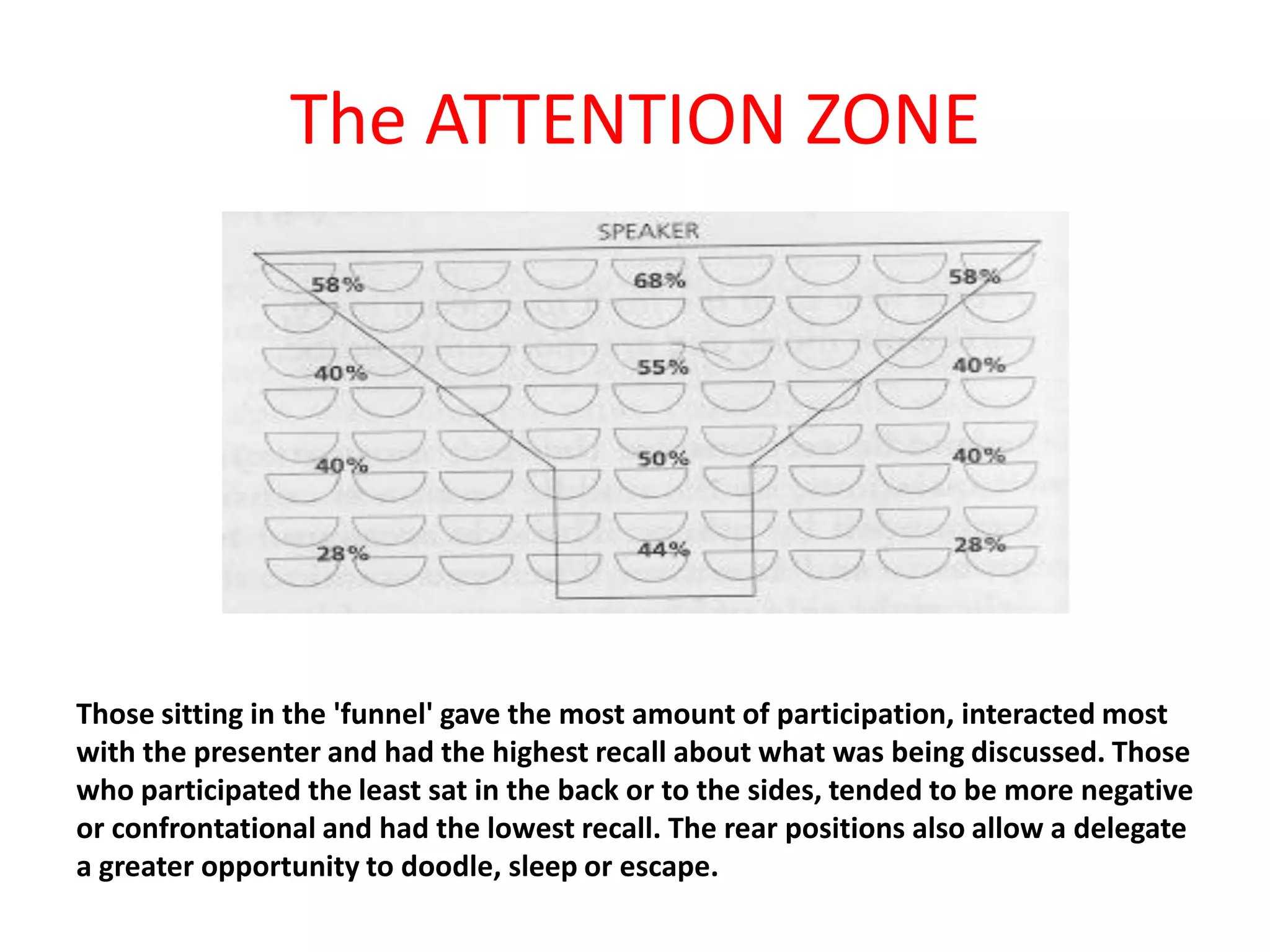
The ATTENTION ZONE
Those sitting in the 'funnel' gave the most amount of participation, interacted most
with the presenter and had the highest recall about what was being discussed. Those
who participated the least sat in the back or to the sides, tended to be more negative
or confrontational and had the lowest recall. The rear positions also allow a delegate
a greater opportunity to doodle, sleep or escape.
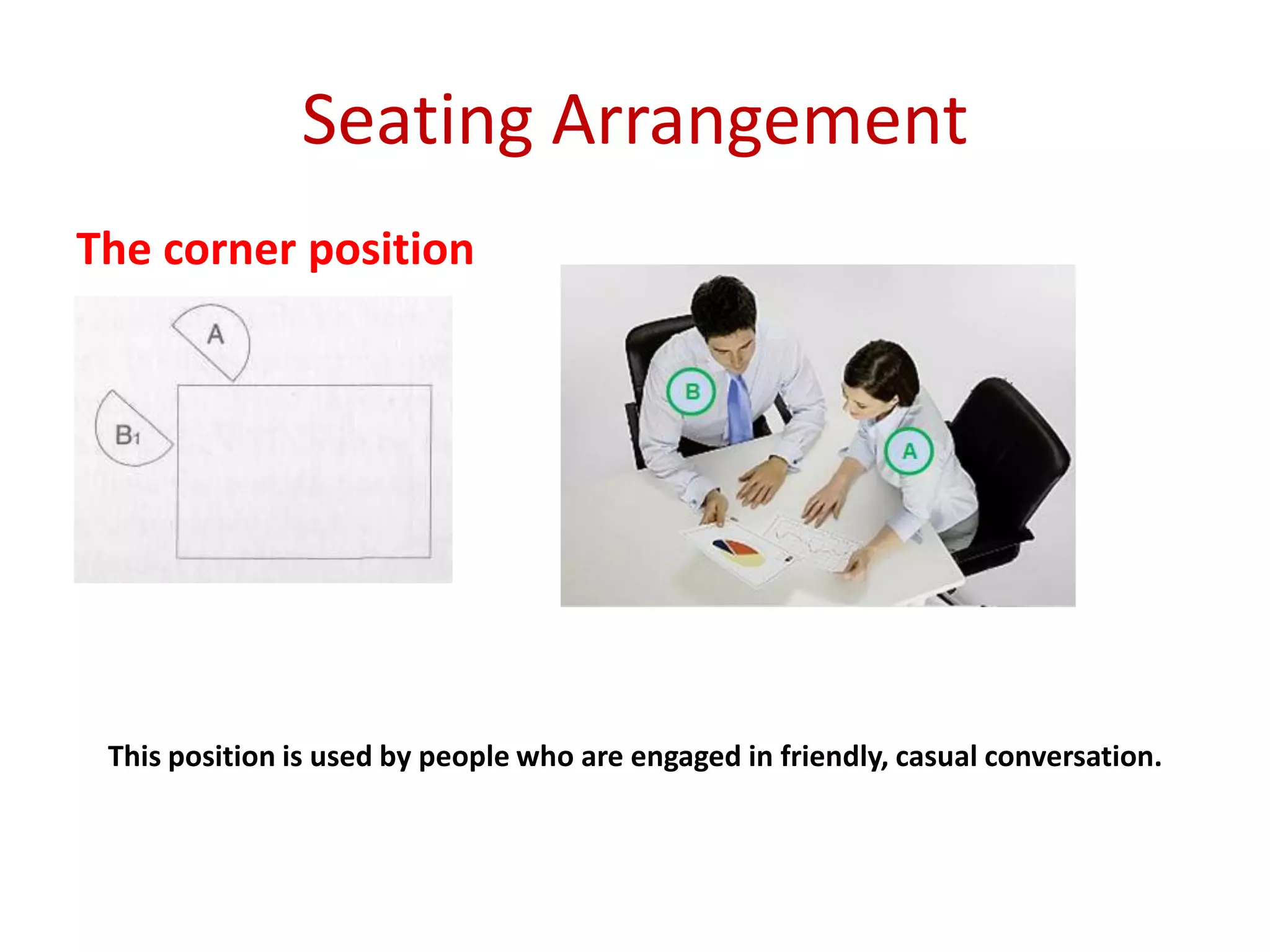
Seating Arrangement
The corner position
This position is used by people who are engaged in friendly, casual conversation.
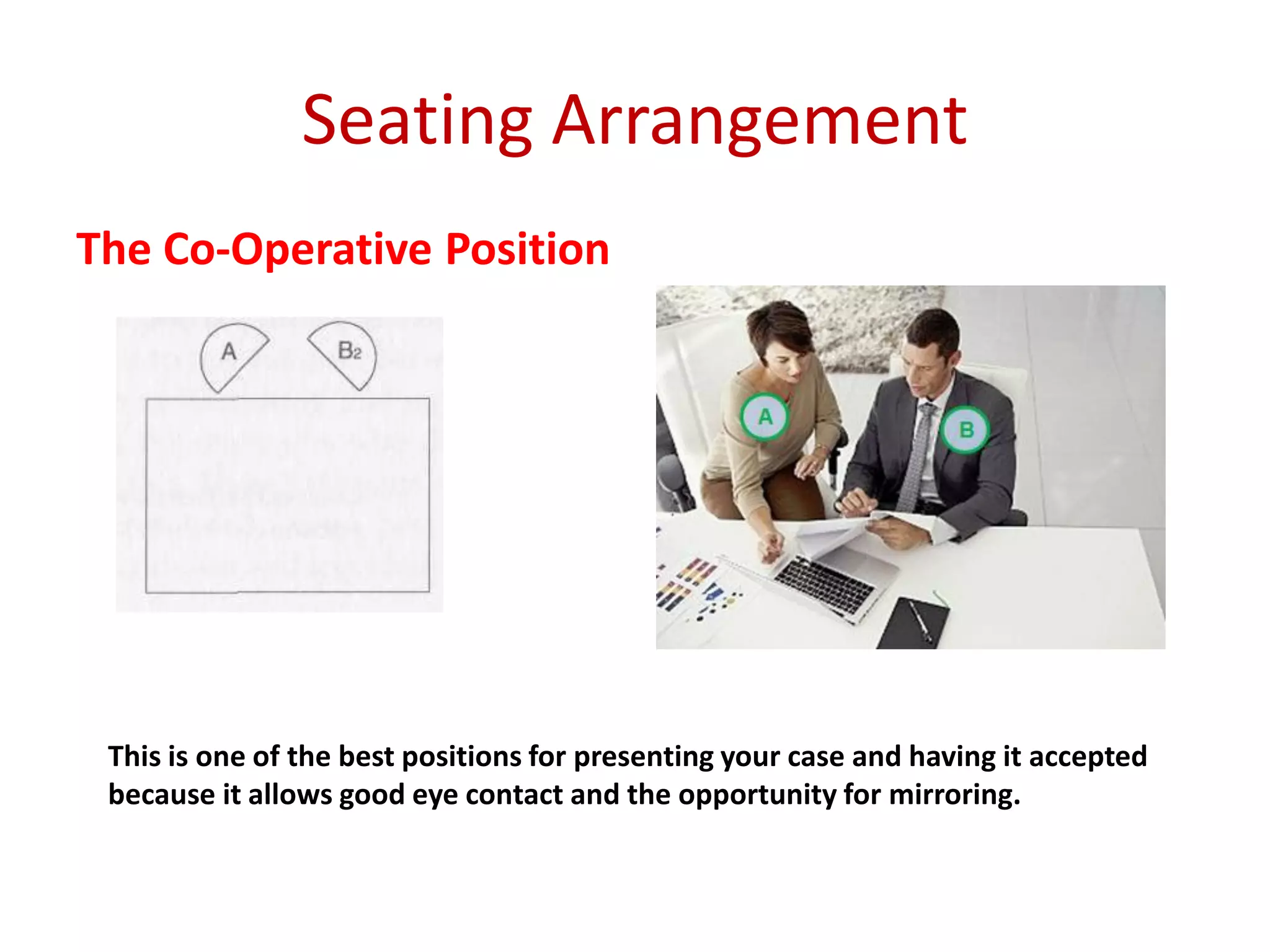
Seating Arrangement
The Co-Operative Position
This is one of the best positions for presenting your case and having it accepted
because it allows good eye contact and the opportunity for mirroring.
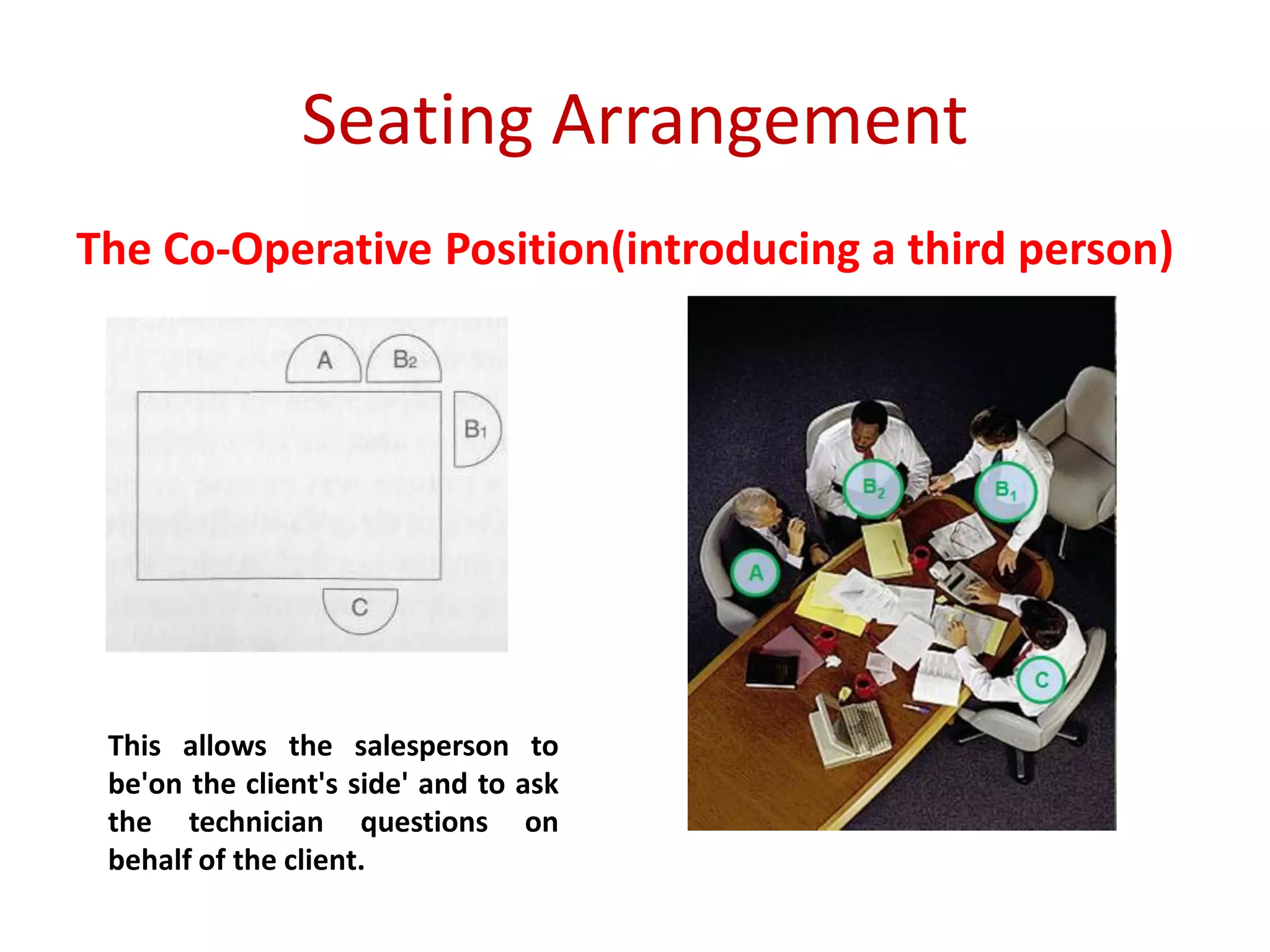
Seating Arrangement
The Co-Operative Position(introducing a third person)
This allows the salesperson to
be'on the client's side' and to ask
the technician questions on
behalf of the client.
Seating Arrangement
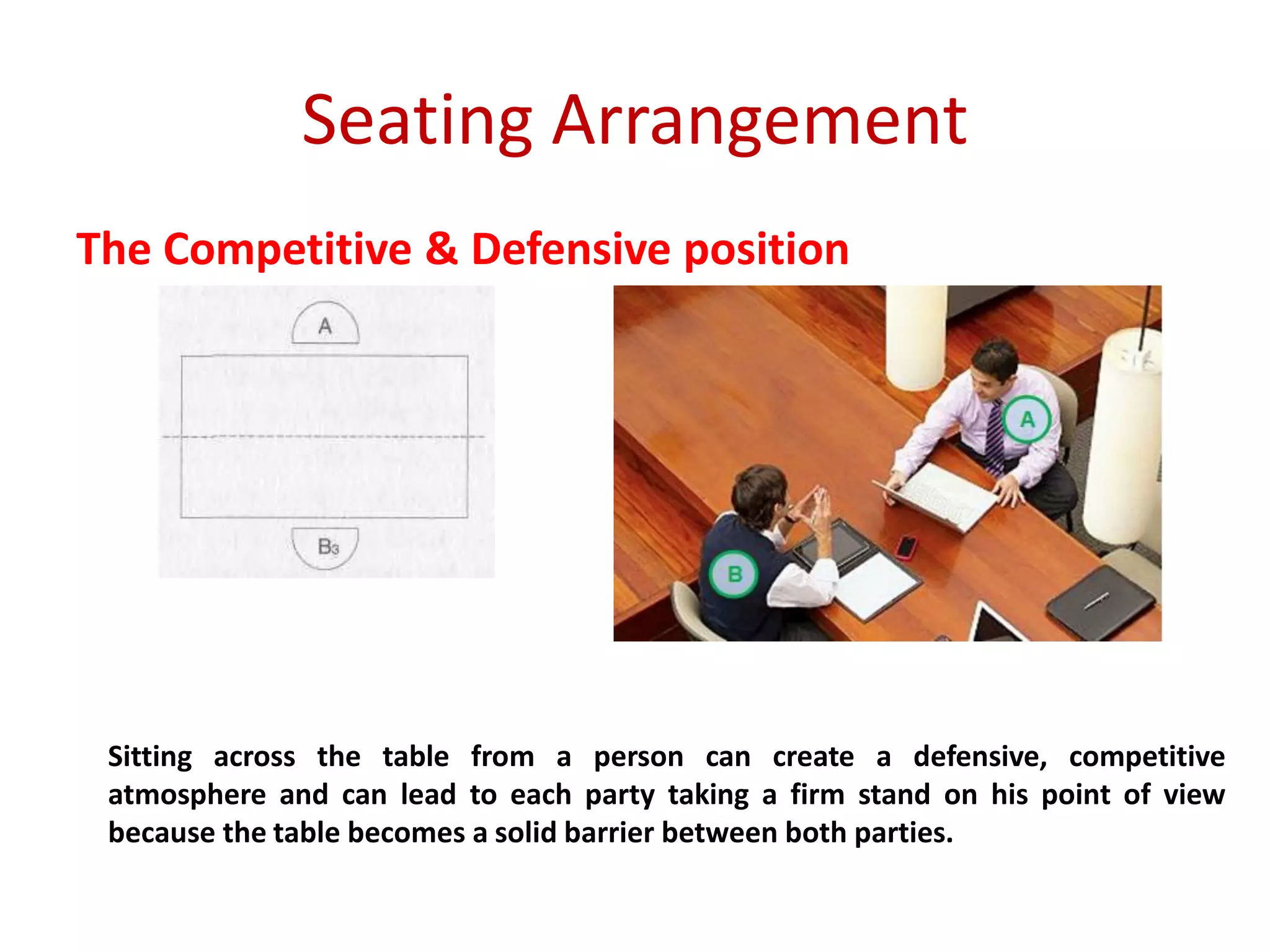
The Competitive & Defensive position
Sitting across the table from a person can create a defensive, competitive
atmosphere and can lead to each party taking a firm stand on his point of view
because the table becomes a solid barrier between both parties.
Seating Arrangement
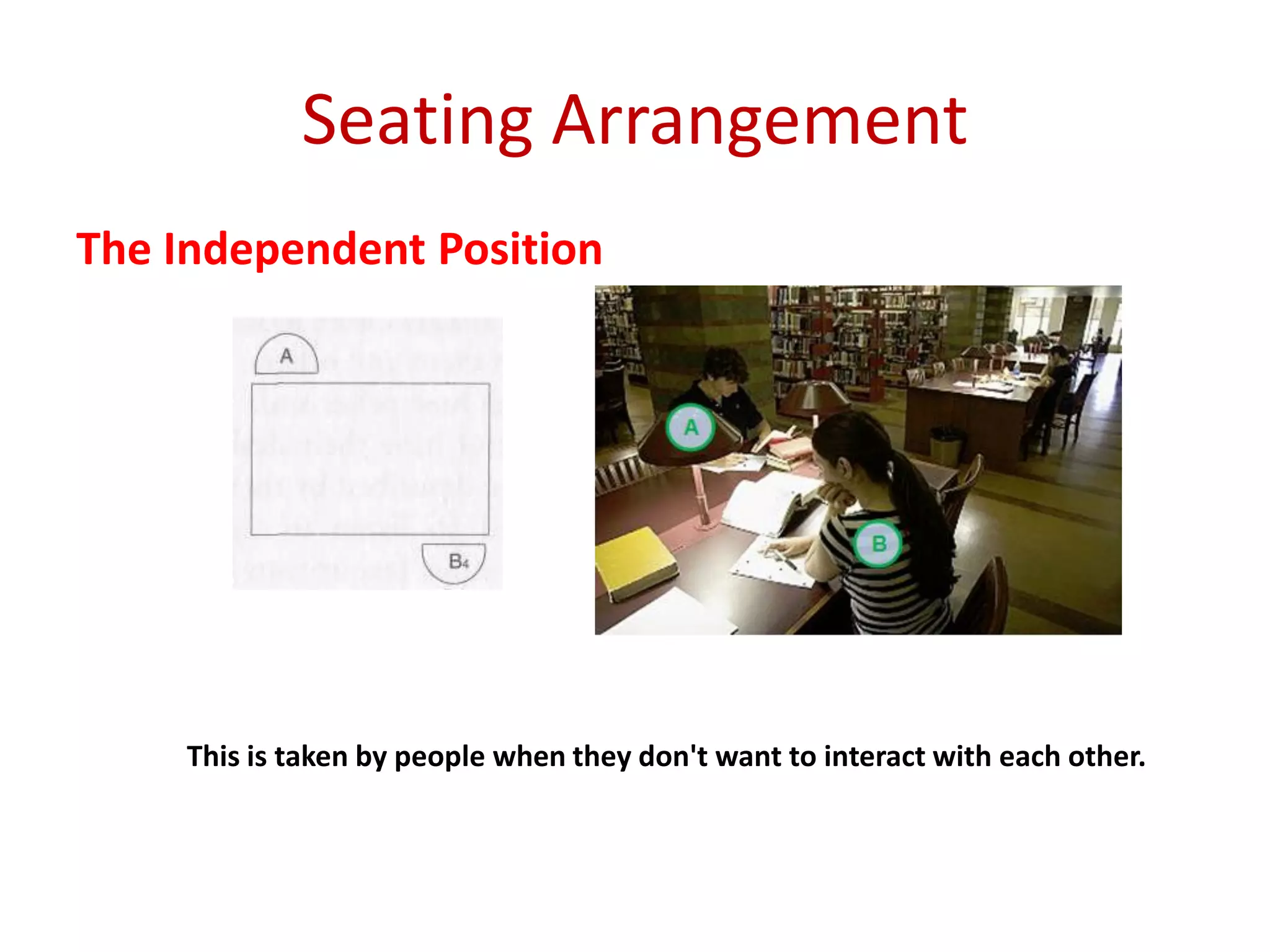
The Independent Position
This is taken by people when they don't want to interact with each other.
Seating Arrangement
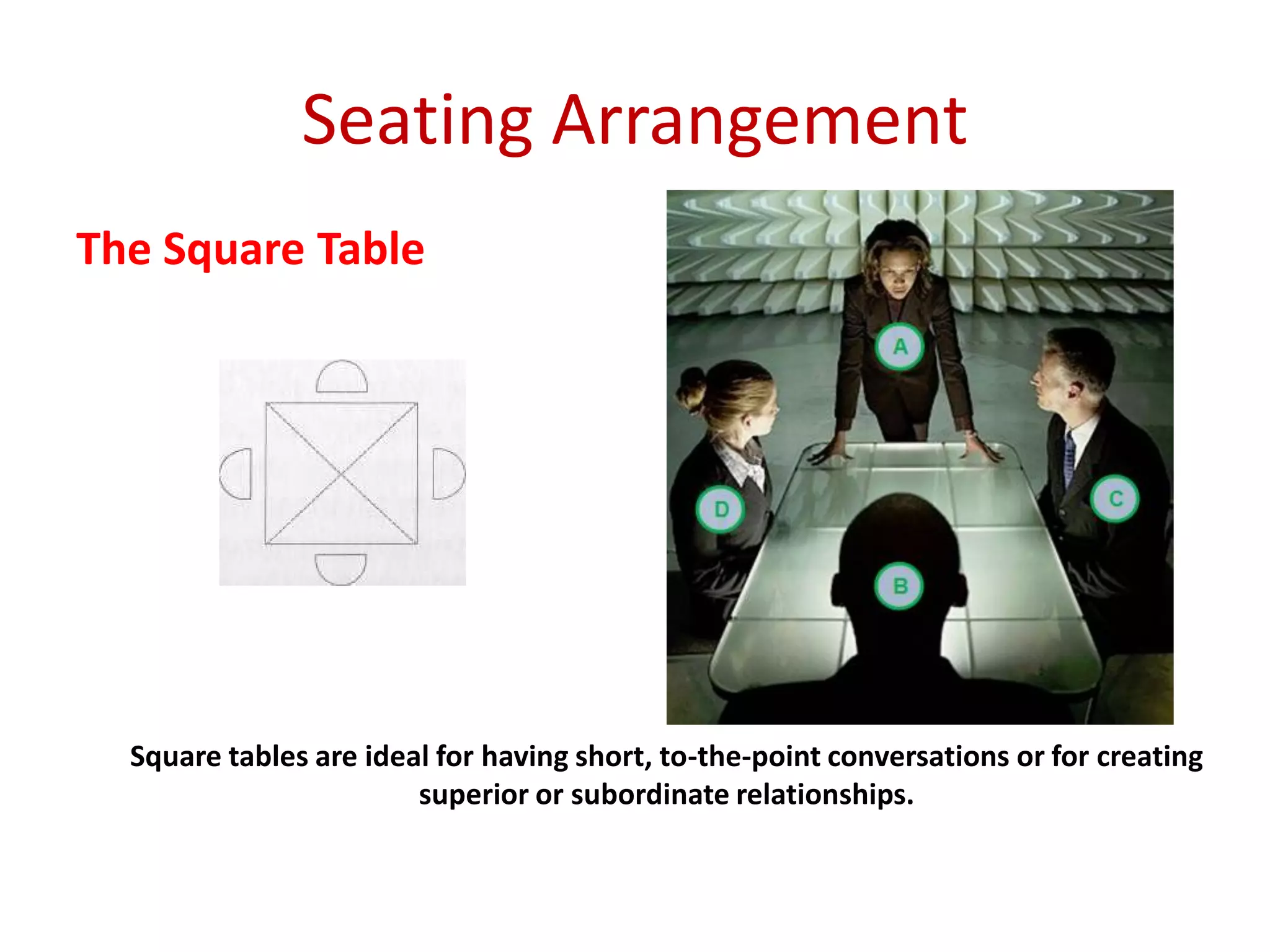
The Square Table
Square tables are ideal for having short, to-the-point conversations or for creating
superior or subordinate relationships.
Seating Arrangement
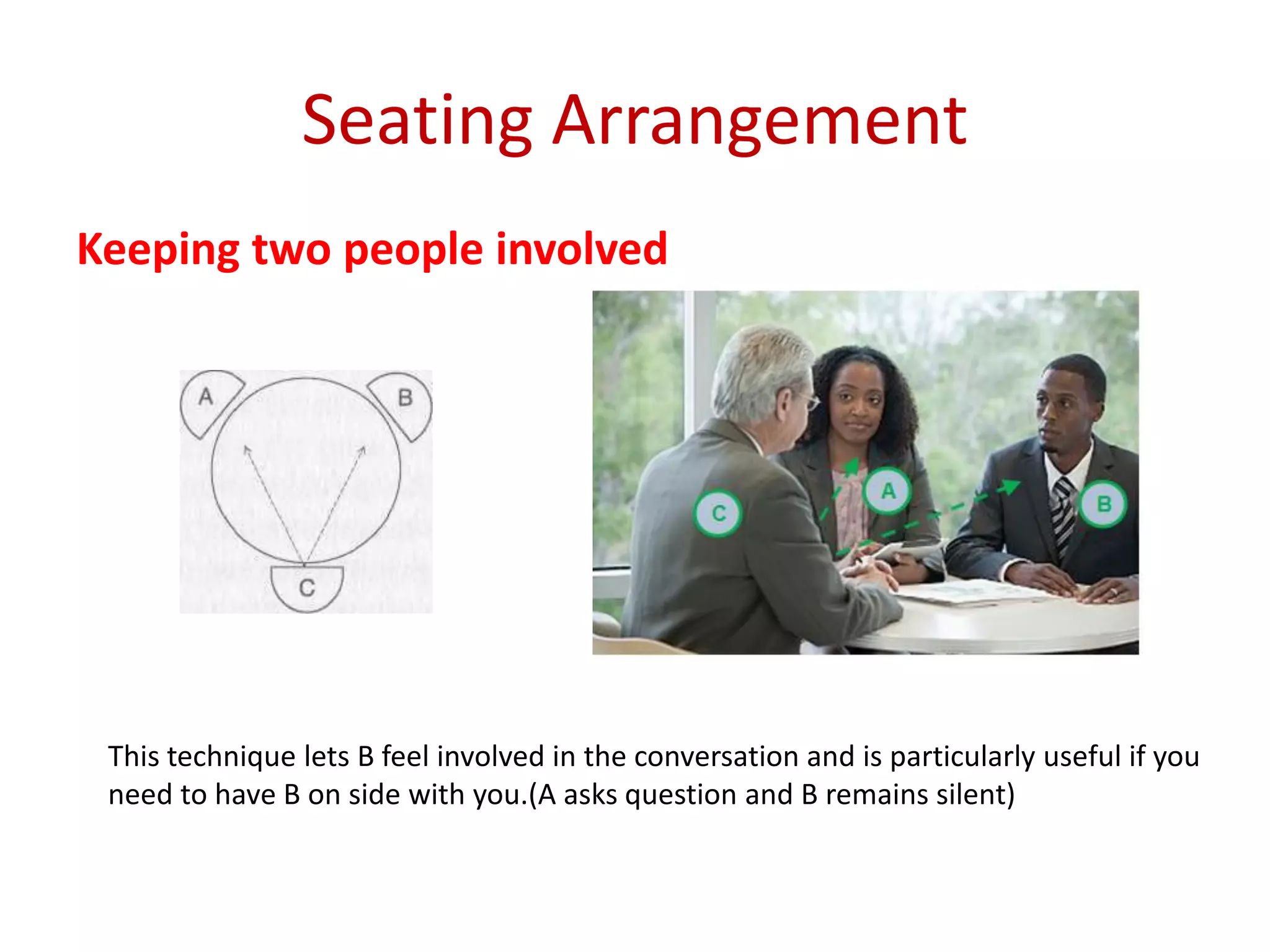
Keeping two people involved
This technique lets B feel involved in the conversation and is particularly useful if you
need to have B on side with you.(A asks question and B remains silent)
GIFTS
Giving Gifts
CHINA
• In general gifts are given at Chinese new year ,weddings,
births & birthdays
• The Chinese like food & a nice food basket will be a great
gift
• Don’t wrap gifts in White ,Blue or Black paper
• Four is unlucky and eight is lucky
• Present gifts with two hands
• Gifts are not opened when received
• Gifts may be refused three times before they are accepted
Giving Gifts
Australia
• Small gifts are generally acceptable on birthdays & Christmas
• If invited to someone’e home for dinner ,it’s polite to bring a box of
chocolates or flowers to the hostess.
• A bottle of good wine is appreciated
• Gifts are opened when they are received
USA
• Gifts are generally accepted for birthdays, anniversaries and major holidays ,
such as Christmas
• Gift can be as simple as a card
• Gift giving is not an elaborate event except at Christmas
• If invited to someone’s home for dinner ,it’s polite to bring a box of chocolates
,a bottle of wine, a potted plant or flowers to the hostess.
• Gifts are opened when they are received
Giving Gifts
Japan
• Giving a gift is highly ritualistic and meaningful
• The ceremony of presenting a gift and the way it is wrapped
is important(Pastel colors)
• Gifts are given on many occasions. Good quality of
chocolates or small cakes is a good idea. Don't give Lilies,
Lotus blossoms and with flowers as the are associated with
funeral; also potted plants associated with sickness.
• A bonsai tree is always acceptable.
• Give items in odd numbers but not nine.
• Gifts are not opened when received
Giving Gifts
Germany
• If you are invited to a german house ,carry a gift such as
chocolates or flower
• Yellow rose and tea roses are well received.
• Don’t give Red roses as it signifies romantic intentions.
• Avoid giving lilies as they are used in funerals.
• If you bring a wine ,it should be imported(french ,
italian)….giving german wine is considered as insult
Giving Gifts
India
• Gift giving is customary in India, and is seen as a sign of friendship.
However, it is generally not expected at the first meeting.
• It is advisable not to give expensive gifts, unless you are very close to
the person. Since Indians try to reciprocate a gift, if it is too expensive,
it can cause embarrassment for the recipient.
• Use red, yellow, green or blue coloured wrapping paper. White and
black colors are considered inauspicious.
• Normally, gifts are not opened in the presence of the giver. However,
sometimes your Indian host may insist on your opening the gift, and
would expect appreciation for his/her choice.
• If you are visiting an Indian during a festival, it is customary to carry a
box of sweets.
• If you are giving money as a gift, do remember that 11, 51, 101, 501,
etc. are considered auspicious numbers.
• Avoid giving leather or alcohol.
Non Verbal Communication

Non Verbal Communication

  • 1.
  • 2.
    Definition and Forms •Body Language • Space Proximities • Touch • Time • Voice Issues • Office,Environment Non-verbal communication includes pitch, speed ,tone, and volume of voice, gestures and facial expressions, body posture, stance, and proximity to the listener, eye movements and contact .
  • 3.
  • 4.
  • 5.
    Body Language • Palms •Handshake • Arms • Thumb • Eyes • Legs • Mirroring
  • 6.
  • 7.
  • 8.
  • 9.
  • 10.
  • 11.
  • 12.
  • 13.
    Clenched Arms-Frustration/Negative attitude The personwould be more difficult to handle when the hands are held high, than he would be with the person whom hands resting on the desk position. Like all negative gestures, some action needs to be taken to unlock the person’s fingers to expose the palms and the front of the body, or the hostile attitude will remain
  • 14.
    Steeple –Raised,Lowered Give theopinion or ideas and is doing the talking. Listening rather than speaking.
  • 15.
  • 16.
    Gripping Hand ,ArmAnd Wrists A position of authority The further the hand is moved up the back, the more angry the person has become A signal of frustration and an attempt at self- control
  • 17.
  • 18.
    Thumb Another show ofconfidence and feeling superior is by showing the thumbs. It could be as shown here, but any position where the thumbs are visible will do the trick. Holding your jacket with your thumb up, or have them stuck out of your back pockets are similar hand gestures that will do the trick.
  • 19.
  • 20.
    Standard Leg-Cross Position Anervous, reserved or defensive attitude.
  • 21.
  • 22.
  • 23.
  • 24.
  • 25.
  • 26.
  • 27.
    Intimate space • 2fists away from your body. • People emotionally close to you are allowed to enter this zone
  • 28.
    Personal space • Ahandshake away • The distance you should stand in friendly gathering
  • 29.
    Social space • Abouttwo arm length away • The distance you should stand with people you don’t know
  • 30.
    Public space • Over3.6 m away • The distance you feel comfortable when addressing people
  • 31.
  • 32.
    Touch(Haptic Communication) Functional/professional: Thisis touch between colleagues and professionals. For example, a handshake or a slap on the back. It is sometimes used to show authority and dominance.

  • 33.
    Social/polite: This isused with acquaintances, or with people in a group who are friends, but not necessarily close friends. It includes a light touch on the arm to get attention, or hugging team members when you win a match. It is generally positive, friendly and affirming.
  • 34.
    Friendship/warmth: Touch hereincludes many of the lighthearted gestures that show you like, and understand, each other. For example, “high 5-ing” a friend when you see each other, or giving them hug when they share bad news.
  • 35.
    Love/intimacy: This typeof touch is associated with emotional closeness, trust and vulnerability. For example, we see this in the way a child clings to his or her mother when they are feeling sad or afraid. Also, holding hands, or embracing each other, as a dating couple.
  • 36.
  • 37.
    Time(Chronemics) Chronemics is thestudy of how we refer to and perceive time. The way that one perceives and values time, structures time and reacts to time frames communication. Across cultures, time perception plays a large role in the nonverbal communication process.
  • 38.
    Monochronic/Polychronic • Monochronic-where thingsare typically done one at a time, where time is segmented into precise, small units, and where time is scheduled, arranged and managed. In such a culture, time is viewed as a tangible commodity than can be spent, saved or wasted, and a paramount value is placed on regimented schedules, tasks and “getting the job done”. United States, Germany and Switzerland, to which could be added Britain, Canada, Japan, South Korea, Turkey, and the Scandinavian countries. • Polychronic – where several things can be done at once, and a more fluid approach is taken to scheduling time. Such cultures tend to be less focused on the precise accounting of each and every moment, and much more steeped in tradition and relationships rather than in tasks. Many Latin American, African, Asian and Arab cultures fall into this category, especially countries like Mexico, Pakistan, India, rural China, the Philippines, Egypt and Saudi Arabia.
  • 39.
  • 40.
  • 41.
    Voice(Paralanguage) Paralanguage involves verbaland nonverbal aspects of speech that influence meaning, including tone, intensity, pausing, and even silence. Various acoustic properties of speech such as tone, pitch and accent, collectively known as prosody, can all give off nonverbal cues. Paralanguage may change the meaning of words .Prosody may reflect various features of the speaker or the utterance: - The emotional state of a speaker; - Whether an utterance is a statement, a question, or a command; -Whether the speaker is being ironic or sarcastic; emphasis, contrast, and focus Other elements of language that may not be encoded by grammar or choice of vocabulary.
  • 42.
    Voice(Paralanguage) • Volume Quality:articulation,nasality, accent, pitch, range of voice and resonance. • Vocal characteristics:tone variations, inflections, the speed at which you speak, whether your voice projects and whatever emotion you may be conveying through tone and inflection and so on. • Voice qualifiers :bright, soft, round, light, cold or hot, strength or weakness, breathy, texture, thick, old or child- like and attitude (angry, chilling, seductive, convincing). • Voice segregates are all the noises listeners make to signify that they are listening: "uh-huh" or "um" or silences. Video: https://www.youtube.com/watch?v=0O3nPzuNIPo
  • 43.
  • 44.
    Office & Environment Environmentinvolves the physical and psychological aspects of the communication context. More than the tables and chairs in an office, environment is an important part of the dynamic communication process. The perception of one’s environment influences one’s reaction to it. • Physical : Physical context includes the environmental factors in a communication encounter. The size, layout, temperature, and lighting of a space influence our communication. • Psychological: Psychological context includes the mental and emotional factors in a communication encounter. Stress, anxiety, and emotions are just some examples of psychological influences that can affect our communication.
  • 45.
    Chair Size andAccessories: The higher the back of the chair, the more power and status the person sitting in it is perceived to have
  • 46.
    The ATTENTION ZONE Thosesitting in the 'funnel' gave the most amount of participation, interacted most with the presenter and had the highest recall about what was being discussed. Those who participated the least sat in the back or to the sides, tended to be more negative or confrontational and had the lowest recall. The rear positions also allow a delegate a greater opportunity to doodle, sleep or escape.
  • 47.
    Seating Arrangement The cornerposition This position is used by people who are engaged in friendly, casual conversation.
  • 48.
    Seating Arrangement The Co-OperativePosition This is one of the best positions for presenting your case and having it accepted because it allows good eye contact and the opportunity for mirroring.
  • 49.
    Seating Arrangement The Co-OperativePosition(introducing a third person) This allows the salesperson to be'on the client's side' and to ask the technician questions on behalf of the client.
  • 50.
    Seating Arrangement The Competitive& Defensive position Sitting across the table from a person can create a defensive, competitive atmosphere and can lead to each party taking a firm stand on his point of view because the table becomes a solid barrier between both parties.
  • 51.
    Seating Arrangement The IndependentPosition This is taken by people when they don't want to interact with each other.
  • 52.
    Seating Arrangement The SquareTable Square tables are ideal for having short, to-the-point conversations or for creating superior or subordinate relationships.
  • 53.
    Seating Arrangement Keeping twopeople involved This technique lets B feel involved in the conversation and is particularly useful if you need to have B on side with you.(A asks question and B remains silent)
  • 54.
  • 55.
    Giving Gifts CHINA • Ingeneral gifts are given at Chinese new year ,weddings, births & birthdays • The Chinese like food & a nice food basket will be a great gift • Don’t wrap gifts in White ,Blue or Black paper • Four is unlucky and eight is lucky • Present gifts with two hands • Gifts are not opened when received • Gifts may be refused three times before they are accepted
  • 56.
    Giving Gifts Australia • Smallgifts are generally acceptable on birthdays & Christmas • If invited to someone’e home for dinner ,it’s polite to bring a box of chocolates or flowers to the hostess. • A bottle of good wine is appreciated • Gifts are opened when they are received USA • Gifts are generally accepted for birthdays, anniversaries and major holidays , such as Christmas • Gift can be as simple as a card • Gift giving is not an elaborate event except at Christmas • If invited to someone’s home for dinner ,it’s polite to bring a box of chocolates ,a bottle of wine, a potted plant or flowers to the hostess. • Gifts are opened when they are received
  • 57.
    Giving Gifts Japan • Givinga gift is highly ritualistic and meaningful • The ceremony of presenting a gift and the way it is wrapped is important(Pastel colors) • Gifts are given on many occasions. Good quality of chocolates or small cakes is a good idea. Don't give Lilies, Lotus blossoms and with flowers as the are associated with funeral; also potted plants associated with sickness. • A bonsai tree is always acceptable. • Give items in odd numbers but not nine. • Gifts are not opened when received
  • 58.
    Giving Gifts Germany • Ifyou are invited to a german house ,carry a gift such as chocolates or flower • Yellow rose and tea roses are well received. • Don’t give Red roses as it signifies romantic intentions. • Avoid giving lilies as they are used in funerals. • If you bring a wine ,it should be imported(french , italian)….giving german wine is considered as insult
  • 59.
    Giving Gifts India • Giftgiving is customary in India, and is seen as a sign of friendship. However, it is generally not expected at the first meeting. • It is advisable not to give expensive gifts, unless you are very close to the person. Since Indians try to reciprocate a gift, if it is too expensive, it can cause embarrassment for the recipient. • Use red, yellow, green or blue coloured wrapping paper. White and black colors are considered inauspicious. • Normally, gifts are not opened in the presence of the giver. However, sometimes your Indian host may insist on your opening the gift, and would expect appreciation for his/her choice. • If you are visiting an Indian during a festival, it is customary to carry a box of sweets. • If you are giving money as a gift, do remember that 11, 51, 101, 501, etc. are considered auspicious numbers. • Avoid giving leather or alcohol.