Presenter
Dr sharan hongal
•Definition
•Etiology
•Classification
•Evaluation
•Management
non-operative
operative
•Prevention
ObjectiveObjective
Non Union
NON UNION OCCURS WHEN A FRACTURE HAVE FAILED TO HEAL IN
EXPECTED TIME AND IS NOT LIKELY TO HEAL WITHOUT NEW
INTERVENTION
FDA defined nonunion as “established when a minimum of 9 months
has elapsed since fracture with no visible progressive signs of
healing for 3 months”
Pseudoarthrosis
Formation of a false joint where a fibro-cartilaginous cavity is lined with
synovial membrane
DELAYED UNION
DELAYED UNON OCCURS WHEN A FRACTURE HAS NOT HEALED COMPLETELY IN EXPECTED
TIME BUT STILL HAS POTENTIAL TO HEAL WITH INTERVENTION
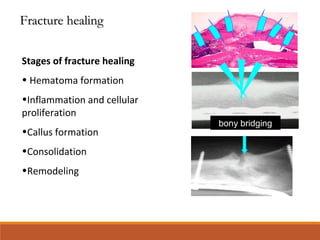
bony bridging
Stages of fracture healing
• Hematoma formation
•Inflammation and cellular
proliferation
•Callus formation
•Consolidation
•Remodeling
Fracture healingFracture healing
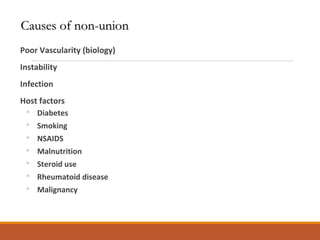
Poor Vascularity (biology)
Instability
Infection
Host factors
◦ Diabetes
◦ Smoking
◦ NSAIDS
◦ Malnutrition
◦ Steroid use
◦ Rheumatoid disease
◦ Malignancy
Causes of non-unionCauses of non-union
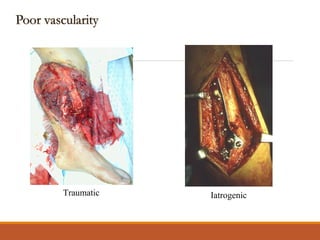
Traumatic Iatrogenic
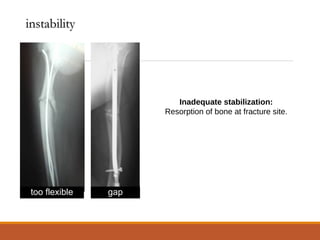
too flexible gap
Inadequate stabilization:
Resorption of bone at fracture site.
instabilityinstability
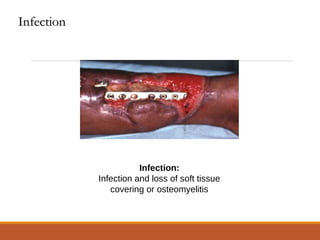
Infection:
Infection and loss of soft tissue
covering or osteomyelitis
InfectionInfection
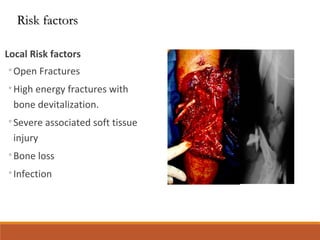
Local Risk factors
◦Open Fractures
◦High energy fractures with
bone devitalization.
◦Severe associated soft tissue
injury
◦Bone loss
◦Infection
Risk factorsRisk factors
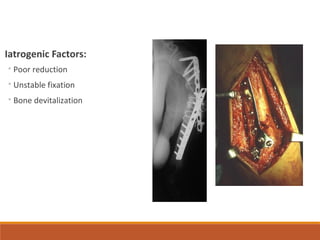
Iatrogenic Factors:
◦Poor reduction
◦Unstable fixation
◦Bone devitalization
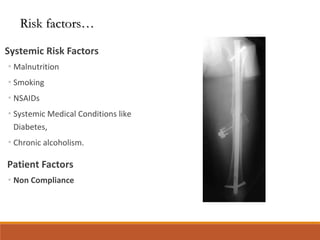
Systemic Risk Factors
◦Malnutrition
◦Smoking
◦NSAIDs
◦Systemic Medical Conditions like
Diabetes,
◦Chronic alcoholism.
Patient Factors
◦Non Compliance
Risk factors…Risk factors…
Site
- Diaphyseal
- Metaphyseal:
- Extraarticular
- Intraarticular
Callus
- Hypertrophic
- Avascular
Infection
- Aseptic
- Septic
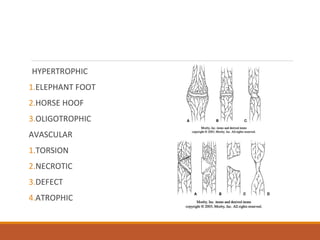
HYPERTROPHIC
1.ELEPHANT FOOT
2.HORSE HOOF
3.OLIGOTROPHIC
AVASCULAR
1.TORSION
2.NECROTIC
3.DEFECT
4.ATROPHIC
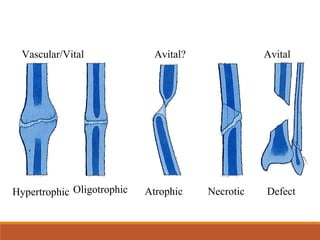
Hypertrophic Atrophic Necrotic DefectOligotrophic
Vascular/Vital Avital? Avital
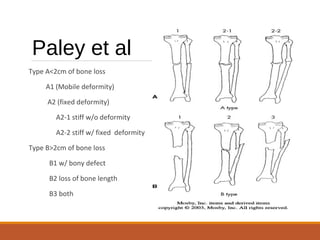
Paley et al
Type A<2cm of bone loss
A1 (Mobile deformity)
A2 (fixed deformity)
A2-1 stiff w/o deformity
A2-2 stiff w/ fixed deformity
Type B>2cm of bone loss
B1 w/ bony defect
B2 loss of bone length
B3 both
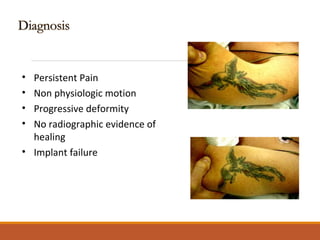
• Persistent Pain
• Non physiologic motion
• Progressive deformity
• No radiographic evidence of
healing
• Implant failure
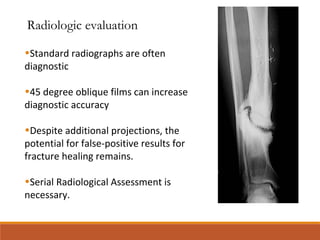
•Standard radiographs are often
diagnostic
•45 degree oblique films can increase
diagnostic accuracy
•Despite additional projections, the
potential for false-positive results for
fracture healing remains.
•Serial Radiological Assessment is
necessary.
Radiologic evaluation
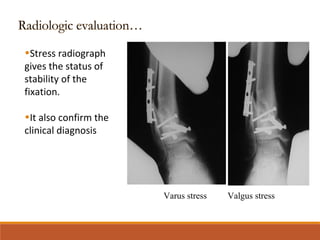
•Stress radiograph
gives the status of
stability of the
fixation.
•It also confirm the
clinical diagnosis
Varus stress Valgus stress
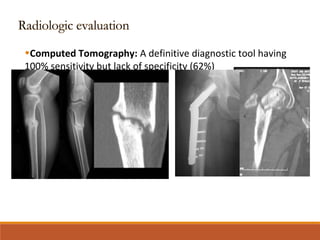
•Computed Tomography: A definitive diagnostic tool having
100% sensitivity but lack of specificity (62%)
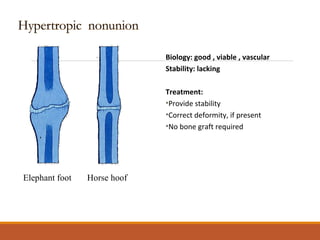
Biology: good , viable , vascular
Stability: lacking
Treatment:
•Provide stability
•Correct deformity, if present
•No bone graft required
Elephant foot Horse hoof
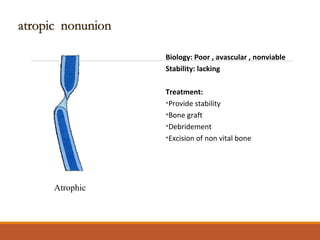
Biology: Poor , avascular , nonviable
Stability: lacking
Treatment:
•Provide stability
•Bone graft
•Debridement
•Excision of non vital bone
Atrophic
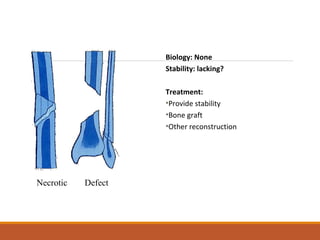
Biology: None
Stability: lacking?
Treatment:
•Provide stability
•Bone graft
•Other reconstruction
Necrotic Defect
NON OPERATIVE
TREATMENT
•Indirect intervention
•Weight bearing And external stabilization
•Electrical stimulation
•Ultrasound stimulation
•Extracorporal shock wave therapy
•Parathyroid harmone
•Gene therapy
Indirect intervention
Cesaation of smoking
Control of diabetes/ metabolic disorder
Maintaining nutrition
Long term use of NSAIDS, steroids , chemotherapic agents etc
Immunosuppresive drugs
Weight bearing and
external stabilization
oApplication of weight bearing in functional brace
Mechanism = stimulation of osteoblastic activity by mechanical loading
Mainly used in hypertrophic
oExternal supportive devices have little role in
Atrophic non union
Pseudoarthrosis
Malaligned nonunions
Infected non unions
Electrical stimulation
Internal application
Direct current = surgical implantation and potentially surgical removal of
stimulation device
External application
Mechanism = alteration of electrical potential at the fracture site .There
by reducing osteoclastic related bone resorpstion , increase osteoid
formation and stimulate angiogenesis.
1.Capative coupling – 24 hrs per day
2.Pulsed electromagnetic field stimulation – 12 hrs per day
3.Combined magnetic field - 30` min per day
Ultrasound stimulation
Low intensity pulsed ultrasound is of low energy
Frequency of 1.5mhz a signal burst width of 200 micro sec a repetation
1 mhz an intensity of 300mW/cm
Mechanism = stimulate ossification
Extracorporal shock wave
therapy
High energy
Requires regional anaesthesia
Enhance biomechanical properties of bone and angiogenesis
Parathyroid hormone
Regulator of calcium metabolism
Pth binds to osteoblasts stimulating release of mediators that in turn
stimulate osteoclasts to resorb bone thus help in acute fracture healing
and non union
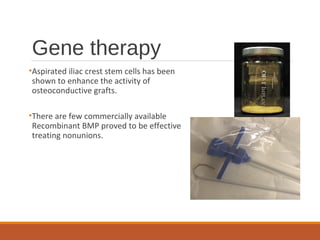
Gene therapy
•Aspirated iliac crest stem cells has been
shown to enhance the activity of
osteoconductive grafts.
•There are few commercially available
Recombinant BMP proved to be effective
treating nonunions.
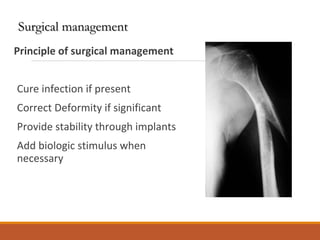
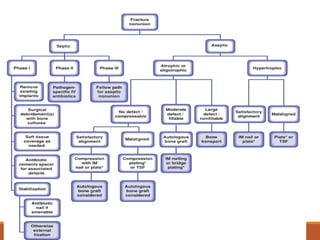
Principle of surgical management
Cure infection if present
Correct Deformity if significant
Provide stability through implants
Add biologic stimulus when
necessary
Surgical managementSurgical management
OPERATIVE
•Timing of operative intervention
•Plate and screw fixation
•IM nailing
•External fixation
•Arthroplasty
•Amputation
•Arthrodesis
•Fragment excision and resection arthroplasty
•Osteotomy
•Synostosis
Timing of operative
intervention
Difficulty in establishing the optimal time to intervene surgically in
treatment of non union parallels the difficulty in the diagnosis of non
union
Standardized protocol
Waiting for 6 months before reoperation
Treat infection before operating
Plate and screw fixation
Intramedullary Devices
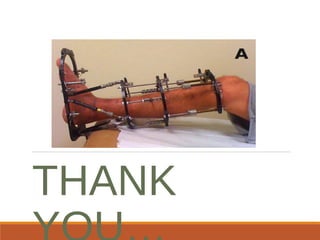
External Fixation
Choice of internal fixation depends on-
Type of nonunion.
Condition of the soft tissues and bone
Size and position of the bone fragments
Size of the bony defect.
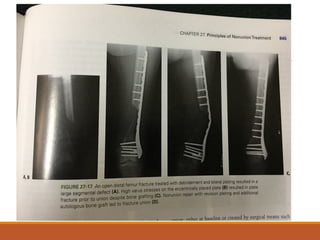
Plate and screw fixation
•Plates provide a powerful reduction tool
•Surgical technique should strive for absolute stability
•Locking plates have improved stability and fixation strength
•Other relative indications:
– Absent medullary canal
– Metaphyseal nonunions
– When open reduction or removal of prior implants is required
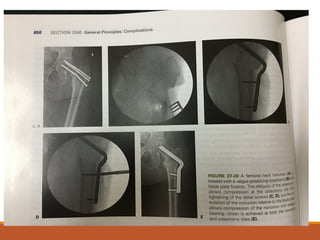
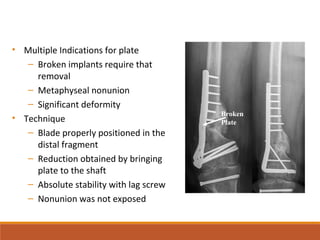
• Multiple Indications for plate
– Broken implants require that
removal
– Metaphyseal nonunion
– Significant deformity
• Technique
– Blade properly positioned in the
distal fragment
– Reduction obtained by bringing
plate to the shaft
– Absolute stability with lag screw
– Nonunion was not exposed
Broken
Plate
Broken
Plate
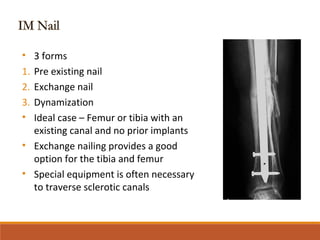
• 3 forms
1. Pre existing nail
2. Exchange nail
3. Dynamization
• Ideal case – Femur or tibia with an
existing canal and no prior implants
• Exchange nailing provides a good
option for the tibia and femur
• Special equipment is often necessary
to traverse sclerotic canals
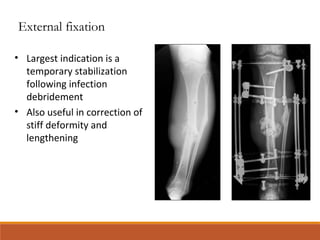
• Largest indication is a
temporary stabilization
following infection
debridement
• Also useful in correction of
stiff deformity and
lengthening
External fixation
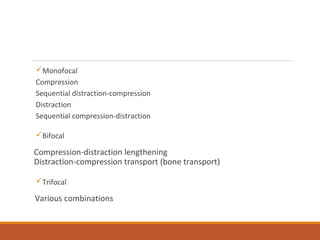
Monofocal
Compression
Sequential distraction-compression
Distraction
Sequential compression-distraction
Bifocal
Compression-distraction lengthening
Distraction-compression transport (bone transport)
Trifocal
Various combinations
Gold standard for biological and mechanical purposes.
Properties of Autograft:
Osteogenic a source of vital bone cells
Osteoinductive recruitment of local mesenchymal cells
Osteoconductive scaffold for ingrowth of new bone
Bone graft can also be allograft.
BONE GRAFT
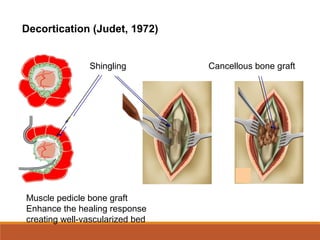
Decortication (Judet, 1972)
Shingling Cancellous bone graft
Muscle pedicle bone graft
Enhance the healing response
creating well-vascularized bed
BONE GRAFT
SUBSTITUTES
Often unnecessary in hypertrophic cases with sufficient inherent biologicOften unnecessary in hypertrophic cases with sufficient inherent biologic
activityactivity
•OptionsOptions
– Aspirated stem cells (with or without expansion)Aspirated stem cells (with or without expansion)
– Demineralized Bone MatrixDemineralized Bone Matrix
– Autogenous Cancellous GraftAutogenous Cancellous Graft
– Platelet rich plasma
– Growth FactorsGrowth Factors
• Platelet derivedPlatelet derived
• Recombinant BMPsRecombinant BMPs
Articular non union
Potential causative factor is inadequate compression of the articular
fracture gap leading to prolonged exposure to synovial membrane
Ideal situation of repair
1.Joint arthrosis
2.Joint instability
3.Stiffness
Therefore soft tissue contracture release or early post operative rom
exercise
Segmental bone loss
They are due to high velocity injury or infected non union
Surgical options include
1.Autogenous bone graft
2.Free vascularized bone graft
3.Bone transport
A critical sized defect is generally regarded as the that requires surgery
It depends on particular bone involved , location within the bone ,
surrounding tissue , host biological response
Infected non union
•Contaminated implants and devitalized implants must be removed
• Infection treated:
• Temporary stabilization (external fixation)
• Culture specific antibiotics
• +/- local antibiotic delivery (antibiobic beads)
•Secondary stabilization with augmentation of osteogenesis (cancellous
grafting)
Active Treatment –
The objective of the active method is to obtain bony union
early and shorten the period of convalescence and
preserve motion in the adjacent joints.
Polymethyl Methacrylate Antibiotic Beads-
Heat-stable antibiotics, such as tobramycin and
gentamicin, can be mixed with PMMA and used locally to
achieve 200 times the antibiotic concentration achieved
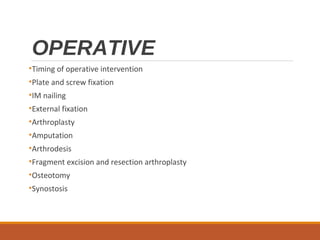
with intravenous administration.
PreventionPrevention
• Good reduction
• Bone grafting
• Firm stabilization
 biomechanical stability and
 biological vitality of the bone.
Principles of treatment applied based on types of nonunion:
- stabilization
- enhancement of biology
- eradication of infection if any
How to prevent delayed unions/nonunions:
- biological fixation in original operation
- early recognition of delayed union
THANK

Non union

  • 1.
  • 2.
  • 3.
    Non Union NON UNIONOCCURS WHEN A FRACTURE HAVE FAILED TO HEAL IN EXPECTED TIME AND IS NOT LIKELY TO HEAL WITHOUT NEW INTERVENTION FDA defined nonunion as “established when a minimum of 9 months has elapsed since fracture with no visible progressive signs of healing for 3 months”
  • 4.
    Pseudoarthrosis Formation of afalse joint where a fibro-cartilaginous cavity is lined with synovial membrane DELAYED UNION DELAYED UNON OCCURS WHEN A FRACTURE HAS NOT HEALED COMPLETELY IN EXPECTED TIME BUT STILL HAS POTENTIAL TO HEAL WITH INTERVENTION
  • 5.
    bony bridging Stages offracture healing • Hematoma formation •Inflammation and cellular proliferation •Callus formation •Consolidation •Remodeling Fracture healingFracture healing
  • 6.
    Poor Vascularity (biology) Instability Infection Hostfactors ◦ Diabetes ◦ Smoking ◦ NSAIDS ◦ Malnutrition ◦ Steroid use ◦ Rheumatoid disease ◦ Malignancy Causes of non-unionCauses of non-union
  • 7.
  • 8.
    too flexible gap Inadequatestabilization: Resorption of bone at fracture site. instabilityinstability
  • 9.
    Infection: Infection and lossof soft tissue covering or osteomyelitis InfectionInfection
  • 10.
    Local Risk factors ◦OpenFractures ◦High energy fractures with bone devitalization. ◦Severe associated soft tissue injury ◦Bone loss ◦Infection Risk factorsRisk factors
  • 11.
  • 12.
    Systemic Risk Factors ◦Malnutrition ◦Smoking ◦NSAIDs ◦SystemicMedical Conditions like Diabetes, ◦Chronic alcoholism. Patient Factors ◦Non Compliance Risk factors…Risk factors…
  • 13.
    Site - Diaphyseal - Metaphyseal: -Extraarticular - Intraarticular Callus - Hypertrophic - Avascular Infection - Aseptic - Septic
  • 14.
  • 15.
    Hypertrophic Atrophic NecroticDefectOligotrophic Vascular/Vital Avital? Avital
  • 16.
    Paley et al TypeA<2cm of bone loss A1 (Mobile deformity) A2 (fixed deformity) A2-1 stiff w/o deformity A2-2 stiff w/ fixed deformity Type B>2cm of bone loss B1 w/ bony defect B2 loss of bone length B3 both
  • 17.
    • Persistent Pain •Non physiologic motion • Progressive deformity • No radiographic evidence of healing • Implant failure
  • 18.
    •Standard radiographs areoften diagnostic •45 degree oblique films can increase diagnostic accuracy •Despite additional projections, the potential for false-positive results for fracture healing remains. •Serial Radiological Assessment is necessary. Radiologic evaluation
  • 19.
    •Stress radiograph gives thestatus of stability of the fixation. •It also confirm the clinical diagnosis Varus stress Valgus stress
  • 20.
    •Computed Tomography: Adefinitive diagnostic tool having 100% sensitivity but lack of specificity (62%)
  • 21.
    Biology: good ,viable , vascular Stability: lacking Treatment: •Provide stability •Correct deformity, if present •No bone graft required Elephant foot Horse hoof
  • 22.
    Biology: Poor ,avascular , nonviable Stability: lacking Treatment: •Provide stability •Bone graft •Debridement •Excision of non vital bone Atrophic
  • 23.
    Biology: None Stability: lacking? Treatment: •Providestability •Bone graft •Other reconstruction Necrotic Defect
  • 24.
    NON OPERATIVE TREATMENT •Indirect intervention •Weightbearing And external stabilization •Electrical stimulation •Ultrasound stimulation •Extracorporal shock wave therapy •Parathyroid harmone •Gene therapy
  • 25.
    Indirect intervention Cesaation ofsmoking Control of diabetes/ metabolic disorder Maintaining nutrition Long term use of NSAIDS, steroids , chemotherapic agents etc Immunosuppresive drugs
  • 26.
    Weight bearing and externalstabilization oApplication of weight bearing in functional brace Mechanism = stimulation of osteoblastic activity by mechanical loading Mainly used in hypertrophic oExternal supportive devices have little role in Atrophic non union Pseudoarthrosis Malaligned nonunions Infected non unions
  • 27.
    Electrical stimulation Internal application Directcurrent = surgical implantation and potentially surgical removal of stimulation device External application Mechanism = alteration of electrical potential at the fracture site .There by reducing osteoclastic related bone resorpstion , increase osteoid formation and stimulate angiogenesis. 1.Capative coupling – 24 hrs per day 2.Pulsed electromagnetic field stimulation – 12 hrs per day 3.Combined magnetic field - 30` min per day
  • 28.
    Ultrasound stimulation Low intensitypulsed ultrasound is of low energy Frequency of 1.5mhz a signal burst width of 200 micro sec a repetation 1 mhz an intensity of 300mW/cm Mechanism = stimulate ossification
  • 29.
    Extracorporal shock wave therapy Highenergy Requires regional anaesthesia Enhance biomechanical properties of bone and angiogenesis
  • 30.
    Parathyroid hormone Regulator ofcalcium metabolism Pth binds to osteoblasts stimulating release of mediators that in turn stimulate osteoclasts to resorb bone thus help in acute fracture healing and non union
  • 31.
    Gene therapy •Aspirated iliaccrest stem cells has been shown to enhance the activity of osteoconductive grafts. •There are few commercially available Recombinant BMP proved to be effective treating nonunions.
  • 32.
    Principle of surgicalmanagement Cure infection if present Correct Deformity if significant Provide stability through implants Add biologic stimulus when necessary Surgical managementSurgical management
  • 33.
    OPERATIVE •Timing of operativeintervention •Plate and screw fixation •IM nailing •External fixation •Arthroplasty •Amputation •Arthrodesis •Fragment excision and resection arthroplasty •Osteotomy •Synostosis
  • 34.
    Timing of operative intervention Difficultyin establishing the optimal time to intervene surgically in treatment of non union parallels the difficulty in the diagnosis of non union Standardized protocol Waiting for 6 months before reoperation Treat infection before operating
  • 35.
    Plate and screwfixation Intramedullary Devices External Fixation Choice of internal fixation depends on- Type of nonunion. Condition of the soft tissues and bone Size and position of the bone fragments Size of the bony defect.
  • 36.
    Plate and screwfixation •Plates provide a powerful reduction tool •Surgical technique should strive for absolute stability •Locking plates have improved stability and fixation strength •Other relative indications: – Absent medullary canal – Metaphyseal nonunions – When open reduction or removal of prior implants is required
  • 37.
    • Multiple Indicationsfor plate – Broken implants require that removal – Metaphyseal nonunion – Significant deformity • Technique – Blade properly positioned in the distal fragment – Reduction obtained by bringing plate to the shaft – Absolute stability with lag screw – Nonunion was not exposed Broken Plate
  • 39.
    Broken Plate • 3 forms 1.Pre existing nail 2. Exchange nail 3. Dynamization • Ideal case – Femur or tibia with an existing canal and no prior implants • Exchange nailing provides a good option for the tibia and femur • Special equipment is often necessary to traverse sclerotic canals
  • 40.
    • Largest indicationis a temporary stabilization following infection debridement • Also useful in correction of stiff deformity and lengthening External fixation
  • 41.
    Monofocal Compression Sequential distraction-compression Distraction Sequential compression-distraction Bifocal Compression-distractionlengthening Distraction-compression transport (bone transport) Trifocal Various combinations
  • 43.
    Gold standard forbiological and mechanical purposes. Properties of Autograft: Osteogenic a source of vital bone cells Osteoinductive recruitment of local mesenchymal cells Osteoconductive scaffold for ingrowth of new bone Bone graft can also be allograft. BONE GRAFT
  • 44.
    Decortication (Judet, 1972) ShinglingCancellous bone graft Muscle pedicle bone graft Enhance the healing response creating well-vascularized bed
  • 45.
    BONE GRAFT SUBSTITUTES Often unnecessaryin hypertrophic cases with sufficient inherent biologicOften unnecessary in hypertrophic cases with sufficient inherent biologic activityactivity •OptionsOptions – Aspirated stem cells (with or without expansion)Aspirated stem cells (with or without expansion) – Demineralized Bone MatrixDemineralized Bone Matrix – Autogenous Cancellous GraftAutogenous Cancellous Graft – Platelet rich plasma – Growth FactorsGrowth Factors • Platelet derivedPlatelet derived • Recombinant BMPsRecombinant BMPs
  • 46.
    Articular non union Potentialcausative factor is inadequate compression of the articular fracture gap leading to prolonged exposure to synovial membrane Ideal situation of repair 1.Joint arthrosis 2.Joint instability 3.Stiffness Therefore soft tissue contracture release or early post operative rom exercise
  • 47.
    Segmental bone loss Theyare due to high velocity injury or infected non union Surgical options include 1.Autogenous bone graft 2.Free vascularized bone graft 3.Bone transport A critical sized defect is generally regarded as the that requires surgery It depends on particular bone involved , location within the bone , surrounding tissue , host biological response
  • 48.
    Infected non union •Contaminatedimplants and devitalized implants must be removed • Infection treated: • Temporary stabilization (external fixation) • Culture specific antibiotics • +/- local antibiotic delivery (antibiobic beads) •Secondary stabilization with augmentation of osteogenesis (cancellous grafting)
  • 49.
    Active Treatment – Theobjective of the active method is to obtain bony union early and shorten the period of convalescence and preserve motion in the adjacent joints. Polymethyl Methacrylate Antibiotic Beads- Heat-stable antibiotics, such as tobramycin and gentamicin, can be mixed with PMMA and used locally to achieve 200 times the antibiotic concentration achieved with intravenous administration.
  • 50.
    PreventionPrevention • Good reduction •Bone grafting • Firm stabilization  biomechanical stability and  biological vitality of the bone.
  • 51.
    Principles of treatmentapplied based on types of nonunion: - stabilization - enhancement of biology - eradication of infection if any How to prevent delayed unions/nonunions: - biological fixation in original operation - early recognition of delayed union
  • 53.