Non-Conventional Concrete
Technologies
Submitted By:
Abhishek Gupta
11113002
Outline
oIntroduction
oConventional vs Non conventional concrete
oWhy Non conventional techniques are better
oSome Non Conventional Concrete Technologies
oConclusion
Conventional Concrete
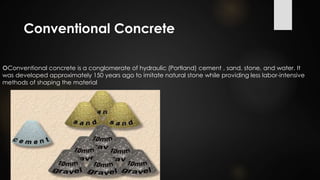
Conventional concrete is a conglomerate of hydraulic (Portland) cement , sand, stone, and water. It
was developed approximately 150 years ago to imitate natural stone while providing less labor-intensive
methods of shaping the material
Non-Conventional Concrete Technologies
Task specific
Environment Friendly
Cost effective
Self Compacting Concrete
oFirst developed in 1988
oto achieve durable concrete structures.
oFirst Practical use in Japan
DEVELOPMENT OF SELF-COMPACTING
CONCRETE
durability of concrete structures in Japan
durable concrete structures sufficient compaction skilled workers
Gradual reduction in skilled workers Requirement of new technology proposed by
Okamura in 1986
It is a ‘High performance Concrete’ due to its high durability
Important Properties & Benefits
Self-compactability
Avoidance of bleeding and segregation
Low shrinkage
Low permeability
Strength as needed
Safer, quieter sites
Better appearance
What is the secret?
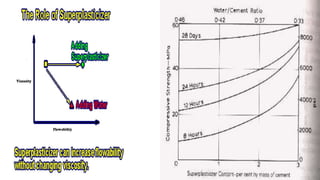
Optimum Paste Viscosity and water content which is attained by one of three means:
High cement content
High content of Fly Ash, Silica Fume etc.
Use of Viscosity Modifying Admixture
Low water content using HRWR High Strength
REQUIREMENTS OF
CONSTITUENT MATERIALS
CEMENT
Typical cement content – 350 to 450 kg/m3.
Cement > 500kg/m3 →shrinkage
Cement < 300kg/m3 →Requires Extra fine fillers
AGGREGATE
Fine Aggregate
Coarse AggregateFly ash: In appropriate quantity may be
the added the quality
REQUIREMENTS OF
CONSTITUENT MATERIALS
Other
Silica fumes: Added to improve the mechanical properties of scc.
Stone powder: finely crushed lime stone,dolomite or granite added to increase the powder content.
Fibres: fibres may be used to enhance the properties of scc as same as normal concrete
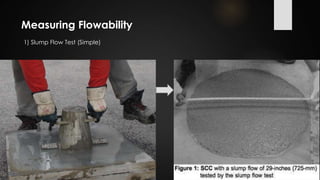
Measuring Flowability
1) Slump Flow Test (Simple)
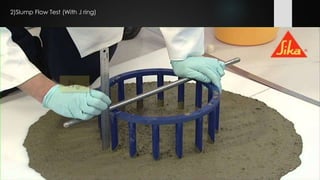
2)Slump Flow Test (With J ring)
What are the difficulties
Higher cost – especially if high strength is not needed
Plant control has to be better
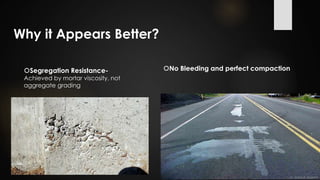
Why it Appears Better?
Segregation Resistance-
Achieved by mortar viscosity, not
aggregate grading
No Bleeding and perfect compaction
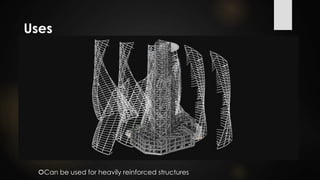
Uses
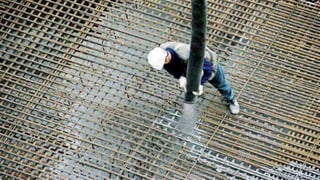
Can be used for heavily reinforced structures
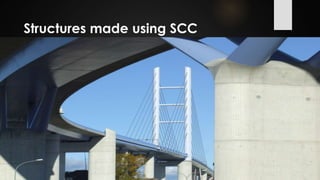
Structures made using SCC
Green Concrete
oFirst invented in Denmark in the year 1998 Kyoto Protoclol
oMade with concrete wastes
oSustainable Construction
ADVANTAGES OF GREEN CONCRETE
Reduced CO 2 emissions.
Low production costs.
Saves energy, emissions and waste water.
Helps in recycling industry wastes.
Reduces the consumption of cement overall.
o Better workability.
o Sustainable development.
o Greater strength and durability than
normal concrete.
o Compressive strength and Flexural
behavior is fairly equal to that of the
conventional concrete.
SUITABILITY OF GREEN CONCRETE IN STRUCTURES
Improve damping resistance of building.
speed of construction, shorten overall construction period.
 Reduce the dead weight of a facade from 5 tons to about 3.5 tons.
Good thermal and fire resistance, sound
 insulation than the traditional granite rock
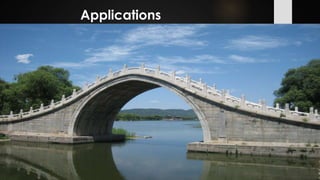
Applications
LIMITATIONS
cost of reinforcement
comparatively less life
Split tension of green concrete
High strength concrete
strength in excess of 60MPa
ultra high performance concrete (UHPC) will more usually contain cement replacement
materials and a high-range water-reducer (HRWR) or superplasticiser(SP
Ultra High Strength Concrete
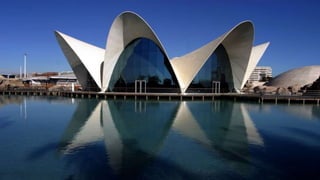
In what kind of structures ?
Conclusion
Concrete that is a little more expensive per cubic meter to buy
BUT
It will require less skill and effort to place
It will look better with no appearance defects
It will be more durable
It will require more skill at the batching plant
References
o Journal of Advanced Concrete Technology Vol . 1 , No . 1 , 5 - 1 5
(Self Compacting Concrete)
o Edvardsen Ing. Carola and Tølløse Karsten (2001). Environmentally
“Green” Concrete Structures
o Benjamin A. Graybeal, and Joseph L. Hartmann(2003). STRENGTH
AND DURABILITY OF ULTRA-HIGH PERFORMANCE CONCRETE

Non conventional concrete technologies

  • 1.
  • 2.
    Outline oIntroduction oConventional vs Nonconventional concrete oWhy Non conventional techniques are better oSome Non Conventional Concrete Technologies oConclusion
  • 3.
    Conventional Concrete Conventional concreteis a conglomerate of hydraulic (Portland) cement , sand, stone, and water. It was developed approximately 150 years ago to imitate natural stone while providing less labor-intensive methods of shaping the material
  • 4.
    Non-Conventional Concrete Technologies Taskspecific Environment Friendly Cost effective
  • 5.
    Self Compacting Concrete oFirstdeveloped in 1988 oto achieve durable concrete structures. oFirst Practical use in Japan
  • 6.
    DEVELOPMENT OF SELF-COMPACTING CONCRETE durabilityof concrete structures in Japan durable concrete structures sufficient compaction skilled workers Gradual reduction in skilled workers Requirement of new technology proposed by Okamura in 1986 It is a ‘High performance Concrete’ due to its high durability
  • 8.
    Important Properties &Benefits Self-compactability Avoidance of bleeding and segregation Low shrinkage Low permeability Strength as needed Safer, quieter sites Better appearance
  • 9.
    What is thesecret? Optimum Paste Viscosity and water content which is attained by one of three means: High cement content High content of Fly Ash, Silica Fume etc. Use of Viscosity Modifying Admixture Low water content using HRWR High Strength
  • 10.
    REQUIREMENTS OF CONSTITUENT MATERIALS CEMENT Typicalcement content – 350 to 450 kg/m3. Cement > 500kg/m3 →shrinkage Cement < 300kg/m3 →Requires Extra fine fillers AGGREGATE Fine Aggregate Coarse AggregateFly ash: In appropriate quantity may be the added the quality
  • 11.
    REQUIREMENTS OF CONSTITUENT MATERIALS Other Silicafumes: Added to improve the mechanical properties of scc. Stone powder: finely crushed lime stone,dolomite or granite added to increase the powder content. Fibres: fibres may be used to enhance the properties of scc as same as normal concrete
  • 13.
  • 14.
    2)Slump Flow Test(With J ring)
  • 15.
    What are thedifficulties Higher cost – especially if high strength is not needed Plant control has to be better
  • 16.
    Why it AppearsBetter? Segregation Resistance- Achieved by mortar viscosity, not aggregate grading No Bleeding and perfect compaction
  • 17.
    Uses Can be usedfor heavily reinforced structures
  • 18.
  • 20.
    Green Concrete oFirst inventedin Denmark in the year 1998 Kyoto Protoclol oMade with concrete wastes oSustainable Construction
  • 21.
    ADVANTAGES OF GREENCONCRETE Reduced CO 2 emissions. Low production costs. Saves energy, emissions and waste water. Helps in recycling industry wastes. Reduces the consumption of cement overall.
  • 22.
    o Better workability. oSustainable development. o Greater strength and durability than normal concrete. o Compressive strength and Flexural behavior is fairly equal to that of the conventional concrete.
  • 23.
    SUITABILITY OF GREENCONCRETE IN STRUCTURES Improve damping resistance of building. speed of construction, shorten overall construction period.  Reduce the dead weight of a facade from 5 tons to about 3.5 tons. Good thermal and fire resistance, sound  insulation than the traditional granite rock
  • 24.
  • 26.
    LIMITATIONS cost of reinforcement comparativelyless life Split tension of green concrete
  • 27.
    High strength concrete strengthin excess of 60MPa ultra high performance concrete (UHPC) will more usually contain cement replacement materials and a high-range water-reducer (HRWR) or superplasticiser(SP
  • 28.
    Ultra High StrengthConcrete In what kind of structures ?
  • 29.
    Conclusion Concrete that isa little more expensive per cubic meter to buy BUT It will require less skill and effort to place It will look better with no appearance defects It will be more durable It will require more skill at the batching plant
  • 30.
    References o Journal ofAdvanced Concrete Technology Vol . 1 , No . 1 , 5 - 1 5 (Self Compacting Concrete) o Edvardsen Ing. Carola and Tølløse Karsten (2001). Environmentally “Green” Concrete Structures o Benjamin A. Graybeal, and Joseph L. Hartmann(2003). STRENGTH AND DURABILITY OF ULTRA-HIGH PERFORMANCE CONCRETE