node.js
 A quick tour


                by Felix Geisendörfer
Introduction
Why?

Node's goal is to provide an easy
way to build scalable network
programs.
                        -- nodejs.org
How?

Keep slow operations from
blocking other operations.
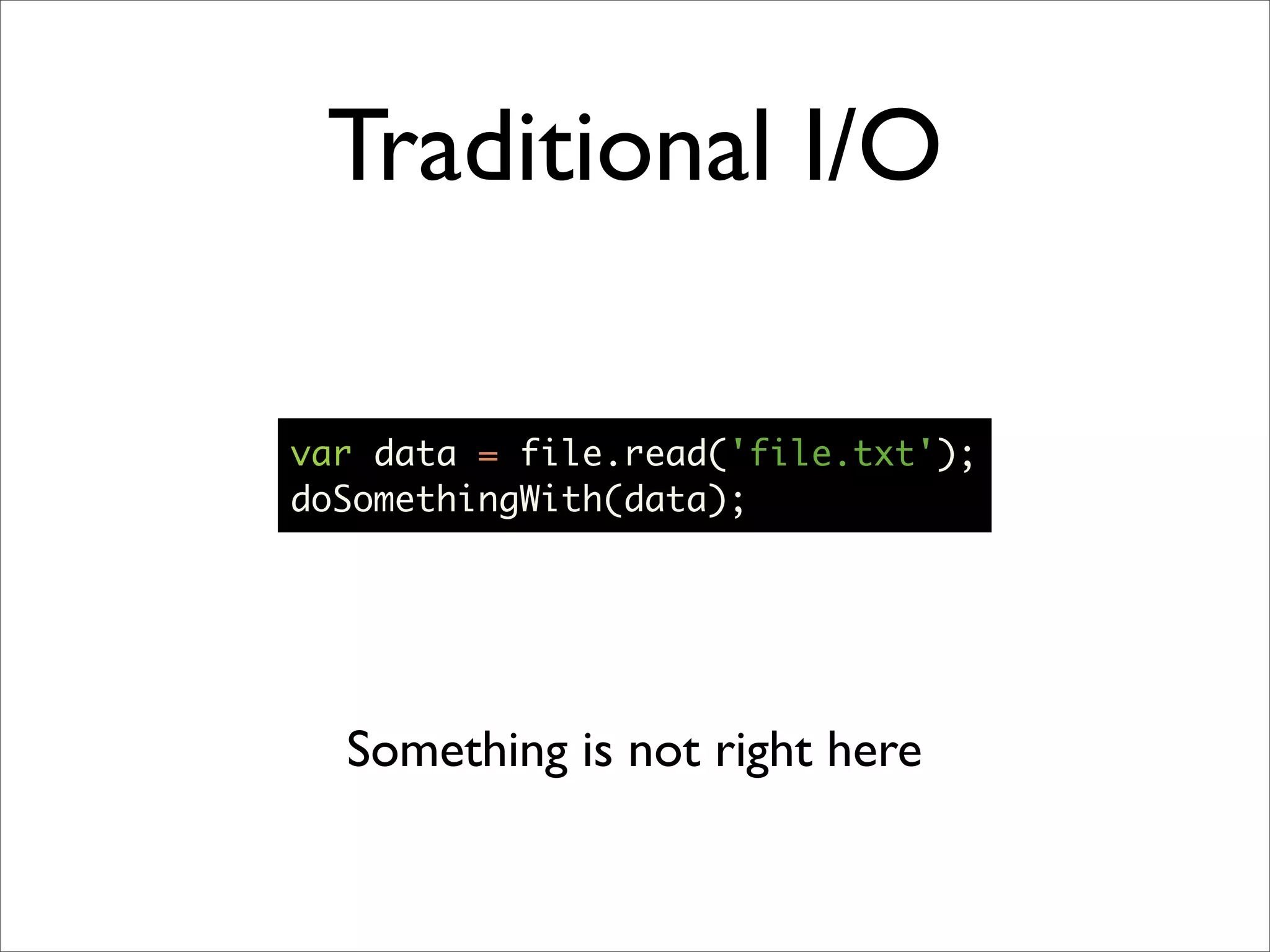
Traditional I/O

var data = file.read('file.txt');
doSomethingWith(data);


  Something is not right here
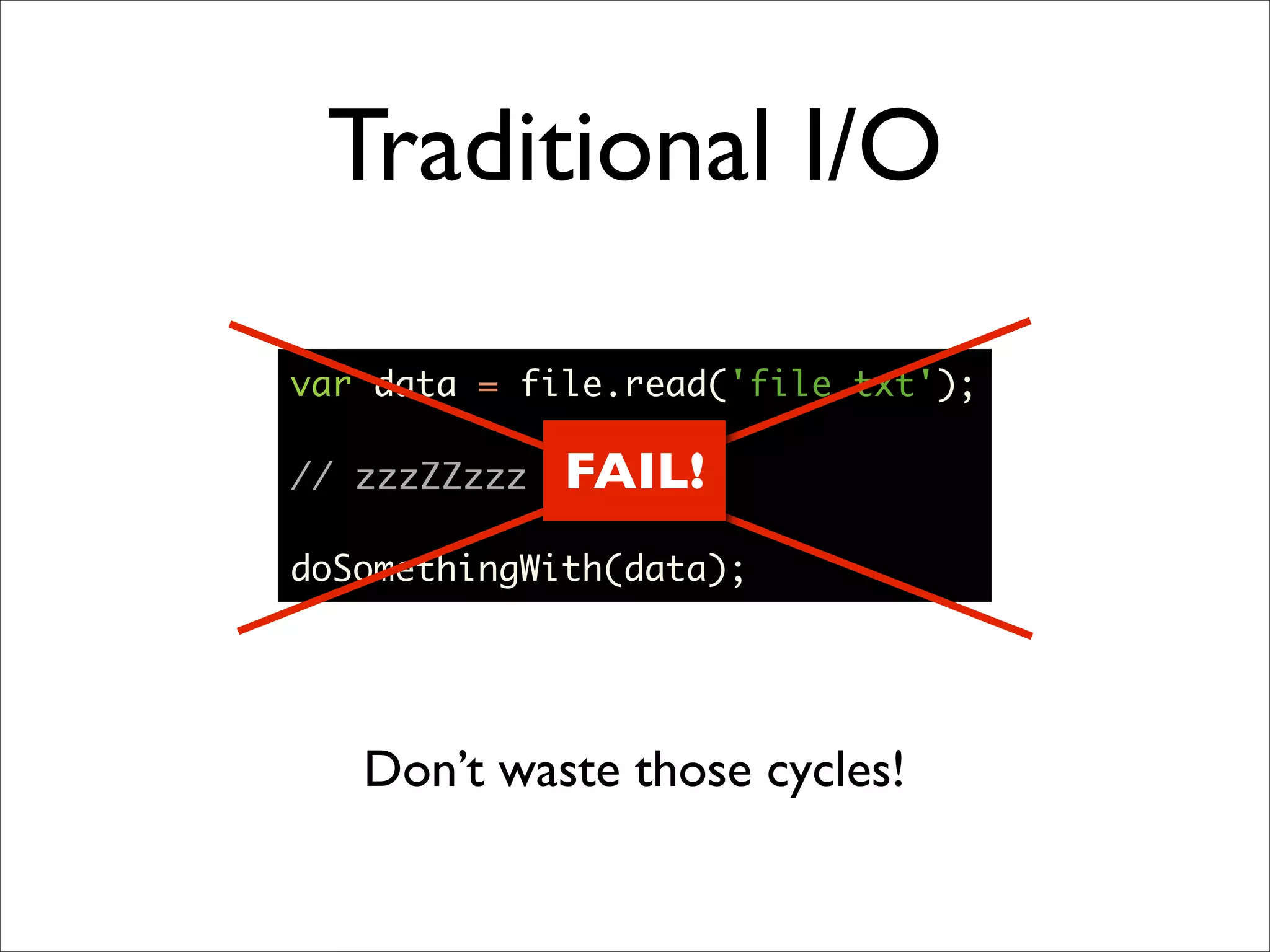
Traditional I/O

var data = file.read('file.txt');

// zzzZZzzz   FAIL!
doSomethingWith(data);


   Don’t waste those cycles!
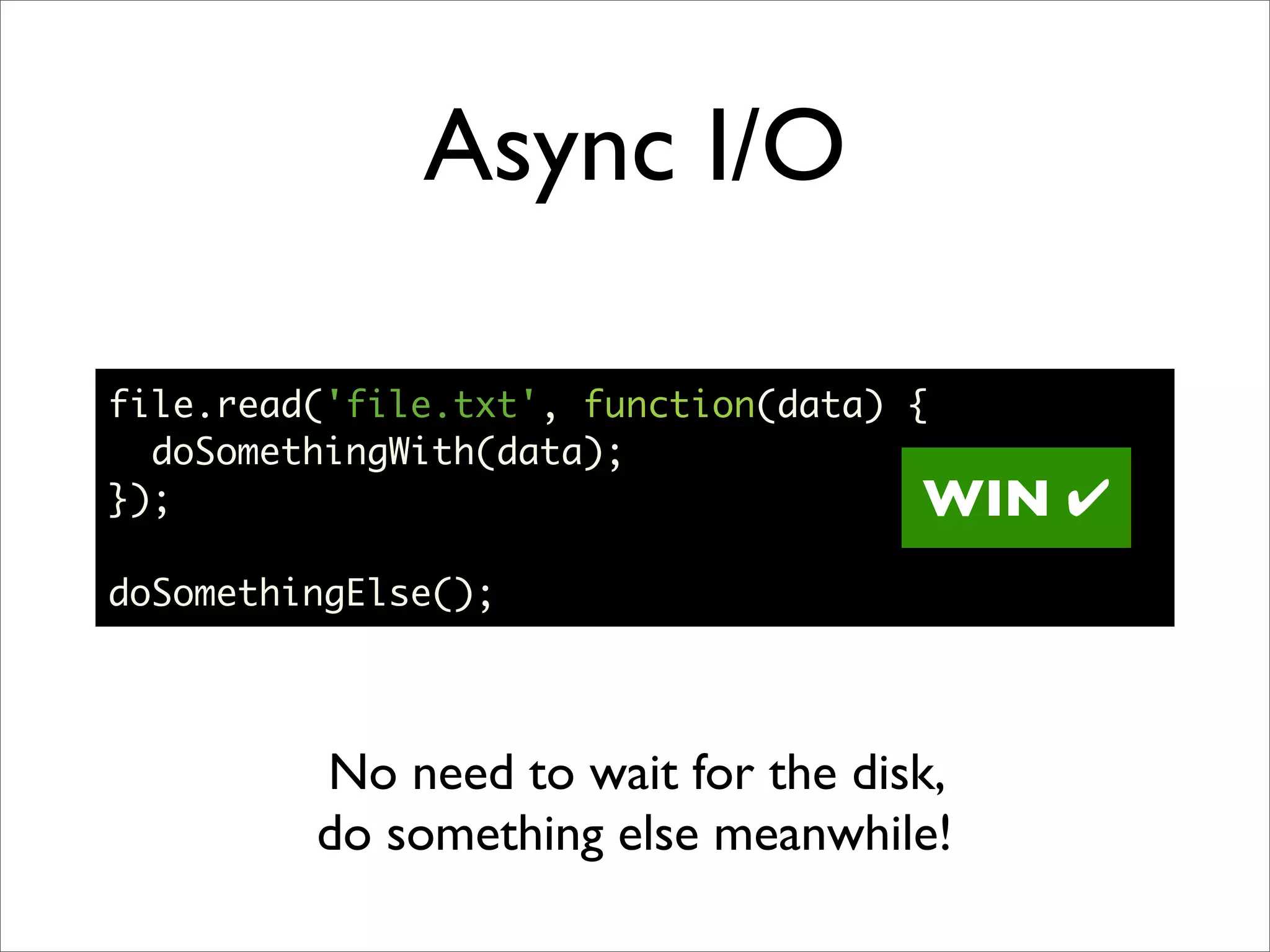
Async I/O

file.read('file.txt', function(data) {
  doSomethingWith(data);
});                                   WIN   !
doSomethingElse();


         No need to wait for the disk,
         do something else meanwhile!
The Present
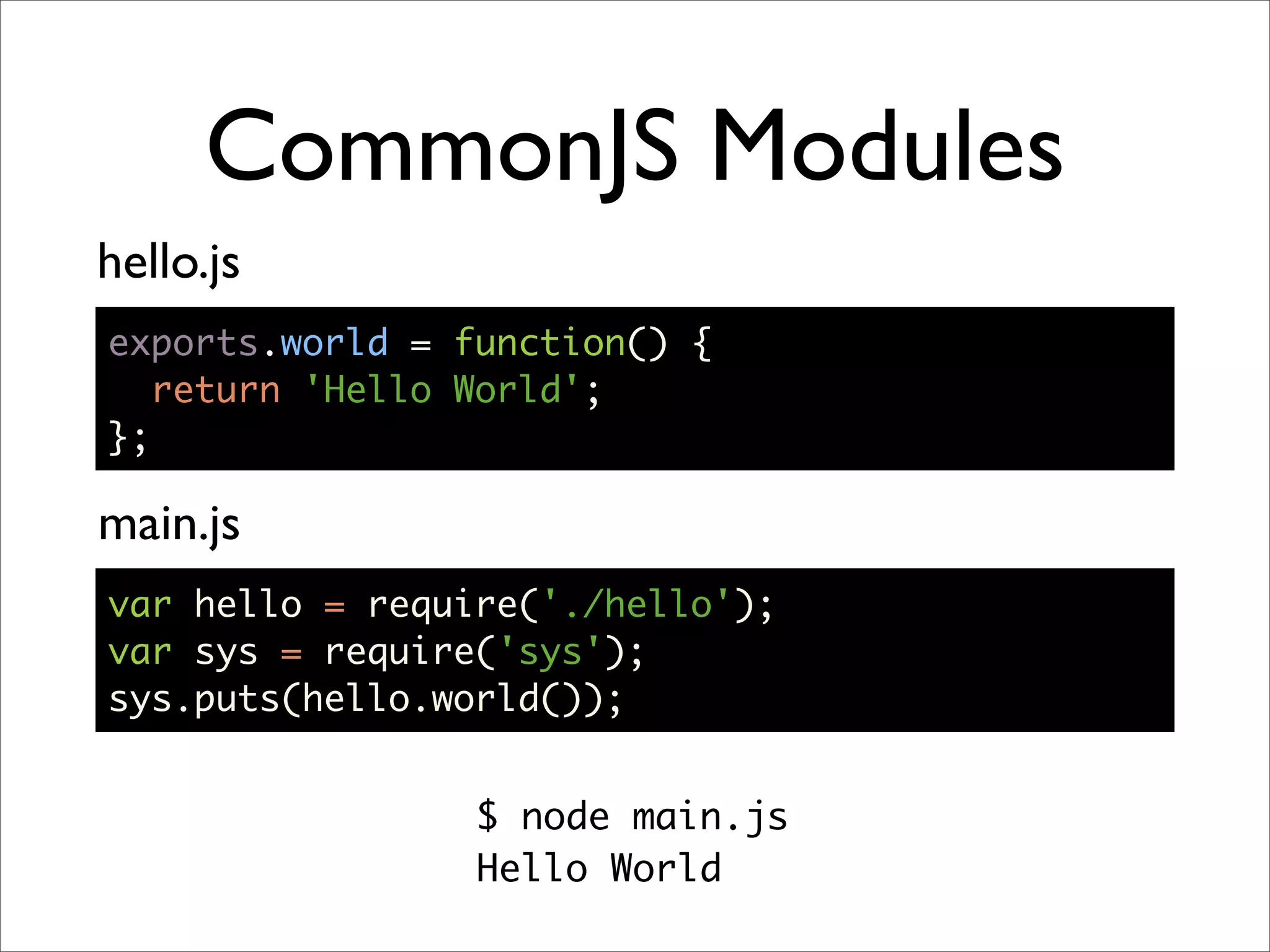
CommonJS Modules
hello.js
exports.world = function() {
   return 'Hello World';
};

main.js
var hello = require('./hello');
var sys = require('sys');
sys.puts(hello.world());


                 $ node main.js
                 Hello World
Child processes
child.js
var child = process.createChildProcess('sh',
['-c', 'echo hello; sleep 1; echo world;']);
child.addListener('output', function (chunk) {
  p(chunk);
});

                $ node child.js
                "hellon"
                # 1 sec delay
                "worldn"
                null
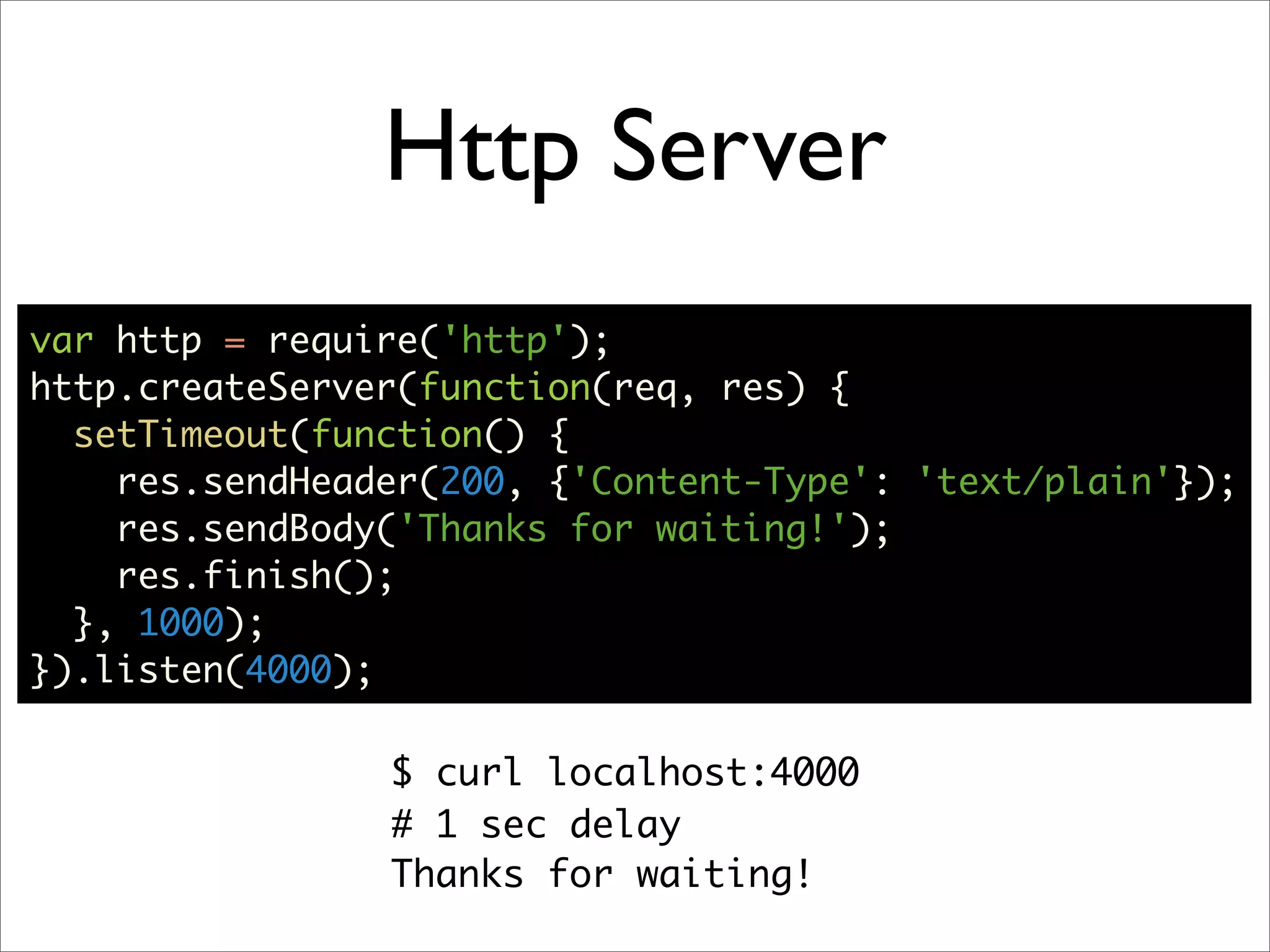
Http Server
var http = require('http');
http.createServer(function(req, res) {
  setTimeout(function() {
    res.sendHeader(200, {'Content-Type': 'text/plain'});
    res.sendBody('Thanks for waiting!');
    res.finish();
  }, 1000);
}).listen(4000);

                $ curl localhost:4000
                # 1 sec delay
                Thanks for waiting!
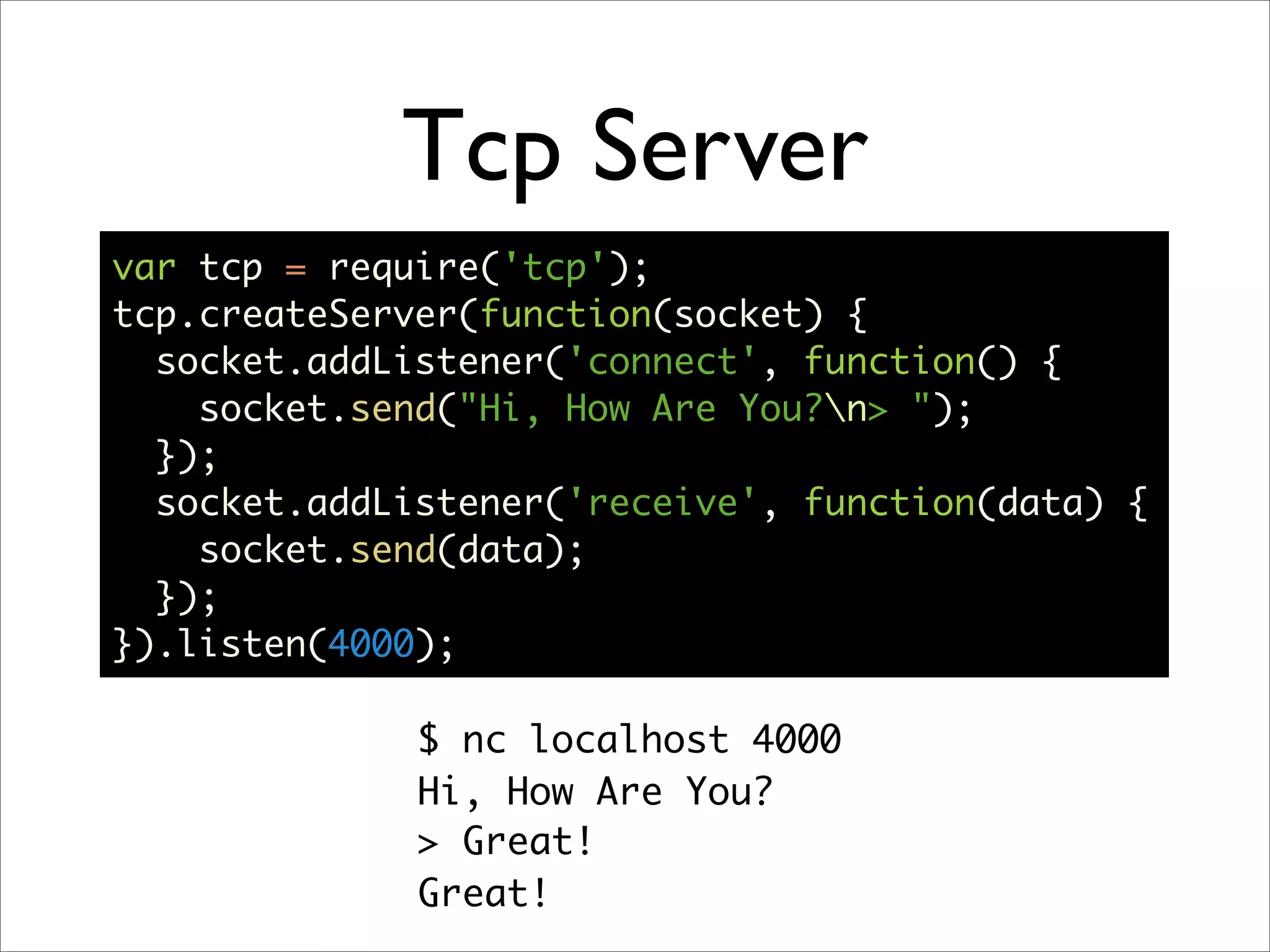
Tcp Server
var tcp = require('tcp');
tcp.createServer(function(socket) {
  socket.addListener('connect', function() {
    socket.send("Hi, How Are You?n> ");
  });
  socket.addListener('receive', function(data) {
    socket.send(data);
  });
}).listen(4000);

              $ nc localhost 4000
              Hi, How Are You?
              > Great!
              Great!
DNS
dns.js
var dns = require('dns');
dns.resolve4('nodejs.org')
  .addCallback(function(r) {
    p(r);
  });


               $ node dns.js
               [
                 "97.107.132.72"
               ]
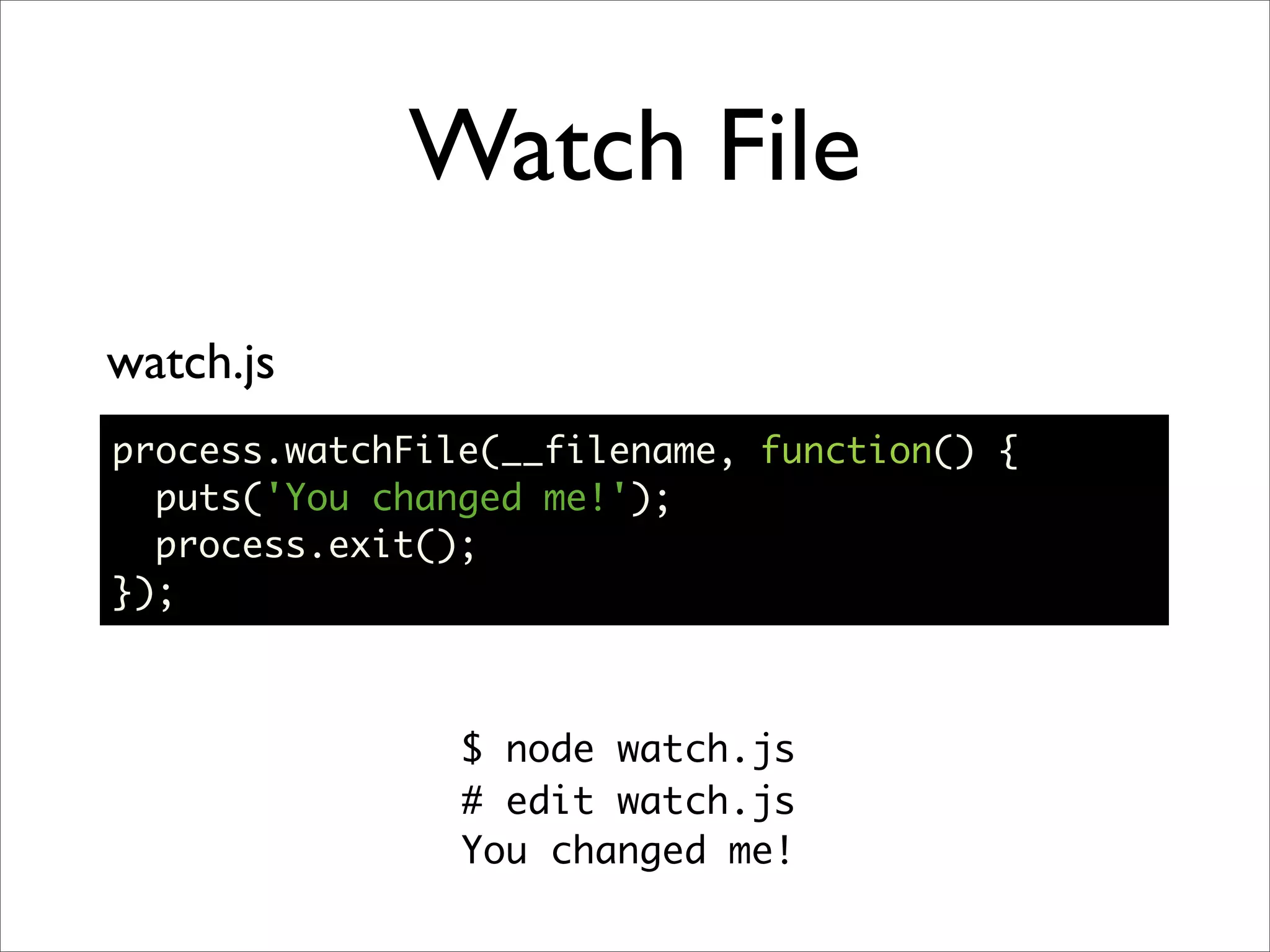
Watch File
watch.js
process.watchFile(__filename, function() {
  puts('You changed me!');
  process.exit();
});


                $ node watch.js
                # edit watch.js
                You changed me!
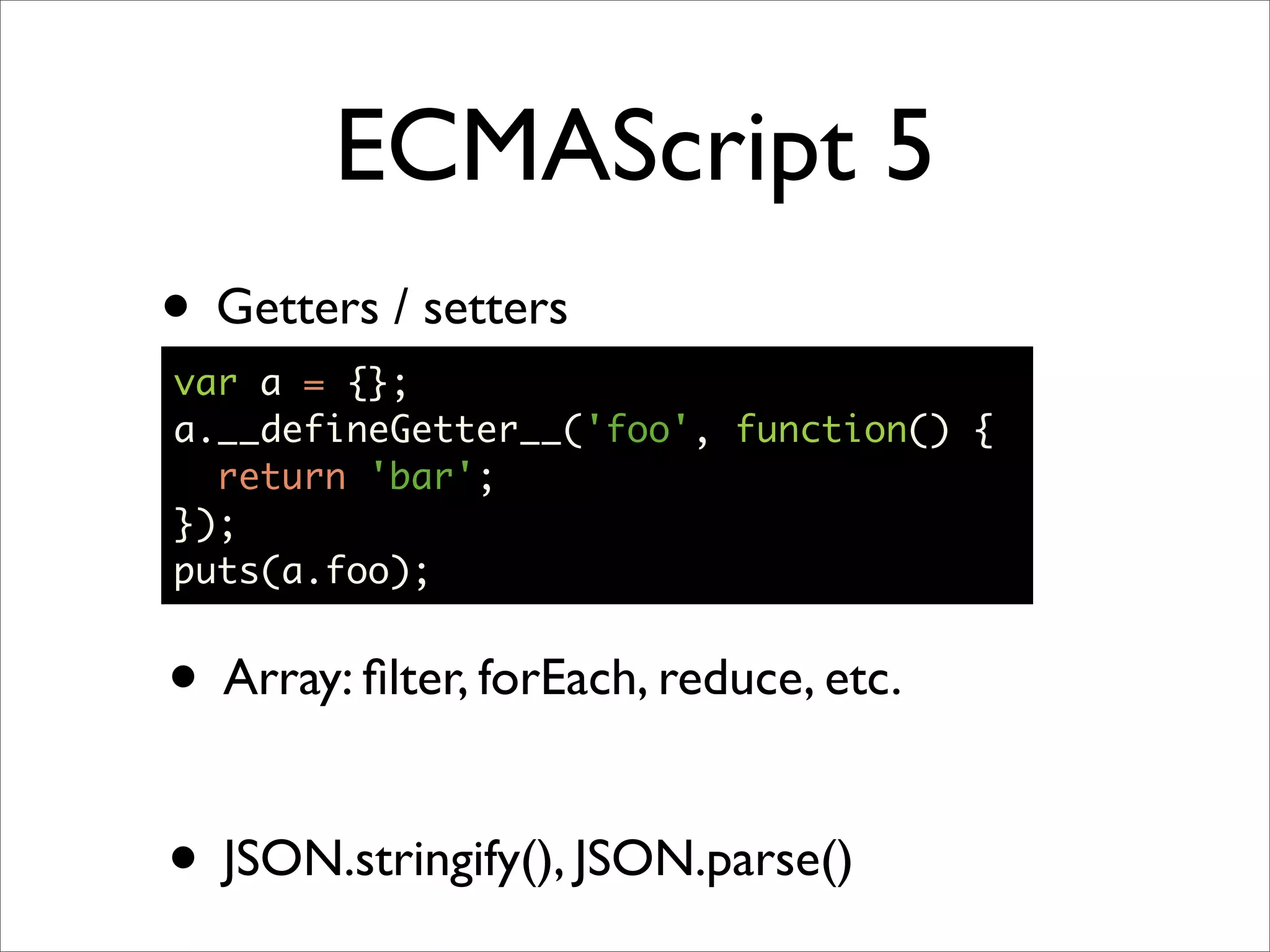
ECMAScript 5
• Getters / setters
var a = {};
a.__defineGetter__('foo', function() {
  return 'bar';
});
puts(a.foo);


• Array: filter, forEach, reduce, etc.

• JSON.stringify(), JSON.parse()
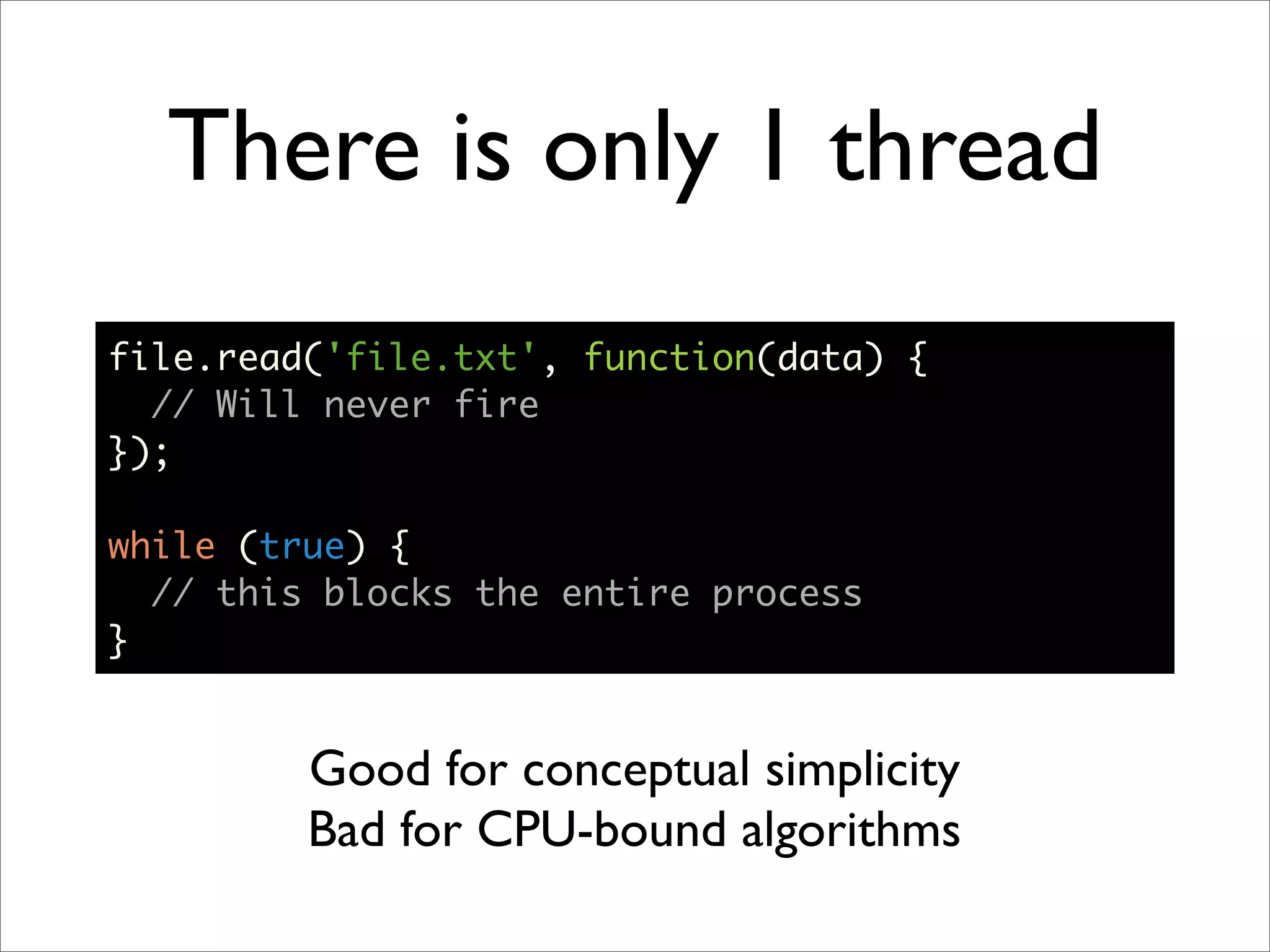
There is only 1 thread
file.read('file.txt', function(data) {
  // Will never fire
});

while (true) {
  // this blocks the entire process
}


         Good for conceptual simplicity
         Bad for CPU-bound algorithms
The Future
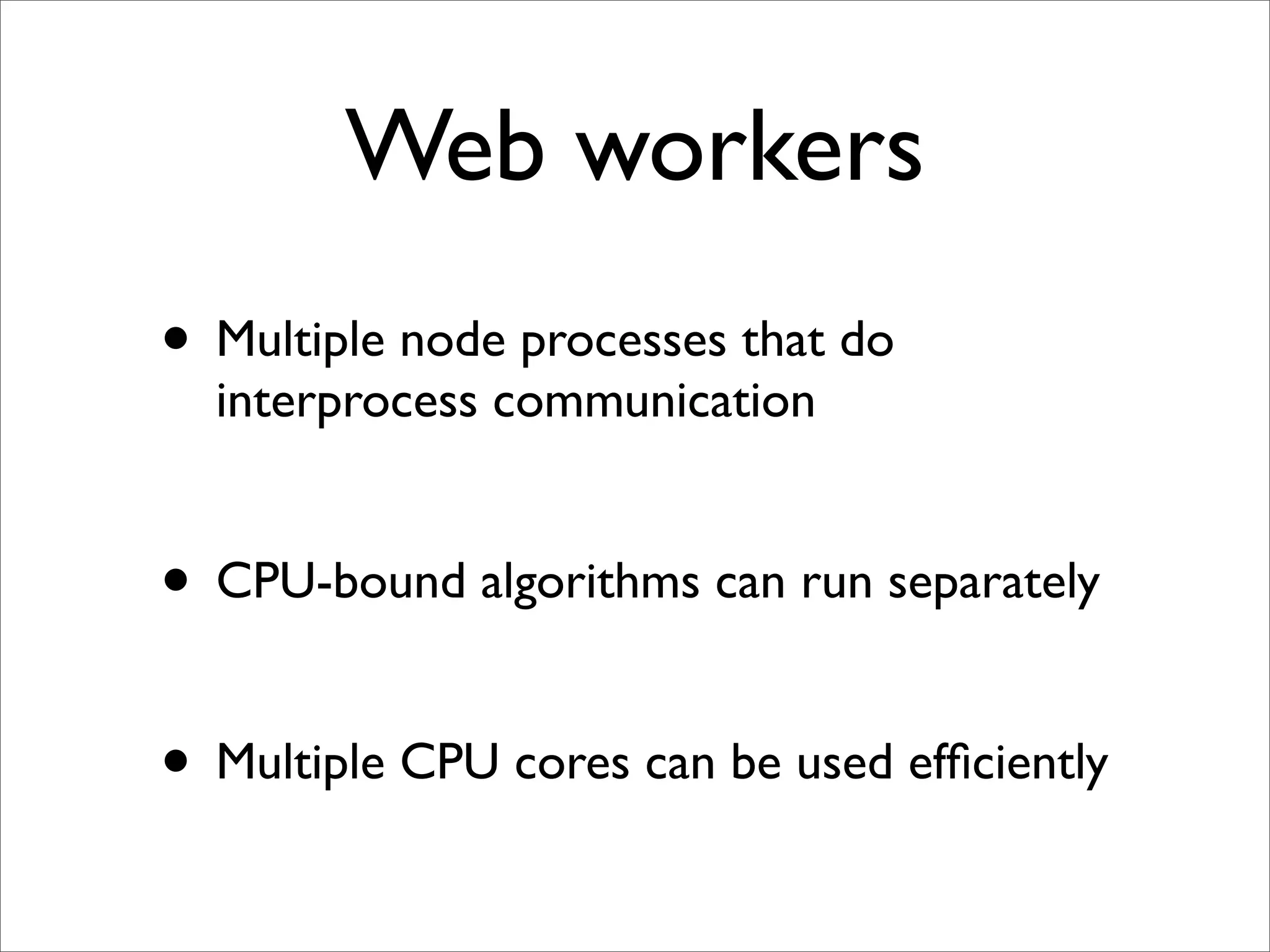
Web workers
• Multiple node processes that do
  interprocess communication


• CPU-bound algorithms can run separately

• Multiple CPU cores can be used efficiently
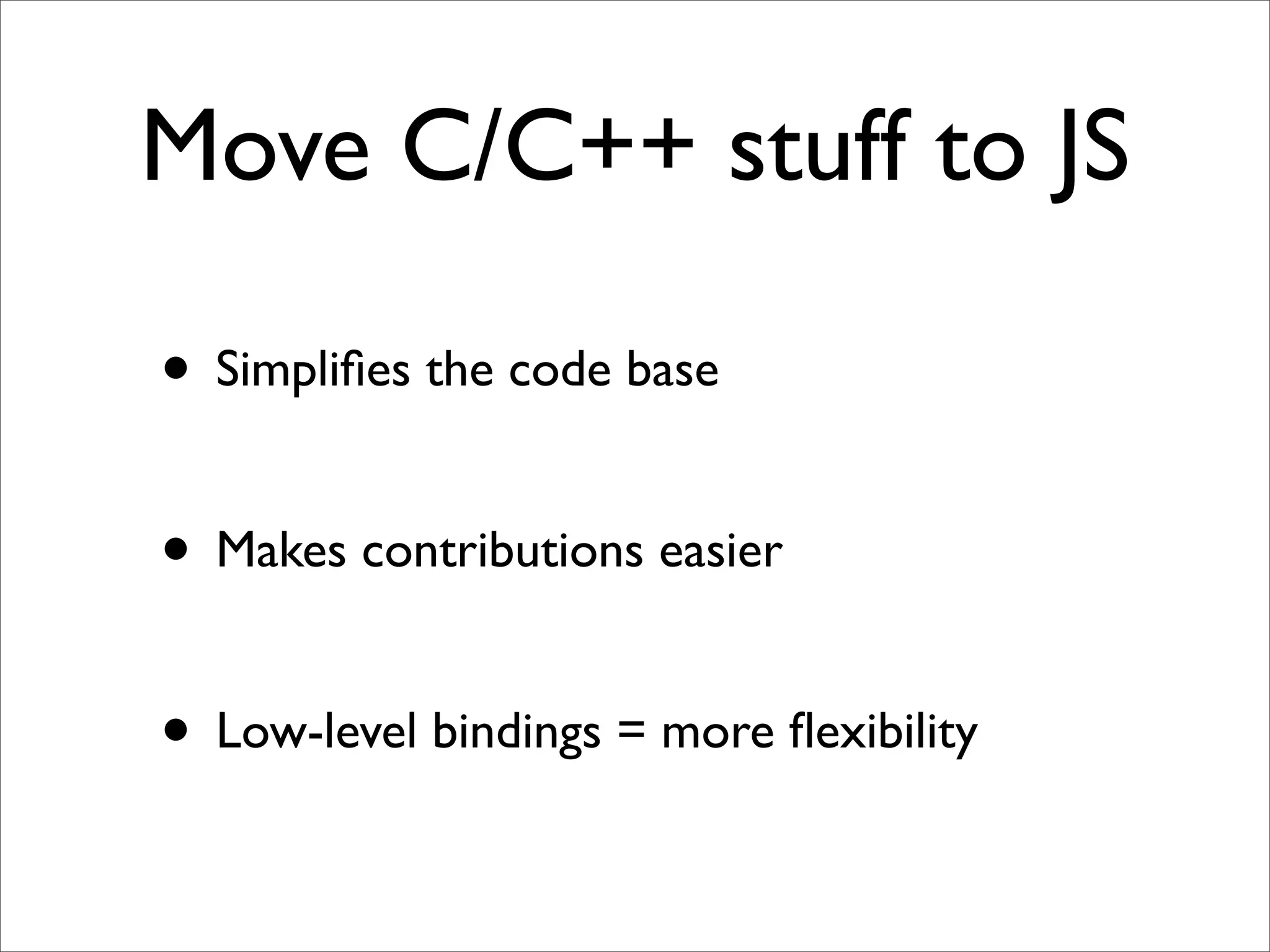
Move C/C++ stuff to JS

• Simplifies the code base

• Makes contributions easier

• Low-level bindings = more flexibility
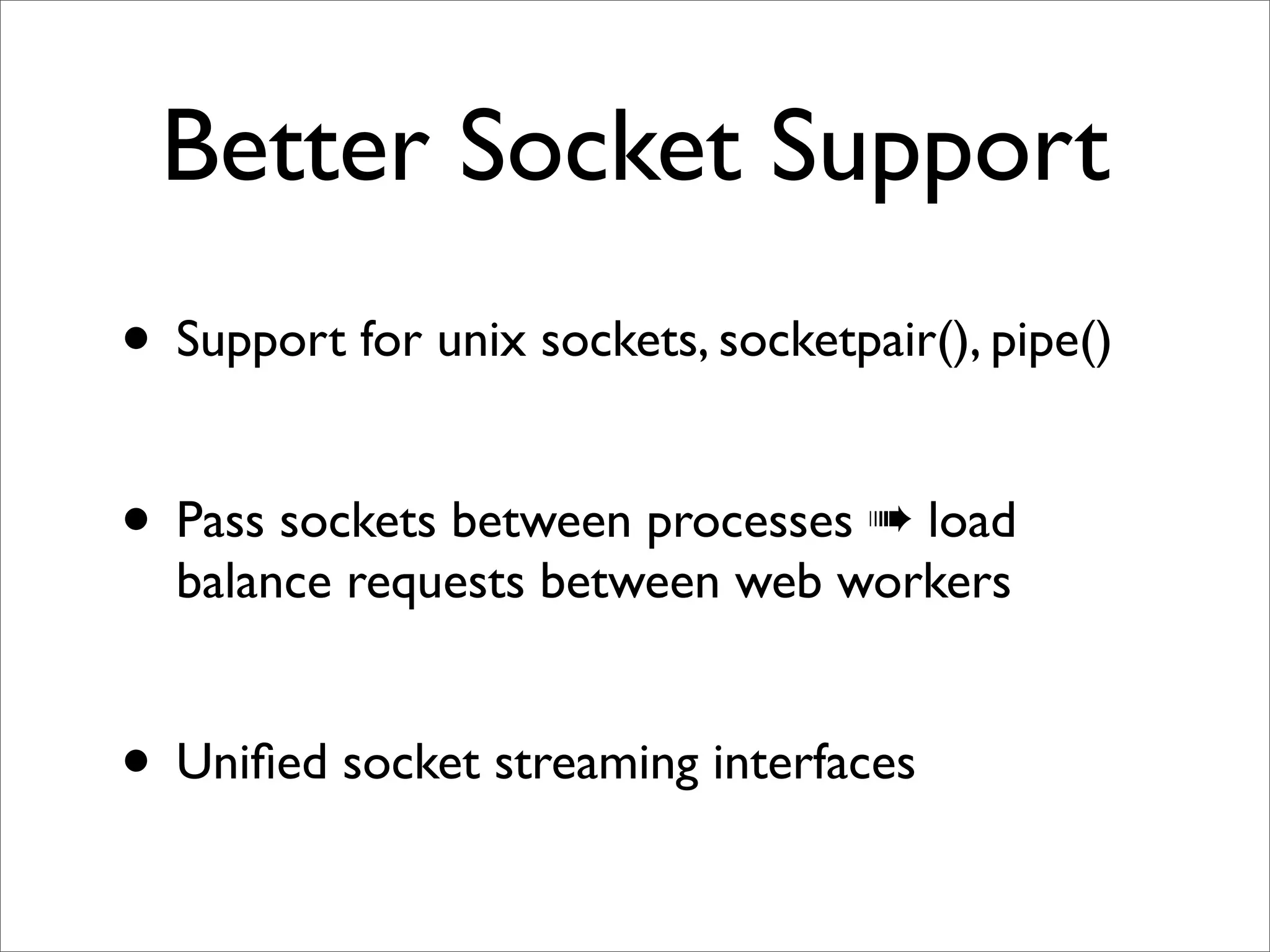
Better Socket Support
• Support for unix sockets, socketpair(), pipe()

• Pass sockets between processes " load
  balance requests between web workers


• Unified socket streaming interfaces
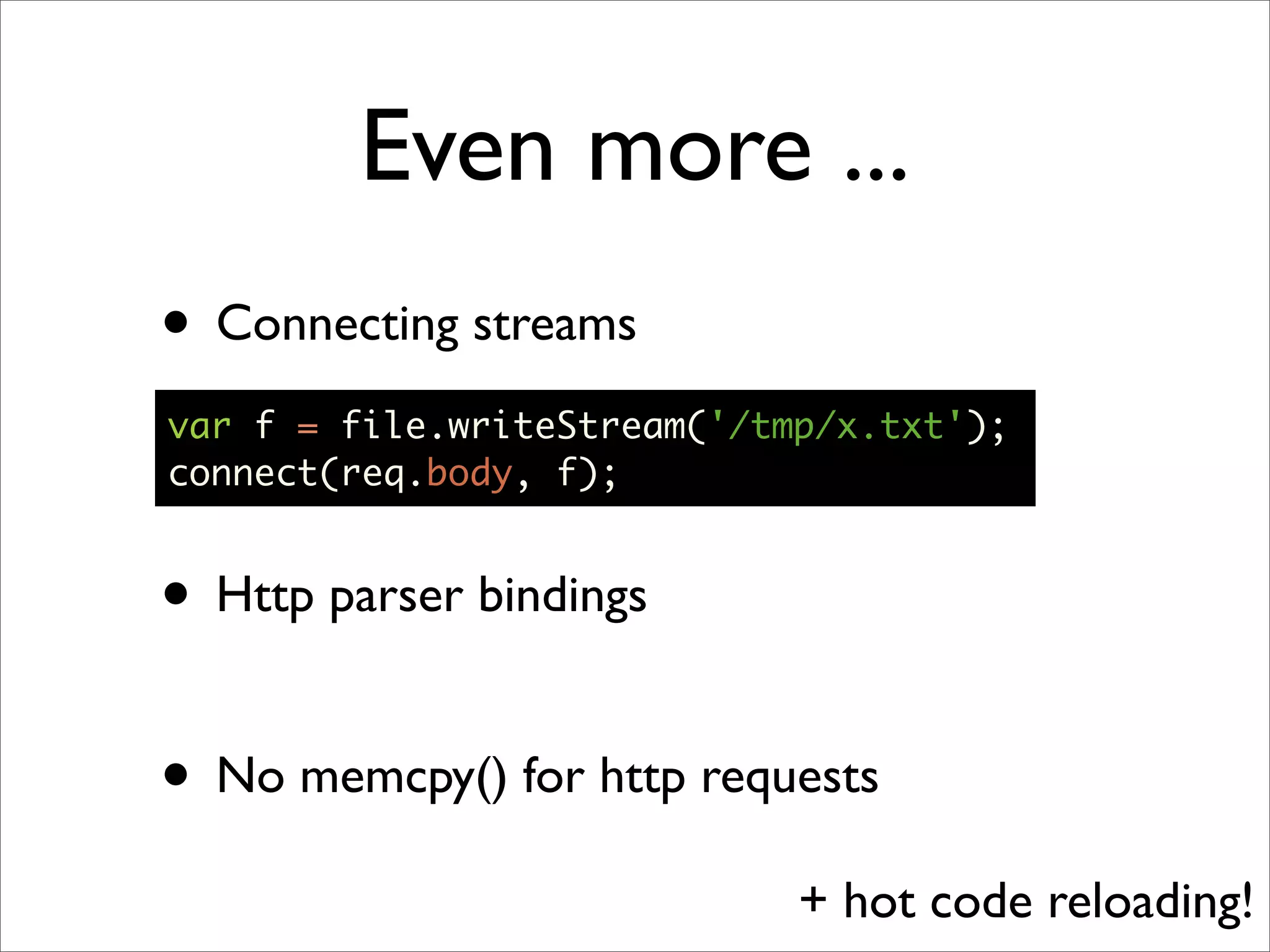
Even more ...
• Connecting streams
var f = file.writeStream('/tmp/x.txt');
connect(req.body, f);


• Http parser bindings

• No memcpy() for http requests
                             + hot code reloading!
Suitable Applications

• Web frameworks

• Real time

• Crawlers
More Applications

• Process monitoring

• File uploading

• Streaming
Demo Time!
Http Chat in 14 LoC
var
  http = require('http'),
  messages = [];

http.createServer(function(req, res) {
  res.sendHeader(200, {'Content-Type' : 'text/plain'});
  if (req.url == '/') {
    res.sendBody(messages.join("n"));
  } else if (req.url !== '/favicon.ico') {
    messages.push(decodeURIComponent(req.url.substr(1)));
    res.sendBody('ok!');
  }
  res.finish();
}).listen(4000);
The chat room:

  http://debuggable.com:4000/

          Send a message:

http://debuggable.com:4000/<msg>
Questions?


✎   @felixge
$   http://debuggable.com/
Bonus Slides!
Dirty


NoSQL for the little man!
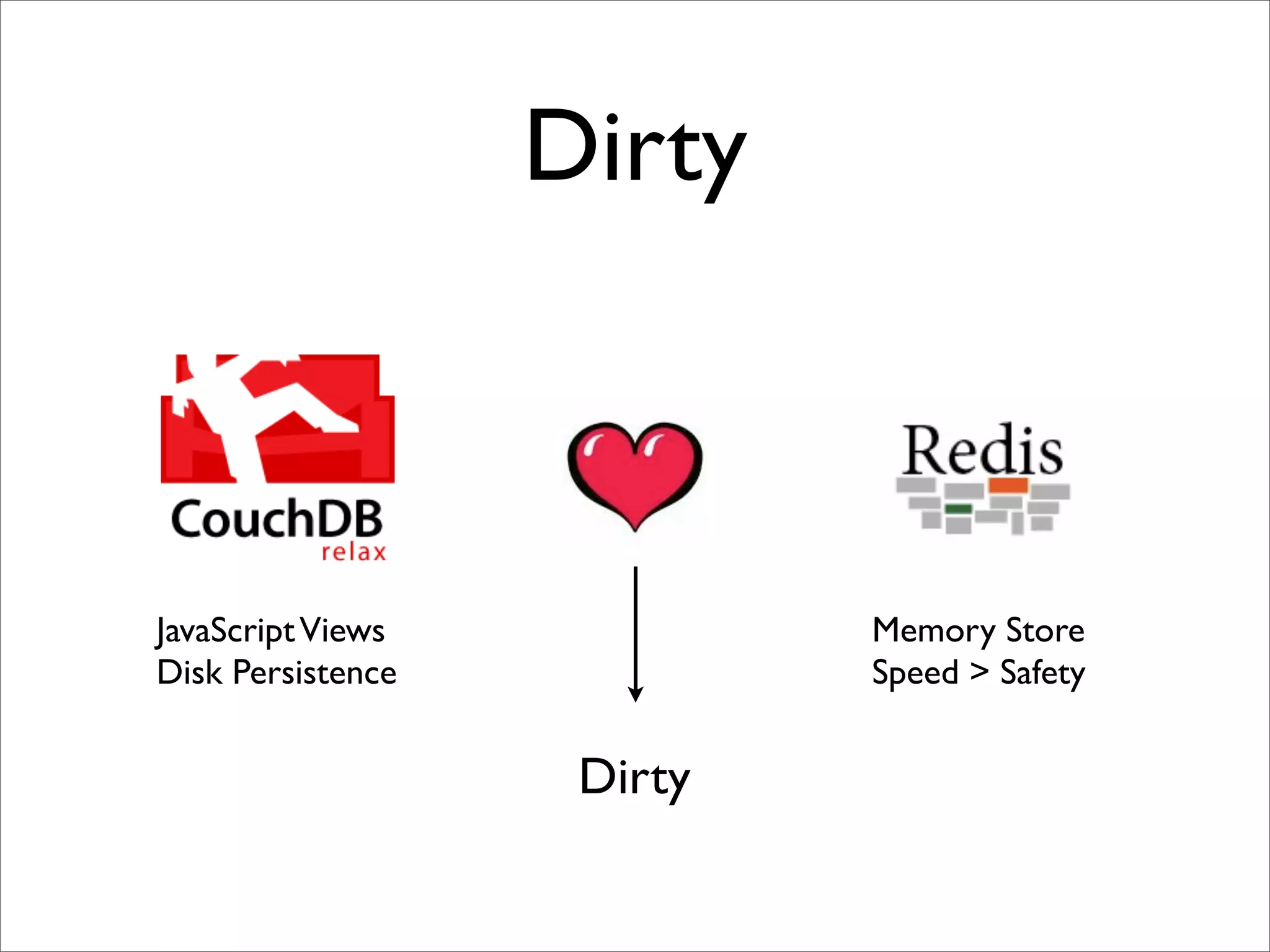
Dirty


JavaScript Views            Memory Store
Disk Persistence            Speed > Safety


                    Dirty
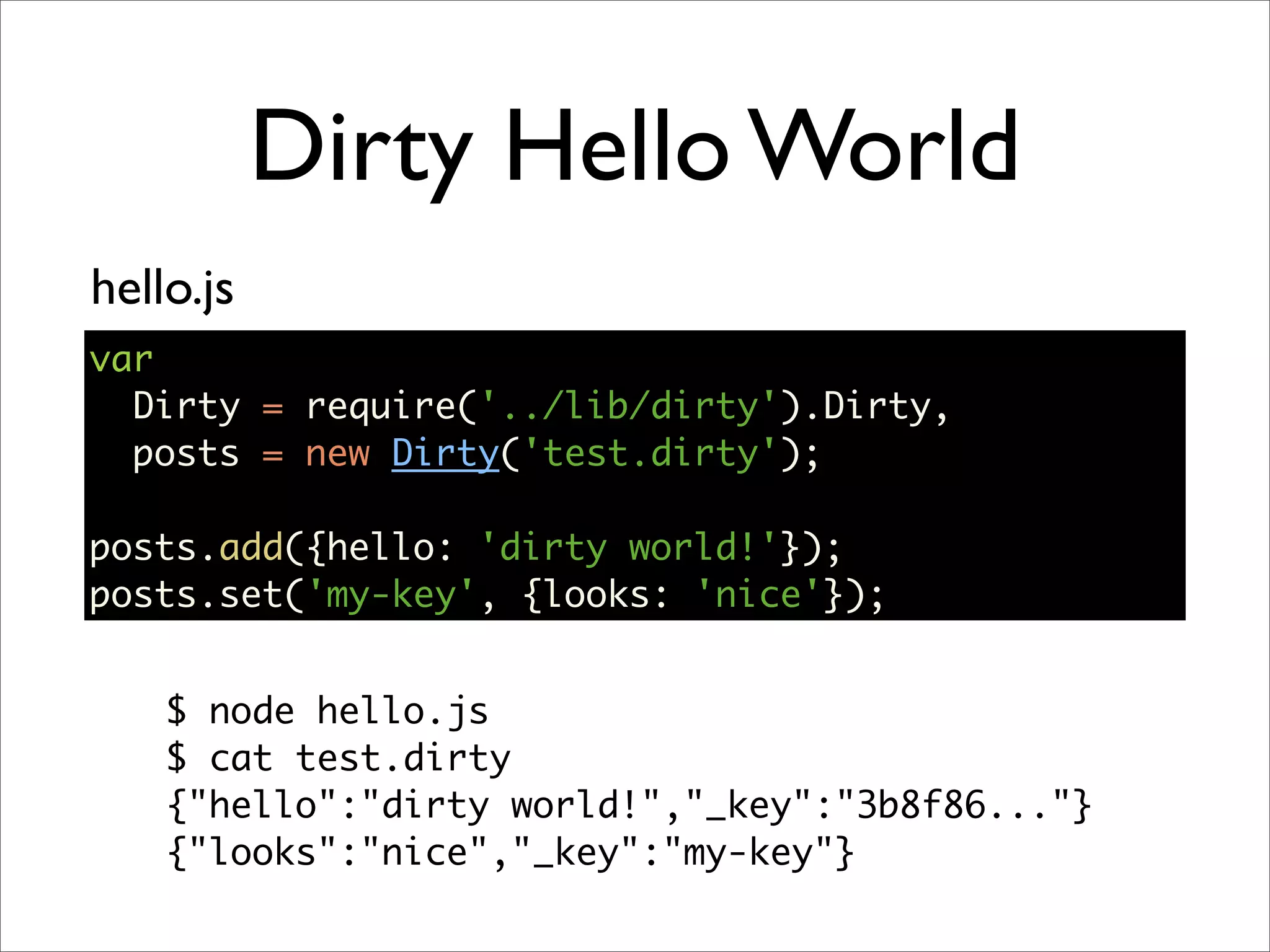
Dirty Hello World
hello.js
var
  Dirty = require('../lib/dirty').Dirty,
  posts = new Dirty('test.dirty');

posts.add({hello: 'dirty world!'});
posts.set('my-key', {looks: 'nice'});


    $ node hello.js
    $ cat test.dirty
    {"hello":"dirty world!","_key":"3b8f86..."}
    {"looks":"nice","_key":"my-key"}
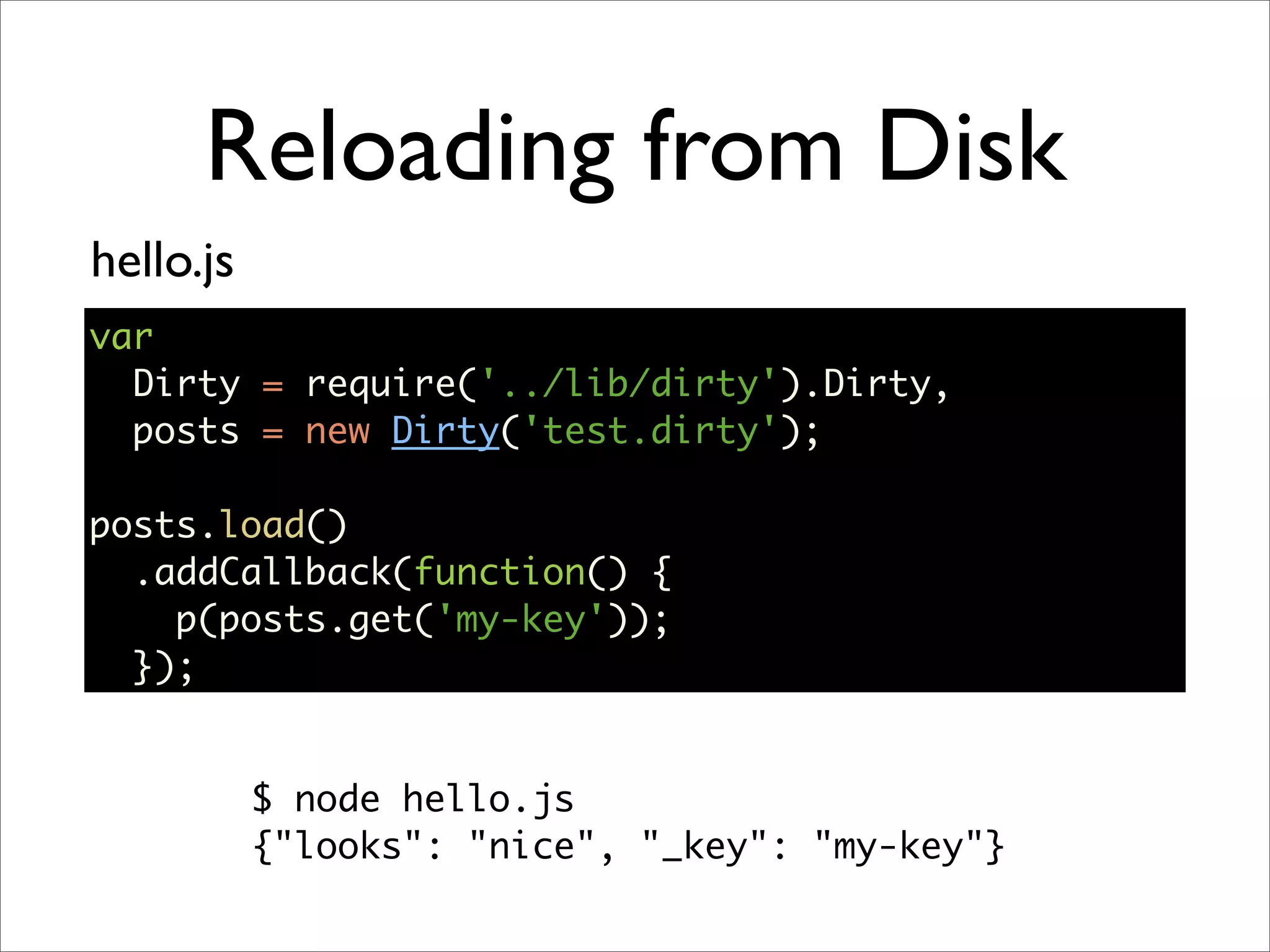
Reloading from Disk
hello.js
var
  Dirty = require('../lib/dirty').Dirty,
  posts = new Dirty('test.dirty');

posts.load()
  .addCallback(function() {
    p(posts.get('my-key'));
  });


           $ node hello.js
           {"looks": "nice", "_key": "my-key"}
Filtering records
hello.js
var
  Dirty = require('../lib/dirty').Dirty,
  posts = new Dirty('test.dirty');

posts.load()
  .addCallback(function() {
    var docs = posts.filter(function(doc) {
      return ('hello' in doc);
    });
    p(docs);
  });

 $ node hello.js
[{"hello": "dirty world!", "_key": "3b8f86..."}]
Benchmarks


Do your own!
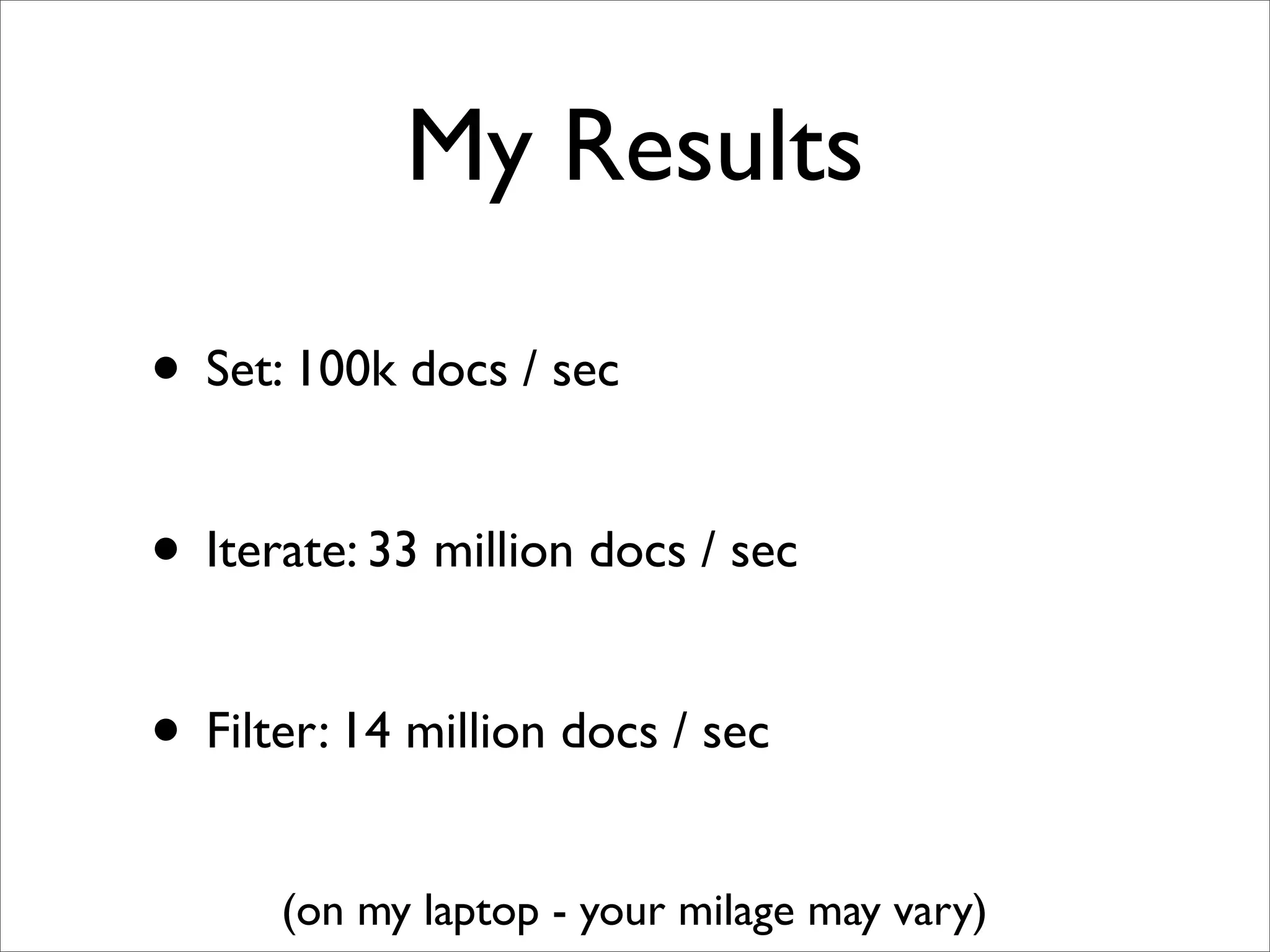
My Results

• Set: 100k docs / sec

• Iterate: 33 million docs / sec

• Filter: 14 million docs / sec
      (on my laptop - your milage may vary)
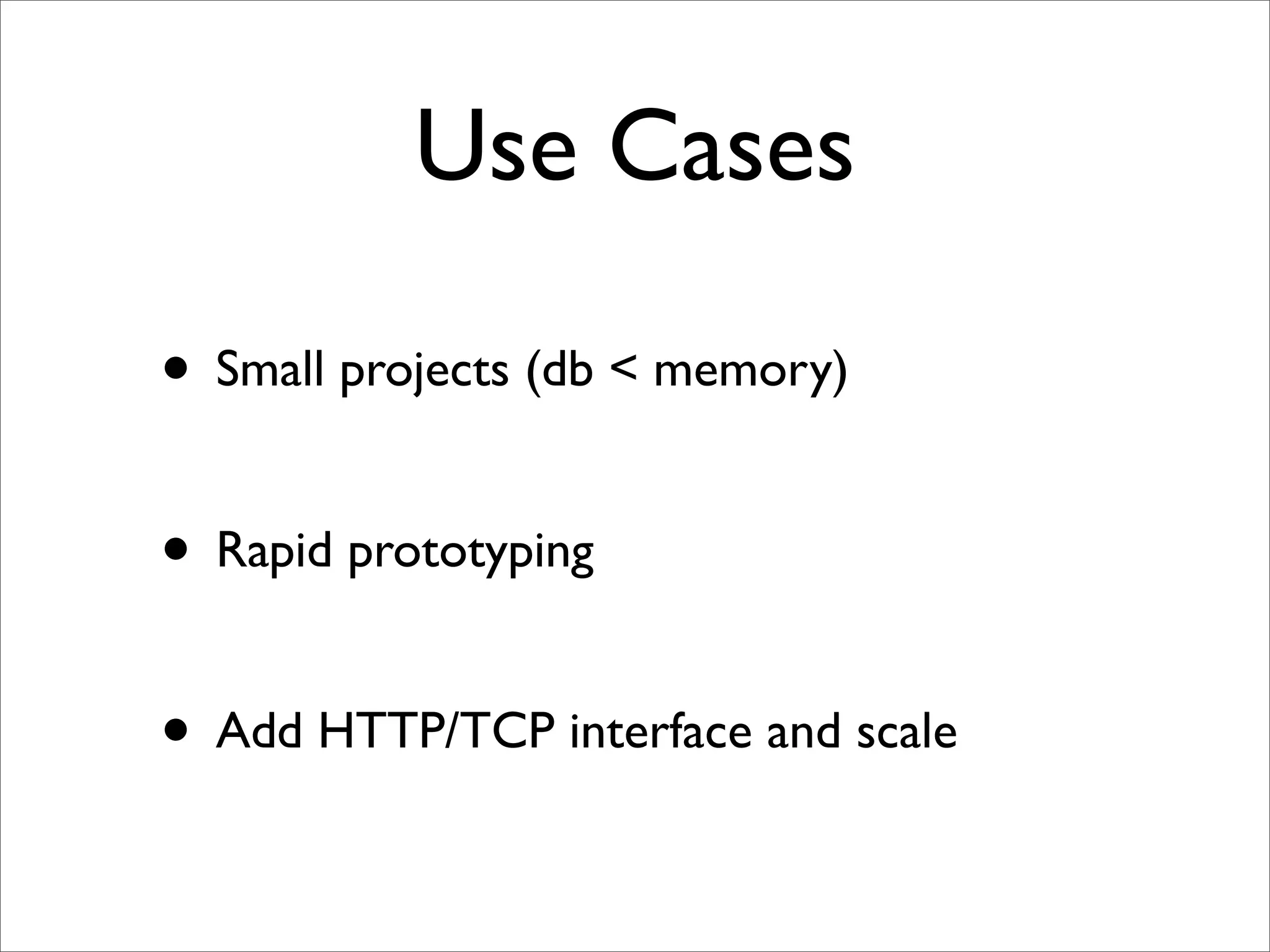
Use Cases

• Small projects (db < memory)

• Rapid prototyping

• Add HTTP/TCP interface and scale
http://github.com/felixge/node-dirty


   (or google for “dirty felixge”)

Node.js - A Quick Tour

  • 1.
    node.js A quicktour by Felix Geisendörfer
  • 2.
  • 3.
    Why? Node's goal isto provide an easy way to build scalable network programs. -- nodejs.org
  • 4.
    How? Keep slow operationsfrom blocking other operations.
  • 5.
    Traditional I/O var data= file.read('file.txt'); doSomethingWith(data); Something is not right here
  • 6.
    Traditional I/O var data= file.read('file.txt'); // zzzZZzzz FAIL! doSomethingWith(data); Don’t waste those cycles!
  • 7.
    Async I/O file.read('file.txt', function(data){ doSomethingWith(data); }); WIN ! doSomethingElse(); No need to wait for the disk, do something else meanwhile!
  • 8.
  • 9.
    CommonJS Modules hello.js exports.world =function() { return 'Hello World'; }; main.js var hello = require('./hello'); var sys = require('sys'); sys.puts(hello.world()); $ node main.js Hello World
  • 10.
    Child processes child.js var child= process.createChildProcess('sh', ['-c', 'echo hello; sleep 1; echo world;']); child.addListener('output', function (chunk) { p(chunk); }); $ node child.js "hellon" # 1 sec delay "worldn" null
  • 11.
    Http Server var http= require('http'); http.createServer(function(req, res) { setTimeout(function() { res.sendHeader(200, {'Content-Type': 'text/plain'}); res.sendBody('Thanks for waiting!'); res.finish(); }, 1000); }).listen(4000); $ curl localhost:4000 # 1 sec delay Thanks for waiting!
  • 12.
    Tcp Server var tcp= require('tcp'); tcp.createServer(function(socket) { socket.addListener('connect', function() { socket.send("Hi, How Are You?n> "); }); socket.addListener('receive', function(data) { socket.send(data); }); }).listen(4000); $ nc localhost 4000 Hi, How Are You? > Great! Great!
  • 13.
    DNS dns.js var dns =require('dns'); dns.resolve4('nodejs.org') .addCallback(function(r) { p(r); }); $ node dns.js [ "97.107.132.72" ]
  • 14.
    Watch File watch.js process.watchFile(__filename, function(){ puts('You changed me!'); process.exit(); }); $ node watch.js # edit watch.js You changed me!
  • 15.
    ECMAScript 5 • Getters/ setters var a = {}; a.__defineGetter__('foo', function() { return 'bar'; }); puts(a.foo); • Array: filter, forEach, reduce, etc. • JSON.stringify(), JSON.parse()
  • 16.
    There is only1 thread file.read('file.txt', function(data) { // Will never fire }); while (true) { // this blocks the entire process } Good for conceptual simplicity Bad for CPU-bound algorithms
  • 17.
  • 18.
    Web workers • Multiplenode processes that do interprocess communication • CPU-bound algorithms can run separately • Multiple CPU cores can be used efficiently
  • 19.
    Move C/C++ stuffto JS • Simplifies the code base • Makes contributions easier • Low-level bindings = more flexibility
  • 20.
    Better Socket Support •Support for unix sockets, socketpair(), pipe() • Pass sockets between processes " load balance requests between web workers • Unified socket streaming interfaces
  • 21.
    Even more ... •Connecting streams var f = file.writeStream('/tmp/x.txt'); connect(req.body, f); • Http parser bindings • No memcpy() for http requests + hot code reloading!
  • 22.
    Suitable Applications • Webframeworks • Real time • Crawlers
  • 23.
    More Applications • Processmonitoring • File uploading • Streaming
  • 24.
  • 25.
    Http Chat in14 LoC var http = require('http'), messages = []; http.createServer(function(req, res) { res.sendHeader(200, {'Content-Type' : 'text/plain'}); if (req.url == '/') { res.sendBody(messages.join("n")); } else if (req.url !== '/favicon.ico') { messages.push(decodeURIComponent(req.url.substr(1))); res.sendBody('ok!'); } res.finish(); }).listen(4000);
  • 26.
    The chat room: http://debuggable.com:4000/ Send a message: http://debuggable.com:4000/<msg>
  • 27.
    Questions? ✎ @felixge $ http://debuggable.com/
  • 28.
  • 29.
  • 30.
    Dirty JavaScript Views Memory Store Disk Persistence Speed > Safety Dirty
  • 31.
    Dirty Hello World hello.js var Dirty = require('../lib/dirty').Dirty, posts = new Dirty('test.dirty'); posts.add({hello: 'dirty world!'}); posts.set('my-key', {looks: 'nice'}); $ node hello.js $ cat test.dirty {"hello":"dirty world!","_key":"3b8f86..."} {"looks":"nice","_key":"my-key"}
  • 32.
    Reloading from Disk hello.js var Dirty = require('../lib/dirty').Dirty, posts = new Dirty('test.dirty'); posts.load() .addCallback(function() { p(posts.get('my-key')); }); $ node hello.js {"looks": "nice", "_key": "my-key"}
  • 33.
    Filtering records hello.js var Dirty = require('../lib/dirty').Dirty, posts = new Dirty('test.dirty'); posts.load() .addCallback(function() { var docs = posts.filter(function(doc) { return ('hello' in doc); }); p(docs); }); $ node hello.js [{"hello": "dirty world!", "_key": "3b8f86..."}]
  • 34.
  • 35.
    My Results • Set:100k docs / sec • Iterate: 33 million docs / sec • Filter: 14 million docs / sec (on my laptop - your milage may vary)
  • 36.
    Use Cases • Smallprojects (db < memory) • Rapid prototyping • Add HTTP/TCP interface and scale
  • 37.
    http://github.com/felixge/node-dirty (or google for “dirty felixge”)