Participatory Training Techniques Dr. R. Prakash Professor Kerala Agricultural University College of Agriculture,Vellayani [email_address] (M)9446331825
“ Genius without education is like silver in the mine.” Benjamin Franklin
What is training? Acquisition or development of knowledge, skills, techniques, attitudes and experiences which enable an individual to perform better. To prepare an individual to carry out his present job satisfactorily or to preparer him for greater responsibility.
Characteristics of Adult Learners Prior knowledge & experience Self-directed learners Critical thinkers Experiential learners Learning is a change of behavior occurring from the process of internalizing knowledge, skills, or attitudes.
Motivation: What’s In It For Me Job requirement  Personal interest in subject Professional enrichment Advancement potential
Trainer’s Tips Plan, Prepare & Practice Know your audience (experience level, comfort level, # of attendees) Involve learners (partner & team activities) Encourage comprehension over content Relate instruction to participant’s job needs Solicit feedback during class & final evaluation Training is a process not an event that has measures & can be improved
Trainer’s Tips Cont. Checklist, include materials needed (handouts, staff resources, supplies, equipment, cars, etc.) Get enough sleep & watch what you eat Realize your limitations Have reliable directions Learn from others Use good visuals Use time wisely & according to agenda
Communication Establish session objectives Be heard and understood Ensure movement Show enthusiasm Create rapport Prepare for questions
Trainer’s Cardinal Rules Know Yourself Know the Audience Know the Subject Know the Environment
Training Techniques Qualities of Instructors Patience Respect Appearance Empathy
Training Techniques Qualities of Instructors (con’t.) Leadership Enthusiasm Preparation (materials, facility, scheduling) Knowledge and experience
Synergy --  Generating “Critical Mass” Increasing the level of interest & involvement within the class -- a synergistic effect. Critical mass - the yield is greater than the investment.
Performance-based Credibility People accept information more readily...  when it’s well presented.
The ATTENTION Factor It’s much easier to “tune in”… become involved… and learn with a cohesive, interesting presentation.
The Adult Learner Relies on prior knowledge & experience Underestimates own ability to learn Makes immediate application of learning Pursues accuracy rather than speed
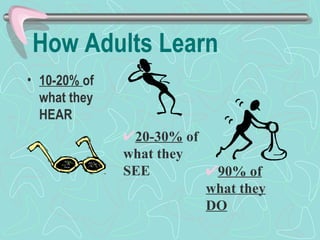
How Adults Learn 10-20%  of what they HEAR   20-30%  of what they SEE 90% of what they DO
Adult Learning: Impact on Training Fit material  to frame  of reference Older attendees may not see as well Ability to hear clearly may diminish with age
Six Ps of Preparation P repare the Environment P rogram Flexibility P roactive Readiness P reparation Time P latform Skills P ractice,  P ractice,  P ractice
Expect the Unexpected Murphy’s Law Rules Make the unexpected a friend
Keep Your Options Open Be prepared to, and capable of presenting the material utilizing minimal technology!
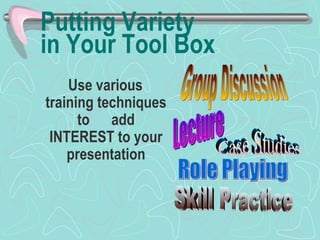
Putting Variety  in Your Tool Box Use various training techniques to  add INTEREST to your presentation Group Discussion Lecture Case Studies Role Playing Skill Practice
Selection of Technique Cognitive and behavioral methods/techniques Depends on Objectives of Training Needs Assessment Organization, Task and Person Analysis Resources
CHOICE OF TRAINING TECHNIQUES-FACTORS HUMAN FACTORS Trainer Participants Enviornment
OBJECTIVES Knowledge Skills Attitudes
TIME AND MATERIAL  FACTORS Time Finance Facilities
LECTURE  A talk given without much, if any, participation in the form of questions or discussion on the part of the trainee
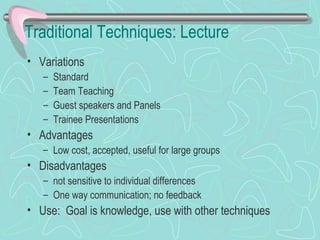
Traditional Techniques: Lecture Variations Standard Team Teaching Guest speakers and Panels Trainee Presentations Advantages Low cost, accepted, useful for large groups Disadvantages not sensitive to individual differences One way communication; no feedback Use:  Goal is knowledge, use with other techniques
TALK A talk incorporating a variety of techniques, and allowing for participation by the trainees
DISCUSSION Knowledge ,ideas and opinions on aparticular subject are freely exchanged among the trainees and the trainer
Managerial/Interpersonal Skills Case Studies Business Games Role Plays meaningful activity; simulates real life; trainee takes seriously Debriefing/processing critical Brainstorming Laboratory Training (“T” or sensitivity groups) “ here and now”, feelings, disclosure, communication and feedback increases personal growth; understanding of self and others Voluntary; screening of participants, trained facilitators
ROLE PLAY Trainees are asked to enact, in the training situation, the role they will be called upon to play in their job of work Role Playing is a training technique in which participants assume an identity other than their own to cope with the real or hypothetical problems in human relations And other areas
BRAINSTORMING A specialized form of discussion. It is commonly used in real problem solving situations Its most frequent use is to teach learners to suspend judgment until a maximum number of ideas have been generated. To train people to listen positively to the ideas of others
CASE STUDY A history of some event or set of circumstances, with the relevant details, is examined by the trainees. Case studies fall into two broad categories Those in which the trainees diagnose the causes of a particular problem Those in which the trainees set out to solve a particular problem
EXERCISES Trainers are asked to  undertake a particular task, leading to a required required result, following lines laid down by the trainers
APPLICATION PROJECT Similar to an exercise but giving the trainee much greater opportunity for the display of initiative  and creative ideas.
IN-BASKET(IN TRAY) Trainees are given a series of files, papers and letters similar to those they will be required to deal with at the lace of work. Trainees take action on each peace of work.
Business games Trainees are presented  with information about a company. They are given different management roles to perform. These groups then run the company.
SENSITIVITY TRAINING(GROUP DYNAMICS) Trainees are put into situations  in which the behaviour of each individual in the group is subject to examination and comment by other trainees
Summary of Instructional Techniques Trainers have access to a variety of different techniques Each technique has strengths and weaknesses Selection depends on Trainee aptitude and needs objectives of training availability and cost Where possible, use a combination of techniques.
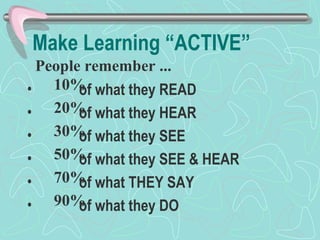
Make Learning “ACTIVE” of what they READ of what they HEAR of what they SEE of what they SEE & HEAR of what THEY SAY of what they DO 10% 20% 30% 50% 70% 90% People remember ...
Creating the Climate Factors… Physical Emotional Intellectual
Establishing a Rapport Greet  participants Encourage communication Non-attribution of comments   Ice-breaker
Create a  “Shared Experience” Introduce yourself Self-introductions  Generate mutual recognition and  a sense of “group” Talk “with”not “to” trainees
Capitalize  on the Situation Be receptive… Allow sharing  of experience Recognize diversity Encourage mutual  respect, openness    & collaboration
Direct Traffic Facilitate Flow  of Information Job is  to “orchestrate” Find the  Balance
Non-Verbal  Presentation Techniques Make eye contact  Use your voice effectively Use appropriate motion and gestures
Conclusion of training Answer questions Administer test(s) (if needed) Summarize the material covered End training Conclude training Answer additional questions Announce start time/location of next class (as appropriate)
In Conclusion... Prepare  Vary techniques RELAX HAVE FUN

Nird Training Techniques

  • 1.
    Participatory Training TechniquesDr. R. Prakash Professor Kerala Agricultural University College of Agriculture,Vellayani [email_address] (M)9446331825
  • 2.
    “ Genius withouteducation is like silver in the mine.” Benjamin Franklin
  • 3.
    What is training?Acquisition or development of knowledge, skills, techniques, attitudes and experiences which enable an individual to perform better. To prepare an individual to carry out his present job satisfactorily or to preparer him for greater responsibility.
  • 4.
    Characteristics of AdultLearners Prior knowledge & experience Self-directed learners Critical thinkers Experiential learners Learning is a change of behavior occurring from the process of internalizing knowledge, skills, or attitudes.
  • 5.
    Motivation: What’s InIt For Me Job requirement Personal interest in subject Professional enrichment Advancement potential
  • 6.
    Trainer’s Tips Plan,Prepare & Practice Know your audience (experience level, comfort level, # of attendees) Involve learners (partner & team activities) Encourage comprehension over content Relate instruction to participant’s job needs Solicit feedback during class & final evaluation Training is a process not an event that has measures & can be improved
  • 7.
    Trainer’s Tips Cont.Checklist, include materials needed (handouts, staff resources, supplies, equipment, cars, etc.) Get enough sleep & watch what you eat Realize your limitations Have reliable directions Learn from others Use good visuals Use time wisely & according to agenda
  • 8.
    Communication Establish sessionobjectives Be heard and understood Ensure movement Show enthusiasm Create rapport Prepare for questions
  • 9.
    Trainer’s Cardinal RulesKnow Yourself Know the Audience Know the Subject Know the Environment
  • 10.
    Training Techniques Qualitiesof Instructors Patience Respect Appearance Empathy
  • 11.
    Training Techniques Qualitiesof Instructors (con’t.) Leadership Enthusiasm Preparation (materials, facility, scheduling) Knowledge and experience
  • 12.
    Synergy -- Generating “Critical Mass” Increasing the level of interest & involvement within the class -- a synergistic effect. Critical mass - the yield is greater than the investment.
  • 13.
    Performance-based Credibility Peopleaccept information more readily... when it’s well presented.
  • 14.
    The ATTENTION FactorIt’s much easier to “tune in”… become involved… and learn with a cohesive, interesting presentation.
  • 15.
    The Adult LearnerRelies on prior knowledge & experience Underestimates own ability to learn Makes immediate application of learning Pursues accuracy rather than speed
  • 16.
    How Adults Learn10-20% of what they HEAR 20-30% of what they SEE 90% of what they DO
  • 17.
    Adult Learning: Impacton Training Fit material to frame of reference Older attendees may not see as well Ability to hear clearly may diminish with age
  • 18.
    Six Ps ofPreparation P repare the Environment P rogram Flexibility P roactive Readiness P reparation Time P latform Skills P ractice, P ractice, P ractice
  • 19.
    Expect the UnexpectedMurphy’s Law Rules Make the unexpected a friend
  • 20.
    Keep Your OptionsOpen Be prepared to, and capable of presenting the material utilizing minimal technology!
  • 21.
    Putting Variety in Your Tool Box Use various training techniques to add INTEREST to your presentation Group Discussion Lecture Case Studies Role Playing Skill Practice
  • 22.
    Selection of TechniqueCognitive and behavioral methods/techniques Depends on Objectives of Training Needs Assessment Organization, Task and Person Analysis Resources
  • 23.
    CHOICE OF TRAININGTECHNIQUES-FACTORS HUMAN FACTORS Trainer Participants Enviornment
  • 24.
  • 25.
    TIME AND MATERIAL FACTORS Time Finance Facilities
  • 26.
    LECTURE Atalk given without much, if any, participation in the form of questions or discussion on the part of the trainee
  • 27.
    Traditional Techniques: LectureVariations Standard Team Teaching Guest speakers and Panels Trainee Presentations Advantages Low cost, accepted, useful for large groups Disadvantages not sensitive to individual differences One way communication; no feedback Use: Goal is knowledge, use with other techniques
  • 28.
    TALK A talkincorporating a variety of techniques, and allowing for participation by the trainees
  • 29.
    DISCUSSION Knowledge ,ideasand opinions on aparticular subject are freely exchanged among the trainees and the trainer
  • 30.
    Managerial/Interpersonal Skills CaseStudies Business Games Role Plays meaningful activity; simulates real life; trainee takes seriously Debriefing/processing critical Brainstorming Laboratory Training (“T” or sensitivity groups) “ here and now”, feelings, disclosure, communication and feedback increases personal growth; understanding of self and others Voluntary; screening of participants, trained facilitators
  • 31.
    ROLE PLAY Traineesare asked to enact, in the training situation, the role they will be called upon to play in their job of work Role Playing is a training technique in which participants assume an identity other than their own to cope with the real or hypothetical problems in human relations And other areas
  • 32.
    BRAINSTORMING A specializedform of discussion. It is commonly used in real problem solving situations Its most frequent use is to teach learners to suspend judgment until a maximum number of ideas have been generated. To train people to listen positively to the ideas of others
  • 33.
    CASE STUDY Ahistory of some event or set of circumstances, with the relevant details, is examined by the trainees. Case studies fall into two broad categories Those in which the trainees diagnose the causes of a particular problem Those in which the trainees set out to solve a particular problem
  • 34.
    EXERCISES Trainers areasked to undertake a particular task, leading to a required required result, following lines laid down by the trainers
  • 35.
    APPLICATION PROJECT Similarto an exercise but giving the trainee much greater opportunity for the display of initiative and creative ideas.
  • 36.
    IN-BASKET(IN TRAY) Traineesare given a series of files, papers and letters similar to those they will be required to deal with at the lace of work. Trainees take action on each peace of work.
  • 37.
    Business games Traineesare presented with information about a company. They are given different management roles to perform. These groups then run the company.
  • 38.
    SENSITIVITY TRAINING(GROUP DYNAMICS)Trainees are put into situations in which the behaviour of each individual in the group is subject to examination and comment by other trainees
  • 39.
    Summary of InstructionalTechniques Trainers have access to a variety of different techniques Each technique has strengths and weaknesses Selection depends on Trainee aptitude and needs objectives of training availability and cost Where possible, use a combination of techniques.
  • 40.
    Make Learning “ACTIVE”of what they READ of what they HEAR of what they SEE of what they SEE & HEAR of what THEY SAY of what they DO 10% 20% 30% 50% 70% 90% People remember ...
  • 41.
    Creating the ClimateFactors… Physical Emotional Intellectual
  • 42.
    Establishing a RapportGreet participants Encourage communication Non-attribution of comments Ice-breaker
  • 43.
    Create a “Shared Experience” Introduce yourself Self-introductions Generate mutual recognition and a sense of “group” Talk “with”not “to” trainees
  • 44.
    Capitalize onthe Situation Be receptive… Allow sharing of experience Recognize diversity Encourage mutual respect, openness & collaboration
  • 45.
    Direct Traffic FacilitateFlow of Information Job is to “orchestrate” Find the Balance
  • 46.
    Non-Verbal PresentationTechniques Make eye contact Use your voice effectively Use appropriate motion and gestures
  • 47.
    Conclusion of trainingAnswer questions Administer test(s) (if needed) Summarize the material covered End training Conclude training Answer additional questions Announce start time/location of next class (as appropriate)
  • 48.
    In Conclusion... Prepare Vary techniques RELAX HAVE FUN