Network Function Virtualisation - 
Compute Domain 
Neelima Sharma
The content of this presentation is taken from the ETSI 
NFV specifications and from various presentations 
available on internet
What is covered… 
 Compute Domain – Overview 
 Compute Domain – Architecture 
 Compute Domain – Functional Elements 
 Compute Domain – Deployment Scenarios 
 Compute Domain – External Interfaces 
 Compute Domain – E2E Requirements 
 Compute Domain – Functional Blocks 
 Compute Domain – Interfaces within domain 
 Compute Domain - Modularity
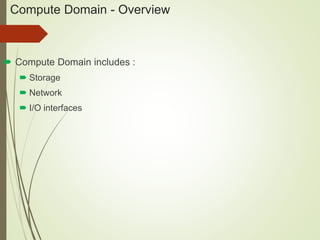
Compute Domain - Overview 
 Compute Domain includes : 
 Storage 
 Network 
 I/O interfaces
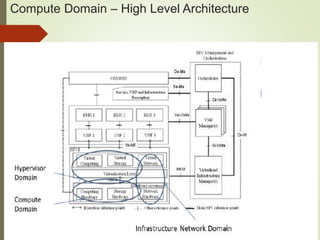
Compute Domain – High Level Architecture
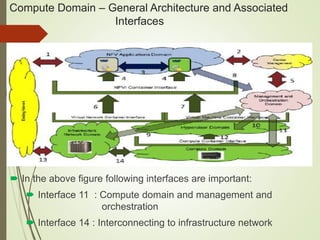
Compute Domain – General Architecture and Associated 
Interfaces 
 In the above figure following interfaces are important: 
 Interface 11 : Compute domain and management and 
orchestration 
 Interface 14 : Interconnecting to infrastructure network
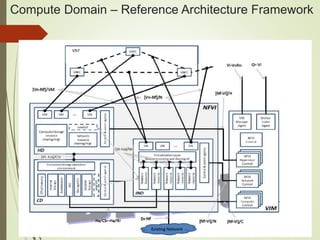
Compute Domain – Reference Architecture Framework
Compute Domain - Interest 
 Compute Domain related interfaces: 
 VNF-NFVI : Reference point between NFVI and VNF 
 VI-Ha : Reference point interfacing the virtualization layer to the 
hardware resources 
 Nf-Vi : Reference point used to assign virtualized resources in 
response to resource allocation requests
Compute Domain – Functional Elements 
 Compute Domain includes following functional elements : 
 Processor and Accelator 
 x86 or ARM based 
 Network interfaces ( NIC’s) card 
 Storage 
Large scale and non-volatile like hard disks, solid state disks and so on.
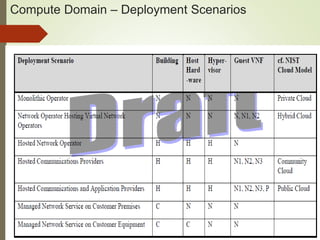
Compute Domain – Deployment Scenarios
Compute Domain – External Interfaces 
 Physical network Interfaces 
 Ethernet 
 CAT 5/ 6 cable with speed up to 1 Gbps 
IEEE802.3 specs compliant 
 Fibre-Channel 
Fibre channel with speeds : 1, 2, 4, 8, 10, 16 and 20 Gbps 
4G and 8G standard compliant 
 Infniband 
Serial style of interface 
 QDR, FDR, EDR speeds
Compute Domain – External Interfaces 
 Internal and External domain interfaces 
 NFVI to VIM (Nf-Vi) 
 Nf-Vi/C 
 Used by VIM to manage the compute and storage portion of NFVI 
 Vi-Ha/csr 
 Interface between the compute domain and hypervisor domain 
 Used by hypervisor/OS to monitor the available physical resources of the 
compute domain 
 Management and Orchestration interfaces
Compute Domain – E2E Requirements 
 Below attachment defines the E2E requirement for compute and 
storage
Compute Domain – Functional Blocks 
 Definition 
“An NFV compute node is a coherent domain with an instruction set 
architecture that is managed as a single compute execution environment. A 
compute node includes a NIC to communicate with other compute nodes, 
network elements and storage elements” 
Various blocks of the compute Domain are detailed below : 
 CPU Complexity 
 Level of integration 
 H/W and S/W interfaces 
 Hypervisor interfaces 
 Instruction-sets and programmability 
 Number of CPU sockets 
 Clock speed and form factor
Compute Domain – Functional Blocks 
 Network Interfaces and Accelerator 
 NIC to include H/W acceleration engines for encryption, encapsulation, 
forwarding and switching 
 Hardware accelerators such as encryption, digital signal processing 
(DSP), packet header processing, packet buffering and scheduling etc 
support 
 Additions to the instruction set architecture which implement new s/w 
acceleration features
Compute Domain – Functional Blocks 
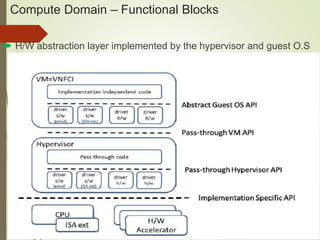
 H/W abstraction layer implemented by the hypervisor and guest O.S
Compute Domain – Interfaces within domain 
 PCIe 
 Interconnects the NIC and/or acceleration cards to the host CPU 
 SR-IOV ( Single Root I/O Virtualisation) 
 Used to virtualize the PCIe and the attached NIC 
 One physical NIC card can support up to 128 virtual functions (VF’s) 
 Assigning each PCI express virtual function can be directly assigned to 
a virtual machine 
 I/O overhead in the software emulation layer is diminished
Compute Domain – Interfaces within domain 
 RDMA ( Remote direct memory access) 
 Allows server-to-server data movement directly between applications 
memory 
 Provides low latency, improved resource utilization, flexible resource 
allocation, scalability and unified fabric 
 RDMA over Converged Ethernet (RoCE) 
 New RDMA protocol over Ethernet 
 Provide data center convergence over reliable Ethernet and Data center 
bridging (DCB) 
 RoCE communications can be as low as 1/10th the latency of any other 
standards
Compute Domain – Interfaces within domain 
 Infiband 
 Direct access to a Network Interface (NIC) straight from application 
space 
 Ability for apps to exchange data directly between their respect buffers 
across a network 
 Creation of a virtual channel connecting two applications which exist in 
entirely separate address space 
 Provides messaging service that application can access 
 Used for storage, IPC, message exchanging 
 Deliver higher bandwidth and low latency
Compute Domain – NFVI Modularity 
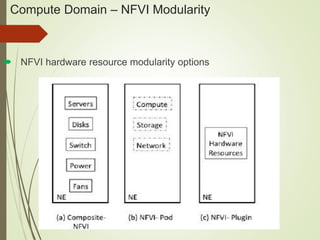
 NFVI hardware resource modularity options
Compute Domain – NFVI Modularity 
 Composite - NFVI 
 NFVI from COTS elements like servers, disk, switches, power supplies, 
fans and so on 
 Another approach is use of an OCP pooled resource structure 
 Field replaceable units are components of the NFVI 
 NFVI-Pod 
 NFVI from COTS elements but with no field replaceable units 
 Deployed with various capacities and form factor 
 Failed elements will be marked as unavailable for use 
 NFVI-Plugin 
 COTS deployable unit of NFVI H/W resources that is field replaceable 
unit within some other network element 
 Managed by the NFV management and orchestration entities
Compute Domain – NFVI Modularity 
 Composite - NFVI 
 NFVI from COTS elements like servers, disk, switches, power supplies, 
fans and so on 
 Another approach is use of an OCP pooled resource structure 
 Field replaceable units are components of the NFVI 
 NFVI-Pod 
 NFVI from COTS elements but with no field replaceable units 
 Deployed with various capacities and form factor 
 Failed elements will be marked as unavailable for use 
 NFVI-Plugin 
 COTS deployable unit of NFVI H/W resources that is field replaceable 
unit within some other network element 
 Managed by the NFV management and orchestration entities

Nfv compute domain

  • 1.
    Network Function Virtualisation- Compute Domain Neelima Sharma
  • 2.
    The content ofthis presentation is taken from the ETSI NFV specifications and from various presentations available on internet
  • 3.
    What is covered…  Compute Domain – Overview  Compute Domain – Architecture  Compute Domain – Functional Elements  Compute Domain – Deployment Scenarios  Compute Domain – External Interfaces  Compute Domain – E2E Requirements  Compute Domain – Functional Blocks  Compute Domain – Interfaces within domain  Compute Domain - Modularity
  • 4.
    Compute Domain -Overview  Compute Domain includes :  Storage  Network  I/O interfaces
  • 5.
    Compute Domain –High Level Architecture
  • 6.
    Compute Domain –General Architecture and Associated Interfaces  In the above figure following interfaces are important:  Interface 11 : Compute domain and management and orchestration  Interface 14 : Interconnecting to infrastructure network
  • 7.
    Compute Domain –Reference Architecture Framework
  • 8.
    Compute Domain -Interest  Compute Domain related interfaces:  VNF-NFVI : Reference point between NFVI and VNF  VI-Ha : Reference point interfacing the virtualization layer to the hardware resources  Nf-Vi : Reference point used to assign virtualized resources in response to resource allocation requests
  • 9.
    Compute Domain –Functional Elements  Compute Domain includes following functional elements :  Processor and Accelator  x86 or ARM based  Network interfaces ( NIC’s) card  Storage Large scale and non-volatile like hard disks, solid state disks and so on.
  • 10.
    Compute Domain –Deployment Scenarios
  • 11.
    Compute Domain –External Interfaces  Physical network Interfaces  Ethernet  CAT 5/ 6 cable with speed up to 1 Gbps IEEE802.3 specs compliant  Fibre-Channel Fibre channel with speeds : 1, 2, 4, 8, 10, 16 and 20 Gbps 4G and 8G standard compliant  Infniband Serial style of interface  QDR, FDR, EDR speeds
  • 12.
    Compute Domain –External Interfaces  Internal and External domain interfaces  NFVI to VIM (Nf-Vi)  Nf-Vi/C  Used by VIM to manage the compute and storage portion of NFVI  Vi-Ha/csr  Interface between the compute domain and hypervisor domain  Used by hypervisor/OS to monitor the available physical resources of the compute domain  Management and Orchestration interfaces
  • 13.
    Compute Domain –E2E Requirements  Below attachment defines the E2E requirement for compute and storage
  • 14.
    Compute Domain –Functional Blocks  Definition “An NFV compute node is a coherent domain with an instruction set architecture that is managed as a single compute execution environment. A compute node includes a NIC to communicate with other compute nodes, network elements and storage elements” Various blocks of the compute Domain are detailed below :  CPU Complexity  Level of integration  H/W and S/W interfaces  Hypervisor interfaces  Instruction-sets and programmability  Number of CPU sockets  Clock speed and form factor
  • 15.
    Compute Domain –Functional Blocks  Network Interfaces and Accelerator  NIC to include H/W acceleration engines for encryption, encapsulation, forwarding and switching  Hardware accelerators such as encryption, digital signal processing (DSP), packet header processing, packet buffering and scheduling etc support  Additions to the instruction set architecture which implement new s/w acceleration features
  • 16.
    Compute Domain –Functional Blocks  H/W abstraction layer implemented by the hypervisor and guest O.S
  • 17.
    Compute Domain –Interfaces within domain  PCIe  Interconnects the NIC and/or acceleration cards to the host CPU  SR-IOV ( Single Root I/O Virtualisation)  Used to virtualize the PCIe and the attached NIC  One physical NIC card can support up to 128 virtual functions (VF’s)  Assigning each PCI express virtual function can be directly assigned to a virtual machine  I/O overhead in the software emulation layer is diminished
  • 18.
    Compute Domain –Interfaces within domain  RDMA ( Remote direct memory access)  Allows server-to-server data movement directly between applications memory  Provides low latency, improved resource utilization, flexible resource allocation, scalability and unified fabric  RDMA over Converged Ethernet (RoCE)  New RDMA protocol over Ethernet  Provide data center convergence over reliable Ethernet and Data center bridging (DCB)  RoCE communications can be as low as 1/10th the latency of any other standards
  • 19.
    Compute Domain –Interfaces within domain  Infiband  Direct access to a Network Interface (NIC) straight from application space  Ability for apps to exchange data directly between their respect buffers across a network  Creation of a virtual channel connecting two applications which exist in entirely separate address space  Provides messaging service that application can access  Used for storage, IPC, message exchanging  Deliver higher bandwidth and low latency
  • 20.
    Compute Domain –NFVI Modularity  NFVI hardware resource modularity options
  • 21.
    Compute Domain –NFVI Modularity  Composite - NFVI  NFVI from COTS elements like servers, disk, switches, power supplies, fans and so on  Another approach is use of an OCP pooled resource structure  Field replaceable units are components of the NFVI  NFVI-Pod  NFVI from COTS elements but with no field replaceable units  Deployed with various capacities and form factor  Failed elements will be marked as unavailable for use  NFVI-Plugin  COTS deployable unit of NFVI H/W resources that is field replaceable unit within some other network element  Managed by the NFV management and orchestration entities
  • 22.
    Compute Domain –NFVI Modularity  Composite - NFVI  NFVI from COTS elements like servers, disk, switches, power supplies, fans and so on  Another approach is use of an OCP pooled resource structure  Field replaceable units are components of the NFVI  NFVI-Pod  NFVI from COTS elements but with no field replaceable units  Deployed with various capacities and form factor  Failed elements will be marked as unavailable for use  NFVI-Plugin  COTS deployable unit of NFVI H/W resources that is field replaceable unit within some other network element  Managed by the NFV management and orchestration entities