News story v/s Feature
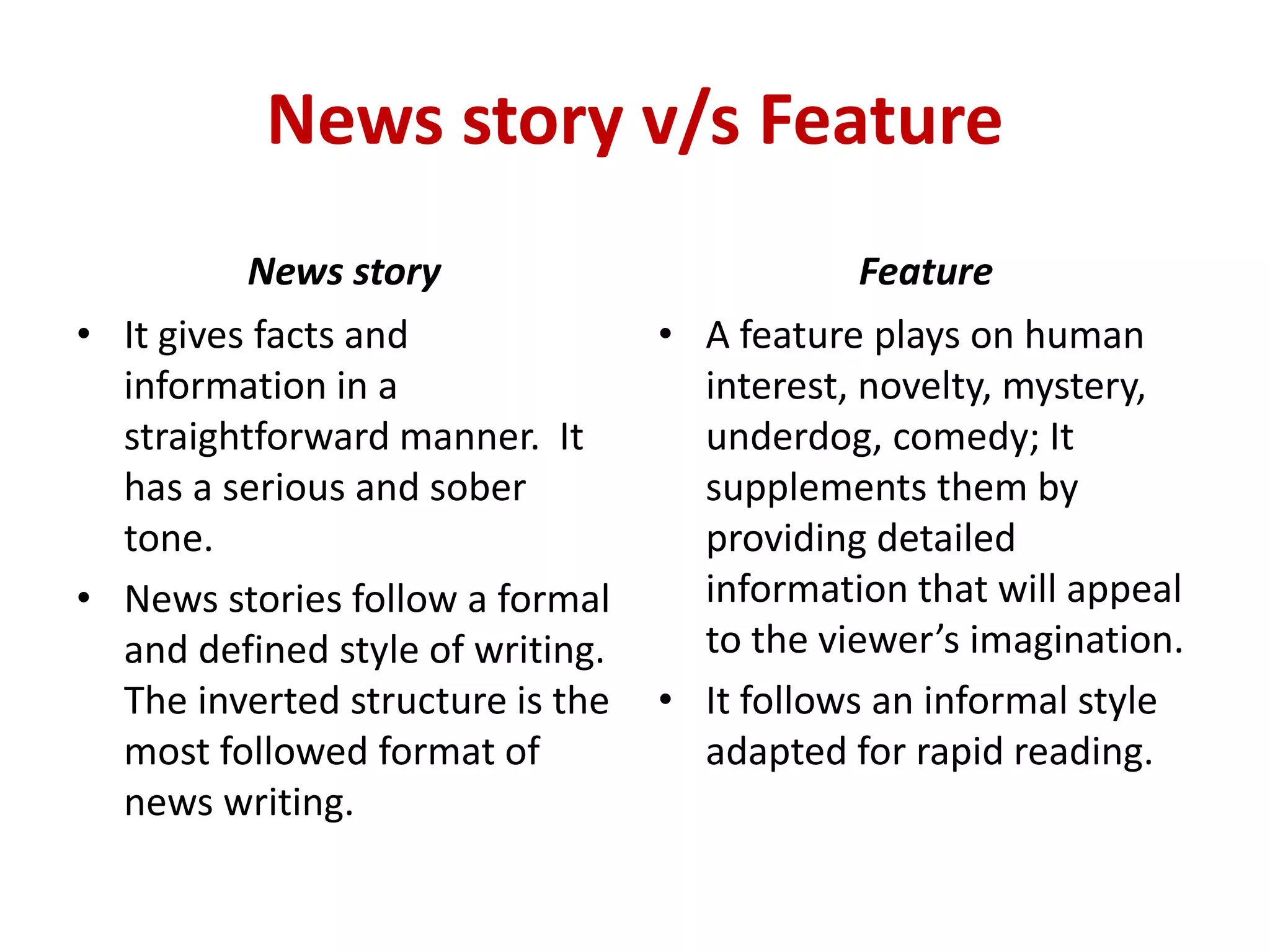
News story
• It gives facts and
information in a
straightforward manner. It
has a serious and sober
tone.
• News stories follow a formal
and defined style of writing.
The inverted structure is the
most followed format of
news writing.
Feature
• A feature plays on human
interest, novelty, mystery,
underdog, comedy; It
supplements them by
providing detailed
information that will appeal
to the viewer’s imagination.
• It follows an informal style
adapted for rapid reading.
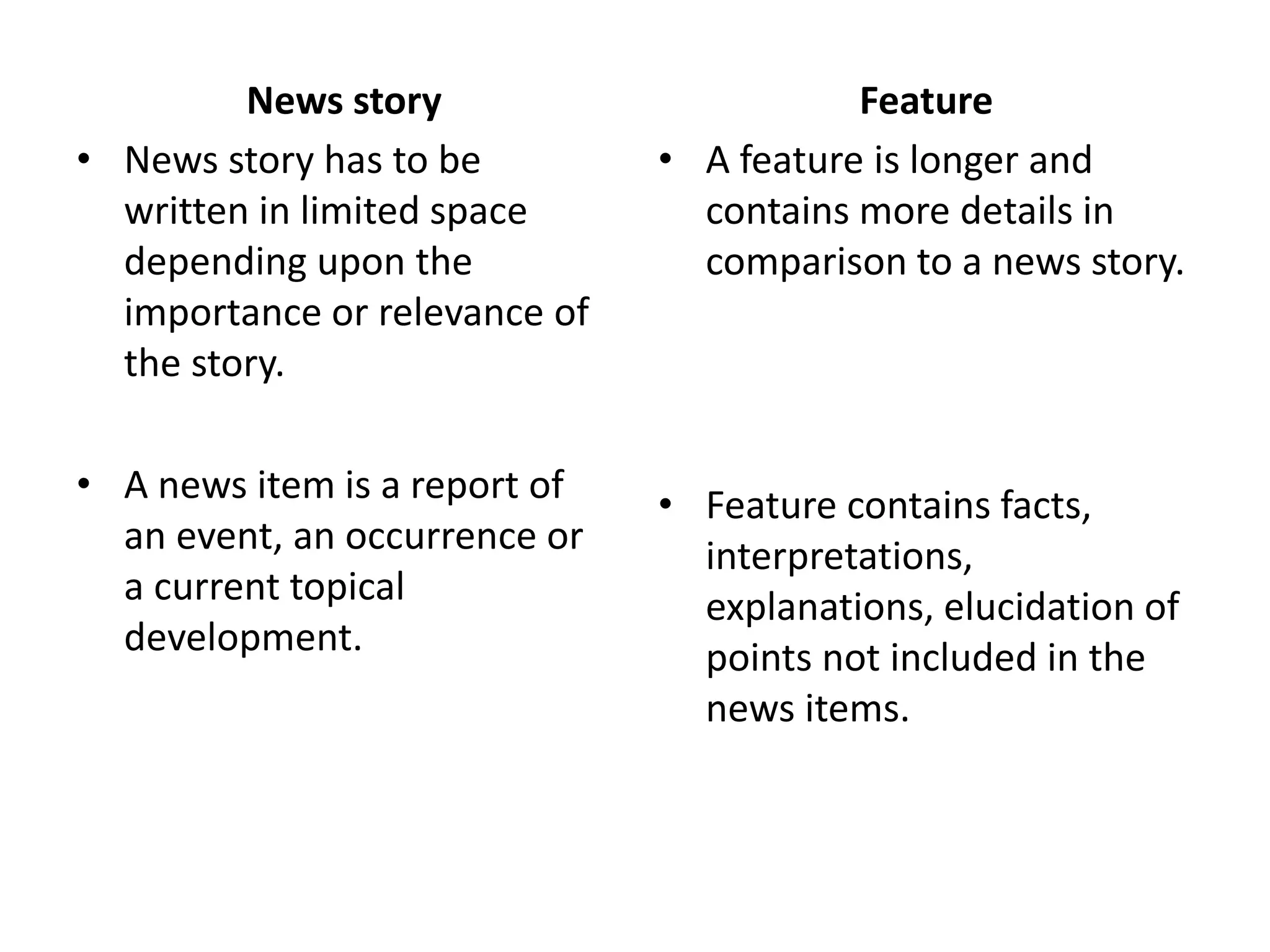
News story
• News story has to be
written in limited space
depending upon the
importance or relevance of
the story.
• A news item is a report of
an event, an occurrence or
a current topical
development.
Feature
• A feature is longer and
contains more details in
comparison to a news story.
• Feature contains facts,
interpretations,
explanations, elucidation of
points not included in the
news items.
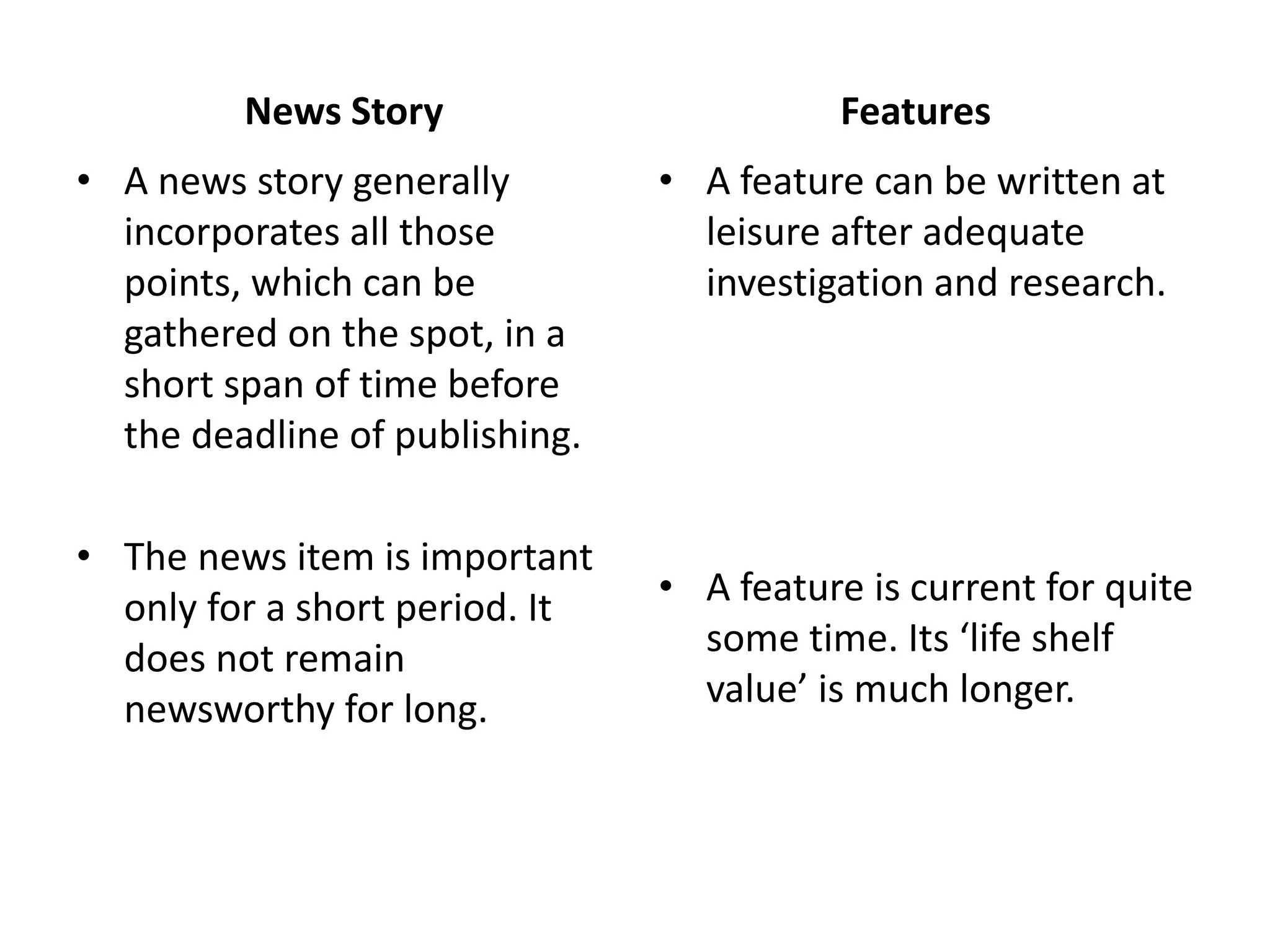
News Story
• A news story generally
incorporates all those
points, which can be
gathered on the spot, in a
short span of time before
the deadline of publishing.
• The news item is important
only for a short period. It
does not remain
newsworthy for long.
Features
• A feature can be written at
leisure after adequate
investigation and research.
• A feature is current for quite
some time. Its ‘life shelf
value’ is much longer.
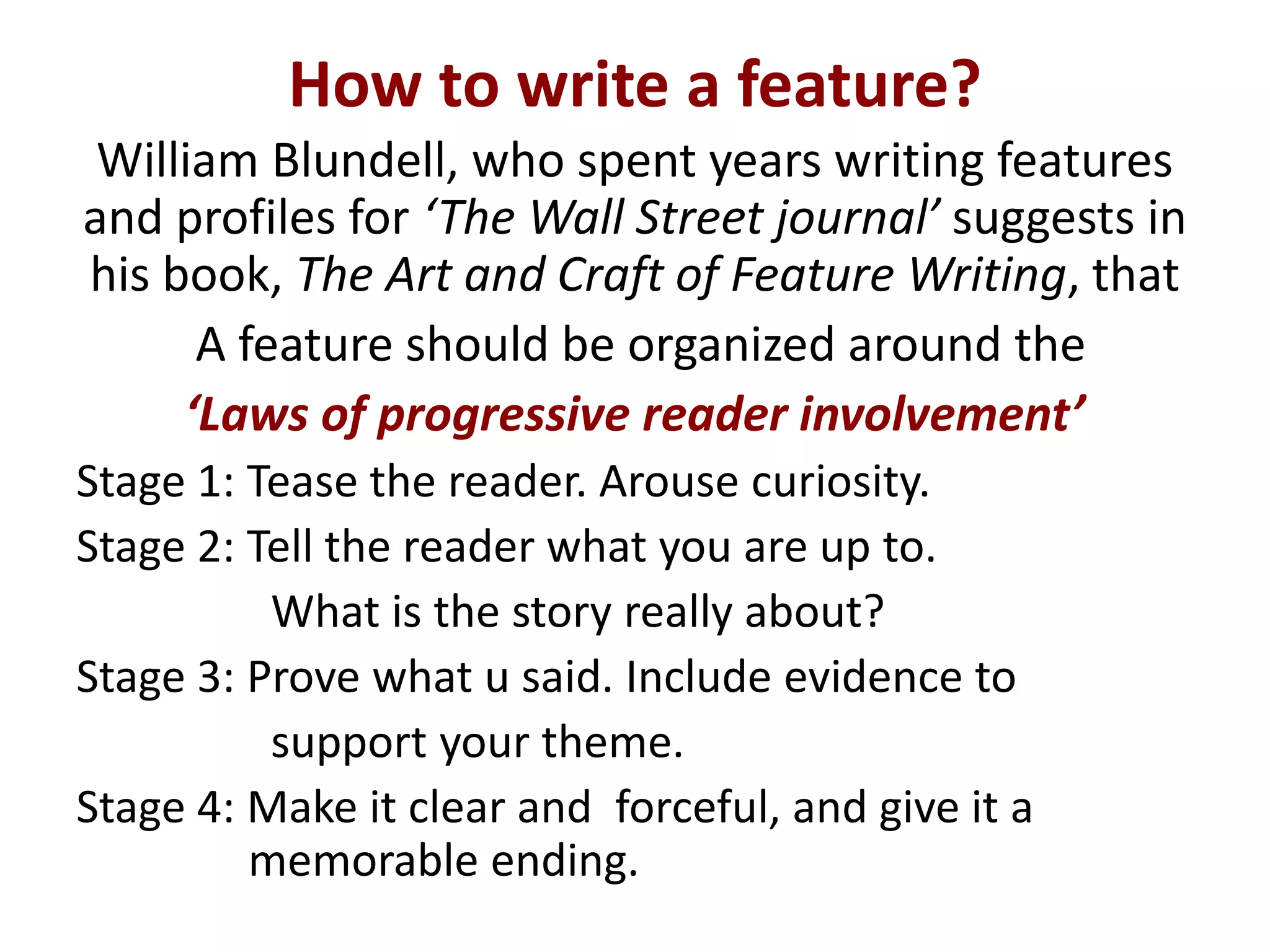
How to write a feature?
William Blundell, who spent years writing features
and profiles for ‘The Wall Street journal’ suggests in
his book, The Art and Craft of Feature Writing, that
A feature should be organized around the
‘Laws of progressive reader involvement’
Stage 1: Tease the reader. Arouse curiosity.
Stage 2: Tell the reader what you are up to.
What is the story really about?
Stage 3: Prove what u said. Include evidence to
support your theme.
Stage 4: Make it clear and forceful, and give it a
memorable ending.
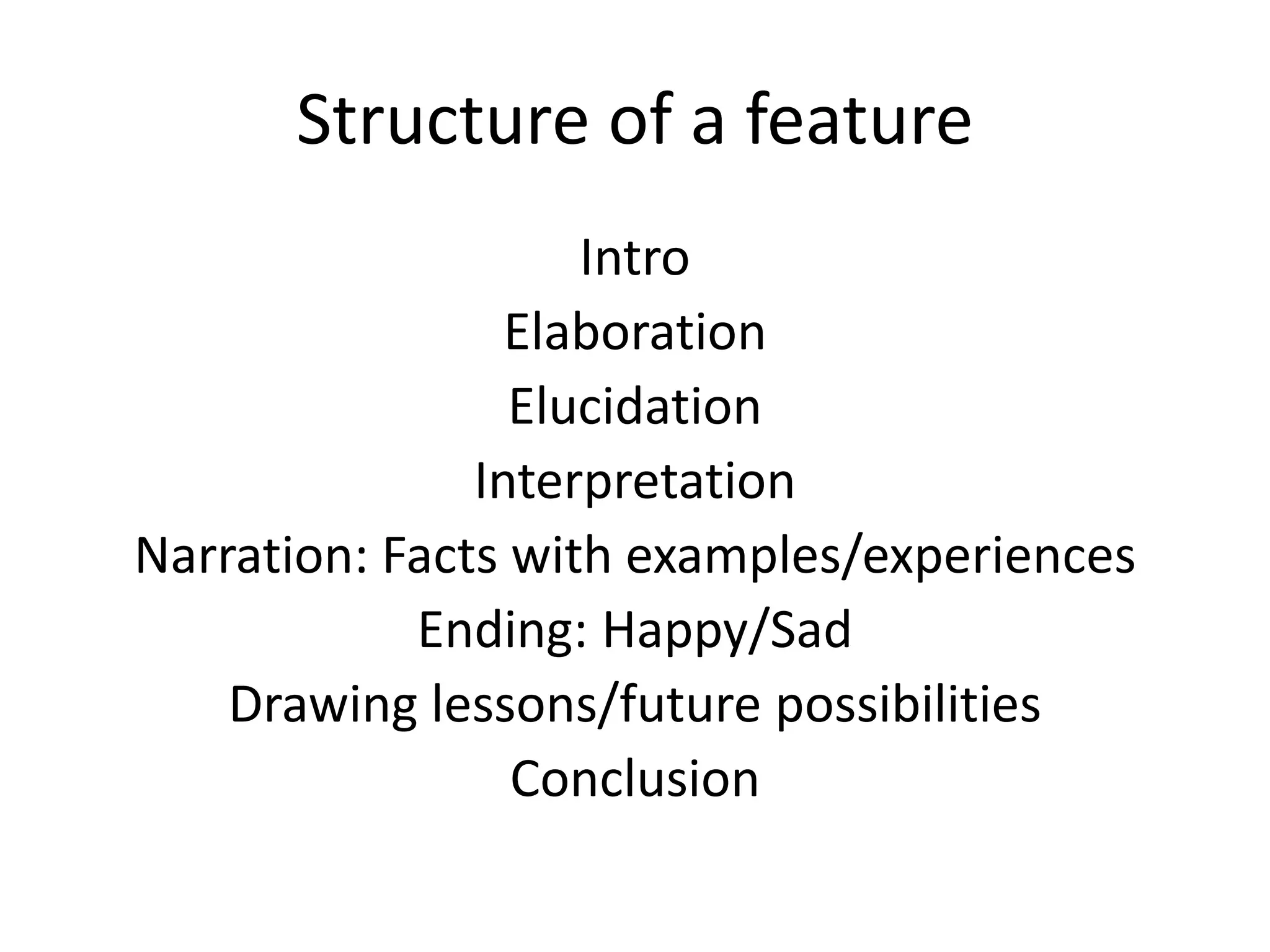
Structure of a feature
Intro
Elaboration
Elucidation
Interpretation
Narration: Facts with examples/experiences
Ending: Happy/Sad
Drawing lessons/future possibilities
Conclusion
Thank you

News vs feature

  • 1.
    News story v/sFeature News story • It gives facts and information in a straightforward manner. It has a serious and sober tone. • News stories follow a formal and defined style of writing. The inverted structure is the most followed format of news writing. Feature • A feature plays on human interest, novelty, mystery, underdog, comedy; It supplements them by providing detailed information that will appeal to the viewer’s imagination. • It follows an informal style adapted for rapid reading.
  • 2.
    News story • Newsstory has to be written in limited space depending upon the importance or relevance of the story. • A news item is a report of an event, an occurrence or a current topical development. Feature • A feature is longer and contains more details in comparison to a news story. • Feature contains facts, interpretations, explanations, elucidation of points not included in the news items.
  • 3.
    News Story • Anews story generally incorporates all those points, which can be gathered on the spot, in a short span of time before the deadline of publishing. • The news item is important only for a short period. It does not remain newsworthy for long. Features • A feature can be written at leisure after adequate investigation and research. • A feature is current for quite some time. Its ‘life shelf value’ is much longer.
  • 4.
    How to writea feature? William Blundell, who spent years writing features and profiles for ‘The Wall Street journal’ suggests in his book, The Art and Craft of Feature Writing, that A feature should be organized around the ‘Laws of progressive reader involvement’ Stage 1: Tease the reader. Arouse curiosity. Stage 2: Tell the reader what you are up to. What is the story really about? Stage 3: Prove what u said. Include evidence to support your theme. Stage 4: Make it clear and forceful, and give it a memorable ending.
  • 5.
    Structure of afeature Intro Elaboration Elucidation Interpretation Narration: Facts with examples/experiences Ending: Happy/Sad Drawing lessons/future possibilities Conclusion
  • 6.