OPERATING SEGMENTS
IFRS 8
INTRODUCTIONINTRODUCTION
Better understand the organisation’s past performance 
Better assess the organisation’s risks and returns
Make more informed judgements about the organisation as a
whole
IFRS 8 OPERATING SEGMENTS
 Objective – an organisation should disclose information to enable
users of its financial statements to evaluate the nature and
financial effects of the types of business activities in which it
engages and the economic environments in which it operates.
 Scope – IFRS 8 applies to the financial statements of an entity:
 whose debt or equity instruments are traded in a public
market; or
 that files, or is in the process of filing, its financial
statements with a regulatory organisation for the purpose
of issuing any class of instruments in a public market.
 If a financial report contains both consolidated and separate
financial statements, segment information is required in respect
of the consolidated financial statements only.
Operating segments
A component of an organisation:
 that which it may earn revenues and incur expenses;
 whose operating results are reviewed regularly by the
organisation’s Chief Operating Decision Maker
(CODM) to make decisions about resources to be
allocated to the segment and assess its performance;
and
 for which discrete financial information is available.
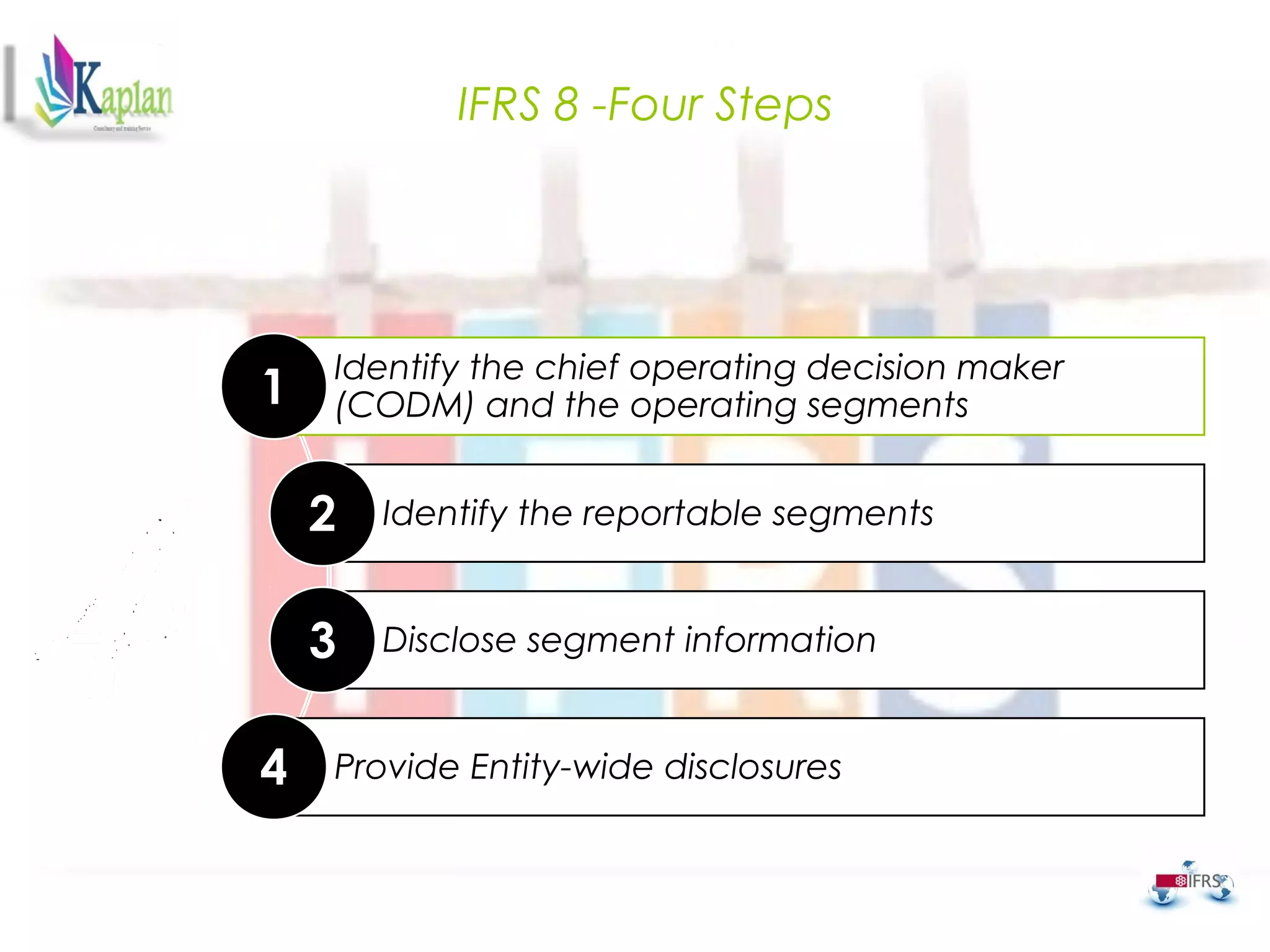
IFRS 8 -Four Steps
Identify the chief operating decision maker
(CODM) and the operating segments1
Identify the reportable segments2
Disclose segment information3
Provide Entity-wide disclosures4
Characteristics that identify
operating segments- Flowchart
Yes
Yes
Yes
No
No
No
Aggregating operating segments
 operating segments often exhibit similar long-term financial
performance if they have similar economic characteristics
 two or more operating segments may be aggregated into a single
operating segment if:
1. the aggregation is consistent with the core principle of IFRS 8
2. the segments have similar economic characteristics
3. the segments are similar in each of the following respects:
 the nature of the products and services
 the nature of the production processes
 the type or class of customer for their products and services
 the methods used to distribute their products or provide their
services
 if applicable, the nature of the regulatory environment, for
example, banking, insurance or public utilities.
Reportable segments
1
2
3
Reportable segments -Thresholds
Reportable segments
The 75% TEST
Total external revenue
of reportable segments
75% Entity's revenue
>=
Disclosure of segment information
Disclose information to enable users of financial statements to evaluate
the nature and financial effects of the business activities in which it
engages and the economic environments in which it operates.
Therefore, an entity should disclose the following for each period for
which a statement of comprehensive income is presented:
1. general information
2. reported segment measures and explanation of the
measurements of those measures
3. reconciliations of the totals of reportable segment
information to the entity's corresponding amounts
Entity-wide disclosures
Entities should provide disclosures about:
1.products and services
2.geographical areas
3.major customers
these disclosures are required for the entity as a whole rather than by
reportable segment and referred to as entity-wide disclosures
entity-wide disclosures are particularly useful when the segment disclosures
do not otherwise include total revenues by product, service or revenue stream
these disclosures are based on amounts incorporated in the primary financial
statements rather than a management basis.

New operating segments

  • 1.
  • 2.
    INTRODUCTIONINTRODUCTION Better understand theorganisation’s past performance  Better assess the organisation’s risks and returns Make more informed judgements about the organisation as a whole
  • 3.
    IFRS 8 OPERATINGSEGMENTS  Objective – an organisation should disclose information to enable users of its financial statements to evaluate the nature and financial effects of the types of business activities in which it engages and the economic environments in which it operates.  Scope – IFRS 8 applies to the financial statements of an entity:  whose debt or equity instruments are traded in a public market; or  that files, or is in the process of filing, its financial statements with a regulatory organisation for the purpose of issuing any class of instruments in a public market.  If a financial report contains both consolidated and separate financial statements, segment information is required in respect of the consolidated financial statements only.
  • 4.
    Operating segments A componentof an organisation:  that which it may earn revenues and incur expenses;  whose operating results are reviewed regularly by the organisation’s Chief Operating Decision Maker (CODM) to make decisions about resources to be allocated to the segment and assess its performance; and  for which discrete financial information is available.
  • 5.
    IFRS 8 -FourSteps Identify the chief operating decision maker (CODM) and the operating segments1 Identify the reportable segments2 Disclose segment information3 Provide Entity-wide disclosures4
  • 6.
    Characteristics that identify operatingsegments- Flowchart Yes Yes Yes No No No
  • 7.
    Aggregating operating segments operating segments often exhibit similar long-term financial performance if they have similar economic characteristics  two or more operating segments may be aggregated into a single operating segment if: 1. the aggregation is consistent with the core principle of IFRS 8 2. the segments have similar economic characteristics 3. the segments are similar in each of the following respects:  the nature of the products and services  the nature of the production processes  the type or class of customer for their products and services  the methods used to distribute their products or provide their services  if applicable, the nature of the regulatory environment, for example, banking, insurance or public utilities.
  • 8.
  • 9.
  • 10.
    Reportable segments The 75%TEST Total external revenue of reportable segments 75% Entity's revenue >=
  • 11.
    Disclosure of segmentinformation Disclose information to enable users of financial statements to evaluate the nature and financial effects of the business activities in which it engages and the economic environments in which it operates. Therefore, an entity should disclose the following for each period for which a statement of comprehensive income is presented: 1. general information 2. reported segment measures and explanation of the measurements of those measures 3. reconciliations of the totals of reportable segment information to the entity's corresponding amounts
  • 12.
    Entity-wide disclosures Entities shouldprovide disclosures about: 1.products and services 2.geographical areas 3.major customers these disclosures are required for the entity as a whole rather than by reportable segment and referred to as entity-wide disclosures entity-wide disclosures are particularly useful when the segment disclosures do not otherwise include total revenues by product, service or revenue stream these disclosures are based on amounts incorporated in the primary financial statements rather than a management basis.

Editor's Notes

  • #6 PRESENTER NOTES:
  • #7 PRESENTER NOTES:
  • #8 PRESENTER NOTES: IFRS 8 requires an entity to identify its operating segments the entity identifies its 'reportable segments' from its operating segments for some large entities, the number of operating segments identified may be excessive and the benefit of disclosing segmental information for each separate segment may be insufficient to justify the cost therefore, prior to determining the reportable segments, IFRS 8 permits, not requires, to aggregate segments with similar economic characteristics that meet the aggregation criteria set out in the slide.
  • #9 PRESENTER NOTES: once the entity's operating segments have been identified and aggregation of operating segments has been considered, the entity must then determine which operating segments are reportable the quantitative thresholds- See the next slide.
  • #10 PRESENTER NOTES: quantitative thresholds are included in IFRS 8 so as to limit the disclosures to a reasonable level the amounts considered when looking at the thresholds are the amounts reported to the CODM if one or more of the aggregated segments has reported a profit but another has reported a loss, the net profit or loss is considered for the purpose of determining the reportable threshold for segment results when reviewing the 10% threshold, transactions between operating segments are included as this gives information about the dependency of the operations.
  • #11 PRESENTER NOTES: IFRS 8 does not specify how to select the additional segments the additional segments do not need to be the next largest by any of the measures judgment should be based on the specific facts and circumstances.
  • #12 PRESENTER NOTES: an entity should disclose the following for each period for which a statement of comprehensive income is presented: general information. See the next slide … …
  • #13 PRESENTER NOTES: the entity-wide disclosures are not required where the necessary information is not available and the cost to develop it would be excessive however, because the information is on an entity basis, it is not expected that this exemption will be invoked often Entity-wide disclosures: products and services- see the next slide … …