Neuroplasticity The Brain That Changes Itself  Safdar I. Chaudhary, MD Ruthann Valentine, PhD,CNS,BC &  S’eclairer Creative Arts Team
Objectives  Understand the science of fear Learn neuroplasticity research and it’s implications in our daily life Transform the pain and suffering into songs and wisdom
The Brain that Changes Itself Researchers are discovering that we can teach an old brain new tricks.  It seems the organ is more flexible than scientists originally thought.
What Controls Our Health  Women who believed that they were prone to heart disease were nearly four times as likely to die compared to women with similar risk factors who didn't hold such fatalistic views. The  higher  risk of death, in other words, had nothing to do with the usual heart disease culprits -- age, blood pressure, cholesterol, weight. Instead, it tracked closely with belief.  Think sick, be sick.
The nocebo response A  placebo  makes patients feel better for reasons unrelated to the specific healing properties of the treatment.  A  nocebo  makes patients feel worse (or does other harm) in the same way. Common symptoms are drowsiness, headache, mild dizziness, difficulty concentrating, and stomach upset. Many health professionals are not aware of nocebos, yet the reaction can cause patients to drop out of clinical trials, stop taking drugs they need, or end up using other drugs that complicate their treatment.
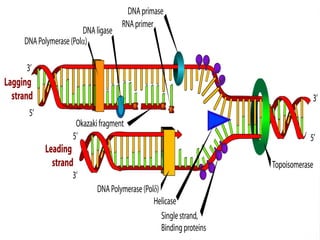
Genes and Disease  The 46 human chromosomes (22 pairs of autosomal chromosomes and 2 sex chromosomes) between them house almost 3 billion base pairs of DNA that contains about 30,000 - 40,000 protein-coding genes.  The coding regions make up less than 5% of the genome (the function of the remaining DNA is not clear) and some chromosomes have a higher density of genes than others.
 
 
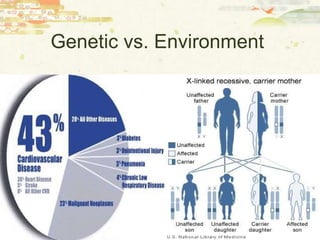
Genetic vs. Environment
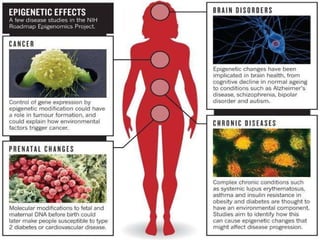
Environment and us  Our genes express based on the environmental exposure  Some estimates indicate- 2 % of diseases are genetic such as  Hemophilia Huntington’s Disease Remaining impacted by life style & Environmental Exposures
Our beautiful body
Our Environment
War and Fear
Fear
Fear at Brain Level British researchers had earlier linked increased amygdala activity to decreased trustworthines. B e cause increased amygdala activation has been associated with social fear in social phobia, genetic risk for anxiety and depression, and possibly with social fear in autism assessed during faces processing, this dual mode of action of oxytocin in humans suggests a potentially powerful treatment approach toward socially relevant fear, suggest the researchers.
Fear Hormones  Fear arousal, initiated by an environmental threat, leads to activation of the stress response, a state of alarm that promotes an array of autonomic and endocrine changes designed to aid self-preservation.  The stress response includes the release of glucocorticoids from the adrenal cortex and catecholamines from the adrenal medulla and sympathetic nerves. These stress hormones, in turn, provide feedback to the brain and influence neural structures that control emotion and cognition
Fears People develop specific fears as a result of learning. This has been studied in psychology as  fear conditioning , beginning with John B. Watson's  Little Albert experiment  in 1920.  In this study, an 11-month-old boy was conditioned to fear a white rat in the laboratory. The fear became generalized to include other white, furry objects. In the real world, fear can be acquired by a frightening traumatic accident.
Fear and its impact
Fear via hormone & nerves
Stem Cells  Potential to develop into different types of cells.
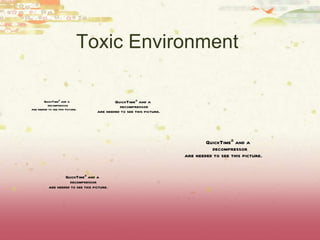
50 Trillion Cells of Body The human body relies on bugs for health and life. Without the microbes the human body plays host to, there would be no human life
Toxic Environment
Our Journey
Trust-building Hormone Short-circuits Fear in Humans St udies in animals, pioneered by NIMH director Dr. Thomas Insel, have shown that oxytocin plays a key role in complex emotional and social behaviors, such as attachment, social recognition and aggression ,  noted NIH Director Elias Zerhouni, M.D. For the first time, we can literally see these same mechanisms at work in the human brain. Dec 2005
NIMH Study 15 healthy men to sniff oxytocin or a placebo prior to undergoing a functional magnetic resonance imaging (fMRI) scan, which reveals what parts of the brain that are activated by particular activities. While in the scanner, the men performed  tasks known to activate the amygdala  matching angry or fearful faces and threatening scenes. Andreas Meyer-Lindenberg, M.D., Ph.D., NIMH Genes Cognition and Psychosis Program, and colleagues, in the December 7, 2005 issue of the  Journal of Neuroscienc e.
 
Oxytocin Oxytocin is best known for its roles in female reproduction. It is released in large amounts 1) after distension of the  cervix  and  uterus  during labor, and 2) after stimulation of the  nipples , facilitating  birth  and  breastfeeding .  Recent studies have begun to investigate oxytocin's role in various behaviors, including  orgasm , social recognition,  pair bonding ,  anxiety , and maternal behaviors. For this reason, it is sometimes referred to as the  "love hormone"
Pathways of Brain
The Brain: How The Brain Rewires Itself Growing number of discoveries showing that greater use of a particular muscle causes the brain to devote more cortical real estate to it. Mental training has the power to change the physical structure of the brain. The ability of mere thought to alter the physical structure and function of our gray matter.
OVERTHROWING THE DOGMA FOR DECADES, THE PREVAILING DOGMA IN neuroscience was that the adult human brain is essentially immutable, hardwired, fixed in form and function, so that by the time we reach adulthood we are pretty much stuck with what we have.
Empowered with Possibilities But research in the past few years has overthrown the dogma. In its place has come the realization that the adult brain retains impressive powers of "neuroplasticity"--the ability to change its structure and function in response to experience.
Obsessive Compulsive Disorder  Jeffrey Schwartz and colleagues at the University of California, Los Angeles, found that cognitive behavior therapy (CBT) can quiet activity in the circuit that underlies obsessive-compulsive disorder (OCD), just as drugs do. Schwartz had become intrigued with the therapeutic potential of mindfulness meditation, the Buddhist practice of observing one's inner experiences as if they were happening to someone else
Obsessive Compulsive Disorder  When OCD patients were plagued by an obsessive thought, Schwartz instructed them to think, "My brain is generating another obsessive thought. Don't I know it is just some garbage thrown up by a faulty circuit?"  After 10 weeks of mindfulness-based therapy, 12 out of 18 patients improved significantly. Before-and-after brain scans showed that activity in the orbital frontal cortex, the core of the OCD circuit, had fallen dramatically and in exactly the way that drugs effective against OCD affect the brain.  Schwartz called it "self-directed neuroplasticity," concluding that "the mind can change the brain."
Prostate Health  A new study by Dr. Dean Ornish shows the power of diet and lifestyle changes to improve cancer survival.
Diet and our Health  In a group of men with prostate cancer, prostate-specific antigen (PSA) levels   marker that tracks prostate cancer growth d e creased by 4 percent after one year on a low-fat vegan diet, complemented by moderate aerobic exercise and stress management. (The diet was supplemented with soy, omega-3 fatty acids, vitamin E, selenium, and vitamin C.)
Prostate Cancer Previous studies have shown that the consumption of dietary fat and dairy products increases prostate cancer risk while compounds in tomatoes, soy, and cruciferous vegetables protect against the disease. Ornish D, Weidner G, Fair WR, et al. Intensive lifestyle changes may affect the progression of prostate cancer.  J Urol.  2005;174:1065-70.
Wonderful Mind  Our Perceptions Our Belief Systems  Emotions- Fear Based or Trusting  Healthy Responses
Story of Wisdom
Good Medicine

Neuroplasticity: The Brain That Changes Itself

  • 1.
    Neuroplasticity The BrainThat Changes Itself Safdar I. Chaudhary, MD Ruthann Valentine, PhD,CNS,BC & S’eclairer Creative Arts Team
  • 2.
    Objectives Understandthe science of fear Learn neuroplasticity research and it’s implications in our daily life Transform the pain and suffering into songs and wisdom
  • 3.
    The Brain thatChanges Itself Researchers are discovering that we can teach an old brain new tricks. It seems the organ is more flexible than scientists originally thought.
  • 4.
    What Controls OurHealth Women who believed that they were prone to heart disease were nearly four times as likely to die compared to women with similar risk factors who didn't hold such fatalistic views. The higher risk of death, in other words, had nothing to do with the usual heart disease culprits -- age, blood pressure, cholesterol, weight. Instead, it tracked closely with belief. Think sick, be sick.
  • 5.
    The nocebo responseA placebo makes patients feel better for reasons unrelated to the specific healing properties of the treatment. A nocebo makes patients feel worse (or does other harm) in the same way. Common symptoms are drowsiness, headache, mild dizziness, difficulty concentrating, and stomach upset. Many health professionals are not aware of nocebos, yet the reaction can cause patients to drop out of clinical trials, stop taking drugs they need, or end up using other drugs that complicate their treatment.
  • 6.
    Genes and Disease The 46 human chromosomes (22 pairs of autosomal chromosomes and 2 sex chromosomes) between them house almost 3 billion base pairs of DNA that contains about 30,000 - 40,000 protein-coding genes. The coding regions make up less than 5% of the genome (the function of the remaining DNA is not clear) and some chromosomes have a higher density of genes than others.

  • 7.
  • 8.
  • 9.
  • 10.
    Environment and us Our genes express based on the environmental exposure Some estimates indicate- 2 % of diseases are genetic such as Hemophilia Huntington’s Disease Remaining impacted by life style & Environmental Exposures
  • 11.
  • 12.
  • 13.
  • 14.
  • 15.
    Fear at BrainLevel British researchers had earlier linked increased amygdala activity to decreased trustworthines. B e cause increased amygdala activation has been associated with social fear in social phobia, genetic risk for anxiety and depression, and possibly with social fear in autism assessed during faces processing, this dual mode of action of oxytocin in humans suggests a potentially powerful treatment approach toward socially relevant fear, suggest the researchers.
  • 16.
    Fear Hormones Fear arousal, initiated by an environmental threat, leads to activation of the stress response, a state of alarm that promotes an array of autonomic and endocrine changes designed to aid self-preservation. The stress response includes the release of glucocorticoids from the adrenal cortex and catecholamines from the adrenal medulla and sympathetic nerves. These stress hormones, in turn, provide feedback to the brain and influence neural structures that control emotion and cognition
  • 17.
    Fears People developspecific fears as a result of learning. This has been studied in psychology as fear conditioning , beginning with John B. Watson's Little Albert experiment in 1920. In this study, an 11-month-old boy was conditioned to fear a white rat in the laboratory. The fear became generalized to include other white, furry objects. In the real world, fear can be acquired by a frightening traumatic accident.
  • 18.
  • 19.
  • 20.
    Stem Cells Potential to develop into different types of cells.
  • 21.
    50 Trillion Cellsof Body The human body relies on bugs for health and life. Without the microbes the human body plays host to, there would be no human life
  • 22.
  • 23.
  • 24.
    Trust-building Hormone Short-circuitsFear in Humans St udies in animals, pioneered by NIMH director Dr. Thomas Insel, have shown that oxytocin plays a key role in complex emotional and social behaviors, such as attachment, social recognition and aggression , noted NIH Director Elias Zerhouni, M.D. For the first time, we can literally see these same mechanisms at work in the human brain. Dec 2005
  • 25.
    NIMH Study 15healthy men to sniff oxytocin or a placebo prior to undergoing a functional magnetic resonance imaging (fMRI) scan, which reveals what parts of the brain that are activated by particular activities. While in the scanner, the men performed tasks known to activate the amygdala matching angry or fearful faces and threatening scenes. Andreas Meyer-Lindenberg, M.D., Ph.D., NIMH Genes Cognition and Psychosis Program, and colleagues, in the December 7, 2005 issue of the Journal of Neuroscienc e.
  • 26.
  • 27.
    Oxytocin Oxytocin isbest known for its roles in female reproduction. It is released in large amounts 1) after distension of the cervix and uterus during labor, and 2) after stimulation of the nipples , facilitating birth and breastfeeding . Recent studies have begun to investigate oxytocin's role in various behaviors, including orgasm , social recognition, pair bonding , anxiety , and maternal behaviors. For this reason, it is sometimes referred to as the "love hormone"
  • 28.
  • 29.
    The Brain: HowThe Brain Rewires Itself Growing number of discoveries showing that greater use of a particular muscle causes the brain to devote more cortical real estate to it. Mental training has the power to change the physical structure of the brain. The ability of mere thought to alter the physical structure and function of our gray matter.
  • 30.
    OVERTHROWING THE DOGMAFOR DECADES, THE PREVAILING DOGMA IN neuroscience was that the adult human brain is essentially immutable, hardwired, fixed in form and function, so that by the time we reach adulthood we are pretty much stuck with what we have.
  • 31.
    Empowered with PossibilitiesBut research in the past few years has overthrown the dogma. In its place has come the realization that the adult brain retains impressive powers of "neuroplasticity"--the ability to change its structure and function in response to experience.
  • 32.
    Obsessive Compulsive Disorder Jeffrey Schwartz and colleagues at the University of California, Los Angeles, found that cognitive behavior therapy (CBT) can quiet activity in the circuit that underlies obsessive-compulsive disorder (OCD), just as drugs do. Schwartz had become intrigued with the therapeutic potential of mindfulness meditation, the Buddhist practice of observing one's inner experiences as if they were happening to someone else
  • 33.
    Obsessive Compulsive Disorder When OCD patients were plagued by an obsessive thought, Schwartz instructed them to think, "My brain is generating another obsessive thought. Don't I know it is just some garbage thrown up by a faulty circuit?" After 10 weeks of mindfulness-based therapy, 12 out of 18 patients improved significantly. Before-and-after brain scans showed that activity in the orbital frontal cortex, the core of the OCD circuit, had fallen dramatically and in exactly the way that drugs effective against OCD affect the brain. Schwartz called it "self-directed neuroplasticity," concluding that "the mind can change the brain."
  • 34.
    Prostate Health A new study by Dr. Dean Ornish shows the power of diet and lifestyle changes to improve cancer survival.
  • 35.
    Diet and ourHealth In a group of men with prostate cancer, prostate-specific antigen (PSA) levels marker that tracks prostate cancer growth d e creased by 4 percent after one year on a low-fat vegan diet, complemented by moderate aerobic exercise and stress management. (The diet was supplemented with soy, omega-3 fatty acids, vitamin E, selenium, and vitamin C.)
  • 36.
    Prostate Cancer Previousstudies have shown that the consumption of dietary fat and dairy products increases prostate cancer risk while compounds in tomatoes, soy, and cruciferous vegetables protect against the disease. Ornish D, Weidner G, Fair WR, et al. Intensive lifestyle changes may affect the progression of prostate cancer. J Urol. 2005;174:1065-70.
  • 37.
    Wonderful Mind Our Perceptions Our Belief Systems Emotions- Fear Based or Trusting Healthy Responses
  • 38.
  • 39.