By
Raj Kumar Rampelli



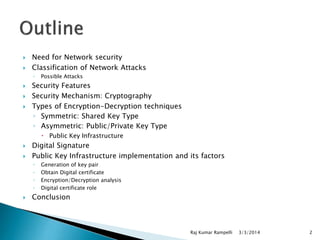
Need for Network security
Classification of Network Attacks
◦





Possible Attacks

Security Features
Security Mechanism: Cryptography
Types of Encryption-Decryption techniques
◦ Symmetric: Shared Key Type
◦ Asymmetric: Public/Private Key Type
 Public Key Infrastructure




Digital Signature
Public Key Infrastructure implementation and its factors
◦
◦
◦
◦



Generation of key pair
Obtain Digital certificate
Encryption/Decryption analysis
Digital certificate role

Conclusion

Raj Kumar Rampelli

3/3/2014

2


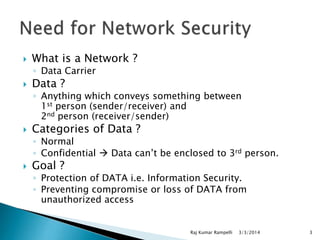
What is a Network ?
◦ Data Carrier



Data ?

◦ Anything which conveys something between
1st person (sender/receiver) and
2nd person (receiver/sender)



Categories of Data ?

◦ Normal
◦ Confidential  Data can’t be enclosed to 3rd person.



Goal ?

◦ Protection of DATA i.e. Information Security.
◦ Preventing compromise or loss of DATA from
unauthorized access

Raj Kumar Rampelli

3/3/2014

3


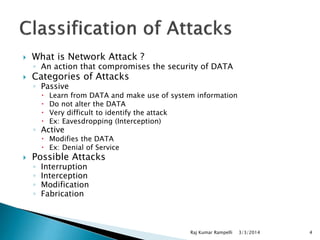
What is Network Attack ?



Categories of Attacks

◦ An action that compromises the security of DATA
◦ Passive





Learn from DATA and make use of system information
Do not alter the DATA
Very difficult to identify the attack
Ex: Eavesdropping (Interception)

◦ Active

 Modifies the DATA
 Ex: Denial of Service



Possible Attacks
◦
◦
◦
◦

Interruption
Interception
Modification
Fabrication

Raj Kumar Rampelli

3/3/2014

4


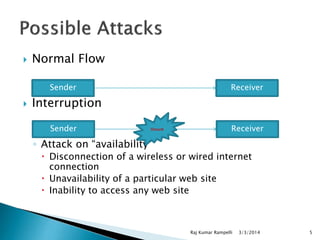
Normal Flow
Sender



Receiver

Interruption
Sender

Disturb

Receiver

◦ Attack on “availability”

 Disconnection of a wireless or wired internet
connection
 Unavailability of a particular web site
 Inability to access any web site

Raj Kumar Rampelli

3/3/2014

5


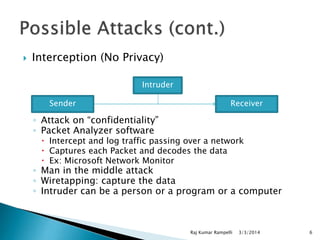
Interception (No Privacy)
Intruder
Sender

Receiver

◦ Attack on “confidentiality”
◦ Packet Analyzer software

 Intercept and log traffic passing over a network
 Captures each Packet and decodes the data
 Ex: Microsoft Network Monitor

◦ Man in the middle attack
◦ Wiretapping: capture the data
◦ Intruder can be a person or a program or a computer

Raj Kumar Rampelli

3/3/2014

6


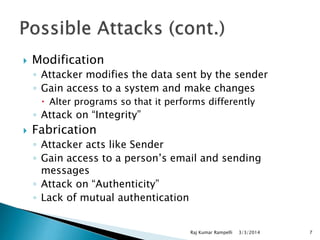
Modification
◦ Attacker modifies the data sent by the sender
◦ Gain access to a system and make changes
 Alter programs so that it performs differently

◦ Attack on “Integrity”


Fabrication
◦ Attacker acts like Sender
◦ Gain access to a person’s email and sending
messages
◦ Attack on “Authenticity”
◦ Lack of mutual authentication

Raj Kumar Rampelli

3/3/2014

7


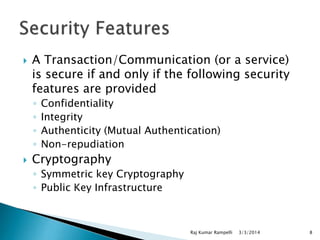
A Transaction/Communication (or a service)
is secure if and only if the following security
features are provided
◦
◦
◦
◦



Confidentiality
Integrity
Authenticity (Mutual Authentication)
Non-repudiation

Cryptography
◦ Symmetric key Cryptography
◦ Public Key Infrastructure

Raj Kumar Rampelli

3/3/2014

8
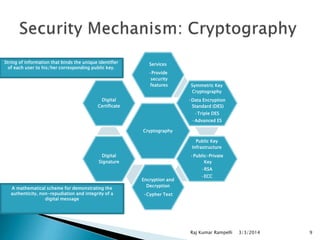
String of information that binds the unique identifier
of each user to his/her corresponding public key.

Services

•Provide
security
features

Digital
Certificate

Symmetric Key
Cryptography
•Data Encryption
Standard (DES)
•Triple DES
•Advanced ES

Cryptography
Public Key
Infrastructure
Digital
Signature

•Public-Private
Key
•RSA

A mathematical scheme for demonstrating the
authenticity, non-repudiation and integrity of a
digital message

Encryption and
Decryption

•ECC

•Cypher Text

Raj Kumar Rampelli

3/3/2014

9


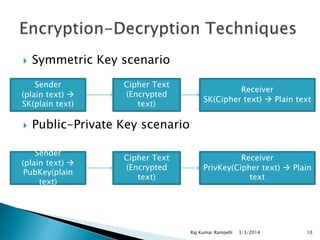
Symmetric Key scenario

Sender
(plain text) 
SK(plain text)



Cipher Text
(Encrypted
text)

Receiver
SK(Cipher text)  Plain text

Public-Private Key scenario

Sender
(plain text) 
PubKey(plain
text)

Cipher Text
(Encrypted
text)

Receiver
PrivKey(Cipher text)  Plain
text

Raj Kumar Rampelli

3/3/2014

10
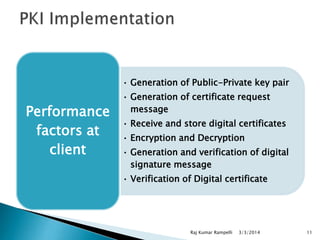
• Generation of Public-Private key pair

Performance
factors at
client

• Generation of certificate request
message
• Receive and store digital certificates
• Encryption and Decryption
• Generation and verification of digital
signature message
• Verification of Digital certificate

Raj Kumar Rampelli

3/3/2014

11




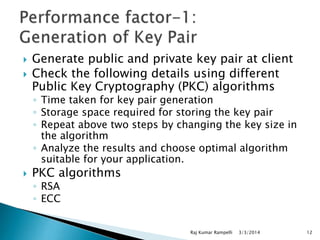
Generate public and private key pair at client
Check the following details using different
Public Key Cryptography (PKC) algorithms

◦ Time taken for key pair generation
◦ Storage space required for storing the key pair
◦ Repeat above two steps by changing the key size in
the algorithm
◦ Analyze the results and choose optimal algorithm
suitable for your application.



PKC algorithms
◦ RSA
◦ ECC

Raj Kumar Rampelli

3/3/2014

12


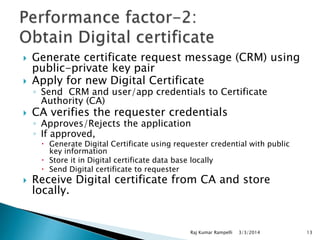
Generate certificate request message (CRM) using
public-private key pair
Apply for new Digital Certificate



CA verifies the requester credentials



◦ Send CRM and user/app credentials to Certificate
Authority (CA)
◦ Approves/Rejects the application
◦ If approved,

 Generate Digital Certificate using requester credential with public
key information
 Store it in Digital certificate data base locally
 Send Digital certificate to requester



Receive Digital certificate from CA and store
locally.

Raj Kumar Rampelli

3/3/2014

13









String of information that binds the unique identifier of each client
to his/her corresponding public key.
Pre-requite for obtaining Digital certificate
◦ Generate public-private key pair locally
◦ Generate certificate request message
Digital certificate used to authenticate server credentials during
mutual authentication process
Mutual authentication process:
◦ a client authenticating themselves to a server and that server
authenticating itself to the user in such a way that both parties are
assured of the others' identity [wiki]
Authenticating an entity using its Digital certificate:
◦ Check the validity period of certificate
◦ Verify the digital signature of CA on the certificate using CA’s
public key

Raj Kumar Rampelli

3/3/2014

14



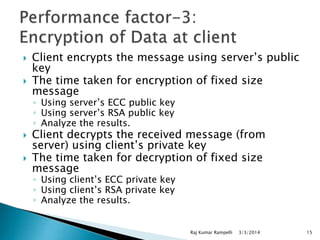
Client encrypts the message using server’s public
key
The time taken for encryption of fixed size
message
◦ Using server’s ECC public key
◦ Using server’s RSA public key
◦ Analyze the results.




Client decrypts the received message (from
server) using client’s private key
The time taken for decryption of fixed size
message
◦ Using client’s ECC private key
◦ Using client’s RSA private key
◦ Analyze the results.

Raj Kumar Rampelli

3/3/2014

15
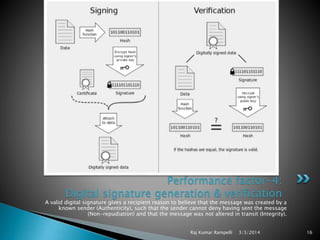
Performance factor-4:
Digital signature generation & verification

A valid digital signature gives a recipient reason to believe that the message was created by a
known sender (Authenticity), such that the sender cannot deny having sent the message
(Non-repudiation) and that the message was not altered in transit (Integrity).
Raj Kumar Rampelli

3/3/2014

16


A method to Secure “Data transactions” between
users is needed
◦ Should ensure all desired security features for any
transaction.



Cryptography: collections of standards/techniques
for securing the Data.
◦ PKI ensures all security features







As the key size increases, the more difficult to crack
the data.
Analyze PKI Implementation factors using different
cryptographic algorithms with different key sizes
Digital certificate: Mainly used for authenticity
Digital signature: Mainly used for Integrity of data

Raj Kumar Rampelli

3/3/2014

17



Have a Look at:
My PPTs:



http://www.slideshare.net/rampalliraj/



My Tech Blog:



http://practicepeople.blogspot.in/

Raj Kumar Rampelli

3/3/2014

18

Network security and cryptography

  • 1.
  • 2.
      Need for Networksecurity Classification of Network Attacks ◦    Possible Attacks Security Features Security Mechanism: Cryptography Types of Encryption-Decryption techniques ◦ Symmetric: Shared Key Type ◦ Asymmetric: Public/Private Key Type  Public Key Infrastructure   Digital Signature Public Key Infrastructure implementation and its factors ◦ ◦ ◦ ◦  Generation of key pair Obtain Digital certificate Encryption/Decryption analysis Digital certificate role Conclusion Raj Kumar Rampelli 3/3/2014 2
  • 3.
     What is aNetwork ? ◦ Data Carrier  Data ? ◦ Anything which conveys something between 1st person (sender/receiver) and 2nd person (receiver/sender)  Categories of Data ? ◦ Normal ◦ Confidential  Data can’t be enclosed to 3rd person.  Goal ? ◦ Protection of DATA i.e. Information Security. ◦ Preventing compromise or loss of DATA from unauthorized access Raj Kumar Rampelli 3/3/2014 3
  • 4.
     What is NetworkAttack ?  Categories of Attacks ◦ An action that compromises the security of DATA ◦ Passive     Learn from DATA and make use of system information Do not alter the DATA Very difficult to identify the attack Ex: Eavesdropping (Interception) ◦ Active  Modifies the DATA  Ex: Denial of Service  Possible Attacks ◦ ◦ ◦ ◦ Interruption Interception Modification Fabrication Raj Kumar Rampelli 3/3/2014 4
  • 5.
     Normal Flow Sender  Receiver Interruption Sender Disturb Receiver ◦ Attackon “availability”  Disconnection of a wireless or wired internet connection  Unavailability of a particular web site  Inability to access any web site Raj Kumar Rampelli 3/3/2014 5
  • 6.
     Interception (No Privacy) Intruder Sender Receiver ◦Attack on “confidentiality” ◦ Packet Analyzer software  Intercept and log traffic passing over a network  Captures each Packet and decodes the data  Ex: Microsoft Network Monitor ◦ Man in the middle attack ◦ Wiretapping: capture the data ◦ Intruder can be a person or a program or a computer Raj Kumar Rampelli 3/3/2014 6
  • 7.
     Modification ◦ Attacker modifiesthe data sent by the sender ◦ Gain access to a system and make changes  Alter programs so that it performs differently ◦ Attack on “Integrity”  Fabrication ◦ Attacker acts like Sender ◦ Gain access to a person’s email and sending messages ◦ Attack on “Authenticity” ◦ Lack of mutual authentication Raj Kumar Rampelli 3/3/2014 7
  • 8.
     A Transaction/Communication (ora service) is secure if and only if the following security features are provided ◦ ◦ ◦ ◦  Confidentiality Integrity Authenticity (Mutual Authentication) Non-repudiation Cryptography ◦ Symmetric key Cryptography ◦ Public Key Infrastructure Raj Kumar Rampelli 3/3/2014 8
  • 9.
    String of informationthat binds the unique identifier of each user to his/her corresponding public key. Services •Provide security features Digital Certificate Symmetric Key Cryptography •Data Encryption Standard (DES) •Triple DES •Advanced ES Cryptography Public Key Infrastructure Digital Signature •Public-Private Key •RSA A mathematical scheme for demonstrating the authenticity, non-repudiation and integrity of a digital message Encryption and Decryption •ECC •Cypher Text Raj Kumar Rampelli 3/3/2014 9
  • 10.
     Symmetric Key scenario Sender (plaintext)  SK(plain text)  Cipher Text (Encrypted text) Receiver SK(Cipher text)  Plain text Public-Private Key scenario Sender (plain text)  PubKey(plain text) Cipher Text (Encrypted text) Receiver PrivKey(Cipher text)  Plain text Raj Kumar Rampelli 3/3/2014 10
  • 11.
    • Generation ofPublic-Private key pair Performance factors at client • Generation of certificate request message • Receive and store digital certificates • Encryption and Decryption • Generation and verification of digital signature message • Verification of Digital certificate Raj Kumar Rampelli 3/3/2014 11
  • 12.
      Generate public andprivate key pair at client Check the following details using different Public Key Cryptography (PKC) algorithms ◦ Time taken for key pair generation ◦ Storage space required for storing the key pair ◦ Repeat above two steps by changing the key size in the algorithm ◦ Analyze the results and choose optimal algorithm suitable for your application.  PKC algorithms ◦ RSA ◦ ECC Raj Kumar Rampelli 3/3/2014 12
  • 13.
     Generate certificate requestmessage (CRM) using public-private key pair Apply for new Digital Certificate  CA verifies the requester credentials  ◦ Send CRM and user/app credentials to Certificate Authority (CA) ◦ Approves/Rejects the application ◦ If approved,  Generate Digital Certificate using requester credential with public key information  Store it in Digital certificate data base locally  Send Digital certificate to requester  Receive Digital certificate from CA and store locally. Raj Kumar Rampelli 3/3/2014 13
  • 14.
         String of informationthat binds the unique identifier of each client to his/her corresponding public key. Pre-requite for obtaining Digital certificate ◦ Generate public-private key pair locally ◦ Generate certificate request message Digital certificate used to authenticate server credentials during mutual authentication process Mutual authentication process: ◦ a client authenticating themselves to a server and that server authenticating itself to the user in such a way that both parties are assured of the others' identity [wiki] Authenticating an entity using its Digital certificate: ◦ Check the validity period of certificate ◦ Verify the digital signature of CA on the certificate using CA’s public key Raj Kumar Rampelli 3/3/2014 14
  • 15.
      Client encrypts themessage using server’s public key The time taken for encryption of fixed size message ◦ Using server’s ECC public key ◦ Using server’s RSA public key ◦ Analyze the results.   Client decrypts the received message (from server) using client’s private key The time taken for decryption of fixed size message ◦ Using client’s ECC private key ◦ Using client’s RSA private key ◦ Analyze the results. Raj Kumar Rampelli 3/3/2014 15
  • 16.
    Performance factor-4: Digital signaturegeneration & verification A valid digital signature gives a recipient reason to believe that the message was created by a known sender (Authenticity), such that the sender cannot deny having sent the message (Non-repudiation) and that the message was not altered in transit (Integrity). Raj Kumar Rampelli 3/3/2014 16
  • 17.
     A method toSecure “Data transactions” between users is needed ◦ Should ensure all desired security features for any transaction.  Cryptography: collections of standards/techniques for securing the Data. ◦ PKI ensures all security features     As the key size increases, the more difficult to crack the data. Analyze PKI Implementation factors using different cryptographic algorithms with different key sizes Digital certificate: Mainly used for authenticity Digital signature: Mainly used for Integrity of data Raj Kumar Rampelli 3/3/2014 17
  • 18.
      Have a Lookat: My PPTs:  http://www.slideshare.net/rampalliraj/  My Tech Blog:  http://practicepeople.blogspot.in/ Raj Kumar Rampelli 3/3/2014 18