
Network Protocols
Introducing Protocols
• Set of predefined rules used by devices in network for
  data transfer
• Network Protocols:
   –   NetBIOS/NetBEUI
   –   TCP/IP
   –   ARP/RARP
   –   ICMP/IGMP
   –   UDP
   –   IPX/SPX
   –   HDLC/SDLC
NetBIOS/NetBEUI
• Developed by IBM and later adopted by Microsoft
• Network Basic Input/Output System (NetBIOS) used for
  communication within LAN
• Operates at Transport and Session layers of OSI model
• NetBIOS Extended User Interface (NetBEUI) adds
  capabilities to NetBIOS and an advanced version of
  NetBIOS used in MS Windows OS
• Widely used in Ethernet, Token Ring and Windows NT
  networks
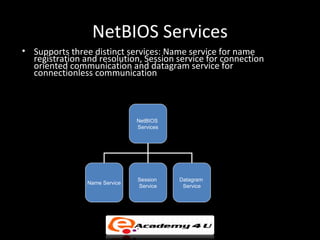
NetBIOS Services
• Supports three distinct services: Name service for name
  registration and resolution, Session service for connection
  oriented communication and datagram service for
  connectionless communication


                               NetBIOS
                               Services


                               Session    Datagram
                Name Service
                               Service     Service
Name Service
• Implemented in Microsoft Windows as Windows
  Internet Name Service (WINS).
• Provides means to application to register its NetBIOS
  name
• NetBIOS names are 16 bytes length
• Service uses UDP port 137
• Name Service functions include
   –   Add Name
   –   Add Group Name
   –   Delete Name
   –   Find Name
Session Service
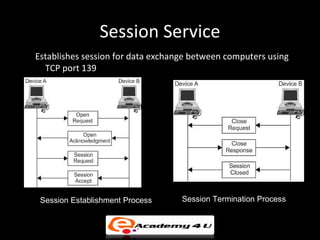
Establishes session for data exchange between computers using
  TCP port 139


 Session Establishment Process     Session Termination Process
Datagram Service
• Uses the UDP port 138 and provides a
  connectionless and broadcast-oriented data
  communication between two devices.
• Divides data in datagrams before sending
• Datagram service functions include:
   – Send Datagram
   – Send Broadcast Datagram
   – Receive Datagram
   – Receive Broadcast Datagram
NetBIOS Name Resolution
• Used to map NetBIOS names to IP addresses
• Methods used to resolve names:
   – NetBIOS Name Cache
   – NetBIOS Name Server (NBNS)
   – Local Broadcast
NetBEUI
• Enhanced version of NetBIOS
• Used by LAN manager, LAN server, Windows
  for workgroups, Windows 95 and Windows NT
• Adapted to other protocols such as IPX or
  TCP/IP as it does not support routing of
  messages to other networks
TCP/IP
• Two layer communication protocol used by Internet
• TCP provides connection-oriented reliable transport
  service
• Divides the message into smaller packets called
  segments
• IP is a connectionless and unreliable datagram protocol
  and provides no error checking
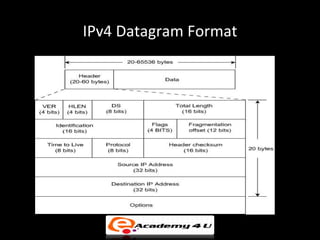
• IP transfers data in the form of packets called datagrams
TCP/IP Protocol Suite
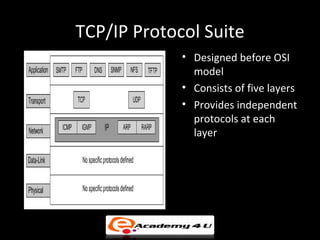
             • Designed before OSI
               model
             • Consists of five layers
             • Provides independent
               protocols at each
               layer
Description of each layer - I
• Physical and Data link layer – standard and
  proprietary protocols are supported by these
  layers.
• Network layer – 1. IP –
  – 2. ARP –
  – 3. RARP –
  – 4. ICMP – used to send query and error reporting
    messages to the sender and not to correct them
  – 5. IGMP – Uses class D IP address
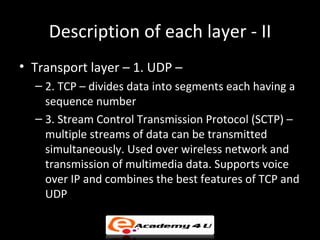
Description of each layer - II
• Transport layer – 1. UDP –
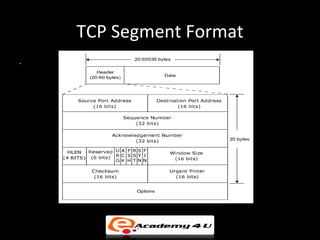
  – 2. TCP – divides data into segments each having a
    sequence number
  – 3. Stream Control Transmission Protocol (SCTP) –
    multiple streams of data can be transmitted
    simultaneously. Used over wireless network and
    transmission of multimedia data. Supports voice
    over IP and combines the best features of TCP and
    UDP
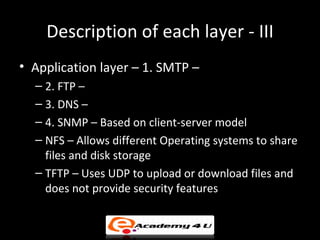
Description of each layer - III
• Application layer – 1. SMTP –
  – 2. FTP –
  – 3. DNS –
  – 4. SNMP – Based on client-server model
  – NFS – Allows different Operating systems to share
    files and disk storage
  – TFTP – Uses UDP to upload or download files and
    does not provide security features
TCP Segment Format
.
IPv4 Datagram Format
IP Datagram Fragmentation
• Fragmentation refers to breaking datagrams into pieces
• Maximum Transfer Unit (MTU) is maximum amount of
  data that frame can carry
• Datagram is fragmented when its size exceeds MTU of
  the network
• Fragments follow different paths to reach destination
ARP/RARP
• To deliver packet both physical and logical addresses are
  necessary
• Address Resolution Protocol (ARP) provides physical
  address when logical address is known
• Reverse Address Resolution Protocol (RARP) maps logical
  address to physical address
• RARP is useful when device is booted for first time
ICMP/IGMP
• Internet Control Message Protocol (ICMP) provides
  error reporting and query management mechanism
• ICMP handles problems occurring while packet
  transmission
• Internet Group Message Protocol (IGMP) manages
  multicasting and group membership of devices
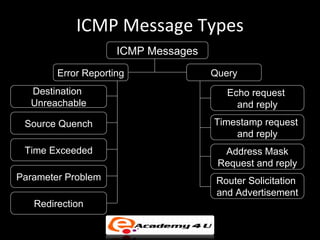
ICMP Message Types
                     ICMP Messages
        Error Reporting              Query
  Destination                           Echo request
  Unreachable                             and reply
 Source Quench                       Timestamp request
                                         and reply
 Time Exceeded                         Address Mask
                                      Request and reply
Parameter Problem                     Router Solicitation
                                      and Advertisement
   Redirection
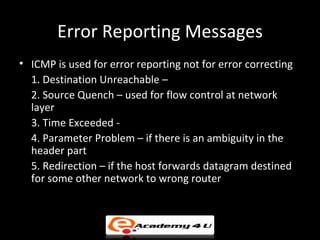
Error Reporting Messages
• ICMP is used for error reporting not for error correcting
  1. Destination Unreachable –
  2. Source Quench – used for flow control at network
  layer
  3. Time Exceeded -
  4. Parameter Problem – if there is an ambiguity in the
  header part
  5. Redirection – if the host forwards datagram destined
  for some other network to wrong router
Query Messages
• Echo Request and Reply – Ping command
• Timestamp request and reply –
• Address Mask request and reply – If a host
  knows the IP address but does not know the
  corresponding mask
• Router Solicitation and Advertisement – Used
  to determine whether the routers in the
  network are working properly
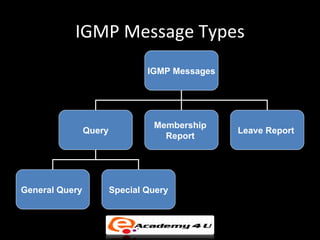
IGMP Message Types
                                IGMP Messages


                                 Membership
                Query                           Leave Report
                                   Report


General Query           Special Query
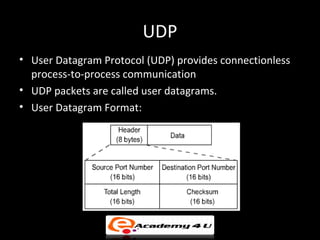
UDP
• User Datagram Protocol (UDP) provides connectionless
  process-to-process communication
• UDP packets are called user datagrams.
• User Datagram Format:
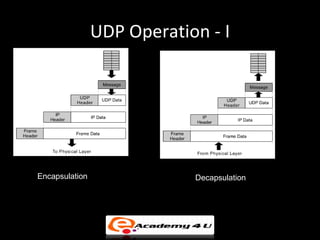
UDP Operation - I


Encapsulation               Decapsulation
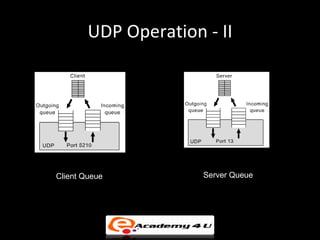
UDP Operation - II


Client Queue          Server Queue
IPX/SPX
• Novell NetWare system uses IPX/SPX as communication
  protocol within networks
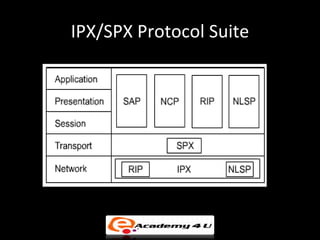
• IPX operates at Network layer for connectionless
  communication
• SPX operates at Transport layer for connection-oriented
  communication
• Together, IPX/SPX provides same services as TCP/IP
IPX/SPX Protocol Suite
IPX/SPX Naming Conventions
• IPX/SPX/NetBIOS Compatible Transport Protocol
  (NWLink) uses two types of IPX network numbers for
  routing purposes:
   – Internal network number – Mentioned as Internal network
     number in NWLink IPX/SPX/NetBIOS Compatible Transport
     Protocol Properties dialog box
     It’s a hexadecimal number with 1 to 8 digits (1 to
     FFFFFFFE)
   – External network number – Mentioned as Network
     number in Manual Frame Detection dialog box
HDLC/SDLC
• DLC protocols are two types: asynchronous and
  synchronous
• High Level Data Link Control (HDLC) and Synchronous
  Data Link Control (SDLC) are bit-oriented synchronous
  protocols in which data frames are interpreted as series
  of bits
• Both are useful for half-duplex and full-duplex
  communication
• HP adopted DLC protocol for use by network printers
• Windows XP still support DLC
HDLC Nodes and Link Configurations
• Types of HDLC nodes are:
   – Primary Station – transmits frames called commands to
     secondary stations
   – Secondary Station – send response frames to primary
     station
   – Combined Station
• Supported link configurations:
   – Unbalanced
   – Balanced
HDLC Data Transfer Modes
• Normal Response Mode (NRM) – Secondary station
  requires permission from primary station before sending
  data
• Asynchronous Response Mode (ARM) – Secondary
  station can transfer without permission from primary
  station
• Asynchronous Balanced Mode (ABM) – Either of the
  combined station can initiate the transmission
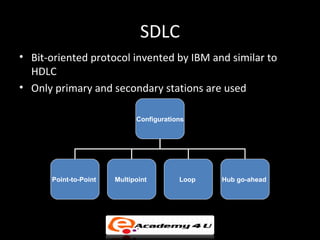
SDLC
• Bit-oriented protocol invented by IBM and similar to
  HDLC
• Only primary and secondary stations are used

                             Configurations


      Point-to-Point   Multipoint        Loop   Hub go-ahead
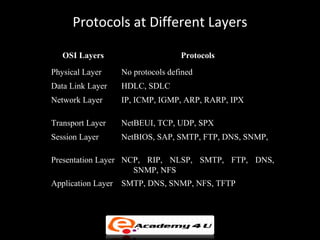
Protocols at Different Layers

   OSI Layers                       Protocols
Physical Layer      No protocols defined
Data Link Layer     HDLC, SDLC
Network Layer       IP, ICMP, IGMP, ARP, RARP, IPX

Transport Layer     NetBEUI, TCP, UDP, SPX
Session Layer       NetBIOS, SAP, SMTP, FTP, DNS, SNMP,

Presentation Layer NCP, RIP, NLSP, SMTP, FTP, DNS,
                     SNMP, NFS
Application Layer   SMTP, DNS, SNMP, NFS, TFTP

Network protocol

  • 1.
  • 2.
    Introducing Protocols • Setof predefined rules used by devices in network for data transfer • Network Protocols: – NetBIOS/NetBEUI – TCP/IP – ARP/RARP – ICMP/IGMP – UDP – IPX/SPX – HDLC/SDLC
  • 3.
    NetBIOS/NetBEUI • Developed byIBM and later adopted by Microsoft • Network Basic Input/Output System (NetBIOS) used for communication within LAN • Operates at Transport and Session layers of OSI model • NetBIOS Extended User Interface (NetBEUI) adds capabilities to NetBIOS and an advanced version of NetBIOS used in MS Windows OS • Widely used in Ethernet, Token Ring and Windows NT networks
  • 4.
    NetBIOS Services • Supportsthree distinct services: Name service for name registration and resolution, Session service for connection oriented communication and datagram service for connectionless communication NetBIOS Services Session Datagram Name Service Service Service
  • 5.
    Name Service • Implementedin Microsoft Windows as Windows Internet Name Service (WINS). • Provides means to application to register its NetBIOS name • NetBIOS names are 16 bytes length • Service uses UDP port 137 • Name Service functions include – Add Name – Add Group Name – Delete Name – Find Name
  • 6.
    Session Service Establishes sessionfor data exchange between computers using TCP port 139 Session Establishment Process Session Termination Process
  • 7.
    Datagram Service • Usesthe UDP port 138 and provides a connectionless and broadcast-oriented data communication between two devices. • Divides data in datagrams before sending • Datagram service functions include: – Send Datagram – Send Broadcast Datagram – Receive Datagram – Receive Broadcast Datagram
  • 8.
    NetBIOS Name Resolution •Used to map NetBIOS names to IP addresses • Methods used to resolve names: – NetBIOS Name Cache – NetBIOS Name Server (NBNS) – Local Broadcast
  • 9.
    NetBEUI • Enhanced versionof NetBIOS • Used by LAN manager, LAN server, Windows for workgroups, Windows 95 and Windows NT • Adapted to other protocols such as IPX or TCP/IP as it does not support routing of messages to other networks
  • 10.
    TCP/IP • Two layercommunication protocol used by Internet • TCP provides connection-oriented reliable transport service • Divides the message into smaller packets called segments • IP is a connectionless and unreliable datagram protocol and provides no error checking • IP transfers data in the form of packets called datagrams
  • 11.
    TCP/IP Protocol Suite • Designed before OSI model • Consists of five layers • Provides independent protocols at each layer
  • 12.
    Description of eachlayer - I • Physical and Data link layer – standard and proprietary protocols are supported by these layers. • Network layer – 1. IP – – 2. ARP – – 3. RARP – – 4. ICMP – used to send query and error reporting messages to the sender and not to correct them – 5. IGMP – Uses class D IP address
  • 13.
    Description of eachlayer - II • Transport layer – 1. UDP – – 2. TCP – divides data into segments each having a sequence number – 3. Stream Control Transmission Protocol (SCTP) – multiple streams of data can be transmitted simultaneously. Used over wireless network and transmission of multimedia data. Supports voice over IP and combines the best features of TCP and UDP
  • 14.
    Description of eachlayer - III • Application layer – 1. SMTP – – 2. FTP – – 3. DNS – – 4. SNMP – Based on client-server model – NFS – Allows different Operating systems to share files and disk storage – TFTP – Uses UDP to upload or download files and does not provide security features
  • 15.
  • 16.
  • 17.
    IP Datagram Fragmentation •Fragmentation refers to breaking datagrams into pieces • Maximum Transfer Unit (MTU) is maximum amount of data that frame can carry • Datagram is fragmented when its size exceeds MTU of the network • Fragments follow different paths to reach destination
  • 18.
    ARP/RARP • To deliverpacket both physical and logical addresses are necessary • Address Resolution Protocol (ARP) provides physical address when logical address is known • Reverse Address Resolution Protocol (RARP) maps logical address to physical address • RARP is useful when device is booted for first time
  • 19.
    ICMP/IGMP • Internet ControlMessage Protocol (ICMP) provides error reporting and query management mechanism • ICMP handles problems occurring while packet transmission • Internet Group Message Protocol (IGMP) manages multicasting and group membership of devices
  • 20.
    ICMP Message Types ICMP Messages Error Reporting Query Destination Echo request Unreachable and reply Source Quench Timestamp request and reply Time Exceeded Address Mask Request and reply Parameter Problem Router Solicitation and Advertisement Redirection
  • 21.
    Error Reporting Messages •ICMP is used for error reporting not for error correcting 1. Destination Unreachable – 2. Source Quench – used for flow control at network layer 3. Time Exceeded - 4. Parameter Problem – if there is an ambiguity in the header part 5. Redirection – if the host forwards datagram destined for some other network to wrong router
  • 22.
    Query Messages • EchoRequest and Reply – Ping command • Timestamp request and reply – • Address Mask request and reply – If a host knows the IP address but does not know the corresponding mask • Router Solicitation and Advertisement – Used to determine whether the routers in the network are working properly
  • 23.
    IGMP Message Types IGMP Messages Membership Query Leave Report Report General Query Special Query
  • 24.
    UDP • User DatagramProtocol (UDP) provides connectionless process-to-process communication • UDP packets are called user datagrams. • User Datagram Format:
  • 25.
    UDP Operation -I Encapsulation Decapsulation
  • 26.
    UDP Operation -II Client Queue Server Queue
  • 27.
    IPX/SPX • Novell NetWaresystem uses IPX/SPX as communication protocol within networks • IPX operates at Network layer for connectionless communication • SPX operates at Transport layer for connection-oriented communication • Together, IPX/SPX provides same services as TCP/IP
  • 28.
  • 29.
    IPX/SPX Naming Conventions •IPX/SPX/NetBIOS Compatible Transport Protocol (NWLink) uses two types of IPX network numbers for routing purposes: – Internal network number – Mentioned as Internal network number in NWLink IPX/SPX/NetBIOS Compatible Transport Protocol Properties dialog box It’s a hexadecimal number with 1 to 8 digits (1 to FFFFFFFE) – External network number – Mentioned as Network number in Manual Frame Detection dialog box
  • 30.
    HDLC/SDLC • DLC protocolsare two types: asynchronous and synchronous • High Level Data Link Control (HDLC) and Synchronous Data Link Control (SDLC) are bit-oriented synchronous protocols in which data frames are interpreted as series of bits • Both are useful for half-duplex and full-duplex communication • HP adopted DLC protocol for use by network printers • Windows XP still support DLC
  • 31.
    HDLC Nodes andLink Configurations • Types of HDLC nodes are: – Primary Station – transmits frames called commands to secondary stations – Secondary Station – send response frames to primary station – Combined Station • Supported link configurations: – Unbalanced – Balanced
  • 32.
    HDLC Data TransferModes • Normal Response Mode (NRM) – Secondary station requires permission from primary station before sending data • Asynchronous Response Mode (ARM) – Secondary station can transfer without permission from primary station • Asynchronous Balanced Mode (ABM) – Either of the combined station can initiate the transmission
  • 33.
    SDLC • Bit-oriented protocolinvented by IBM and similar to HDLC • Only primary and secondary stations are used Configurations Point-to-Point Multipoint Loop Hub go-ahead
  • 34.
    Protocols at DifferentLayers OSI Layers Protocols Physical Layer No protocols defined Data Link Layer HDLC, SDLC Network Layer IP, ICMP, IGMP, ARP, RARP, IPX Transport Layer NetBEUI, TCP, UDP, SPX Session Layer NetBIOS, SAP, SMTP, FTP, DNS, SNMP, Presentation Layer NCP, RIP, NLSP, SMTP, FTP, DNS, SNMP, NFS Application Layer SMTP, DNS, SNMP, NFS, TFTP