NetApp C-Mode for 7 mode
        engineers
      Brendon Higgins
Brendon Higgins – The numbers
• 30 Petabytes of NetApp storage
• 15 Years service in operational roles
• 5 Years using NetApp 7-mode
NetApp Data ONTAP 8


 7-Mode or C-Mode
Data ONTAP 8
      7 - Mode

•   64 bit aggregates
•   Compression
•   Data Migration
•   Unified Connect
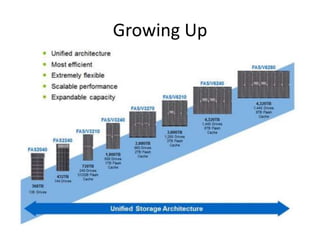
Growing Up
Limits of the box
          • CPU
          • Memory
          • Disk Shelves
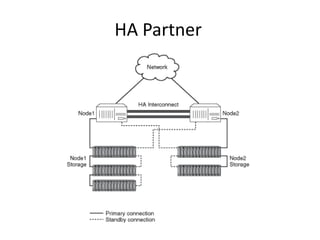
HA Partner
Oops!
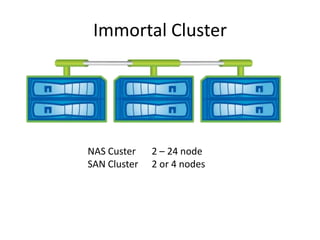
Immortal Cluster


NAS Custer    2 – 24 node
SAN Cluster   2 or 4 nodes
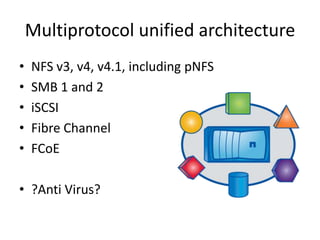
Multiprotocol unified architecture
•   NFS v3, v4, v4.1, including pNFS
•   SMB 1 and 2
•   iSCSI
•   Fibre Channel
•   FCoE

• ?Anti Virus?
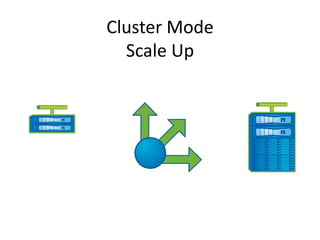
Cluster Mode
  Scale Up
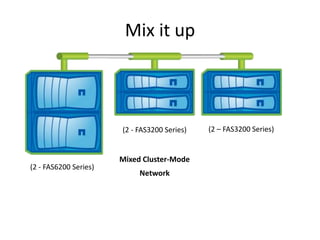
Mix it up


                       (2 - FAS3200 Series)   (2 – FAS3200 Series)


                       Mixed Cluster-Mode
(2 - FAS6200 Series)
                            Network
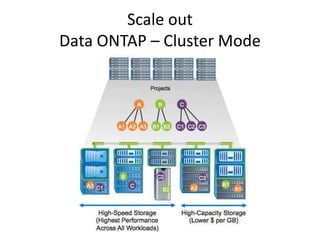
Scale out
Data ONTAP – Cluster Mode
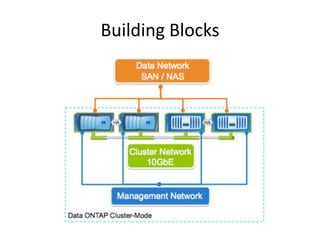
Building Blocks
Physical Cluster
• Storage Controllers – Cluster Nodes
• Individual disks – Defined into aggregates
• Ports
  – HBA
  – Network Interface Card


Only visible to the cluster administrator
Logical Cluster
• Virtual Server
  – Volumes
  – NFS service
  – CIFS service
  – LUNs (requires ALUA)
  – Logical Interface (or LIF)
     • Either IP or WWN address
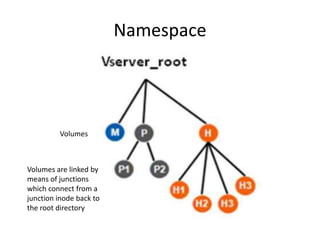
Namespace


         Volumes


Volumes are linked by
means of junctions
which connect from a
junction inode back to
the root directory
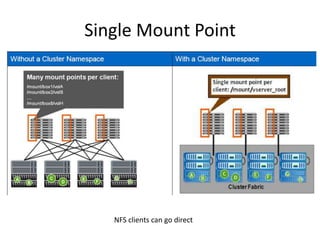
Single Mount Point


   NFS clients can go direct
Management
Purchase configured system
• Element Manager
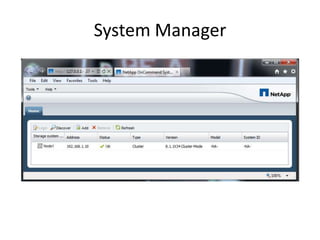
• System Manager 2.0.2
• CLI
• Powershell
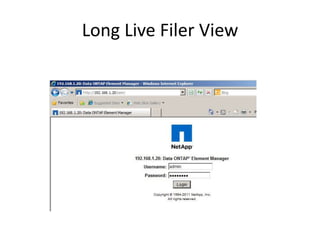
Long Live Filer View
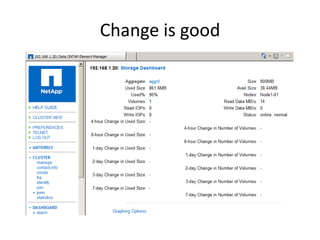
Change is good
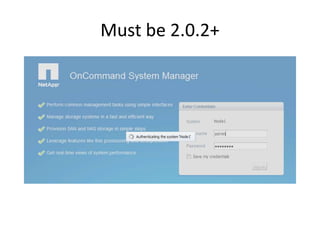
Must be 2.0.2+
System Manager
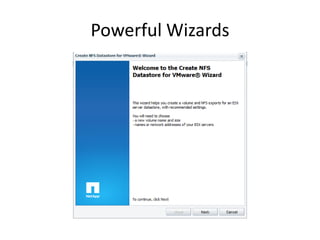
Powerful Wizards
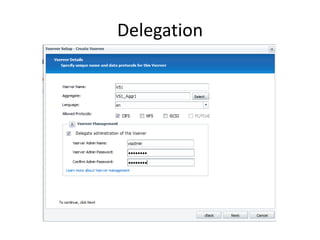
Delegation
CLI
• Most powerful management tool
• New command names
  Data ONTAP® 8.1
  7-Mode to Cluster-Mode Command Map
    i.e. snap list is now snap show
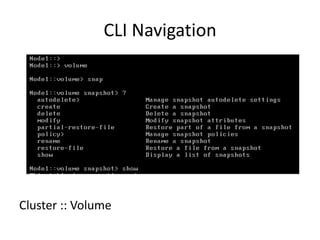
CLI Navigation


Cluster :: Volume
Easy Navigation
•   Tab autocomplete
•   .. Back one level
•   ‘top’ Returns to ::
•   ? For help
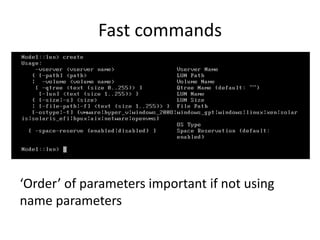
Fast commands


‘Order’ of parameters important if not using
name parameters
Demo


• Add disks to aggregate
• Add volume to virtual filer
NetApp Simulator
• Download from NOW site
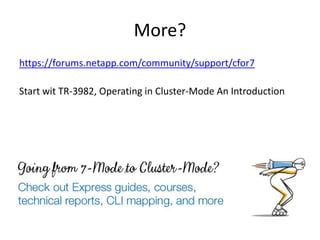
More?
https://forums.netapp.com/community/support/cfor7

Start wit TR-3982, Operating in Cluster-Mode An Introduction
February 2013
Thank you

NetApp C-mode for 7 mode engineers

Editor's Notes

  • #3 Brendon Higgins is an operational engineer who supports cloud infrastructure. He is very active in the NetApp user community and speaks at user group events about his role.
  • #6 http://www.cisco.com/en/US/docs/unified_computing/ucs/UCS_CVDs/ucs_sharepoint2010_flexpod_vmware.html
  • #9 Everything on one large box
  • #13 Image fromhttps://communities.netapp.com/community/netapp-blogs/exposed/blog/2011/11/02/hpc-comes-to-enterprise-it
  • #14 https://communities.netapp.com/docs/DOC-17138/
  • #15 Storage Failover between HA pairs• Cluster interconnect. A 10Gbps, private, dedicated, redundant, high-throughput network used forcommunication between the cluster nodes and for data motion. The cluster interconnect infrastructureis included with every Data ONTAP 8.1 configuration to support this network.• Management network. All management traffic passes over this network. The management networkswitches are also included with every Data ONTAP 8.1 configuration.OnCommand™ System Manager 2.0 and unified manager are available for management,configuration, and monitoring of Data ONTAP clusters along with 7-Mode systems. These utilitiesprovide GUI management, including a number of easy-to-use wizards for common tasks. In addition,a CLI, ZAPI set, and SDK are available for more specialized use.• Data networks. Provide data access services over Ethernet or Fibre Channel to the SAN hosts andNAS clients. These networks are customer provided according to requirements and could alsoinclude connections to other clusters acting as volume replication targets for data protection.
  • #17 The primary logical cluster component is the virtual server. Data ONTAP supports from one to hundredsof virtual servers in a single cluster. Each virtual server enables one or more SAN and NAS accessprotocols and contains at least one volume and at least one logical interface. The administration of eachvirtual server can also be delegated if desired, so that separate administrators could be responsible forprovisioning volumes and other virtual server–specific operations. This is particularly appropriate for multitenantedenvironments or where workload separation is desired.For NAS clients, the volumes are junctioned together into a namespace for CIFS and NFS access, andfor SAN hosts, LUNs are defined in the volumes and made available, as described in section 1.2.The accessing hosts and clients connect to the virtual server using a logical interface (or LIF). LIFspresent either an IP address (which will be used by NAS clients and iSCSI hosts) or a WWN (for FC andFCoE access). Each LIF is mapped to a home port on a NIC or HBA. LIFs are used to virtualize the NICand HBA ports rather than mapping IP addresses or WWNs directly to the physical ports, because therewill almost always be many more LIFs than physical ports in a cluster. Each virtual server requires its owndedicated set of LIFs, and up to 128 LIFs can be defined on any cluster node. A LIF defined for NASaccess can temporarily move or migrate to another port on the same or a different controller to preserveavailability or to rebalance client performance.Figure 3 shows a single virtual server that is providing data services to SAN hosts and NAS clients. Eachvolume, shown by the orange circles, is provisioned on an aggregate on a cluster node, and thecombination of all the volumes constitutes the entire namespace or resource pool for LUNs. By default,volumes in a virtual server can be created in any of the defined aggregates and moved at any time fromaggregate to aggregate as required. A delegated virtual server administrator can provision volumes intheir own virtual server. The delegated virtual server administrator cannot, however, initiate the movementof volumes around across the cluster, since this might affect the entire cluster. For this reason, only acluster administrator can move volumes.
  • #18 A cluster namespace is a collection of file systems hosted from different nodes in the cluster. Each Vserver has a file namespace that consists of a single root volume. The Vserver namespace consists of one or more volumes linked by means of junctions that connect from a named junction inode in one volume to the root directory of another volume. A cluster can have more than one Vserver. All the volumes belonging to the Vserver are linked into the global namespace in that cluster. The cluster namespace is mounted at a single point in the cluster. The top directory of the cluster namespace within a cluster is a synthetic directory containing entries for the root directory of each Vserver namespace in the cluster.
  • #19 Namespace unchanged as data moves Much easier to manage Much easier to change Seamlessly scales to petabytes
  • #33 tr-3982 Data ONTAP 8.1 and 8.1.1 Operating in Cluster-Mode An Introduction.pdf