The NET GenerationAnne Arendt
DOD Eight Norms of Net Gen1. Freedom - The Net Generation, more than any other generation, expects to set and abide by its own priorities. Net-Geners place high priority on time with family and friends, so much so that they see their job fitting into their personal and social lives/lifestyles, instead of the opposite, more traditional behavior.3Source: http://cio-nii.defense.gov/initiatives/netgenerationguide/norms.html
DOD Eight Norms of Net Gen2. Customization - Living in a custom-created world is second nature to the Net Generation. They choose how they get their information or entertainment, when they get it, the color, configuration, and applications on the delivery device, and the picture on the credit card used to pay for it. In selecting a workplace, Net-Geners will look for choices in job benefits and will want to customize the jobs they select.4Source: http://cio-nii.defense.gov/initiatives/netgenerationguide/norms.html
DOD Eight Norms of Net Gen3. Scrutinizers - The Net Generation is highly adept at online comparative analysis. Net-Geners in the hunt for work will carefully consider which occupations best fit their professional goals and work style preferences; and they will thoroughly research jobs available and the associated employers’ culture, benefits and emphasis on career development.6Once hired, Net-Geners will demand trusting and transparent relationships with their organizationSource: http://cio-nii.defense.gov/initiatives/netgenerationguide/norms.html
DOD Eight Norms of Net Gen4. Integrity - As part of the scrutiny Net-Geners apply to their job hunts, they will be keen to uncover the record and reputation of potential employers with respect to their commitment to integrity and ethical practices.10 They will not embrace a company/organization that has questionable ethics or that does not appear to translate words (policy) into action (practice), nor will they follow questionable leadership.11Source: http://cio-nii.defense.gov/initiatives/netgenerationguide/norms.html
DOD Eight Norms of Net Gen5. Collaboration - The Net Generation has grown up in an interactive world. They are used to pulsing their social networks for information and feedback and working collaboratively on tasks.12 Additionally, they want to provide their stamp on product and process development.13Source: http://cio-nii.defense.gov/initiatives/netgenerationguide/norms.html
DOD Eight Norms of Net Gen6. Entertainment - Enjoyment of the job and the workplace is also very important to Net-Geners. They want to learn new things and be a part of the action, and they expect to have fun while doing it.14 Equally important, they tend to work hard at tasks and then want to decompress. Source: http://cio-nii.defense.gov/initiatives/netgenerationguide/norms.html
DOD Eight Norms of Net Gen7. Speed - Owing to their demand for speed of communication, Net-Geners tend not to use more traditional methods such as the telephone and email in their personal communications, preferring the speed of instant messenging.16 They will look for avenues to speed their productivity and response time wherever possible. This includes everything from feedback on performance to their rate of professional growth within an organization.17 Net-Geners will value those who provide the timely feedback they desire.http://cio-nii.defense.gov/initiatives/netgenerationguide/norms.html
DOD Eight Norms of Net Gen8. Innovation - Members of the Net Generation are “digital natives.” Having grown up with technology in every aspect of their lives, IT capabilities are often second nature to them.18 And, with their desire to customize, they work hard to provide the solutions to adapt things to suit their own needs.19Source: http://cio-nii.defense.gov/initiatives/netgenerationguide/norms.html
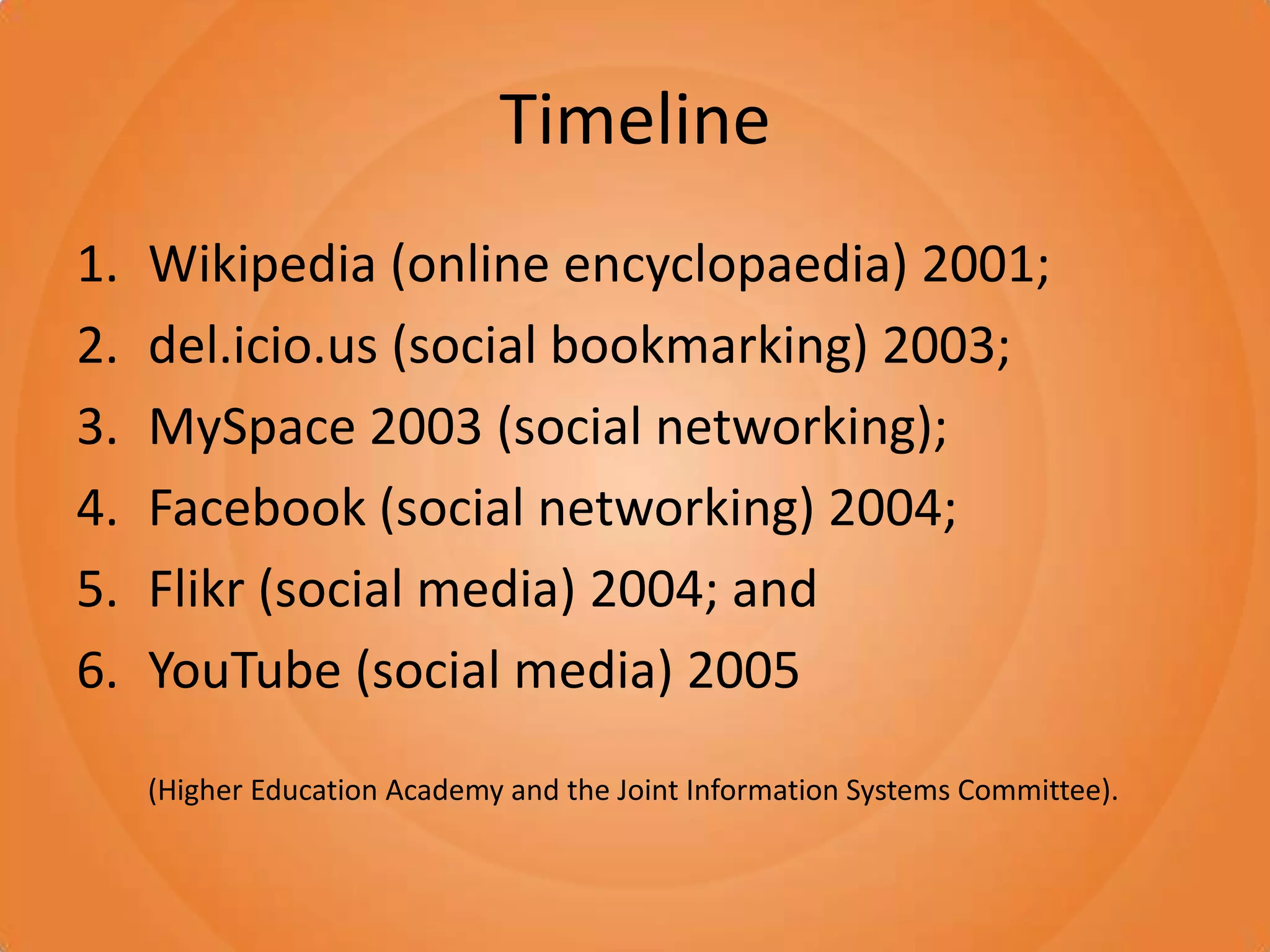
TimelineWikipedia (online encyclopaedia) 2001;del.icio.us (social bookmarking) 2003;MySpace 2003 (social networking); Facebook (social networking) 2004; Flikr (social media) 2004; and YouTube (social media) 2005  (Higher Education Academy and the Joint Information Systems Committee).
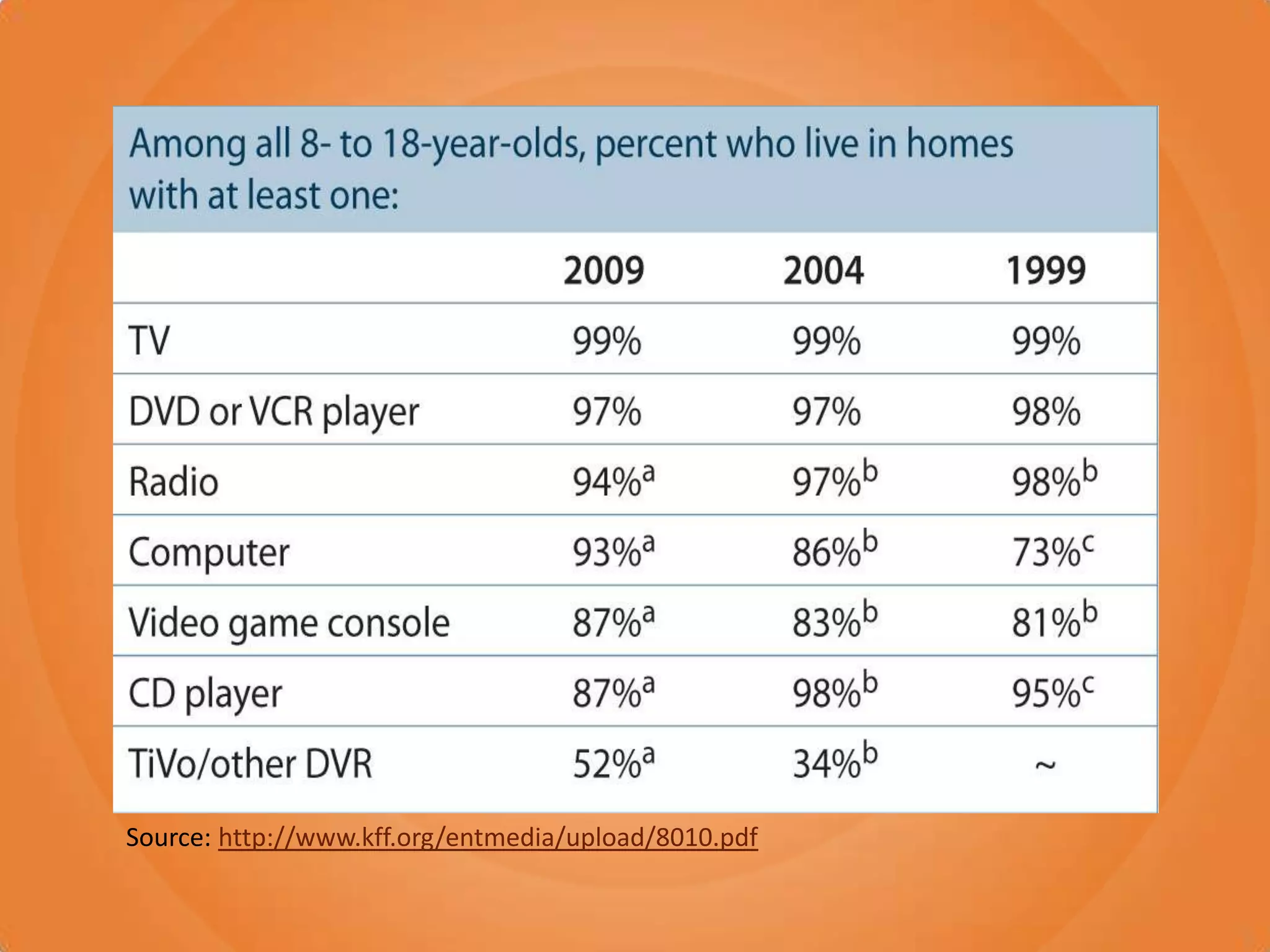
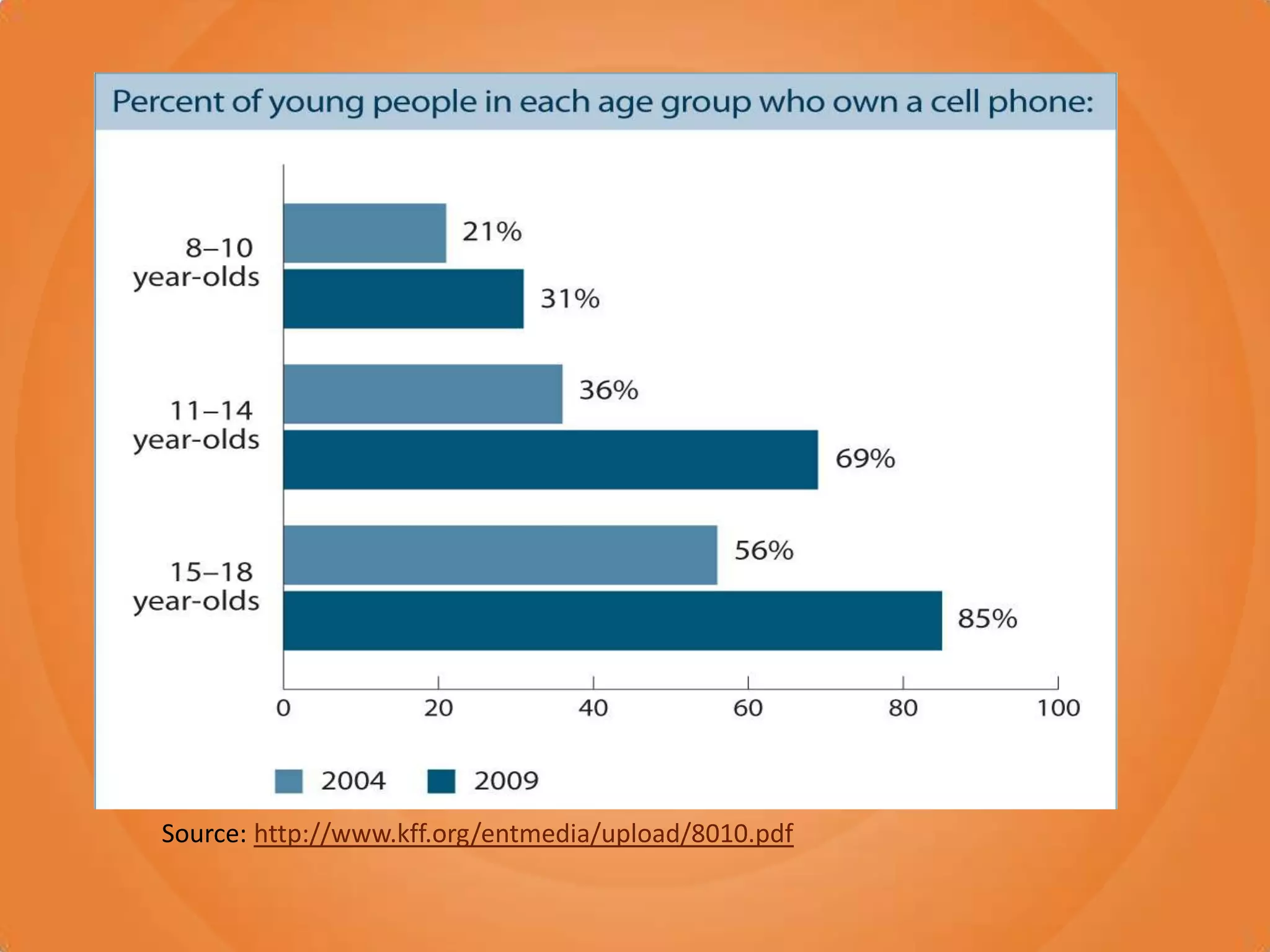
Source: http://www.kff.org/entmedia/upload/8010.pdf
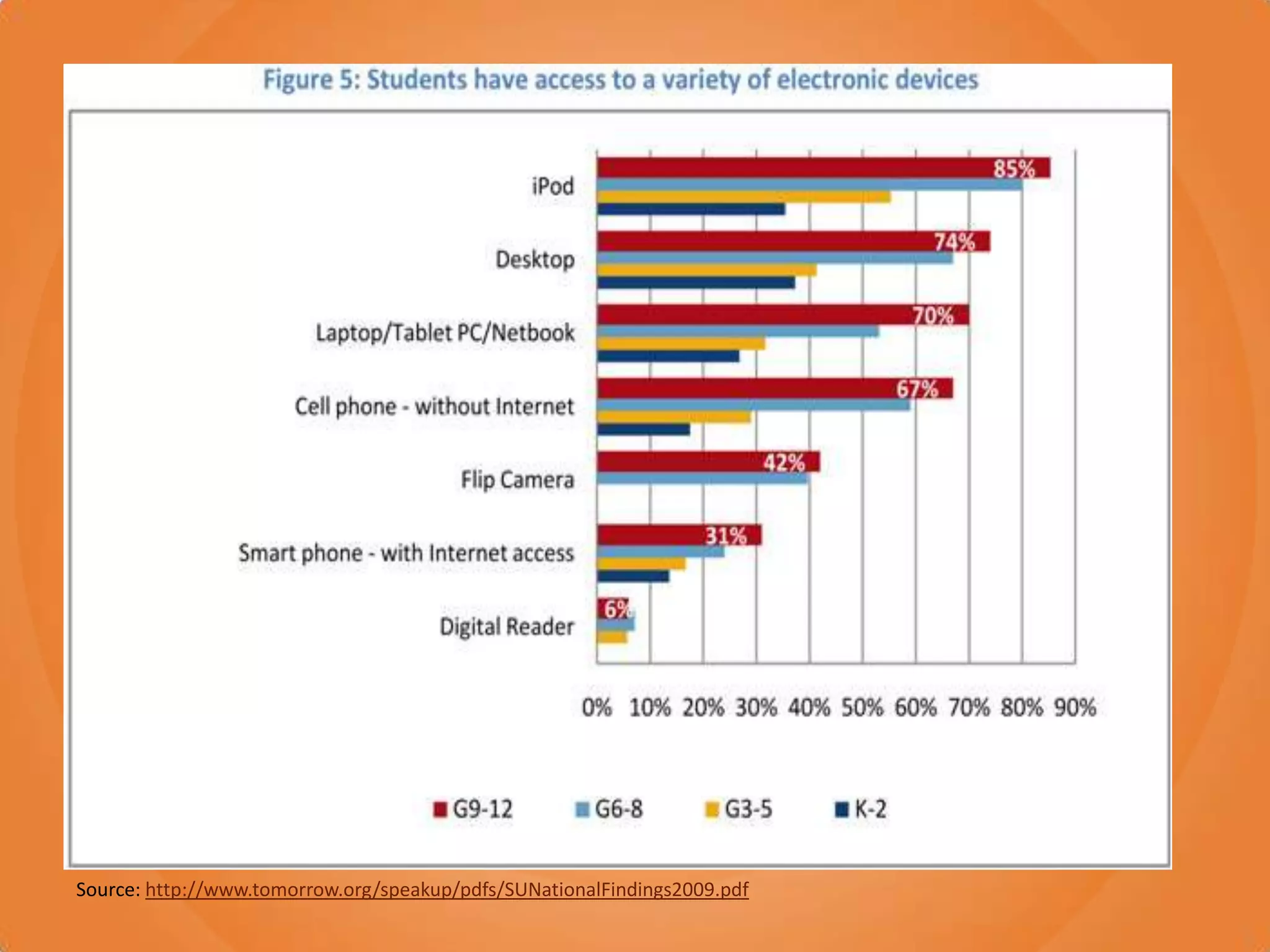
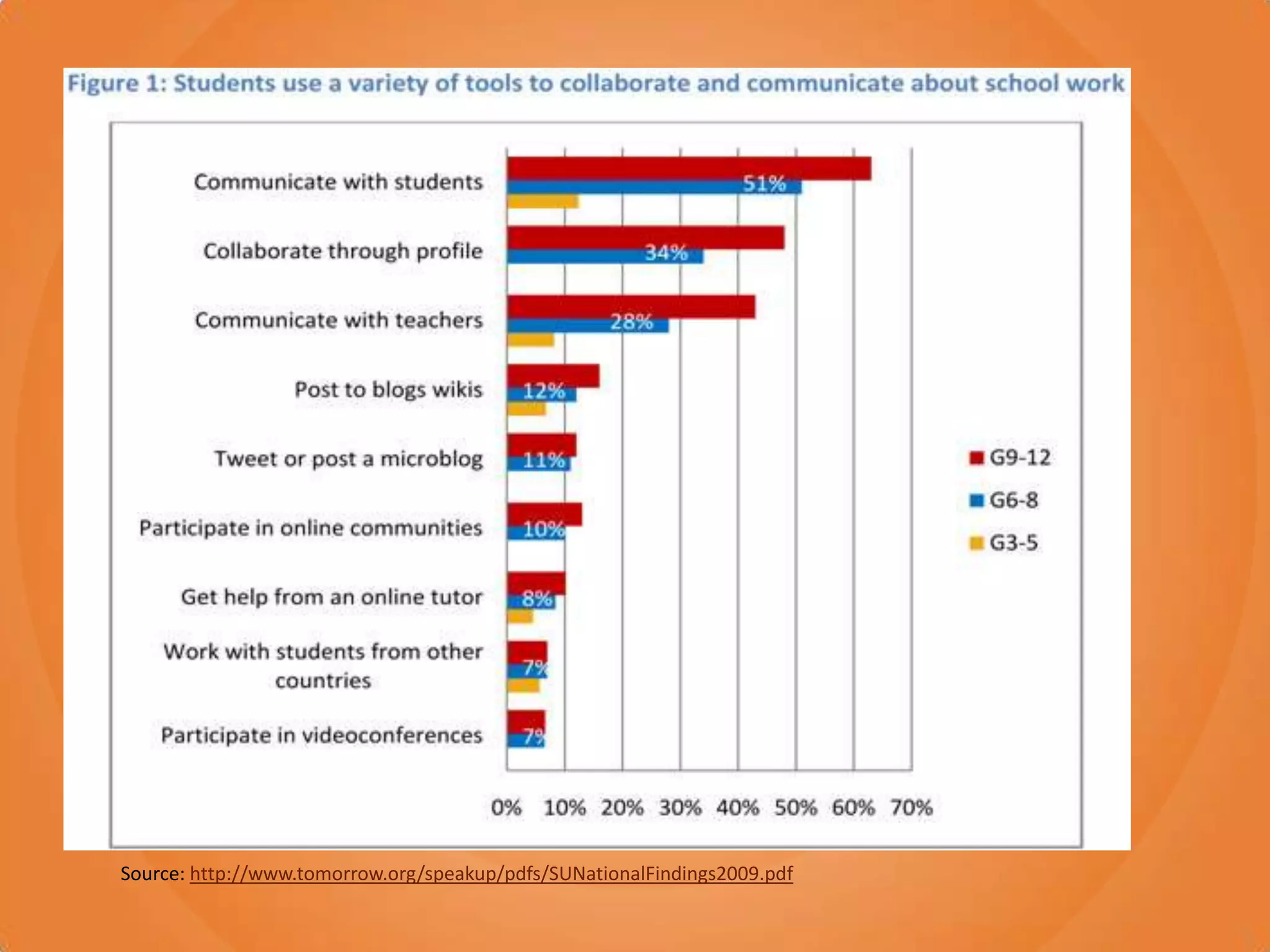
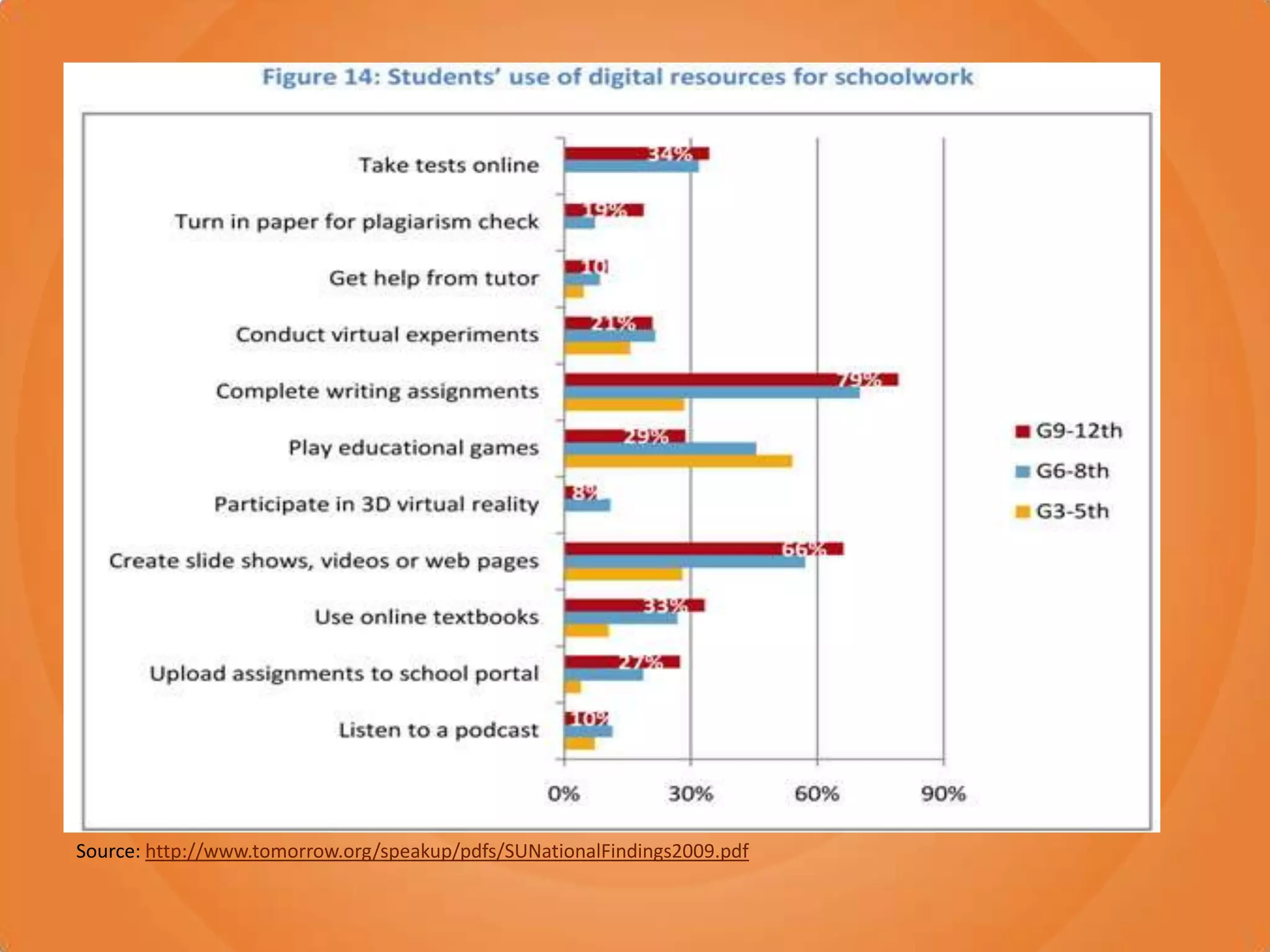
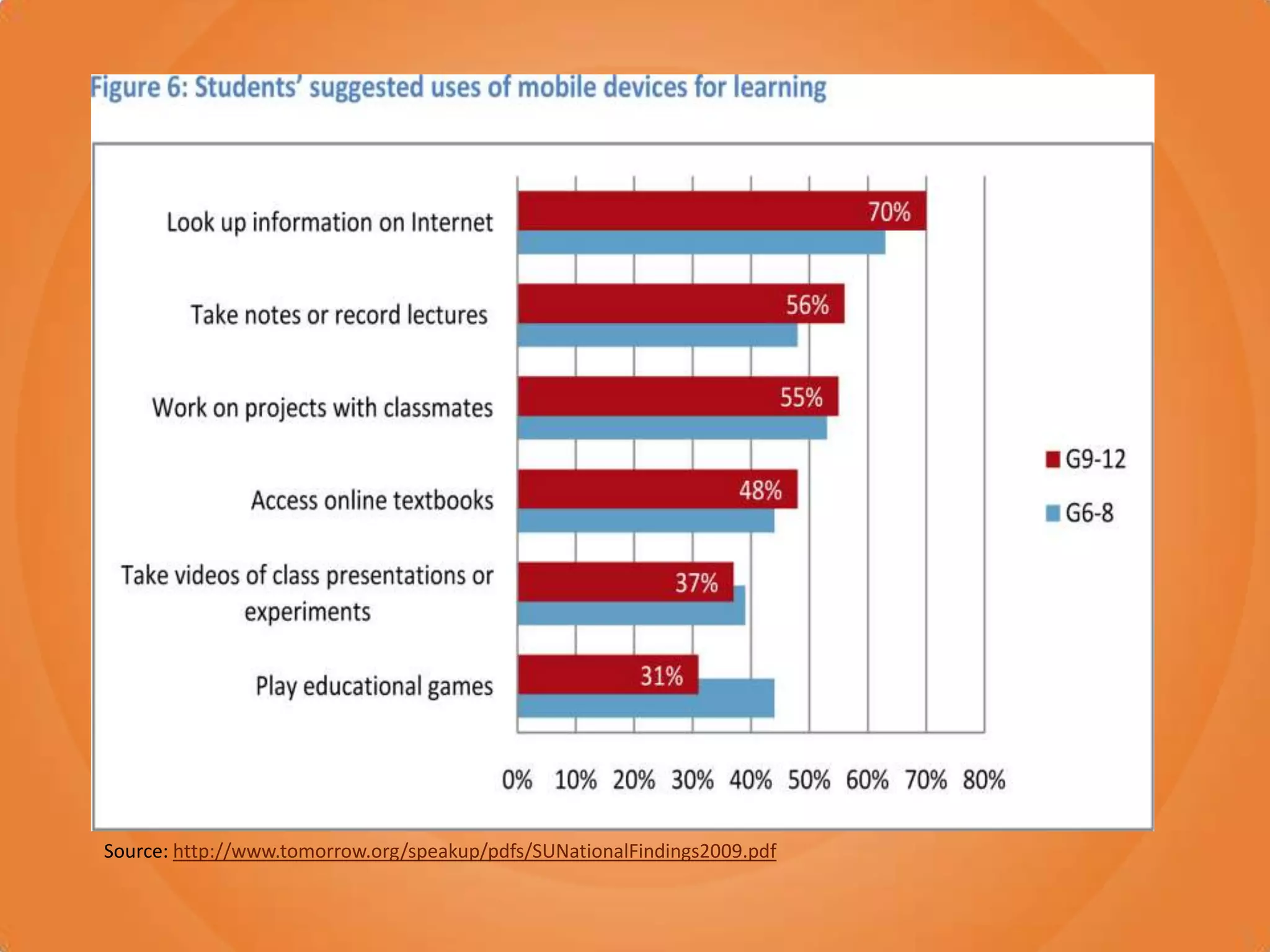
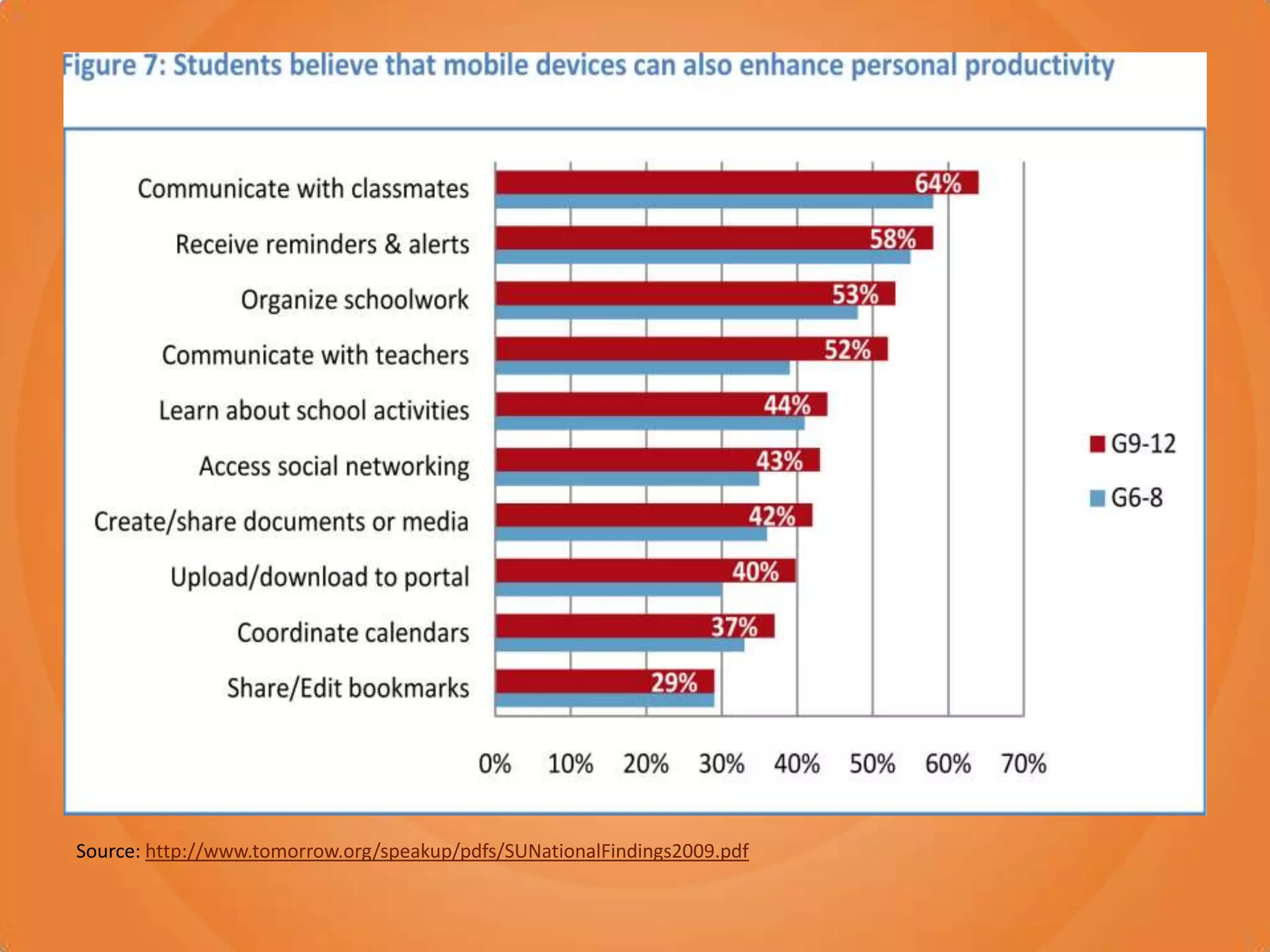
Source: http://www.tomorrow.org/speakup/pdfs/SUNationalFindings2009.pdf
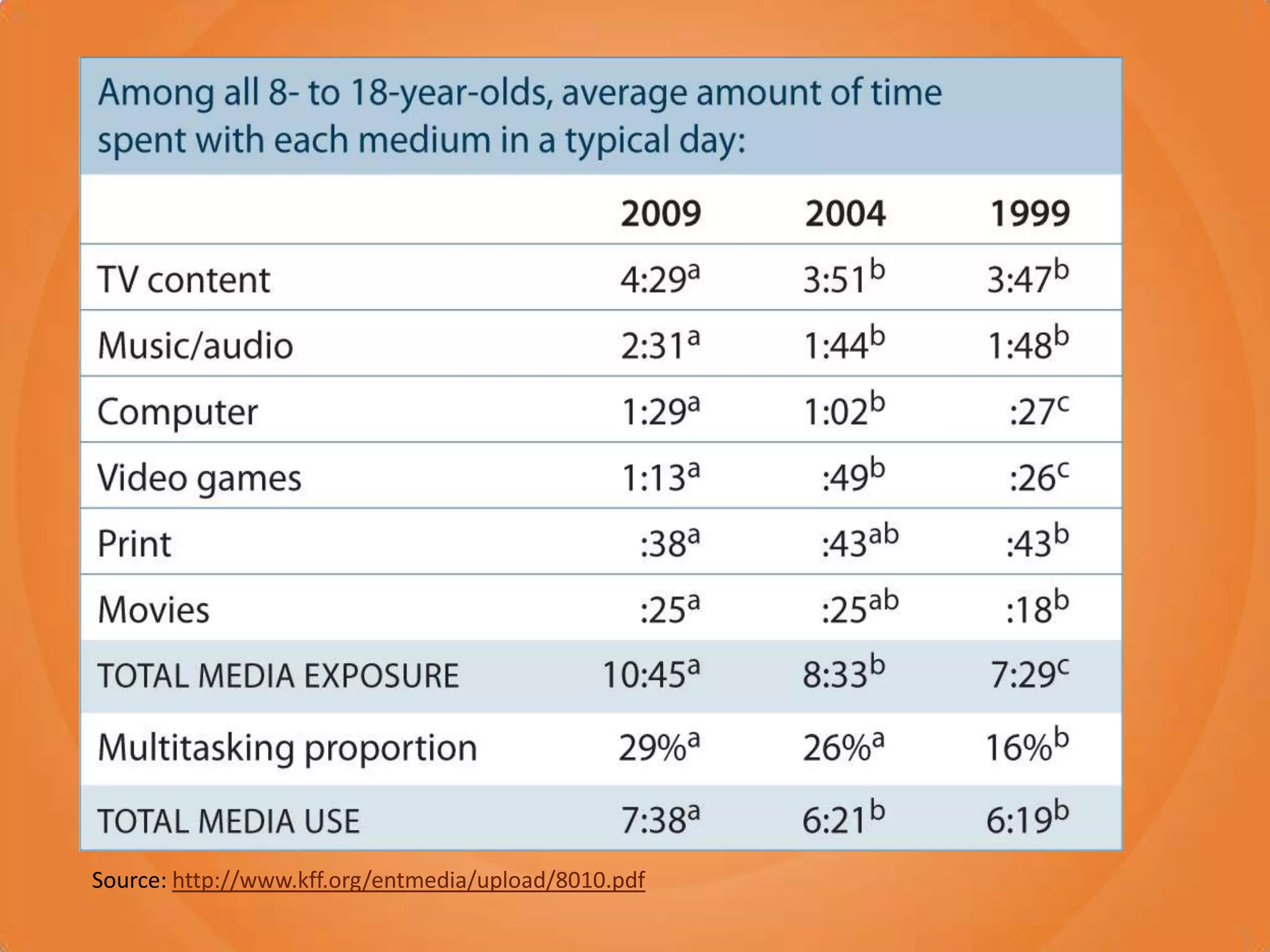
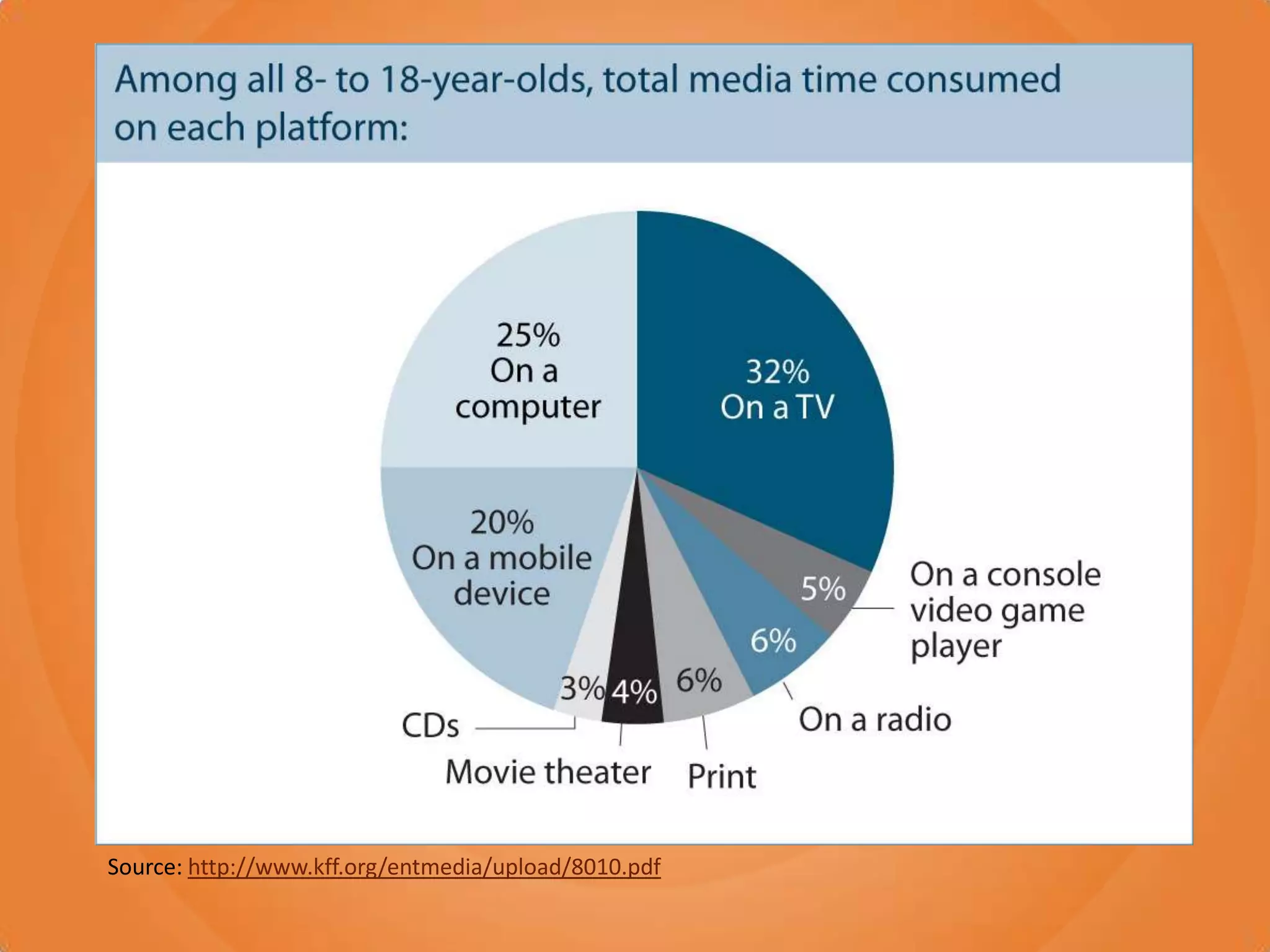
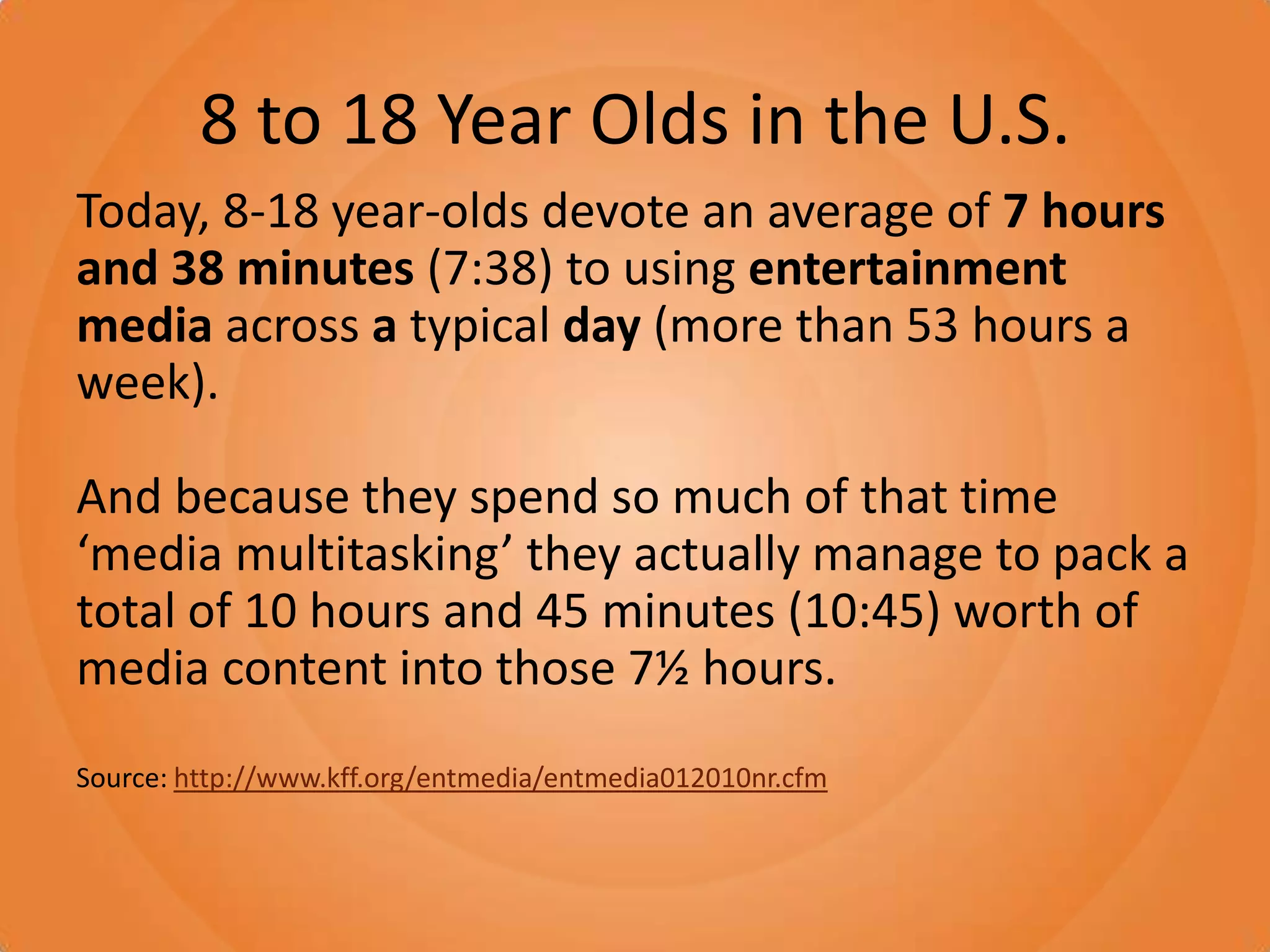
8 to 18 Year Olds in the U.S.Today, 8-18 year-olds devote an average of 7 hours and 38 minutes (7:38) to using entertainment media across a typical day (more than 53 hours a week).  And because they spend so much of that time ‘media multitasking’ they actually manage to pack a total of 10 hours and 45 minutes (10:45) worth of media content into those 7½ hours.Source: http://www.kff.org/entmedia/entmedia012010nr.cfm
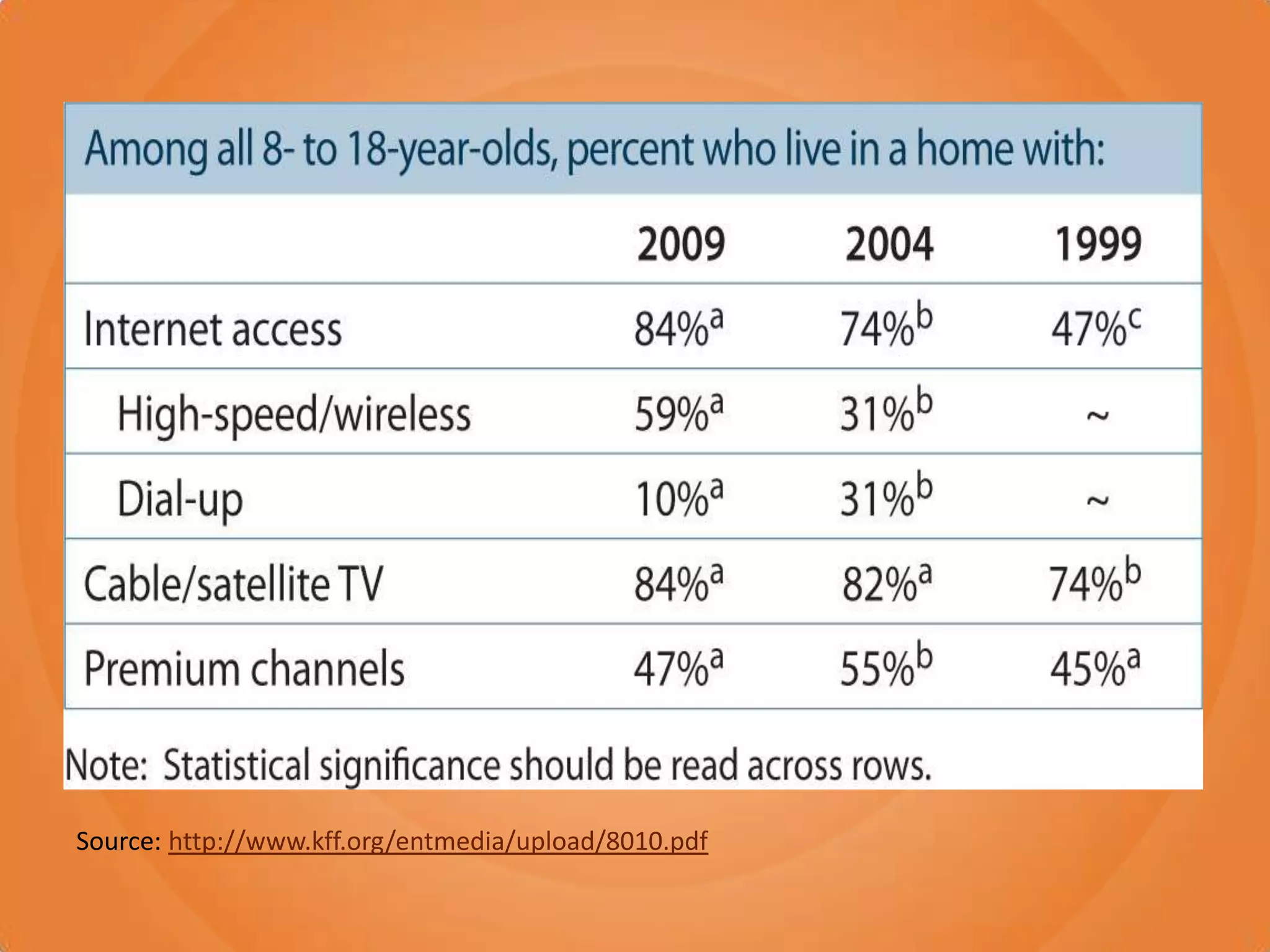
Source: http://www.kff.org/entmedia/upload/8010.pdf
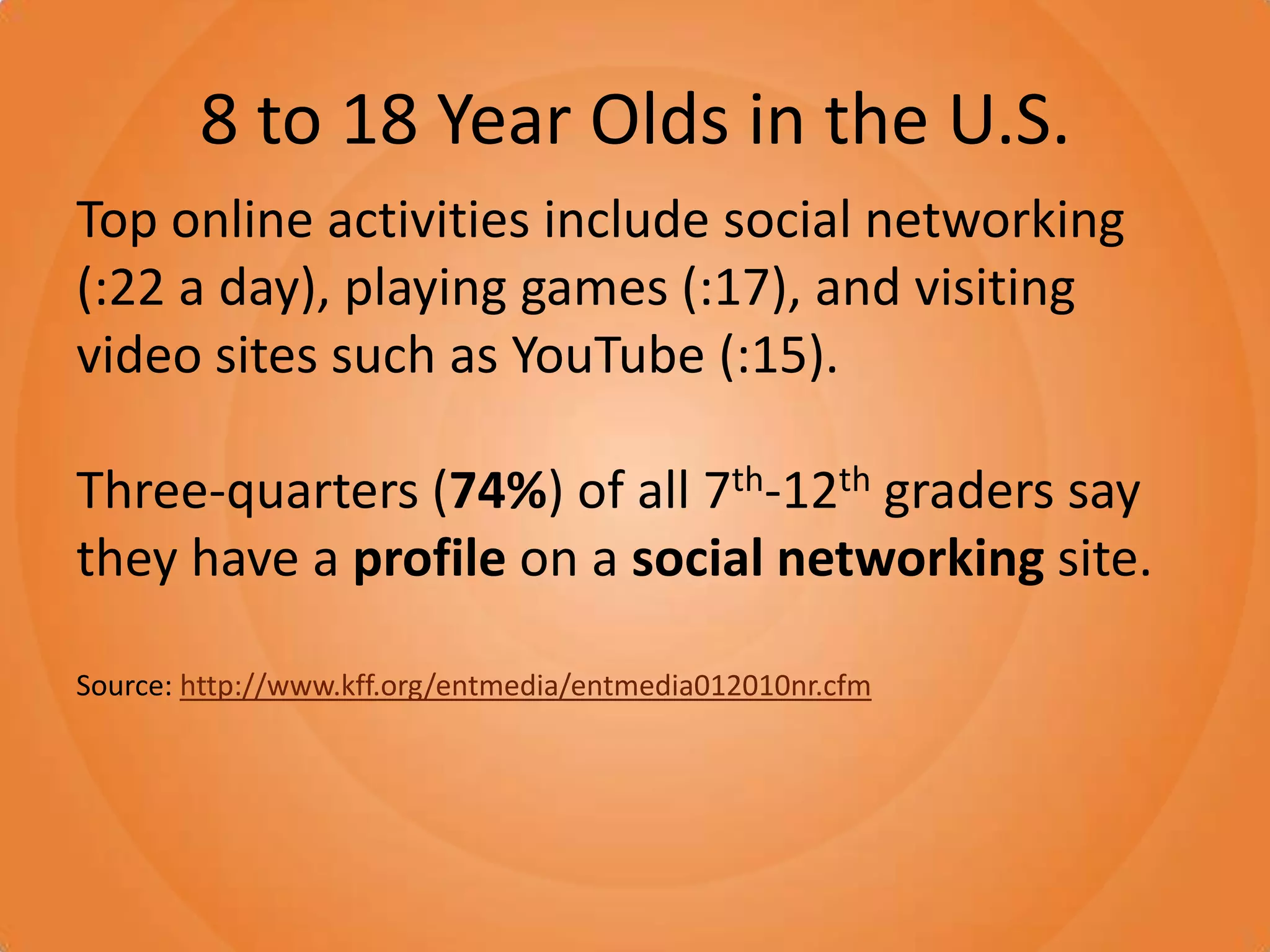
8 to 18 Year Olds in the U.S.Top online activities include social networking (:22 a day), playing games (:17), and visiting video sites such as YouTube (:15).  Three-quarters (74%) of all 7th-12th graders say they have a profile on a social networking site. Source: http://www.kff.org/entmedia/entmedia012010nr.cfm
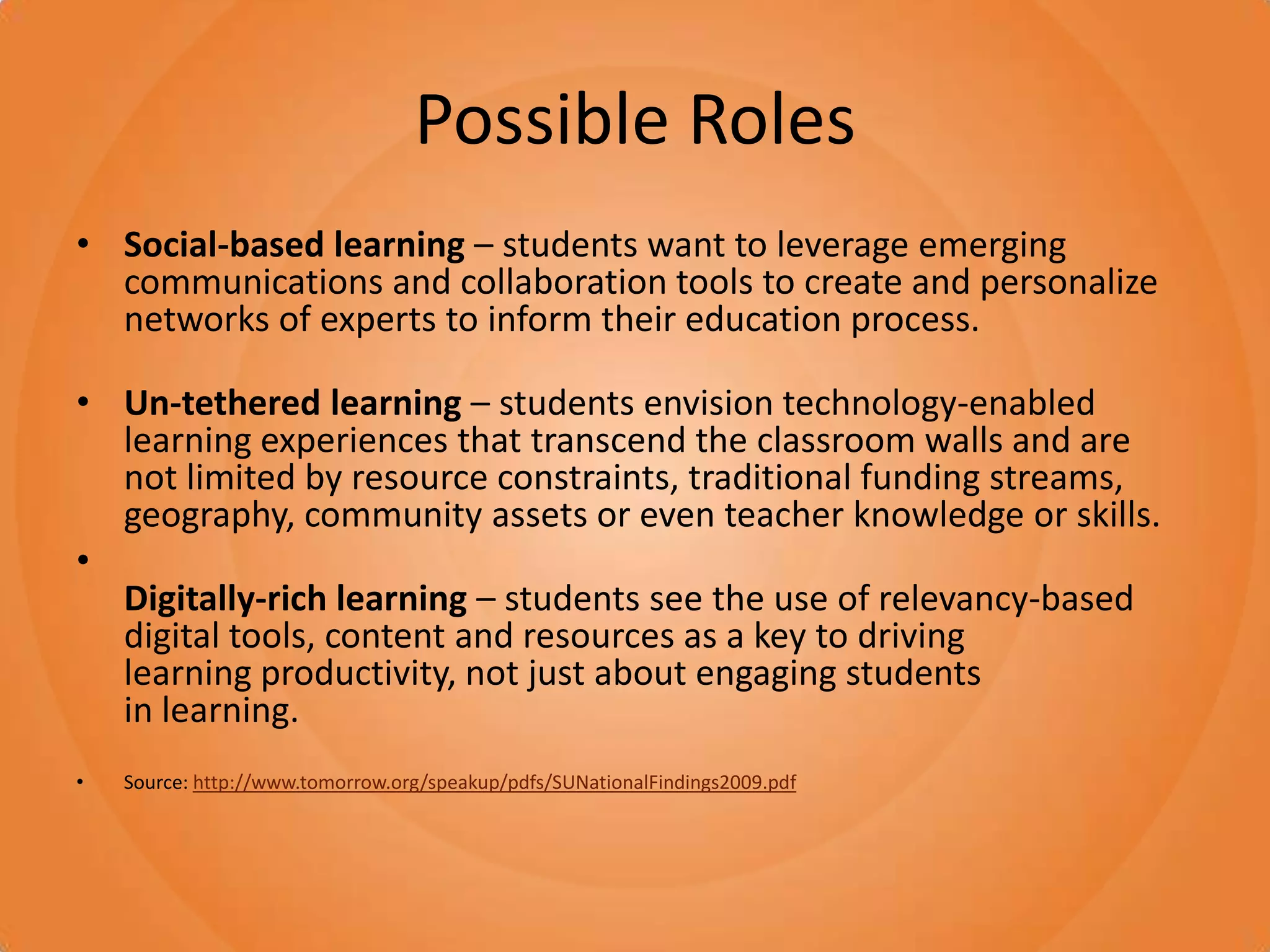
Possible Roles Social-based learning – students want to leverage emerging communications and collaboration tools to create and personalize networks of experts to inform their education process.Un-tethered learning – students envision technology-enabled learning experiences that transcend the classroom walls and are not limited by resource constraints, traditional funding streams, geography, community assets or even teacher knowledge or skills.Digitally-rich learning – students see the use of relevancy-based digital tools, content and resources as a key to driving learning productivity, not just about engaging students in learning.Source: http://www.tomorrow.org/speakup/pdfs/SUNationalFindings2009.pdf
Types of SpaceSecret/private/personal space: eg Short Message Service (SMS); Instant Message (IM)group space: egBebo, Facebookpublishing space: eg blogs, wikis, YouTubeperformance space: eg Second Life, World of Warcraftparticipation space: eg meetings, markets, eventswatching space: eg lectures (Locke 2007)
GenerationalThe consequences of this generation’s experience have become increasingly apparent over time:a strong sense of a community linked in its own virtual spaces of blogs and social networking and gaming sites; a similarly strong sense of group identity; and a disposition to share and to participate.
GenerationalThey also include: impatience – a preference for instant answers; a downgrading of text in favor of image; and a casual approach to evaluating information and attributing it, and also to copyright and legal constraints” (Higher Education Academy and the Joint Information Systems Committee, 2009).
Educating the Net GenAbility to read visual images—they are intuitive visual communicatorsVisual-spatial skills—perhaps because of their expertise with games they can integrate the virtual and physicalInductive discovery—they learn better through discovery than by being toldAttentional deployment—they are able to shift their attention rapidly from one task to another, and may choose not to pay attention to things that don’t interest themFast response time—they are able to respond quickly and expect rapid responses in returnSource: http://www.educause.edu/Resources/EducatingtheNetGeneration/
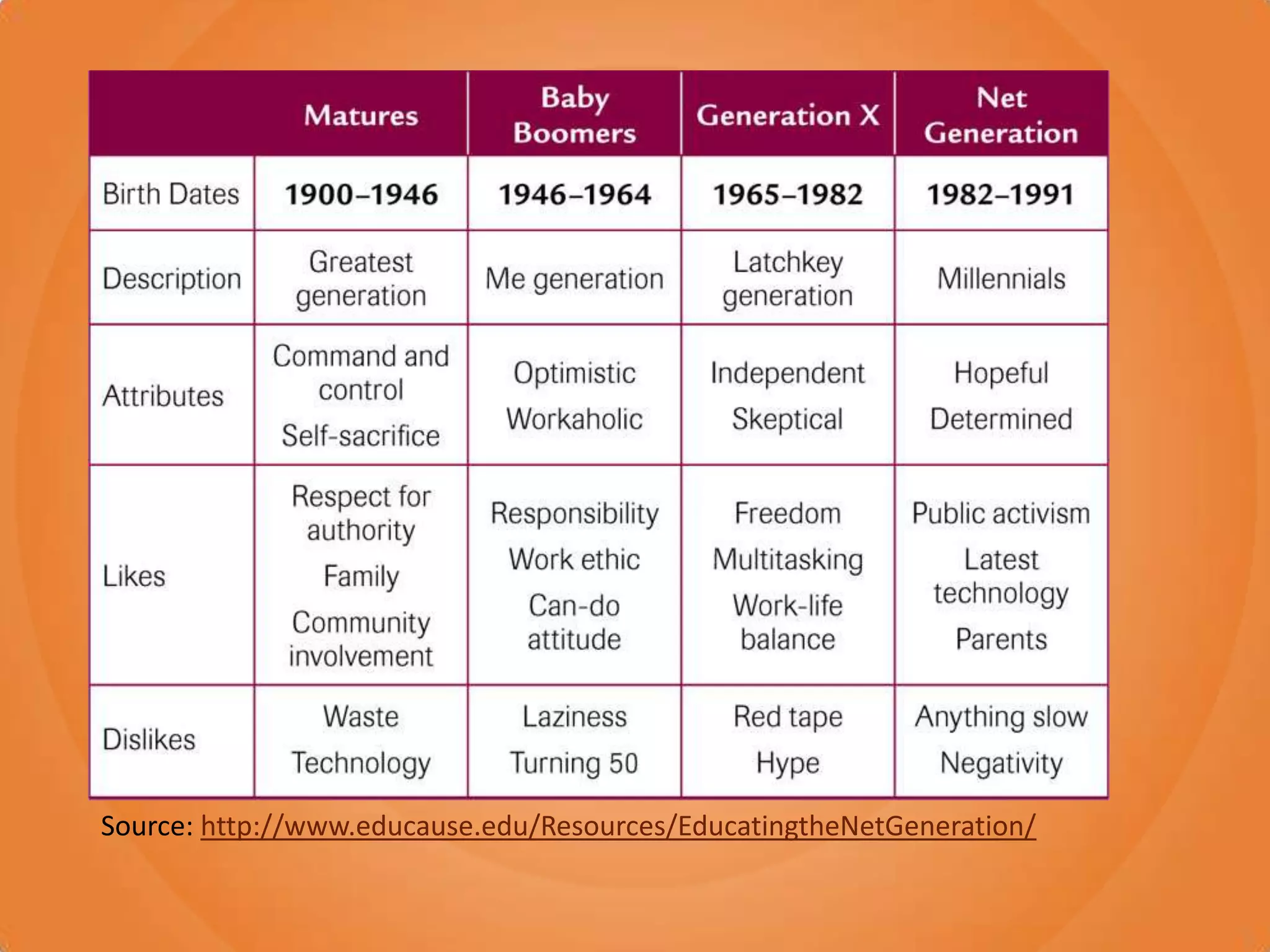
Source: http://www.educause.edu/Resources/EducatingtheNetGeneration/
Millenials (Net Gen)Gravitate toward group activityIdentify with parents’ values and feel close to their parentsBelieve it’s cool to be smartAre fascinated by new technologiesAre racially and ethnically diverse; one in five has at least one immigrant parentAre focused on grades and performanceAre busy with extracurricular activitiesSource: http://www.educause.edu/Resources/EducatingtheNetGeneration/
Educating the Net GenDigitally LiterateConnected (networked media)Immediate (receipt and response)Multi-taskExperiental (learn by doing)Social Source: http://www.educause.edu/Resources/EducatingtheNetGeneration/
Educating the Net GenProlific communicators, they gravitate toward activities that promote and reinforce social interaction—whether IMing old friends, teaming up in an Internet game, posting Web diaries (blogging), or forwarding joke e-mails. The Net Gen displays a striking openness to diversity, differences, and sharing; they are at ease meeting strangers on the NetSource: http://www.educause.edu/Resources/EducatingtheNetGeneration/
Educating the Net GenMany of their exchanges on the Internet are emotionally open, sharing very personal information about themselves. The Net Gen has developed a mechanism of inclusiveness that does not necessarily involve personally knowing someone admitted to their group. Being a friend of a friend is acceptable.http://www.educause.edu/Resources/EducatingtheNetGeneration/
Educating the Net GenTeams (prefer to learn and work in teamsStructure - achievement oriented (“They want parameters, rules, priorities, and procedures)Engagement and ExperienceVisual and Kinesthetic (image rich)Community activities (believe they can make a difference)http://www.educause.edu/Resources/EducatingtheNetGeneration/
Educating the Net GenThey don’t think in terms of technology; they think in terms of the activity technology enablesNet Gen views the Internet as an access tool—a medium for distribution of resources rather than a resource with limitationsFor example, instant messaging wasn’t considered a technology; IMing is treated as a verb—it is an action, not a technologyTheir communities and social networks are physical, virtual, and hybrid.http://www.educause.edu/Resources/EducatingtheNetGeneration/
DOD Characteristics of Net GenThe Net Generation can be generally characterized as the most demanding generation in history, demanding challenge, meaningful work with impact, committed co-workers, and the ability to reach personal and financial goals.Source: http://cio-nii.defense.gov/initiatives/netgenerationguide/norms.html
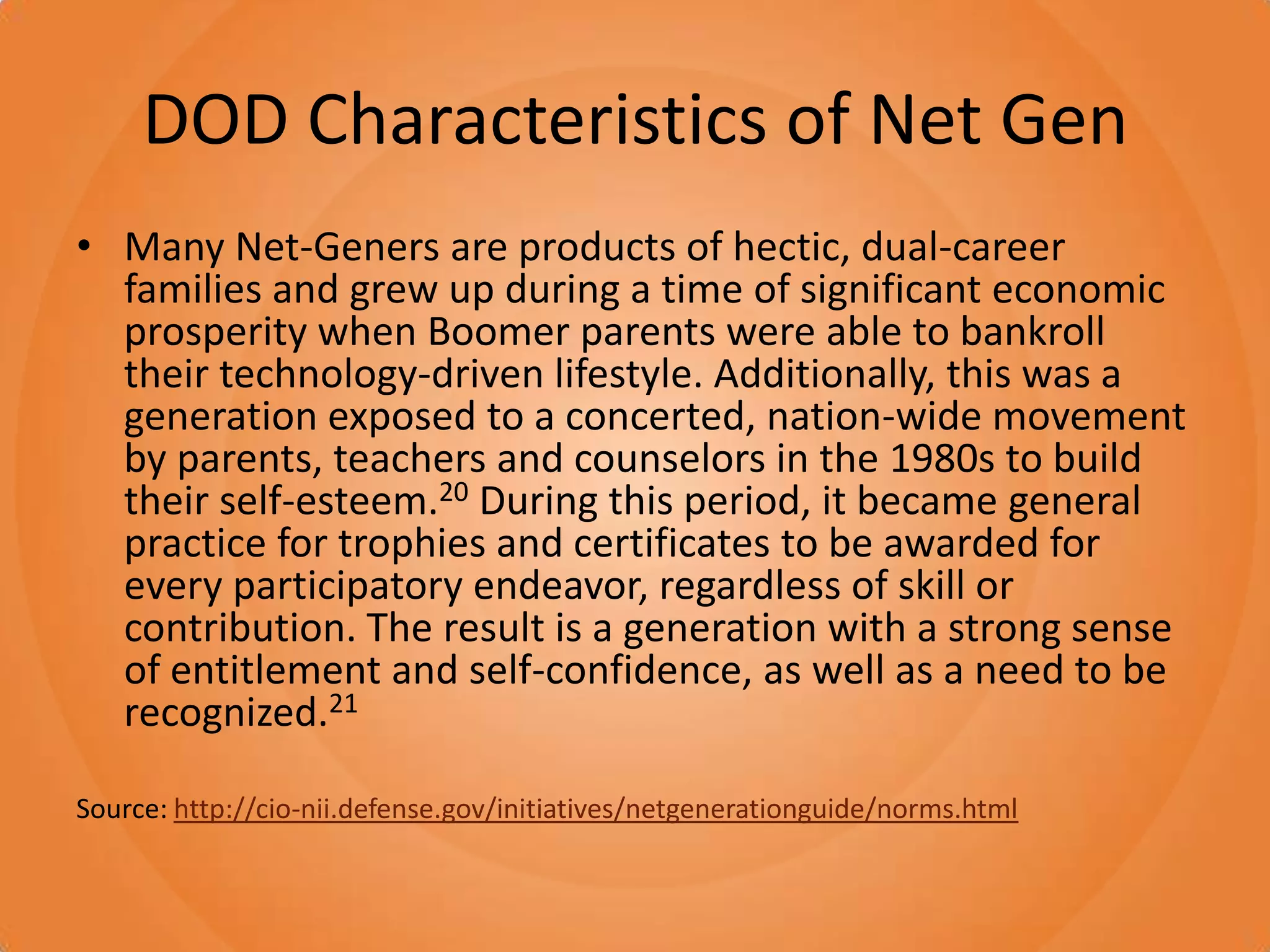
DOD Characteristics of Net GenMany Net-Geners are products of hectic, dual-career families and grew up during a time of significant economic prosperity when Boomer parents were able to bankroll their technology-driven lifestyle. Additionally, this was a generation exposed to a concerted, nation-wide movement by parents, teachers and counselors in the 1980s to build their self-esteem.20 During this period, it became general practice for trophies and certificates to be awarded for every participatory endeavor, regardless of skill or contribution. The result is a generation with a strong sense of entitlement and self-confidence, as well as a need to be recognized.21Source: http://cio-nii.defense.gov/initiatives/netgenerationguide/norms.html
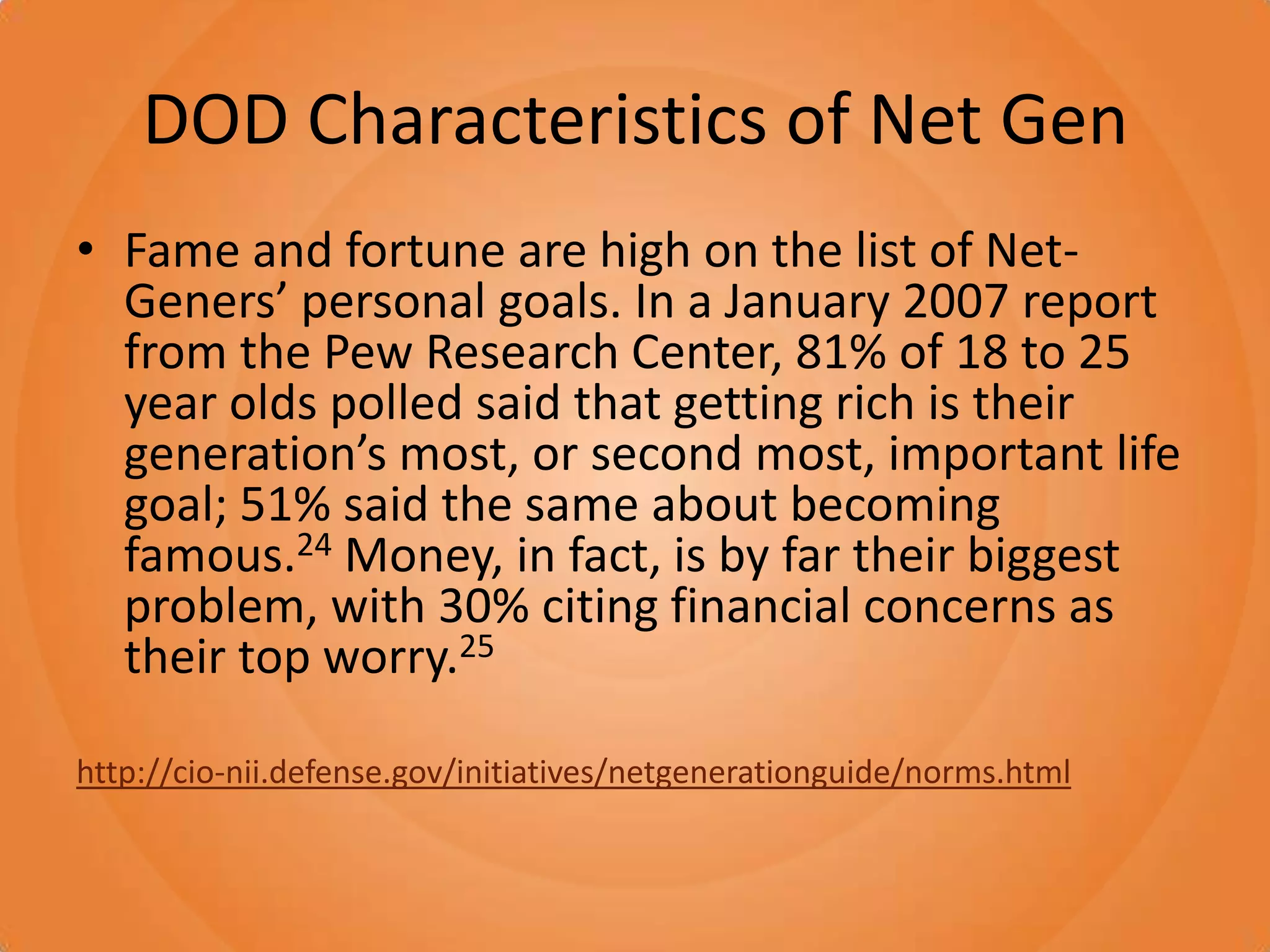
DOD Characteristics of Net GenFame and fortune are high on the list of Net-Geners’ personal goals. In a January 2007 report from the Pew Research Center, 81% of 18 to 25 year olds polled said that getting rich is their generation’s most, or second most, important life goal; 51% said the same about becoming famous.24 Money, in fact, is by far their biggest problem, with 30% citing financial concerns as their top worry.25http://cio-nii.defense.gov/initiatives/netgenerationguide/norms.html
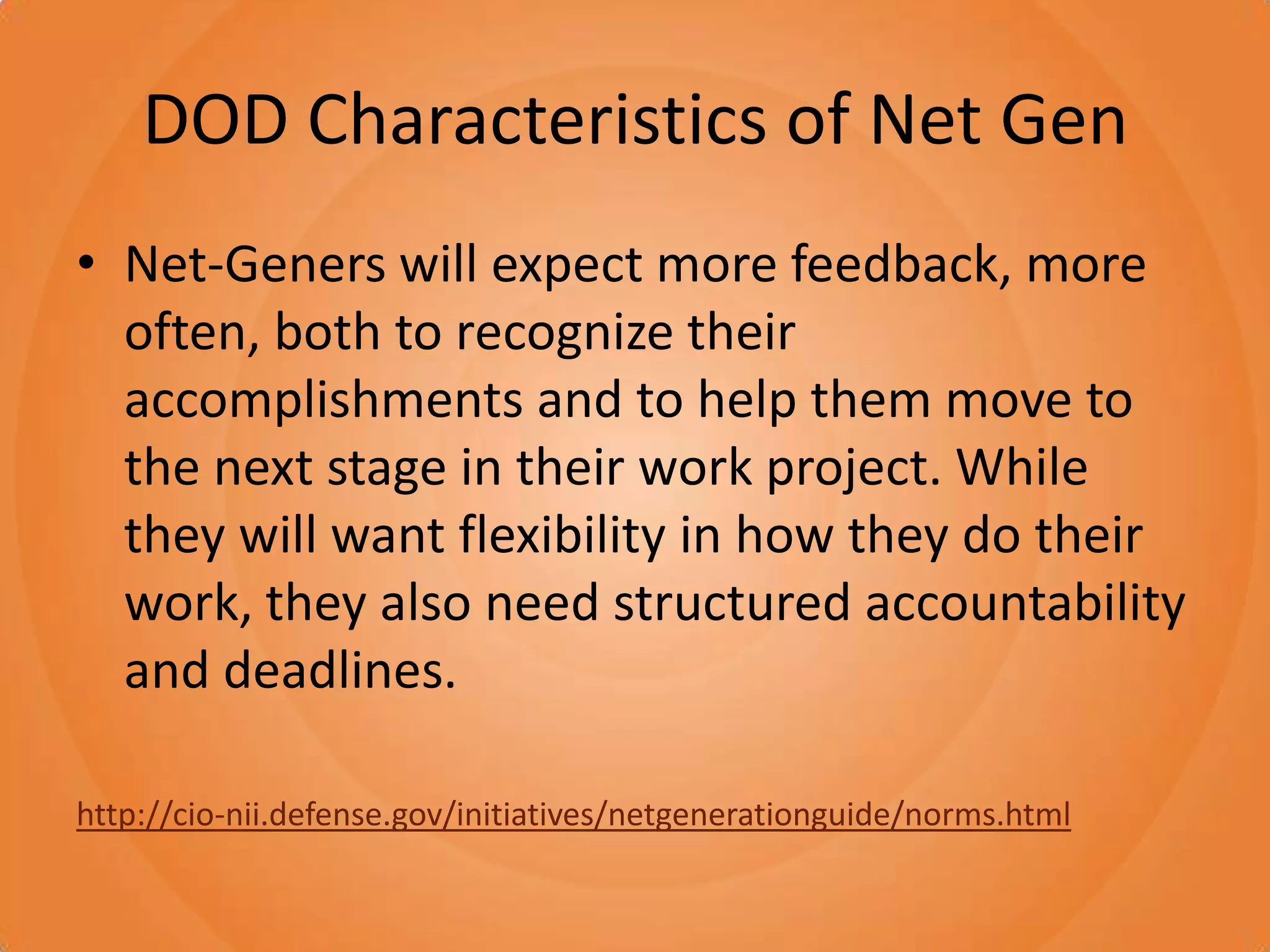
DOD Characteristics of Net GenNet-Geners will expect more feedback, more often, both to recognize their accomplishments and to help them move to the next stage in their work project. While they will want flexibility in how they do their work, they also need structured accountability and deadlines.http://cio-nii.defense.gov/initiatives/netgenerationguide/norms.html
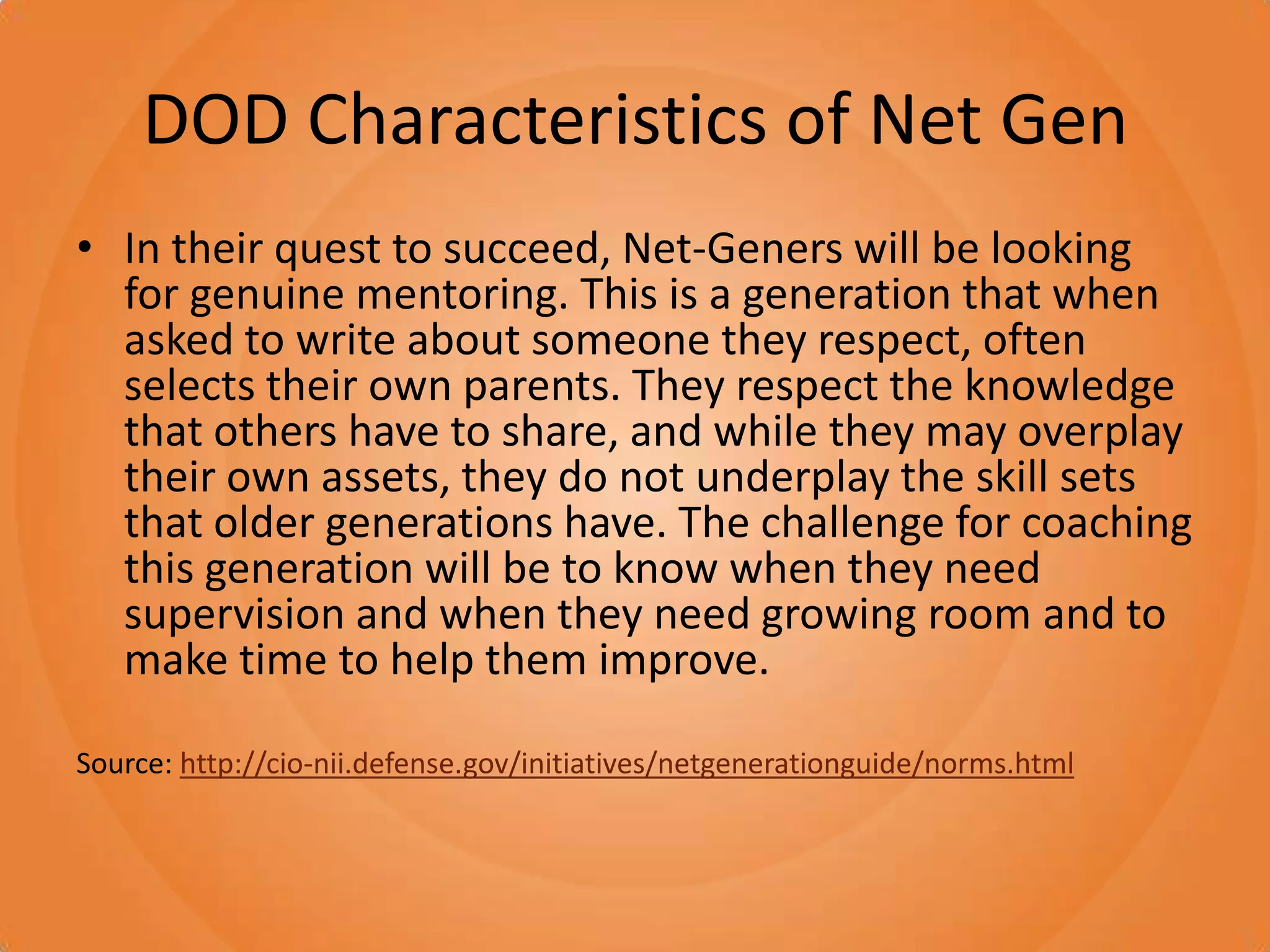
DOD Characteristics of Net GenIn their quest to succeed, Net-Geners will be looking for genuine mentoring. This is a generation that when asked to write about someone they respect, often selects their own parents. They respect the knowledge that others have to share, and while they may overplay their own assets, they do not underplay the skill sets that older generations have. The challenge for coaching this generation will be to know when they need supervision and when they need growing room and to make time to help them improve.Source: http://cio-nii.defense.gov/initiatives/netgenerationguide/norms.html
DOD Characteristics of Net GenNet-Geners are also used to being heard. They will want to share their ideas with senior leaders and decision-makers. Organizations would do well to determine how to balance protocol and openness to ensure they do not stifle the creativity and energy that the Net Generation will bring to the workplace. Source: http://cio-nii.defense.gov/initiatives/netgenerationguide/norms.html
DOD Characteristics of Net GenThey don’t want to be labeled.
They want continuous feedback and recognition.
They value genuine mentoring.
They want autonomy, responsibility, and challenges.
They need structured accountability.
They’re not interested in “paying their dues.”
They’re used to having their opinions heard.
They’re used to group/team problem solving.
They expect high tech/constant stimulation.
They’re used to living in a 24/7 environment.Source: http://cio-nii.defense.gov/initiatives/netgenerationguide/norms.html
Some LiteratureKaiser Family: Generation M2: Media in the Lives of 8- to 18-Year-Oldshttp://www.kff.org/entmedia/mh012010pkg.cfmPew Research: Millennials a portrait of generation next http://pewresearch.org/millennials/Digital Youth Research: Living and learning with new mediahttp://digitalyouth.ischool.berkeley.edu/reportNielsen: How Teens Use Media http://blog.nielsen.com/nielsenwire/reports/nielsen_howteensusemedia_june09.pdfEducating the Net Generationhttp://www.educause.edu/Resources/EducatingtheNetGenerationDepartment of Defense Net Generation Reporthttp://cio-nii.defense.gov/initiatives/netgenerationguide/

The NET Generation (Generation Next, Gen Y, Generation Y, Millenials)

  • 1.
  • 2.
    DOD Eight Normsof Net Gen1. Freedom - The Net Generation, more than any other generation, expects to set and abide by its own priorities. Net-Geners place high priority on time with family and friends, so much so that they see their job fitting into their personal and social lives/lifestyles, instead of the opposite, more traditional behavior.3Source: http://cio-nii.defense.gov/initiatives/netgenerationguide/norms.html
  • 3.
    DOD Eight Normsof Net Gen2. Customization - Living in a custom-created world is second nature to the Net Generation. They choose how they get their information or entertainment, when they get it, the color, configuration, and applications on the delivery device, and the picture on the credit card used to pay for it. In selecting a workplace, Net-Geners will look for choices in job benefits and will want to customize the jobs they select.4Source: http://cio-nii.defense.gov/initiatives/netgenerationguide/norms.html
  • 4.
    DOD Eight Normsof Net Gen3. Scrutinizers - The Net Generation is highly adept at online comparative analysis. Net-Geners in the hunt for work will carefully consider which occupations best fit their professional goals and work style preferences; and they will thoroughly research jobs available and the associated employers’ culture, benefits and emphasis on career development.6Once hired, Net-Geners will demand trusting and transparent relationships with their organizationSource: http://cio-nii.defense.gov/initiatives/netgenerationguide/norms.html
  • 5.
    DOD Eight Normsof Net Gen4. Integrity - As part of the scrutiny Net-Geners apply to their job hunts, they will be keen to uncover the record and reputation of potential employers with respect to their commitment to integrity and ethical practices.10 They will not embrace a company/organization that has questionable ethics or that does not appear to translate words (policy) into action (practice), nor will they follow questionable leadership.11Source: http://cio-nii.defense.gov/initiatives/netgenerationguide/norms.html
  • 6.
    DOD Eight Normsof Net Gen5. Collaboration - The Net Generation has grown up in an interactive world. They are used to pulsing their social networks for information and feedback and working collaboratively on tasks.12 Additionally, they want to provide their stamp on product and process development.13Source: http://cio-nii.defense.gov/initiatives/netgenerationguide/norms.html
  • 7.
    DOD Eight Normsof Net Gen6. Entertainment - Enjoyment of the job and the workplace is also very important to Net-Geners. They want to learn new things and be a part of the action, and they expect to have fun while doing it.14 Equally important, they tend to work hard at tasks and then want to decompress. Source: http://cio-nii.defense.gov/initiatives/netgenerationguide/norms.html
  • 8.
    DOD Eight Normsof Net Gen7. Speed - Owing to their demand for speed of communication, Net-Geners tend not to use more traditional methods such as the telephone and email in their personal communications, preferring the speed of instant messenging.16 They will look for avenues to speed their productivity and response time wherever possible. This includes everything from feedback on performance to their rate of professional growth within an organization.17 Net-Geners will value those who provide the timely feedback they desire.http://cio-nii.defense.gov/initiatives/netgenerationguide/norms.html
  • 9.
    DOD Eight Normsof Net Gen8. Innovation - Members of the Net Generation are “digital natives.” Having grown up with technology in every aspect of their lives, IT capabilities are often second nature to them.18 And, with their desire to customize, they work hard to provide the solutions to adapt things to suit their own needs.19Source: http://cio-nii.defense.gov/initiatives/netgenerationguide/norms.html
  • 10.
    TimelineWikipedia (online encyclopaedia)2001;del.icio.us (social bookmarking) 2003;MySpace 2003 (social networking); Facebook (social networking) 2004; Flikr (social media) 2004; and YouTube (social media) 2005 (Higher Education Academy and the Joint Information Systems Committee).
  • 11.
  • 12.
  • 13.
  • 14.
  • 15.
  • 16.
  • 17.
  • 18.
    8 to 18Year Olds in the U.S.Today, 8-18 year-olds devote an average of 7 hours and 38 minutes (7:38) to using entertainment media across a typical day (more than 53 hours a week).  And because they spend so much of that time ‘media multitasking’ they actually manage to pack a total of 10 hours and 45 minutes (10:45) worth of media content into those 7½ hours.Source: http://www.kff.org/entmedia/entmedia012010nr.cfm
  • 19.
  • 20.
  • 21.
  • 22.
    8 to 18Year Olds in the U.S.Top online activities include social networking (:22 a day), playing games (:17), and visiting video sites such as YouTube (:15).  Three-quarters (74%) of all 7th-12th graders say they have a profile on a social networking site. Source: http://www.kff.org/entmedia/entmedia012010nr.cfm
  • 23.
    Possible Roles Social-basedlearning – students want to leverage emerging communications and collaboration tools to create and personalize networks of experts to inform their education process.Un-tethered learning – students envision technology-enabled learning experiences that transcend the classroom walls and are not limited by resource constraints, traditional funding streams, geography, community assets or even teacher knowledge or skills.Digitally-rich learning – students see the use of relevancy-based digital tools, content and resources as a key to driving learning productivity, not just about engaging students in learning.Source: http://www.tomorrow.org/speakup/pdfs/SUNationalFindings2009.pdf
  • 24.
    Types of SpaceSecret/private/personalspace: eg Short Message Service (SMS); Instant Message (IM)group space: egBebo, Facebookpublishing space: eg blogs, wikis, YouTubeperformance space: eg Second Life, World of Warcraftparticipation space: eg meetings, markets, eventswatching space: eg lectures (Locke 2007)
  • 25.
    GenerationalThe consequences ofthis generation’s experience have become increasingly apparent over time:a strong sense of a community linked in its own virtual spaces of blogs and social networking and gaming sites; a similarly strong sense of group identity; and a disposition to share and to participate.
  • 26.
    GenerationalThey also include:impatience – a preference for instant answers; a downgrading of text in favor of image; and a casual approach to evaluating information and attributing it, and also to copyright and legal constraints” (Higher Education Academy and the Joint Information Systems Committee, 2009).
  • 27.
    Educating the NetGenAbility to read visual images—they are intuitive visual communicatorsVisual-spatial skills—perhaps because of their expertise with games they can integrate the virtual and physicalInductive discovery—they learn better through discovery than by being toldAttentional deployment—they are able to shift their attention rapidly from one task to another, and may choose not to pay attention to things that don’t interest themFast response time—they are able to respond quickly and expect rapid responses in returnSource: http://www.educause.edu/Resources/EducatingtheNetGeneration/
  • 28.
  • 29.
    Millenials (Net Gen)Gravitatetoward group activityIdentify with parents’ values and feel close to their parentsBelieve it’s cool to be smartAre fascinated by new technologiesAre racially and ethnically diverse; one in five has at least one immigrant parentAre focused on grades and performanceAre busy with extracurricular activitiesSource: http://www.educause.edu/Resources/EducatingtheNetGeneration/
  • 30.
    Educating the NetGenDigitally LiterateConnected (networked media)Immediate (receipt and response)Multi-taskExperiental (learn by doing)Social Source: http://www.educause.edu/Resources/EducatingtheNetGeneration/
  • 31.
    Educating the NetGenProlific communicators, they gravitate toward activities that promote and reinforce social interaction—whether IMing old friends, teaming up in an Internet game, posting Web diaries (blogging), or forwarding joke e-mails. The Net Gen displays a striking openness to diversity, differences, and sharing; they are at ease meeting strangers on the NetSource: http://www.educause.edu/Resources/EducatingtheNetGeneration/
  • 32.
    Educating the NetGenMany of their exchanges on the Internet are emotionally open, sharing very personal information about themselves. The Net Gen has developed a mechanism of inclusiveness that does not necessarily involve personally knowing someone admitted to their group. Being a friend of a friend is acceptable.http://www.educause.edu/Resources/EducatingtheNetGeneration/
  • 33.
    Educating the NetGenTeams (prefer to learn and work in teamsStructure - achievement oriented (“They want parameters, rules, priorities, and procedures)Engagement and ExperienceVisual and Kinesthetic (image rich)Community activities (believe they can make a difference)http://www.educause.edu/Resources/EducatingtheNetGeneration/
  • 34.
    Educating the NetGenThey don’t think in terms of technology; they think in terms of the activity technology enablesNet Gen views the Internet as an access tool—a medium for distribution of resources rather than a resource with limitationsFor example, instant messaging wasn’t considered a technology; IMing is treated as a verb—it is an action, not a technologyTheir communities and social networks are physical, virtual, and hybrid.http://www.educause.edu/Resources/EducatingtheNetGeneration/
  • 35.
    DOD Characteristics ofNet GenThe Net Generation can be generally characterized as the most demanding generation in history, demanding challenge, meaningful work with impact, committed co-workers, and the ability to reach personal and financial goals.Source: http://cio-nii.defense.gov/initiatives/netgenerationguide/norms.html
  • 36.
    DOD Characteristics ofNet GenMany Net-Geners are products of hectic, dual-career families and grew up during a time of significant economic prosperity when Boomer parents were able to bankroll their technology-driven lifestyle. Additionally, this was a generation exposed to a concerted, nation-wide movement by parents, teachers and counselors in the 1980s to build their self-esteem.20 During this period, it became general practice for trophies and certificates to be awarded for every participatory endeavor, regardless of skill or contribution. The result is a generation with a strong sense of entitlement and self-confidence, as well as a need to be recognized.21Source: http://cio-nii.defense.gov/initiatives/netgenerationguide/norms.html
  • 37.
    DOD Characteristics ofNet GenMany Net-Geners are products of hectic, dual-career families and grew up during a time of significant economic prosperity when Boomer parents were able to bankroll their technology-driven lifestyle. Additionally, this was a generation exposed to a concerted, nation-wide movement by parents, teachers and counselors in the 1980s to build their self-esteem.20 During this period, it became general practice for trophies and certificates to be awarded for every participatory endeavor, regardless of skill or contribution. The result is a generation with a strong sense of entitlement and self-confidence, as well as a need to be recognized.21Source: http://cio-nii.defense.gov/initiatives/netgenerationguide/norms.html
  • 38.
    DOD Characteristics ofNet GenFame and fortune are high on the list of Net-Geners’ personal goals. In a January 2007 report from the Pew Research Center, 81% of 18 to 25 year olds polled said that getting rich is their generation’s most, or second most, important life goal; 51% said the same about becoming famous.24 Money, in fact, is by far their biggest problem, with 30% citing financial concerns as their top worry.25http://cio-nii.defense.gov/initiatives/netgenerationguide/norms.html
  • 39.
    DOD Characteristics ofNet GenNet-Geners will expect more feedback, more often, both to recognize their accomplishments and to help them move to the next stage in their work project. While they will want flexibility in how they do their work, they also need structured accountability and deadlines.http://cio-nii.defense.gov/initiatives/netgenerationguide/norms.html
  • 40.
    DOD Characteristics ofNet GenIn their quest to succeed, Net-Geners will be looking for genuine mentoring. This is a generation that when asked to write about someone they respect, often selects their own parents. They respect the knowledge that others have to share, and while they may overplay their own assets, they do not underplay the skill sets that older generations have. The challenge for coaching this generation will be to know when they need supervision and when they need growing room and to make time to help them improve.Source: http://cio-nii.defense.gov/initiatives/netgenerationguide/norms.html
  • 41.
    DOD Characteristics ofNet GenNet-Geners are also used to being heard. They will want to share their ideas with senior leaders and decision-makers. Organizations would do well to determine how to balance protocol and openness to ensure they do not stifle the creativity and energy that the Net Generation will bring to the workplace. Source: http://cio-nii.defense.gov/initiatives/netgenerationguide/norms.html
  • 42.
    DOD Characteristics ofNet GenThey don’t want to be labeled.
They want continuous feedback and recognition.
They value genuine mentoring.
They want autonomy, responsibility, and challenges.
They need structured accountability.
They’re not interested in “paying their dues.”
They’re used to having their opinions heard.
They’re used to group/team problem solving.
They expect high tech/constant stimulation.
They’re used to living in a 24/7 environment.Source: http://cio-nii.defense.gov/initiatives/netgenerationguide/norms.html
  • 43.
    Some LiteratureKaiser Family:Generation M2: Media in the Lives of 8- to 18-Year-Oldshttp://www.kff.org/entmedia/mh012010pkg.cfmPew Research: Millennials a portrait of generation next http://pewresearch.org/millennials/Digital Youth Research: Living and learning with new mediahttp://digitalyouth.ischool.berkeley.edu/reportNielsen: How Teens Use Media http://blog.nielsen.com/nielsenwire/reports/nielsen_howteensusemedia_june09.pdfEducating the Net Generationhttp://www.educause.edu/Resources/EducatingtheNetGenerationDepartment of Defense Net Generation Reporthttp://cio-nii.defense.gov/initiatives/netgenerationguide/