“.NET FRAMEWORK”
Contents
 Target Audience
 Platform & Framework
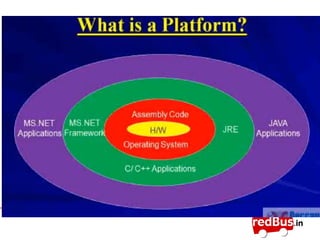
 What is a Platform?
 Framework Component
 What is .Net?
 .Net Framework Versions
 Core of .Net Framework – CLR
 CLR Main Actors I & II
 How compilation works
 Compilation & Execution
 Types of .Net Applications
 Take Away
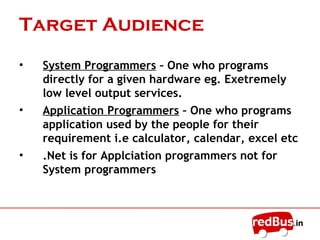
Target Audience
• System Programmers – One who programs
directly for a given hardware eg. Exetremely
low level output services.
• Application Programmers – One who programs
application used by the people for their
requirement i.e calculator, calendar, excel etc
• .Net is for Applciation programmers not for
System programmers
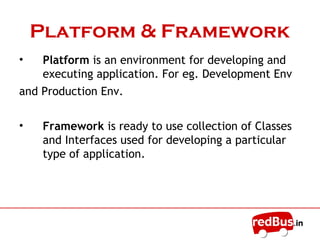
Platform & Framework
• Platform is an environment for developing and
executing application. For eg. Development Env
and Production Env.
• Framework is ready to use collection of Classes
and Interfaces used for developing a particular
type of application.
Framework Components
• Microsoft .net Runtime
Used for both Development + Production environment
of .Net Appication
• Microsoft .net Framework SDK
Used mainly for Development environment
• Visula Studio .Net
IDE + RAD for developing and debugging .Net
application
Supports multiple languages like VB, C#, VC++etc
Not needed in Production environment
What is .Net?
• Definition: MS.Net is a Framework built on open
internet protocols & standards with tools and
services that meld computing and
communication is new ways.
• Simple Definition: It is an environment for
developing and running software application
can be stand alone window apps or web
services or web applications written in variety
of programming languages + provides inter
language and inter machine interoperability.
.Net Framework Version
• V1.0 in Year 2002 (standalone version)
• V1.1 in Year 2003 (standalone version)
• V2.0 in Year 2005 (standalone version)
• V3.0 in Year 2006 (installed over 2.0)
• V3.5 in Year 2008 (installed over 3.0)
• V4.0 in Year 2009
• All versions can be installed side by side on same
machine.
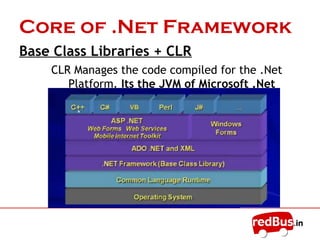
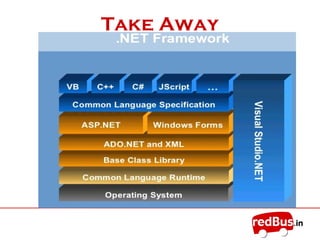
Core of .Net Framework
Base Class Libraries + CLR
CLR Manages the code compiled for the .Net
Platform. Its the JVM of Microsoft .Net
CLR – Main Actors I
1) CTS (Common Type System)
- Provides every language running on .Net platform a
base set of Data Types
- Everything in CTS is an object
- Most languages implement aliases to those types
- For eg. Int is a 4 byte integer value of CTS type
System.Int32
CLR – Main Actors II
2) CLS (Common Language Specification)
The CLS is a set of rules a language compiler must
follow to create a .Net application
CLS defines the following -
- Common variable types (CTS)
- Common visibility like when and where one can see
the variables
- Common method specification and so on
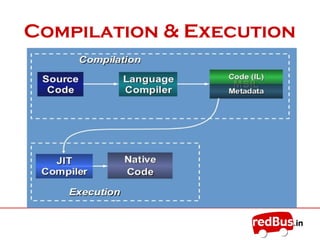
How compilation work?
• User writes code in any language i.e VB, C#
• The respective compiler (VBC or CSC) will take
the responsibility of compiling the code into MSIL
• CLR takes the MSIL and pass it to CLR
• CLR allows JIT(Just in Time compiler) runs its
rule and process the MSIL to machine code which
can be understood by OS.
• Note: Machine/Native language totally depends
upon the client machine
configuration/OS/processor/RAM
Compilation & Execution
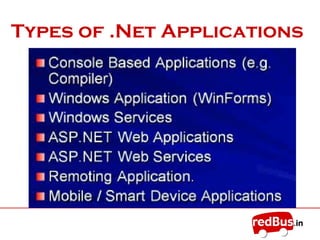
Types of .Net Applications
Take Away

.Net framework

  • 1.
  • 2.
    Contents  Target Audience Platform & Framework  What is a Platform?  Framework Component  What is .Net?  .Net Framework Versions  Core of .Net Framework – CLR  CLR Main Actors I & II  How compilation works  Compilation & Execution  Types of .Net Applications  Take Away
  • 3.
    Target Audience • SystemProgrammers – One who programs directly for a given hardware eg. Exetremely low level output services. • Application Programmers – One who programs application used by the people for their requirement i.e calculator, calendar, excel etc • .Net is for Applciation programmers not for System programmers
  • 4.
    Platform & Framework •Platform is an environment for developing and executing application. For eg. Development Env and Production Env. • Framework is ready to use collection of Classes and Interfaces used for developing a particular type of application.
  • 6.
    Framework Components • Microsoft.net Runtime Used for both Development + Production environment of .Net Appication • Microsoft .net Framework SDK Used mainly for Development environment • Visula Studio .Net IDE + RAD for developing and debugging .Net application Supports multiple languages like VB, C#, VC++etc Not needed in Production environment
  • 7.
    What is .Net? •Definition: MS.Net is a Framework built on open internet protocols & standards with tools and services that meld computing and communication is new ways. • Simple Definition: It is an environment for developing and running software application can be stand alone window apps or web services or web applications written in variety of programming languages + provides inter language and inter machine interoperability.
  • 8.
    .Net Framework Version •V1.0 in Year 2002 (standalone version) • V1.1 in Year 2003 (standalone version) • V2.0 in Year 2005 (standalone version) • V3.0 in Year 2006 (installed over 2.0) • V3.5 in Year 2008 (installed over 3.0) • V4.0 in Year 2009 • All versions can be installed side by side on same machine.
  • 9.
    Core of .NetFramework Base Class Libraries + CLR CLR Manages the code compiled for the .Net Platform. Its the JVM of Microsoft .Net
  • 10.
    CLR – MainActors I 1) CTS (Common Type System) - Provides every language running on .Net platform a base set of Data Types - Everything in CTS is an object - Most languages implement aliases to those types - For eg. Int is a 4 byte integer value of CTS type System.Int32
  • 11.
    CLR – MainActors II 2) CLS (Common Language Specification) The CLS is a set of rules a language compiler must follow to create a .Net application CLS defines the following - - Common variable types (CTS) - Common visibility like when and where one can see the variables - Common method specification and so on
  • 12.
    How compilation work? •User writes code in any language i.e VB, C# • The respective compiler (VBC or CSC) will take the responsibility of compiling the code into MSIL • CLR takes the MSIL and pass it to CLR • CLR allows JIT(Just in Time compiler) runs its rule and process the MSIL to machine code which can be understood by OS. • Note: Machine/Native language totally depends upon the client machine configuration/OS/processor/RAM
  • 13.
  • 14.
    Types of .NetApplications
  • 15.