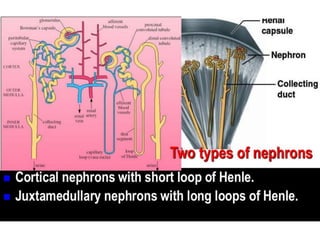
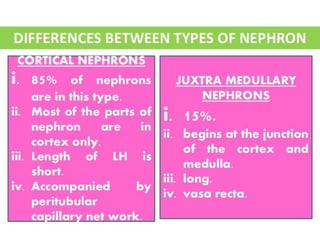
NEPHRON
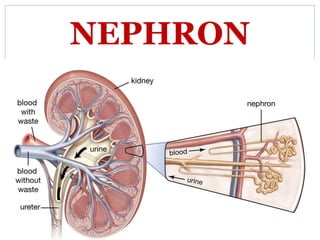
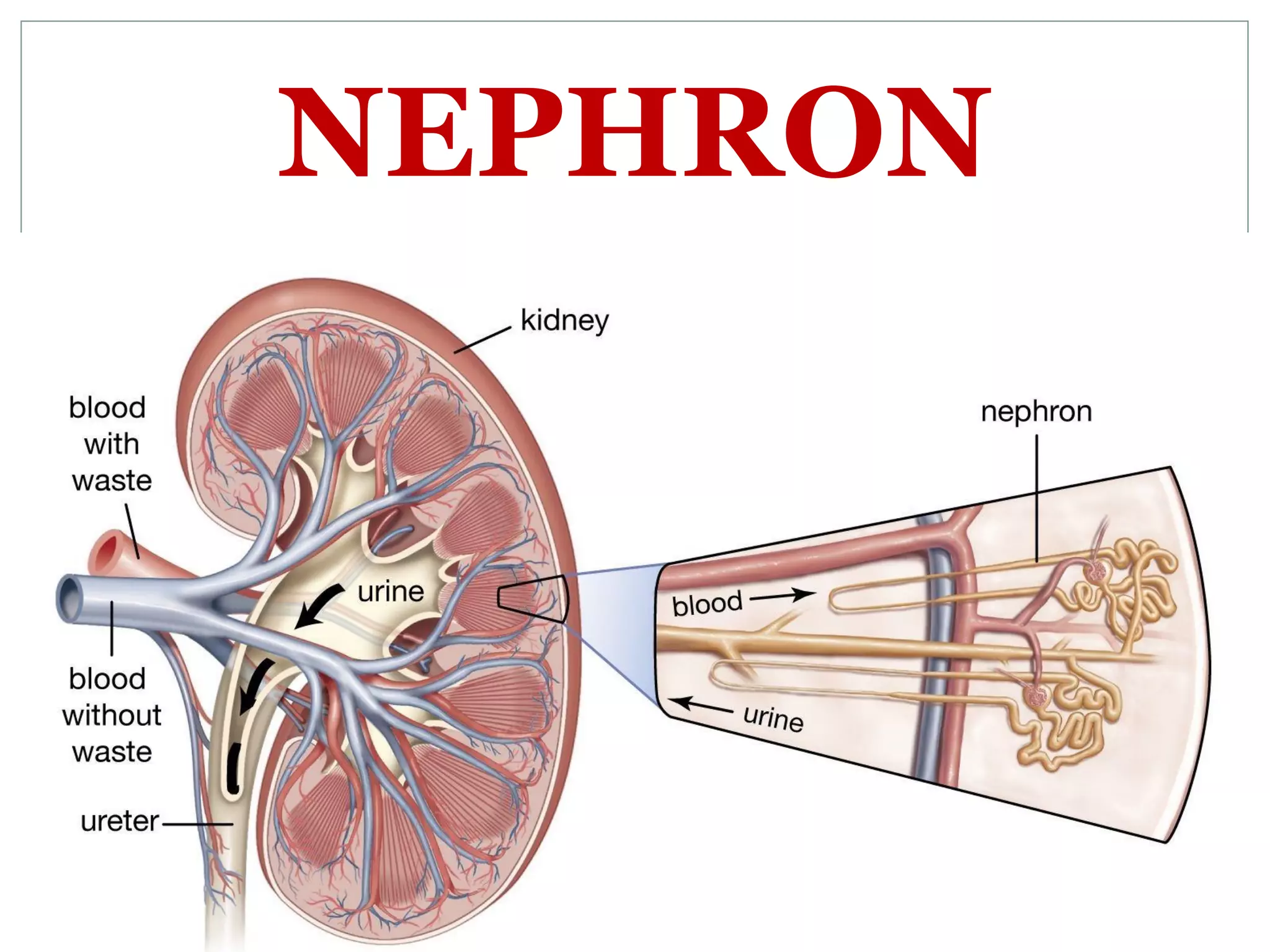
THE NEPHRON
✓ Each kidney consists of about 1 million basic
structural and functional units called nephrons
where blood filtering and urine formation occur.
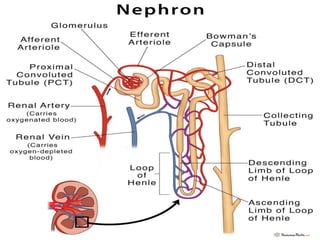
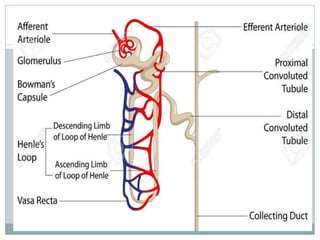
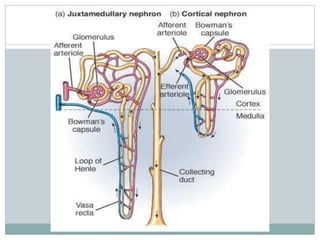
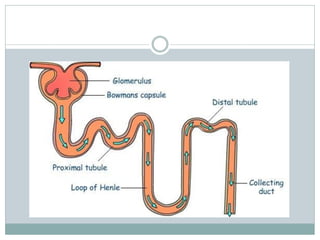
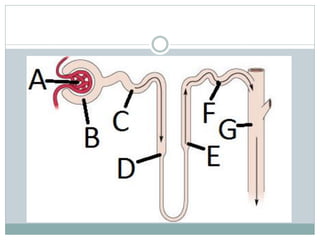
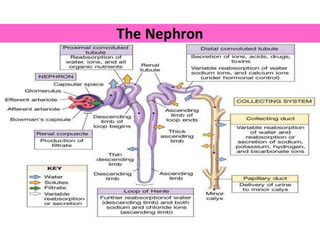
✓ Each nephron is composed of 10 parts – Afferent
Arteriole → Glomerulus →Bowman's Capsule
→ Efferent Arteriole → Proximal Convoluted
Tubule (PCT) → Descending Limb Of Loop Of
Henle →Vasa Recta → Ascending Limb Of
Loop Of Henle → Distal Convoluted
Tubule(DCT) → Collecting Duct.
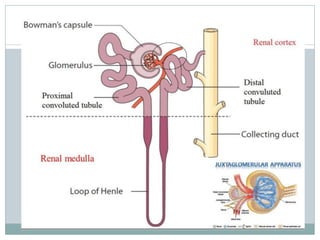
NEPHRON ANATOMY
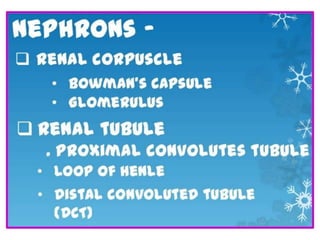
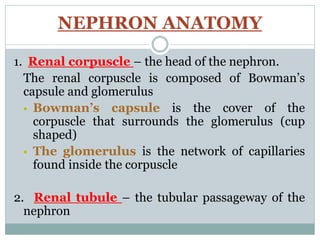
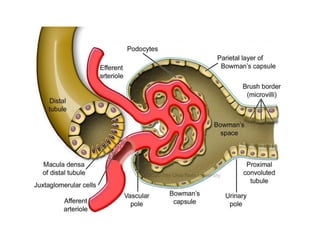
1. Renal corpuscle – the head of the nephron.
The renal corpuscle is composed of Bowman’s
capsule and glomerulus
▪ Bowman’s capsule is the cover of the
corpuscle that surrounds the glomerulus (cup
shaped)
▪ The glomerulus is the network of capillaries
found inside the corpuscle
2. Renal tubule – the tubular passageway of the
nephron
Glomerulus
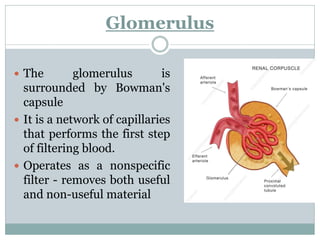
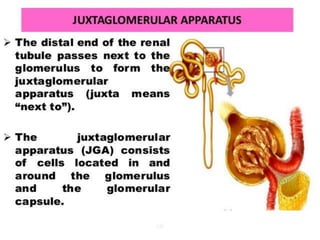
 The glomerulus is
surrounded by Bowman's
capsule
 It is a network of capillaries
that performs the first step
of filtering blood.
 Operates as a nonspecific
filter - removes both useful
and non-useful material
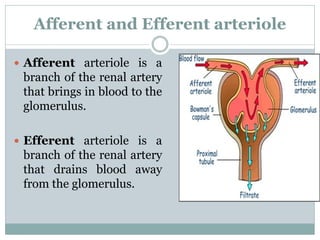
Afferent and Efferent arteriole
 Afferent arteriole is a
branch of the renal artery
that brings in blood to the
glomerulus.
 Efferent arteriole is a
branch of the renal artery
that drains blood away
from the glomerulus.
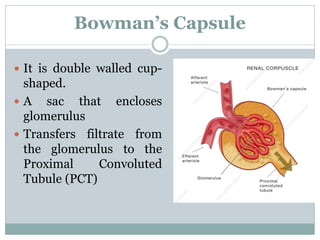
Bowman’s Capsule
 It is double walled cup-
shaped.
 A sac that encloses
glomerulus
 Transfers filtrate from
the glomerulus to the
Proximal Convoluted
Tubule (PCT)
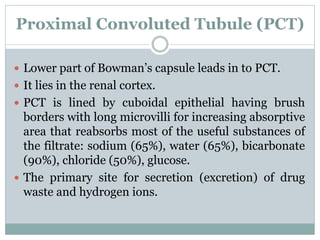
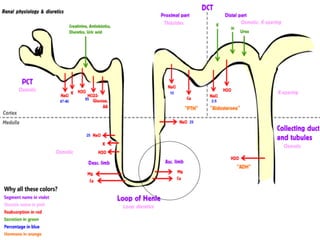
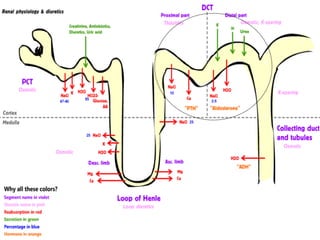
Proximal Convoluted Tubule (PCT)
 Lower part of Bowman’s capsule leads in to PCT.
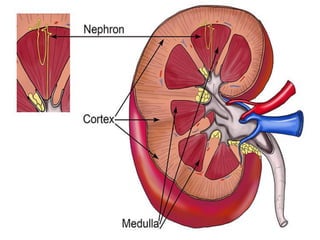
 It lies in the renal cortex.
 PCT is lined by cuboidal epithelial having brush
borders with long microvilli for increasing absorptive
area that reabsorbs most of the useful substances of
the filtrate: sodium (65%), water (65%), bicarbonate
(90%), chloride (50%), glucose.
 The primary site for secretion (excretion) of drug
waste and hydrogen ions.
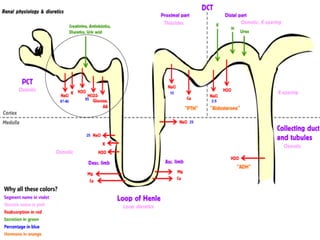
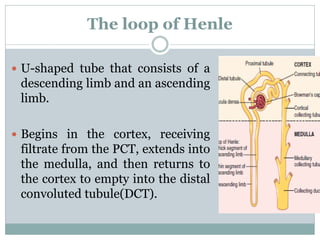
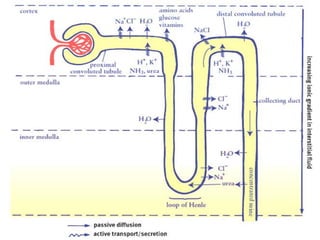
The loop of Henle
 U-shaped tube that consists of a
descending limb and an ascending
limb.
 Begins in the cortex, receiving
filtrate from the PCT, extends into
the medulla, and then returns to
the cortex to empty into the distal
convoluted tubule(DCT).
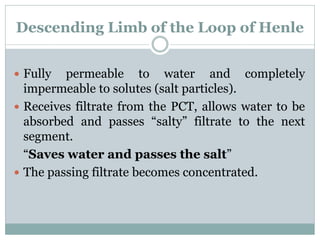
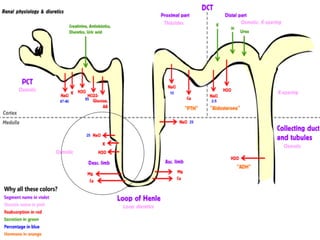
Descending Limb of the Loop of Henle
 Fully permeable to water and completely
impermeable to solutes (salt particles).
 Receives filtrate from the PCT, allows water to be
absorbed and passes “salty” filtrate to the next
segment.
“Saves water and passes the salt”
 The passing filtrate becomes concentrated.
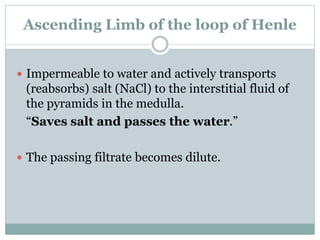
Ascending Limb of the loop of Henle
 Impermeable to water and actively transports
(reabsorbs) salt (NaCl) to the interstitial fluid of
the pyramids in the medulla.
“Saves salt and passes the water.”
 The passing filtrate becomes dilute.
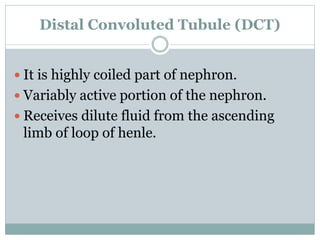
Distal Convoluted Tubule (DCT)
 It is highly coiled part of nephron.
 Variably active portion of the nephron.
 Receives dilute fluid from the ascending
limb of loop of henle.
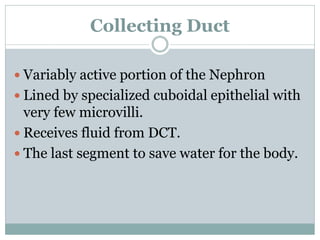
Collecting Duct
 Variably active portion of the Nephron
 Lined by specialized cuboidal epithelial with
very few microvilli.
 Receives fluid from DCT.
 The last segment to save water for the body.
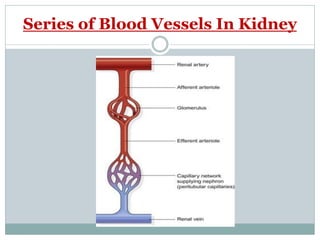
Series of Blood Vessels In Kidney
Functions of Nephron
1. Nephron remove urea and uric acid from the
blood
2. Nephron regulate blood pressure.
3. Nephron also remove pigments, drugs, poisons,
excess vitamins from the blood.
4. It regulates the amount of mineral salts in the
body.
5. Also regulate blood pH.
nephrons.pdf
nephrons.pdf

nephrons.pdf

  • 1.
  • 4.
    THE NEPHRON ✓ Eachkidney consists of about 1 million basic structural and functional units called nephrons where blood filtering and urine formation occur. ✓ Each nephron is composed of 10 parts – Afferent Arteriole → Glomerulus →Bowman's Capsule → Efferent Arteriole → Proximal Convoluted Tubule (PCT) → Descending Limb Of Loop Of Henle →Vasa Recta → Ascending Limb Of Loop Of Henle → Distal Convoluted Tubule(DCT) → Collecting Duct.
  • 10.
    NEPHRON ANATOMY 1. Renalcorpuscle – the head of the nephron. The renal corpuscle is composed of Bowman’s capsule and glomerulus ▪ Bowman’s capsule is the cover of the corpuscle that surrounds the glomerulus (cup shaped) ▪ The glomerulus is the network of capillaries found inside the corpuscle 2. Renal tubule – the tubular passageway of the nephron
  • 11.
    Glomerulus  The glomerulusis surrounded by Bowman's capsule  It is a network of capillaries that performs the first step of filtering blood.  Operates as a nonspecific filter - removes both useful and non-useful material
  • 12.
    Afferent and Efferentarteriole  Afferent arteriole is a branch of the renal artery that brings in blood to the glomerulus.  Efferent arteriole is a branch of the renal artery that drains blood away from the glomerulus.
  • 13.
    Bowman’s Capsule  Itis double walled cup- shaped.  A sac that encloses glomerulus  Transfers filtrate from the glomerulus to the Proximal Convoluted Tubule (PCT)
  • 14.
    Proximal Convoluted Tubule(PCT)  Lower part of Bowman’s capsule leads in to PCT.  It lies in the renal cortex.  PCT is lined by cuboidal epithelial having brush borders with long microvilli for increasing absorptive area that reabsorbs most of the useful substances of the filtrate: sodium (65%), water (65%), bicarbonate (90%), chloride (50%), glucose.  The primary site for secretion (excretion) of drug waste and hydrogen ions.
  • 16.
    The loop ofHenle  U-shaped tube that consists of a descending limb and an ascending limb.  Begins in the cortex, receiving filtrate from the PCT, extends into the medulla, and then returns to the cortex to empty into the distal convoluted tubule(DCT).
  • 17.
    Descending Limb ofthe Loop of Henle  Fully permeable to water and completely impermeable to solutes (salt particles).  Receives filtrate from the PCT, allows water to be absorbed and passes “salty” filtrate to the next segment. “Saves water and passes the salt”  The passing filtrate becomes concentrated.
  • 19.
    Ascending Limb ofthe loop of Henle  Impermeable to water and actively transports (reabsorbs) salt (NaCl) to the interstitial fluid of the pyramids in the medulla. “Saves salt and passes the water.”  The passing filtrate becomes dilute.
  • 21.
    Distal Convoluted Tubule(DCT)  It is highly coiled part of nephron.  Variably active portion of the nephron.  Receives dilute fluid from the ascending limb of loop of henle.
  • 23.
    Collecting Duct  Variablyactive portion of the Nephron  Lined by specialized cuboidal epithelial with very few microvilli.  Receives fluid from DCT.  The last segment to save water for the body.
  • 30.
    Series of BloodVessels In Kidney
  • 31.
    Functions of Nephron 1.Nephron remove urea and uric acid from the blood 2. Nephron regulate blood pressure. 3. Nephron also remove pigments, drugs, poisons, excess vitamins from the blood. 4. It regulates the amount of mineral salts in the body. 5. Also regulate blood pH.