M I R E L L A S T R O I N K , P H . D .
D E P A R T M E N T O F P S Y C H O L O G Y
C O N N I E N E L S O N , P H . D .
S C H O O L O F S O C I A L W O R K
F O O D S E C U R I T Y R E S E A R C H N E T W O R K
L A K E H E A D U N I V E R S I T Y
C O M M U N I T Y - E N G A G E D S C H O L A R S H I P : C R I T I C A L
J U N C T U R E S I N R E S E A R C H , P R A C T I C E A N D P O L I C Y
C O N F E R E N C E
G U E L P H , O N T A R I O
N O V E M B E R 4 - 5 , 2 0 1 0
Community Engaged Scholars:
Impact of an Interdisciplinary
Food Security Partnership Model
OUR MISSION
The FSRN began in 2006 and is dedicated to bringing
together a unique blend of resources from the academy
and the community for the purposes of
— Developing resilient, thriving and adaptive local food
systems in Northwestern Ontario through community
service learning (CSL), graduate student theses and
community-based research
— Giving participants life-influencing experiences in being a
symbiotic part of the organic transformation to an
ecological focused food system
OUR VISION
— A knowledge commons emerges from a confluence of
faculty, students and community interactive
engagement.
— From this culture of engagement, the emergent
knowledge commons becomes the foundation for a
self-organizing approach for generating adaptive,
resilient and innovative community-based solutions
to regional food security.
Why Food Security Theme?
— Food is a core and essential social determinant of our
physical and mental health and well-being; and
— Food has proven to be an engaging unifying and
rallying issue for bringing together faculty, students
and community.
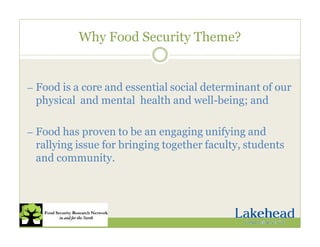
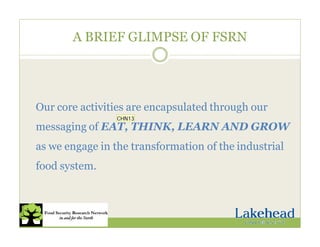
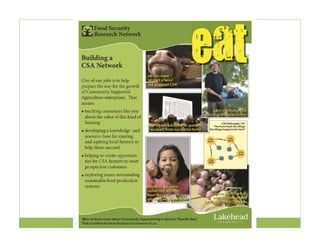
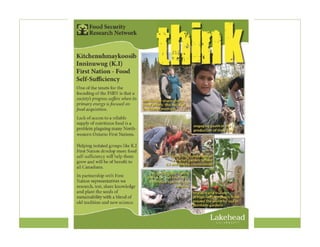
A BRIEF GLIMPSE OF FSRN
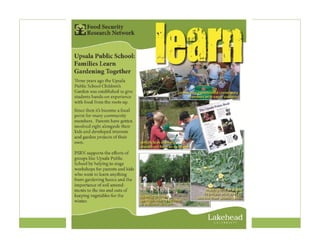
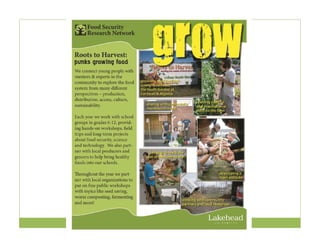
Our core activities are encapsulated through our
messaging of EAT, THINK, LEARN AND GROW
as we engage in the transformation of the industrial
food system.
CHN13
Slide 5
CHN13 I wanted to add all the examples as is included in the notes for this slide, but we don't have time...so how about what I have on this
slide and then I will say that we will quickly (15 seconds) present the Eat, Grow, Learn, Think slides and welcome more discussion on
any specifics throughout the conference.
Connie Nelson, 31/10/2010
AcademyAcademy
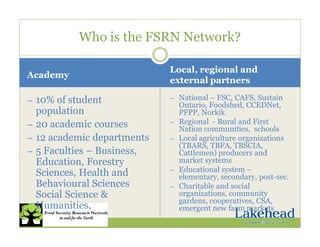
Local, regional and
external partners
Local, regional and
external partners
— 10% of student
population
— 20 academic courses
— 12 academic departments
— 5 Faculties – Business,
Education, Forestry
Sciences, Health and
Behavioural Sciences
Social Science &
Humanities,
— National – FSC, CAFS, Sustain
Ontario, Foodshed, CCEDNet,
PFPP, Norkik
— Regional - Rural and First
Nation communities, schools
— Local agriculture organizations
(TBARS, TBFA, TBSCIA,
Cattlemen) producers and
market systems
— Educational system –
elementary, secondary, post-sec.
— Charitable and social
organizations, community
gardens, cooperatives, CSA,
emergent new farm markets
Who is the FSRN Network?
CHN15
Slide 11
CHN15 I will follow-up on finding someone for help with the spiral for the submission of the paper by Dec. 1.
I will spend about 5 seconds on this slide and on to the specific examples. The real meaning of this presentation needs to be focused
on your case example. Hopefully, your case study will make our approach 'live and be dynamic'!
Connie Nelson, 31/10/2010
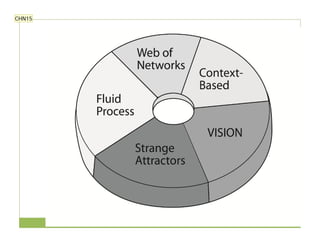
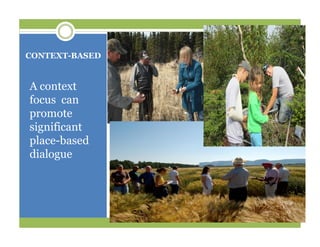
CONTEXT-BASED
A context
focus can
promote
significant
place-based
dialogue
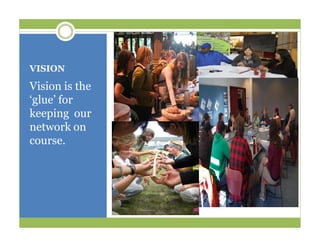
VISION
Vision is the
‘glue’ for
keeping our
network on
course.
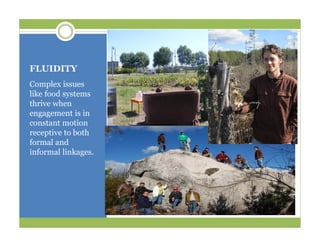
FLUIDITY
Complex issues
like food systems
thrive when
engagement is in
constant motion
receptive to both
formal and
informal linkages.
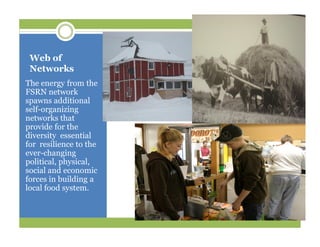
Web of
Networks
The energy from the
FSRN network
spawns additional
self-organizing
networks that
provide for the
diversity essential
for resilience to the
ever-changing
political, physical,
social and economic
forces in building a
local food system.
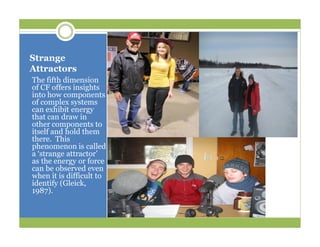
Strange
Attractors
The fifth dimension
of CF offers insights
into how components
of complex systems
can exhibit energy
that can draw in
other components to
itself and hold them
there. This
phenomenon is called
a ‘strange attractor’
as the energy or force
can be observed even
when it is difficult to
identify (Gleick,
1987).
FACULTY ENGAGEMENT:
A Case Study of Building Knowledge Commons
— Community Service Learning facilitates reaching out
and trying out ideas in the ‘real world’ and connecting
the ‘real world’ with the intellectual content of the
classroom to develop knowledge commons thus
enriching pedagogy
— Develop new avenues for community-based research
and the essaying of theory
— Develop beneficial interdepartmental and community
relationships which can benefit and improve research
capacity and increase professional standing.
A CASE STUDY IN
TRANSFORMATIVE CSL
Dr. Mirella Stroink:
Pedagogy
— My approach to Community Service Learning
evolved over 3 years and 6 courses
¡ “Standard” CSL experience in large 2nd year Social Psychology
course
¡ “Expanded” CSL experience in 4th year Community
Psychology course
¡ “Transformative” CSL experience in 3rd year Environmental
Psychology course and two Graduate Directed Studies courses
÷ Community knowledge integrated into the course
÷ Community needs drive student learning and knowledge creation
Graduate Student Supervision
— 3 Master’s Level Student Theses as CSL
¡ 1 MA Psychology
¡ 1 Masters of Public Health
¡ 1 Masters of Environmental Studies
— 1 PhD Level Student Dissertation as CSL
¡ Education
— 3 Undergraduate Honours Theses as CSL
¡ Psychology
Research
— Research moving toward increasing community
engagement
— Community-driven research questions
— Community taking control of its own knowledge
creation, recognizing its own “right” to create and
use valid knowledge
Observations of CF Model in Action
— Context Based:
¡ Faculty member IS a community member. This recognition
provides the passion to which I lend the tools of my craft.
— Vision:
¡ Vision shared by students and partners and me. Vision
becomes the centre out of which swirls an abundance of
innovation and research
— Fluidity:
¡ Being Fully Present. Serving the task at hand in the situation;
not coming “at” the task with a set of a-priori roles to play,
categories to apply, and hidden goals or fears to act upon
Observations of CF Model
— Web of Networks:
¡ Continuously self-expanding network of relationships fuels
ongoing work toward the vision. Diversity of connections as a
source of innovation.
— Strange Attractors:
¡ Particular combination of connections creates an energy that
fosters emerging social movements; people are finding the
hubs on their own
Next Policy Steps:
In Building a Knowledge Commons
Our findings to date reveal that knowledge appears
to be profoundly generated within context and raises
challenges to a more traditional positivistic
university oriented approach to knowledge creation
and transmission.
Next Policy Steps:
In Building a Knowledge Commons
— Re-think and re-tool university structures
— Rigid application of university structures acts as a
barrier to community participation in knowledge
creation. For example:
¡ Calendaring transdisciplinary courses
¡ Relevant recognition of knowledge creation
¡ Distinction between “course” and “research”
¡ Recognition of faculty contributions
Next Policy Steps:
In Building a Knowledge Commons
— Re-consider the role of the university
¡ The university is a hub of knowledge creation
¡ The context has changed
— Re-imagine the university in a world where
knowledge creation is being democratized
¡ Can information, ideas, knowledge creation be “owned”?
¡ Are university structures useful in light of how knowledge
creation is occurring today?
Thank you!

Nelson, lakehead

  • 1.
    M I RE L L A S T R O I N K , P H . D . D E P A R T M E N T O F P S Y C H O L O G Y C O N N I E N E L S O N , P H . D . S C H O O L O F S O C I A L W O R K F O O D S E C U R I T Y R E S E A R C H N E T W O R K L A K E H E A D U N I V E R S I T Y C O M M U N I T Y - E N G A G E D S C H O L A R S H I P : C R I T I C A L J U N C T U R E S I N R E S E A R C H , P R A C T I C E A N D P O L I C Y C O N F E R E N C E G U E L P H , O N T A R I O N O V E M B E R 4 - 5 , 2 0 1 0 Community Engaged Scholars: Impact of an Interdisciplinary Food Security Partnership Model
  • 2.
    OUR MISSION The FSRNbegan in 2006 and is dedicated to bringing together a unique blend of resources from the academy and the community for the purposes of — Developing resilient, thriving and adaptive local food systems in Northwestern Ontario through community service learning (CSL), graduate student theses and community-based research — Giving participants life-influencing experiences in being a symbiotic part of the organic transformation to an ecological focused food system
  • 3.
    OUR VISION — Aknowledge commons emerges from a confluence of faculty, students and community interactive engagement. — From this culture of engagement, the emergent knowledge commons becomes the foundation for a self-organizing approach for generating adaptive, resilient and innovative community-based solutions to regional food security.
  • 4.
    Why Food SecurityTheme? — Food is a core and essential social determinant of our physical and mental health and well-being; and — Food has proven to be an engaging unifying and rallying issue for bringing together faculty, students and community.
  • 5.
    A BRIEF GLIMPSEOF FSRN Our core activities are encapsulated through our messaging of EAT, THINK, LEARN AND GROW as we engage in the transformation of the industrial food system. CHN13
  • 6.
    Slide 5 CHN13 Iwanted to add all the examples as is included in the notes for this slide, but we don't have time...so how about what I have on this slide and then I will say that we will quickly (15 seconds) present the Eat, Grow, Learn, Think slides and welcome more discussion on any specifics throughout the conference. Connie Nelson, 31/10/2010
  • 11.
    AcademyAcademy Local, regional and externalpartners Local, regional and external partners — 10% of student population — 20 academic courses — 12 academic departments — 5 Faculties – Business, Education, Forestry Sciences, Health and Behavioural Sciences Social Science & Humanities, — National – FSC, CAFS, Sustain Ontario, Foodshed, CCEDNet, PFPP, Norkik — Regional - Rural and First Nation communities, schools — Local agriculture organizations (TBARS, TBFA, TBSCIA, Cattlemen) producers and market systems — Educational system – elementary, secondary, post-sec. — Charitable and social organizations, community gardens, cooperatives, CSA, emergent new farm markets Who is the FSRN Network?
  • 12.
  • 13.
    Slide 11 CHN15 Iwill follow-up on finding someone for help with the spiral for the submission of the paper by Dec. 1. I will spend about 5 seconds on this slide and on to the specific examples. The real meaning of this presentation needs to be focused on your case example. Hopefully, your case study will make our approach 'live and be dynamic'! Connie Nelson, 31/10/2010
  • 14.
  • 15.
    VISION Vision is the ‘glue’for keeping our network on course.
  • 16.
    FLUIDITY Complex issues like foodsystems thrive when engagement is in constant motion receptive to both formal and informal linkages.
  • 17.
    Web of Networks The energyfrom the FSRN network spawns additional self-organizing networks that provide for the diversity essential for resilience to the ever-changing political, physical, social and economic forces in building a local food system.
  • 18.
    Strange Attractors The fifth dimension ofCF offers insights into how components of complex systems can exhibit energy that can draw in other components to itself and hold them there. This phenomenon is called a ‘strange attractor’ as the energy or force can be observed even when it is difficult to identify (Gleick, 1987).
  • 19.
    FACULTY ENGAGEMENT: A CaseStudy of Building Knowledge Commons — Community Service Learning facilitates reaching out and trying out ideas in the ‘real world’ and connecting the ‘real world’ with the intellectual content of the classroom to develop knowledge commons thus enriching pedagogy — Develop new avenues for community-based research and the essaying of theory — Develop beneficial interdepartmental and community relationships which can benefit and improve research capacity and increase professional standing.
  • 20.
    A CASE STUDYIN TRANSFORMATIVE CSL Dr. Mirella Stroink:
  • 21.
    Pedagogy — My approachto Community Service Learning evolved over 3 years and 6 courses ¡ “Standard” CSL experience in large 2nd year Social Psychology course ¡ “Expanded” CSL experience in 4th year Community Psychology course ¡ “Transformative” CSL experience in 3rd year Environmental Psychology course and two Graduate Directed Studies courses ÷ Community knowledge integrated into the course ÷ Community needs drive student learning and knowledge creation
  • 22.
    Graduate Student Supervision —3 Master’s Level Student Theses as CSL ¡ 1 MA Psychology ¡ 1 Masters of Public Health ¡ 1 Masters of Environmental Studies — 1 PhD Level Student Dissertation as CSL ¡ Education — 3 Undergraduate Honours Theses as CSL ¡ Psychology
  • 23.
    Research — Research movingtoward increasing community engagement — Community-driven research questions — Community taking control of its own knowledge creation, recognizing its own “right” to create and use valid knowledge
  • 24.
    Observations of CFModel in Action — Context Based: ¡ Faculty member IS a community member. This recognition provides the passion to which I lend the tools of my craft. — Vision: ¡ Vision shared by students and partners and me. Vision becomes the centre out of which swirls an abundance of innovation and research — Fluidity: ¡ Being Fully Present. Serving the task at hand in the situation; not coming “at” the task with a set of a-priori roles to play, categories to apply, and hidden goals or fears to act upon
  • 25.
    Observations of CFModel — Web of Networks: ¡ Continuously self-expanding network of relationships fuels ongoing work toward the vision. Diversity of connections as a source of innovation. — Strange Attractors: ¡ Particular combination of connections creates an energy that fosters emerging social movements; people are finding the hubs on their own
  • 26.
    Next Policy Steps: InBuilding a Knowledge Commons Our findings to date reveal that knowledge appears to be profoundly generated within context and raises challenges to a more traditional positivistic university oriented approach to knowledge creation and transmission.
  • 27.
    Next Policy Steps: InBuilding a Knowledge Commons — Re-think and re-tool university structures — Rigid application of university structures acts as a barrier to community participation in knowledge creation. For example: ¡ Calendaring transdisciplinary courses ¡ Relevant recognition of knowledge creation ¡ Distinction between “course” and “research” ¡ Recognition of faculty contributions
  • 28.
    Next Policy Steps: InBuilding a Knowledge Commons — Re-consider the role of the university ¡ The university is a hub of knowledge creation ¡ The context has changed — Re-imagine the university in a world where knowledge creation is being democratized ¡ Can information, ideas, knowledge creation be “owned”? ¡ Are university structures useful in light of how knowledge creation is occurring today?
  • 29.