NEFT/RTGS
Group Members
•   Benson Verghese   19
•   Sarita Sapaliga   29
•   Aditi Mahapadi    40
•   Dhananjay Joshi   43
•   Shruti Ketkar     52
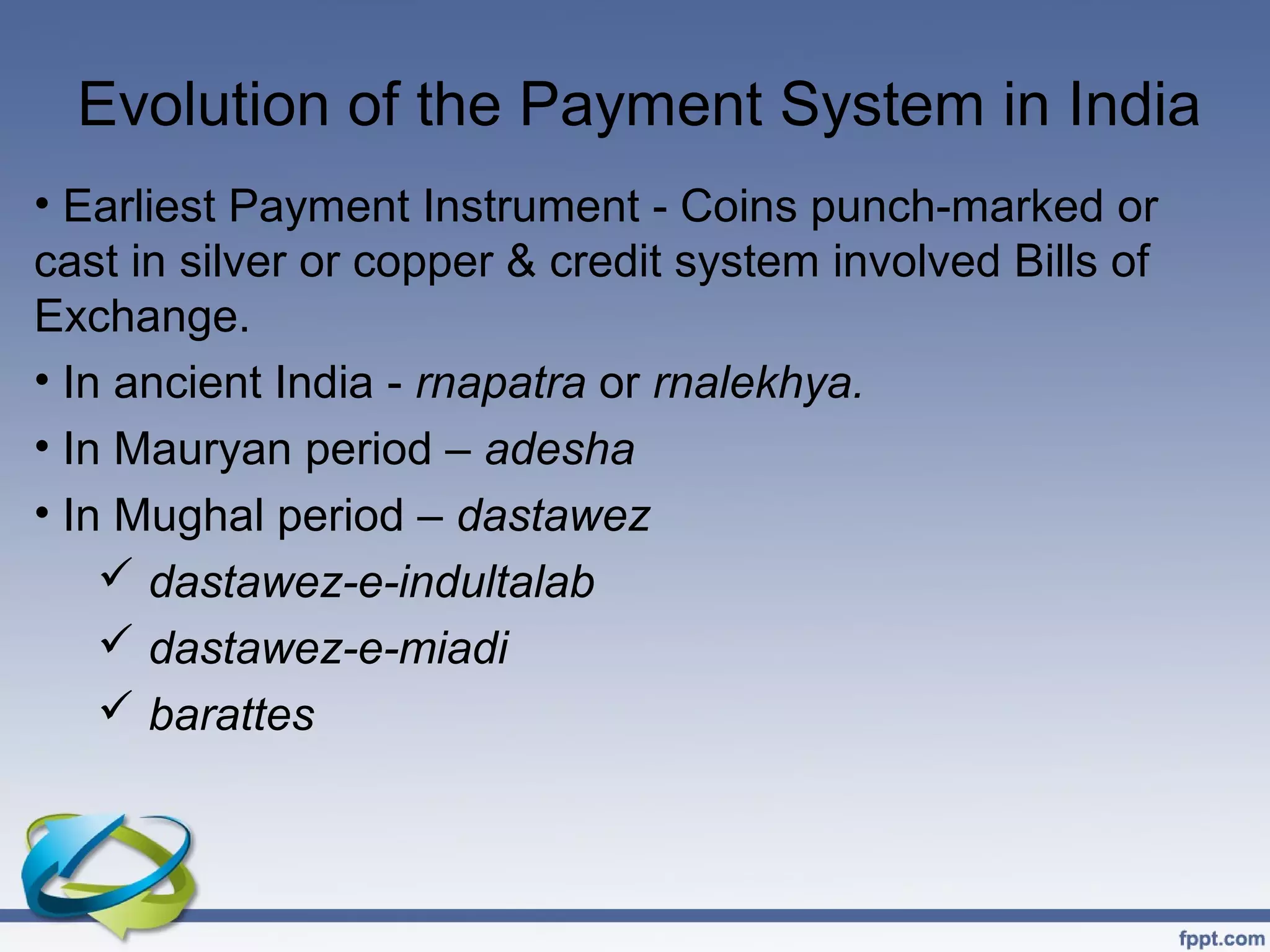
Evolution of the Payment System in India
• Earliest Payment Instrument - Coins punch-marked or
cast in silver or copper & credit system involved Bills of
Exchange.
• In ancient India - rnapatra or rnalekhya.
• In Mauryan period – adesha
• In Mughal period – dastawez
     dastawez-e-indultalab
     dastawez-e-miadi
     barattes
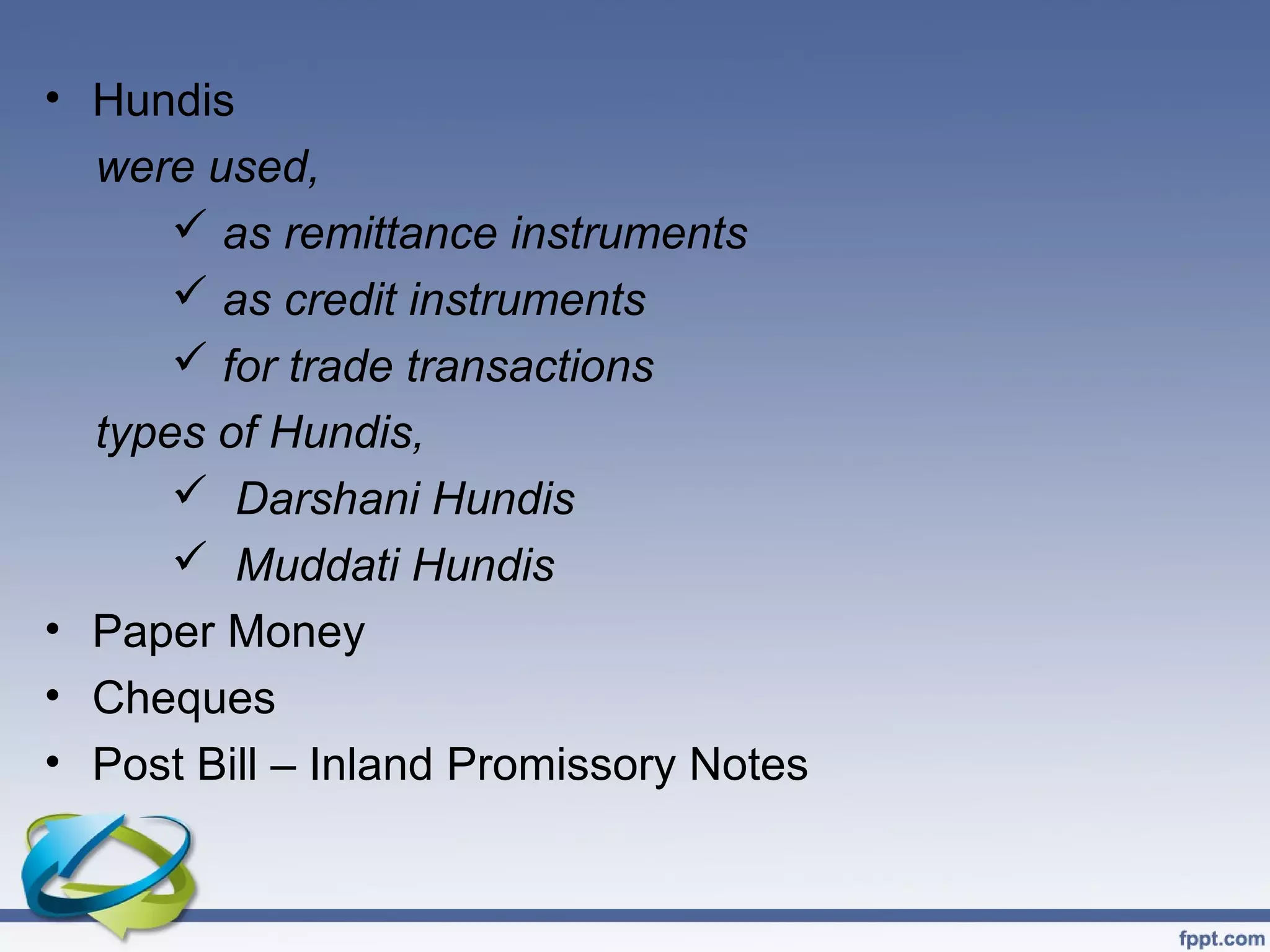
• Hundis
  were used,
       as remittance instruments
       as credit instruments
       for trade transactions
  types of Hundis,
       Darshani Hundis
       Muddati Hundis
• Paper Money
• Cheques
• Post Bill – Inland Promissory Notes
• Cash Credit Account & Buying and Selling of Bills of
  Exchange
• Negotiable Instruments Act, 1881
• Clearing House
• Reserve Bank of India (RBI)
• Till early 2000, cash, DDs & cheque payments were the
  famous modes of transactions
• Payment going E-way
        ECS (Credit)
        ECS (Debit)
        NEFT
        Credit cards & Debit cards etc
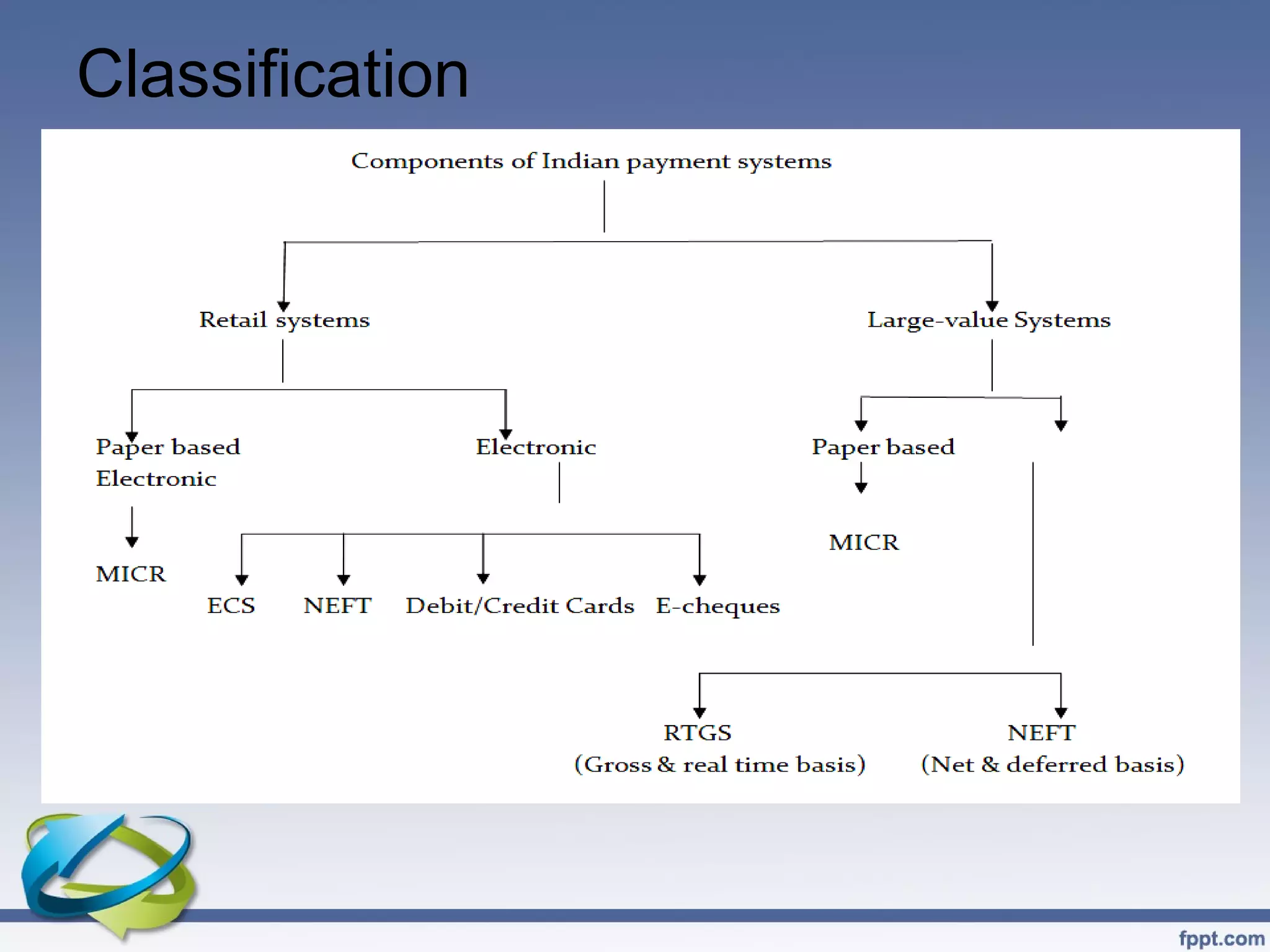
Classification
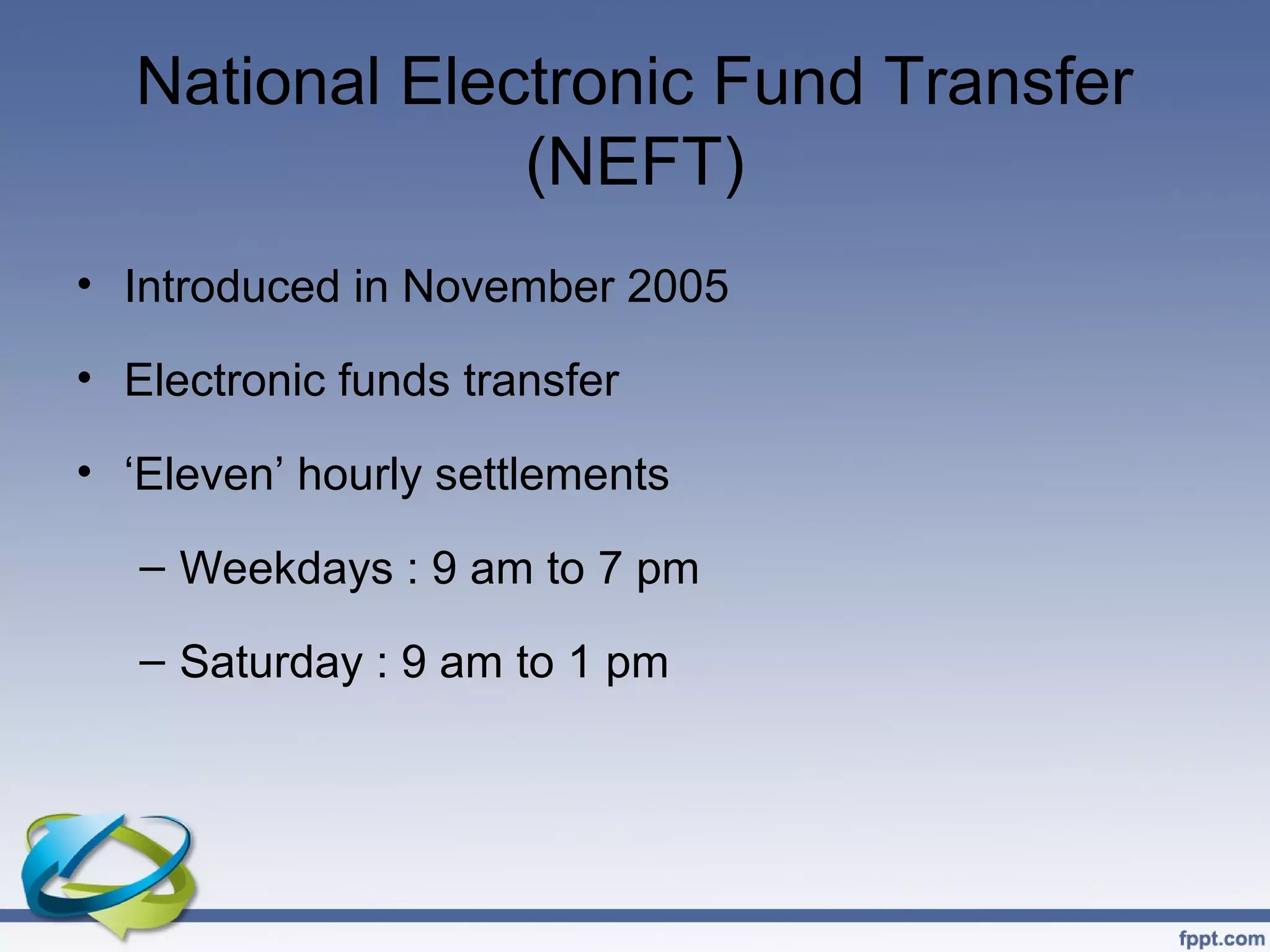
National Electronic Fund Transfer
               (NEFT)
• Introduced in November 2005

• Electronic funds transfer

• ‘Eleven’ hourly settlements

   – Weekdays : 9 am to 7 pm

   – Saturday : 9 am to 1 pm
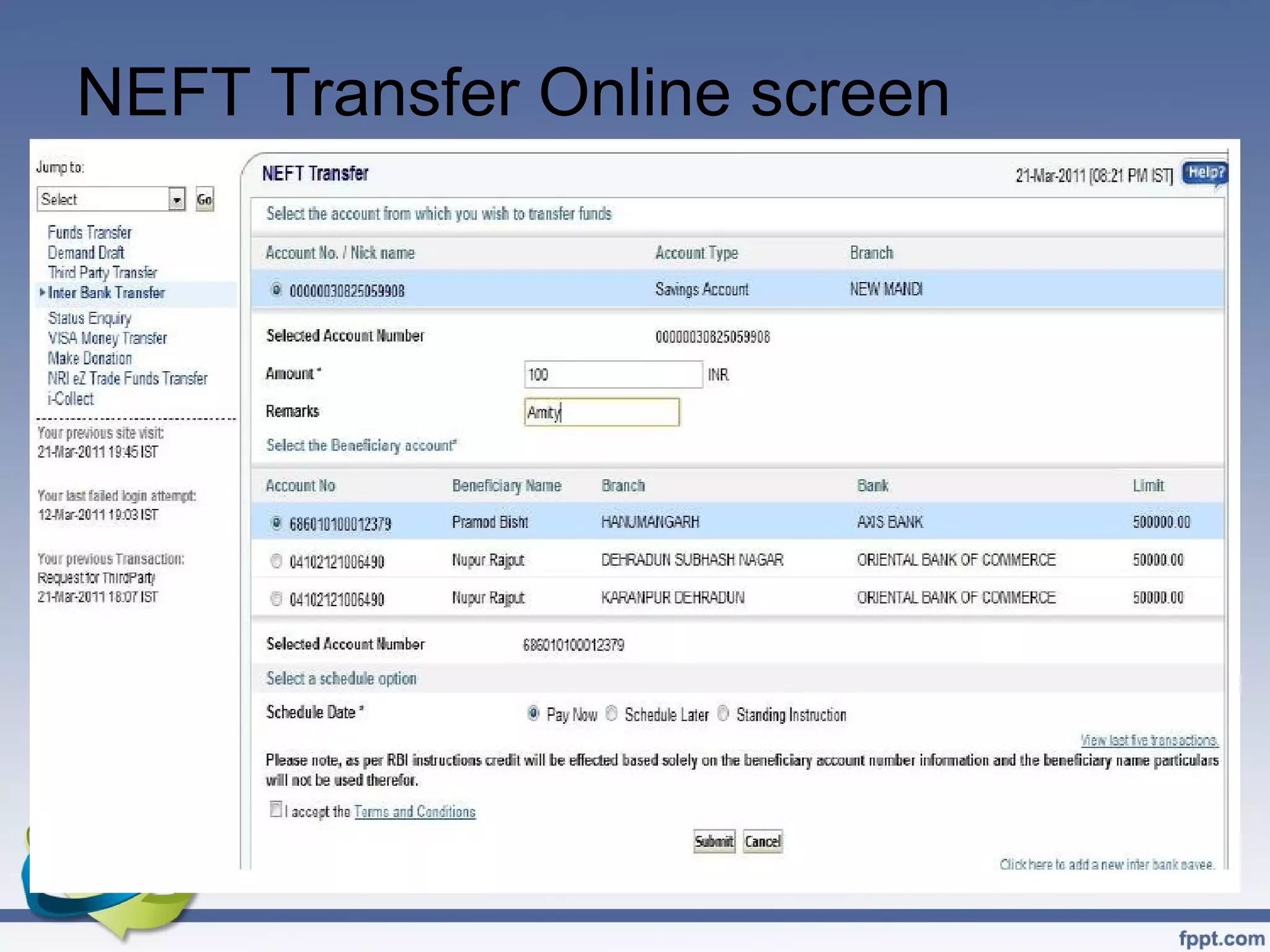
NEFT Transfer Online screen
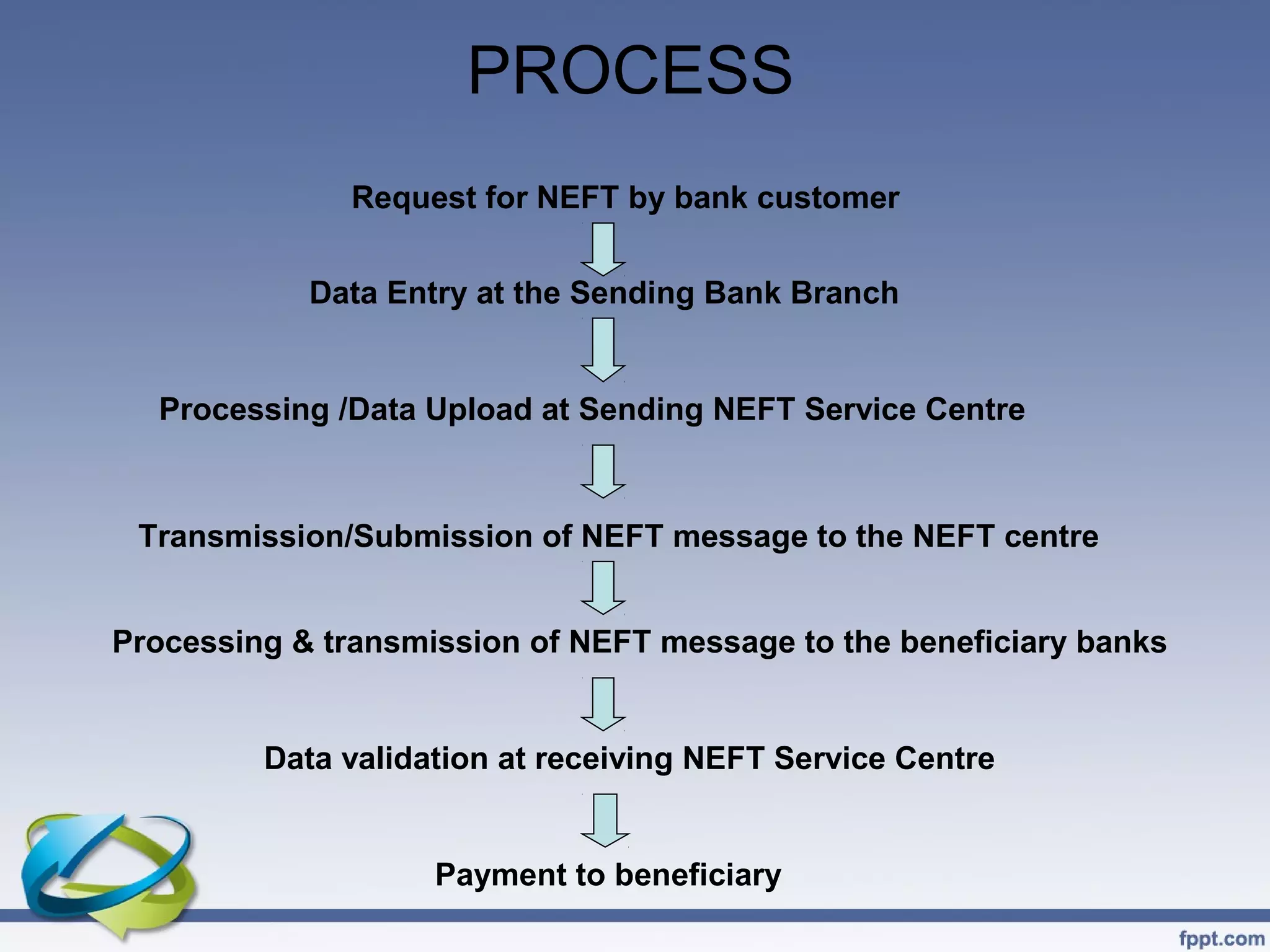
PROCESS
              Request for NEFT by bank customer


            Data Entry at the Sending Bank Branch


  Processing /Data Upload at Sending NEFT Service Centre


 Transmission/Submission of NEFT message to the NEFT centre


Processing & transmission of NEFT message to the beneficiary banks


         Data validation at receiving NEFT Service Centre


                    Payment to beneficiary
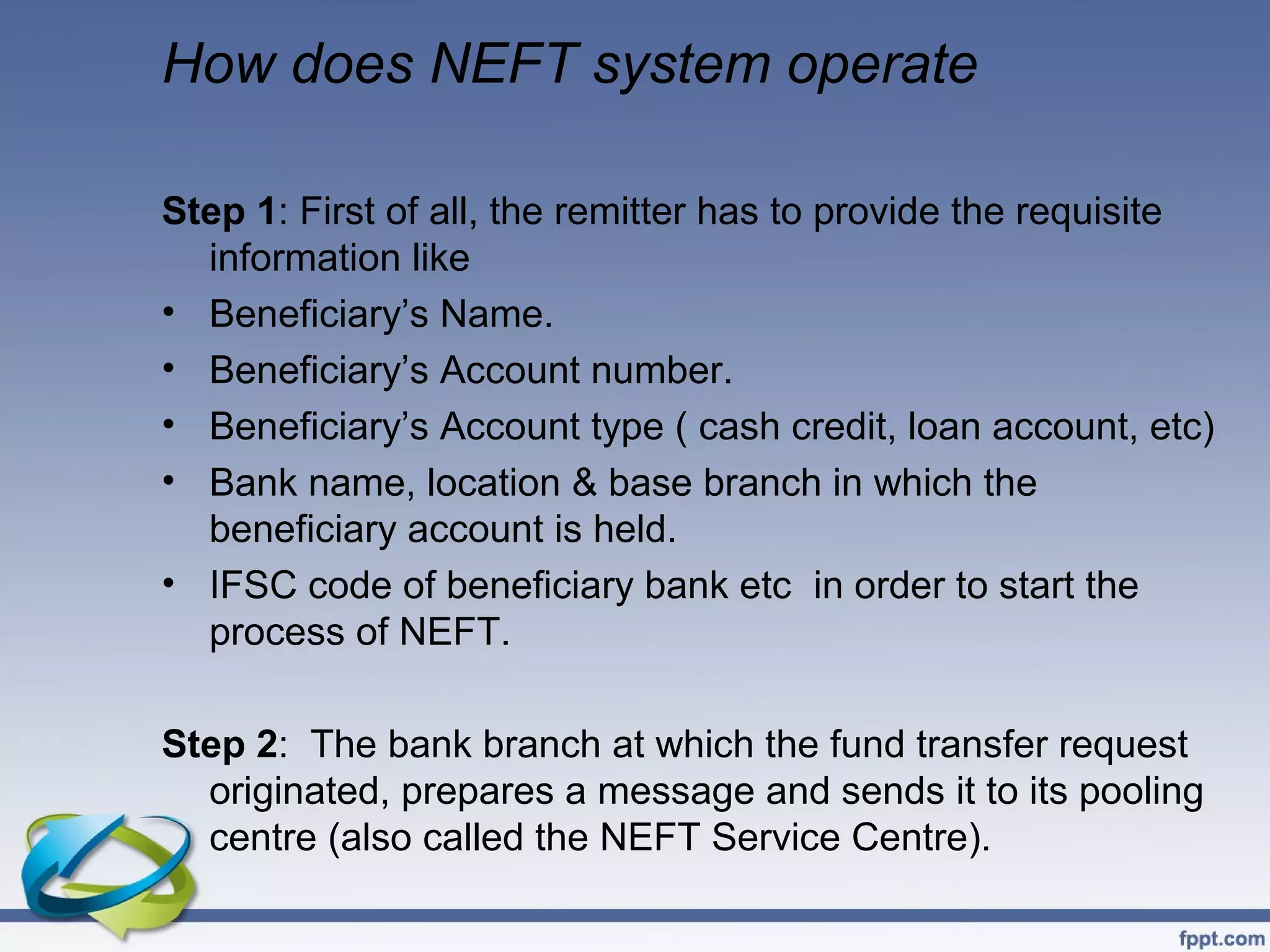
How does NEFT system operate

Step 1: First of all, the remitter has to provide the requisite
  information like
• Beneficiary’s Name.
• Beneficiary’s Account number.
• Beneficiary’s Account type ( cash credit, loan account, etc)
• Bank name, location & base branch in which the
  beneficiary account is held.
• IFSC code of beneficiary bank etc in order to start the
  process of NEFT.

Step 2: The bank branch at which the fund transfer request
  originated, prepares a message and sends it to its pooling
  centre (also called the NEFT Service Centre).
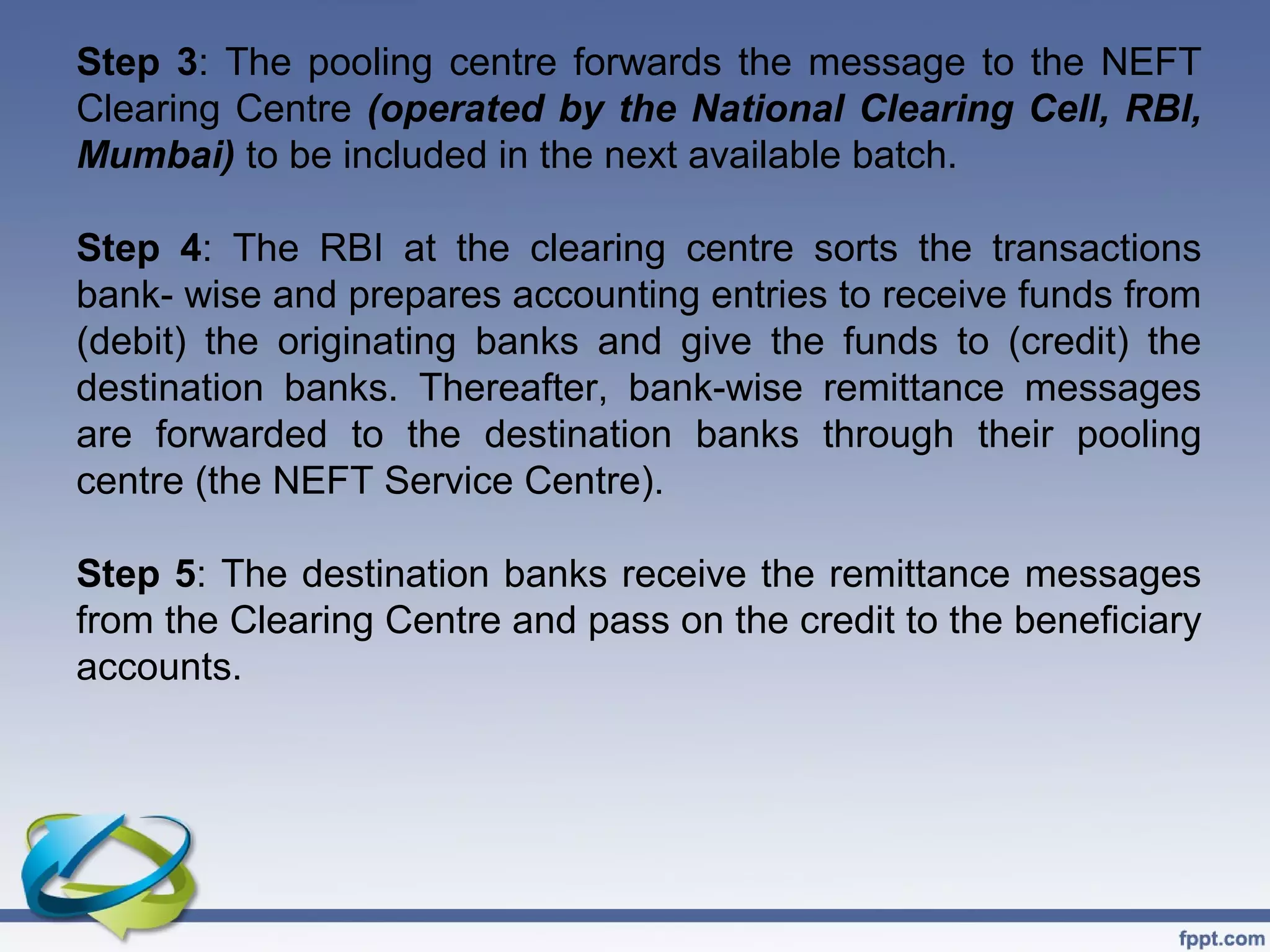
Step 3: The pooling centre forwards the message to the NEFT
Clearing Centre (operated by the National Clearing Cell, RBI,
Mumbai) to be included in the next available batch.

Step 4: The RBI at the clearing centre sorts the transactions
bank- wise and prepares accounting entries to receive funds from
(debit) the originating banks and give the funds to (credit) the
destination banks. Thereafter, bank-wise remittance messages
are forwarded to the destination banks through their pooling
centre (the NEFT Service Centre).

Step 5: The destination banks receive the remittance messages
from the Clearing Centre and pass on the credit to the beneficiary
accounts.
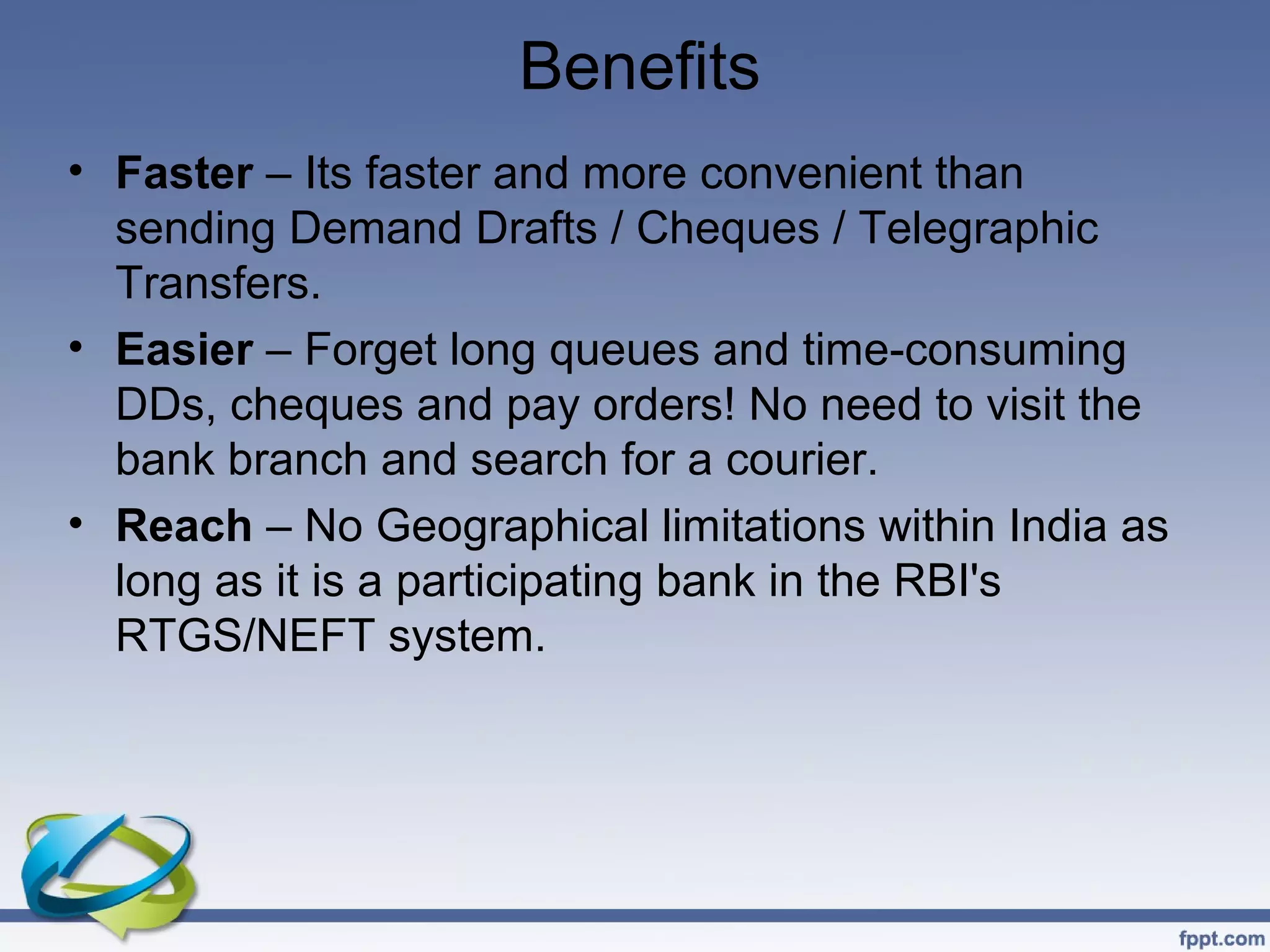
Benefits
• Faster – Its faster and more convenient than
  sending Demand Drafts / Cheques / Telegraphic
  Transfers.
• Easier – Forget long queues and time-consuming
  DDs, cheques and pay orders! No need to visit the
  bank branch and search for a courier.
• Reach – No Geographical limitations within India as
  long as it is a participating bank in the RBI's
  RTGS/NEFT system.
Indian Financial System Code(IFSC)
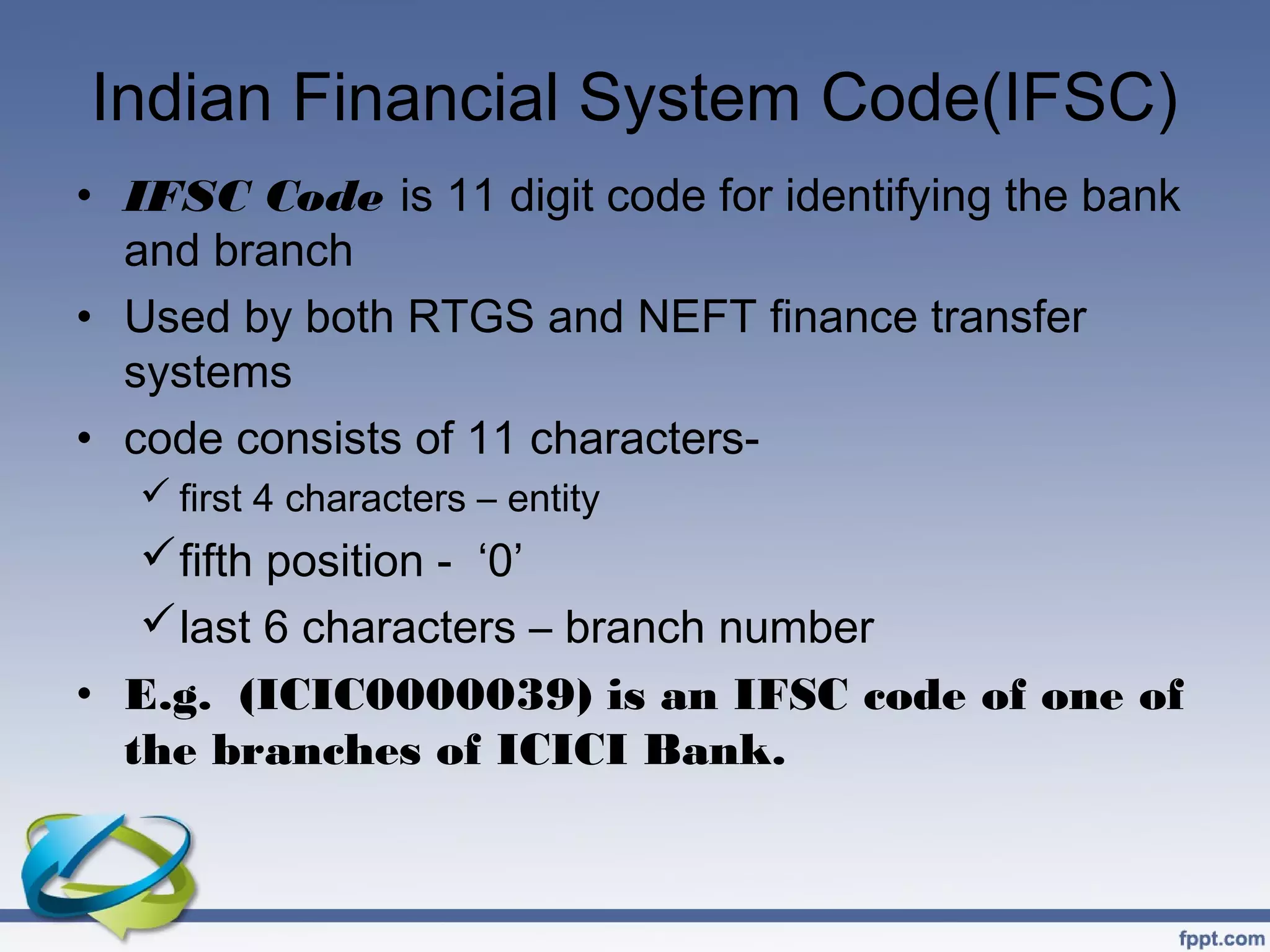
• IFSC Code is 11 digit code for identifying the bank
  and branch
• Used by both RTGS and NEFT finance transfer
  systems
• code consists of 11 characters-
    first 4 characters – entity
    fifth position - ‘0’
    last 6 characters – branch number
• E.g. (ICIC0000039) is an IFSC code of one of
  the branches of ICICI Bank.
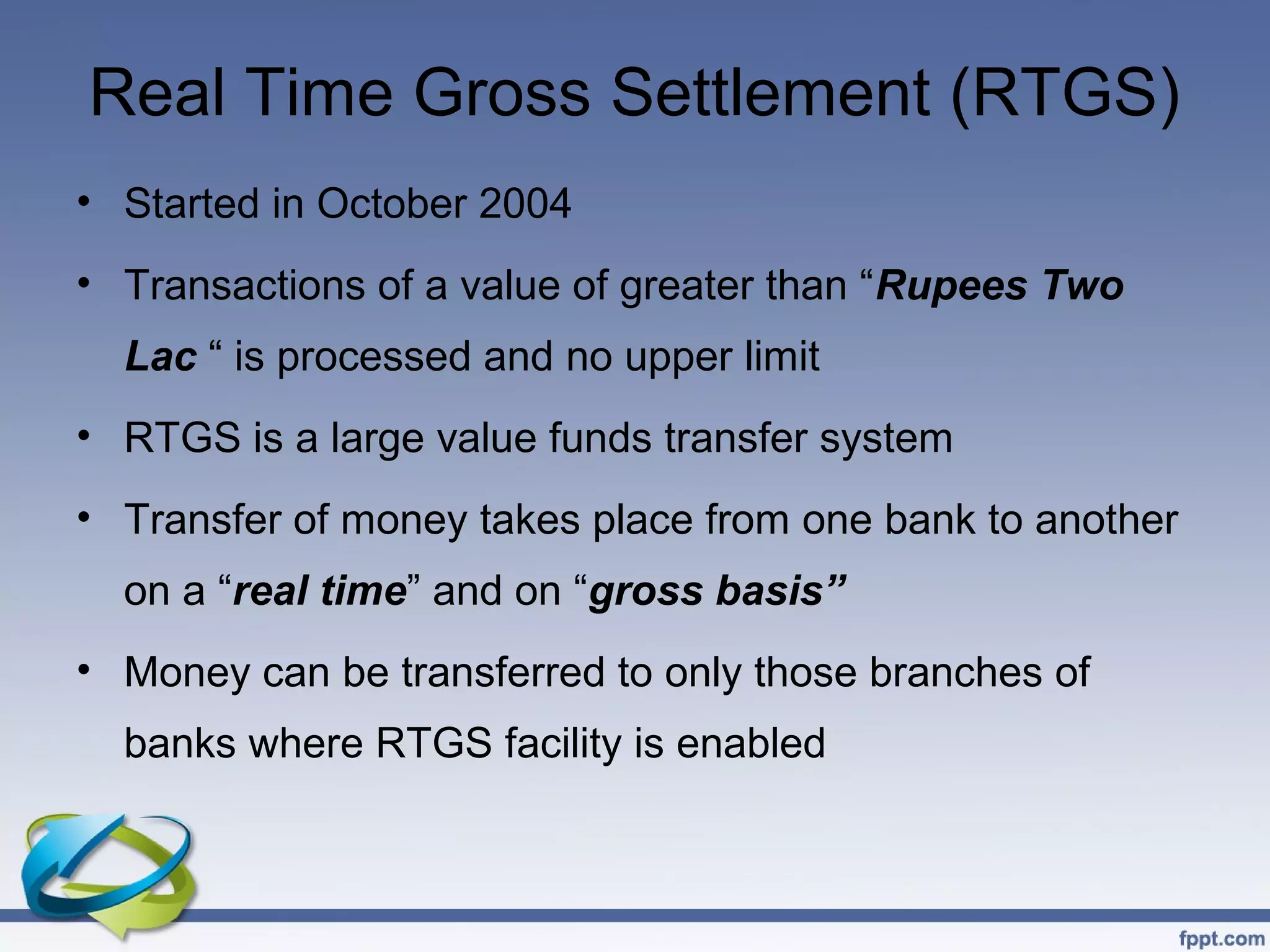
Real Time Gross Settlement (RTGS)
• Started in October 2004
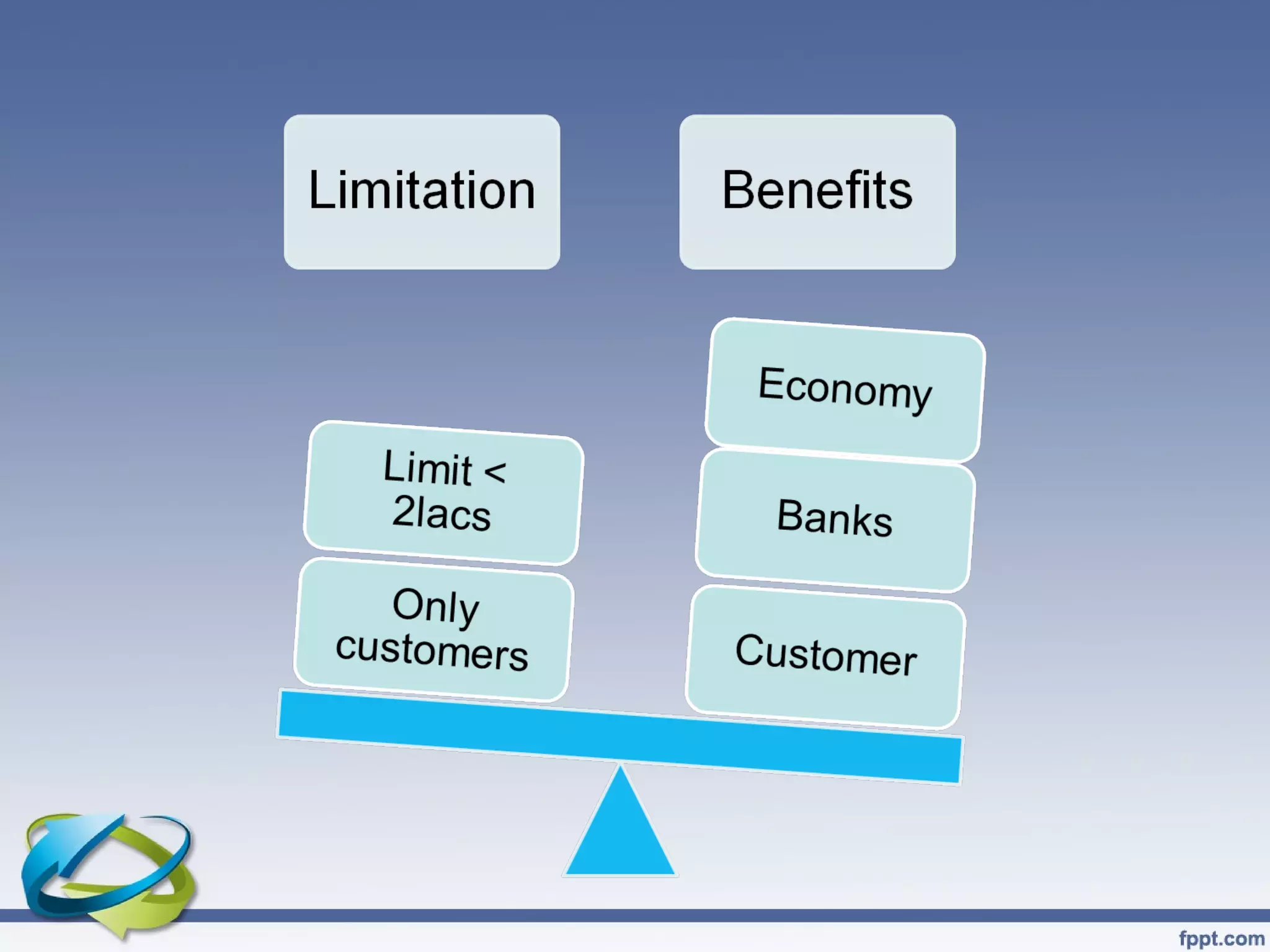
• Transactions of a value of greater than “Rupees Two
  Lac “ is processed and no upper limit
• RTGS is a large value funds transfer system
• Transfer of money takes place from one bank to another
  on a “real time” and on “gross basis”
• Money can be transferred to only those branches of
  banks where RTGS facility is enabled
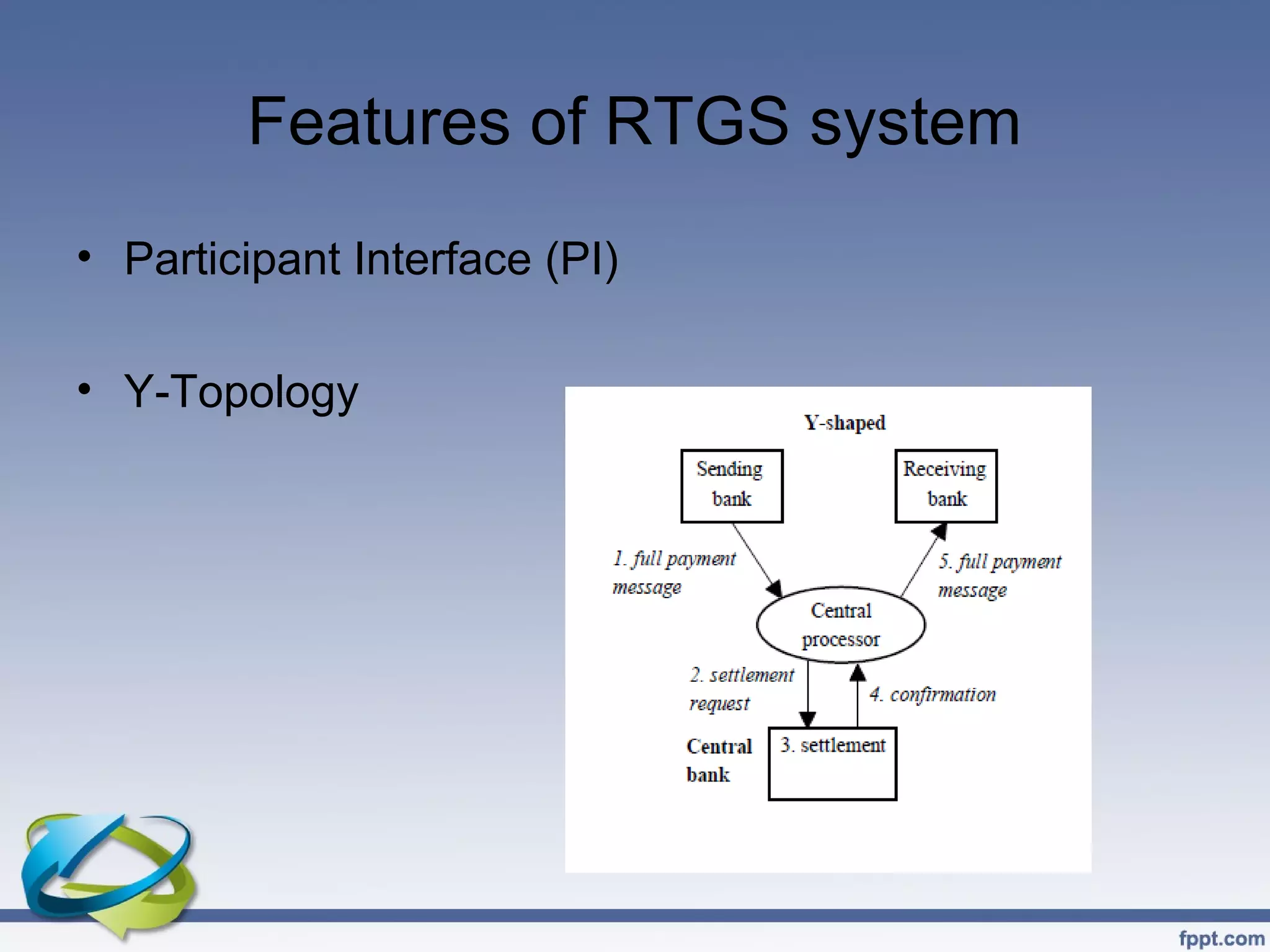
Features of RTGS system
• Participant Interface (PI)

• Y-Topology
Features Contd.

• Intra-day Liquidity Provision

• Interaction with Net Settlement Systems
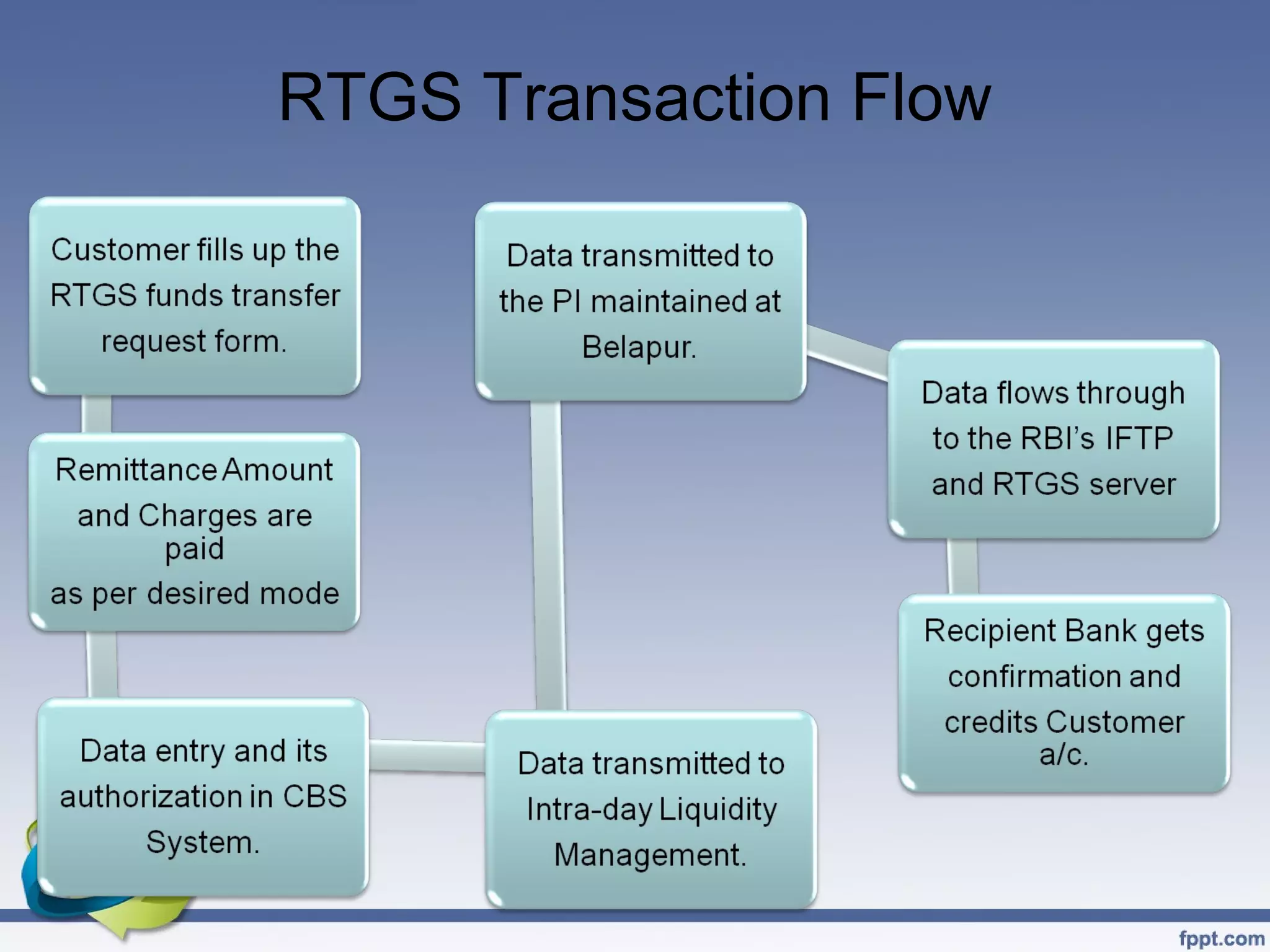
RTGS Transaction Flow
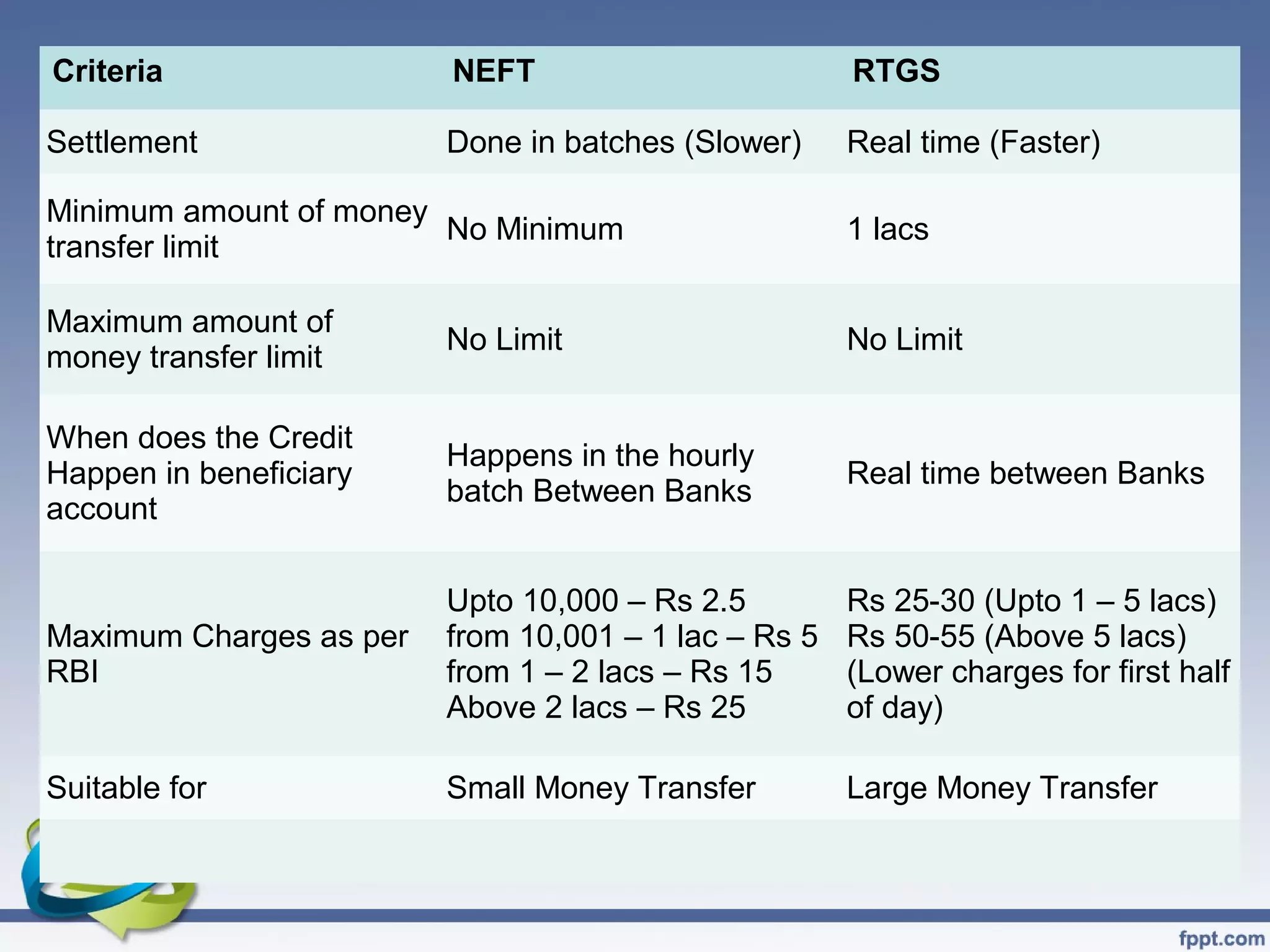
Criteria                 NEFT                         RTGS

Settlement               Done in batches (Slower)     Real time (Faster)

Minimum amount of money
                        No Minimum                    1 lacs
transfer limit

Maximum amount of
                         No Limit                     No Limit
money transfer limit

When does the Credit
                         Happens in the hourly
Happen in beneficiary                                 Real time between Banks
                         batch Between Banks
account

                         Upto 10,000 – Rs 2.5         Rs 25-30 (Upto 1 – 5 lacs)
Maximum Charges as per   from 10,001 – 1 lac – Rs 5   Rs 50-55 (Above 5 lacs)
RBI                      from 1 – 2 lacs – Rs 15      (Lower charges for first half
                         Above 2 lacs – Rs 25         of day)

Suitable for             Small Money Transfer         Large Money Transfer
Thank You.

Neft&rtgs

  • 1.
  • 2.
    Group Members • Benson Verghese 19 • Sarita Sapaliga 29 • Aditi Mahapadi 40 • Dhananjay Joshi 43 • Shruti Ketkar 52
  • 3.
    Evolution of thePayment System in India • Earliest Payment Instrument - Coins punch-marked or cast in silver or copper & credit system involved Bills of Exchange. • In ancient India - rnapatra or rnalekhya. • In Mauryan period – adesha • In Mughal period – dastawez  dastawez-e-indultalab  dastawez-e-miadi  barattes
  • 4.
    • Hundis were used,  as remittance instruments  as credit instruments  for trade transactions types of Hundis,  Darshani Hundis  Muddati Hundis • Paper Money • Cheques • Post Bill – Inland Promissory Notes
  • 5.
    • Cash CreditAccount & Buying and Selling of Bills of Exchange • Negotiable Instruments Act, 1881 • Clearing House • Reserve Bank of India (RBI) • Till early 2000, cash, DDs & cheque payments were the famous modes of transactions • Payment going E-way  ECS (Credit)  ECS (Debit)  NEFT  Credit cards & Debit cards etc
  • 6.
  • 7.
    National Electronic FundTransfer (NEFT) • Introduced in November 2005 • Electronic funds transfer • ‘Eleven’ hourly settlements – Weekdays : 9 am to 7 pm – Saturday : 9 am to 1 pm
  • 8.
  • 9.
    PROCESS Request for NEFT by bank customer Data Entry at the Sending Bank Branch Processing /Data Upload at Sending NEFT Service Centre Transmission/Submission of NEFT message to the NEFT centre Processing & transmission of NEFT message to the beneficiary banks Data validation at receiving NEFT Service Centre Payment to beneficiary
  • 10.
    How does NEFTsystem operate Step 1: First of all, the remitter has to provide the requisite information like • Beneficiary’s Name. • Beneficiary’s Account number. • Beneficiary’s Account type ( cash credit, loan account, etc) • Bank name, location & base branch in which the beneficiary account is held. • IFSC code of beneficiary bank etc in order to start the process of NEFT. Step 2: The bank branch at which the fund transfer request originated, prepares a message and sends it to its pooling centre (also called the NEFT Service Centre).
  • 11.
    Step 3: Thepooling centre forwards the message to the NEFT Clearing Centre (operated by the National Clearing Cell, RBI, Mumbai) to be included in the next available batch. Step 4: The RBI at the clearing centre sorts the transactions bank- wise and prepares accounting entries to receive funds from (debit) the originating banks and give the funds to (credit) the destination banks. Thereafter, bank-wise remittance messages are forwarded to the destination banks through their pooling centre (the NEFT Service Centre). Step 5: The destination banks receive the remittance messages from the Clearing Centre and pass on the credit to the beneficiary accounts.
  • 12.
    Benefits • Faster –Its faster and more convenient than sending Demand Drafts / Cheques / Telegraphic Transfers. • Easier – Forget long queues and time-consuming DDs, cheques and pay orders! No need to visit the bank branch and search for a courier. • Reach – No Geographical limitations within India as long as it is a participating bank in the RBI's RTGS/NEFT system.
  • 13.
    Indian Financial SystemCode(IFSC) • IFSC Code is 11 digit code for identifying the bank and branch • Used by both RTGS and NEFT finance transfer systems • code consists of 11 characters-  first 4 characters – entity  fifth position - ‘0’  last 6 characters – branch number • E.g. (ICIC0000039) is an IFSC code of one of the branches of ICICI Bank.
  • 14.
    Real Time GrossSettlement (RTGS) • Started in October 2004 • Transactions of a value of greater than “Rupees Two Lac “ is processed and no upper limit • RTGS is a large value funds transfer system • Transfer of money takes place from one bank to another on a “real time” and on “gross basis” • Money can be transferred to only those branches of banks where RTGS facility is enabled
  • 15.
    Features of RTGSsystem • Participant Interface (PI) • Y-Topology
  • 16.
    Features Contd. • Intra-dayLiquidity Provision • Interaction with Net Settlement Systems
  • 17.
  • 19.
    Criteria NEFT RTGS Settlement Done in batches (Slower) Real time (Faster) Minimum amount of money No Minimum 1 lacs transfer limit Maximum amount of No Limit No Limit money transfer limit When does the Credit Happens in the hourly Happen in beneficiary Real time between Banks batch Between Banks account Upto 10,000 – Rs 2.5 Rs 25-30 (Upto 1 – 5 lacs) Maximum Charges as per from 10,001 – 1 lac – Rs 5 Rs 50-55 (Above 5 lacs) RBI from 1 – 2 lacs – Rs 15 (Lower charges for first half Above 2 lacs – Rs 25 of day) Suitable for Small Money Transfer Large Money Transfer
  • 20.