
Natural
Language
Processing
Assignment
Help
What is natural language
processing?
Natural language processing can be a
theoretically motivated range of computational
techniques for analyzing and also which
represents naturally occurring texts or speech
with more than one numbers of linguistic analysis
for the purpose of achieving human such as
language processing with regard to a variety of
tasks or even applications.
Cont…
• Natural-Language-Processing
– Process information within natural language
text.
– Also called Computational Linguistics(CL),
Human Language Technology (HLT) and
Natural Language Engineering (NLE)
• Can machines understand human language?
– Define understand.
Cont…
• Analyze, understand as well as generate human
languages the same as humans do.
• Using computational techniques to language
domain.
• To describe linguistic theories, to make use of
the theories to build systems which can be
regarding social use.
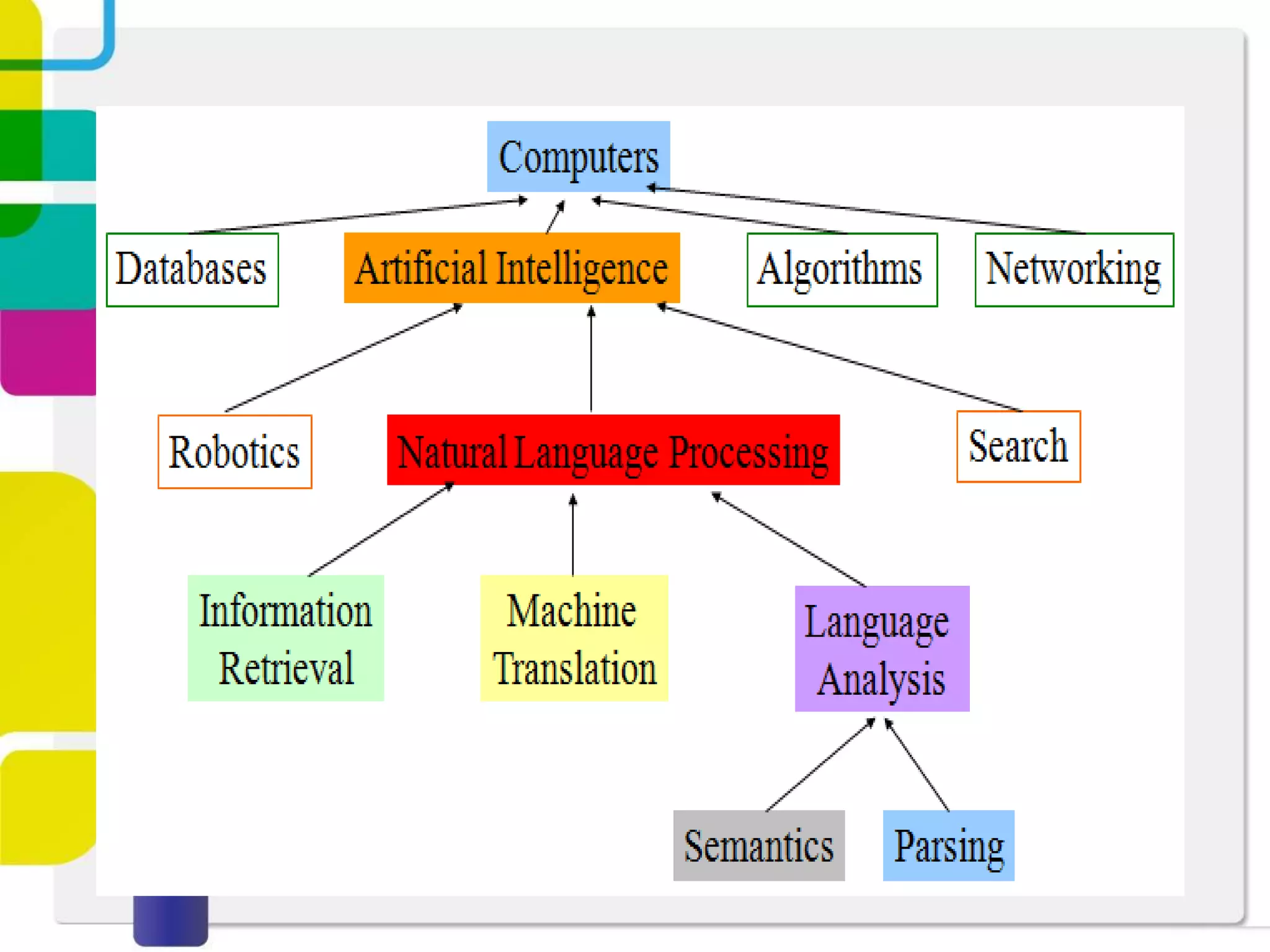
• Started off like a branch associated with
Artificial Intelligence.
Cont…
• Borrows from Linguistics, Psycholinguistics,
Cognitive Science as well as Statistics.
• Help to make computers learn our language
rather than we learn theirs.
Kinds of Natural Language
• The input or output of a natural language
processing system could be called
– written text and
– speech
• We will mainly focused on written text (not
necessarily speech).
• To be able to method written text, we need:
– Lexical
– Syntactic
– semantic information
Cont…
– discourse details
– real world knowledge
• In order to procedure spoken language, we need
every thing necessary to process written text, as
well as the problems associated with speech
recognition as well as speech synthesis.
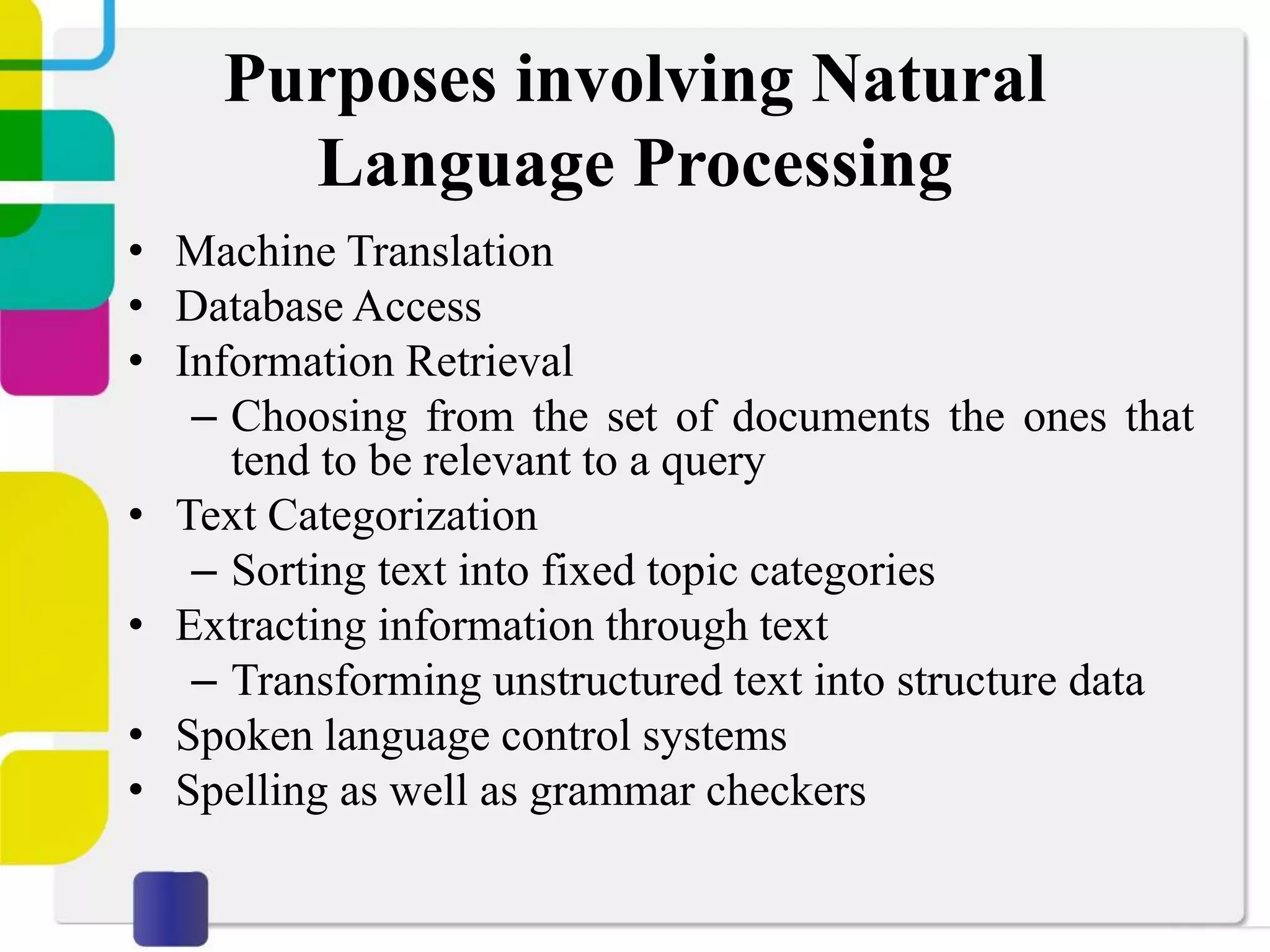
Purposes involving Natural
Language Processing
• Machine Translation
• Database Access
• Information Retrieval
– Choosing from the set of documents the ones that
tend to be relevant to a query
• Text Categorization
– Sorting text into fixed topic categories
• Extracting information through text
– Transforming unstructured text into structure data
• Spoken language control systems
• Spelling as well as grammar checkers
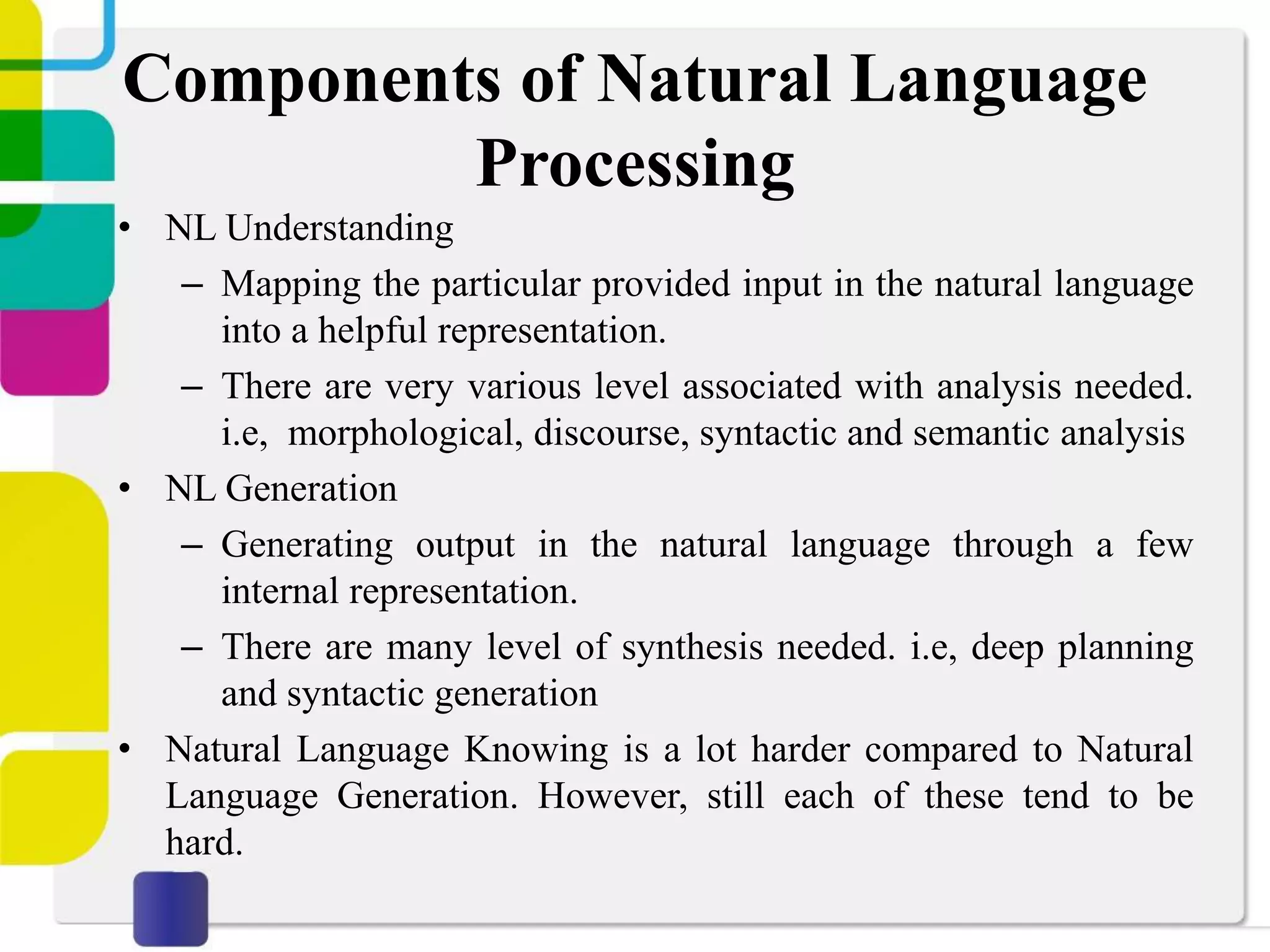
Components of Natural Language
Processing
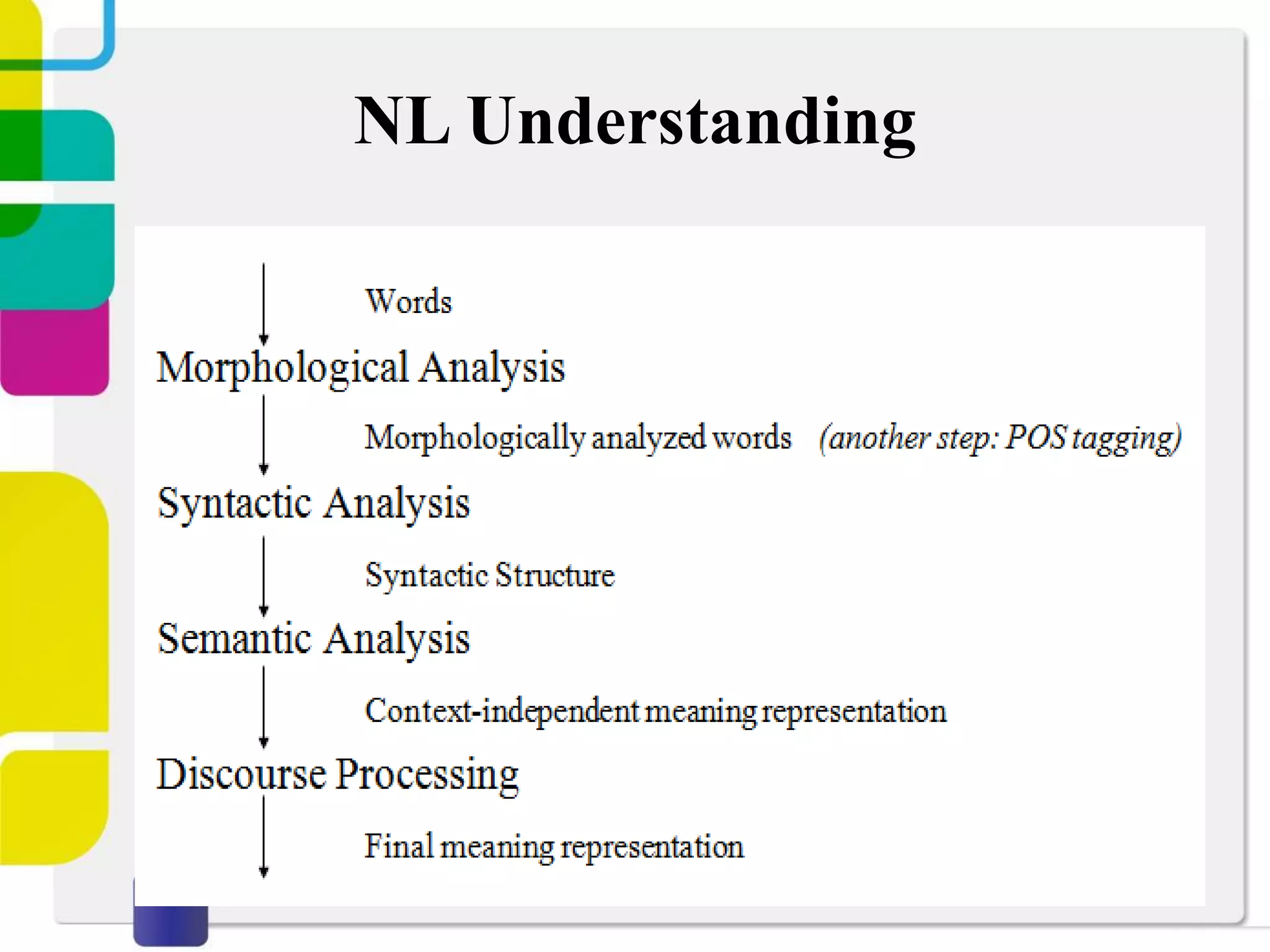
• NL Understanding
– Mapping the particular provided input in the natural language
into a helpful representation.
– There are very various level associated with analysis needed.
i.e, morphological, discourse, syntactic and semantic analysis
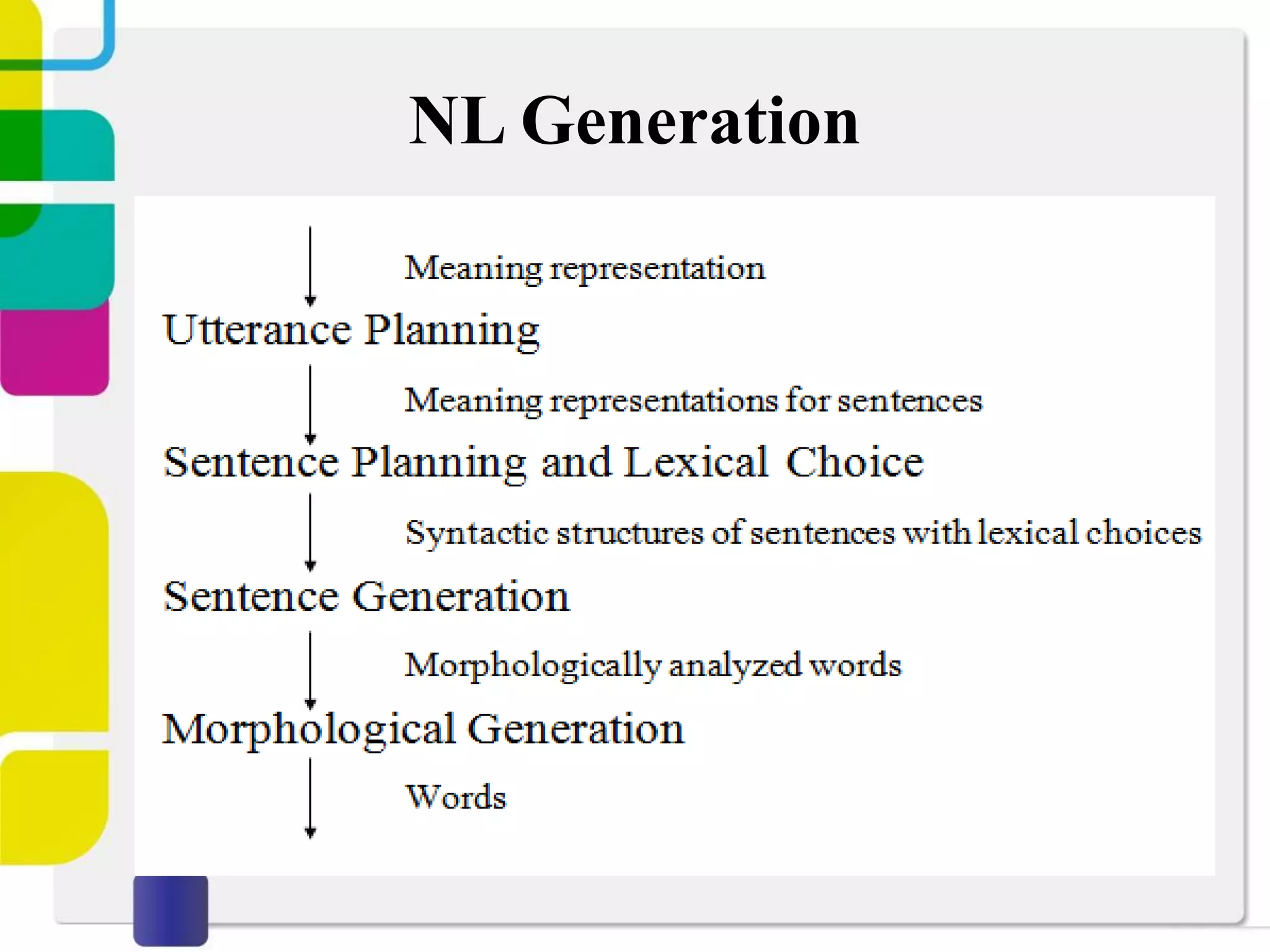
• NL Generation
– Generating output in the natural language through a few
internal representation.
– There are many level of synthesis needed. i.e, deep planning
and syntactic generation
• Natural Language Knowing is a lot harder compared to Natural
Language Generation. However, still each of these tend to be
hard.
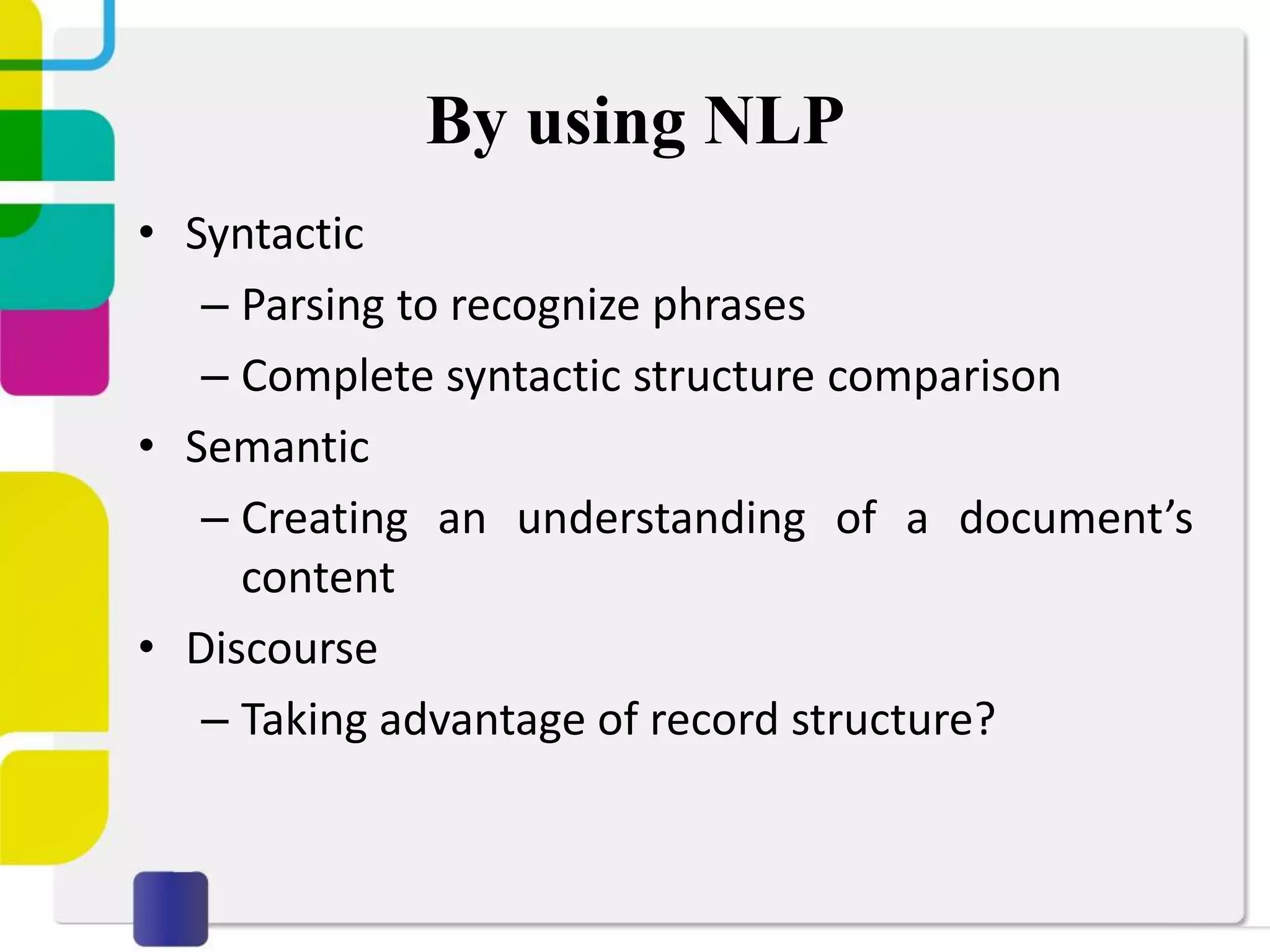
By using NLP
• Syntactic
– Parsing to recognize phrases
– Complete syntactic structure comparison
• Semantic
– Creating an understanding of a document’s
content
• Discourse
– Taking advantage of record structure?
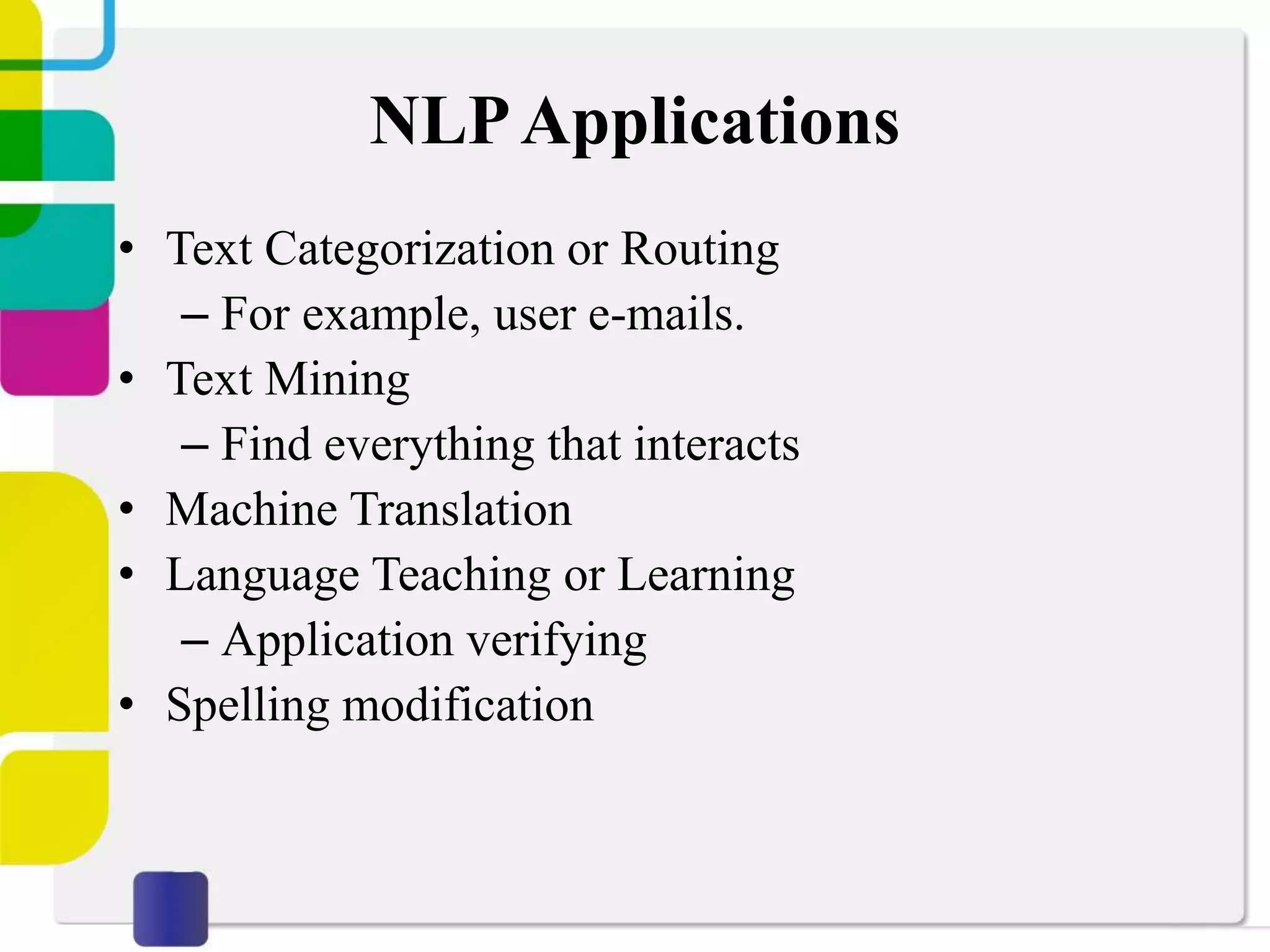
NLPApplications
• Text Categorization or Routing
– For example, user e-mails.
• Text Mining
– Find everything that interacts
• Machine Translation
• Language Teaching or Learning
– Application verifying
• Spelling modification
Cont…
• Machine Translation - Translation in between 2 NL.
• Information Retrieval - Web search
• Query Answering - NL interface user interface having
a data source program, or a dialogue system.
• Report Generation - Generation associated with
reports for example weather reports.
• Many Applications i.e,
– Checking Grammar correctly
– Checking the spelling
– Spell Corrector
Knowledge of Language
• Phonology - considerations the way words tend to be
related to the sounds which recognize all of them.
• Morphology - considerations the way words are
constructed from more basic meaning units that is known as
morphemes. A morpheme would be the primitive unit
connected with meaning in a language.
• Semantics - considerations what exactly words indicate as
well as exactly how these types of meaning combine in
sentences to form sentence meaning.
Cont…
• Syntax - considerations how should be placed
together to form correct sentences as well as
decides what structural role each word plays within
the sentence and what phrases tend to be subparts
associated with other phrases.
NL Understanding
NL Generation
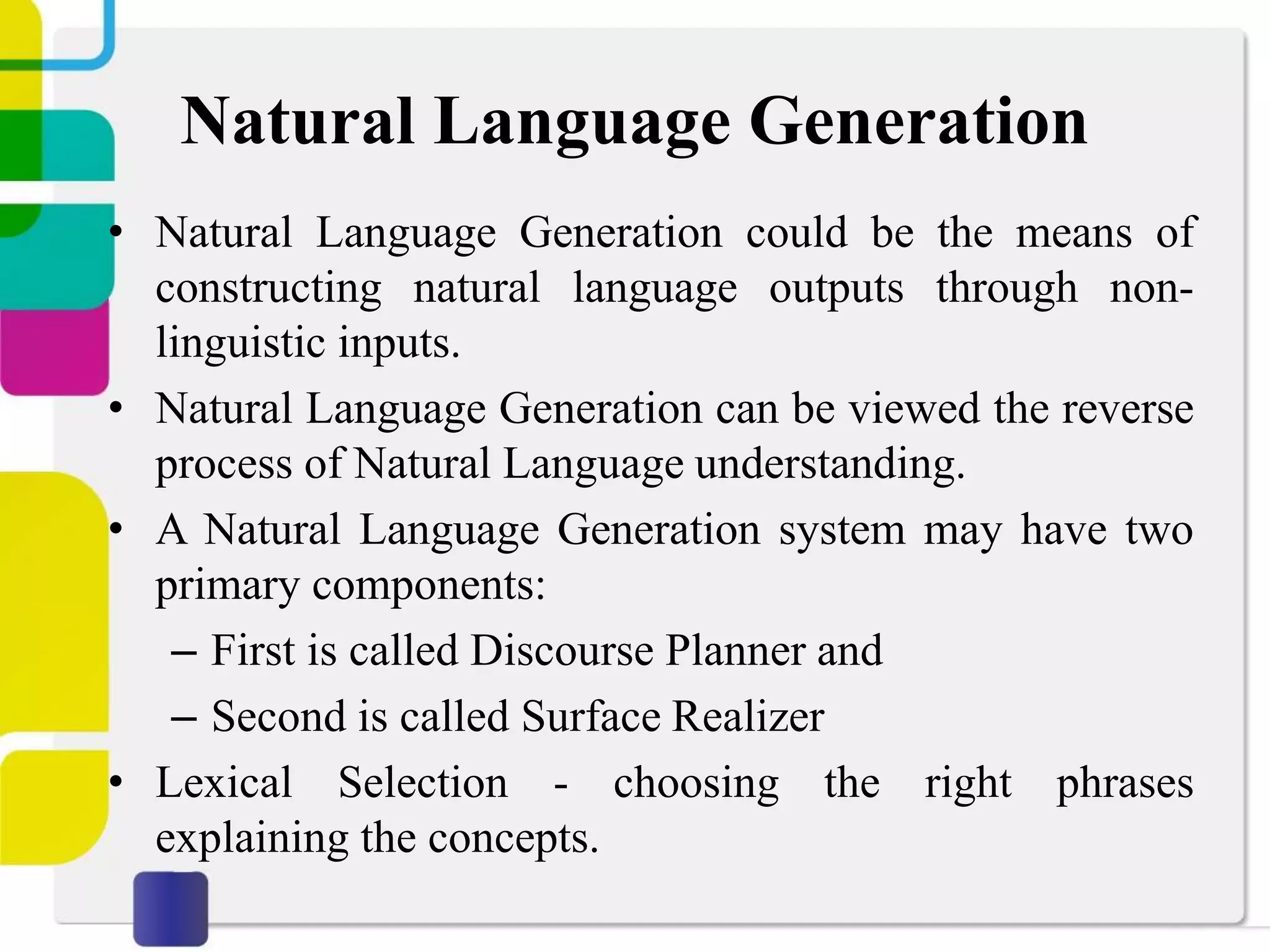
Natural Language Generation
• Natural Language Generation could be the means of
constructing natural language outputs through non-
linguistic inputs.
• Natural Language Generation can be viewed the reverse
process of Natural Language understanding.
• A Natural Language Generation system may have two
primary components:
– First is called Discourse Planner and
– Second is called Surface Realizer
• Lexical Selection - choosing the right phrases
explaining the concepts.
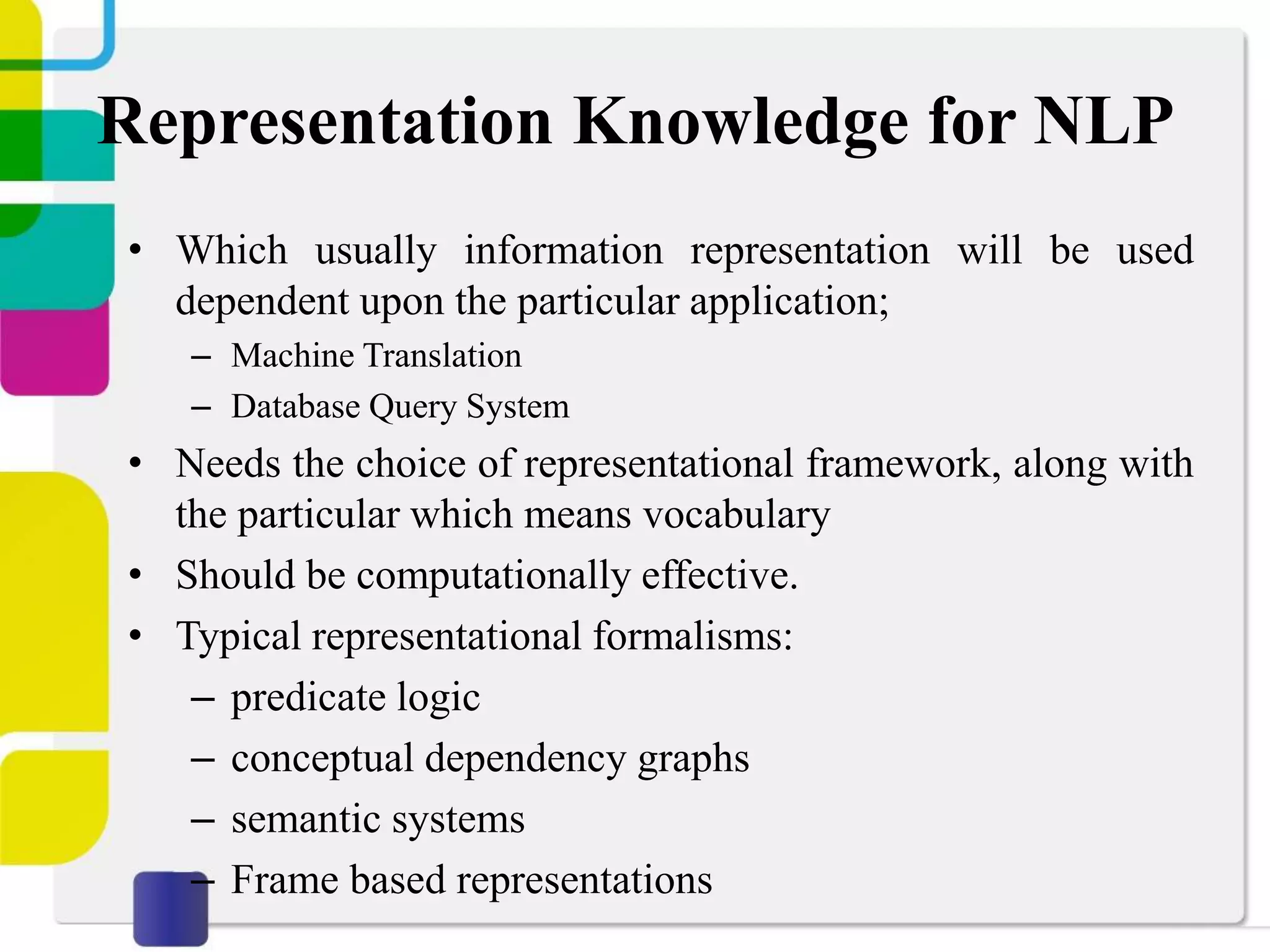
Representation Knowledge for NLP
• Which usually information representation will be used
dependent upon the particular application;
– Machine Translation
– Database Query System
• Needs the choice of representational framework, along with
the particular which means vocabulary
• Should be computationally effective.
• Typical representational formalisms:
– predicate logic
– conceptual dependency graphs
– semantic systems
– Frame based representations
NLP Terminology
• Phonology
• Morphology
• Morpheme
• Syntax
• Semantics
• Pragmatics
• Discourse
• World Knowledge
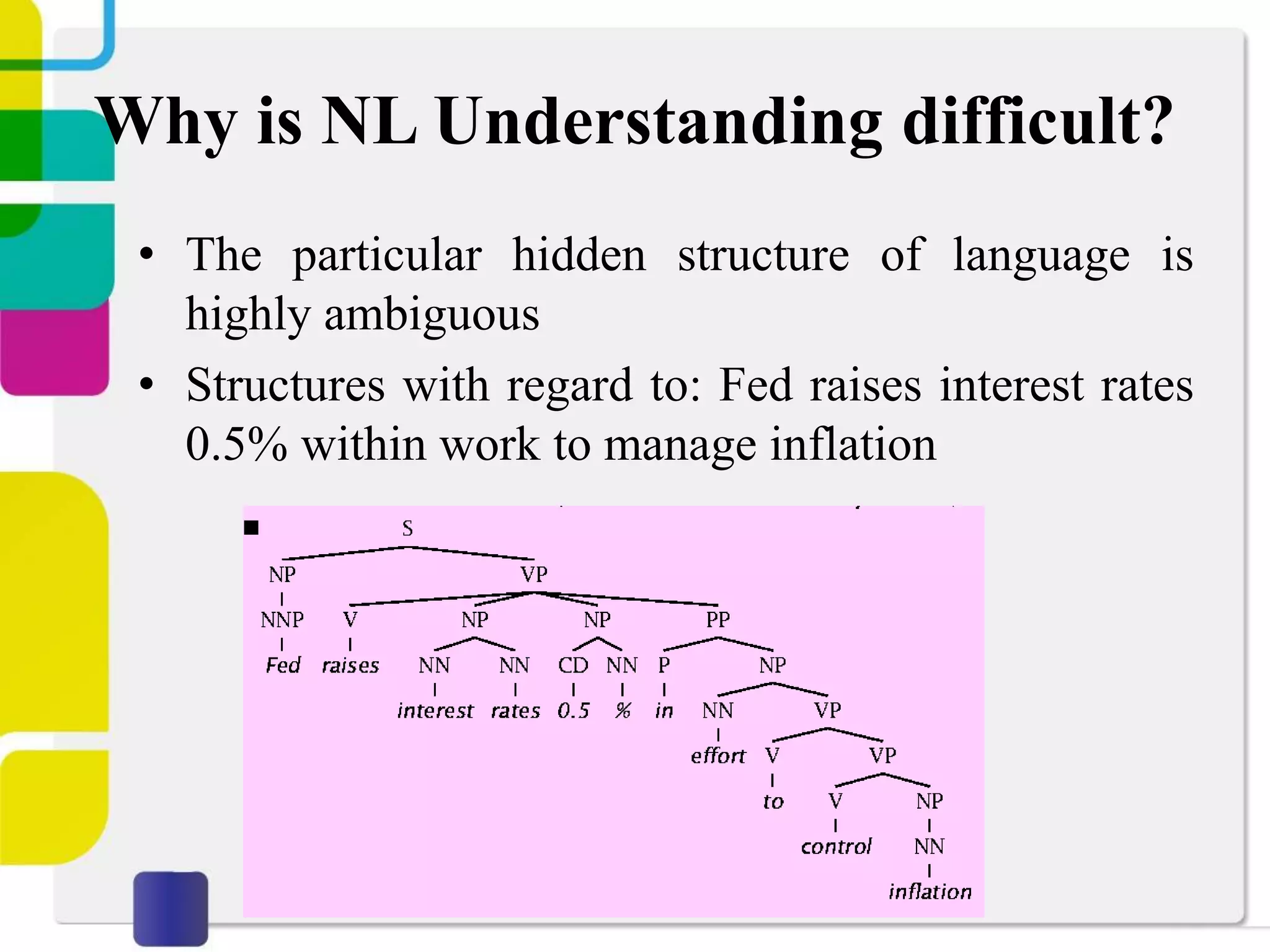
Why is NL Understanding difficult?
• The particular hidden structure of language is
highly ambiguous
• Structures with regard to: Fed raises interest rates
0.5% within work to manage inflation
Thank You
www.myassignmenthelp.net
Email Us at :
support@myassignmenthelp.net

natural language processing help at myassignmenthelp.net

  • 1.
  • 2.
    What is naturallanguage processing? Natural language processing can be a theoretically motivated range of computational techniques for analyzing and also which represents naturally occurring texts or speech with more than one numbers of linguistic analysis for the purpose of achieving human such as language processing with regard to a variety of tasks or even applications.
  • 3.
    Cont… • Natural-Language-Processing – Processinformation within natural language text. – Also called Computational Linguistics(CL), Human Language Technology (HLT) and Natural Language Engineering (NLE) • Can machines understand human language? – Define understand.
  • 4.
    Cont… • Analyze, understandas well as generate human languages the same as humans do. • Using computational techniques to language domain. • To describe linguistic theories, to make use of the theories to build systems which can be regarding social use. • Started off like a branch associated with Artificial Intelligence.
  • 5.
    Cont… • Borrows fromLinguistics, Psycholinguistics, Cognitive Science as well as Statistics. • Help to make computers learn our language rather than we learn theirs.
  • 7.
    Kinds of NaturalLanguage • The input or output of a natural language processing system could be called – written text and – speech • We will mainly focused on written text (not necessarily speech). • To be able to method written text, we need: – Lexical – Syntactic – semantic information
  • 8.
    Cont… – discourse details –real world knowledge • In order to procedure spoken language, we need every thing necessary to process written text, as well as the problems associated with speech recognition as well as speech synthesis.
  • 9.
    Purposes involving Natural LanguageProcessing • Machine Translation • Database Access • Information Retrieval – Choosing from the set of documents the ones that tend to be relevant to a query • Text Categorization – Sorting text into fixed topic categories • Extracting information through text – Transforming unstructured text into structure data • Spoken language control systems • Spelling as well as grammar checkers
  • 10.
    Components of NaturalLanguage Processing • NL Understanding – Mapping the particular provided input in the natural language into a helpful representation. – There are very various level associated with analysis needed. i.e, morphological, discourse, syntactic and semantic analysis • NL Generation – Generating output in the natural language through a few internal representation. – There are many level of synthesis needed. i.e, deep planning and syntactic generation • Natural Language Knowing is a lot harder compared to Natural Language Generation. However, still each of these tend to be hard.
  • 11.
    By using NLP •Syntactic – Parsing to recognize phrases – Complete syntactic structure comparison • Semantic – Creating an understanding of a document’s content • Discourse – Taking advantage of record structure?
  • 12.
    NLPApplications • Text Categorizationor Routing – For example, user e-mails. • Text Mining – Find everything that interacts • Machine Translation • Language Teaching or Learning – Application verifying • Spelling modification
  • 13.
    Cont… • Machine Translation- Translation in between 2 NL. • Information Retrieval - Web search • Query Answering - NL interface user interface having a data source program, or a dialogue system. • Report Generation - Generation associated with reports for example weather reports. • Many Applications i.e, – Checking Grammar correctly – Checking the spelling – Spell Corrector
  • 14.
    Knowledge of Language •Phonology - considerations the way words tend to be related to the sounds which recognize all of them. • Morphology - considerations the way words are constructed from more basic meaning units that is known as morphemes. A morpheme would be the primitive unit connected with meaning in a language. • Semantics - considerations what exactly words indicate as well as exactly how these types of meaning combine in sentences to form sentence meaning.
  • 15.
    Cont… • Syntax -considerations how should be placed together to form correct sentences as well as decides what structural role each word plays within the sentence and what phrases tend to be subparts associated with other phrases.
  • 16.
  • 17.
  • 18.
    Natural Language Generation •Natural Language Generation could be the means of constructing natural language outputs through non- linguistic inputs. • Natural Language Generation can be viewed the reverse process of Natural Language understanding. • A Natural Language Generation system may have two primary components: – First is called Discourse Planner and – Second is called Surface Realizer • Lexical Selection - choosing the right phrases explaining the concepts.
  • 19.
    Representation Knowledge forNLP • Which usually information representation will be used dependent upon the particular application; – Machine Translation – Database Query System • Needs the choice of representational framework, along with the particular which means vocabulary • Should be computationally effective. • Typical representational formalisms: – predicate logic – conceptual dependency graphs – semantic systems – Frame based representations
  • 20.
    NLP Terminology • Phonology •Morphology • Morpheme • Syntax • Semantics • Pragmatics • Discourse • World Knowledge
  • 21.
    Why is NLUnderstanding difficult? • The particular hidden structure of language is highly ambiguous • Structures with regard to: Fed raises interest rates 0.5% within work to manage inflation
  • 22.
    Thank You www.myassignmenthelp.net Email Usat : support@myassignmenthelp.net