
P
R
E
S
S
K
I
T
Table of CONTENTS
Introduction							03
What Are the Solar Wind
and the Heliosphere?					05
Mission Overview						06
IMAP Spacecraft						10
IMAP Instruments					12
Glossary							15
Media Services						16
Mission Management					18
IMAP Quick Facts
Spacecraft weight: 797 kg (1,757 pounds)
Spacecraft diameter: 8 feet (2.4 meters)
Instruments: 10
Launch: 2025
Destination: Earth–Sun Lagrange Point 1 (L1)
(1 million miles from Earth toward Sun)
Length of Trip to L1: 108 days
Prime Mission Duration: 2 years
IMAP PRESS KIT 01
"IMAP is a remarkable
mission of discovery
and exploration
that unlocks secrets
of our heliosphere
and how it protects
Earth and human
explorers in our
solar system."
Dave McComas,
Principal Investigator,
IMAP
02  
Billions of miles into space, an invisible boundary is formed around our solar system by the
interaction between the continual flow of energetic particles from the Sun, known as the solar
wind, and the material found between the stars — the interstellar medium. The solar wind
streams outward from the Sun into space and carves out a protective bubble around our entire
solar system. This bubble is called the heliosphere.
Launching in 2025, NASA’s Interstellar Mapping and Acceleration Probe (IMAP) will study
the boundary of the heliosphere from afar to answer several questions about how this
boundary protects our solar system.
Built by an international team of 25 partner institutions, IMAP features 10 instruments that are
able to capture data on energetic neutral atoms (ENAs), the solar wind, interstellar dust, and
more in order to provide a map of our heliosphere. NASA's IMAP mission collects near-
real-time measurements of the solar wind, high-energy particles, and magnetic fields.
Scientists can use this data to research space weather, which can harm technologies
and astronauts in space.
INTRODUCTION
IMAP PRESS KIT 03
IMAP will focus on a region
9 billion miles (14 billion kilometers)
away from Earth,
or around 100 times the distance
between Earth and the Sun.
Credit: NASA/IBEX/Adler Planetarium
04  
The solar wind is a stream of charged particles emitted by the Sun that travels beyond all
planets in our solar system. As the solar wind flows through space, it brings with it radiation
and magnetic fields that shape the space environment around planets.
It also helps form a vast bubble called the heliosphere that protects our planet and others
within the solar system from cosmic radiation.
The heliosphere is a definable, measurable region in space with a distinct geography of
its own. The inner heliosphere is created as the solar wind blows through our solar system in all
directions. The solar wind slows down and heats up as it begins to interact with the interstellar
medium in a region called the termination shock.
The outermost edge, or heliopause, is formed where the solar wind is fully stopped by
the interstellar medium. The edge of this boundary region starts approximately 9 billion miles
(14 billion kilometers) away from Earth, or around 100 times the distance between Earth and
the Sun. However, this distance from the Sun is not uniform, and the average distance varies
with solar activity.
The solar wind is also not evenly distributed, and events such as solar storms are directional
and create a ripple effect in the boundary encompassing our solar system. Parts of the
heliopause are 11 billion miles (18 billion kilometers) from Earth, while in other directions,
the heliopause is much farther away. IMAP will help answer fundamental scientific questions
about the essential physical processes occurring in this area and its influence on our solar
system’s evolving space environment.
What Are the
SOLAR WIND and
THE HELIOSPHERE?
IMAP PRESS KIT 05
The groundbreaking IMAP mission addresses several critical questions by studying the
heliosphere boundary from afar.
The spacecraft orbits the Sun at a location 1 million miles (1.6 million kilometers) from Earth
toward the Sun, called Lagrange Point 1 (L1). Positioned at L1, IMAP can provide astronauts
and spacecraft near Earth with roughly 30 minutes’ warning of incoming harmful radiation.
IMAP spins once every 15 seconds, allowing the comprehensive suite of 10 instruments
to scan every part of the heliosphere. The spacecraft collects near-real-time measurements
of the solar wind’s high-energy particles and magnetic fields in interplanetary space and also
collects, counts, and measures ENAs, which are fast-moving particles formed when charged
particles from the solar wind gain or exchange electrons and become neutral, allowing them to
travel without being impacted by magnetic fields.
IMAP also continually monitors space weather to protect space explorers and critical
space infrastructure.
The collection of data is used to create a comprehensive map of the Sun’s influence,
an instrumental piece in resolving the fundamental physical processes that control our solar
system’s evolving space environment and in answering the following key questions:
• What are the properties of the local interstellar medium?
• How does the Sun’s magnetic field interact with the local interstellar medium?
• How do the solar wind and interstellar medium interact at the boundary of our heliosphere?
• How do parts of the solar wind rapidly accelerate to incredible energies?
The IMAP mission’s scientific goals and objectives build on a heritage of findings from
past missions that have expanded our knowledge of the heliosphere and its dynamics,
dating back to NASA’s Voyager program that began in the 1970s. Since 2009, NASA’s
Interstellar Boundary Explorer (IBEX) mission has imaged the entire sky, giving us a complete
global view of the heliosphere's boundary. Combined data from both Voyager and IBEX have
helped scientists create a more complete model of the boundary of our solar system. New
instruments aboard IMAP collect ENAs over a larger energy range and more frequently than
IBEX, allowing better mapping of the heliosphere.
Mission OVERVIEW
06  
The groundbreaking IMAP mission
addresses SEVERAL CRITICAL
questions by studying the
heliosphere boundary from afar.
What are the properties of the local
interstellar medium?
How do magnetic fields interact from the Sun
through the local interstellar medium?
How do the solar wind and interstellar medium
interact through the boundaries of our heliosphere?
How are particles accelerated to high energies
throughout the solar system?
1.
2.
3.
4.
IMAP PRESS KIT 07
IMAP at L1
Lagrange points are positions in space where
the gravitational forces of Earth and the
Sun perfectly balance smaller objects like
a spacecraft or satellite. There are five
Lagrange points positioned at various
locations in space.
IMAP will sit at Lagrange Point 1, or L1,
approximately 1 million miles from
Earth toward the Sun. Heliophysics
missions like IMAP benefit greatly
from this position because it
provides an unobstructed view
of solar activity.
Not to scale.
L3
08  
L1 L2
L4
L5
IMAP PRESS KIT 09
The IMAP spacecraft is about 3 feet (0.9 meters) tall
and 8 feet (2.4 meters) in diameter. The spacecraft’s
frame is divided into six bays that hold 12 instrument
sensors, plus one on top. The completed spacecraft,
with fuel for the propulsion system, weighs 1,757
pounds (797 kilograms). Careful placement of the
instruments around the perimeter of the observatory, and
two magnetometers on a deployable boom, allows the
instruments to operate without interfering with each other.
IMAP launches on a SpaceX Falcon 9 two-stage rocket
from Kennedy Space Center at Cape Canaveral, Florida.
In space, IMAP’s onboard propulsion system steers
the spacecraft to its final orbit about 1 million miles
(1.6 million kilometers) from Earth toward the Sun, at L1.
Solar panels facing the Sun provide the power to run the
instruments and other systems during the mission.
IMAP’s magnetometer (MAG) is fastened to a boom arm
that is folded to fit perfectly between the two sets of solar
array panels on the top deck for launch. In space, the
boom unfolds, extending the sensors out away from the
spacecraft and any magnetic interference caused by the
electrical systems.
IMAP
SPACECRAFT
The IMAP spacecraft is shown after installation
into the X-Ray and Cryogenic Facility (XRCF)
chamber at Marshall Space Flight Center in
Huntsville, Alabama. (Credit: NASA/Johns
Hopkins APL/Princeton/Ed Whitman)
Emory Toomey and Tyler Radomsky prepare
to lift IMAP in the “yoke” fixture to the mass
properties machine at the Johns Hopkins
Applied Physics Laboratory in Laurel,
Maryland. (Credit: NASA/Johns Hopkins APL/
Princeton/Ed Whitman)
10  
MAG Boom Arm
100 inches
(2.5 meters)
Height
3 feet (0.9 meters)
Diameter
8 feet (2.4 meters)
Weight
1,757 pounds
(797 kilograms)
IMAP PRESS KIT 11
To capture the extensive data required to map our heliosphere, IMAP hosts a suite of
10 instruments that will measure ENAs, magnetic fields, cosmic dust, and ultraviolet light,
and make near-real-time observations of the solar wind and its energetic particles.
IMAP INSTRUMENTS
SWAPI
The Solar Wind and Pickup Ions (SWAPI) instrument built by
Princeton University that measures ions from the solar wind
and particles from beyond the solar system
MAG
Magnetometer built by Imperial that will
measure the interplanetary magnetic
field that originates from the Sun
IMAP-Lo
Imager built by the University of New Hampshire (UNH)
that measures and maps low-energy ENAs, particles
created where the solar wind and interstellar medium meet,
as well as interstellar neutral particles from beyond the
solar system
IMAP-Hi
Imager developed collaboratively by Los Alamos
National Laboratory (LANL), Southwest Research
Institute (SwRI), UNH, and the University of Bern
in Switzerland (UBern) that measures and maps
medium-range ENAs at the edge of the heliosphere
12  
HIT
The High-energy Ion Telescope built by NASA's Goddard
Space Flight Center (GSFC) that studies high-energy ions that
come from the solar wind and deep space
IMAP-Ultra
Imager built by APL that measures and
maps ENAs at their highest range at the
edge of the heliosphere
IDEX
The Interstellar Dust Experiment (IDEX) instrument built by the
Laboratory for Atmospheric and Space Physics (LASP) that
measures the composition of interstellar and interplanetary
dust particles
CoDICE
The Compact Dual Ion Composition Experiment
(CoDICE) instrument built by SwRI that is designed
to measure the mass and electric charge of ions
originating from both interstellar space and the
solar wind
GLOWS
The GLObal Solar Wind Structure (GLOWS) instrument
built by the Space Research Center of the Polish Academy
of Sciences (CBK PAN) that investigates the ultraviolet
glow created by the solar wind to understand how it
evolves over time
SWE
The Solar Wind Electron (SWE) instrument
built by LANL that is used to measure
electrons found in the solar wind
IMAP PRESS KIT 13
14  
IMAP sits in the “yoke” fixture on the mass properties machine at
the Johns Hopkins Applied Physics Laboratory in Laurel, Maryland.
(Credit: NASA/Johns Hopkins APL/Princeton/Ed Whitman)
Coronal mass ejections: Events during
which solar material bursts away from the Sun
into space and possibly toward Earth.
Energetic neutral atoms (ENAs):
Fast-moving particles formed when
charged particles from the solar wind
gain or exchange electrons and become
neutral, allowing them to travel without being
impacted by magnetic fields.
Energetic particles: Charged particles
(electrons, protons, and ions) that move very
fast (high energy). If the particles originate at
the Sun, they are known as solar energetic
particles.
Helioglow: A faint ultraviolet light created
when neutral hydrogen atoms from outside
the solar system absorb and re-emit energy
from the Sun’s ultraviolet photons.
Heliopause: The outermost boundary of the
heliosphere formed where the Sun’s solar
wind and the interstellar medium, and their
associated magnetic fields, meet.
Heliosphere: The bubble-like region,
inflated by the solar wind, that surrounds
the solar system and shields it from
interstellar radiation.
Interstellar dust: Small particles of solid
matter that formed in part by supernova star
events, and are the building blocks of stars
and planetary systems.
Interstellar medium: The combination of gas,
dust, and charged particles that fills the space
between stars in a galaxy.
Lagrange point: A position in space where
the gravitational forces of the Sun and Earth
are balanced enough to allow a spacecraft to
stay in a stable position.
Lyman-alpha: A specific wavelength of
ultraviolet light emitted by hydrogen atoms.
Pickup ions (PUIs): Neutral atoms that
become electrically charged when they
interact with the solar wind, allowing the solar
wind’s magnetic field to carry them along.
Solar cycle: A cycle of activity driven by the
Sun’s magnetic field every 11 years.
Termination shock: The boundary marking
one of the outer limits of the Sun’s influence.
At the termination shock, solar wind particles
slow down as they begin to press into the
particles forming the interstellar medium.
GLOSSARY
IMAP PRESS KIT 15
NASA Contacts
Sarah Frazier
Heliophysics Communications Manager
sarah.frazier@nasa.gov
Abbey Interrante
Heliophysics Public Affairs Officer
abbey.a.interrante@nasa.gov
IMAP Contacts
Margaret M. Shaw-Lecerf
IMAP Communications Lead
mmshaw@princeton.edu
Lindsay Bartolone
IMAP Deputy Communications
and Outreach Lead
lindsayc@princeton.edu
Brett Molina
APL Space Public Affairs Officer
Brett.Molina@jhuapl.edu
Products and Events
News Releases, Features,
and Status Reports
News, updates, and feature stories about the
IMAP mission are available at
https://science.nasa.gov/mission/imap/.
Video and Images
Videos, animations, images, and graphics
are available in the mission website’s media
gallery: https://svs.gsfc.nasa.gov/.
Please consult NASA’s image use policy for
guidelines on use of videos, images, or other
multimedia.
MEDIA Services
16  
Additional Resources on the Web
To learn more about the IMAP mission, visit the following
websites:
https://imap.princeton.edu/
https://science.nasa.gov/blogs/imap/
https://imap.princeton.edu/public-media-library
Social Media
Join the conversation about IMAP by following these
accounts and hashtags for the latest mission updates:
X:
@NASA, @NASASolarSystem, @Princeton,
@JHUAPL
Facebook:
/NASA, /NASASolarSystem, /Princeton,
/JHUAPL
Instagram:
@nasa, @princeton,
@johnshopkinsapl
IMAP PRESS KIT 17
Mission
MANAGEMENT
Princeton University professor David J. McComas leads
the IMAP mission and an international team of 25 partner
institutions. The Johns Hopkins Applied Physics Laboratory
in Laurel, Maryland, is managing mission development,
built the IMAP spacecraft, and is operating the mission.
IMAP is the fifth mission in NASA’s Solar Terrestrial Probes
(STP) Program portfolio of the Heliophysics Division in
NASA’s Science Mission Directorate. The IMAP mission is
made possible through the incredible collaborative efforts of
19 domestic partners and 6 international partners.
NASA Leads
Joe Westlake
Division Director
NASA Heliophysics
Nicki Rayl
Interim Deputy Director
NASA Heliophysics
Brad Williams
IMAP Program Executive
NASA Heliophysics
Patrick Koehn
Program Scientist
NASA HQ IMAP
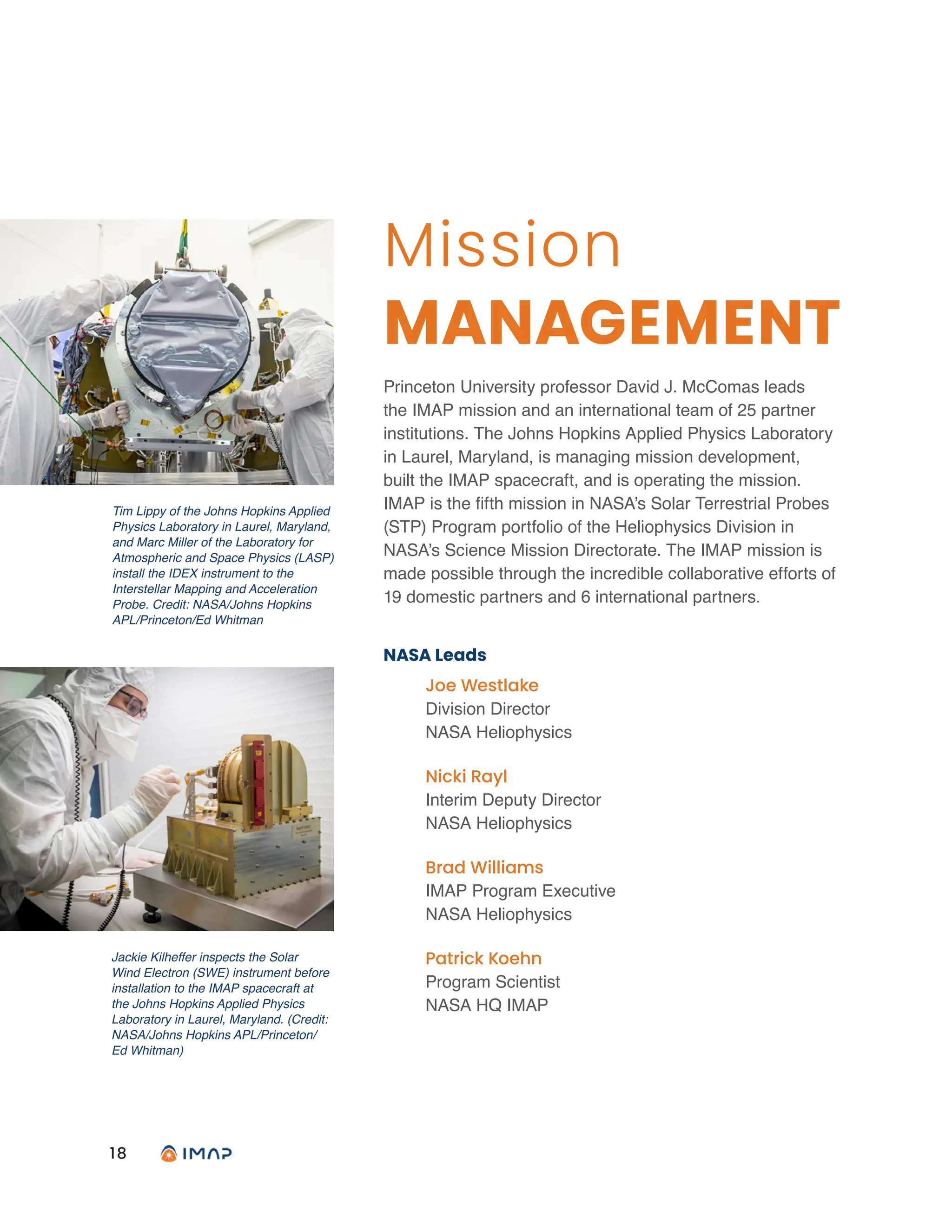
Tim Lippy of the Johns Hopkins Applied
Physics Laboratory in Laurel, Maryland,
and Marc Miller of the Laboratory for
Atmospheric and Space Physics (LASP)
install the IDEX instrument to the
Interstellar Mapping and Acceleration
Probe. Credit: NASA/Johns Hopkins
APL/Princeton/Ed Whitman
Jackie Kilheffer inspects the Solar
Wind Electron (SWE) instrument before
installation to the IMAP spacecraft at
the Johns Hopkins Applied Physics
Laboratory in Laurel, Maryland. (Credit:
NASA/Johns Hopkins APL/Princeton/
Ed Whitman)
18  
David J. McComas
McComas is the principal investigator on the IMAP mission. He is a professor
of astrophysical sciences as well as participating faculty in mechanical
and aerospace engineering at Princeton University. He also served as vice
president of the Princeton Plasma Physics Laboratory from 2016 to 2024. His
research interests span nearly all of heliophysics, including the solar corona,
solar wind, terrestrial and planetary magnetospheres, interstellar PUIs, and
the outer heliosphere and its interaction with the local interstellar medium.
Eric Christian
Christian is deputy principal investigator on IMAP and instrument lead for HIT.
He is a senior research scientist and associate lab chief in the Heliospheric
Laboratory at NASA Goddard Space Flight Center. His scientific interests
are the origin of energetic particles and the design, construction, testing, and
data analysis of particle detectors.
Nathan Schwadron
Schwadron is deputy principal investigator on IMAP and lead for the IMAP-Lo
instrument. A visiting professor at Princeton University, he serves as a
presidential chair and the Norman S. and Anna Marie Waite Professor of
Physics at the University of New Hampshire. His research interests include
the effects of radiation, acceleration of energetic particles and cosmic rays,
and the origins of solar and stellar winds.
Matina Gkioulidou
Gkioulidou is IMAP’s project scientist and a space physicist at Johns
Hopkins APL. She is also a member of the European Space Agency’s
JUpiter ICy moons Explorer (JUICE) mission and previously worked on
NASA’s Van Allen Probes mission. Her scientific interests include energetic
particle instrumentation and data analysis, focusing on plasma acceleration
processes in planetary magnetospheres and the heliosphere’s interactions
with the local interstellar medium.
Kieran Hegarty
Hegarty is IMAP’s project manager from Johns Hopkins APL. He previously
served at NASA’s Goddard Space Flight Center and has worked in the
spaceflight industry since 2010.
NASA Leads
IMAP Leads
IMAP PRESS KIT 19
Scott E. Weidner
Deputy Project Manager
Princeton University
Michael Cully
Deputy Project Manager
Johns Hopkins Applied Physics Laboratory
Drew Turner
Deputy Project Scientist
Johns Hopkins Applied Physics Laboratory
Sanae Kubota
Mission Systems Engineer
Johns Hopkins Applied Physics Laboratory
Marsha Schwinger
Deputy Mission Systems Engineer/
Spacecraft Systems Engineer
Johns Hopkins Applied Physics Laboratory
Evan Smith
Deputy Mission Systems Engineer
Johns Hopkins Applied Physics Laboratory
Chelle Reno
Science and Mission Operations Lead
Princeton University
Christina Collura
Mission Assurance Manager
Johns Hopkins Applied Physics Laboratory
Susan Pope
Payload Project Manager
Southwest Research Institute
Mark Tapley
Payload Systems Engineer
Southwest Research Institute
Herbert Funsten
Instrument Lead, IMAP-Hi
Los Alamos National Laboratory
George Clark
Instrument Lead, IMAP-Ultra
Johns Hopkins Applied Physics Laboratory
Tim Horbury
Instrument Lead, MAG
Imperial
Ruth Skoug
Instrument Lead, SWE
Los Alamos National Laboratory
Jamie Rankin
Instrument Lead, SWAPI
Princeton University
Stefano Livi
Instrument Lead, CoDICE
Southwest Research Institute
Mihaly Horanyi
Instrument Lead, IDEX
Laboratory for Atmospheric
and Space Physics
Maciej Bzowski
Instrument Lead, GLOWS
Space Research Center of the
Polish Academy of Sciences
20  
1–DE
1–DC
3–VA
Princeton–PI
3–MA
1–NH
3–NY
3–PA
1–CT
10–CA 7–MD
4–OR
8–CO
3–NJ
KEY
Industry Partner
Co-Investigating Organization
Principal Investigating
Organization (PI)
NASA’s IMAP mission, led by Princeton University and managed by the Johns Hopkins
Applied Physics Laboratory, will study the heliosphere — the Sun’s magnetic bubble that
shields our solar system — to better understand its protective boundary and provide critical
space weather monitoring.
Major U.S. industry partners include L3Harris, Moog, Northern Machining,
Rocket Lab, Sierra Space Corporation, SSC Space US, Teledyne Reynolds,
Vantage Systems, and Vertex Aerospace.
82 U.S. Partners and
Co-Investigating Organizations
35 States
IMAP PRESS KIT 21
NASA IMAP (Interstellar Mapping and Acceleration Probe) Celestial Cartographer

NASA IMAP (Interstellar Mapping and Acceleration Probe) Celestial Cartographer

  • 1.
  • 3.
    Table of CONTENTS Introduction 03 WhatAre the Solar Wind and the Heliosphere? 05 Mission Overview 06 IMAP Spacecraft 10 IMAP Instruments 12 Glossary 15 Media Services 16 Mission Management 18 IMAP Quick Facts Spacecraft weight: 797 kg (1,757 pounds) Spacecraft diameter: 8 feet (2.4 meters) Instruments: 10 Launch: 2025 Destination: Earth–Sun Lagrange Point 1 (L1) (1 million miles from Earth toward Sun) Length of Trip to L1: 108 days Prime Mission Duration: 2 years IMAP PRESS KIT 01
  • 4.
    "IMAP is aremarkable mission of discovery and exploration that unlocks secrets of our heliosphere and how it protects Earth and human explorers in our solar system." Dave McComas, Principal Investigator, IMAP 02  
  • 5.
    Billions of milesinto space, an invisible boundary is formed around our solar system by the interaction between the continual flow of energetic particles from the Sun, known as the solar wind, and the material found between the stars — the interstellar medium. The solar wind streams outward from the Sun into space and carves out a protective bubble around our entire solar system. This bubble is called the heliosphere. Launching in 2025, NASA’s Interstellar Mapping and Acceleration Probe (IMAP) will study the boundary of the heliosphere from afar to answer several questions about how this boundary protects our solar system. Built by an international team of 25 partner institutions, IMAP features 10 instruments that are able to capture data on energetic neutral atoms (ENAs), the solar wind, interstellar dust, and more in order to provide a map of our heliosphere. NASA's IMAP mission collects near- real-time measurements of the solar wind, high-energy particles, and magnetic fields. Scientists can use this data to research space weather, which can harm technologies and astronauts in space. INTRODUCTION IMAP PRESS KIT 03
  • 6.
    IMAP will focuson a region 9 billion miles (14 billion kilometers) away from Earth, or around 100 times the distance between Earth and the Sun. Credit: NASA/IBEX/Adler Planetarium 04  
  • 7.
    The solar windis a stream of charged particles emitted by the Sun that travels beyond all planets in our solar system. As the solar wind flows through space, it brings with it radiation and magnetic fields that shape the space environment around planets. It also helps form a vast bubble called the heliosphere that protects our planet and others within the solar system from cosmic radiation. The heliosphere is a definable, measurable region in space with a distinct geography of its own. The inner heliosphere is created as the solar wind blows through our solar system in all directions. The solar wind slows down and heats up as it begins to interact with the interstellar medium in a region called the termination shock. The outermost edge, or heliopause, is formed where the solar wind is fully stopped by the interstellar medium. The edge of this boundary region starts approximately 9 billion miles (14 billion kilometers) away from Earth, or around 100 times the distance between Earth and the Sun. However, this distance from the Sun is not uniform, and the average distance varies with solar activity. The solar wind is also not evenly distributed, and events such as solar storms are directional and create a ripple effect in the boundary encompassing our solar system. Parts of the heliopause are 11 billion miles (18 billion kilometers) from Earth, while in other directions, the heliopause is much farther away. IMAP will help answer fundamental scientific questions about the essential physical processes occurring in this area and its influence on our solar system’s evolving space environment. What Are the SOLAR WIND and THE HELIOSPHERE? IMAP PRESS KIT 05
  • 8.
    The groundbreaking IMAPmission addresses several critical questions by studying the heliosphere boundary from afar. The spacecraft orbits the Sun at a location 1 million miles (1.6 million kilometers) from Earth toward the Sun, called Lagrange Point 1 (L1). Positioned at L1, IMAP can provide astronauts and spacecraft near Earth with roughly 30 minutes’ warning of incoming harmful radiation. IMAP spins once every 15 seconds, allowing the comprehensive suite of 10 instruments to scan every part of the heliosphere. The spacecraft collects near-real-time measurements of the solar wind’s high-energy particles and magnetic fields in interplanetary space and also collects, counts, and measures ENAs, which are fast-moving particles formed when charged particles from the solar wind gain or exchange electrons and become neutral, allowing them to travel without being impacted by magnetic fields. IMAP also continually monitors space weather to protect space explorers and critical space infrastructure. The collection of data is used to create a comprehensive map of the Sun’s influence, an instrumental piece in resolving the fundamental physical processes that control our solar system’s evolving space environment and in answering the following key questions: • What are the properties of the local interstellar medium? • How does the Sun’s magnetic field interact with the local interstellar medium? • How do the solar wind and interstellar medium interact at the boundary of our heliosphere? • How do parts of the solar wind rapidly accelerate to incredible energies? The IMAP mission’s scientific goals and objectives build on a heritage of findings from past missions that have expanded our knowledge of the heliosphere and its dynamics, dating back to NASA’s Voyager program that began in the 1970s. Since 2009, NASA’s Interstellar Boundary Explorer (IBEX) mission has imaged the entire sky, giving us a complete global view of the heliosphere's boundary. Combined data from both Voyager and IBEX have helped scientists create a more complete model of the boundary of our solar system. New instruments aboard IMAP collect ENAs over a larger energy range and more frequently than IBEX, allowing better mapping of the heliosphere. Mission OVERVIEW 06  
  • 9.
    The groundbreaking IMAPmission addresses SEVERAL CRITICAL questions by studying the heliosphere boundary from afar. What are the properties of the local interstellar medium? How do magnetic fields interact from the Sun through the local interstellar medium? How do the solar wind and interstellar medium interact through the boundaries of our heliosphere? How are particles accelerated to high energies throughout the solar system? 1. 2. 3. 4. IMAP PRESS KIT 07
  • 10.
    IMAP at L1 Lagrangepoints are positions in space where the gravitational forces of Earth and the Sun perfectly balance smaller objects like a spacecraft or satellite. There are five Lagrange points positioned at various locations in space. IMAP will sit at Lagrange Point 1, or L1, approximately 1 million miles from Earth toward the Sun. Heliophysics missions like IMAP benefit greatly from this position because it provides an unobstructed view of solar activity. Not to scale. L3 08  
  • 11.
  • 12.
    The IMAP spacecraftis about 3 feet (0.9 meters) tall and 8 feet (2.4 meters) in diameter. The spacecraft’s frame is divided into six bays that hold 12 instrument sensors, plus one on top. The completed spacecraft, with fuel for the propulsion system, weighs 1,757 pounds (797 kilograms). Careful placement of the instruments around the perimeter of the observatory, and two magnetometers on a deployable boom, allows the instruments to operate without interfering with each other. IMAP launches on a SpaceX Falcon 9 two-stage rocket from Kennedy Space Center at Cape Canaveral, Florida. In space, IMAP’s onboard propulsion system steers the spacecraft to its final orbit about 1 million miles (1.6 million kilometers) from Earth toward the Sun, at L1. Solar panels facing the Sun provide the power to run the instruments and other systems during the mission. IMAP’s magnetometer (MAG) is fastened to a boom arm that is folded to fit perfectly between the two sets of solar array panels on the top deck for launch. In space, the boom unfolds, extending the sensors out away from the spacecraft and any magnetic interference caused by the electrical systems. IMAP SPACECRAFT The IMAP spacecraft is shown after installation into the X-Ray and Cryogenic Facility (XRCF) chamber at Marshall Space Flight Center in Huntsville, Alabama. (Credit: NASA/Johns Hopkins APL/Princeton/Ed Whitman) Emory Toomey and Tyler Radomsky prepare to lift IMAP in the “yoke” fixture to the mass properties machine at the Johns Hopkins Applied Physics Laboratory in Laurel, Maryland. (Credit: NASA/Johns Hopkins APL/ Princeton/Ed Whitman) 10  
  • 13.
    MAG Boom Arm 100inches (2.5 meters) Height 3 feet (0.9 meters) Diameter 8 feet (2.4 meters) Weight 1,757 pounds (797 kilograms) IMAP PRESS KIT 11
  • 14.
    To capture theextensive data required to map our heliosphere, IMAP hosts a suite of 10 instruments that will measure ENAs, magnetic fields, cosmic dust, and ultraviolet light, and make near-real-time observations of the solar wind and its energetic particles. IMAP INSTRUMENTS SWAPI The Solar Wind and Pickup Ions (SWAPI) instrument built by Princeton University that measures ions from the solar wind and particles from beyond the solar system MAG Magnetometer built by Imperial that will measure the interplanetary magnetic field that originates from the Sun IMAP-Lo Imager built by the University of New Hampshire (UNH) that measures and maps low-energy ENAs, particles created where the solar wind and interstellar medium meet, as well as interstellar neutral particles from beyond the solar system IMAP-Hi Imager developed collaboratively by Los Alamos National Laboratory (LANL), Southwest Research Institute (SwRI), UNH, and the University of Bern in Switzerland (UBern) that measures and maps medium-range ENAs at the edge of the heliosphere 12  
  • 15.
    HIT The High-energy IonTelescope built by NASA's Goddard Space Flight Center (GSFC) that studies high-energy ions that come from the solar wind and deep space IMAP-Ultra Imager built by APL that measures and maps ENAs at their highest range at the edge of the heliosphere IDEX The Interstellar Dust Experiment (IDEX) instrument built by the Laboratory for Atmospheric and Space Physics (LASP) that measures the composition of interstellar and interplanetary dust particles CoDICE The Compact Dual Ion Composition Experiment (CoDICE) instrument built by SwRI that is designed to measure the mass and electric charge of ions originating from both interstellar space and the solar wind GLOWS The GLObal Solar Wind Structure (GLOWS) instrument built by the Space Research Center of the Polish Academy of Sciences (CBK PAN) that investigates the ultraviolet glow created by the solar wind to understand how it evolves over time SWE The Solar Wind Electron (SWE) instrument built by LANL that is used to measure electrons found in the solar wind IMAP PRESS KIT 13
  • 16.
    14   IMAP sits inthe “yoke” fixture on the mass properties machine at the Johns Hopkins Applied Physics Laboratory in Laurel, Maryland. (Credit: NASA/Johns Hopkins APL/Princeton/Ed Whitman)
  • 17.
    Coronal mass ejections:Events during which solar material bursts away from the Sun into space and possibly toward Earth. Energetic neutral atoms (ENAs): Fast-moving particles formed when charged particles from the solar wind gain or exchange electrons and become neutral, allowing them to travel without being impacted by magnetic fields. Energetic particles: Charged particles (electrons, protons, and ions) that move very fast (high energy). If the particles originate at the Sun, they are known as solar energetic particles. Helioglow: A faint ultraviolet light created when neutral hydrogen atoms from outside the solar system absorb and re-emit energy from the Sun’s ultraviolet photons. Heliopause: The outermost boundary of the heliosphere formed where the Sun’s solar wind and the interstellar medium, and their associated magnetic fields, meet. Heliosphere: The bubble-like region, inflated by the solar wind, that surrounds the solar system and shields it from interstellar radiation. Interstellar dust: Small particles of solid matter that formed in part by supernova star events, and are the building blocks of stars and planetary systems. Interstellar medium: The combination of gas, dust, and charged particles that fills the space between stars in a galaxy. Lagrange point: A position in space where the gravitational forces of the Sun and Earth are balanced enough to allow a spacecraft to stay in a stable position. Lyman-alpha: A specific wavelength of ultraviolet light emitted by hydrogen atoms. Pickup ions (PUIs): Neutral atoms that become electrically charged when they interact with the solar wind, allowing the solar wind’s magnetic field to carry them along. Solar cycle: A cycle of activity driven by the Sun’s magnetic field every 11 years. Termination shock: The boundary marking one of the outer limits of the Sun’s influence. At the termination shock, solar wind particles slow down as they begin to press into the particles forming the interstellar medium. GLOSSARY IMAP PRESS KIT 15
  • 18.
    NASA Contacts Sarah Frazier HeliophysicsCommunications Manager sarah.frazier@nasa.gov Abbey Interrante Heliophysics Public Affairs Officer abbey.a.interrante@nasa.gov IMAP Contacts Margaret M. Shaw-Lecerf IMAP Communications Lead mmshaw@princeton.edu Lindsay Bartolone IMAP Deputy Communications and Outreach Lead lindsayc@princeton.edu Brett Molina APL Space Public Affairs Officer Brett.Molina@jhuapl.edu Products and Events News Releases, Features, and Status Reports News, updates, and feature stories about the IMAP mission are available at https://science.nasa.gov/mission/imap/. Video and Images Videos, animations, images, and graphics are available in the mission website’s media gallery: https://svs.gsfc.nasa.gov/. Please consult NASA’s image use policy for guidelines on use of videos, images, or other multimedia. MEDIA Services 16  
  • 19.
    Additional Resources onthe Web To learn more about the IMAP mission, visit the following websites: https://imap.princeton.edu/ https://science.nasa.gov/blogs/imap/ https://imap.princeton.edu/public-media-library Social Media Join the conversation about IMAP by following these accounts and hashtags for the latest mission updates: X: @NASA, @NASASolarSystem, @Princeton, @JHUAPL Facebook: /NASA, /NASASolarSystem, /Princeton, /JHUAPL Instagram: @nasa, @princeton, @johnshopkinsapl IMAP PRESS KIT 17
  • 20.
    Mission MANAGEMENT Princeton University professorDavid J. McComas leads the IMAP mission and an international team of 25 partner institutions. The Johns Hopkins Applied Physics Laboratory in Laurel, Maryland, is managing mission development, built the IMAP spacecraft, and is operating the mission. IMAP is the fifth mission in NASA’s Solar Terrestrial Probes (STP) Program portfolio of the Heliophysics Division in NASA’s Science Mission Directorate. The IMAP mission is made possible through the incredible collaborative efforts of 19 domestic partners and 6 international partners. NASA Leads Joe Westlake Division Director NASA Heliophysics Nicki Rayl Interim Deputy Director NASA Heliophysics Brad Williams IMAP Program Executive NASA Heliophysics Patrick Koehn Program Scientist NASA HQ IMAP Tim Lippy of the Johns Hopkins Applied Physics Laboratory in Laurel, Maryland, and Marc Miller of the Laboratory for Atmospheric and Space Physics (LASP) install the IDEX instrument to the Interstellar Mapping and Acceleration Probe. Credit: NASA/Johns Hopkins APL/Princeton/Ed Whitman Jackie Kilheffer inspects the Solar Wind Electron (SWE) instrument before installation to the IMAP spacecraft at the Johns Hopkins Applied Physics Laboratory in Laurel, Maryland. (Credit: NASA/Johns Hopkins APL/Princeton/ Ed Whitman) 18  
  • 21.
    David J. McComas McComasis the principal investigator on the IMAP mission. He is a professor of astrophysical sciences as well as participating faculty in mechanical and aerospace engineering at Princeton University. He also served as vice president of the Princeton Plasma Physics Laboratory from 2016 to 2024. His research interests span nearly all of heliophysics, including the solar corona, solar wind, terrestrial and planetary magnetospheres, interstellar PUIs, and the outer heliosphere and its interaction with the local interstellar medium. Eric Christian Christian is deputy principal investigator on IMAP and instrument lead for HIT. He is a senior research scientist and associate lab chief in the Heliospheric Laboratory at NASA Goddard Space Flight Center. His scientific interests are the origin of energetic particles and the design, construction, testing, and data analysis of particle detectors. Nathan Schwadron Schwadron is deputy principal investigator on IMAP and lead for the IMAP-Lo instrument. A visiting professor at Princeton University, he serves as a presidential chair and the Norman S. and Anna Marie Waite Professor of Physics at the University of New Hampshire. His research interests include the effects of radiation, acceleration of energetic particles and cosmic rays, and the origins of solar and stellar winds. Matina Gkioulidou Gkioulidou is IMAP’s project scientist and a space physicist at Johns Hopkins APL. She is also a member of the European Space Agency’s JUpiter ICy moons Explorer (JUICE) mission and previously worked on NASA’s Van Allen Probes mission. Her scientific interests include energetic particle instrumentation and data analysis, focusing on plasma acceleration processes in planetary magnetospheres and the heliosphere’s interactions with the local interstellar medium. Kieran Hegarty Hegarty is IMAP’s project manager from Johns Hopkins APL. He previously served at NASA’s Goddard Space Flight Center and has worked in the spaceflight industry since 2010. NASA Leads IMAP Leads IMAP PRESS KIT 19
  • 22.
    Scott E. Weidner DeputyProject Manager Princeton University Michael Cully Deputy Project Manager Johns Hopkins Applied Physics Laboratory Drew Turner Deputy Project Scientist Johns Hopkins Applied Physics Laboratory Sanae Kubota Mission Systems Engineer Johns Hopkins Applied Physics Laboratory Marsha Schwinger Deputy Mission Systems Engineer/ Spacecraft Systems Engineer Johns Hopkins Applied Physics Laboratory Evan Smith Deputy Mission Systems Engineer Johns Hopkins Applied Physics Laboratory Chelle Reno Science and Mission Operations Lead Princeton University Christina Collura Mission Assurance Manager Johns Hopkins Applied Physics Laboratory Susan Pope Payload Project Manager Southwest Research Institute Mark Tapley Payload Systems Engineer Southwest Research Institute Herbert Funsten Instrument Lead, IMAP-Hi Los Alamos National Laboratory George Clark Instrument Lead, IMAP-Ultra Johns Hopkins Applied Physics Laboratory Tim Horbury Instrument Lead, MAG Imperial Ruth Skoug Instrument Lead, SWE Los Alamos National Laboratory Jamie Rankin Instrument Lead, SWAPI Princeton University Stefano Livi Instrument Lead, CoDICE Southwest Research Institute Mihaly Horanyi Instrument Lead, IDEX Laboratory for Atmospheric and Space Physics Maciej Bzowski Instrument Lead, GLOWS Space Research Center of the Polish Academy of Sciences 20  
  • 23.
    1–DE 1–DC 3–VA Princeton–PI 3–MA 1–NH 3–NY 3–PA 1–CT 10–CA 7–MD 4–OR 8–CO 3–NJ KEY Industry Partner Co-InvestigatingOrganization Principal Investigating Organization (PI) NASA’s IMAP mission, led by Princeton University and managed by the Johns Hopkins Applied Physics Laboratory, will study the heliosphere — the Sun’s magnetic bubble that shields our solar system — to better understand its protective boundary and provide critical space weather monitoring. Major U.S. industry partners include L3Harris, Moog, Northern Machining, Rocket Lab, Sierra Space Corporation, SSC Space US, Teledyne Reynolds, Vantage Systems, and Vertex Aerospace. 82 U.S. Partners and Co-Investigating Organizations 35 States IMAP PRESS KIT 21