The function of narrative‘To raise the question of the nature of narrative is to invite reflection on the very nature of culture and, possibly, even on the nature of humanity itself. So natural is the impulse to narrate, so inevitable is the form of narrative for any report on the way things really happened, that narrativity could appear problematical only in a culture in which it was absent’ White, Hayden (1987). The Content and the Form. p. 2
‘Human beings have a deep-seated need to establish narrative patterns, something that is connected with the tendency to see life as a story – a temporally limited line of development from beginning to end, from birth to death, in which we like to find each stage meaningful and to justify the choices we make’ Lothe, Jakob (2000). Narrative in Fiction & Film. p. 3
‘narrative is a meta-code, a human universal on the basis of which transcultural messages about the nature of a shared reality can be transmitted …A refusal of narrative indicates an absence or refusal of meaning itself’ White, Hayden (1987). The Content and the Form. p. 2-3
‘Where, in any account of reality, narrativity is present, we can be sure that morality or a moralizing impulse is present’  White, Hayden (1987). The Content and the Form. p. 24
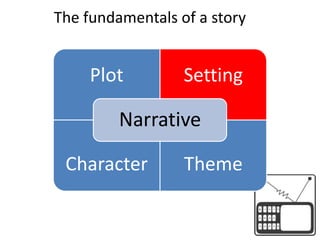
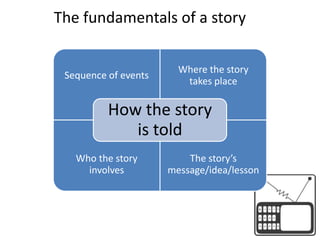
The fundamentals of a story
Aristotle’s Poetics.‘what is action in real life becomes muthos, that is, an ordered sequence of events’ Muthos = plot.‘Muthos [the way the material is organised] …is all important… Muthos is the soul of drama, just as in painting an outline sketch will predominate over a haphazard conglomeration of even the loveliest colours’. Aristotle. (1998 edition). Poetics. Translated by K. McLeish.p. 10-11
Aristotle’s Poetics.‘A beginning is something which does not follow or result from anything else but after which something else follows or results […] an endis the mirror-image of this: something which follows or results from something else, but which nothing else results from or follows. [...] A middlefollows something else and is itself followed. A properly organised muthos should not begin at random or end at random; it should observe the rules just stated’.Aristotle. (1998 edition). Poetics. Translated by K. McLeish.p. 11-12
Aristotle’s Poetics.‘[Plot] must imitate a single, unified, and complete sequence of action. Its incidents must be organised in such a way that if any is removed or has its position changed, the whole is dislocated and disjointed. If something can be added or taken away without any obvious effect, it is not intrinsic to the whole’ Aristotle. (1998 edition). Poetics. Translated by K. McLeish.p. 13
Story creation is about technique. This involves…The ordering of information …this is the sequence in which information is delivered to the audience.The exposition of information … how the information is conveyed or passed on to the audienceThe juxtaposition of information to create meaning… placing different pieces of info together
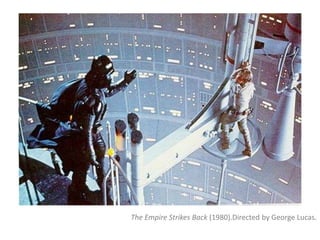
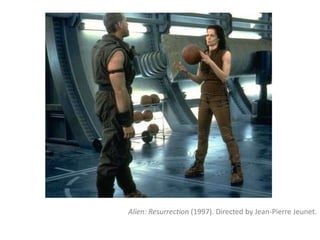
Revelation:A change from ignorance to knowledgeKnowledge gained by the protagonist orthe audience with dramatic consequences
The Empire Strikes Back (1980).Directed by George Lucas.
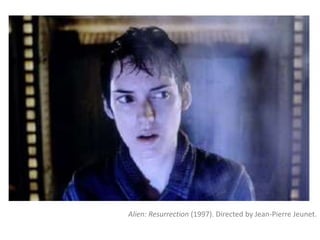
Alien: Resurrection (1997). Directed by Jean-Pierre Jeunet.
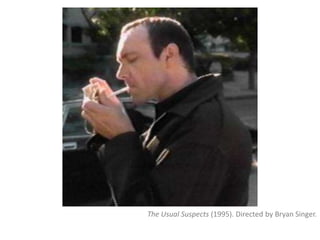
The Usual Suspects (1995). Directed by Bryan Singer.
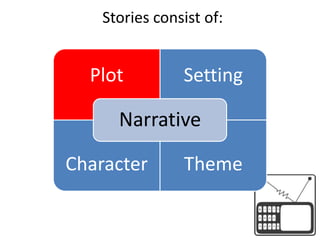
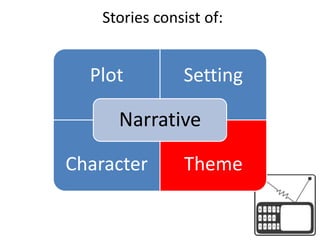
Stories consist of:
‘[A story is] the chopped off length of the tape worm of time ... a narrative of events arranged in their time sequence. A plot is also a narrative of events, the emphasis falling on causality…’E.M Forster. Quoted in:Burroway, J. (2007). Writing Fiction: a Guide to Narrative Craft.
“The king died, and then the Queen died,” is a story. “The king died, and then the queen died of grief,” is a plot. Or again: “The queen died, no one knew why, until it was discovered that it was through grief at the death of the king.”E.M Forster. Quoted in:Burroway, J. (2007). Writing Fiction: a Guide to Narrative Craft.
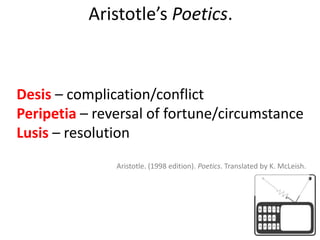
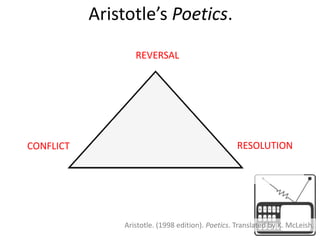
Aristotle’s Poetics.Desis– complication/conflictPeripetia– reversal of fortune/circumstanceLusis– resolutionAristotle. (1998 edition). Poetics. Translated by K. McLeish.
Aristotle’s Poetics.REVERSALRESOLUTIONCONFLICTAristotle. (1998 edition). Poetics. Translated by K. McLeish.
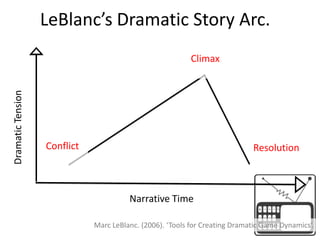
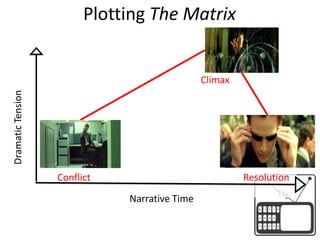
ClimaxConflictResolutionLeBlanc’s Dramatic Story Arc.Dramatic TensionNarrative TimeMarc LeBlanc. (2006). ‘Tools for Creating Dramatic Game Dynamics’.
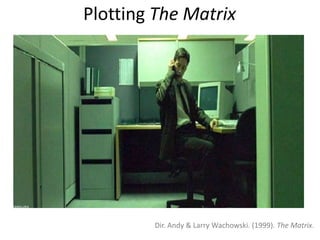
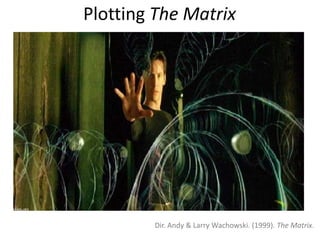
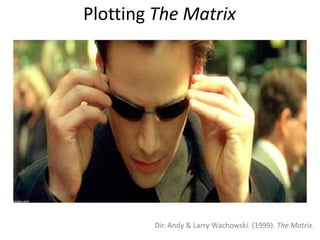
Plotting The MatrixDir. Andy & Larry Wachowski. (1999). The Matrix.
Plotting The MatrixDramatic TensionClimaxNarrative TimeResolutionConflict
The fundamentals of a story
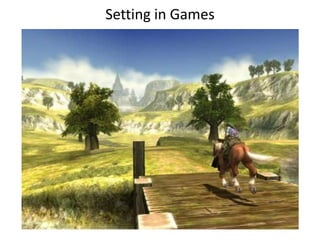
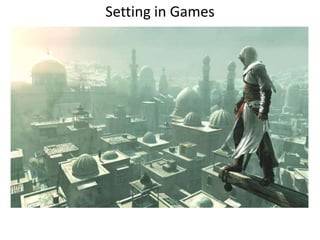
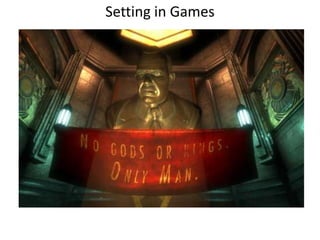
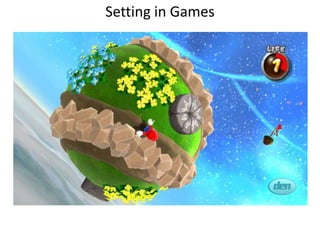
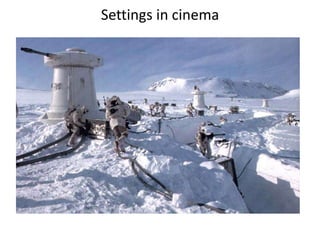
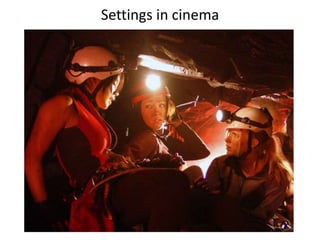
What do we mean by setting?Setting is where the story takes placeSetting involves everything that supports and impinges on your  characters. The props of the world – artefacts and architecture, infrastructure, books, food, fabrics, tools and technology, geographical and temporal location, and other people.
What do we mean by setting?Setting is where the story takes placeSetting situates the story in a time and place, it gives the story a context which the viewer interprets it. A story’s setting helps the viewer understand the position of the story their are engaging with.
The mise-en-scène A term taken from French theatre, mise-en-scène is quite a simple concept: it refers to all of the things which are 'put in the scene' of a film: the setting and props; people and how they move, look and dress; and abstract design principles in the frame, such as colour, line, shape and plane. The concept enables [us] to consider and describe what is in a frame or series of frames of a film at a slightly more abstracted level than just 'what's happening'http://www.bfi.org.uk/education/teaching/movingshorts/thinking/technical.html
Setting in Games
Setting in Games
Setting in Games
Setting in Games
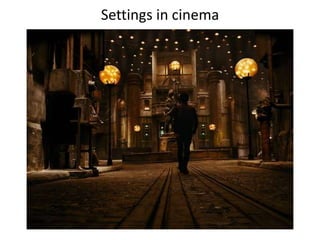
Settings in cinema
Settings in cinema
Settings in cinema
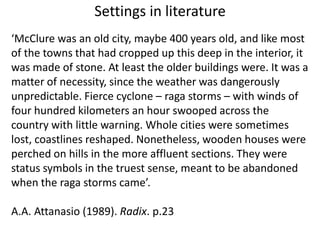
Settings in literature‘McClure was an old city, maybe 400 years old, and like most of the towns that had cropped up this deep in the interior, it was made of stone. At least the older buildings were. It was a matter of necessity, since the weather was dangerously unpredictable. Fierce cyclone – raga storms – with winds of four hundred kilometers an hour swooped across the country with little warning. Whole cities were sometimes lost, coastlines reshaped. Nonetheless, wooden houses were perched on hills in the more affluent sections. They were status symbols in the truest sense, meant to be abandoned when the raga storms came’.A.A. Attanasio (1989). Radix. p.23
‘He walks through the narrow streets of the port. The air smells of salt and newsawn lumber. At night whores call to him from the dark like souls in want. A week and he is on the move again, a few dollars in his purse that he’s earned, walking the sand roads of his southern night alone, his hands balled in the cotton pockets of his cheap coat. Earthern causeways across the marshland. Egrets in their rookeries white as candles among the moss [...] He moves north through small settlements and farms, working for a days wages and found. He sees a parricide hanged in a crossroads hamlet and the mans friends run forward and pull his legs and he hangs dead from his rope while urine darkens his trousers’.Cormac McCarthy. (1989) Blood Meridian. p. 5
Same story … told differently?Brown, Ford Madox (1870) Romeo and Juliet [oil on canvas]Romeo + Juliet (1996) Dir. BazLuhrmann
Stories consist of:
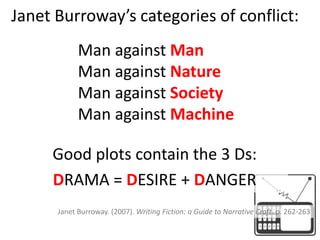
Janet Burroway’s categories of conflict:Man against ManMan against NatureMan against SocietyMan against MachineGood plots contain the 3 Ds:DRAMA = DESIRE + DANGERJanet Burroway. (2007). Writing Fiction: a Guide to Narrative Craft. p. 262-263
Joseph Campbell: The ‘Hero’s Journey’ ModelDepartureInitiationReturnJoseph Campbell. (1949). The Hero with a Thousand Faces.
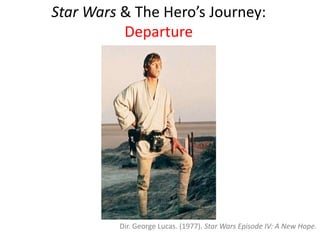
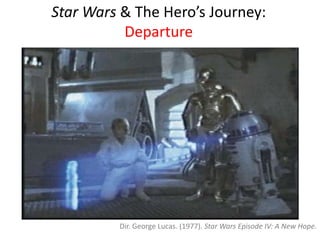
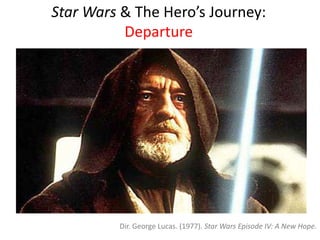
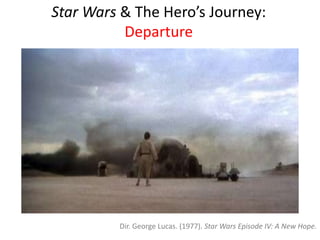
Star Wars & The Hero’s Journey:DepartureDir. George Lucas. (1977). Star Wars Episode IV: A New Hope.
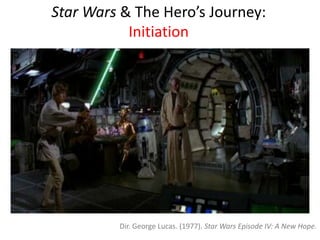
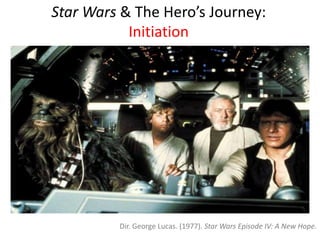
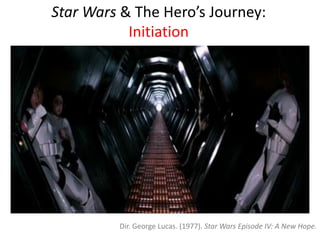
Star Wars & The Hero’s Journey:InitiationDir. George Lucas. (1977). Star Wars Episode IV: A New Hope.
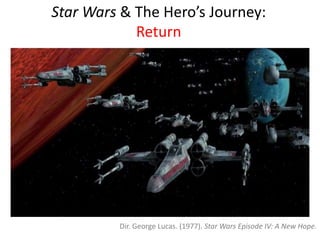
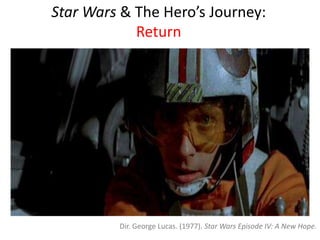
Star Wars & The Hero’s Journey:ReturnDir. George Lucas. (1977). Star Wars Episode IV: A New Hope.
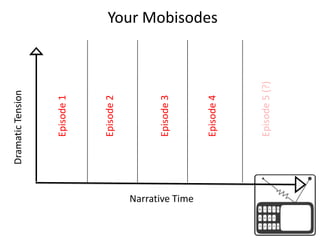
Your MobisodesDramatic TensionEpisode 5 (?)Episode 1Episode 2Episode 3Episode 4Narrative Time

MED316 - Narrative Construction

  • 2.
    The function ofnarrative‘To raise the question of the nature of narrative is to invite reflection on the very nature of culture and, possibly, even on the nature of humanity itself. So natural is the impulse to narrate, so inevitable is the form of narrative for any report on the way things really happened, that narrativity could appear problematical only in a culture in which it was absent’ White, Hayden (1987). The Content and the Form. p. 2
  • 3.
    ‘Human beings havea deep-seated need to establish narrative patterns, something that is connected with the tendency to see life as a story – a temporally limited line of development from beginning to end, from birth to death, in which we like to find each stage meaningful and to justify the choices we make’ Lothe, Jakob (2000). Narrative in Fiction & Film. p. 3
  • 4.
    ‘narrative is ameta-code, a human universal on the basis of which transcultural messages about the nature of a shared reality can be transmitted …A refusal of narrative indicates an absence or refusal of meaning itself’ White, Hayden (1987). The Content and the Form. p. 2-3
  • 5.
    ‘Where, in anyaccount of reality, narrativity is present, we can be sure that morality or a moralizing impulse is present’ White, Hayden (1987). The Content and the Form. p. 24
  • 6.
  • 7.
    Aristotle’s Poetics.‘what isaction in real life becomes muthos, that is, an ordered sequence of events’ Muthos = plot.‘Muthos [the way the material is organised] …is all important… Muthos is the soul of drama, just as in painting an outline sketch will predominate over a haphazard conglomeration of even the loveliest colours’. Aristotle. (1998 edition). Poetics. Translated by K. McLeish.p. 10-11
  • 8.
    Aristotle’s Poetics.‘A beginningis something which does not follow or result from anything else but after which something else follows or results […] an endis the mirror-image of this: something which follows or results from something else, but which nothing else results from or follows. [...] A middlefollows something else and is itself followed. A properly organised muthos should not begin at random or end at random; it should observe the rules just stated’.Aristotle. (1998 edition). Poetics. Translated by K. McLeish.p. 11-12
  • 9.
    Aristotle’s Poetics.‘[Plot] mustimitate a single, unified, and complete sequence of action. Its incidents must be organised in such a way that if any is removed or has its position changed, the whole is dislocated and disjointed. If something can be added or taken away without any obvious effect, it is not intrinsic to the whole’ Aristotle. (1998 edition). Poetics. Translated by K. McLeish.p. 13
  • 10.
    Story creation isabout technique. This involves…The ordering of information …this is the sequence in which information is delivered to the audience.The exposition of information … how the information is conveyed or passed on to the audienceThe juxtaposition of information to create meaning… placing different pieces of info together
  • 11.
    Revelation:A change fromignorance to knowledgeKnowledge gained by the protagonist orthe audience with dramatic consequences
  • 12.
    The Empire StrikesBack (1980).Directed by George Lucas.
  • 13.
    Alien: Resurrection (1997).Directed by Jean-Pierre Jeunet.
  • 14.
    Alien: Resurrection (1997).Directed by Jean-Pierre Jeunet.
  • 15.
    The Usual Suspects(1995). Directed by Bryan Singer.
  • 16.
  • 17.
    ‘[A story is]the chopped off length of the tape worm of time ... a narrative of events arranged in their time sequence. A plot is also a narrative of events, the emphasis falling on causality…’E.M Forster. Quoted in:Burroway, J. (2007). Writing Fiction: a Guide to Narrative Craft.
  • 18.
    “The king died,and then the Queen died,” is a story. “The king died, and then the queen died of grief,” is a plot. Or again: “The queen died, no one knew why, until it was discovered that it was through grief at the death of the king.”E.M Forster. Quoted in:Burroway, J. (2007). Writing Fiction: a Guide to Narrative Craft.
  • 19.
    Aristotle’s Poetics.Desis– complication/conflictPeripetia–reversal of fortune/circumstanceLusis– resolutionAristotle. (1998 edition). Poetics. Translated by K. McLeish.
  • 20.
    Aristotle’s Poetics.REVERSALRESOLUTIONCONFLICTAristotle. (1998edition). Poetics. Translated by K. McLeish.
  • 21.
    ClimaxConflictResolutionLeBlanc’s Dramatic StoryArc.Dramatic TensionNarrative TimeMarc LeBlanc. (2006). ‘Tools for Creating Dramatic Game Dynamics’.
  • 22.
    Plotting The MatrixDir.Andy & Larry Wachowski. (1999). The Matrix.
  • 23.
    Plotting The MatrixDir.Andy & Larry Wachowski. (1999). The Matrix.
  • 24.
    Plotting The MatrixDir.Andy & Larry Wachowski. (1999). The Matrix.
  • 25.
    Plotting The MatrixDramaticTensionClimaxNarrative TimeResolutionConflict
  • 26.
  • 27.
    What do wemean by setting?Setting is where the story takes placeSetting involves everything that supports and impinges on your characters. The props of the world – artefacts and architecture, infrastructure, books, food, fabrics, tools and technology, geographical and temporal location, and other people.
  • 28.
    What do wemean by setting?Setting is where the story takes placeSetting situates the story in a time and place, it gives the story a context which the viewer interprets it. A story’s setting helps the viewer understand the position of the story their are engaging with.
  • 29.
    The mise-en-scène Aterm taken from French theatre, mise-en-scène is quite a simple concept: it refers to all of the things which are 'put in the scene' of a film: the setting and props; people and how they move, look and dress; and abstract design principles in the frame, such as colour, line, shape and plane. The concept enables [us] to consider and describe what is in a frame or series of frames of a film at a slightly more abstracted level than just 'what's happening'http://www.bfi.org.uk/education/teaching/movingshorts/thinking/technical.html
  • 30.
  • 31.
  • 32.
  • 33.
  • 34.
  • 35.
  • 36.
  • 37.
    Settings in literature‘McClurewas an old city, maybe 400 years old, and like most of the towns that had cropped up this deep in the interior, it was made of stone. At least the older buildings were. It was a matter of necessity, since the weather was dangerously unpredictable. Fierce cyclone – raga storms – with winds of four hundred kilometers an hour swooped across the country with little warning. Whole cities were sometimes lost, coastlines reshaped. Nonetheless, wooden houses were perched on hills in the more affluent sections. They were status symbols in the truest sense, meant to be abandoned when the raga storms came’.A.A. Attanasio (1989). Radix. p.23
  • 38.
    ‘He walks throughthe narrow streets of the port. The air smells of salt and newsawn lumber. At night whores call to him from the dark like souls in want. A week and he is on the move again, a few dollars in his purse that he’s earned, walking the sand roads of his southern night alone, his hands balled in the cotton pockets of his cheap coat. Earthern causeways across the marshland. Egrets in their rookeries white as candles among the moss [...] He moves north through small settlements and farms, working for a days wages and found. He sees a parricide hanged in a crossroads hamlet and the mans friends run forward and pull his legs and he hangs dead from his rope while urine darkens his trousers’.Cormac McCarthy. (1989) Blood Meridian. p. 5
  • 39.
    Same story …told differently?Brown, Ford Madox (1870) Romeo and Juliet [oil on canvas]Romeo + Juliet (1996) Dir. BazLuhrmann
  • 40.
  • 41.
    Janet Burroway’s categoriesof conflict:Man against ManMan against NatureMan against SocietyMan against MachineGood plots contain the 3 Ds:DRAMA = DESIRE + DANGERJanet Burroway. (2007). Writing Fiction: a Guide to Narrative Craft. p. 262-263
  • 42.
    Joseph Campbell: The‘Hero’s Journey’ ModelDepartureInitiationReturnJoseph Campbell. (1949). The Hero with a Thousand Faces.
  • 43.
    Star Wars &The Hero’s Journey:DepartureDir. George Lucas. (1977). Star Wars Episode IV: A New Hope.
  • 44.
    Star Wars &The Hero’s Journey:DepartureDir. George Lucas. (1977). Star Wars Episode IV: A New Hope.
  • 45.
    Star Wars &The Hero’s Journey:DepartureDir. George Lucas. (1977). Star Wars Episode IV: A New Hope.
  • 46.
    Star Wars &The Hero’s Journey:DepartureDir. George Lucas. (1977). Star Wars Episode IV: A New Hope.
  • 47.
    Star Wars &The Hero’s Journey:InitiationDir. George Lucas. (1977). Star Wars Episode IV: A New Hope.
  • 48.
    Star Wars &The Hero’s Journey:InitiationDir. George Lucas. (1977). Star Wars Episode IV: A New Hope.
  • 49.
    Star Wars &The Hero’s Journey:InitiationDir. George Lucas. (1977). Star Wars Episode IV: A New Hope.
  • 50.
    Star Wars &The Hero’s Journey:ReturnDir. George Lucas. (1977). Star Wars Episode IV: A New Hope.
  • 51.
    Star Wars &The Hero’s Journey:ReturnDir. George Lucas. (1977). Star Wars Episode IV: A New Hope.
  • 52.
    Your MobisodesDramatic TensionEpisode5 (?)Episode 1Episode 2Episode 3Episode 4Narrative Time