NANOPHYSICS
Nanomaterials and Nanotechnology
• Nanomaterials is a field which takes a
materials science-based approach to
nanotechnology.
• Nanomaterials studies materials that have
very different properties on the nanoscale.
• Nanoscale means smaller than one tenth of a
micrometer in at least one dimension of an
object.
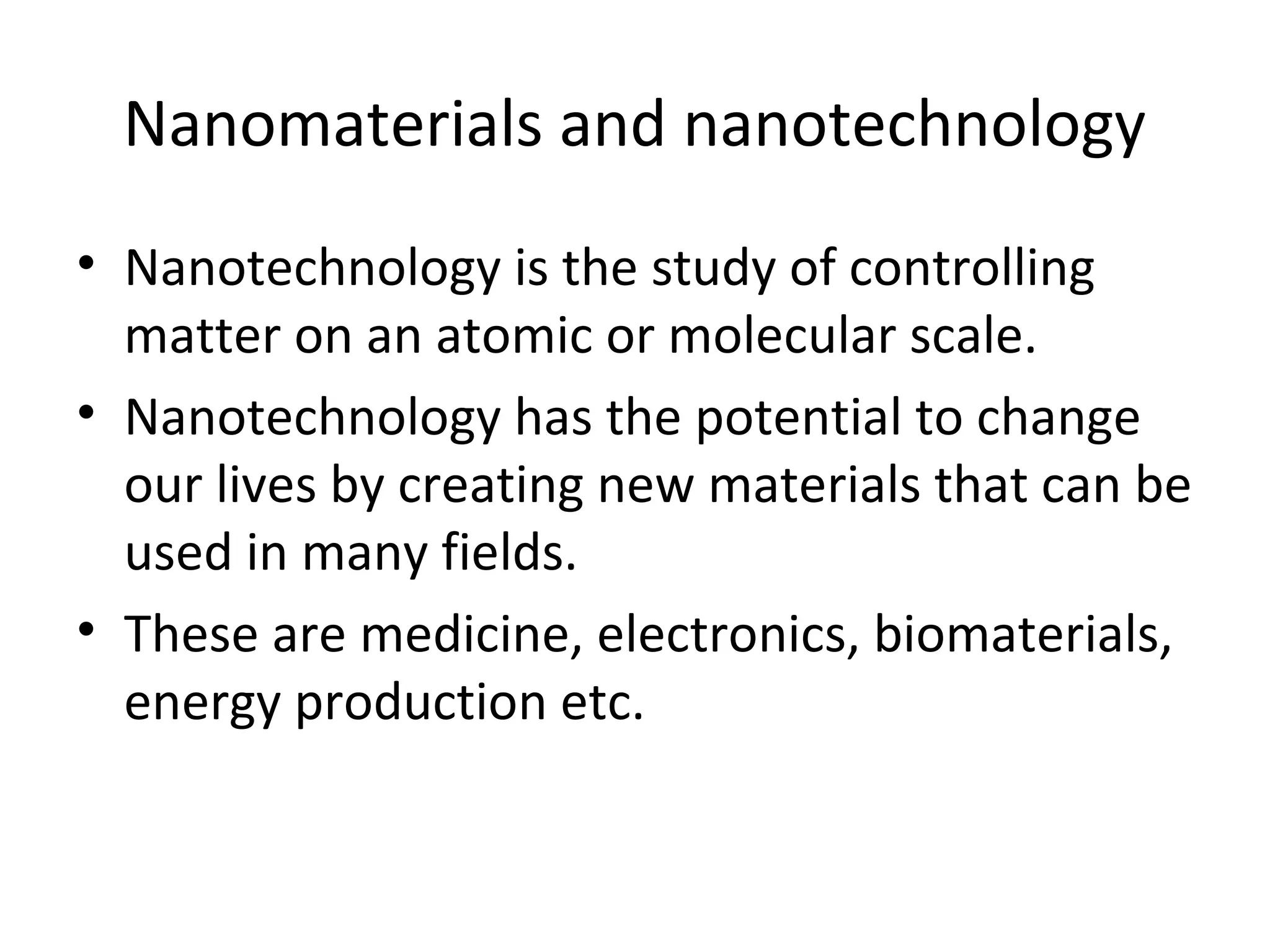
Nanomaterials and nanotechnology
• Nanotechnology is the study of controlling
matter on an atomic or molecular scale.
• Nanotechnology has the potential to change
our lives by creating new materials that can be
used in many fields.
• These are medicine, electronics, biomaterials,
energy production etc.
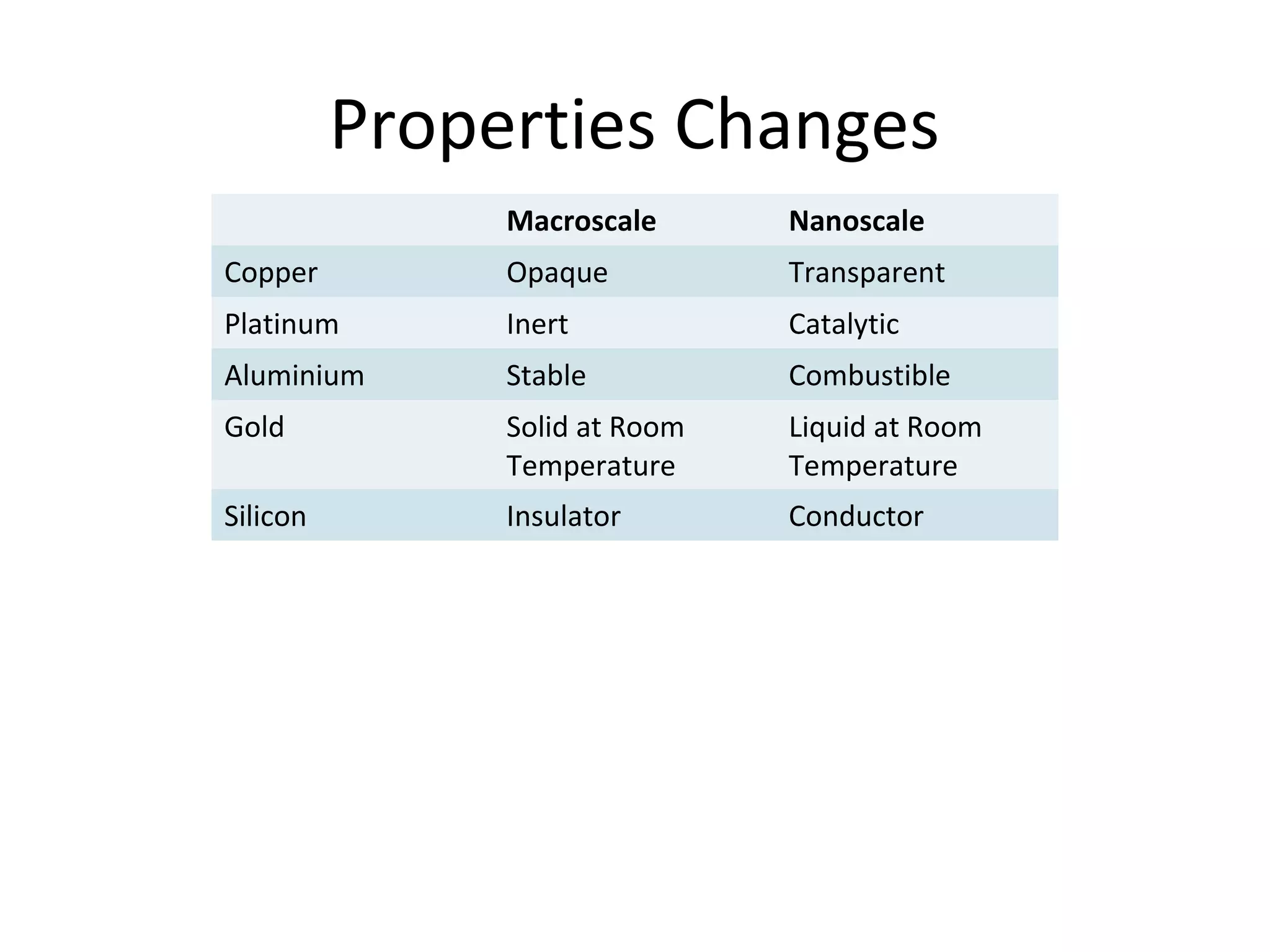
Properties Changes
• When materials shrink to nanoscale, their
properties will change drastically.
• This can be explained by the largely increased
surface area to volume ratio.
• The larger ratio gives rise to new quantum
mechanical effects. For example, electronic
properties of many solids are altered when
they reach nanoscale.
Properties Changes
Macroscale Nanoscale
Copper Opaque Transparent
Platinum Inert Catalytic
Aluminium Stable Combustible
Gold Solid at Room
Temperature
Liquid at Room
Temperature
Silicon Insulator Conductor
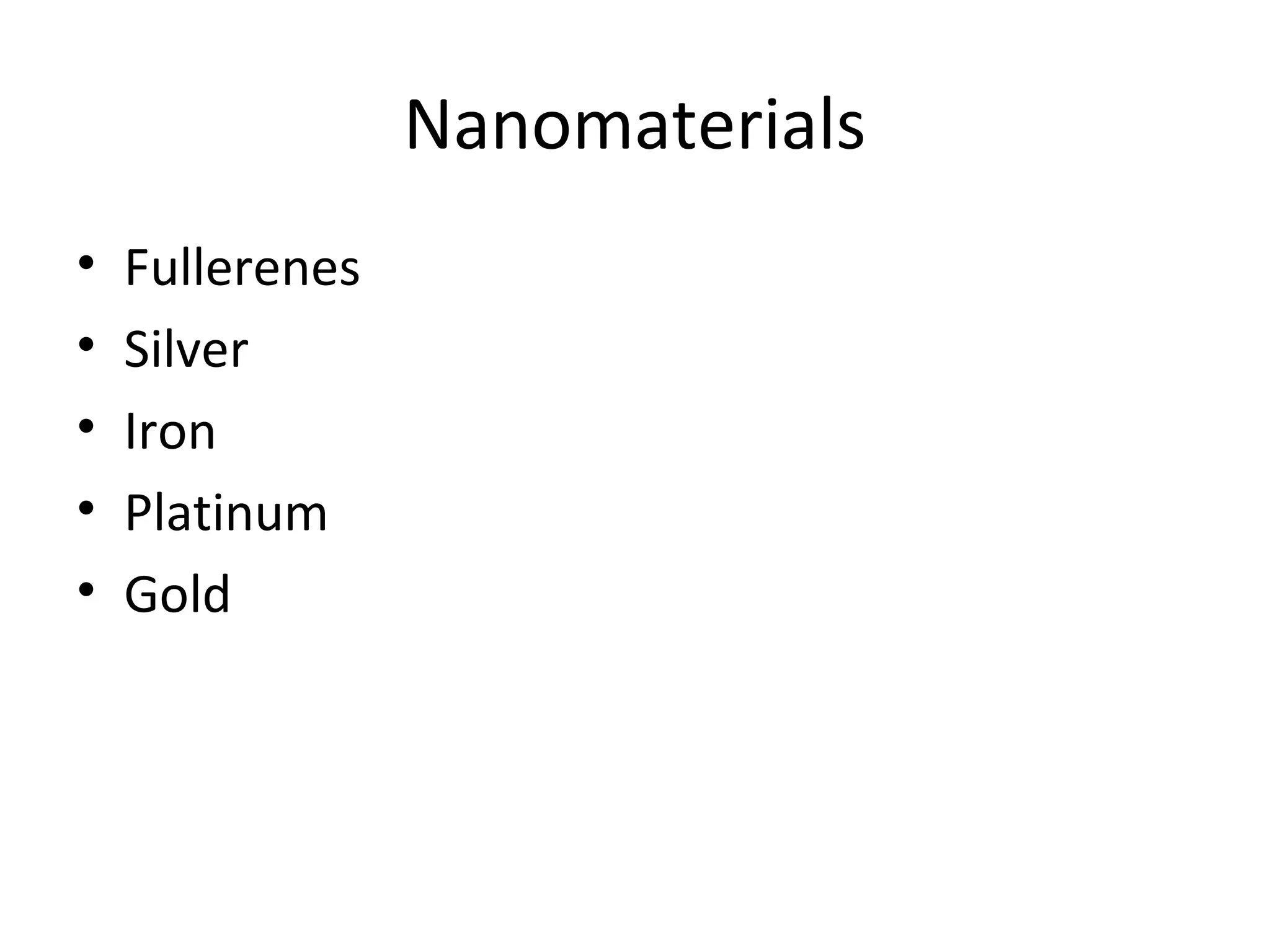
Nanomaterials
• Fullerenes
• Silver
• Iron
• Platinum
• Gold
Fullerenes
• Fullerenes are molecules made completely
out of carbon, regardless of its molecular
structure. They can come in spheres,
cylinders, ellipsoids or tubes.
• Cylindrical fullerenes are also known as
carbon nanotubes or buckytubes.
• Fullerene=Buckyball
Variations (Structural Differences)
• buckyball clusters
• Nanotubes
• Megatubes
• Polymers
• Nano “onions”
• linked "ball-and-chain" dimers
• fullerene rings
Introduction
• The first fullerene (buckminsterfullerene C60)
was made by Robert Curl, Harold Kroto and
Richard Smalley in 1985.
• The name was a homage to Richard
Buckminster Fuller as fullerenes resemble his
geodesic domes.
Introduction
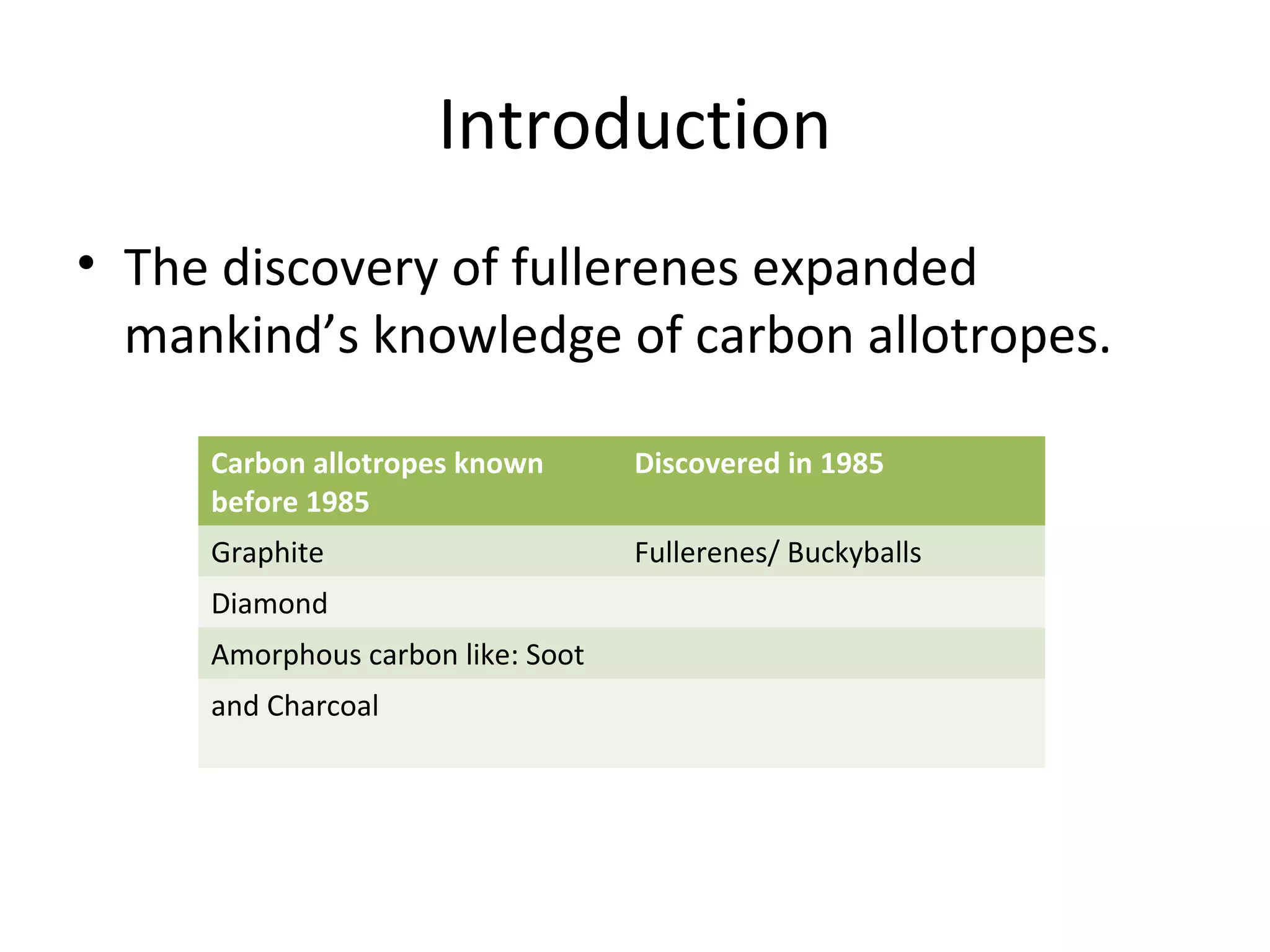
• The discovery of fullerenes expanded
mankind’s knowledge of carbon allotropes.
Carbon allotropes known
before 1985
Discovered in 1985
Graphite Fullerenes/ Buckyballs
Diamond
Amorphous carbon like: Soot
and Charcoal
Properties of fullerenes
• Fullerenes are stable chemically, but not completely
unreactive.
• Fullerenes are also sparingly soluble in many solvents,
including toluene and carbon disulfide. Solutions of pure
buckminsterfullerene have a deep purple colour.
• Solutions of C70 are a reddish brown.
• The higher fullerenes C76 to C84 have a variety of colors.
• C76 has two optical forms, while other higher fullerenes
have several isomers.
• Fullerenes are the only known carbon allotropes that can
be dissolved in common solvents at room temperature.
Applications: Nanotubes
• They can conduct heat efficiently. They have
extraordinary strength and unique electrical
properties.
• Solar cells developed at the New Jersey Institute
of Technology use a carbon nanotube complex,
formed by a mixture of carbon nanotubes and
carbon buckyballs.
• Nanotubes are also used to improve
ultracapacitors.
• implemented in nanoelectromechanical systems
• Transistors in electrical circuits
Applications: : Nano Onion
• Used in therapy for cancer/ tumors
• Possible application in the lubricant industry
• Applications of fullerenes as a whole
• Armor
• Potential medicinal use
Nanoparticle Applications
• Optical
• Anti-reflection coatings.
Tailored refractive index of surfaces.
Light based sensors for cancer diagnosis .
• Magnetic
• Increased density storage media.
Nanomagnetic particles to create improved
detail and contrast in MRI images.
Taken from: Malvern.com
Nanoparticle Applications
• Thermal
• Enhance heat transfer from solar collectors to
storage tanks.
Improve efficiency of coolants in
transformers.
• Mechanical
• Improved wear resistance.
New anti-corrosion properties.
New structural materials, composites,
stronger and lighter.
Taken from: Malvern.com
Nanoparticle Applications
• Electronic
• High performance and smaller components,
e,g, capacitors for small consumer devices
such as mobile phones.
Displays that are cheaper, larger, brighter, and
more efficient.
High conductivity materials.
Taken from: Malvern.com
Nanoparticle Applications
• Energy
• High energy density and more durable
batteries.
Hydrogen storage applications using metal
nanoclusters.
Electrocatalysts for high efficiency fuel cells.
Renewable energy, ultra high performance
solar cells.
Catalysts for combustion engines to improve
efficiency, hence economy.
Taken from: Malvern.com
Nanoparticle Applications
• Biomedical
• Antibacterial silver coatings on wound
dressings.
Sensors for disease detection (quantum dots).
Programmed release drug delivery systems.
“interactive” food and beverages that change
color, flavor or nutrients depending on a
diner’s taste or health.
Taken from: Malvern.com
Nanoparticle Applications
• Environmental
• Clean up of soil contamination and pollution, e.g. oil.
Biodegradable polymers.
Aids for germination.
Treatment of industrial emissions.
More efficient and effective water filtration.
• Surfaces
• Dissolution rates of materials are highly size dependant.
Activity of catalysts.
Coatings for self cleaning surfaces, Pilkington’s glass for
example.
• Personal care
• Effective clear inorganic sunscreens .
Taken from: Malvern.com
Silver Nanoparticle
• Silver nanoparticles are silver particles that
are between 1 nm and 100 nm in size.
• Some silver nanoparticles are composed
mainly of silver oxide.
• Ways to produce silver nanoparticles:
1.Physical vapour deposition
2.Ion implantation
3.Wet chemistry
Silver Nanoparticle
• Medical Uses:
1.bone cement
2.surgical instruments
3.surgical masks
4.wound dressings
5.treatment of HIV-1
Iron Nanoparticle
• They are highly reactive because of their large
surface area.
• Iron nanoparticles are widely used in:
1.medical and laboratory applications
2.remediation of industrial sites contaminated
with chlorinated organic compounds
Iron Nanoparticle
• Iron nanoparticles can be used to treat several
forms of ground contamination, including
grounds contaminated by polychlorinated
biphenyls (PCBs), chlorinated organic solvents,
and organochlorine pesticides.
• They tend to agglomerate on soil surfaces and
can be easily transported through ground
water.
Platinum Nanoparticle
• Platinum nanoparticles are usually in the form
of a suspension or colloid of sub-micrometre-
sized particles of platinumin a fluid, usually
water.
• A colloid is defined to be particles which
remain suspended without forming an ionic or
dissolved solution.
• Platinum nanoparticles range between 2-3nm.
Platinum Nanoparticle
• They have antioxidant properties and are
substantially researched.
• Platinum nanoparticles may have applications
in the following areas:
1.Nanotechnology
2.Medicine
3.Synthesis of novel materials with unique
properties
Platinum Nanoparticle
• Platinum nanoparticles are fabricated by the
reduction of hexachloroplatinate.
• Platinum nanoparticles have been used to
increase the lifespan of the roundworm
Caenorhabditis elegans.
• They can cause inflammation and lung
disease.
Gold Nanoparticle
• Colloidal gold/Gold nanoparticles is a
suspension (or colloid) of sub-micrometre-
sized particles of gold in a fluid — usually
water.
• Since ancient times, colloidal gold is
synthesized for staining glass.
• A relatively simpler method of producing gold
nanoparticles is to reduce chloroauric acid.
Gold Nanoparticle
• Now, colloidal gold is a subject of substantial
research as it may have applications in many fields:
1. Electron microscopy
2. Electronics
3. Nanotechnology
4. Materials science
• Colloidal gold is used as a therapy for rheumatoid
arthritis in rats.
• The implantation of gold beads near arthritic hip
joints in dogs has been found to relieve pain.

Nanophysics

  • 1.
  • 2.
    Nanomaterials and Nanotechnology •Nanomaterials is a field which takes a materials science-based approach to nanotechnology. • Nanomaterials studies materials that have very different properties on the nanoscale. • Nanoscale means smaller than one tenth of a micrometer in at least one dimension of an object.
  • 3.
    Nanomaterials and nanotechnology •Nanotechnology is the study of controlling matter on an atomic or molecular scale. • Nanotechnology has the potential to change our lives by creating new materials that can be used in many fields. • These are medicine, electronics, biomaterials, energy production etc.
  • 4.
    Properties Changes • Whenmaterials shrink to nanoscale, their properties will change drastically. • This can be explained by the largely increased surface area to volume ratio. • The larger ratio gives rise to new quantum mechanical effects. For example, electronic properties of many solids are altered when they reach nanoscale.
  • 5.
    Properties Changes Macroscale Nanoscale CopperOpaque Transparent Platinum Inert Catalytic Aluminium Stable Combustible Gold Solid at Room Temperature Liquid at Room Temperature Silicon Insulator Conductor
  • 6.
  • 7.
    Fullerenes • Fullerenes aremolecules made completely out of carbon, regardless of its molecular structure. They can come in spheres, cylinders, ellipsoids or tubes. • Cylindrical fullerenes are also known as carbon nanotubes or buckytubes. • Fullerene=Buckyball
  • 8.
    Variations (Structural Differences) •buckyball clusters • Nanotubes • Megatubes • Polymers • Nano “onions” • linked "ball-and-chain" dimers • fullerene rings
  • 9.
    Introduction • The firstfullerene (buckminsterfullerene C60) was made by Robert Curl, Harold Kroto and Richard Smalley in 1985. • The name was a homage to Richard Buckminster Fuller as fullerenes resemble his geodesic domes.
  • 10.
    Introduction • The discoveryof fullerenes expanded mankind’s knowledge of carbon allotropes. Carbon allotropes known before 1985 Discovered in 1985 Graphite Fullerenes/ Buckyballs Diamond Amorphous carbon like: Soot and Charcoal
  • 11.
    Properties of fullerenes •Fullerenes are stable chemically, but not completely unreactive. • Fullerenes are also sparingly soluble in many solvents, including toluene and carbon disulfide. Solutions of pure buckminsterfullerene have a deep purple colour. • Solutions of C70 are a reddish brown. • The higher fullerenes C76 to C84 have a variety of colors. • C76 has two optical forms, while other higher fullerenes have several isomers. • Fullerenes are the only known carbon allotropes that can be dissolved in common solvents at room temperature.
  • 12.
    Applications: Nanotubes • Theycan conduct heat efficiently. They have extraordinary strength and unique electrical properties. • Solar cells developed at the New Jersey Institute of Technology use a carbon nanotube complex, formed by a mixture of carbon nanotubes and carbon buckyballs. • Nanotubes are also used to improve ultracapacitors. • implemented in nanoelectromechanical systems • Transistors in electrical circuits
  • 13.
    Applications: : NanoOnion • Used in therapy for cancer/ tumors • Possible application in the lubricant industry • Applications of fullerenes as a whole • Armor • Potential medicinal use
  • 14.
    Nanoparticle Applications • Optical •Anti-reflection coatings. Tailored refractive index of surfaces. Light based sensors for cancer diagnosis . • Magnetic • Increased density storage media. Nanomagnetic particles to create improved detail and contrast in MRI images. Taken from: Malvern.com
  • 15.
    Nanoparticle Applications • Thermal •Enhance heat transfer from solar collectors to storage tanks. Improve efficiency of coolants in transformers. • Mechanical • Improved wear resistance. New anti-corrosion properties. New structural materials, composites, stronger and lighter. Taken from: Malvern.com
  • 16.
    Nanoparticle Applications • Electronic •High performance and smaller components, e,g, capacitors for small consumer devices such as mobile phones. Displays that are cheaper, larger, brighter, and more efficient. High conductivity materials. Taken from: Malvern.com
  • 17.
    Nanoparticle Applications • Energy •High energy density and more durable batteries. Hydrogen storage applications using metal nanoclusters. Electrocatalysts for high efficiency fuel cells. Renewable energy, ultra high performance solar cells. Catalysts for combustion engines to improve efficiency, hence economy. Taken from: Malvern.com
  • 18.
    Nanoparticle Applications • Biomedical •Antibacterial silver coatings on wound dressings. Sensors for disease detection (quantum dots). Programmed release drug delivery systems. “interactive” food and beverages that change color, flavor or nutrients depending on a diner’s taste or health. Taken from: Malvern.com
  • 19.
    Nanoparticle Applications • Environmental •Clean up of soil contamination and pollution, e.g. oil. Biodegradable polymers. Aids for germination. Treatment of industrial emissions. More efficient and effective water filtration. • Surfaces • Dissolution rates of materials are highly size dependant. Activity of catalysts. Coatings for self cleaning surfaces, Pilkington’s glass for example. • Personal care • Effective clear inorganic sunscreens . Taken from: Malvern.com
  • 20.
    Silver Nanoparticle • Silvernanoparticles are silver particles that are between 1 nm and 100 nm in size. • Some silver nanoparticles are composed mainly of silver oxide. • Ways to produce silver nanoparticles: 1.Physical vapour deposition 2.Ion implantation 3.Wet chemistry
  • 21.
    Silver Nanoparticle • MedicalUses: 1.bone cement 2.surgical instruments 3.surgical masks 4.wound dressings 5.treatment of HIV-1
  • 22.
    Iron Nanoparticle • Theyare highly reactive because of their large surface area. • Iron nanoparticles are widely used in: 1.medical and laboratory applications 2.remediation of industrial sites contaminated with chlorinated organic compounds
  • 23.
    Iron Nanoparticle • Ironnanoparticles can be used to treat several forms of ground contamination, including grounds contaminated by polychlorinated biphenyls (PCBs), chlorinated organic solvents, and organochlorine pesticides. • They tend to agglomerate on soil surfaces and can be easily transported through ground water.
  • 24.
    Platinum Nanoparticle • Platinumnanoparticles are usually in the form of a suspension or colloid of sub-micrometre- sized particles of platinumin a fluid, usually water. • A colloid is defined to be particles which remain suspended without forming an ionic or dissolved solution. • Platinum nanoparticles range between 2-3nm.
  • 25.
    Platinum Nanoparticle • Theyhave antioxidant properties and are substantially researched. • Platinum nanoparticles may have applications in the following areas: 1.Nanotechnology 2.Medicine 3.Synthesis of novel materials with unique properties
  • 26.
    Platinum Nanoparticle • Platinumnanoparticles are fabricated by the reduction of hexachloroplatinate. • Platinum nanoparticles have been used to increase the lifespan of the roundworm Caenorhabditis elegans. • They can cause inflammation and lung disease.
  • 27.
    Gold Nanoparticle • Colloidalgold/Gold nanoparticles is a suspension (or colloid) of sub-micrometre- sized particles of gold in a fluid — usually water. • Since ancient times, colloidal gold is synthesized for staining glass. • A relatively simpler method of producing gold nanoparticles is to reduce chloroauric acid.
  • 28.
    Gold Nanoparticle • Now,colloidal gold is a subject of substantial research as it may have applications in many fields: 1. Electron microscopy 2. Electronics 3. Nanotechnology 4. Materials science • Colloidal gold is used as a therapy for rheumatoid arthritis in rats. • The implantation of gold beads near arthritic hip joints in dogs has been found to relieve pain.